Qubic Says Dogecoin Mining Build Is Underway, Revives 51% Attack Fears

bitcoinist2026-01-23 tarihinde yayınlandı2026-01-23 tarihinde güncellendi

Özet

Qubic has announced the development of a Dogecoin mining integration after a community vote selected DOGE. This move transitions the project from its previous "attention" narrative around Monero into implementation, raising renewed concerns about 51% attacks. Qubic emphasized that integrating ASIC hardware into its useful Proof-of-Work (uPoW) model requires significant engineering and protocol work, but could bring scale by incorporating Dogecoin's large mining economy. The announcement revisits security debates sparked in August 2025 when Qubic claimed a Monero "takeover demonstration" with over 51% hashrate dominance, though subsequent research found its control peaked at 23–34%. Unlike Monero's CPU-based mining, Dogecoin uses Scrypt and has merged mining with Litecoin, making a brute-force 51% attack economically challenging. Research firm 21Shares estimated it would cost billions in hardware and millions daily in electricity. A more plausible risk is Qubic incentivizing existing Scrypt miners to redirect hashpower through its system—a "vampire mining" approach.

Qubic says it is now building a Dogecoin mining integration, a step that moves the project’s post-Monero “attention” narrative into an implementation phase and reopens a familiar set of security questions around majority-hashrate risk.

In an X post shared Thursday, Qubic wrote: “The community didn’t hesitate. The vote was decisive: DOGE won with 301 votes. This isn’t a plug-and-play upgrade. Integrating ASIC hardware into uPoW requires real engineering, deep protocol work, and time to do it right. But the upside is significant. DOGE represents one of the largest and most established mining economies in crypto. Bringing it into Qubic’s useful Proof-of-Work model extends uPoW beyond theory, into scale. [...] Development is underway. This is just the beginning of what is to come.”

Could Dogecoin Suffer A 51% Attack?

The announcement lands with baggage. In August 2025, Qubic ran what it publicly described as a Monero “takeover demonstration,” claiming it had achieved “over 51% hashrate dominance” during parts of the experiment and reporting a brief chain disruption that included a six-block reorganization and orphaned blocks.
That episode became a lightning rod for the broader PoW security debate: how quickly external incentives can concentrate hashpower, and how markets react when “51%” enters the conversation.

Subsequent research challenged the strongest interpretation of those claims. A December 2025 paper reconstructing Qubic-attributed activity on Monero describes the operation as an advertised “selfish mining campaign,” finding Qubic’s hashrate share rising into the 23–34% range in detected intervals, while “sustained 51% control is never observed.”

Dogecoin’s mining economy is structurally unlike Monero’s CPU-oriented RandomX landscape. Dogecoin uses Scrypt and has, since 2014, supported merged mining alongside Litecoin, an architecture that has historically helped bolster its security budget by tapping into a broader Scrypt ASIC miner base.

That hardware reality is central to Qubic’s own messaging. The project said “integrating ASIC hardware into uPoW requires real engineering, deep protocol work, and time to do it right,” explicitly acknowledging that this is not a simple pool launch.

It is also where most of the immediate 51% attack fears run into friction. In an August 2025 research note, published when Qubic first began floating Dogecoin as the “next” network after Monero, 21Shares argued that a brute-force Dogecoin majority would be economically prohibitive, estimating that Qubic would need to match and then exceed roughly 2.78 PH/s, implying about $2.85 billion in hardware plus roughly $2.5 million per day in electricity (before logistics).

The more plausible risk vector, if any, is not Qubic buying its way to majority hashrate, but whether it can engineer incentives and integrations that convince existing Scrypt ASIC operators to route meaningful hashpower through a Qubic-mediated setup, an approach 21Shares characterized as “vampire mining.”

At press time, DOGE traded at $0.12521.
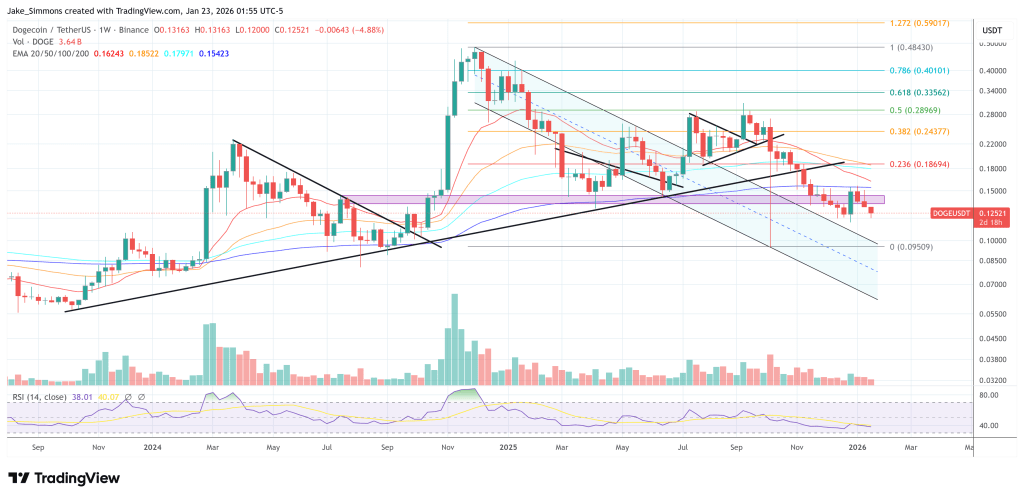
DOGE price, 1-week chart | Source: DOGEUSDT on TradingView.com

İlgili Sorular

QWhat is Qubic currently building and which cryptocurrency does it involve?

AQubic is currently building a Dogecoin mining integration.

QWhat security concern is reignited by Qubic's announcement of Dogecoin mining integration?

AThe announcement reignites fears of a potential 51% attack on the Dogecoin network.

QWhat was the outcome of Qubic's previous 'takeover demonstration' on the Monero network according to subsequent research?

ASubsequent research found that Qubic's hashrate share on Monero reached 23-34% in detected intervals, but sustained 51% control was never observed, challenging the strongest claims of the demonstration.

QWhy does 21Shares argue that a brute-force 51% attack on Dogecoin would be economically prohibitive for Qubic?

A21Shares argued it would be economically prohibitive because Qubic would need to acquire roughly $2.85 billion in hardware and spend about $2.5 million per day on electricity to match the required hashrate.

QWhat is the more plausible risk vector for a Dogecoin 51% attack, as opposed to a brute-force approach?

AThe more plausible risk vector is not a brute-force purchase of hardware, but rather Qubic engineering incentives to convince existing Scrypt ASIC operators to route their hashpower through a Qubic-mediated setup, an approach termed 'vampire mining'.

İlgili Okumalar

Annual Salary of Millions Competing for Electricians, Meta Rushes to Open Its Own Technical School

The AI boom is facing an unexpected bottleneck: a severe shortage of skilled construction workers and electricians. As tech giants like Meta, OpenAI, and Alphabet race to build massive data centers—such as OpenAI's $16 billion "Stargate" project—they are hitting a critical labor wall. The U.S. needs an estimated 130,000 more electricians, 240,000 construction workers, and 150,000 supervisors by 2030 for AI infrastructure alone, but tens of thousands of electrician jobs go unfilled each year. While AI companies offer high premiums, with electricians earning up to $280,000 annually, worker scarcity still causes massive losses—delays on a single project can cost $14.2 million per month. The complexity of building AI data centers, which require immense power (equivalent to powering hundreds of thousands of homes), sophisticated electrical systems, and advanced liquid cooling solutions, demands highly skilled technicians who are in short supply. To combat this, companies are investing heavily in training. Meta has committed $115 million to a free training school offering tuition, housing, and stipends, targeting 5,000 new workers. OpenAI is partnering with unions to secure skilled labor. These efforts are paying off, with a significant rise in Gen Z interest in trade schools over college. However, the power demands are staggering. AI data centers are driving a rapid surge in electricity consumption, projected to account for up to 12% of U.S. power use by 2028 and raising costs for consumers. Furthermore, the construction boom is project-based, leading to a potential future glut of trained workers once building peaks, which could depress wages industry-wide. The race for AI supremacy now depends as much on skilled hands as on advanced chips.

marsbit1 saat önce

Annual Salary of Millions Competing for Electricians, Meta Rushes to Open Its Own Technical School

marsbit1 saat önce

OpenAI No Longer Sells Its Most Expensive Model for Profit

OpenAI is shifting its business strategy away from promoting its most expensive, flagship models for every task. Recent price cuts—80% for GPT-5.6 Luna and 20% for Terra—signal a deeper change: the company now actively advises users that many tasks don't require the most powerful model. Instead, OpenAI recommends a tiered approach: use the high-end GPT-5.6 Sol for complex planning and analysis, then delegate execution to cheaper models like Luna. This mirrors moves by Anthropic, which recently launched Claude Opus 5 at half the price of its top model, Fable 5. Both companies are de-emphasizing flagship models as primary revenue drivers, using them instead for brand prestige and technological showcases. The industry is entering a "mass-market" phase, similar to automotive, where high-volume, cost-effective models handle daily operations and drive scale. OpenAI's price reductions are partly enabled by AI models themselves optimizing underlying code and infrastructure, creating a self-reinforcing cycle of efficiency gains and cost reduction. Competition is shifting from "who is smartest" to "who offers the best value." The goal is no longer selling individual models but fostering widespread API adoption and ecosystem lock-in. By making AI calls cheap and ubiquitous, companies like OpenAI aim to become the indispensable, utility-like infrastructure powering automated workflows—the "water and electricity" of software, quietly embedded everywhere.

marsbit1 saat önce

OpenAI No Longer Sells Its Most Expensive Model for Profit

marsbit1 saat önce

İşlemler

Spot
活动图片





