Qubic Reveals How Its Dogecoin Mining Launch Will Work Starting April 1

bitcoinist2026-03-31 tarihinde yayınlandı2026-03-31 tarihinde güncellendi

Özet

Qubic has detailed its transition to Dogecoin mining, set to begin on April 1, through a three-phase mainnet rollout. The move shifts Qubic from a mixed model of Monero mining and AI training to a parallel system where external ASIC miners handle Dogecoin via Scrypt algorithm, while Qubic’s own computational resources focus entirely on its AI project, Aigarth. The process uses a bridge called "Doge Connect" to link external miners to Qubic’s network, validate shares, and manage payouts. Monero mining will be phased out gradually over the transition. Miners will be paid in Cubics rather than direct DOGE, as Qubic will sell mined DOGE for stablecoins and buy back Cubics for redistribution—a mechanism expected to yield roughly 10% higher returns than standard Dogecoin mining. The system is designed to support multiple chains in the future, though Dogecoin is the initial focus.

Qubic used a March 30 AMA to lay out the mechanics behind its Dogecoin mining rollout, with core tech lead Joetom outlining a three-phase mainnet transition that begins April 1. The shift matters because it is designed to move Qubic away from its current split between Monero-linked outsourced mining and AI training into a model where both activities run at full scale in parallel.

The presentation centered on what Qubic calls its internal “Doge Connect” architecture, a bridge that links external Scrypt miners to Qubic’s network while redirecting Qubic’s own CPU and GPU resources fully toward its AI initiative, Aigarth. Joetom said the system relies on a dispatcher that connects to pools, translates mining tasks between the Dogecoin and Qubic networks, validates shares, and feeds results back through Qubic’s infrastructure.

“So how does this work? We call it internally Dodge Connect,” he said. “We bridge basically the mining power from outside ... with ASIC miners, we use the Scrypt algorithm and you can connect to any of the Qubic pools. So for you as a miner, nothing changes.”

That bridge is not limited to a single coin, at least in theory. Joetom said the task and messaging system was built generically enough that Qubic could support multiple chains or switch to other mineable assets later. For now, the focus is Dogecoin, with the longer-term goal of running Qubic’s AI research at full capacity while using outsourced mining as a revenue engine.

Qubic Starts Dogecoin Mining Transition

The rollout itself will happen in three stages, with each phase expected to last one to two weeks if testing goes as planned. Phase one begins on mainnet April 1 and is framed as a validation period, covering task distribution, solution handling, pool communications, and public statistics. During that phase, Qubic will reduce its current Monero “marathons” from three days per week to two, beginning a gradual shift away from XMR mining.

Joetom described the process as a controlled crossover rather than a hard cut. “We will reduce this starting with phase one to two days per week,” he said. “So they will basically cross each other and at the end of phase two the Monero stuff will be removed.”

By the final state, he said, the network is meant to reach “100% AI training and 100% outsourced mining.” In practice, that means Qubic’s CPUs and GPUs would be dedicated to Aigarth research, while Dogecoin mining would be handled externally by ASIC miners connected through Qubic pools.

One of the more important economic details from the AMA was the payout model. Rather than distributing DOGE directly, Qubic plans to sell outsourced mining proceeds for stablecoins, use those funds to buy back Cubics, and then redistribute Cubics to miners. Joetom called the mechanism a “buyback” system and said the team expects it to make mining through Qubic more attractive than mining Dogecoin alone.

“We assume that we will see an acceleration for the DOGE revenue,” he said. “Meaning that the Qubic revenue when you mine DOGE via Qubic you will see approximately 10% more revenue than if you would go only for doge.”

The technical path also leans heavily on Qubic’s oracle infrastructure. Shares submitted through the network are validated internally, with oracle machines acting as the source of truth for whether a mined share is accepted. That makes the integration more than a simple mining proxy; it effectively routes Dogecoin-related work through Qubic’s own validation and accounting model.

For miners, the immediate takeaway is operational rather than conceptual. Joetom said older hardware such as Antminer L3 units can still participate, even if newer machines like the L9 offer stronger economics. Public testing is expected to open April 1, with connection details to be shared through Qubic’s Discord and pool operators.

At press time, DOGE traded at $0.09.
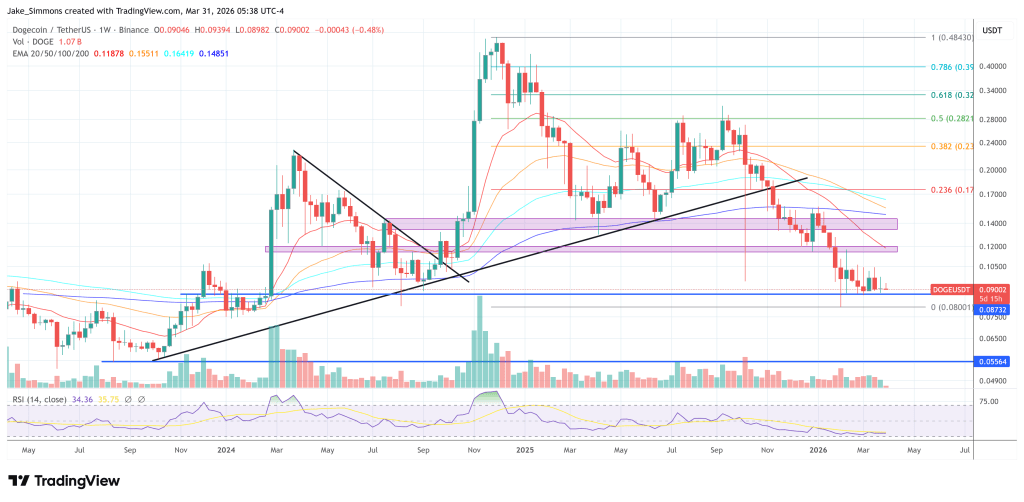
DOGE hovers above key support, 1-month chart | Source: DOGEUSDT on TradingView.com

İlgili Sorular

QWhat is the main purpose of Qubic's Dogecoin mining rollout starting April 1?

AThe main purpose is to transition Qubic away from its current split between Monero-linked outsourced mining and AI training into a model where both activities run at full scale in parallel, dedicating Qubic's CPU and GPU resources fully to its AI initiative Aigarth while using outsourced mining for Dogecoin as a revenue engine.

QHow does Qubic's 'Doge Connect' architecture function?

ADoge Connect is a bridge that links external Scrypt miners to Qubic's network. It uses a dispatcher to connect to pools, translates mining tasks between the Dogecoin and Qubic networks, validates shares, and feeds results back through Qubic's infrastructure, allowing ASIC miners to connect to Qubic pools without changing their operations.

QWhat are the three phases of the mainnet transition and what happens in phase one?

AThe rollout will happen in three phases, each expected to last one to two weeks. Phase one begins on mainnet April 1 and is a validation period covering task distribution, solution handling, pool communications, and public statistics. During this phase, Qubic will reduce its current Monero 'marathons' from three days per week to two.

QHow will Qubic handle payouts for Dogecoin miners using its system?

ARather than distributing DOGE directly, Qubic plans to sell the outsourced mining proceeds for stablecoins, use those funds to buy back Cubics (Qubic's native token), and then redistribute Cubics to the miners. This 'buyback' system is expected to provide approximately 10% more revenue than mining Dogecoin alone.

QWhat role does Qubic's oracle infrastructure play in the new mining system?

AQubic's oracle machines act as the source of truth for validating whether a mined share is accepted. Shares submitted through the network are validated internally, making the integration more than a simple mining proxy by effectively routing Dogecoin-related work through Qubic's own validation and accounting model.

İlgili Okumalar

Claude Code Introduces Dynamic Workflows: Enabling AI to Form Teams and Collaborate

Claude Code introduces dynamic workflows, enabling AI to coordinate teams of specialized agents for complex tasks. This transforms Claude from a code assistant into a programmable workbench. Workflows address key limitations of single-agent systems: agentic laziness (premature task completion), self-preferential bias (favoring own outputs), and goal drift (losing sight of original objectives). The system allows Claude to dynamically create execution frameworks using JavaScript. It can split tasks, dispatch parallel agents for isolated work (e.g., in separate worktrees), implement adversarial validation, run tournaments, and synthesize results. This multi-agent approach is valuable for tasks requiring deep research, factual verification, code migration, root cause analysis, large-scale triage, and qualitative sorting. Key patterns include: classify-and-route, fan-out-and-synthesize, adversarial verification, generate-and-filter, tournaments, and loop-until-done. While token usage is higher, workflows excel where tasks resemble programming—needing problem decomposition, isolated context, hypothesis testing, and handling many details. They extend Claude Code's utility beyond technical work to areas like business plan review, resume screening, and naming brainstorm. The feature is not a universal solution but points to a future where AI tool competitiveness depends on organizing reliable, reusable, and auditable execution flows for complex goals.

marsbit35 dk önce

Claude Code Introduces Dynamic Workflows: Enabling AI to Form Teams and Collaborate

marsbit35 dk önce

Hyperliquid, Wall Street's 24/7 Trading Convenience Store

Hyperliquid: The 24/7 Trading "Convenience Store" for Wall Street Hyperliquid, a decentralized cryptocurrency exchange, has become a go-to platform for Wall Street traders seeking to trade around the clock, especially during traditional market closures. Founded by Jeff Yan, a former quantitative trader, after the FTX collapse, the platform emphasizes user self-custody of assets. It offers a wide range of perpetual contracts—leveraged derivatives with no expiry—on assets from Bitcoin and crude oil to the S&P 500 and even pre-IPO companies like SpaceX. A notable example involves a hedge fund trader who capitalized on geopolitical news over a weekend, securing a 243% return on oil derivatives before markets reopened. The platform, run by just 11 employees, generated approximately $800 million in revenue last year, and its native token HYPE has seen significant growth. Its rise highlights the merging of traditional finance and crypto. While U.S. users are currently restricted, recent CFTC rule changes could open access. The platform is known for its transparency, having processed $10 billion in liquidations during a market crash while competitors faltered. Regulators warn of the high risks and complexity of perpetual contracts for retail investors. Key to its appeal is a strong community culture, direct engagement with founders, and a simple interface. Despite rules against VPN use, it attracts global users with its permissionless approach. Hyperliquid plans to expand into prediction markets and options, aiming to eventually host all financial activity.

marsbit35 dk önce

Hyperliquid, Wall Street's 24/7 Trading Convenience Store

marsbit35 dk önce

Who Funds the Agents?

**Summary: Who Funds AI Agents?** OpenAI recently shut down a feature allowing AI agents to shop for users, highlighting the challenge of creating a secure and regulated environment for agent-driven transactions. While payment infrastructure exists, a crucial governance layer—defining spending limits, fraud detection, tax handling, and return policies—is largely missing. The potential is enormous: AI agents already processed $73M across 176M transactions last year, with McKinsey forecasting this could grow to $3-5T in global consumer commerce by 2030. The core competition isn't just about processing payments, which can be very cheap (especially with crypto-based settlement), but about controlling the rules that govern agent spending. Key players like Stripe and Coinbase are racing to dominate this governance layer. Stripe's acquisition of wallet provider Privy allows it to set spending policies, identity checks, and human-in-the-loop approvals directly at the wallet level. Similarly, Coinbase's stack, including its x402 protocol and AgentKit, embeds governance rules. This vertical integration across settlement, wallet, and governance layers is becoming the dominant strategy. Control over the governance layer is where significant future value lies. If agents handle trillions in transactions, even a small fee for managing compliance, fraud prevention, and policy enforcement could generate billions in annual revenue. The companies that successfully integrate across the payment stack will capture value from idle agent balances, transaction fees, and governance services, positioning themselves as the foundational banks of the AI agent economy.

marsbit1 saat önce

Who Funds the Agents?

marsbit1 saat önce

İşlemler

Spot
Futures
活动图片