Congratulations to Team China!
At the International Mathematical Olympiad (IMO), Team China has won the championship!
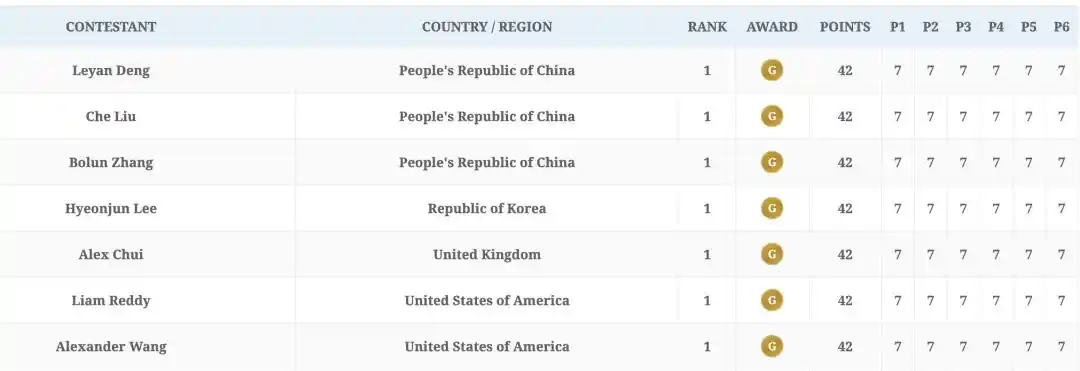
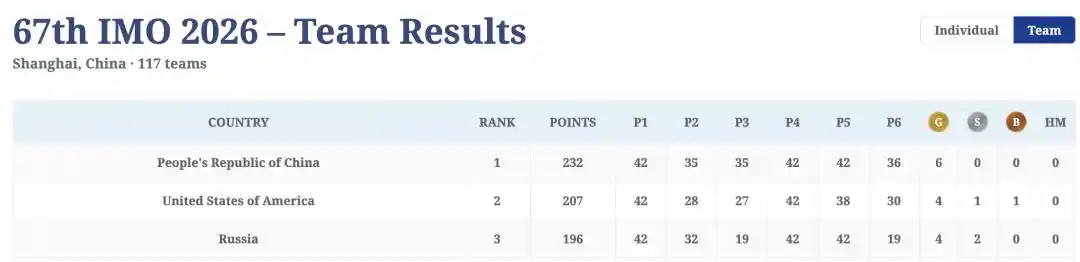
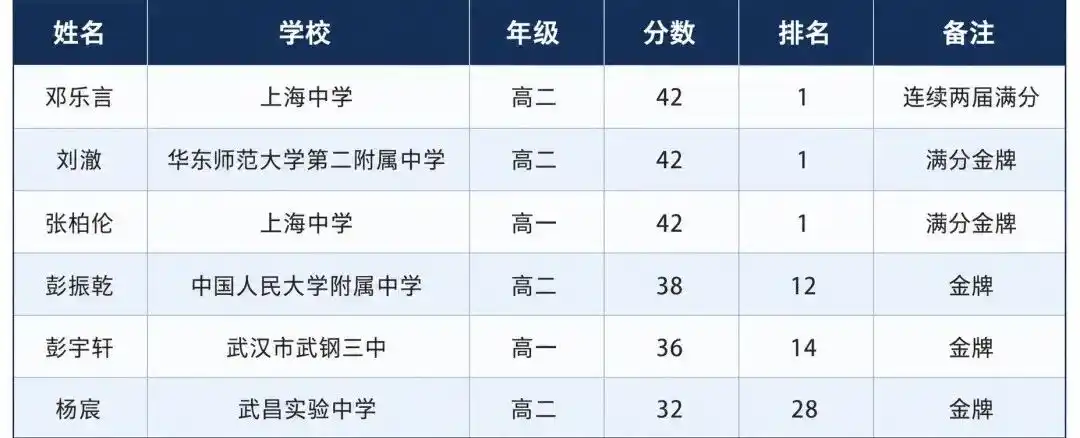
Team China claimed the top spot with all team members winning gold medals and a team total of 232 points, surpassing the second-place team by 25 points. Among them, Deng Leyan and Zhang Bolun from Shanghai High School, and Liu Che from East China Normal University Second High School, achieved perfect scores and secured gold medals.
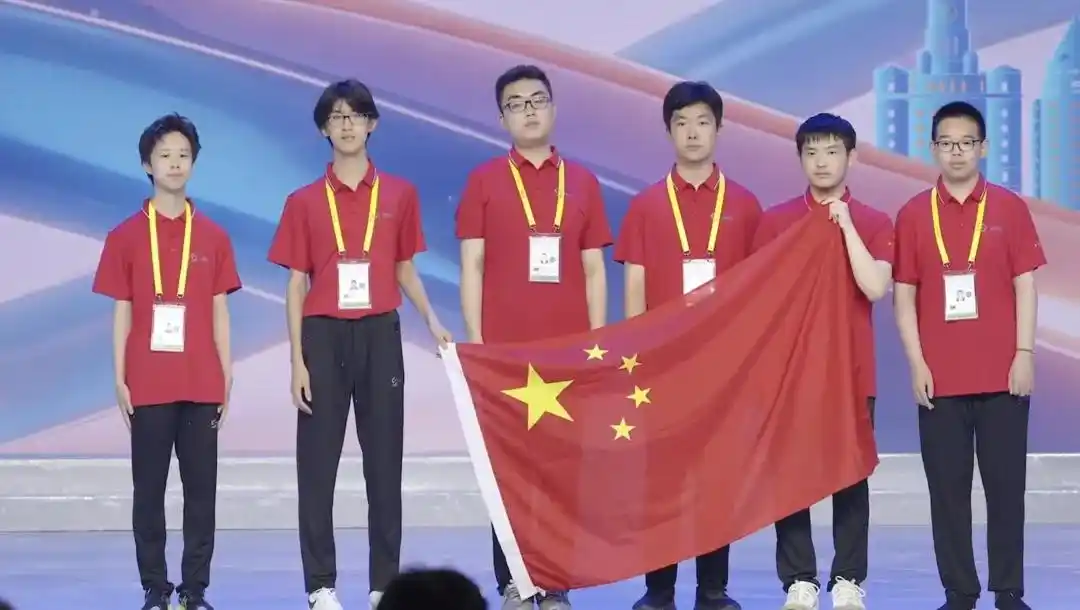
It is reported that since Team China first won the team title in 1989, this marks the 26th time they have topped the rankings, with team members achieving perfect scores for 8 consecutive competitions!
In addition, 1 contestant from the United Kingdom, 1 from South Korea, and 2 from the United States also achieved perfect scores and won gold medals at IMO 2026.
Team USA, with 4 gold, 1 silver, and 1 bronze medals and a team total of 207 points, secured second place; Russia, with 4 gold and 2 silver medals and a team total of 196 points, came in third.
Congratulations to all the award winners! Congratulations to all the young geniuses who participated in the finals!
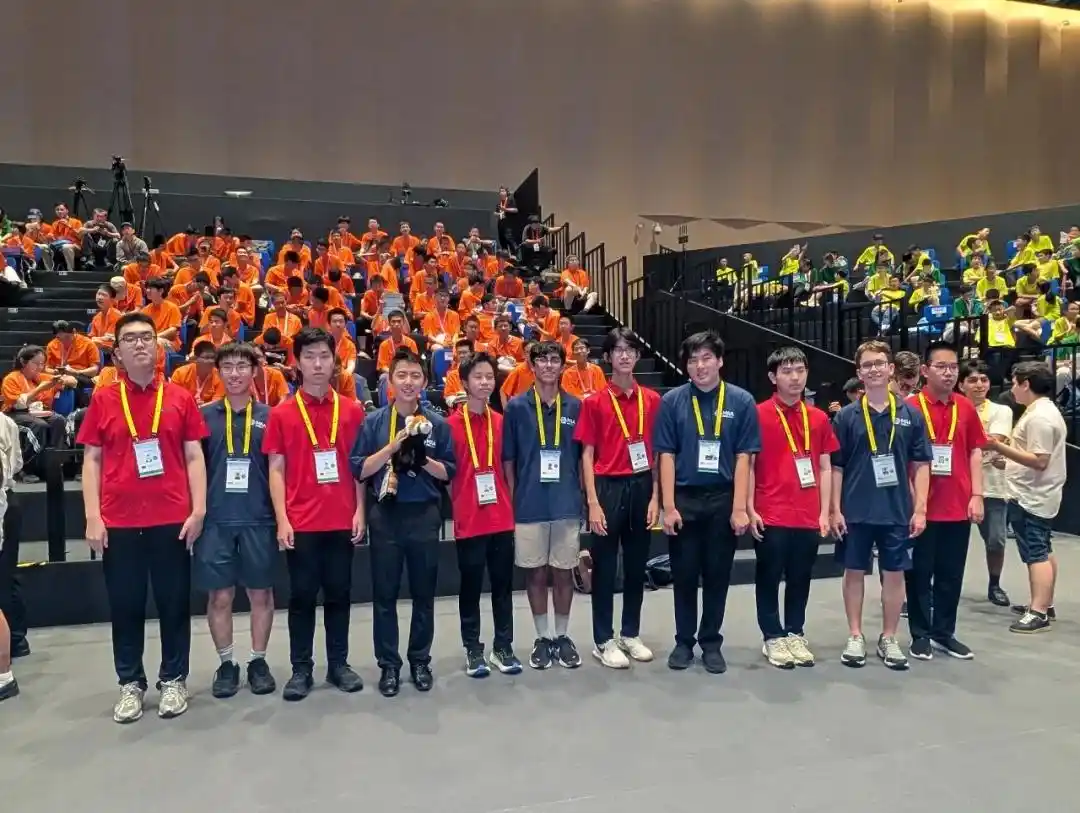
A photo of Team China and Team USA taken on-site by US Deputy Team Leader Liu Yang
Chinese Contestants Compete at Home: IMO Held in a High School for the First Time
It is understood that this International Mathematical Olympiad, IMO 2026, is the 67th edition of the event. It was held in Shanghai from July 13 to 21, 2026. The team leader for the Chinese team was Mr. Qu Zhenhua from East China Normal University.
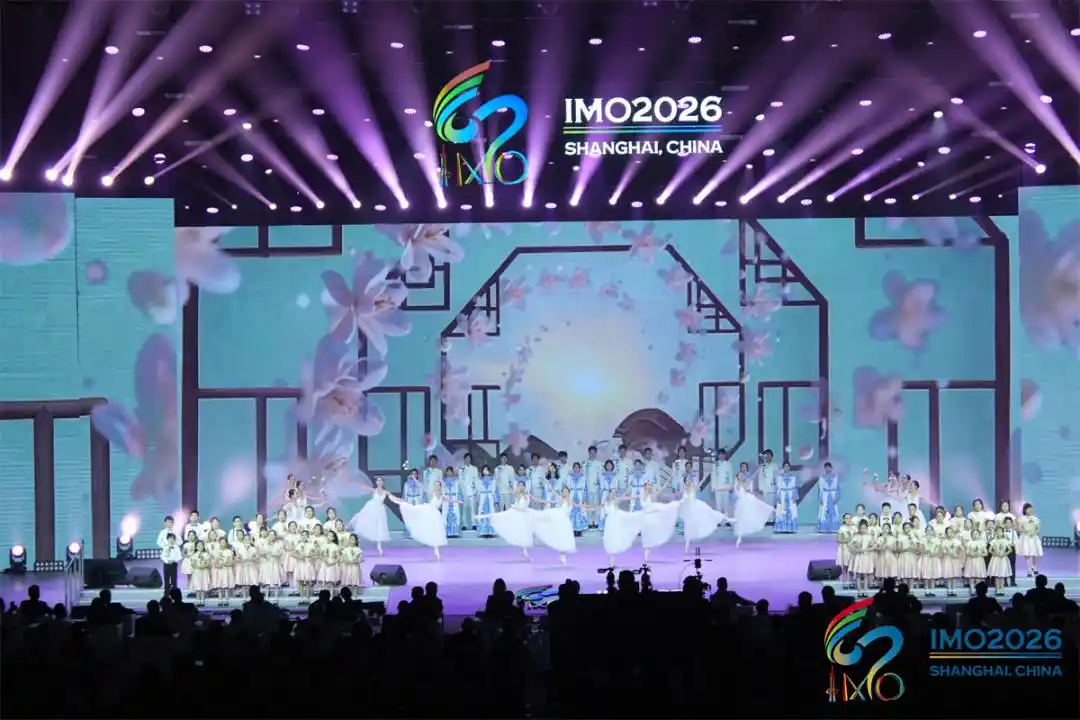
To date, Team China has achieved an outstanding record at the International Mathematical Olympiad (IMO) with 197 gold medals, 37 silver medals, and 6 bronze medals.
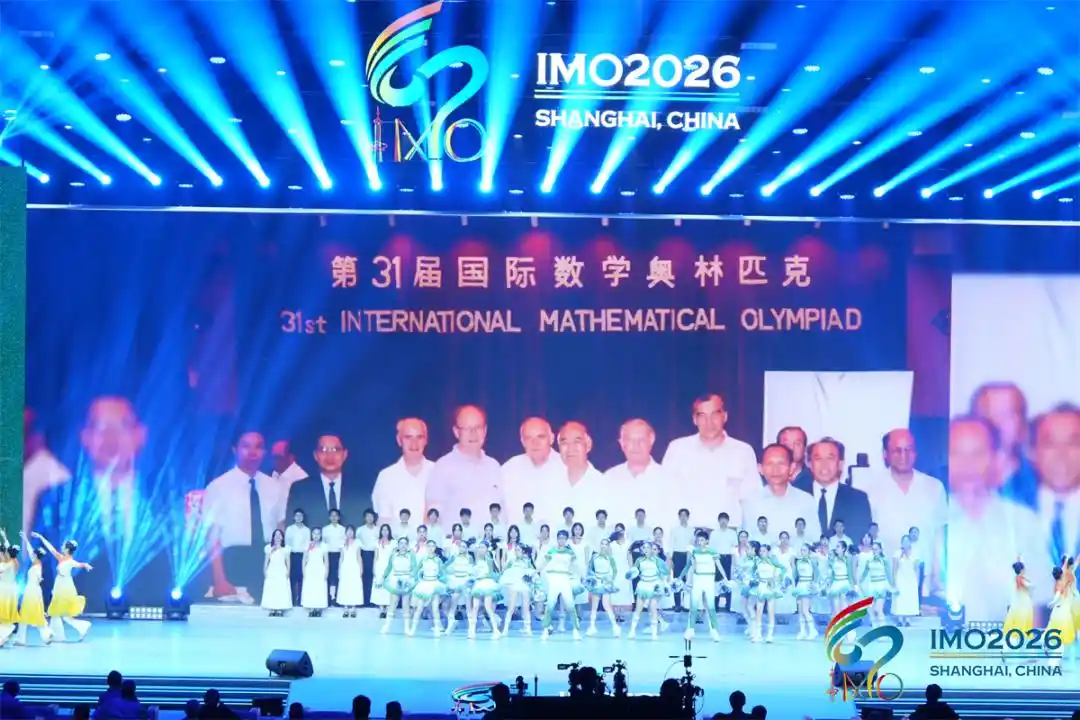
This is the second time the event has been held in mainland China. The 31st International Mathematical Olympiad was held in Beijing in 1990.
According to statistics from the WeChat public account "Tech Grand Slam," there were no third-year high school (Grade 12) students on this year's Chinese team:
As the first high school to host the IMO, Shanghai High School has now accumulated a total of 20 IMO gold medals. Since 2022, they have won 6 gold medals for four consecutive years.
Additionally, many alumni of Shanghai High School have grown into accomplished mathematicians. For example, Tang Yunqing, a recipient of the Ramanujan Prize, the Cole Prize in Number Theory, and the New Horizons in Mathematics Prize, who will give a 45-minute talk at the upcoming ICM2026; Zhang Mingjia, an IAS von Neumann Fellow and recipient of the Maryam Mirzakhani New Frontiers Prize; Zhang Shengtong, who published in a top-four mathematics journal during undergraduate studies and received the ICCM Baowen Award for Best Paper; Li Yang, who has already published several papers in top-four mathematics journals...
The AlphaGo Moment for Olympiad Mathematics
But outside the Shanghai exam venue this year stood another contestant without eligibility to participate—AI.
Every year when the IMO results are announced, someone inevitably compares the human solutions with those generated by AI.
This is an inescapable background noise of our era.
Last year, OpenAI's o3 and Google DeepMind's AlphaProof and AlphaGeometry 2 all reached gold medal-level performance on IMO problems.
This event shook the entire mathematics community at the time. The conclusion was simply this: AI achieved what only elite humans could do.
But upon closer reflection, questions arise.
The perfect score at IMO is 42 points, while the gold medal cutoff is typically around 28-30 points.
Deng Leyan, Zhang Bolun, and Liu Che submitted perfect 42-point scores—6 problems, each flawlessly solved, zero deductions.
AI's ability to reach the gold medal level relies on massive computational power to search for solution paths, finding the correct one among many attempts.
A perfect score is something else entirely—it's not "finally finding the answer," but rather "every step of reasoning is correct, every line of proof is flawless, every stroke of the pen for every problem is precise and error-free."
These are two completely different things.
The machine is approaching "being able to solve problems," while these three teenagers demonstrated "perfect, error-free execution."
This year, major labs will, as usual, benchmark using the 2026 actual exam problems. As of the results announcement, no official public results have been released.
But news has already arrived. According to reports, GPT-5.6 Pro solved all six problems of the 2026 IMO on its first attempt, without any human prompting or guidance throughout the process.
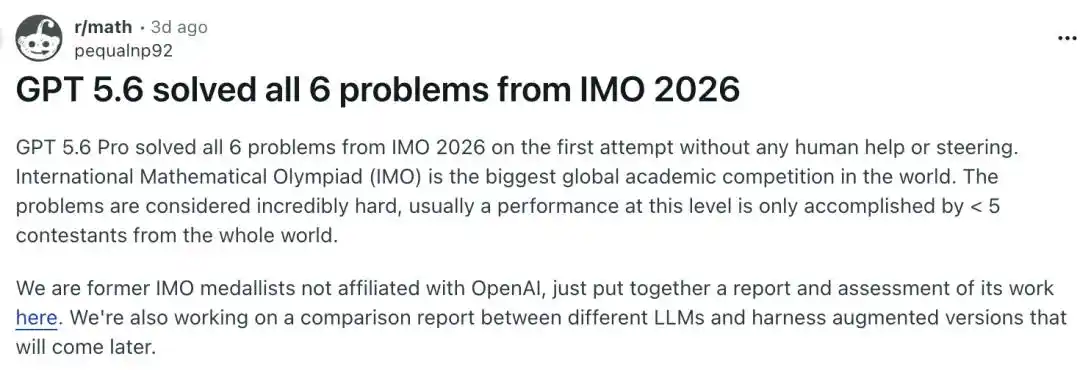
An independent evaluation by SignalPilot Labs also stated that it generated complete solutions for these six problems.
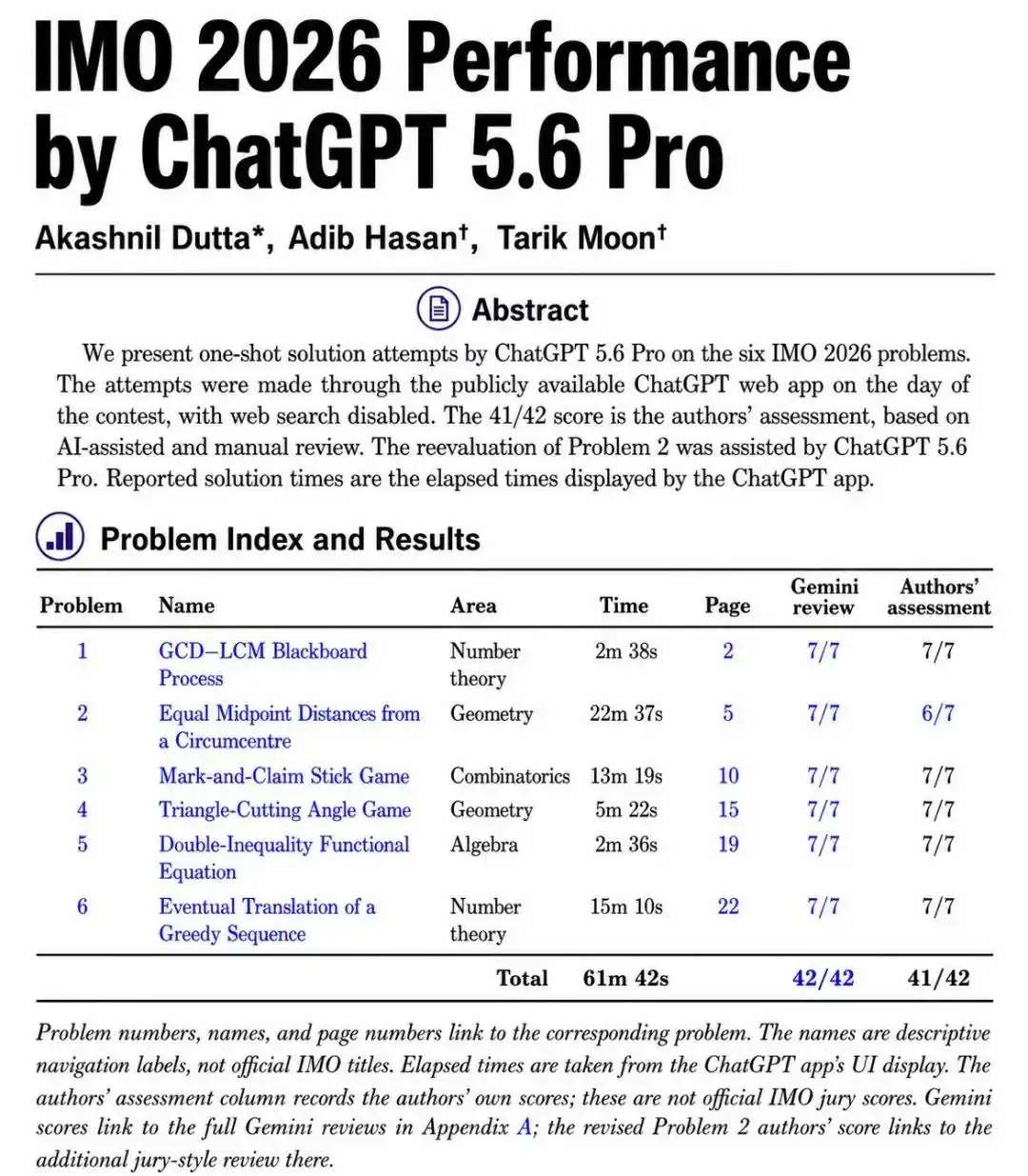
If these reports are true, what truly deserves attention is precisely the phrase "first attempt."
It suggests the machine might be crossing that line—from "repeatedly searching, finally finding" to "one stroke of the pen, one flawless step." And this line is exactly the one we just used to separate the machine from the teenagers.
By the way, OpenAI is offering a 12-month ChatGPT Pro subscription to all gold medalists and recipients of the Maryam Mirzakhani Prize.

The contestant ineligible to enter the exam hall might already be outside the door, having completed what those inside just accomplished.
References:
https://www.imo2026.com/Results/Individual_Results.htm
https://x.com/_simonsmith/status/2078468111678722448
https://mp.weixin.qq.com/s/HekpOfjea9-NrRP5TxL5Zw
https://mp.weixin.qq.com/s/nQVfMccLl0ArddDwF6GPVg
This article is from the WeChat public account "XinZhiYuan" (AI Era), author: ASI启示录, editor: David