Qubic Reveals How Its Dogecoin Mining Launch Will Work Starting April 1

bitcoinist2026-03-31 tarihinde yayınlandı2026-03-31 tarihinde güncellendi

Özet

Qubic has detailed its transition to Dogecoin mining, set to begin on April 1, through a three-phase mainnet rollout. The move shifts Qubic from a mixed model of Monero mining and AI training to a parallel system where external ASIC miners handle Dogecoin via Scrypt algorithm, while Qubic’s own computational resources focus entirely on its AI project, Aigarth. The process uses a bridge called "Doge Connect" to link external miners to Qubic’s network, validate shares, and manage payouts. Monero mining will be phased out gradually over the transition. Miners will be paid in Cubics rather than direct DOGE, as Qubic will sell mined DOGE for stablecoins and buy back Cubics for redistribution—a mechanism expected to yield roughly 10% higher returns than standard Dogecoin mining. The system is designed to support multiple chains in the future, though Dogecoin is the initial focus.

Qubic used a March 30 AMA to lay out the mechanics behind its Dogecoin mining rollout, with core tech lead Joetom outlining a three-phase mainnet transition that begins April 1. The shift matters because it is designed to move Qubic away from its current split between Monero-linked outsourced mining and AI training into a model where both activities run at full scale in parallel.

The presentation centered on what Qubic calls its internal “Doge Connect” architecture, a bridge that links external Scrypt miners to Qubic’s network while redirecting Qubic’s own CPU and GPU resources fully toward its AI initiative, Aigarth. Joetom said the system relies on a dispatcher that connects to pools, translates mining tasks between the Dogecoin and Qubic networks, validates shares, and feeds results back through Qubic’s infrastructure.

“So how does this work? We call it internally Dodge Connect,” he said. “We bridge basically the mining power from outside ... with ASIC miners, we use the Scrypt algorithm and you can connect to any of the Qubic pools. So for you as a miner, nothing changes.”

That bridge is not limited to a single coin, at least in theory. Joetom said the task and messaging system was built generically enough that Qubic could support multiple chains or switch to other mineable assets later. For now, the focus is Dogecoin, with the longer-term goal of running Qubic’s AI research at full capacity while using outsourced mining as a revenue engine.

Qubic Starts Dogecoin Mining Transition

The rollout itself will happen in three stages, with each phase expected to last one to two weeks if testing goes as planned. Phase one begins on mainnet April 1 and is framed as a validation period, covering task distribution, solution handling, pool communications, and public statistics. During that phase, Qubic will reduce its current Monero “marathons” from three days per week to two, beginning a gradual shift away from XMR mining.

Joetom described the process as a controlled crossover rather than a hard cut. “We will reduce this starting with phase one to two days per week,” he said. “So they will basically cross each other and at the end of phase two the Monero stuff will be removed.”

By the final state, he said, the network is meant to reach “100% AI training and 100% outsourced mining.” In practice, that means Qubic’s CPUs and GPUs would be dedicated to Aigarth research, while Dogecoin mining would be handled externally by ASIC miners connected through Qubic pools.

One of the more important economic details from the AMA was the payout model. Rather than distributing DOGE directly, Qubic plans to sell outsourced mining proceeds for stablecoins, use those funds to buy back Cubics, and then redistribute Cubics to miners. Joetom called the mechanism a “buyback” system and said the team expects it to make mining through Qubic more attractive than mining Dogecoin alone.

“We assume that we will see an acceleration for the DOGE revenue,” he said. “Meaning that the Qubic revenue when you mine DOGE via Qubic you will see approximately 10% more revenue than if you would go only for doge.”

The technical path also leans heavily on Qubic’s oracle infrastructure. Shares submitted through the network are validated internally, with oracle machines acting as the source of truth for whether a mined share is accepted. That makes the integration more than a simple mining proxy; it effectively routes Dogecoin-related work through Qubic’s own validation and accounting model.

For miners, the immediate takeaway is operational rather than conceptual. Joetom said older hardware such as Antminer L3 units can still participate, even if newer machines like the L9 offer stronger economics. Public testing is expected to open April 1, with connection details to be shared through Qubic’s Discord and pool operators.

At press time, DOGE traded at $0.09.
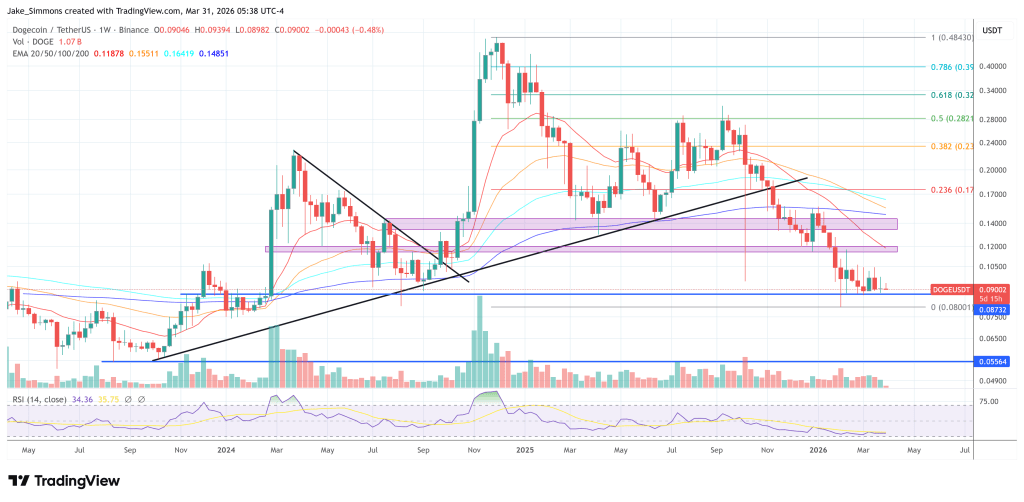
DOGE hovers above key support, 1-month chart | Source: DOGEUSDT on TradingView.com

İlgili Sorular

QWhat is the main purpose of Qubic's Dogecoin mining rollout starting April 1?

AThe main purpose is to transition Qubic away from its current split between Monero-linked outsourced mining and AI training into a model where both activities run at full scale in parallel, dedicating Qubic's CPU and GPU resources fully to its AI initiative Aigarth while using outsourced mining for Dogecoin as a revenue engine.

QHow does Qubic's 'Doge Connect' architecture function?

ADoge Connect is a bridge that links external Scrypt miners to Qubic's network. It uses a dispatcher to connect to pools, translates mining tasks between the Dogecoin and Qubic networks, validates shares, and feeds results back through Qubic's infrastructure, allowing ASIC miners to connect to Qubic pools without changing their operations.

QWhat are the three phases of the mainnet transition and what happens in phase one?

AThe rollout will happen in three phases, each expected to last one to two weeks. Phase one begins on mainnet April 1 and is a validation period covering task distribution, solution handling, pool communications, and public statistics. During this phase, Qubic will reduce its current Monero 'marathons' from three days per week to two.

QHow will Qubic handle payouts for Dogecoin miners using its system?

ARather than distributing DOGE directly, Qubic plans to sell the outsourced mining proceeds for stablecoins, use those funds to buy back Cubics (Qubic's native token), and then redistribute Cubics to the miners. This 'buyback' system is expected to provide approximately 10% more revenue than mining Dogecoin alone.

QWhat role does Qubic's oracle infrastructure play in the new mining system?

AQubic's oracle machines act as the source of truth for validating whether a mined share is accepted. Shares submitted through the network are validated internally, making the integration more than a simple mining proxy by effectively routing Dogecoin-related work through Qubic's own validation and accounting model.

İlgili Okumalar

Anthropic Cries Wolf: Is the AGI Threat Real, or Just an IPO Story?

Anthropic has published an article titled "When AI builds itself," discussing the emerging concept of "recursive self-improvement," where AI begins to actively participate in designing, training, testing, and optimizing its own subsequent versions. The company presents internal data showing that by May 2026, over 80% of code merged into its codebase was written by Claude, its AI model. Claude's capabilities have expanded to handling complex, open-ended engineering tasks, achieving a 76% success rate in such areas, and even contributing to research processes, such as optimizing code performance and conducting AI safety experiments. Anthropic outlines an evolution from human-driven development to AI-assisted workflows, culminating in the current stage where AI agents can autonomously write, run, and delegate code. The company cautions that the path toward a "closed loop," where AI continuously improves itself, is becoming visible. It calls for coordinated global mechanisms to potentially slow or pause frontier AI development to allow safety research and societal structures to catch up. However, the timing of this warning coincides with Anthropic's preparations for an IPO, framing the narrative not just as a safety concern but also as a demonstration of Claude's advanced capabilities and its integral role in accelerating Anthropic's own R&D—creating a potential "flywheel" effect for competitive advantage. This contrasts with OpenAI's recent, more policy-oriented discussion of the same risks, highlighting the competitive dynamics in the AI industry as companies position themselves in both the technological and regulatory landscape.

marsbit34 dk önce

Anthropic Cries Wolf: Is the AGI Threat Real, or Just an IPO Story?

marsbit34 dk önce

BIT Research: ETF Purchases Have Slowed, Strategy (MicroStrategy) Has Slowed, What Else Can Drive Bitcoin's Rise?

Market Refocus on Inflation and Rate Expectations Weighs on Bitcoin Currently, the market is in a phase of macro-repricing dominated by inflation and interest rate expectations. Bitcoin, which previously benefited from easy liquidity and low inflation, is seeing its core bullish drivers weaken. These drivers were market expectations for interest rate cuts and strong inflows from Bitcoin ETFs and institutions like MicroStrategy (referred to as "Strategy" in the text). The logic has shifted. Recent high inflation data (e.g., CPI hitting 3.8% in a May 2026 report) has caused the market to sharply reduce its rate cut expectations for 2025 and even price in potential hikes. This is a key constraint for Bitcoin, as it lacks cash flows and is highly sensitive to rate expectations. Concurrently, institutional capital flows have slowed significantly. Following the hot CPI data, Bitcoin ETFs saw accelerated outflows, with around $4.3 billion leaving over a period. MicroStrategy's ability to keep adding substantial Bitcoin to its balance sheet is also diminishing. Together, ETF and MicroStrategy holdings total roughly $110 billion, but their momentum as growth engines is cooling. In summary, Bitcoin's current pressure stems not from its own fundamentals but from a changing macro environment. As long as inflation stays elevated, Bitcoin is likely to remain in a consolidating phase. However, historically, inflation eventually peaks. Once it recedes and rate cut expectations rebuild, institutional capital could return, potentially fueling a new and more robust recovery phase for Bitcoin.

marsbit41 dk önce

BIT Research: ETF Purchases Have Slowed, Strategy (MicroStrategy) Has Slowed, What Else Can Drive Bitcoin's Rise?

marsbit41 dk önce

Earning 1000 Trillion in Half a Year, 'Pocketing' 20 Million per Capita: This Round of Wealth Creation in the Korean Stock Market is Unprecedented in Scale

The South Korean stock market is experiencing an unprecedented wealth surge in 2026, with household equity and fund asset values soaring by over 1,000 trillion KRW (~$730bn) year-to-date. This translates to an average per capita wealth increase of roughly 20 million KRW, fueled by a historic 109% rally in the KOSPI index. The boom is driven by three converging forces: an AI-driven semiconductor supercycle boosting giants like Samsung and SK Hynix; the government's "Value-Up" market reforms addressing long-standing corporate governance issues; and aggressive real estate regulations that have locked capital within financial markets, preventing profits from flowing back into property. This has triggered a wealth effect, boosting high-end consumption significantly. However, the gains are highly concentrated. The two semiconductor behemoths account for over half the index's value, but retail investors own relatively low stakes in them, systematically missing the biggest rallies. Wealth and consumption benefits are skewed towards luxury goods and imported cars, bypassing mainstream retail. Further risks stem from excessive leverage, with high trading volume in leveraged ETFs, and a market sentiment heavily reliant on the AI sector's fortunes and speculative rumors. While this cycle marks a potential shift from real estate to equities as a primary wealth generator for Koreans, its sustainability, amid structural imbalances and leverage, remains a critical test.

marsbit47 dk önce

Earning 1000 Trillion in Half a Year, 'Pocketing' 20 Million per Capita: This Round of Wealth Creation in the Korean Stock Market is Unprecedented in Scale

marsbit47 dk önce

Behind ZEC's Over 30% Plunge: An 'Unlimited Minting' Vulnerability with No Way to Prove if It Was Ever Exploited

A critical vulnerability was discovered in Zcash's Orchard privacy pool, allowing for the theoretical creation of undetectable counterfeit ZEC. Researcher Taylor Hornby found the flaw on May 29th, 2024, within the Orchard circuit's cryptographic constraints, which could let an attacker bypass asset conservation rules. Although a rapid emergency fix was deployed within days via a coordinated soft and hard fork, a core uncertainty remains: due to Orchard's privacy features, it is impossible to cryptographically prove whether this "unlimited mint" flaw was exploited in the nearly four years since the pool's 2022 launch. This uncertainty, rather than the patched flaw itself, triggered a market panic, causing ZEC's price to drop over 30%. While the Zcash Foundation stated no evidence of exploitation was found, independent entity Shielded Labs emphasized the impossibility of definitively proving no counterfeit ZEC was ever created. The incident highlights the unique trust challenge in privacy systems. To address this, developers are proposing a new network upgrade with enhanced auditing to allow verifiable proof of supply integrity. Notably, the researcher utilized the newly released AI model Claude Opus 4.8 as a tool during the security review, signaling the growing role of advanced AI in uncovering complex cryptographic vulnerabilities.

marsbit49 dk önce

Behind ZEC's Over 30% Plunge: An 'Unlimited Minting' Vulnerability with No Way to Prove if It Was Ever Exploited

marsbit49 dk önce

İşlemler

Spot
Futures
活动图片