Prediction Market Giants Clash as Competition Between Kalshi and Polymarket Heats Up

marsbit2026-04-02 tarihinde yayınlandı2026-04-02 tarihinde güncellendi

Özet

The competition between US-based prediction market platforms Kalshi and Polymarket has intensified, with both companies exchanging sharp public criticisms. Kalshi, which is regulated by the CFTC, launched an ad campaign in Washington, D.C., with slogans such as "We don’t do death markets," directly targeting Polymarket’s offshore operations and its controversial contracts related to military conflicts and sensitive events. Kalshi accused Polymarket of being "irresponsible, dangerous, and non-compliant," while Polymarket responded by calling for fact-based discussions and emphasizing its commitment to market integrity. The dispute highlights fundamental differences in their regulatory approaches and comes amid growing scrutiny over insider trading and ethical concerns in the prediction market industry, which has seen combined weekly volumes nearing $6 billion.

Written by: Yash Roy, Bloomberg

Compiled by: Saoirse, Foresight News

This is an advertisement placed by the American prediction market platform Kalshi at a Washington bus stop in March. With the slogan 'We Don't Do Death Markets,' it emphasizes its own federally regulated compliance to attack its competitor Polymarket's unregulated overseas operations and sensitive contracts related to military conflicts. Photographer: Daniel Hoyle / Bloomberg

As competition in the prediction market industry intensifies and this emerging field faces strict regulatory scrutiny in Washington, Kalshi and Polymarket are exchanging heavy accusations in a fierce confrontation.

The two platforms have frequently clashed before, but recent conflicts have escalated completely — Kalshi launched a highly targeted advertising campaign, and its employees have publicly criticized Polymarket, with the rhetoric from both sides becoming increasingly heated.

Benjamin Freeman, who is responsible for political and election markets at Kalshi, posted on social media on Monday, stating: 'Polymarket's irresponsible, dangerous, and allegedly违规的行为 (non-compliant behavior) is threatening the survival of legitimate prediction markets in the United States.'

This accusation quickly sparked a fierce war of words between the two companies.

Polymarket responded in a statement: 'We welcome competition but believe discussions should be based on facts. Misleading the public only harms the entire industry and its participants.'

Kalshi spokesperson Elisabeth Diana directly retorted: 'It's laughable to hear this from a company whose vast majority of trading volume is on an unregulated overseas platform, with rules that even allow for 'death markets'.'

(Note: Death Markets is a general term in the prediction market industry for trading contracts that directly/indirectly bet on events related to death, military conflicts, assassinations, etc., also known as 'assassination markets.')

This internal strife erupts at a critical time when Polymarket and Kalshi are vying for the leading position in the rapidly growing prediction market industry. This industry provides Americans with a new way to bet on various events, from sports games to election outcomes. According to data compiled by a user on Dune Analytics, the two startups have recently set new records in weekly trading volume, with their combined nominal trading volume recently approaching $6 billion.

Prediction Market Trading Volume Reaches Billions
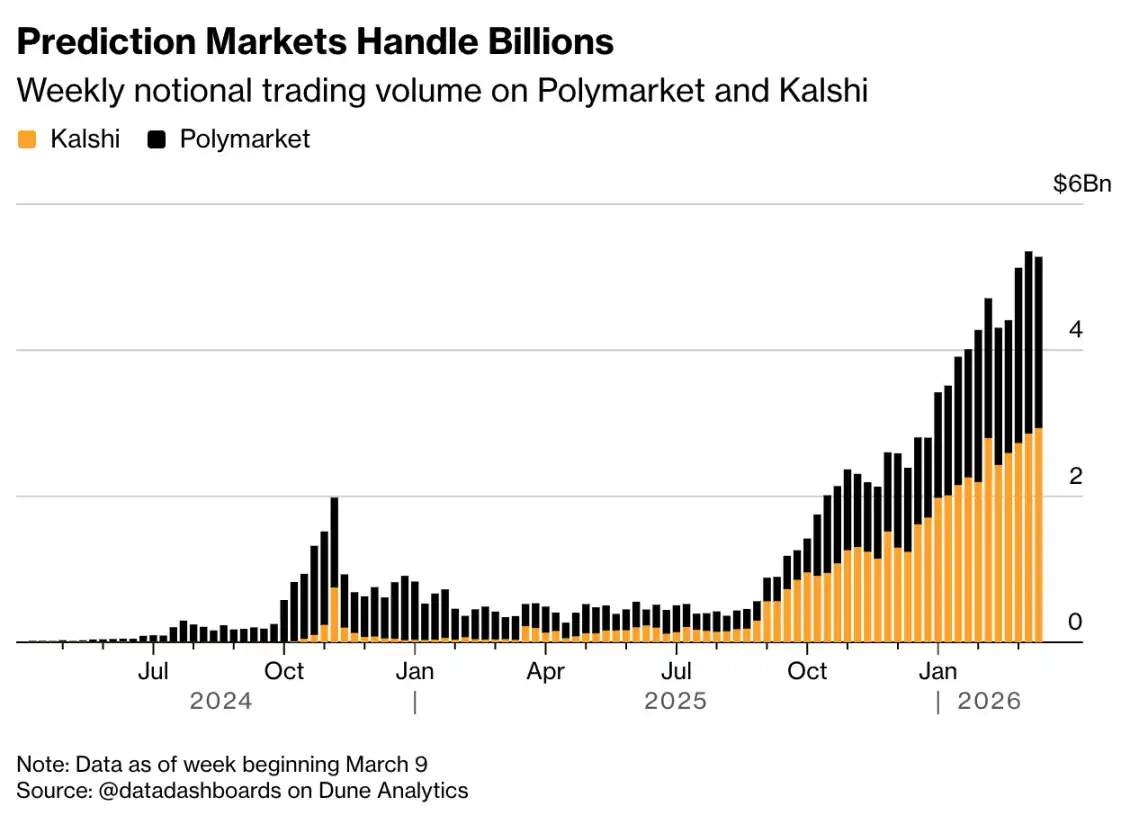
Weekly nominal trading volume of Polymarket and Kalshi. Note: Data is for the week ending March 9th. Source: @datadashboards on Dune Analytics

The core of the dispute lies in the fundamental differences in the establishment models and operating rules of the trading platforms. The Kalshi platform is headquartered in the United States and is regulated by the U.S. Commodity Futures Trading Commission (CFTC); Polymarket's main trading platform is based overseas.

Polymarket leverages its overseas operational advantage to list contracts related to military conflicts, including those involving Iran. Kalshi directly states that such products are both unethical and illegal.

One of Kalshi's advertisements bluntly states: 'We Don't Do Death Markets.'

Earlier this week, this set of marketing ads from Kalshi, in the form of a 'platform rules list,' began appearing at bus stops and subway stations in Washington.

One of them reads: 'Rule 1: We ban insider trading because Kalshi is a federally regulated U.S. exchange.' In the eyes of industry observers, the subtext of this statement is obvious: Polymarket's main platform is not under the jurisdiction of U.S. regulators.
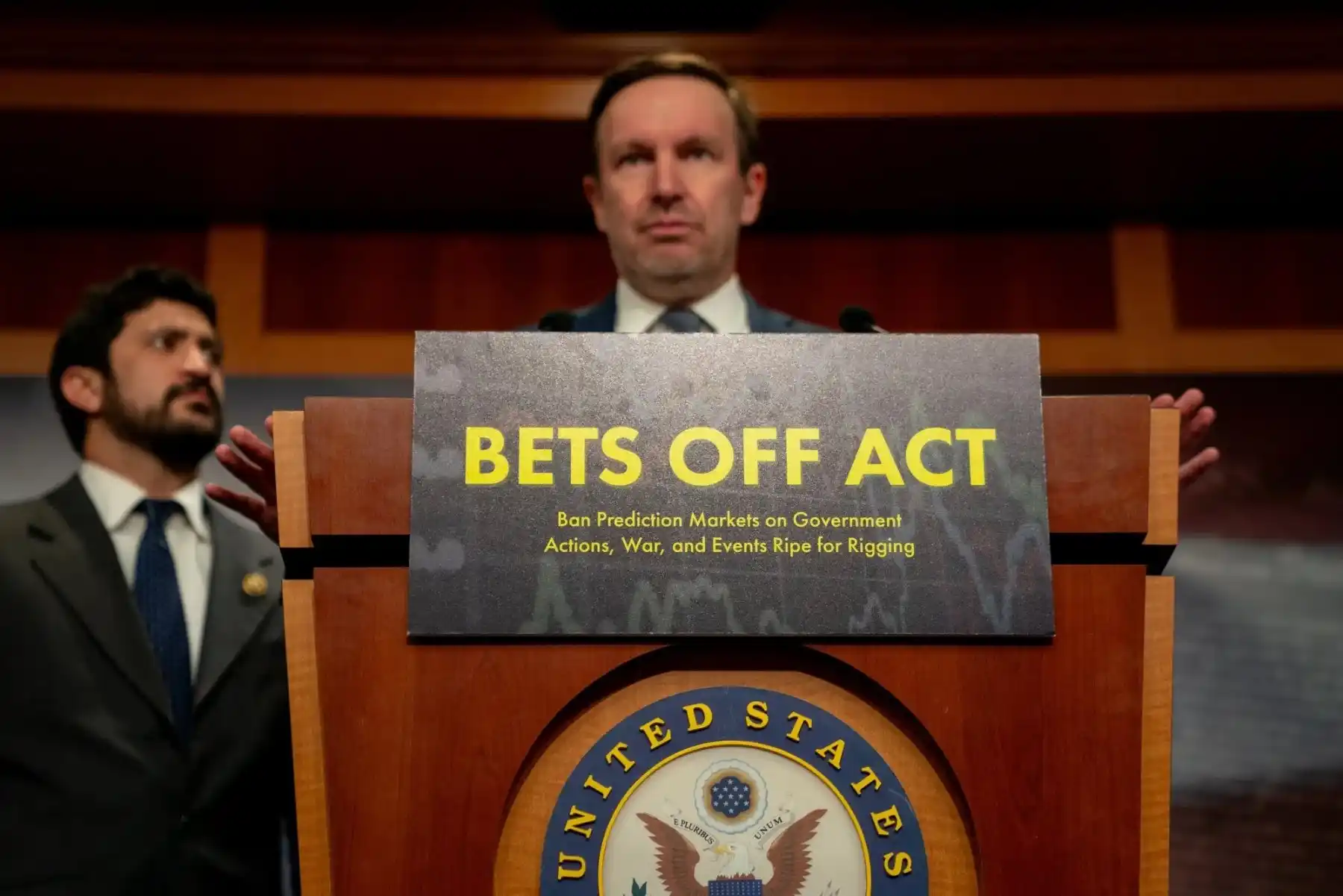
'BETS OFF Act' signage, Representative Greg Casar and Senator Chris Murphy speak at a press conference regarding the 'Betting on Events with Security and Federal Functions Off-Limits (BETS OFF) Act'. Photographer: Stephanie Reynolds / Bloomberg

Following allegations that insider information was used to improperly bet on U.S. military actions in Iran and Venezuela, Congress has turned its focus to the issue of insider trading in prediction markets. In response, Kalshi has taken a tougher stance, imposing fines, suspending trading, and other penalties on users it deems to have violated rules; Polymarket has been relatively permissive, though with increased regulatory attention, the platform recently announced its own insider trading rules.

Kalshi spokesperson Diana said: 'We want to make these significant differences clear. Many people in the market currently conflate Kalshi and Polymarket and confuse the different paths we have taken regarding regulatory compliance.'

In addition to its overseas main platform, Polymarket also has a U.S.-regulated platform, which is still in the testing phase. The company stated in a declaration that both platforms enforce 'the same strict market integrity standards, including prohibitions on insider trading and market manipulation, active monitoring of trading, and ongoing communication and cooperation with regulators and law enforcement agencies.'

A trade on the Polymarket website regarding whether the Houthis will attack Israeli territory. Photographer: Gabby Jones / Bloomberg

Just a few months ago, Kalshi co-founder Luana Lopes Lara was still trying to ease tensions between the two rivals. In a social media post last October, she expressed hope that the industry could move beyond 'destructive infighting' and develop together.

Now, that vision seems largely shattered.

The conflict became even more difficult to reconcile after Kalshi advisor and former U.S. Commodity Futures Trading Commissioner Brian Quintenz joined the fray. In response to reports that prosecutors are investigating insider trading, Brian Quintenz publicly hinted on social media this week that the investigation should focus on Polymarket. When contacted by Bloomberg News, he declined to comment further.


İlgili Sorular

QWhat is the main point of contention between Kalshi and Polymarket?

AThe core dispute revolves around their operational models and regulatory compliance. Kalshi, a US-based platform regulated by the CFTC, criticizes Polymarket for its primarily offshore, unregulated main platform and for offering controversial 'death market' contracts related to military conflicts.

QWhat specific advertising campaign did Kalshi launch against Polymarket?

AKalshi launched a targeted ad campaign in Washington, D.C., bus and metro stations. One ad stated, 'We don't do death markets,' emphasizing its federal regulation and taking a direct shot at Polymarket's offshore operations and sensitive contracts.

QHow did Polymarket respond to the allegations from Kalshi?

APolymarket responded with a statement saying, 'We welcome competition, but believe discussions should be based on facts,' and argued that misleading the public harms the entire industry and its participants. They also stated that both their offshore and US-regulated platforms maintain the same strict market integrity standards.

QWhat recent legislative focus is mentioned in the article that impacts prediction markets?

AThe article mentions that Congress has turned its focus to the issue of insider trading in prediction markets, particularly following allegations that people used inside information to bet on U.S. military actions in Iran and Venezuela. This has led to the proposed 'BETS OFF Act'.

QWhat was the reported combined recent trading volume for Kalshi and Polymarket?

AAccording to user-compiled data on Dune Analytics, the two startups recently set new weekly trading volume records, with their combined nominal trading volume approaching $6 billion.

İlgili Okumalar

OpenAI Post-Training Engineer Weng Jiayi Proposes a New Paradigm Hypothesis for Agentic AI

OpenAI engineer Weng Jiayi's "Heuristic Learning" experiments propose a new paradigm for Agentic AI, suggesting that intelligent agents can improve not just by training neural networks, but also by autonomously writing and refining code based on environmental feedback. In the experiment, a coding agent (powered by Codex) was tasked with developing and maintaining a programmatic strategy for the Atari game Breakout. Starting from a basic prompt, the agent iteratively wrote code, ran the game, analyzed logs and video replays to identify failures, and then modified the code. Through this engineering loop of "code-run-debug-update," it evolved a pure Python heuristic strategy that achieved a perfect score of 864 in Breakout and performed competitively with deep reinforcement learning (RL) algorithms in MuJoCo control tasks like Ant and HalfCheetah. This approach, termed Heuristic Learning (HL), contrasts with Deep RL. In HL, experience is captured in readable, modifiable code, tests, logs, and configurations—a software system—rather than being encoded solely into opaque neural network weights. This offers potential advantages in explainability, auditability for safety-critical applications, easier integration of regression tests to combat catastrophic forgetting, and more efficient sample use in early learning stages, as demonstrated in broader tests on 57 Atari games. However, the blog acknowledges clear limitations. Programmatic strategies struggle with tasks requiring long-horizon planning or complex perception (e.g., Montezuma's Revenge), areas where neural networks excel. The future vision is a hybrid architecture: specialized neural networks for fast perception (System 1), HL systems for rules, safety, and local recovery (also System 1), and LLM agents providing high-level feedback and learning from the HL system's data (System 2). The core proposition is that in the era of capable coding agents, a significant portion of an AI's learned experience could be maintained as an auditable, evolving software system.

marsbit26 dk önce

OpenAI Post-Training Engineer Weng Jiayi Proposes a New Paradigm Hypothesis for Agentic AI

marsbit26 dk önce

Your Claude Will Dream Tonight, Don't Disturb It

This article explores the recent phenomenon of AI companies increasingly using anthropomorphic language—like "thinking," "memory," "hallucination," and now "dreaming"—to describe machine learning processes. Focusing on Anthropic's newly announced "Dreaming" feature for its Claude Agent platform, the piece explains that this function is essentially an automated, offline batch processing of an agent's operational logs. It analyzes past task sessions to identify patterns, optimize future actions, and consolidate learnings into a persistent memory system, akin to a form of reinforcement learning and self-correction. The article draws parallels to similar features in other AI agent systems like Hermes Agent and OpenClaw, which also implement mechanisms for reviewing historical data, extracting reusable "skills," and strengthening long-term memory. It notes a key difference from human dreaming: these AI "dreams" still consume computational resources and user tokens. Further context is provided by discussing the technical challenges of managing AI "memory" or context, highlighting the computational expense of large context windows and innovations like Subquadratic's new model claiming drastically longer contexts. The core critique argues that this strategic use of human-centric vocabulary does more than market products; it subtly reshapes user perception. By framing algorithms with terms associated with consciousness, companies blur the line between tool and autonomous entity. This linguistic shift can influence user expectations, tolerance for errors, and even perceptions of responsibility when systems fail, potentially diverting scrutiny from the companies and engineers behind the technology. The article concludes by speculating that terms like "daydreaming" for predictive task simulation might be next, continuing this trend of embedding the idea of an "inner life" into computational processes.

marsbit28 dk önce

Your Claude Will Dream Tonight, Don't Disturb It

marsbit28 dk önce

İşlemler

Spot
Futures
活动图片