OpenAI Post-Training Engineer Weng Jiayi Proposes a New Paradigm Hypothesis for Agentic AI

marsbit2026-05-11 tarihinde yayınlandı2026-05-11 tarihinde güncellendi

Özet

OpenAI engineer Weng Jiayi's "Heuristic Learning" experiments propose a new paradigm for Agentic AI, suggesting that intelligent agents can improve not just by training neural networks, but also by autonomously writing and refining code based on environmental feedback. In the experiment, a coding agent (powered by Codex) was tasked with developing and maintaining a programmatic strategy for the Atari game Breakout. Starting from a basic prompt, the agent iteratively wrote code, ran the game, analyzed logs and video replays to identify failures, and then modified the code. Through this engineering loop of "code-run-debug-update," it evolved a pure Python heuristic strategy that achieved a perfect score of 864 in Breakout and performed competitively with deep reinforcement learning (RL) algorithms in MuJoCo control tasks like Ant and HalfCheetah. This approach, termed Heuristic Learning (HL), contrasts with Deep RL. In HL, experience is captured in readable, modifiable code, tests, logs, and configurations—a software system—rather than being encoded solely into opaque neural network weights. This offers potential advantages in explainability, auditability for safety-critical applications, easier integration of regression tests to combat catastrophic forgetting, and more efficient sample use in early learning stages, as demonstrated in broader tests on 57 Atari games. However, the blog acknowledges clear limitations. Programmatic strategies struggle with tasks requiring long-...

Over the past decade, the advancement of AI has primarily relied on one path: feeding more data and computing power into larger models, allowing experience to accumulate within neural network parameters. This path has led to the leap in large models after ChatGPT, but it has also left behind a persistent challenge: as models become increasingly powerful, the reasons behind their successes and failures often remain difficult to explain and correct.

Recent experiments by OpenAI engineer Weng Jiayi suggest another possibility: within a clear objective, a runnable environment, and a feedback loop, AI can improve not only by training models but also by "autonomously modifying code."

On May 8, 2026, Weng Jiayi systematically documented this set of experiments in his personal blog "Learning Beyond Gradients" and simultaneously made the code repository, CSV experiment logs, and video replays public. He has long focused on reinforcement learning and post-training infrastructure, participated in the initial launch of ChatGPT, and contributed to projects like GPT-4, GPT-4 Turbo, GPT-4o, o-series, and GPT-5. Before joining OpenAI, he earned his bachelor's degree from the Department of Computer Science at Tsinghua University and his master's degree from Carnegie Mellon University. He is also a main author of the open-source reinforcement learning library Tianshou and the high-performance parallel environment engine EnvPool.

Image generated by AI

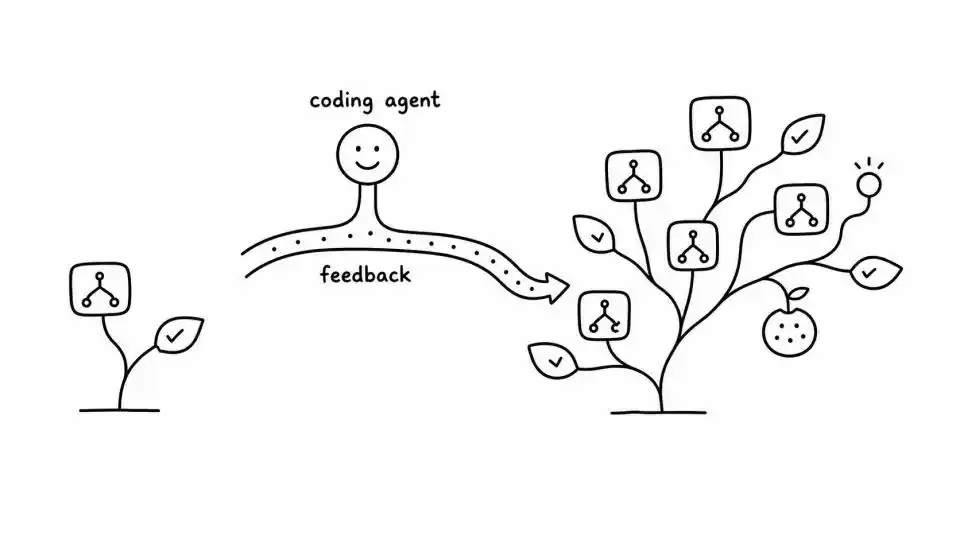
He had Codex repeatedly write policy code, run environments, read logs, review replays, locate failures, then modify code, add tests, and continue evaluation. After multiple iterations, Codex "cultivated" a set of pure Python programmatic strategies: it achieved a theoretical perfect score of 864 points in Atari Breakout and also produced results in robot control simulation environments like MuJoCo Ant and HalfCheetah that were close to those of common deep reinforcement learning algorithms.

The truly significant aspect of these experiments lies in a core question: When the coding agent is sufficiently capable, must learning necessarily occur within neural network weights?

In this experimental setup, experience is written into code, tests, logs, and replays, becoming a software system that can be read, modified, reviewed, and audited. If this direction continues to hold, the next step for Agentic AI might not only be training larger models but also enabling models to participate in maintaining a continuously evolving engineering system.
01

From 387 Points to a Perfect Score: An Engineering Loop

Weng Jiayi wrote in his blog that the starting point for this experiment was actually an engineering need. While maintaining EnvPool in his spare time, he required a cheaper method than "running a neural network every time" to test whether the game environment was functioning correctly, as placing neural networks in CI was too expensive. The original question was: Could he write cheap, reproducible, heuristic rules that were clearly better than a random policy, to drive the environment to information-rich states?

He used Codex (base model gpt-5.4) to attempt writing a completely rule-based version. The initial prompt was very direct: "Write a strategy that can solve Breakout." The result was unsatisfactory. A low score itself provided no information—the action semantics could be wrong, state detection could be wrong, the evaluation process could be wrong, or the policy structure itself could be too weak.

Subsequently, Weng Jiayi changed the task format. He no longer asked Codex to simply deliver a policy.py file; instead, he required it to maintain a complete loop: probe actions and observations, write state detectors, write the policy, run complete episodes, record trials.jsonl and summary.csv, generate videos or curves, inspect failure modes, modify the policy, simplify code, and run regressions.

The experimental log for Breakout clearly recorded this process. In the first round, Codex confirmed the action space and observation shape, identified the colors of the ball, paddle, and bricks from the RGB frames, and then used image labels to scan the 128-byte Atari RAM. The initial baseline scored only 99 points. After adding tunnel offset logic, the score increased to 387 points.

387 points was a deceptively high local optimum. The strategy could stably hit the ball, but the ball path was trapped in a periodic loop: no lives were lost, but no new bricks could be broken, and the score was stuck. If a human were writing the code, they might continue fine-tuning the "accuracy of hitting the ball." Codex watched the video and the last few dozen steps of the trajectory, and identified the problem as a lack of disturbance in the ball's path.

Image: Atari Breakout gameplay. The player controls the bottom paddle to bounce a ball, breaking layers of colored bricks above. Codex achieved the theoretical perfect score of 864 points in this game.

Codex then added a mechanism to "break the cycle": if no reward was received for a long time, periodically add an offset to the landing point prediction to knock the ball out of the local loop. The score jumped from 387 to 507. During further iterations, a new problem emerged: for fast low balls, conventional interception would cause the paddle to "over-lead" and drift away. Codex added a `fast_low_ball_lead_steps=3` parameter, and the score jumped from 507 to 839. The final improvement from 839 to 864 resembled maintaining an already complex system: trying deadband, serve offset, stuck offset, brick balance bias, lookahead steps; many directions were ineffective. The final useful change was a late-stage condition: "After the first wall of bricks is cleared, enable the stuck offset only when the ball is far from the paddle, and gradually release it when the ball is close."

The final RAM default configuration stably output 864 / 864 / 864 points across three episodes, reaching the theoretical limit of Breakout. Codex then migrated the same geometric controller to a pure vision input version—without reading RAM, relying solely on RGB segmentation to identify the paddle, ball, and brick balance. The vision version initially scored 310 points, then 428 points, and reached 864 points after the seventh local episode, corresponding to 14,504 local policy environment steps.
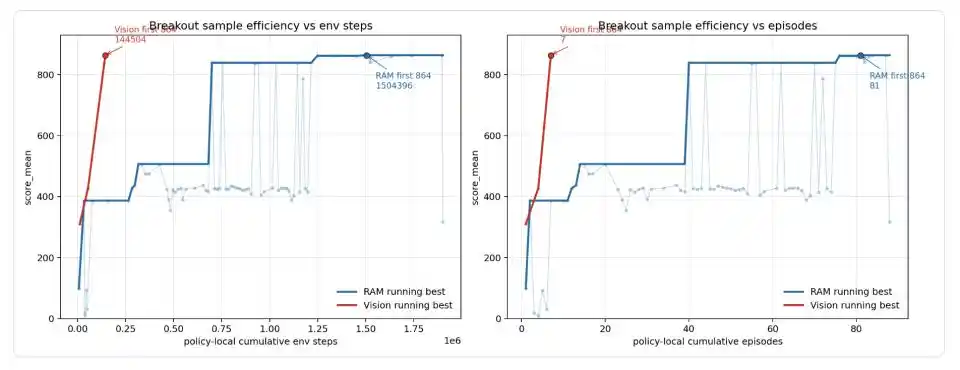
Image: Sample efficiency curve of Codex on Breakout. The blue line is the version that reads game memory (RAM), and the red line is the vision-only version (Vision). The RAM version experienced several jumps: 99 → 387 → 507 → 839 → 864, finally reaching the perfect score for the first time at episode 81, with a cumulative 1.5 million environment steps; the Vision version, migrating the mature structure from the RAM version, reached 864 points with only 7 episodes and approximately 14,500 environment steps.

Weng Jiayi specifically noted that this should not be understood as "the vision input started from scratch and reached a perfect score using only 14.5K steps." The actual process was that Codex first discovered the geometric controller, cycle-breaking mechanism, and late-stage offset release in the RAM version. Once the structure was stable, the state reading layer was switched from RAM to RGB. The 14.5K steps represent the migration budget for the vision version.

02

Defining Heuristic Learning

Finding a name for this evolving "software policy" was more difficult than writing the first version of the policy. Weng Jiayi ultimately named this process Heuristic Learning (HL) and termed the object it maintains as a Heuristic System (HS).

According to his blog definition, HL is composed of program code. Like today's common deep reinforcement learning, it has a loop of state, action, feedback, and update. The difference is that the object being updated is the software structure, not neural network parameters; its feedback, digested by the coding agent, can come from environmental rewards, test cases, logs, videos, replays, or human feedback; its update does not use backpropagation, but rather the coding agent directly edits the policy, state detectors, tests, configurations, or memories.

It should be added that the concept of "using programs rather than neural networks as policies" is not Weng Jiayi's original creation. Academic discussions on Programmatic RL have been ongoing for years: the PROPEL framework proposed by Rice University and Caltech in 2019 researched reinforcement learning methods representing policies as short programs in a symbolic language; the 2021 LEAPS work further learned program embedding spaces, combining differentiable program policies with RL training; the HPRL (Hierarchical Programmatic Reinforcement Learning) presented at ICML 2023 allows a meta-policy to combine multiple programs; the LLM-GS framework from National Taiwan University and Microsoft in 2024 uses LLM's programming ability and commonsense reasoning to guide the search for programmatic RL policies.

The consensus from this research is that, compared to neural policies, programmatic policies possess better interpretability, formal verifiability, and generalization ability to unseen scenarios.

Weng Jiayi's substantive contribution this time lies in treating the coding agent as the engineering channel for maintaining the heuristic system. In the past, doing programmatic RL either relied on manually designed domain-specific languages or search algorithms within restricted program spaces; Weng Jiayi, however, uses Codex to integrate code, logs, tests, video replays, and parameter adjustments into the same agent workflow, drastically reducing the iteration cost of program policies at once. In other words, he is arguing for a new engineering path: when the coding agent is sufficiently capable, those heuristic strategies once deemed "too expensive to maintain" might become cost-effective again.

Weng Jiayi provided a comparison table in his blog to clearly illustrate the differences between HL and Deep RL: in terms of policy form, the former consists of rules, state machines, controllers, model predictive control (MPC), and macro actions composed into code, while the latter consists of neural network parameters; in terms of state form, the former uses explicit variables, detectors, and caches, while the latter uses network-readable observation vectors; in terms of feedback form, the former treats tests, logs, and replays as valid signals, while the latter primarily relies on fixed reward functions; in terms of memory form, the former can explicitly store trials, summaries, failure reasons, and version diffs, while the latter has essentially none in on-policy algorithms and relies on replay buffers in off-policy algorithms.
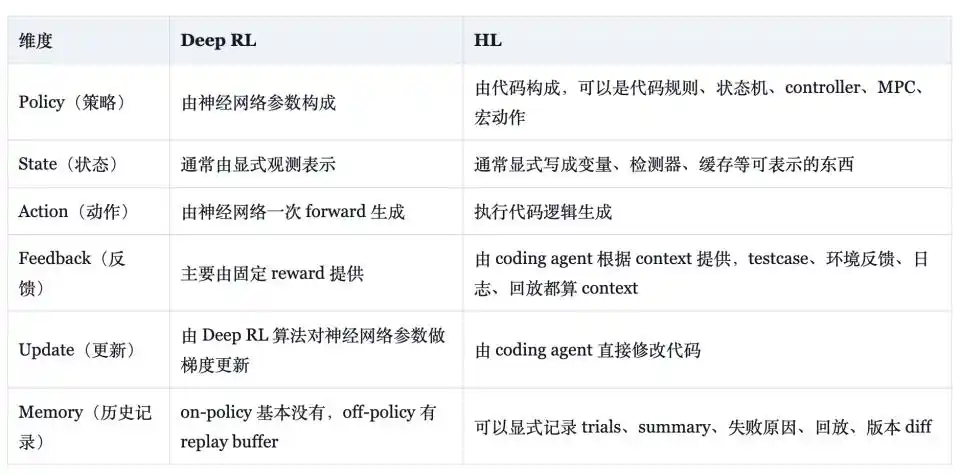
This comparison demonstrates that HL possesses some engineering attributes: the policy is interpretable and can be translated into natural language; sample efficiency is measured in units of "one effective code change," not slow gradient updates; old capabilities can become regression tests, fixed-seed replays, or golden cases; overfitting to training seeds or test loopholes can be constrained through simplification, regression checks, and multi-seed evaluation; old capabilities don't have to reside solely in weights but can also reside in rule sets and tests, which partly addresses the catastrophic forgetting problem that neural networks have long struggled to solve.

03

Bulk Validation on Atari57: Boundaries and Shortcomings

If focusing only on Breakout, the story could easily be simplified to "AI wrote a perfect strategy." But Weng Jiayi didn't stop at Breakout; he scaled this Codex workflow in bulk to Atari57, running 57 games, two observation modes, and three repetitions each, totaling 342 "unattended" search trajectories.

The experimental design was quite rigorous. Each game was tested with two input methods: one directly reading game memory, and the other viewing only the screen. Each method was independently repeated three times. This produced a total of 342 "unattended" experimental trajectories: each Codex agent received the same prompt template, explored actions on its own, wrote code on its own, ran experiments on its own, and recorded results on its own, with no human providing hints. Constraints were strictly enforced: no training neural networks, no reading game source code, no exploiting any hidden information. All steps used for debugging and trial-and-error had to be counted in the total cost. This was to prevent Codex from cheating in any "peeking at the answers" way.

When measuring results, a metric called HNS (Human-Normalized Score) is commonly used—simply put, it standardizes the score of each game relative to "average human player performance = 1" for easy cross-game comparison.
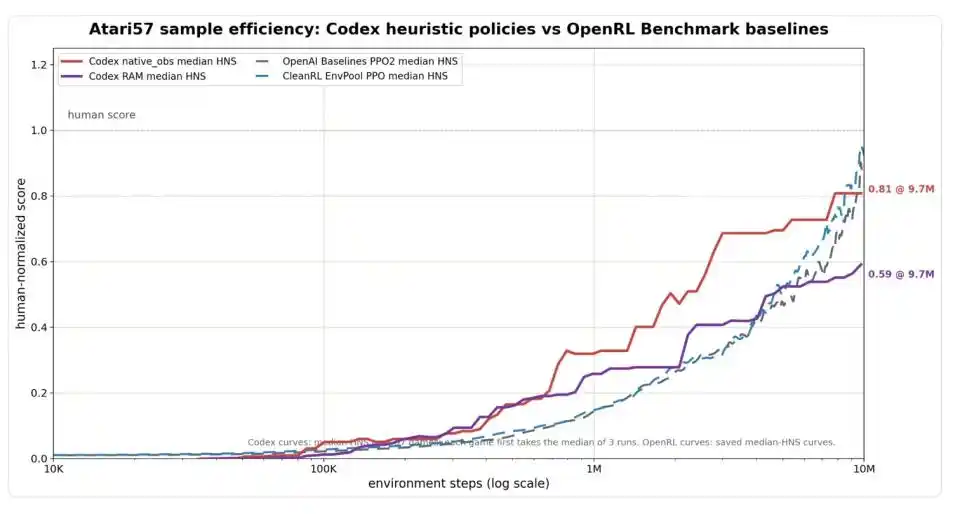
Image: Sample efficiency comparison on the full Atari57 suite. The x-axis is environment steps (log scale), and the y-axis is HNS (Human-Normalized Score, where 1.0 indicates reaching average human player level). Codex's vision input version (red line) significantly outperforms the PPO baseline (blue/gray dashed lines) in early-stage efficiency, reaching 0.81 at 9.7 million steps, comparable to PPO's level around 10 million steps; Codex's memory input version (purple line) converges at 0.59.

Measured by this standard, Codex's early-stage efficiency appears quite impressive. With only 1 million environment steps consumed, Codex's median HNS for vision input had already reached 0.32, and for memory input, 0.26, significantly higher than that of classical reinforcement learning algorithms like PPO at the same stage. By 9.7 million steps, Codex's vision version reached 0.81, already close to PPO's level of approximately 0.88 to 0.92 at 10 million steps. If allowed to aggregate by selecting the better-performing input method for each game, Codex's median HNS was 0.83, OpenAI Baselines PPO2 was 0.80, and CleanRL EnvPool PPO was 0.98—essentially a tie.

However, Weng Jiayi himself calmly drew a boundary: this is only a comparison of environment interaction efficiency, without accounting for the costs of Codex reading logs, writing code, and watching videos. "Running fast" does not equal "low total cost," and the latter remains a black box for now.

More noteworthy is that Codex's performance across the 57 games was not uniform. In games with clear geometric structures like Breakout, Boxing, and Krull, both heuristic strategies and deep reinforcement learning could significantly surpass human levels; in games with clear rules like Asterix, Jamesbond, and Tennis, heuristic strategies were even stronger; but in fast-paced, complex-pattern games like Atlantis, VideoPinball, RoadRunner, and StarGunner, PPO still dominated.
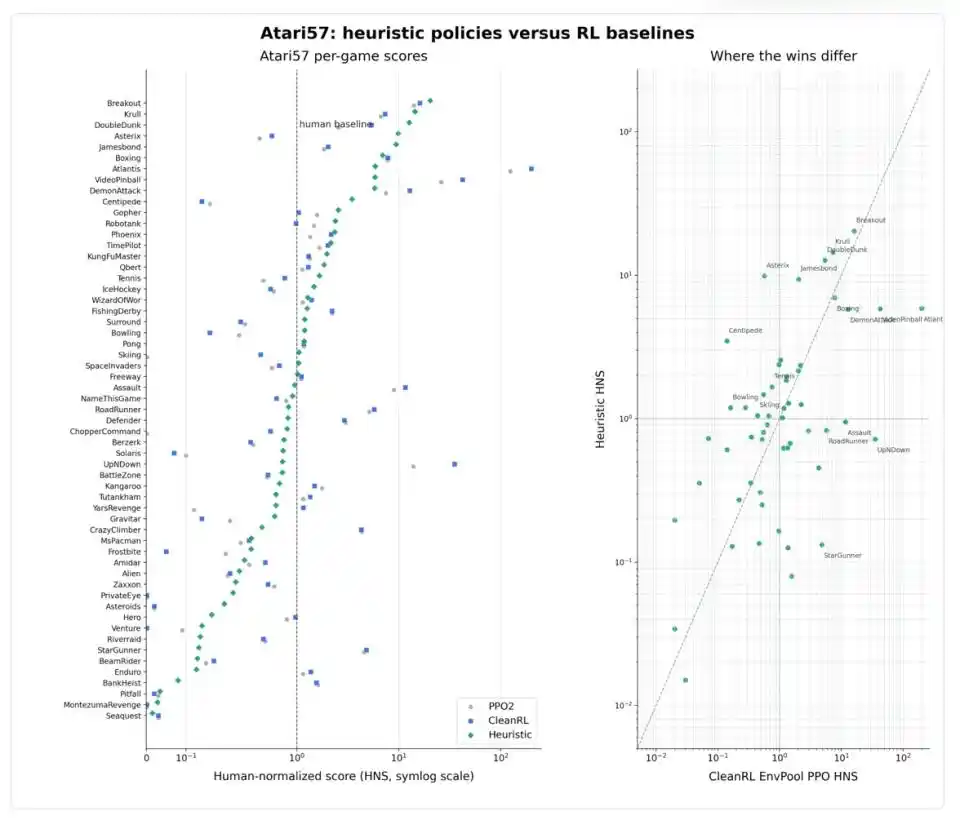
The most cautionary counterexample is Montezuma's Revenge. This is a notorious "hard nut to crack" in reinforcement learning, where the protagonist needs to find keys, avoid enemies, and open doors in a complex underground labyrinth, with extremely sparse reward signals—a classic "long-term planning + failure recovery" challenge. Codex did score 400 points in this game, but examining the policy file it generated reveals that it's not a true "strategy" but a hardcoded sequence of 86 actions corresponding to 1,769 environment steps: more like memorizing a fixed route than learning to navigate a maze. Weng Jiayi specifically noted: "This is a boundary case and should not be understood as a generic Montezuma strategy."

Montezuma exposes the expressive limits of Heuristic Learning. Ordinary programmatic strategies are essentially reactive logic of "do this action when you see that state," struggling with tasks requiring strict action sequences, resuming plans from intermediate states, and long-horizon planning. Such tasks require not just more if-else statements but program structures closer to "macro-action combination + recoverable search state + long-term memory." This tells us one thing: even if the coding agent becomes very powerful, some problems cannot be contained by ordinary code.

04

If the Paradigm Holds, What Are the Industrial Implications?

Zooming out to an industrial perspective. If the Heuristic Learning path truly holds—meaning "coding agents can stably maintain programmatic strategies surpassing handcrafted rules and approaching RL baselines"—where does its practical significance lie?

The first application point is robot control, especially in structurally stable scenarios. The framework Weng Jiayi outlined in his blog involves hierarchical division of labor: joint-level HL, limb-level HL, full-body balance HL, and task-level HL. Lower levels handle safety and low-latency control, middle levels handle gait and contact, and higher levels handle tasks and long-term memory; the coding agent doesn't need to "understand walking"—it's more like an update channel inserted into the system, sending failure videos, sensor streams, and simulation results back to the system, and rewriting feedback into code, parameters, protection rules, and memories.

Scenarios like warehouse AGVs, inspection robots, factory robotic arms, and standardized sorting, where the environment structure is relatively fixed and safety boundaries are clear—if core control strategies can be solidified into lightweight code, robots wouldn't need to run a large policy network for every action step. Deployment-end reliance on high-power GPU inference cards would decrease, with more load handled by traditional controllers and local program logic.

This doesn't mean robots don't need GPUs; perception, localization, mapping, and semantic understanding still rely on neural networks. What changes is the role of the GPU, shifting from "burning compute for end-to-end action decisions every second" to "playing a periodic role in perception, offline simulation, policy generation, and anomaly analysis."

The second application point is the auditability of safety-critical scenarios. The most troublesome engineering problem with neural policies is the inability to locate the cause after a failure. When a robotic arm suddenly fails at a certain angle, a vehicle misjudges in an edge case, or a medical robot acts abnormally in a rare posture, engineers cannot answer "which weight caused this error." Ultimately, they can only add data, retrain, run regression tests, and bet that the new model hasn't introduced new problems.

If the policy exists in code form, state variables, conditional branches, failure logs, and regression tests are all visible; a dangerous action can be hardcoded to be prohibited, a corner case can be written as a test, and an erroneous state transition can be individually patched. This doesn't make the system inherently safer, but it allows safety issues to enter normal software engineering workflows for the first time—they can be code-reviewed, intercepted by CI, and responded to by SRE on-call. In fields requiring regulation and liability division, like autonomous driving, industrial robotic arms, and medical robots, this auditability itself is of commercial value.

The third application point is the engineering of continual learning and online learning. Weng Jiayi presented this as the main argument of the entire blog post. Catastrophic forgetting in neural networks is a structural problem: learning new things washes away old capabilities. HL also experiences forgetting, but in a more engineering form: a new rule fixes one failure mode but breaks an old scenario; a new memory repeatedly leads the agent in the wrong direction; a test range is too narrow, and the policy learns to exploit it; a patch modifies a shared interface, and old calling paths silently fail.

These problems don't disappear automatically, but they are issues that software engineering has dealt with for decades, with existing toolchains—regression testing, version diffs, fixed-seed replays, golden traces, and explicitly recorded failure directions.

A healthy HS must perform two operations simultaneously: absorbing new feedback and compressing historical patches. An HS that only grows without reduction will eventually become a "code ball of mud" no one dares to touch. In other words, HL transforms the mathematical problem of "how to update parameters" into the engineering problem of "how to maintain a software system that continuously absorbs feedback."

The latter is not necessarily easier, but it is closer to the existing boundaries of human capability.

The fourth application point is capability accumulation in Agent products. What current Agent products lack most are stable tool invocation, reliable execution chains, reusable failure experiences, and auditable task records. If HL's logic holds, an Agent's memories during execution would precipitate into code assets that can be reused across sessions, users, and tasks. It can directly interface with existing DevOps processes and also means that Agents from different companies and teams can share heuristics without needing to share models—something the neural network approach cannot achieve.

However, it must be emphasized: all four application points depend on further validation of the HL path on more complex tasks. Breakout and Ant are relatively clean environments. Real robots face changes in ground friction, lighting variations, actuator delays, and sensor noise—none of which have been systematically evaluated in public materials. The Montezuma counterexample has already shown that long-horizon tasks require program forms beyond ordinary if-else. How far this vision can go depends on the next phase of experiments.

05

Technical Debt Shifts from Weights to Code

Weng Jiayi's assessment in his blog is measured. He wrote that HL cannot accomplish everything neural networks can do; it is limited by what code can express, especially in complex perception and long-horizon generalization. With today's understanding, he cannot imagine an agent using pure Python code without any neural networks to solve ImageNet. The truly worthwhile question is how to combine neural networks with HL to jointly address Online Learning and Continual Learning.

The division of labor he proposes borrows from the System 1 / System 2 framework: specialized shallow neural networks take on part of System 1, responsible for fast perception, classification, and object state estimation; HL also takes on part of System 1, responsible for processing fresh data, rules, tests, replays, memories, safety boundaries, and local recovery; the LLM agent acts as System 2, providing feedback and improvement data to HL, and periodically extracting information from data generated by HL to update itself.

If deep learning over the past decade has proven that "experience can be compressed into weights," then the hypothesis Weng Jiayi proposes this time is another proposition: in the era of coding agents, experience might once again become readable, modifiable, testable software.

This article is from the WeChat public account "Tencent Technology," author: Xiao Jing, editor: Xu Qingyang


İlgili Sorular

QWhat is Heuristic Learning (HL) as proposed by Weng Jiayi, and how does it differ from traditional deep reinforcement learning?

AHeuristic Learning (HL) is a paradigm proposed by OpenAI engineer Weng Jiayi where an AI agent, like Codex, learns by iteratively writing, running, and modifying programmatic code for a policy within an explicit goal, runnable environment, and feedback loop. The core difference from traditional deep reinforcement learning (Deep RL) is that in HL, experience and improvements are encoded directly into readable, editable software components like code, tests, logs, and configurations. This is updated via direct code edits by the AI, rather than being learned through gradient descent and embedded as inscrutable weights in a neural network. This approach aims for better interpretability, auditability, and sample efficiency in terms of 'effective code changes'.

QWhat was the specific process and final result of the Atari Breakout experiment conducted by Weng Jiayi?

AIn the Atari Breakout experiment, Weng Jiayi tasked Codex not just with writing a policy, but with maintaining a full engineering loop: probing the environment, writing state detectors, running episodes, recording logs and videos, analyzing failures, and modifying the code. Starting from a baseline score of 99, the agent iteratively improved its strategy. Key breakthroughs included adding a mechanism to break cyclical ball patterns (raising the score from 387 to 507) and adjusting parameters for intercepting fast low balls (jumping from 507 to 839). The final policy, refined with late-stage conditionals, achieved a perfect score of 864 across three episodes, which is the theoretical maximum for the game. This was achieved using both game RAM data and later migrated to a vision-only (RGB) input version.

QWhat were the key findings and limitations when scaling the Heuristic Learning approach to the full Atari57 benchmark?

AWhen scaled to the Atari57 benchmark, the Heuristic Learning approach showed promising early sample efficiency, with a median Human-Normalized Score (HNS) of 0.32 at 1 million steps for the vision-based version, outperforming PPO baselines at that stage. By 9.7 million steps, its performance (HNS ~0.81) was competitive with PPO. However, performance was uneven. It excelled in geometrically clear games (e.g., Breakout, Boxing) but struggled in fast-paced, complex games (e.g., Atlantis, RoadRunner). A key limitation was exposed in Montezuma's Revenge, where the agent merely memorized a fixed action sequence instead of learning a generalizable policy, highlighting the expressivity limits of simple programmatic strategies for tasks requiring long-term planning and state recovery.

QWhat are the potential industry applications and implications if the Heuristic Learning paradigm proves viable?

AIf proven viable, Heuristic Learning could have significant industry implications: 1) **Robotics Control**: For structured environments (e.g., warehouse AGVs, industrial arms), core control logic could be lightweight, auditable code, reducing reliance on heavy GPU inference for every action. 2) **Safety-Critical Systems**: The interpretability of code allows for auditing, debugging, and embedding safety rules directly, which is crucial for autonomous vehicles and medical robots. 3) **Continual Learning Engineering**: It transforms the 'catastrophic forgetting' problem into a software maintenance challenge, solvable with regression tests and version control. 4) **Agentic AI Products**: Agent experiences could be codified into reusable, sharable software assets integrated into DevOps workflows, enabling capability沉淀 without sharing model weights.

QAccording to Weng Jiayi, how might Neural Networks and Heuristic Learning be combined in a future AI system architecture?

AWeng Jiayi suggests a potential hybrid architecture借鉴 the System 1 / System 2 framework. Specialized, shallow neural networks would act as part of System 1, handling fast perception and state estimation. The Heuristic Learning system would also be part of System 1, responsible for rules, tests, memory, safety boundaries, and local recovery based on fresh data. A large language model (LLM) agent would serve as System 2, providing high-level feedback and improvement directions to the HL system, and periodically updating itself from the structured data and experiences generated by the HL process. This combines the perceptual strength of neural networks with the interpretability and engineering manageability of programmatic systems.

İlgili Okumalar

380,000 Apps Exposed, 2,000+ Apps Leaked Secrets: AI Programming Turns 'Intranet' into Public Internet

Israeli cybersecurity firm RedAccess uncovered a severe data exposure trend linked to "vibe coding" or AI-powered software development tools. Their research found approximately 38,000 publicly accessible web applications built with platforms like Lovable, Base44, Netlify, and Replit. Of these, an estimated 2,000 apps exposed sensitive corporate and personal data, including medical records, financial information, internal strategic documents, and customer chat logs. In some cases, access even granted administrative privileges. The core issue stems from default privacy settings that make applications public by default, combined with a lack of built-in security controls (like authentication) in the AI-generated code. This allows employees without security expertise—"citizen developers"—to easily create and deploy applications that bypass standard corporate security reviews. The exposed apps, often indexed by search engines, are trivially discoverable. While some platform providers (Replit, Lovable, Wix/Base44) argue that security configuration is the user's responsibility and question the validity of some findings, security researchers confirm the widespread reality of such exposures. This pattern, also noted in prior studies, highlights a critical security gap as AI democratizes app creation, potentially leading to massive, unintentional data leaks.

marsbit37 dk önce

380,000 Apps Exposed, 2,000+ Apps Leaked Secrets: AI Programming Turns 'Intranet' into Public Internet

marsbit37 dk önce

Attracting Global Capital, Asia's New 'Super Cycle' Is Unfolding

Investors are turning to Asia as the next frontier for global equity growth, with a new "super cycle" unfolding across the region. Driven by the AI revolution, Asian markets, particularly South Korea, have seen significant rallies. According to Morgan Stanley analysis, the underlying drivers of Asia's industrial cycle are shifting from traditional sectors like real estate and manufacturing to massive investments in AI infrastructure, energy security and transition, and supply chain resilience. Fixed asset investment in Asia is projected to grow from around $11 trillion in 2025 to $16 trillion by 2030, with a 7% annual growth rate from 2026-2030. The AI wave is a primary catalyst, driving immense capital expenditure for chips, servers, data centers, and power systems. Asia is central to this hardware supply chain. In China, AI investment is focused on building a full-system domestic capability, with the local AI chip market potentially reaching $86 billion by 2030. Beyond AI, China's export story is expanding from EVs and batteries to robotics. The country already captures about half of new global industrial robot demand and over 90% of humanoid robot shipments. This growth phase mirrors the early stages of China's EV export boom. Simultaneously, energy security investments, spurred by AI's massive power needs, are rising, with China benefiting from its leadership in solar, batteries, and EVs. Regional defense spending is also increasing structurally, supporting demand for advanced manufacturing. The main beneficiaries are China, South Korea, and Japan, positioned in core supply chain areas. However, risks remain, including potential overcapacity, profit margin pressures from competition, persistent technological restrictions, geopolitical friction, and workforce displacement due to AI-driven automation. Market volatility is also expected to increase as investor expectations diverge on the realization of these capital investment and export themes.

marsbit37 dk önce

Attracting Global Capital, Asia's New 'Super Cycle' Is Unfolding

marsbit37 dk önce

Funding Weekly Report | 14 Public Funding Events, Kalshi Completes $10B New Funding Round at $220B Valuation Led by Coatue Management

Weekly Funding Roundup: 14 Deals and $10.49B+ in Total Funding, Led by Kalshi's $1B Round Last week (5.4-5.10) saw 14 notable funding events in the global blockchain ecosystem, raising over $10.49 billion in total. Key highlights include Kalshi, a prediction market platform, securing a $1 billion round led by Coatue Management, reaching a $22 billion valuation. The platform now boasts ~2 million MAUs and $178B in annualized trading volume. In DeFi, regulated on-chain reinsurer OnRe raised $5 million in Series A funding, and Bitcoin-backed credit protocol Saturn Credit completed a $2 million seed round. For Infrastructure & Tools, OpenTrade raised $17 million to expand its stablecoin yield infrastructure, and RWA platform Balcony secured $12.7 million to deploy its property settlement service in the US. Centralized Finance saw one deal: AI-driven trading platform Stockcoin.ai completed a seed round led by Amber Group. In the prediction market sector alongside Kalshi, AI-powered platform Elastics raised $2 million. Other notable deals include SC Ventures' strategic investment in crypto market maker GSR and Centrifuge securing a "seven-figure" investment from Coinbase to become a core RWA partner for Base. On the investor side, Haun Ventures raised a new $1 billion fund targeting crypto and AI, and Multi Investment raised ~$616 million to focus on blockchain and Web3 investments.

marsbit1 saat önce

Funding Weekly Report | 14 Public Funding Events, Kalshi Completes $10B New Funding Round at $220B Valuation Led by Coatue Management

marsbit1 saat önce

İşlemler

Spot
Futures

Popüler Makaleler

GROK AI Nedir

Grok AI: Web3 Döneminde Konuşma Teknolojisini Devrim Niteliğinde Yenilik Giriş Hızla gelişen yapay zeka alanında, Grok AI, ileri teknoloji ve kullanıcı etkileşimi alanlarını birleştiren dikkate değer bir proje olarak öne çıkıyor. Ünlü girişimci Elon Musk'ın liderliğindeki xAI tarafından geliştirilen Grok AI, yapay zeka ile etkileşim şeklimizi yeniden tanımlamayı hedefliyor. Web3 hareketi devam ederken, Grok AI, karmaşık sorgulara yanıt vermek için konuşma yapay zekasının gücünden yararlanmayı amaçlıyor ve kullanıcılara sadece bilgilendirici değil, aynı zamanda eğlenceli bir deneyim sunuyor. Grok AI Nedir? Grok AI, kullanıcılarla dinamik bir şekilde etkileşimde bulunmak üzere tasarlanmış sofistike bir konuşma yapay zeka sohbet botudur. Birçok geleneksel yapay zeka sisteminin aksine, Grok AI, genellikle uygunsuz veya standart yanıtların dışında kabul edilen daha geniş bir sorgu yelpazesini benimsemektedir. Projenin temel hedefleri şunlardır: Güvenilir Akıl Yürütme: Grok AI, bağlamsal anlayışa dayalı mantıklı yanıtlar sağlamak için sağduyu akıl yürütmeyi vurgular. Ölçeklenebilir Denetim: Araç yardımı entegrasyonu, kullanıcı etkileşimlerinin hem izlenmesini hem de kalite için optimize edilmesini sağlar. Resmi Doğrulama: Güvenlik en önemli önceliktir; Grok AI, çıktılarının güvenilirliğini artırmak için resmi doğrulama yöntemlerini entegre eder. Uzun Bağlam Anlayışı: AI modeli, kapsamlı konuşma geçmişini saklama ve hatırlama konusunda mükemmel bir performans sergileyerek anlamlı ve bağlamsal olarak farkında tartışmaların yapılmasını kolaylaştırır. Saldırgan Dayanıklılık: Manipüle edilmiş veya kötü niyetli girdilere karşı savunmalarını geliştirmeye odaklanarak, Grok AI kullanıcı etkileşimlerinin bütünlüğünü korumayı hedefler. Özünde, Grok AI sadece bir bilgi alma cihazı değil; dinamik diyalogu teşvik eden, etkileyici bir konuşma partneridir. Grok AI'nın Yaratıcısı Grok AI'nın arkasındaki beyin, otomotiv, uzay yolculuğu ve teknoloji gibi çeşitli alanlarda yenilikle özdeşleşen Elon Musk'tır. Yapay zeka teknolojisini faydalı yollarla geliştirmeye odaklanan xAI çatısı altında, Musk'ın vizyonu, yapay zeka etkileşimlerinin anlaşılmasını yeniden şekillendirmeyi amaçlıyor. Liderlik ve temel etik, Musk'ın teknolojik sınırları zorlamaya olan bağlılığı tarafından derinden etkilenmektedir. Grok AI'nın Yatırımcıları Grok AI'yi destekleyen yatırımcılarla ilgili spesifik detaylar sınırlı kalmakla birlikte, projenin kuluçka merkezi olan xAI'nin, esasen Elon Musk tarafından kurulduğu ve desteklendiği kamuya açık bir şekilde kabul edilmektedir. Musk'ın önceki girişimleri ve mülkleri, Grok AI'nın güvenilirliğini ve büyüme potansiyelini daha da artıran sağlam bir destek sağlar. Ancak, şu anda Grok AI'yı destekleyen ek yatırım fonları veya kuruluşlarıyla ilgili bilgiye kolayca erişim sağlanamamaktadır; bu da potansiyel gelecekteki keşif alanını işaret etmektedir. Grok AI Nasıl Çalışır? Grok AI'nın operasyonel mekanikleri, kavramsal çerçevesi kadar yenilikçidir. Proje, benzersiz işlevselliklerini kolaylaştıran birkaç son teknoloji ürünü teknolojiyi entegre eder: Sağlam Altyapı: Grok AI, konteyner orkestrasyonu için Kubernetes, performans ve güvenlik için Rust ve yüksek performanslı sayısal hesaplama için JAX kullanılarak inşa edilmiştir. Bu üçlü, sohbet botunun verimli çalışmasını, etkili bir şekilde ölçeklenmesini ve kullanıcılara zamanında hizmet vermesini sağlar. Gerçek Zamanlı Bilgi Erişimi: Grok AI'nın ayırt edici özelliklerinden biri, X platformu (önceden Twitter olarak biliniyordu) aracılığıyla gerçek zamanlı verilere erişim yeteneğidir. Bu yetenek, yapay zekaya en son bilgilere erişim sağlar ve diğer yapay zeka modellerinin gözden kaçırabileceği zamanında yanıtlar ve öneriler sunmasına olanak tanır. İki Etkileşim Modu: Grok AI, kullanıcılara “Eğlenceli Mod” ve “Normal Mod” arasında seçim yapma imkanı sunar. Eğlenceli Mod, daha eğlenceli ve mizahi bir etkileşim tarzı sağlarken, Normal Mod, kesin ve doğru yanıtlar vermeye odaklanır. Bu çok yönlülük, çeşitli kullanıcı tercihlerine hitap eden özelleştirilmiş bir deneyim sağlar. Özünde, Grok AI performansı etkileşimle birleştirerek, hem zenginleştirici hem de eğlenceli bir deneyim yaratmaktadır. Grok AI'nın Zaman Çizelgesi Grok AI'nın yolculuğu, gelişim ve dağıtım aşamalarını yansıtan önemli dönüm noktalarıyla işaretlenmiştir: İlk Geliştirme: Grok AI'nın temel aşaması, modelin ilk eğitim ve ince ayarının yapıldığı yaklaşık iki ay boyunca gerçekleşmiştir. Grok-2 Beta Yayını: Önemli bir ilerleme olarak, Grok-2 beta duyurulmuştur. Bu sürüm, sohbet etme, kodlama ve akıl yürütme yetenekleriyle donatılmış iki versiyon—Grok-2 ve Grok-2 mini—sunmuştur. Halka Açık Erişim: Beta geliştirmesinin ardından, Grok AI X platformu kullanıcılarına sunulmuştur. Telefon numarasıyla doğrulanan ve en az yedi gün aktif olan hesap sahipleri, sınırlı bir versiyona erişim sağlayarak teknolojiyi daha geniş bir kitleye ulaştırmaktadır. Bu zaman çizelgesi, Grok AI'nın kuruluşundan kamu etkileşimine kadar sistematik büyümesini kapsar ve sürekli iyileştirme ve kullanıcı etkileşimine olan bağlılığını vurgular. Grok AI'nın Ana Özellikleri Grok AI, yenilikçi kimliğine katkıda bulunan birkaç ana özelliği kapsamaktadır: Gerçek Zamanlı Bilgi Entegrasyonu: Güncel ve ilgili bilgilere erişim, Grok AI'yı birçok statik modelden ayırarak, etkileyici ve doğru bir kullanıcı deneyimi sağlar. Çeşitli Etkileşim Tarzları: Farklı etkileşim modları sunarak, Grok AI çeşitli kullanıcı tercihlerine hitap eder ve yapay zeka ile konuşurken yaratıcılığı ve kişiselleştirmeyi teşvik eder. Gelişmiş Teknolojik Altyapı: Kubernetes, Rust ve JAX kullanımı, projeye güvenilirlik ve optimal performans sağlamak için sağlam bir çerçeve sunar. Etik Tartışma Dikkati: Görüntü üreten bir işlevin dahil edilmesi, projenin yenilikçi ruhunu sergiler. Ancak, aynı zamanda tanınabilir figürlerin saygılı bir şekilde tasvir edilmesi ve telif hakkı ile ilgili etik konuları da gündeme getirir—bu, yapay zeka topluluğunda süregelen bir tartışmadır. Sonuç Konuşma yapay zekası alanında öncü bir varlık olarak Grok AI, dijital çağda dönüştürücü kullanıcı deneyimlerinin potansiyelini kapsar. xAI tarafından geliştirilen ve Elon Musk'ın vizyoner yaklaşımıyla yönlendirilen Grok AI, gerçek zamanlı bilgiyi gelişmiş etkileşim yetenekleriyle birleştirir. Yapay zekanın neler başarabileceği konusunda sınırları zorlamayı hedeflerken, etik konulara ve kullanıcı güvenliğine odaklanmayı sürdürmektedir. Grok AI, sadece teknolojik ilerlemeyi değil, aynı zamanda Web3 manzarasında yeni bir konuşma paradigmasını da temsil eder ve kullanıcılara hem yetkin bilgi hem de eğlenceli etkileşim sunma vaadinde bulunur. Proje gelişmeye devam ederken, teknolojinin, yaratıcılığın ve insan benzeri etkileşimin kesişim noktasında nelerin başarılabileceğinin bir kanıtı olarak durmaktadır.

326 Toplam GörüntülenmeYayınlanma 2024.12.26Güncellenme 2024.12.26

GROK AI Nedir

ERC AI Nedir

Euruka Tech: $erc ai ve Web3'teki Hedefleri Üzerine Bir Genel Bakış Giriş Blockchain teknolojisi ve merkeziyetsiz uygulamaların hızla gelişen manzarasında, her biri benzersiz hedefler ve metodolojilerle yeni projeler sıkça ortaya çıkmaktadır. Bu projelerden biri, kripto para ve Web3 alanında faaliyet gösteren Euruka Tech'tir. Euruka Tech'in, özellikle $erc ai token'ının ana odak noktası, merkeziyetsiz teknolojinin büyüyen yeteneklerinden yararlanmak için tasarlanmış yenilikçi çözümler sunmaktır. Bu makale, Euruka Tech'in kapsamlı bir genel görünümünü, hedeflerini, işlevselliğini, yaratıcısının kimliğini, potansiyel yatırımcılarını ve Web3'teki daha geniş bağlam içindeki önemini keşfetmeyi amaçlamaktadır. Euruka Tech, $erc ai Nedir? Euruka Tech, Web3 ortamının sunduğu araçlar ve işlevsellikleri kullanan bir proje olarak tanımlanmaktadır ve operasyonlarında yapay zekayı entegre etmeye odaklanmaktadır. Projenin çerçevesine dair spesifik detaylar biraz belirsiz olsa da, kullanıcı etkileşimini artırmayı ve kripto alanındaki süreçleri otomatikleştirmeyi amaçlamaktadır. Proje, yalnızca işlemleri kolaylaştırmakla kalmayıp, aynı zamanda yapay zeka aracılığıyla öngörücü işlevsellikleri de entegre eden merkeziyetsiz bir ekosistem yaratmayı hedeflemektedir; bu nedenle token'ının adı $erc ai'dir. Amaç, büyüyen Web3 alanında daha akıllı etkileşimleri ve verimli işlem işleme süreçlerini kolaylaştıran sezgisel bir platform sunmaktır. Euruka Tech'in Yaratıcısı Kimdir, $erc ai? Şu anda, Euruka Tech'in arkasındaki yaratıcı veya kurucu ekip hakkında bilgi verilmemiştir ve bu durum biraz belirsizdir. Bu veri eksikliği, ekibin geçmişi hakkında bilgi sahibi olmanın genellikle blockchain sektöründe güvenilirlik oluşturmak için gerekli olduğu endişelerini doğurmaktadır. Bu nedenle, somut detaylar kamuya sunulana kadar bu bilgiyi bilinmeyen olarak sınıflandırdık. Euruka Tech'in Yatırımcıları Kimlerdir, $erc ai? Benzer şekilde, Euruka Tech projesinin yatırımcıları veya destekleyen organizasyonları hakkında mevcut araştırmalarla kolayca sağlanan bir bilgi yoktur. Euruka Tech ile etkileşimde bulunmayı düşünen potansiyel paydaşlar veya kullanıcılar için kritik bir unsur, kurumsal finansal ortaklıklar veya saygın yatırım firmalarından gelen destekle sağlanan güvencedir. Yatırım ilişkileri hakkında açıklamalar olmadan, projenin finansal güvenliği veya sürdürülebilirliği hakkında kapsamlı sonuçlar çıkarmak zordur. Bulunan bilgilere paralel olarak, bu bölüm de bilinmeyen durumundadır. Euruka Tech, $erc ai Nasıl Çalışır? Euruka Tech için detaylı teknik spesifikasyonların eksik olmasına rağmen, yenilikçi hedeflerini göz önünde bulundurmak önemlidir. Proje, yapay zekanın hesaplama gücünden yararlanarak kripto para ortamında kullanıcı deneyimini otomatikleştirmeyi ve geliştirmeyi hedeflemektedir. AI'yi blockchain teknolojisiyle entegre ederek, Euruka Tech otomatik ticaret, risk değerlendirmeleri ve kişiselleştirilmiş kullanıcı arayüzleri gibi özellikler sunmayı amaçlamaktadır. Euruka Tech'in yenilikçi özü, kullanıcılar ile merkeziyetsiz ağların sunduğu geniş olanaklar arasında kesintisiz bir bağlantı yaratma hedefinde yatmaktadır. Makine öğrenimi algoritmaları ve AI kullanarak, ilk kez kullanıcı zorluklarını en aza indirmeyi ve Web3 çerçevesindeki işlem deneyimlerini düzene sokmayı amaçlamaktadır. AI ve blockchain arasındaki bu simbiyoz, $erc ai token'ının önemini vurgulamakta ve geleneksel kullanıcı arayüzleri ile merkeziyetsiz teknolojilerin gelişmiş yetenekleri arasında bir köprü işlevi görmektedir. Euruka Tech, $erc ai Zaman Çizelgesi Maalesef, Euruka Tech hakkında mevcut olan sınırlı bilgiler nedeniyle, projenin yolculuğundaki önemli gelişmeler veya kilometre taşları hakkında detaylı bir zaman çizelgesi sunamıyoruz. Genellikle bir projenin evrimini haritalamak ve büyüme eğrisini anlamak için değerli olan bu zaman çizelgesi şu anda mevcut değildir. Önemli olaylar, ortaklıklar veya işlevsel eklemeler hakkında bilgiler belirgin hale geldikçe, güncellemeler kesinlikle Euruka Tech'in kripto alanındaki görünürlüğünü artıracaktır. Diğer “Eureka” Projeleri Üzerine Açıklama Birden fazla projenin ve şirketin “Eureka” benzeri bir isimlendirmeye sahip olduğunu belirtmek önemlidir. Araştırmalar, robotlara karmaşık görevler öğretmeye odaklanan NVIDIA Research'ten bir AI ajanı gibi girişimleri, ayrıca eğitim ve müşteri hizmetleri analitiğinde kullanıcı deneyimini geliştiren Eureka Labs ve Eureka AI'yi tanımlamıştır. Ancak, bu projeler Euruka Tech'ten farklıdır ve hedefleri veya işlevleri ile karıştırılmamalıdır. Sonuç Euruka Tech, $erc ai token'ı ile birlikte, Web3 manzarasında umut verici ancak şu anda belirsiz bir oyuncuyu temsil etmektedir. Yaratıcısı ve yatırımcıları hakkında detaylar açıklanmamış olsa da, yapay zekayı blockchain teknolojisiyle birleştirme konusundaki temel hedefi ilgi odağı olmaktadır. Projenin, gelişmiş otomasyon aracılığıyla kullanıcı etkileşimini teşvik etme konusundaki benzersiz yaklaşımları, Web3 ekosistemi ilerledikçe onu farklı kılabilir. Kripto piyasası gelişmeye devam ederken, paydaşların Euruka Tech etrafındaki gelişmelere dikkat etmeleri önemlidir; belgelenmiş yeniliklerin, ortaklıkların veya tanımlanmış bir yol haritasının gelişimi, önümüzdeki dönemde önemli fırsatlar sunabilir. Şu an itibarıyla, Euruka Tech'in potansiyelini ve rekabetçi kripto manzarasındaki konumunu açığa çıkarabilecek daha somut içgörüler beklemekteyiz.

309 Toplam GörüntülenmeYayınlanma 2025.01.02Güncellenme 2025.01.02

ERC AI Nedir

DUOLINGO AI Nedir

DUOLINGO AI: Dil Öğrenimini Web3 ve AI İnovasyonu ile Entegre Etmek Teknolojinin eğitimi yeniden şekillendirdiği bir çağda, yapay zeka (AI) ve blok zinciri ağlarının entegrasyonu dil öğrenimi için yeni bir ufuk açmaktadır. DUOLINGO AI ve ona bağlı kripto para birimi $DUOLINGO AI ile tanışın. Bu proje, önde gelen dil öğrenme platformlarının eğitimsel yeteneklerini merkeziyetsiz Web3 teknolojisinin faydalarıyla birleştirmeyi hedefliyor. Bu makale, DUOLINGO AI'nın temel yönlerini, hedeflerini, teknolojik çerçevesini, tarihsel gelişimini ve gelecekteki potansiyelini incelerken, orijinal eğitim kaynağı ile bu bağımsız kripto para girişimi arasındaki netliği korumaktadır. DUOLINGO AI Genel Görünümü DUOLINGO AI'nın temelinde, öğrenicilerin dil yeterliliğinde eğitimsel kilometre taşlarına ulaşmaları için kriptografik ödüller kazanabilecekleri merkeziyetsiz bir ortam oluşturma hedefi yatmaktadır. Akıllı sözleşmeler uygulayarak, proje beceri doğrulama süreçlerini ve token tahsislerini otomatikleştirmeyi amaçlamakta, şeffaflık ve kullanıcı sahipliğini vurgulayan Web3 ilkelerine uymaktadır. Model, dil edinimindeki geleneksel yaklaşımlardan ayrılarak, token sahiplerinin kurs içeriği ve ödül dağıtımları üzerinde iyileştirmeler önermesine olanak tanıyan topluluk odaklı bir yönetişim yapısına dayanmaktadır. DUOLINGO AI'nın bazı dikkat çekici hedefleri şunlardır: Oyunlaştırılmış Öğrenme: Proje, dil yeterlilik seviyelerini temsil etmek için blok zinciri başarıları ve değiştirilemez tokenleri (NFT'ler) entegre ederek, katılımcıları motive eden dijital ödüller sunmaktadır. Merkeziyetsiz İçerik Üretimi: Eğitmenler ve dil meraklılarının kendi kurslarını katkıda bulunmalarına olanak tanıyarak, tüm katkıda bulunanların fayda sağladığı bir gelir paylaşım modeli oluşturmaktadır. AI Destekli Kişiselleştirme: Gelişmiş makine öğrenimi modellerini kullanarak, DUOLINGO AI dersleri bireysel öğrenme ilerlemesine uyacak şekilde kişiselleştirmekte, köklü platformlarda bulunan uyarlamalı özelliklere benzer bir deneyim sunmaktadır. Proje Yaratıcıları ve Yönetişim Nisan 2025 itibarıyla, $DUOLINGO AI'nın arkasındaki ekip takma isimler kullanmaktadır; bu, merkeziyetsiz kripto para alanında sıkça görülen bir uygulamadır. Bu anonimlik, bireysel geliştiricilere odaklanmak yerine kolektif büyümeyi ve paydaş katılımını teşvik etmek amacıyla tasarlanmıştır. Solana blok zincirinde dağıtılan akıllı sözleşme, geliştiricinin cüzdan adresini not etmekte, bu da yaratıcıların kimliğinin bilinmemesine rağmen işlemlerle ilgili şeffaflık taahhüdünü simgelemektedir. Yol haritasına göre, DUOLINGO AI, Merkeziyetsiz Otonom Organizasyon (DAO) haline gelmeyi hedeflemektedir. Bu yönetişim yapısı, token sahiplerinin özellik uygulamaları ve hazine tahsisleri gibi kritik konularda oy kullanmalarına olanak tanımaktadır. Bu model, çeşitli merkeziyetsiz uygulamalarda bulunan topluluk güçlendirme ethosu ile uyumlu olup, kolektif karar verme sürecinin önemini vurgulamaktadır. Yatırımcılar ve Stratejik Ortaklıklar Şu anda, $DUOLINGO AI ile bağlantılı olarak kamuya açık tanımlanabilir kurumsal yatırımcılar veya risk sermayedarları bulunmamaktadır. Bunun yerine, projenin likiditesi esas olarak merkeziyetsiz borsa (DEX) kaynaklıdır ve bu, geleneksel eğitim teknolojisi şirketlerinin finansman stratejileriyle keskin bir zıtlık oluşturmaktadır. Bu tabandan gelen model, merkeziyetsizliğe olan bağlılığını yansıtan topluluk odaklı bir yaklaşımı işaret etmektedir. DUOLINGO AI, beyaz kitabında, kurs tekliflerini zenginleştirmeyi amaçlayan belirsiz “blok zinciri eğitim platformları” ile işbirlikleri kurmayı planladığını belirtmektedir. Belirli ortaklıklar henüz açıklanmamış olsa da, bu işbirlikçi çabalar, blok zinciri yeniliğini eğitim girişimleri ile birleştirmeyi amaçlayan bir stratejiyi ima etmektedir ve çeşitli öğrenme yollarında erişimi ve kullanıcı katılımını genişletmektedir. Teknolojik Mimari AI Entegrasyonu DUOLINGO AI, eğitimsel tekliflerini geliştirmek için iki ana AI destekli bileşen içermektedir: Uyarlanabilir Öğrenme Motoru: Bu sofistike motor, kullanıcı etkileşimlerinden öğrenmekte olup, büyük eğitim platformlarından gelen özel modellere benzer. Belirli öğrenici zorluklarını ele almak için ders zorluğunu dinamik olarak ayarlamakta ve zayıf alanları hedeflenmiş alıştırmalarla pekiştirmektedir. Konuşma Ajanları: GPT-4 destekli sohbet botlarını kullanarak, DUOLINGO AI kullanıcıların simüle edilmiş konuşmalara katılmalarına olanak tanıyarak, daha etkileşimli ve pratik bir dil öğrenme deneyimi sunmaktadır. Blok Zinciri Altyapısı $DUOLINGO AI, Solana blok zincirinde inşa edilmiş kapsamlı bir teknolojik çerçeve kullanmaktadır: Beceri Doğrulama Akıllı Sözleşmeleri: Bu özellik, yeterlilik testlerini başarıyla geçen kullanıcılara otomatik olarak token ödülleri vermekte, gerçek öğrenim sonuçları için teşvik yapısını güçlendirmektedir. NFT Rozetleri: Bu dijital tokenler, öğrenicilerin kurslarının bir bölümünü tamamlamak veya belirli becerileri ustalaşmak gibi ulaştıkları çeşitli kilometre taşlarını simgelemekte ve bunları dijital olarak takas etmelerine veya sergilemelerine olanak tanımaktadır. DAO Yönetişimi: Token sahibi topluluk üyeleri, anahtar öneriler üzerinde oy kullanarak yönetişime katılabilir, bu da kurs teklifleri ve platform özelliklerinde yeniliği teşvik eden katılımcı bir kültürü kolaylaştırmaktadır. Tarihsel Zaman Çizelgesi 2022–2023: Kavramsallaştırma DUOLINGO AI için temel, dil öğrenimindeki AI ilerlemeleri ile blok zinciri teknolojisinin merkeziyetsiz potansiyeli arasındaki sinerjiyi vurgulayan bir beyaz kağıdın oluşturulmasıyla başlar. 2024: Beta Lansmanı Sınırlı bir beta sürümü, popüler dillerdeki teklifleri tanıtarak, erken kullanıcıları token teşvikleri ile ödüllendirir ve projenin topluluk katılım stratejisinin bir parçası olarak sunulmaktadır. 2025: DAO Geçişi Nisan ayında, tokenlerin dolaşıma girmesiyle tam bir ana ağ lansmanı gerçekleşir ve topluluk, Asya dillerine ve diğer kurs gelişmelerine olası genişlemeler hakkında tartışmalara başlar. Zorluklar ve Gelecek Yönelimleri Teknik Engeller Hırslı hedeflerine rağmen, DUOLINGO AI önemli zorluklarla karşı karşıyadır. Ölçeklenebilirlik, AI işleme ile merkeziyetsiz bir ağı sürdürme maliyetleri arasında denge kurma konusunda sürekli bir endişe kaynağıdır. Ayrıca, merkeziyetsiz bir teklif arasında kaliteli içerik üretimi ve moderasyonu sağlamak, eğitim standartlarını koruma konusunda karmaşıklıklar yaratmaktadır. Stratejik Fırsatlar İleriye dönük olarak, DUOLINGO AI, akademik kurumlarla mikro yeterlilik ortaklıkları kurma potansiyeline sahiptir ve dil becerilerinin blok zinciri ile doğrulanmış onaylarını sağlamaktadır. Ayrıca, çapraz zincir genişlemesi, projenin daha geniş kullanıcı tabanlarına ve ek blok zinciri ekosistemlerine erişim sağlamasına olanak tanıyabilir, böylece birlikte çalışabilirliğini ve erişimini artırabilir. Sonuç DUOLINGO AI, yapay zeka ve blok zinciri teknolojisinin yenilikçi bir birleşimini temsil etmekte olup, geleneksel dil öğrenim sistemlerine topluluk odaklı bir alternatif sunmaktadır. Takma isimli geliştirme süreci ve ortaya çıkan ekonomik modeli bazı riskler taşısa da, projenin oyunlaştırılmış öğrenme, kişiselleştirilmiş eğitim ve merkeziyetsiz yönetişim konusundaki taahhüdü, Web3 alanında eğitim teknolojisi için bir yol haritası aydınlatmaktadır. AI gelişmeye devam ederken ve blok zinciri ekosistemi evrim geçirirken, DUOLINGO AI gibi girişimler, kullanıcıların dil eğitimi ile etkileşim biçimlerini yeniden tanımlayabilir, toplulukları güçlendirebilir ve yenilikçi öğrenme mekanizmaları aracılığıyla katılımı ödüllendirebilir.

310 Toplam GörüntülenmeYayınlanma 2025.04.11Güncellenme 2025.04.11

DUOLINGO AI Nedir

Tartışmalar

HTX Topluluğuna hoş geldiniz. Burada, en son platform gelişmeleri hakkında bilgi sahibi olabilir ve profesyonel piyasa görüşlerine erişebilirsiniz. Kullanıcıların AI (AI) fiyatı hakkındaki görüşleri aşağıda sunulmaktadır.

活动图片