Polymarket: 84% of Traders Are Losing Money, 0.033% of People Take the Majority of Profits

marsbit2026-04-08 tarihinde yayınlandı2026-04-08 tarihinde güncellendi

Özet

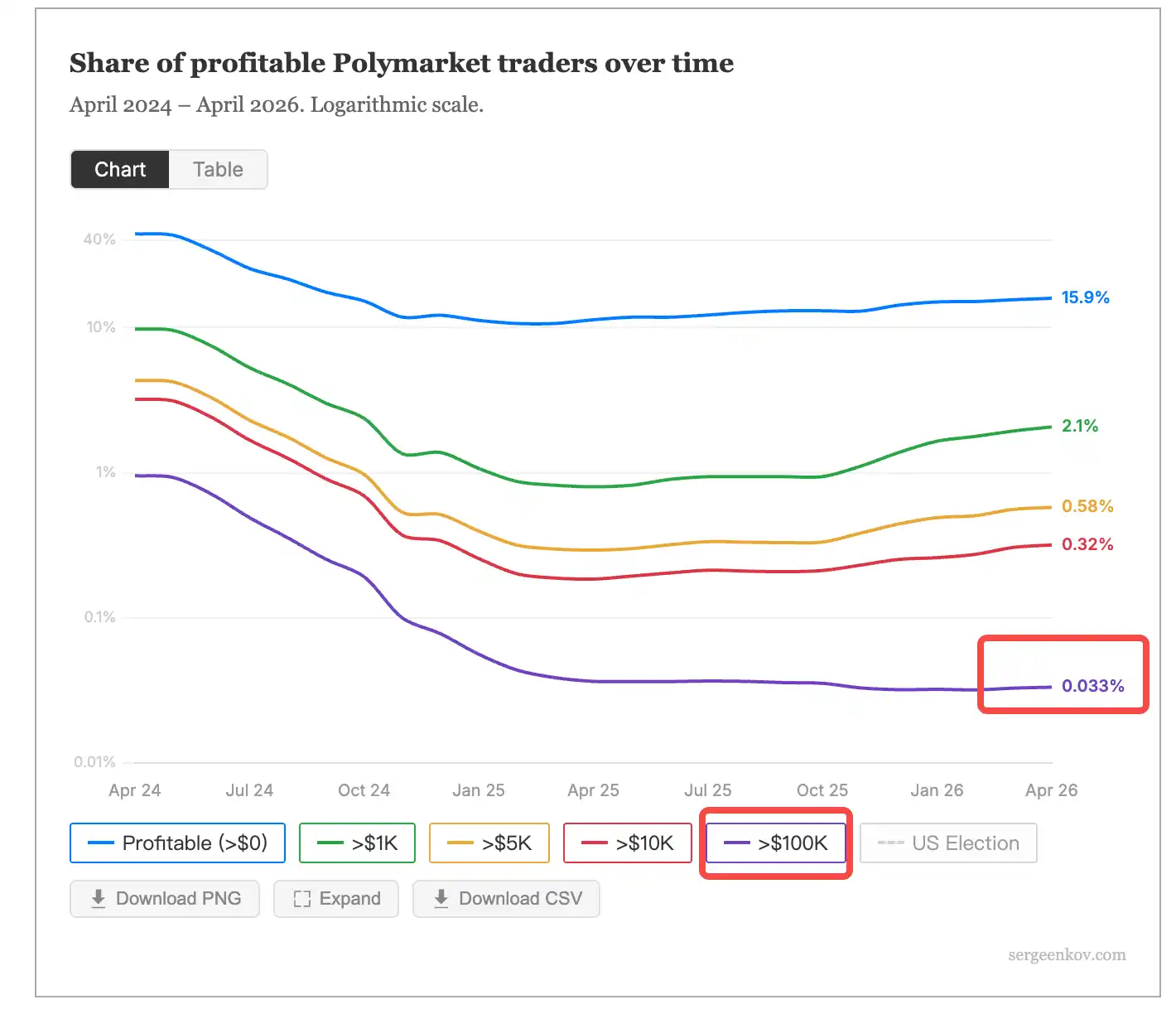
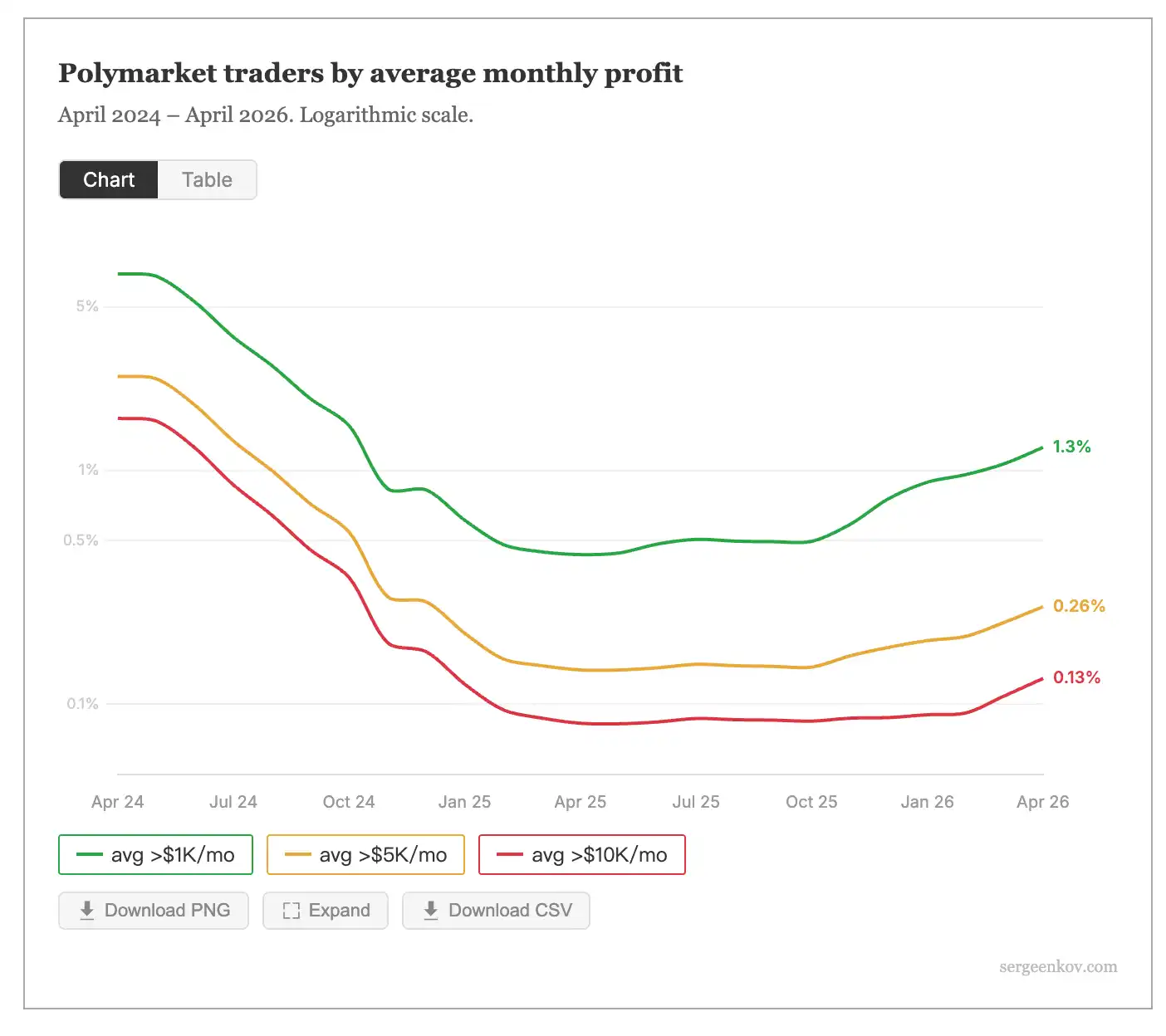
A recent analysis of 2.5 million Polymarket wallet addresses by on-chain researcher Andrey Sergeenkov reveals that 84.1% of traders are losing money, with only 16% achieving any profit. A mere 2% of addresses have accumulated over $1,000 in profits, while just 0.033% (840 addresses) have earned more than $100,000. The study, which improved on prior methodologies by accounting for token splits and mergers, shows a significant increase in unprofitable traders compared to a previous 70% estimate. Profit concentration is extreme: only 1.25% of addresses make over $1,000 monthly, 0.26% earn above $5,000, and just 0.13% surpass $10,000. Most high-earning addresses are short-lived, with 53% of top traders active for only one month. Research indicates that automated strategies—such as arbitrage bots and high-frequency trading systems—dominate profits, exploiting public on-chain data and speed advantages that manual retail traders lack. Despite Polymarket’s accuracy in prediction (94% a month before outcomes), the platform exhibits a stark wealth disparity, raising questions about its function as an information aggregator versus a zero-sum game favoring sophisticated players.

Author: Deep Tide TechFlow

Deep Tide Guide: The latest analysis of 2.5 million wallet addresses on Polymarket by on-chain researcher Andrey Sergeenkov shows that 84.1% of traders are at a loss, with only 2% of addresses accumulating profits exceeding $1,000, and 840 addresses (0.033%) profiting over $100,000. The timing of this report is quite delicate—Polymarket has just secured an exclusive predictive market partnership with MLB for up to $300 million and is pushing hard for retail user growth.

Wealth distribution in on-chain prediction markets is even more brutal than most people imagine.

According to a report by The Defiant on April 6, independent on-chain researcher Andrey Sergeenkov released a profit and loss analysis covering 2.5 million Polymarket wallet addresses, with data as of April 1, 2026. The core conclusion: 84.1% of traders are losing money, and less than 16% of addresses have achieved any level of positive returns.

This is not the first such study. In December 2025, blockchain analyst DeFi Oasis analyzed 1.7 million addresses and 124 million transactions, concluding that 70% of traders were not profitable. Sergeenkov's data sample is larger, and the methodology has been improved (capturing token splits and merges missed in previous research), with the loss ratio jumping from 70% to 84%.

The Top of the Pyramid: Less Than 0.26% Earn Over $5,000 Monthly

Sergeenkov conducted a full analysis of transaction data from two smart contracts, CTF Exchange and NegRisk CTF Exchange, by tracking all USDC fund flows (including buys, sells, redemptions, splits, and merges) on the Polygon chain.

The numbers in the high-profit range are quite stark: addresses with average monthly profits exceeding $1,000 account for 1.25%; those exceeding $5,000 are only 0.26%, about 6,600 addresses; and those exceeding $10,000 drop to 3,250, representing 0.13% of all traders.
More critical is the issue of sustainability. Among those 6,600 addresses with average monthly profits exceeding $5,000, 53% were active for one month and then disappeared, with only 2.6% trading continuously for over a year. Sergeenkov summarized in the report: "Most traders come, trade for a while, and then leave."

In contrast, bottom-feeders consistently harvest profits. An academic paper from Spain's IMDEA Networks Institute analyzed 86 million on-chain transactions between April 2024 and April 2025, finding that arbitrage traders extracted approximately $40 million in profits just from price differences. A single wallet achieved the highest profit of $2 million from 4,049 transactions, averaging $496 per trade.

Retail Manual Trading Can't Beat Bots, Information Advantage Highly Concentrated

The root cause of losses is not complicated. IMDEA's research shows that the largest profits are concentrated in wallets using automated strategies: arbitrage bots, market-making algorithms, and high-frequency trading systems. Manual retail traders typically enter the market only after prices have already adjusted.

This is the fundamental difference between prediction markets and traditional gambling. Polymarket's order book is completely public, and on-chain data is transparent, but this transparency instead makes it easier for professional traders to build systematic advantages. A quantitative wallet equipped with low-latency APIs and probability models is not in the same arena as an ordinary user who opens the app to place a bet after seeing the news.

According to Token Terminal data, Polymarket's nominal trading volume over the past 30 days is approximately $9.8 billion, with about 462,600 monthly active traders. The platform's growth itself is not an issue, but the relationship between user growth and user profitability is inverse—Sergeenkov's data shows that the decline in the proportion of profitable traders is directly related to peaks in user growth, especially the influx after the November 2024 U.S. election.
Information Aggregation Tool or Zero-Sum Game?

This report has reignited an old debate: who exactly do prediction markets serve?

The core argument of supporters is information aggregation. Polymarket's official data claims that its price prediction accuracy exceeds 94% one month before the outcome is determined. In other words, even if 84% of traders are losing money, the market as a whole is still producing valuable probability signals. The losing retail traders are essentially paying for information pricing.

Critics argue that when 84% of a platform's participants are losing money and profits are highly concentrated in the hands of automated traders, the difference between it and a casino is merely a matter of regulatory classification. Especially in the realm of sports contracts, the line between prediction markets and sports betting is being deliberately blurred.

Polymarket's valuation has exceeded $20 billion, and the Intercontinental Exchange (parent company of the NYSE) invested $2 billion in October 2025. Capital markets are clearly betting on the growth story of prediction markets.

But Sergeenkov's report raises a simple question: when the next wave of 2.5 million users floods in, how will their fate differ from the previous wave?


Trend Kriptolar

İlgili Sorular

QAccording to the analysis of 2.5 million Polymarket wallet addresses, what percentage of traders are losing money?

A84.1% of traders are losing money.

QWhat is the estimated number of addresses that have profited more than $100,000 on Polymarket, according to the researcher Andrey Sergeenkov?

A840 addresses (0.033% of the total) have profited more than $100,000.

QWhat does the research from the IMDEA Networks Institute identify as the primary reason for散户 (retail traders) losses on prediction markets like Polymarket?

AThe research found that the largest profits are concentrated in wallets using automated strategies (arbitrage bots, market-making algorithms, and high-frequency trading systems), while manual retail traders typically enter the market after prices have already adjusted.

QWhat key statistic does the article mention about the sustainability of high-earning traders (those making over $5,000 monthly)?

AAmong the 6,600 addresses with monthly profits exceeding $5,000, 53% were only active for one month before disappearing, and only 2.6% traded consistently for over a year.

QDespite most traders losing money, what is the core argument of supporters who defend the value of prediction markets like Polymarket?

ASupporters argue that prediction markets serve as valuable information aggregation tools, with Polymarket's prices achieving over 94% accuracy in predicting outcomes one month in advance, meaning the market as a whole produces valuable probabilistic signals even if most individual traders lose money.

İlgili Okumalar

Who Decides the Rules of Bitcoin? BIP-110 Ignites Governance Debate

Bitcoin's governance is once again at the center of a heated debate, this time ignited by BIP-110, the "Reduced Data Temporary Softfork." This proposal aims to curb non-monetary data (like inscriptions and Runes) by introducing seven new consensus-layer restrictions over a year, such as limiting new output scripts to 34 bytes and restoring the OP_RETURN cap to 83 bytes. The controversy stems from BIP-110's fundamental shift: it moves the battle against "spam" from node relay and miner policies to the consensus layer, rendering currently valid transactions invalid. Supporters, arguing that default policy governance has failed (highlighted by Bitcoin Core v30's relaxation of OP_RETURN limits), see this as necessary to protect node resources and Bitcoin's monetary focus. Opponents, led by figures like Michael Saylor and Adam Back, warn it dangerously centralizes governance. Saylor listed 110 reasons against it, criticizing its low 55% miner activation threshold and potential for chain splits. Back emphasized Bitcoin's "permissionless" ethos, arguing no single group should impose value judgments via consensus rules. Further complicating matters, technical critiques suggest BIP-110 may be technically circumventable, and a "BlockSlop" vulnerability in its upgrade path poses a consensus risk. The debate has drawn in diverse stakeholders: miners (with pools like Ocean signaling support and Foundry polling clients), node operators (like Bitcoin Knots), and new players like corporate treasury holder MicroStrategy (Saylor), whose market influence adds a novel dimension. Ultimately, BIP-110 acts as a governance stress test, exposing the unresolved question: who decides Bitcoin's rules? It pits the authority of miners, node operators, developers, and capital holders against each other, with each side claiming to defend Bitcoin's core principles of neutrality and security.

marsbit7 dk önce

Who Decides the Rules of Bitcoin? BIP-110 Ignites Governance Debate

marsbit7 dk önce

Who Decides Bitcoin's Rules? BIP-110 Ignites Governance Debate

Title: Who Decides Bitcoin's Rules? BIP-110 Ignites Governance Debate A new technical proposal, BIP-110 (Reduced Data Temporary Softfork), has sparked a fundamental governance debate within the Bitcoin community. It aims to impose new consensus rules for one year to limit non-financial data (like inscriptions and Runes) on-chain, moving beyond simple node and miner policy filters to invalidate currently valid transactions. Supporters argue that default policies have failed due to workarounds, necessitating consensus-layer changes to protect Bitcoin's core monetary function from data spam. Critics, including Michael Saylor and Adam Back, contend this dangerously centralizes judgment, undermines permissionlessness, and sets a risky governance precedent. They advocate for market-based solutions like fees or Layer 2s instead. The debate exposes deeper tensions: miners are divided on activation; node operators assert their sovereignty; Bitcoin Core developers influence defaults without direct accountability; and large corporate holders like MicroStrategy now wield narrative influence. Technically, BIP-110 may not fully block data and carries a disclosed consensus bug risk. Ultimately, BIP-110 acts as a stress test, forcing the community to confront the unresolved question: who legitimately decides what Bitcoin is and how it evolves, amidst competing claims from miners, nodes, developers, and capital holders.

链捕手19 dk önce

Who Decides Bitcoin's Rules? BIP-110 Ignites Governance Debate

链捕手19 dk önce

Zcash's New Node Zakura Goes Live: Privacy Payments Can Reach 50,000 TPS, Aiming to Rival Visa and Mastercard

Zcash, a privacy-focused cryptocurrency, has launched a new full node software called Zakura version 1.0.0. Developed by Zcash co-founder Sean Bowe and Dev Ojha, with private ZEC donations, its goal is to enable Zcash to process over 50,000 transactions per second (TPS)—matching the scale of Visa and Mastercard—while maintaining full transaction privacy and verifiability. This addresses a key bottleneck, as Zcash currently handles only about 1 private transaction per second. Zakura is a fork of the Zcash Foundation's Zebra node. It features chain pruning and snapshots, reducing disk usage and allowing new nodes to sync in under two minutes. It also offers compatibility with the legacy `zcashd` client interface. The scalability challenge stems from the large data size of privacy proofs. Bowe's Tachyon project aims to use recursive proofs to reduce consensus-layer data needs from ~500 MB/s to ~100 MB/s. For wallet scalability, Valar Group is researching Private Information Retrieval (PIR) tech to allow wallets to fetch their data privately. Zakura supports fast block propagation and the upcoming "Ironwood" network upgrade (NU6.3), scheduled for activation around July 28th. Ironwood was created to contain a critical inflation bug discovered in the Orchard shielded pool in May 2024. The fix uses "turnstiles" to trap any counterfeit ZEC created during the vulnerability period within the shielded pool, preventing it from entering circulation and restoring supply integrity.

marsbit34 dk önce

Zcash's New Node Zakura Goes Live: Privacy Payments Can Reach 50,000 TPS, Aiming to Rival Visa and Mastercard

marsbit34 dk önce

Replicating the "DeepSeek Moment"? Wall Street Unanimously Says: Kimi K3 Instead Strengthens Computing Power Demand

Title: Wall Street Sees Kimi K3 as a Catalyst for Compute Demand, Not a "DeepSeek Moment 2.0" Summary: Following the release of Moonshot AI's powerful open-source model Kimi K3, initial market reaction mirrored the "DeepSeek moment" that sparked a sell-off in compute stocks earlier in 2025, fearing reduced demand for AI infrastructure. However, major Wall Street banks including UBS, Nomura, BofA, and Citi argue the opposite: K3 will accelerate, not weaken, demand for compute, memory, storage, and networking. Their analysis centers on K3's specifications—2.8 trillion parameters, 1M token context, and MoE architecture—which represent a "scale" story rather than a pure "efficiency" one like DeepSeek R1. These features increase pressure on inference, memory (especially KV cache), and storage. Analysts invoke Jevons Paradox: as high-quality models become more affordable (K3 is cheaper than top closed models but not the cheapest), usage and token volumes expand, ultimately increasing total compute consumption. The reports highlight that competition will force leading US AI labs (OpenAI, Anthropic, Google) to invest more in training and iteration to maintain their edge. Furthermore, the rise of capable open-source models like K3 is expanding the global AI developer ecosystem, with Chinese models now accounting for over 45% of developer traffic. Key beneficiaries identified across the AI infrastructure chain include memory/storage players (e.g., Micron, Samsung), compute leaders (Nvidia, TSMC), networking suppliers (due to "super-node" cluster needs for deploying K3), and cloud platforms (e.g., Alibaba) that host diverse model ecosystems. The consensus is that stronger open-source models are an entry point for the next wave of infrastructure demand diffusion, provided workload growth outpaces efficiency gains.

链捕手37 dk önce

Replicating the "DeepSeek Moment"? Wall Street Unanimously Says: Kimi K3 Instead Strengthens Computing Power Demand

链捕手37 dk önce

İşlemler

Spot

Popüler Makaleler

PEOPLE Nasıl Satın Alınır

HTX.com’a hoş geldiniz! ConstitutionDAO (PEOPLE) satın alma işlemlerini basit ve kullanışlı bir hâle getirdik. Adım adım açıkladığımız rehberimizi takip ederek kripto yolculuğunuza başlayın. 1. Adım: HTX Hesabınızı OluşturunHTX'te ücretsiz bir hesap açmak için e-posta adresinizi veya telefon numaranızı kullanın. Sorunsuzca kaydolun ve tüm özelliklerin kilidini açın. Hesabımı Aç2. Adım: Kripto Satın Al Bölümüne Gidin ve Ödeme Yönteminizi SeçinKredi/Banka Kartı: Visa veya Mastercard'ınızı kullanarak anında ConstitutionDAO (PEOPLE) satın alın.Bakiye: Sorunsuz bir şekilde işlem yapmak için HTX hesap bakiyenizdeki fonları kullanın.Üçüncü Taraflar: Kullanımı kolaylaştırmak için Google Pay ve Apple Pay gibi popüler ödeme yöntemlerini ekledik.P2P: HTX'teki diğer kullanıcılarla doğrudan işlem yapın.Borsa Dışı (OTC): Yatırımcılar için kişiye özel hizmetler ve rekabetçi döviz kurları sunuyoruz.3. Adım: ConstitutionDAO (PEOPLE) Varlıklarınızı SaklayınConstitutionDAO (PEOPLE) satın aldıktan sonra HTX hesabınızda saklayın. Alternatif olarak, blok zinciri transferi yoluyla başka bir yere gönderebilir veya diğer kripto para birimlerini takas etmek için kullanabilirsiniz.4. Adım: ConstitutionDAO (PEOPLE) Varlıklarınızla İşlem YapınHTX'in spot piyasasında ConstitutionDAO (PEOPLE) ile kolayca işlemler yapın.Hesabınıza erişin, işlem çiftinizi seçin, işlemlerinizi gerçekleştirin ve gerçek zamanlı olarak izleyin. Hem yeni başlayanlar hem de deneyimli yatırımcılar için kullanıcı dostu bir deneyim sunuyoruz.

583 Toplam GörüntülenmeYayınlanma 2024.12.12Güncellenme 2026.06.02

PEOPLE Nasıl Satın Alınır

Tartışmalar

HTX Topluluğuna hoş geldiniz. Burada, en son platform gelişmeleri hakkında bilgi sahibi olabilir ve profesyonel piyasa görüşlerine erişebilirsiniz. Kullanıcıların PEOPLE (PEOPLE) fiyatı hakkındaki görüşleri aşağıda sunulmaktadır.

活动图片