Polygon's $250 Million Acquisition Signals Shift in L2 Competition

marsbit2026-01-14 tarihinde yayınlandı2026-01-14 tarihinde güncellendi

Özet

Polygon Labs has announced the acquisition of cryptocurrency payment infrastructure provider Coinme and blockchain development platform Sequence for a total exceeding $250 million. The strategic move aims to bolster Polygon's stablecoin strategy and its vision for an "Open Money Stack." Coinme, a long-standing compliant crypto business in the U.S., operates a vast network of over 50,000 retail locations and holds a series of money transmitter licenses. This acquisition provides Polygon with critical off-ramp and on-ramp capabilities, enabling seamless conversion between cash, fiat, and on-chain assets like stablecoins. Sequence contributes its modular technology stack, including a smart wallet with account abstraction and a cross-chain orchestration engine called Trails. This simplifies the user experience by allowing seamless interactions across multiple chains without users needing to manage gas fees or underlying complexities. Together, these acquisitions form the foundation of Polygon's Open Money Stack, which integrates layers for fiat ramps, wallet infrastructure, cross-chain interoperability, and blockchain settlement. This reflects a broader shift in the Layer 2 competitive landscape, where success is increasingly determined by full-stack integration—combining compliant entry points with seamless user experiences—rather than just technical performance.

Original Author: Sanqing, Foresight News

On January 13, Polygon Labs announced the completion of its acquisition of cryptocurrency payment infrastructure Coinme and blockchain development platform Sequence, with a total acquisition amount exceeding $250 million. However, Polygon Labs did not disclose the specific acquisition price for each company, nor did it specify whether the transactions were conducted in cash, equity, or a combination of both.

Marc Boiron, CEO of Polygon Labs, and Sandeep Nailwal, founder of the Polygon Foundation, stated that this acquisition aims to support the blockchain network's stablecoin strategy. Coinme holds a series of money transmission licenses in the United States, while Sequence is dedicated to building blockchain infrastructure, including crypto wallets.

Coinme: Complementing the Offline Entry Point for the Stablecoin Ecosystem

On January 9, CoinDesk reported, citing sources, that Polygon was in talks to acquire Bitcoin ATM operator Coinme. Polygon plans to spend between $100 million and $125 million to complete this acquisition.

Founded in 2014, Coinme has long operated in the U.S. compliant crypto business. It launched the first licensed Bitcoin ATM in the United States and has partnered with traditional brands like Coinstar and MoneyGram to establish a cash network of over 50,000 retail points across 48 states.

Coinme is regulated by the Nationwide Multistate Licensing System (NMLS) and state financial regulators, offering online wallet and vending machine transaction services. It supports the exchange and withdrawal of mainstream cryptocurrencies such as Bitcoin, Ethereum, and Litecoin, making it easier for users to trade crypto assets.

As early as 2024, Coinme's transaction volume exceeded $1 billion and achieved profitability for the first time, demonstrating the sustained demand for its compliant payment model.

For Polygon, acquiring Coinme means directly obtaining a series of money transmission licenses across the United States, enabling Polygon to connect cash, debit cards, and on-chain assets within a compliant framework, further advancing the integration of stablecoin payments and off-chain capital inflows.

Sequence: Simplifying Web3 User Experience

While Coinme handles "money," Sequence focuses on "users." Sequence is dedicated to eliminating the complexity of blockchain through a modular stack, including smart wallets, account abstraction, and the Trails cross-chain orchestration engine.

Sequence's core technology includes the Smart Wallet, which uses account abstraction to make wallet behavior more akin to Web2 account experiences, supporting features like social recovery, gas fee abstraction, and automatic transactions.

Its key component for cross-chain execution is Trails, which allows users to automatically find and execute the optimal path for cross-chain or cross-protocol transactions without needing to be aware of cross-chain complexities, gas fees, or token compatibility after expressing their intent.

Combining chain abstraction and account abstraction, Sequence not only enables developers to "build once, run on multiple chains" but also allows end-users to trade, pay, and interact across multiple chains with a single identity, much like using internet services, lowering the barrier for new users entering the on-chain world.

Building the Open Money Stack Strategy

Polygon Labs stated that the core goal of this acquisition is its stablecoin strategy and the Open Money Stack, aiming to reduce system fragmentation through a unified API.
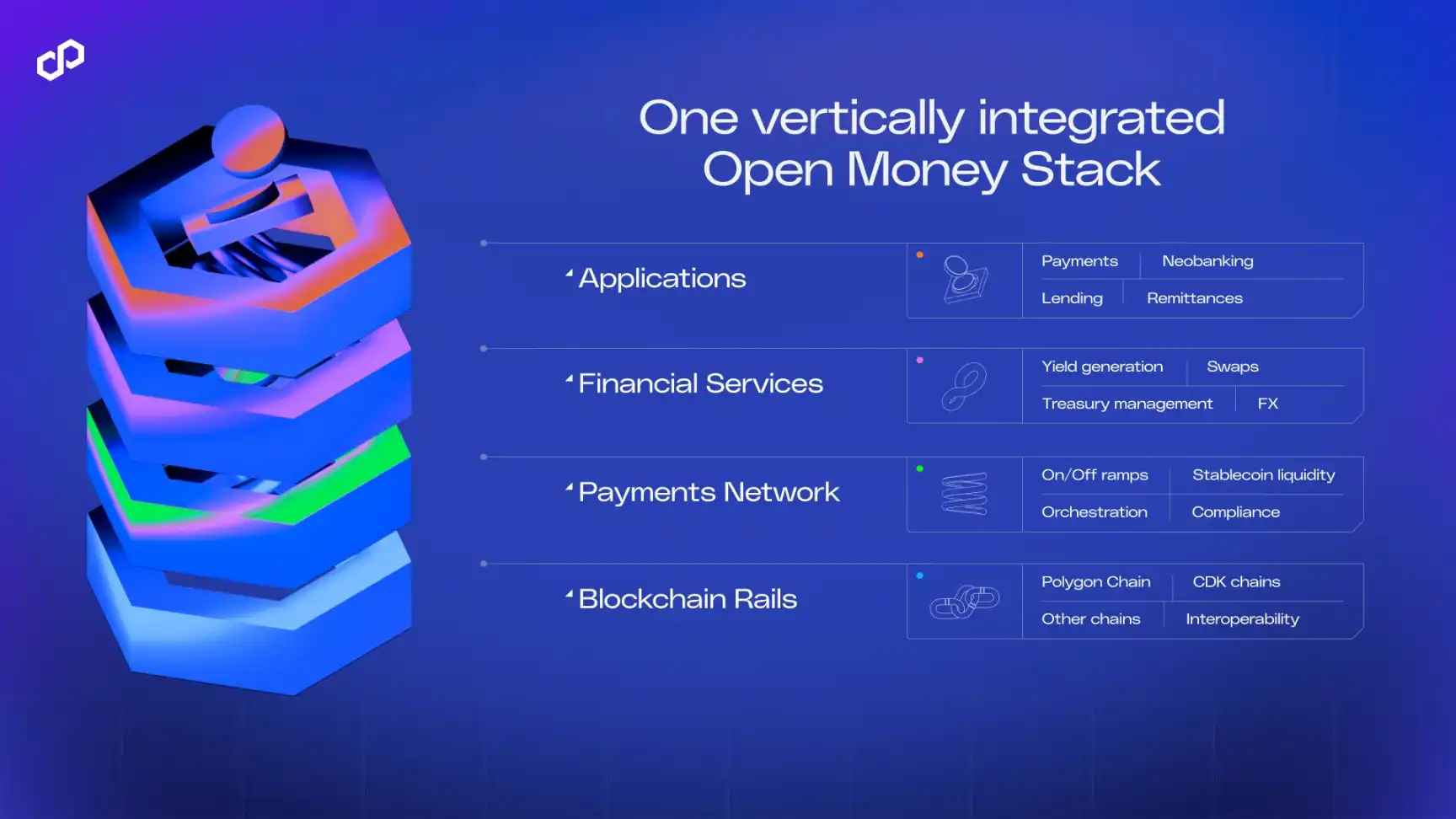
Open Money Stack | Source: Polygon Tweet

On/Off & Cash Ramps Layer: Utilizes Coinme's compliant network and U.S. regulatory licenses to enable instant cash and fiat on-ramps and off-ramps, converting physical cash or electronic fiat into stablecoins or other on-chain assets.

Wallet & Interaction Layer: Leverages Sequence's enterprise-grade smart wallets and account abstraction technology, along with one-click cross-chain transactions and cross-chain interaction capabilities, allowing end-users to receive, send, and make on-chain payments without worrying about underlying chains, gas, or intermediate assets.

Cross-Chain Interoperability Layer: Combines Sequence's Trails cross-chain orchestration engine and Polygon's interoperability protocol to make value flow between different chains completely transparent to users and support cross-chain transactions for any chain and any token.

Settlement Layer (Blockchain Rails): Relies on the Polygon network and its scaling technology to provide high-speed, low-cost, secure on-chain settlement infrastructure, enabling commercial-scale efficiency for stablecoin payments and value transfer.

Additionally, the Open Money Stack plans to integrate stablecoin orchestration with modules for compliance, identity, and yield generation, providing enterprises with payment and treasury management solutions.

L2 Competition Shifts to "Full-Stack Integration"

Polygon's $250 million acquisition reflects that the focus of competition in the L2 space is shifting from underlying technical parameters to full-stack business integration.

This path is highly consistent with the logic behind Coinbase's support for Base. The compliant entry point—acquiring Coinme—is to address the短板 (shortcoming) of fiat on-ramps and off-ramps,对标 (countering) Coinbase's CEX core advantage. For interaction experience, integrating Sequence is to lower the barrier to on-chain entry,对标 (countering) the ease of use of Coinbase Wallet (Base).

Against the backdrop of increasingly converging L2 technologies, ecosystems with compliant channels and low-barrier experiences will more easily attract incremental capital. Through this series of acquisitions, Polygon is attempting to build its own full-link moat in competition with opponents like Base, which possess native centralized advantages.


Trend Kriptolar

İlgili Sorular

QWhat is the total acquisition amount announced by Polygon Labs, and which two companies were acquired?

APolygon Labs announced a total acquisition amount exceeding $250 million for the cryptocurrency payment infrastructure company Coinme and the blockchain development platform Sequence.

QHow does the acquisition of Coinme benefit Polygon's stablecoin strategy?

AThe acquisition of Coinme provides Polygon with a series of U.S. money transmission licenses and an extensive cash network, enabling compliant integration of cash, debit cards, and on-chain assets to facilitate stablecoin payments and off-chain capital inflows.

QWhat core technologies does Sequence offer to simplify the Web3 user experience?

ASequence offers a modular stack including Smart Wallet with account abstraction for features like social recovery and gas fee abstraction, and the Trails cross-chain orchestration engine to enable seamless cross-chain transactions without user awareness of underlying complexities.

QWhat is the 'Open Money Stack' strategy that Polygon aims to build through these acquisitions?

AThe 'Open Money Stack' strategy aims to create a unified API system comprising layers for on/off ramps (using Coinme's network), wallet infrastructure (via Sequence's technology), cross-chain interoperability, and blockchain settlement, all integrated with stablecoin orchestration and compliance modules.

QHow does Polygon's acquisition approach reflect the shifting competitive focus in the L2 space?

APolygon's acquisitions indicate that L2 competition is moving from underlying technical parameters to full-stack business integration, focusing on compliant entry points and user-friendly experiences to attract incremental capital and build a comprehensive competitive moat.

İlgili Okumalar

How Does Codex Use a Computer? Three Entry Points and Permission Boundaries

This article explains the three primary methods for Codex to interact with a computer, each with distinct use cases, permission boundaries, and trust levels. **1. Computer Use:** This offers the broadest access, allowing Codex to visually control and interact with the graphical user interface of authorized macOS/Windows apps, system settings, and even iOS simulators. It's ideal for tasks lacking APIs or structured tools, such as operating legacy software or multi-app workflows. However, it's the slowest method and has the widest permission scope, requiring careful supervision for sensitive actions. **2. Chrome Extension:** This grants Codex access to the user's logged-in Chrome browser state, including cookies, profiles, and open tabs. It's best for tasks requiring user identity across websites like Gmail, LinkedIn, Salesforce, or internal dashboards. Its key advantage is multi-tab control for complex workflows. While more powerful for browser-based tasks than Computer Use, it carries higher sensitivity as actions are performed under the user's identity. **3. In-App Browser:** This is a browser isolated within the Codex thread, separate from the user's personal browsing data. It excels in web development and debugging scenarios—previewing local servers, testing responsive layouts, or annotating designs directly on the page. Its isolation is a strength for development but a limitation for tasks requiring login sessions. The core principle is to choose the narrowest, safest, and most structured interface for the task. Use plugins or MCPs first, resort to visual control (Computer Use) only for GUI-dependent tasks, employ the Chrome extension for identity-reliant browser work, and prefer the In-App Browser for isolated development. **Appshots** are clarified as a fourth, complementary tool for *inputting* context—capturing a screenshot of a window to point Codex to something—rather than a method for Codex to *act*. Together, this layered approach highlights a key to AI agent productization: not granting unlimited permissions, but constraining them within clear boundaries for specific tasks while preserving user oversight.

marsbit13 dk önce

How Does Codex Use a Computer? Three Entry Points and Permission Boundaries

marsbit13 dk önce

The "Iron Rule" of Chip Equipment Is Being Broken

For years, the semiconductor equipment industry followed an unwritten "iron rule": suppliers offered steep discounts for new tool introductions (Design-in) and faced consistent price pressure during repeat orders, especially during market downturns. This long-standing buyer's market dynamic is now being upended. Recently, SK Hynix's primary equipment suppliers have reportedly requested a 3-4% price *increase*, a nearly unprecedented move. This shift is driven by a severe supply-demand imbalance fueled by the AI compute boom. Securing equipment has become an urgent arms race as chipmakers' expansion speed dictates their ability to fulfill massive AI chip orders. Key areas feeling the strain include: **TCB (Thermal Compression Bonding) Equipment:** Demand is exploding, driven by the simultaneous needs of HBM4 memory stacking, AI chip Chip-on-Substrate (C2S), and logic Chiplet Chip-on-Wafer (C2W) packaging. Players like Hanmi Semiconductor, Hanwha Semitech, and ASMPT are receiving major orders. While hybrid bonding is seen as the future, TCB remains the pragmatic choice for HBM4 mass production, with its lifecycle extended by relaxed specifications and ongoing technological upgrades. **Test Equipment Bottlenecks:** Ironically, AI-driven shortages are now crippling test equipment manufacturing. Critical components like FPGAs, Driver ICs, and CPUs face severe shortages and extended lead times (up to 52 weeks for FPGAs), as AI data center and server vendors prioritize supply. This creates a paradoxical cycle: AI chip shortages drive fab expansion, which requires more test equipment, whose production is delayed because its key parts are diverted to make AI chips. The industry is entering a broad, AI-powered upcycle. SEMI forecasts global semiconductor equipment sales to hit a record $156 billion by 2027, fueled by investment in advanced logic/foundry, HBM-driven DRAM, and advanced packaging (like CoWoS). Major players like TSMC, SK Hynix, and Micron are aggressively ramping capital expenditure. In conclusion, leading equipment vendors are no longer just selling tools; they are selling the critical capability to deliver AI-era capacity. Pricing power is shifting decisively to those with indispensable technology in key process nodes like advanced logic, HBM, and advanced packaging, rewriting the industry's traditional power structure.

marsbit26 dk önce

The "Iron Rule" of Chip Equipment Is Being Broken

marsbit26 dk önce

İşlemler

Spot
Futures

Popüler Makaleler

T Nasıl Satın Alınır

HTX.com’a hoş geldiniz! Threshold Network Token (T) satın alma işlemlerini basit ve kullanışlı bir hâle getirdik. Adım adım açıkladığımız rehberimizi takip ederek kripto yolculuğunuza başlayın. 1. Adım: HTX Hesabınızı OluşturunHTX'te ücretsiz bir hesap açmak için e-posta adresinizi veya telefon numaranızı kullanın. Sorunsuzca kaydolun ve tüm özelliklerin kilidini açın. Hesabımı Aç2. Adım: Kripto Satın Al Bölümüne Gidin ve Ödeme Yönteminizi SeçinKredi/Banka Kartı: Visa veya Mastercard'ınızı kullanarak anında Threshold Network Token (T) satın alın.Bakiye: Sorunsuz bir şekilde işlem yapmak için HTX hesap bakiyenizdeki fonları kullanın.Üçüncü Taraflar: Kullanımı kolaylaştırmak için Google Pay ve Apple Pay gibi popüler ödeme yöntemlerini ekledik.P2P: HTX'teki diğer kullanıcılarla doğrudan işlem yapın.Borsa Dışı (OTC): Yatırımcılar için kişiye özel hizmetler ve rekabetçi döviz kurları sunuyoruz.3. Adım: Threshold Network Token (T) Varlıklarınızı SaklayınThreshold Network Token (T) satın aldıktan sonra HTX hesabınızda saklayın. Alternatif olarak, blok zinciri transferi yoluyla başka bir yere gönderebilir veya diğer kripto para birimlerini takas etmek için kullanabilirsiniz.4. Adım: Threshold Network Token (T) Varlıklarınızla İşlem YapınHTX'in spot piyasasında Threshold Network Token (T) ile kolayca işlemler yapın.Hesabınıza erişin, işlem çiftinizi seçin, işlemlerinizi gerçekleştirin ve gerçek zamanlı olarak izleyin. Hem yeni başlayanlar hem de deneyimli yatırımcılar için kullanıcı dostu bir deneyim sunuyoruz.

485 Toplam GörüntülenmeYayınlanma 2024.12.10Güncellenme 2026.06.02

T Nasıl Satın Alınır

Tartışmalar

HTX Topluluğuna hoş geldiniz. Burada, en son platform gelişmeleri hakkında bilgi sahibi olabilir ve profesyonel piyasa görüşlerine erişebilirsiniz. Kullanıcıların T (T) fiyatı hakkındaki görüşleri aşağıda sunulmaktadır.

活动图片