PIPPIN falls hard after $0.90 peak – Can bulls take back control?

ambcrypto2026-03-24 tarihinde yayınlandı2026-03-24 tarihinde güncellendi

Özet

PIPPIN's price experienced a sharp decline from its peak of $0.90, falling to around $0.0915, driven by aggressive selling pressure and long liquidations. Open Interest dropped by 40%, indicating a significant exit of speculative capital and a fragile market structure. However, the token has recently stabilized between $0.082 and $0.10, with RSI recovering from oversold levels and trading volume declining—suggesting seller exhaustion. A break above the $0.113 resistance could signal a short-term bullish reversal, potentially pushing the price toward $0.15.

Pippin’s [PIPPIN] price action reflects classic memecoin expansion followed by rapid unwinding, as momentum shifts from hype to distribution.

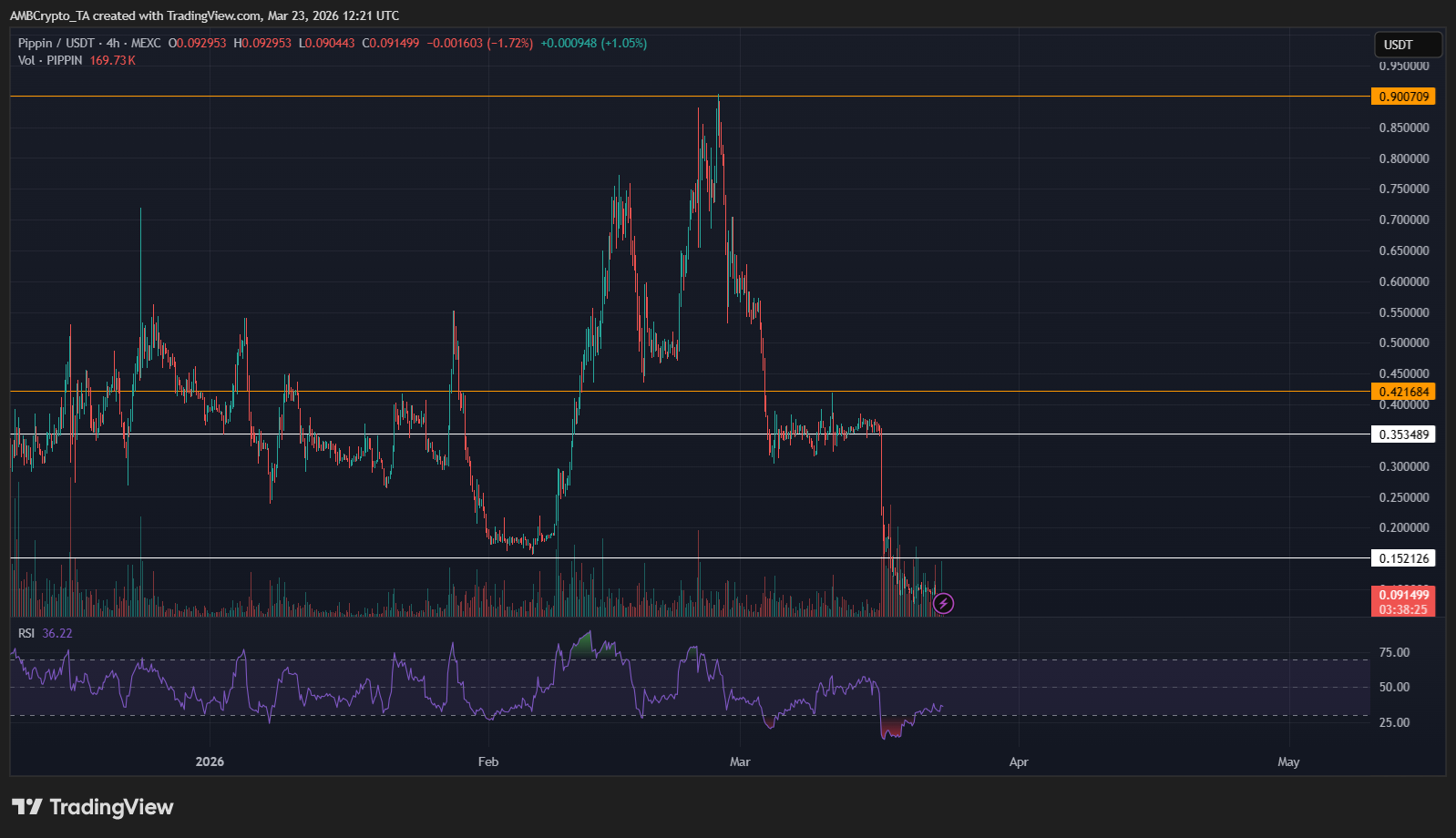
The rally from $0.20–$0.30 into the $0.90 peak shows aggressive speculative inflows, likely driven by social momentum and short-term positioning.

As the price approached $0.90, selling pressure intensified, leading to a sharp drop toward $0.15, which marked the first major profit-taking phase. This move weakened the structure, as buyers failed to sustain higher levels, allowing momentum to fade.
Source: TradingView

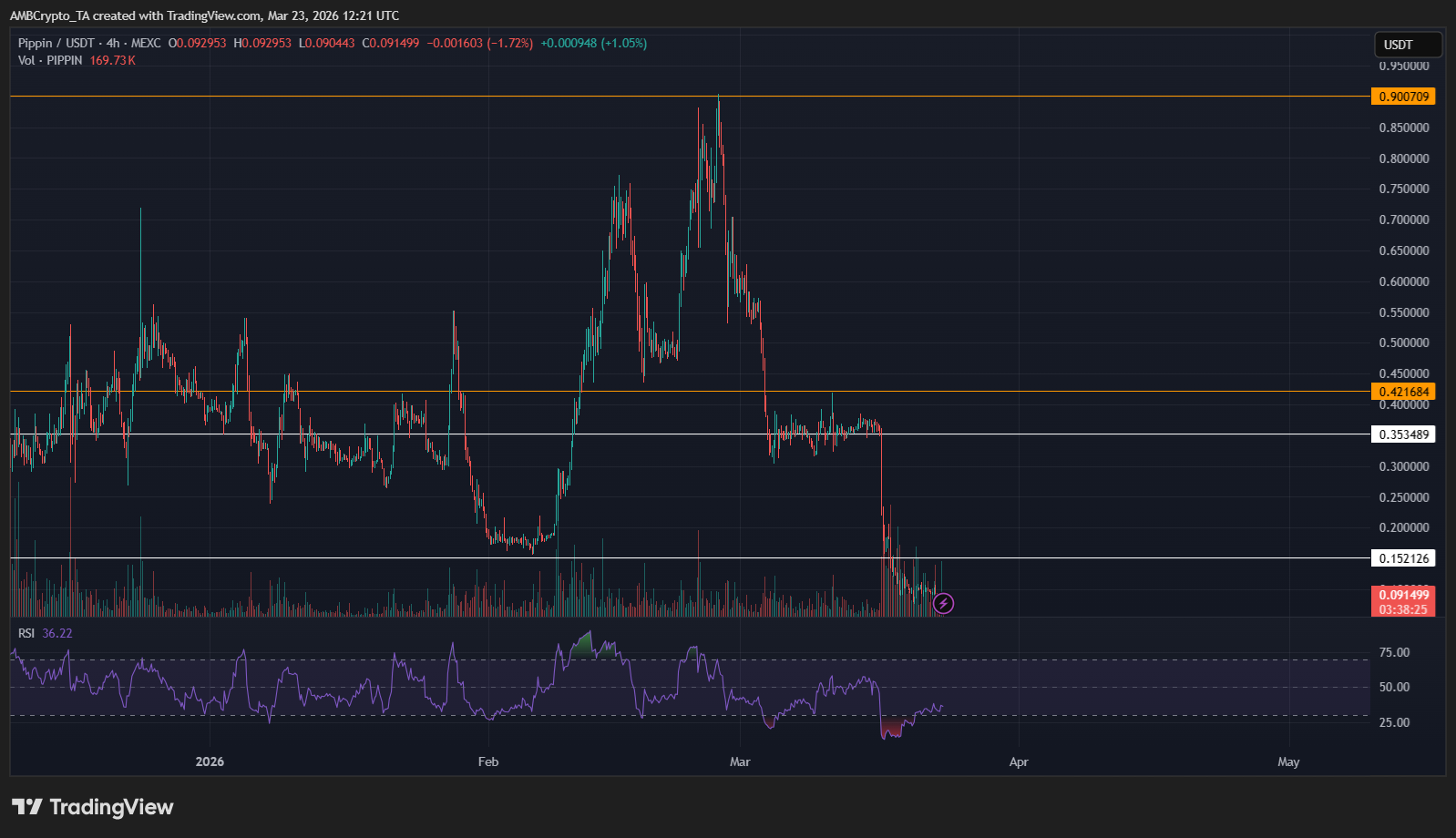
Price then consolidated briefly before breaking below $0.15, accelerating downside toward $0.0915, now acting as immediate support. RSI near 36 confirms bearish momentum, yet it is not fully oversold, which leaves room for further downside.

This decline reflects liquidity exit and fading demand, as speculative capital rotates out quickly. If $0.0915 fails, price may extend toward $0.05–$0.07, reinforcing a fragile, sentiment-driven structure.

Long liquidations accelerate as PIPPIN’s structure weakens

As price breaks below $0.15 and accelerates toward $0.0915, derivatives positioning confirms that the decline is driven by forced unwinding rather than fresh bearish bets.

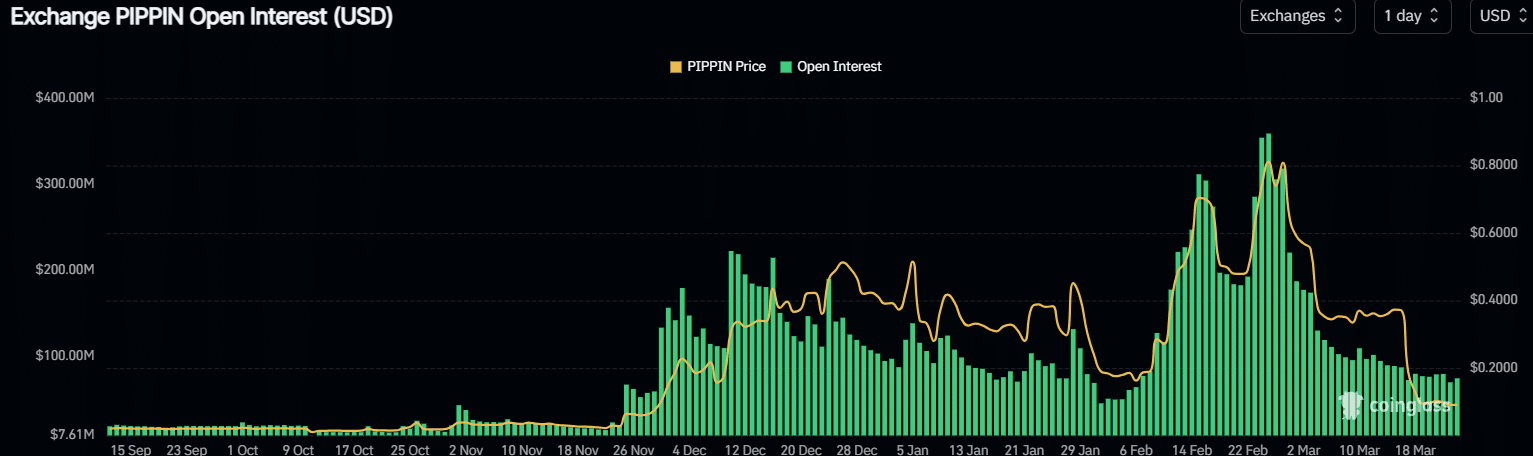
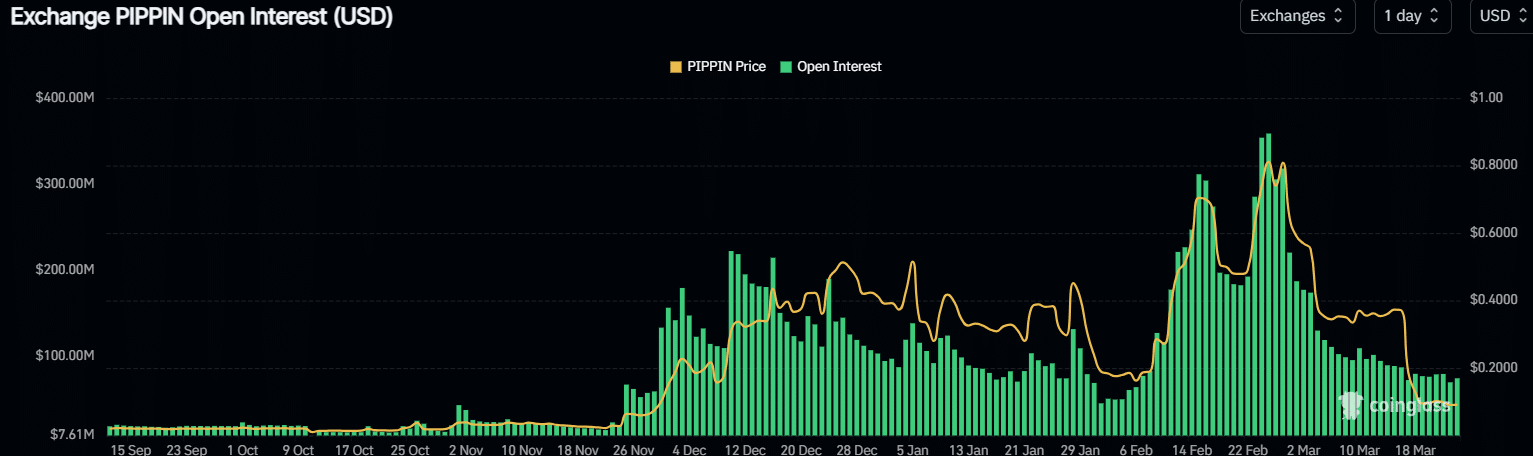
Open Interest contracted to 74.14 million, dropping 12% in 24 hours and nearly 40% across major venues, which shows traders are closing positions instead of adding exposure.
Source: CoinGlass

This shift reflects a long unwind phase, where overleveraged participants exit as losses mount, amplifying downside pressure. At the same time, Funding Rates remained positive near 0.05%, which revealed that some longs still held positions, expecting a rebound despite weakening structure.

As liquidations increased, long-side wipes dominated, contributing to cascading sell pressure and reinforcing the breakdown. This imbalance highlights a fragile market, where liquidity thins as participants retreat.

With conviction fading and capital exiting, the structure becomes hollow, meaning price lacks strong support. Until Open Interest stabilizes and funding normalizes, the market remains vulnerable to further downside or sharp volatility spikes.

Short-term strength builds as PIPPIN finds a floor

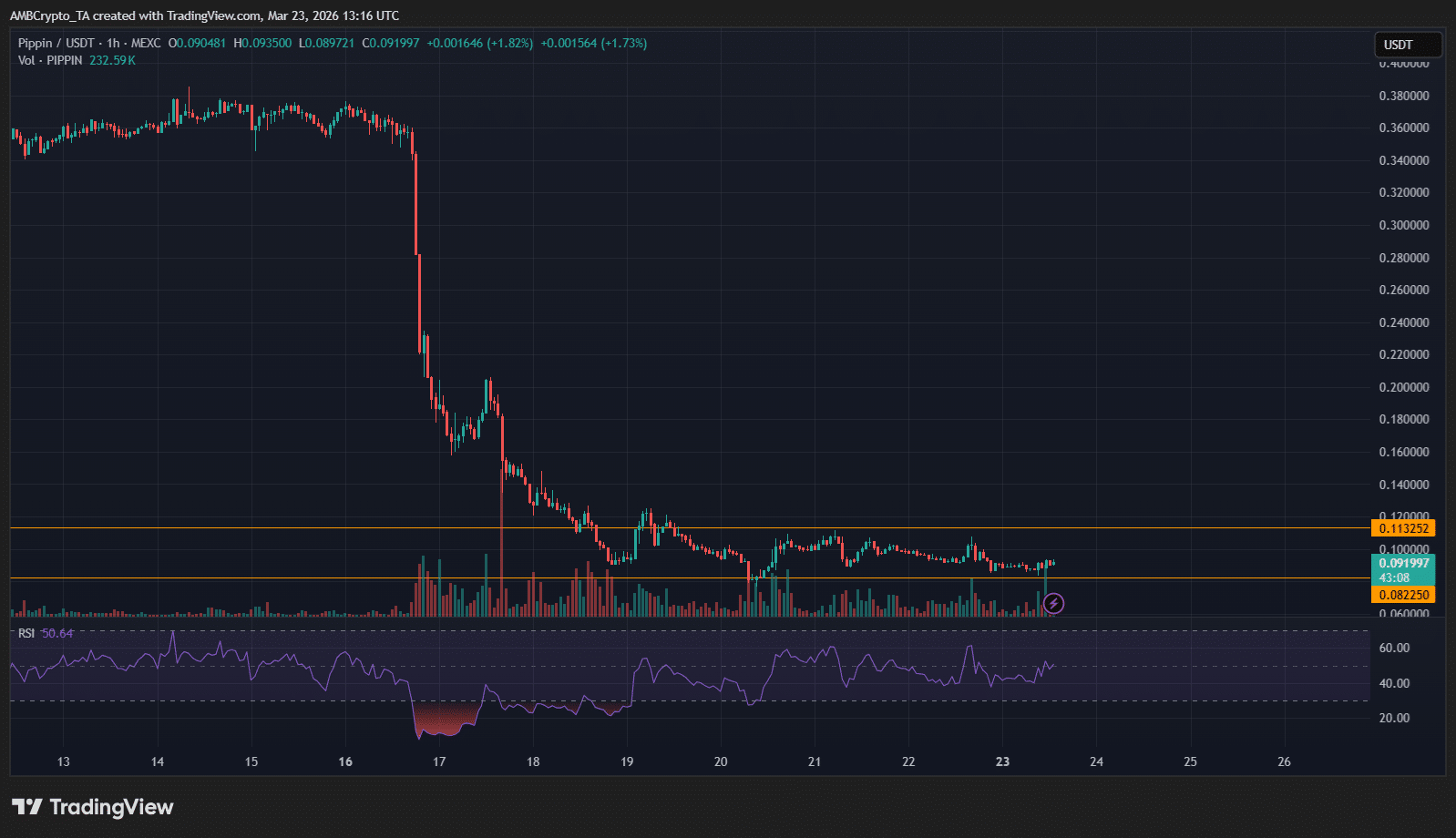
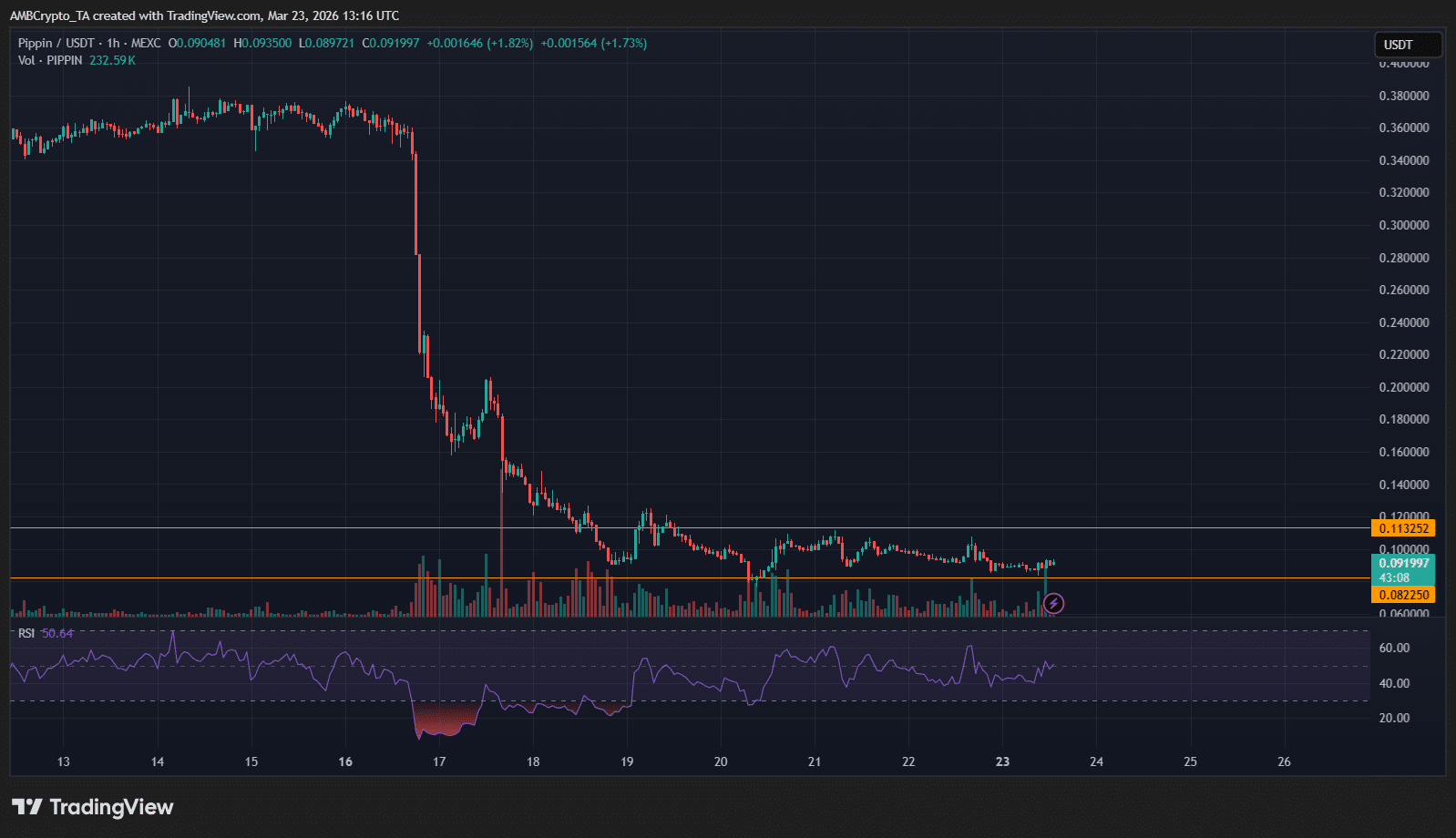
After the sharp breakdown, price began stabilizing between $0.082 and $0.10, forming a clear short-term floor. As lower lows disappeared, buyers gradually absorbed remaining sell pressure, shifting structure from decline to accumulation.

The RSI recovered from oversold levels below 20 to around 50.6, signaling improving momentum as buying strength starts matching selling pressure. This transition suggests that short-term control is slowly rotating back toward bulls.
Source: TradingView

At the same time, volume declines noticeably compared to the crash on the 17th of March, indicating seller exhaustion as aggressive dumping fades. With fewer sellers, smaller buy orders can now influence price more effectively.

Price tightens below the $0.113 resistance, creating a compression range. If this level breaks, momentum could accelerate toward $0.15, confirming a short-term reversal structure.


Final Summary

  • PIPPIN’s collapse from $0.90 to $0.0915, driven by long liquidations and a 40% Open Interest drop signals liquidity exit and fragile structure.
  • PIPPIN stabilization between $0.082 and $0.10 with RSI recovery and declining volume suggests seller exhaustion, positioning for short-term rebound if $0.113 breaks.


Trend Kriptolar

İlgili Sorular

QWhat was the peak price of PIPPIN and what does its subsequent drop to $0.0915 indicate?

APIPPIN reached a peak price of $0.90. The subsequent sharp drop to $0.0915 indicates a classic memecoin pattern of rapid unwinding, driven by profit-taking, long liquidations, and a significant exit of speculative capital, revealing a fragile market structure.

QHow did Open Interest and Funding Rates change during PIPPIN's decline, and what does this suggest about market sentiment?

AOpen Interest contracted by 12% in 24 hours and nearly 40% across major venues, indicating traders were closing positions rather than adding new exposure. Despite this, Funding Rates remained slightly positive at 0.05%, suggesting some longs were still holding, hoping for a rebound, but the overall sentiment was weak with capital exiting.

QWhat key support level is PIPPIN currently testing, and what is the significance of a break below it?

APIPPIN is testing immediate support at $0.0915. A break below this level could lead to a further decline toward the $0.05–$0.07 range, reinforcing the fragile, sentiment-driven nature of its market structure.

QWhat signs suggest that PIPPIN might be forming a short-term bottom and a potential rebound?

ASigns of a short-term bottom include price stabilization between $0.082 and $0.10, the RSI recovering from oversold levels (20) to around 50.6, and a noticeable decline in trading volume indicating seller exhaustion. A break above the $0.113 resistance could confirm a short-term reversal.

QWhat was the primary driver behind the cascading sell pressure during PIPPIN's price crash?

AThe cascading sell pressure was primarily driven by long liquidations, where overleveraged participants were forced to exit their positions as losses mounted. This created a cycle of amplified downside pressure and contributed to the rapid breakdown in price.

İlgili Okumalar

My Coding Betting Dashboard is Profiting, but Polymarket is Truly Not a Good Place for 'Arbitrage'

The author built a custom monitoring dashboard for Polymarket, a prediction market platform, and tested it with $1,600, achieving over 30% returns. However, the core argument is that Polymarket is not a good venue for traditional arbitrage. The dashboard has two main sections: a "Portfolio Dashboard" for tracking active positions with key metrics like total capital, P&L, and a risk-control module using a tier system (T1, T2, T3), and an "Opportunity Watchlist" for monitoring markets. The article details a critical structural trap in binary markets: a bet with a high perceived probability of success still carries a 100% loss risk if wrong. The author's T1/T2/T3 system is designed to manage this by limiting position sizes based on conviction and time horizon, emphasizing that high confidence should not equal high concentration. A key insight is the danger of "pseudo-diversification"—betting on different markets driven by the same underlying variable. The author concludes that Polymarket offers few true low-risk, arbitrage opportunities. It is instead a high-risk environment where wins can create a false sense of mastery, leading to large losses. The platform is better viewed as a training ground for honing judgment through disciplined, framework-driven betting rather than a reliable income source. The tools help transform intuition into structured, rule-based decisions to mitigate the risk of catastrophic errors.

marsbit8 dk önce

My Coding Betting Dashboard is Profiting, but Polymarket is Truly Not a Good Place for 'Arbitrage'

marsbit8 dk önce

WeChat AI Card Hands-On Guide: Has the AI Shopping Era Arrived?

**"WeChat AI Card" Practical Test Guide: Has the Era of AI Shopping Arrived?** WeChat has officially launched the "AI Exclusive Card," a feature integrated into its Workbuddy AI assistant. This card is designed to handle payments for AI-initiated purchases. Our hands-on test reveals it's not yet a tool for fully autonomous AI shopping, but rather a controlled payment layer for AI agents. The AI Card functions as an isolated sub-wallet within WeChat Pay. Users must bind the card and transfer funds into it from their main wallet. Crucially, every transaction requires explicit user confirmation via smartphone scan; AI cannot spend autonomously. Currently accessible through the Workbuddy agent, the card targets specific digital consumption scenarios: purchasing paid content (reports, data), calling paid APIs/tools, and subscribing to services. Its design prioritizes security and control by separating funds and mandating approval for each payment. We tested a real-world scenario: ordering bubble tea via Workbuddy using a "Meituan Life Assistant" skill. The process encountered multiple hurdles: high "skill" usage costs (exceeding daily free credits), and most importantly, while a payment was successfully initiated, the AI purchased an incorrect product (a mismatched group-buy coupon instead of the desired drink). This highlights the current limitation: the **AI Card only solves the payment step**. The broader challenge lies in the **AI agent's execution chain**—accurately understanding intent, navigating third-party platforms, selecting the right product, and ensuring proper fulfillment. The payment succeeded, but the purchase failed to meet the user's need. In conclusion, the WeChat AI Exclusive Card is a cautious, early-step experiment in AI commerce. It provides a secure, user-controlled payment method for agent interactions but is not yet capable of reliable, end-to-end complex purchases. For now, it's best used for low-value, low-risk digital services with careful user verification at each step. The vision of AI handling complete shopping tasks remains a work in progress.

marsbit2 saat önce

WeChat AI Card Hands-On Guide: Has the AI Shopping Era Arrived?

marsbit2 saat önce

Deconstructing Notion's Growth: From a Note-taking Tool to 100 Million Users—How Notion Built a Triple Growth Flywheel Through Product, Templates, and Community

Notion's growth from a niche note-taking tool to a platform with 100 million users is powered by three interconnected flywheels: Product-Led Growth (PLG), a Template Economy, and Community-Driven Growth. First, Notion's PLG strategy relies on a highly flexible, "plastic" product that users can adapt to countless personal and team workflows. Its freemium model lowers the barrier to entry, while features like page sharing and collaboration drive organic, usage-based viral growth as users naturally invite others. Second, the Template Economy solves the "blank page" problem. Templates, created by both Notion and its community, transform abstract product capabilities into concrete, copyable solutions for specific scenarios (e.g., project management, content calendars). This dramatically lowers activation costs for new users and fuels SEO-driven discovery. Third, a vibrant Community acts as a distributed growth engine. Users and official Ambassadors create tutorials, share use cases, and host local events. This community not only educates users but also fosters a sense of identity around pursuing "better ways of working," strengthening loyalty and enabling global, low-cost expansion. Together, these flywheels create a self-reinforcing ecosystem: a great product attracts users who create templates and community content, which in turn attracts more users and deepens engagement. This system allowed Notion to scale from individuals to teams and enterprises through a bottom-up adoption path. Looking ahead, AI integration promises to accelerate these flywheels further by making templates smarter and the platform a potential AI-native work operating system. Ultimately, Notion's defensible advantage is not just its features, but this deeply entrenched network of user assets, creators, and community trust.

marsbit2 saat önce

Deconstructing Notion's Growth: From a Note-taking Tool to 100 Million Users—How Notion Built a Triple Growth Flywheel Through Product, Templates, and Community

marsbit2 saat önce

$10 Billion, Qualcomm to Acquire Chip Legend Jim Keller's Company

Global mobile chip giant Qualcomm is in advanced talks to acquire AI chip startup Tenstorrent in a deal valued between $8-10 billion, according to media reports. This potential acquisition would be one of the largest in the AI chip sector in recent years. Tenstorrent, led by legendary chip architect Jim Keller, has gained prominence for its RISC-V architecture and AI accelerator designs. The move highlights Qualcomm's strategic push to diversify beyond its core smartphone chip business. As the smartphone market matures, Qualcomm is aggressively targeting growth in automotive, data center, and cloud AI. Acquiring Tenstorrent would allow Qualcomm to rapidly enter the high-end AI computing market, bypassing lengthy in-house development cycles. Tenstorrent's cost-effective system architecture, which avoids expensive HBM memory and relies on standard Ethernet for clustering, offers a potential alternative to Nvidia's costly solutions. Furthermore, Tenstorrent's high-performance RISC-V CPU technology and its focus on the automotive and edge computing segments align with Qualcomm's strategic goals, including its "Snapdragon Digital Chassis" platform. Despite the strategic rationale, the high valuation has sparked some investor caution. The successful integration of Tenstorrent's open-source culture and independent team into Qualcomm's organization, along with the commercialization of its technology, remains a key challenge.

marsbit3 saat önce

$10 Billion, Qualcomm to Acquire Chip Legend Jim Keller's Company

marsbit3 saat önce

CARDS' Brutal Truth of $535M FDV: Only $43M Net Revenue, Profit Margin Halved

The article deconstructs Collector Crypt (CC), a blockchain-based platform for trading tokenized collectible cards, revealing a significant disparity between its high volume and actual business fundamentals. Key findings include: * CC's cumulative revenue of $635M is misleading; 90.6% is instantly returned to users via card buybacks, leaving only $43M in net revenue (6.7% retention). * Trading activity is minimal, with real secondary market trading below $5M. eBay sales as a percentage of volume have declined for six consecutive quarters. * The platform's user base is highly concentrated, with a few dozen high-frequency wallets driving most of the volume, resembling a "casino" with ~420 daily active players. * As volume shifts to higher-priced card packs, the net profit margin has halved from 11.2% to 5.8%. * Token value capture (via burns and buybacks) totals only $1.4M, just 3.4% of net revenue. Meanwhile, operational wallets have off-ramped $45.7M in USDC. * With a Fully Diluted Valuation (FDV) of ~$535M, the token trades at 7.3x net revenue. The float is only 20.5%, with 72% of the supply allocated to insiders and locked until November 2027. The analysis concludes that while CC has found product-market fit as a high-speed gacha machine, it shows little evidence of evolving into a sustainable collector's marketplace, with minimal value accruing to its CARDS token.

marsbit3 saat önce

CARDS' Brutal Truth of $535M FDV: Only $43M Net Revenue, Profit Margin Halved

marsbit3 saat önce

İşlemler

Spot
Futures

Popüler Makaleler

PIPPIN Nasıl Satın Alınır

HTX.com’a hoş geldiniz! pippin (PIPPIN) satın alma işlemlerini basit ve kullanışlı bir hâle getirdik. Adım adım açıkladığımız rehberimizi takip ederek kripto yolculuğunuza başlayın. 1. Adım: HTX Hesabınızı OluşturunHTX'te ücretsiz bir hesap açmak için e-posta adresinizi veya telefon numaranızı kullanın. Sorunsuzca kaydolun ve tüm özelliklerin kilidini açın. Hesabımı Aç2. Adım: Kripto Satın Al Bölümüne Gidin ve Ödeme Yönteminizi SeçinKredi/Banka Kartı: Visa veya Mastercard'ınızı kullanarak anında pippin (PIPPIN) satın alın.Bakiye: Sorunsuz bir şekilde işlem yapmak için HTX hesap bakiyenizdeki fonları kullanın.Üçüncü Taraflar: Kullanımı kolaylaştırmak için Google Pay ve Apple Pay gibi popüler ödeme yöntemlerini ekledik.P2P: HTX'teki diğer kullanıcılarla doğrudan işlem yapın.Borsa Dışı (OTC): Yatırımcılar için kişiye özel hizmetler ve rekabetçi döviz kurları sunuyoruz.3. Adım: pippin (PIPPIN) Varlıklarınızı Saklayınpippin (PIPPIN) satın aldıktan sonra HTX hesabınızda saklayın. Alternatif olarak, blok zinciri transferi yoluyla başka bir yere gönderebilir veya diğer kripto para birimlerini takas etmek için kullanabilirsiniz.4. Adım: pippin (PIPPIN) Varlıklarınızla İşlem YapınHTX'in spot piyasasında pippin (PIPPIN) ile kolayca işlemler yapın.Hesabınıza erişin, işlem çiftinizi seçin, işlemlerinizi gerçekleştirin ve gerçek zamanlı olarak izleyin. Hem yeni başlayanlar hem de deneyimli yatırımcılar için kullanıcı dostu bir deneyim sunuyoruz.

537 Toplam GörüntülenmeYayınlanma 2025.01.11Güncellenme 2026.06.02

PIPPIN Nasıl Satın Alınır

Tartışmalar

HTX Topluluğuna hoş geldiniz. Burada, en son platform gelişmeleri hakkında bilgi sahibi olabilir ve profesyonel piyasa görüşlerine erişebilirsiniz. Kullanıcıların PIPPIN (PIPPIN) fiyatı hakkındaki görüşleri aşağıda sunulmaktadır.

活动图片