Pharos Establishes RealFi Alliance to Promote Institutional-Grade On-Chain Execution Standardization for RWA

marsbit2026-02-23 tarihinde yayınlandı2026-02-23 tarihinde güncellendi

Özet

Pharos Network has launched the RealFi Alliance, a strategic ecosystem initiative aimed at unifying institutional asset issuers, financial infrastructure providers, and on-chain builders. The alliance seeks to standardize and scale the execution framework for real-world assets (RWA), moving beyond isolated pilots. Founding members include Chainlink, Asseto Finance, Ember, Faroo, LayerZero, R25, Re7 Labs, TopNod, and Centrifuge. The alliance addresses systemic issues like fragmented liquidity, inconsistent infrastructure standards, and regulatory disconnects by creating a unified operational layer where RWAs remain active, composable, and capable of supporting institutional workflows. It operates on four core pillars: Asset Enablement (bringing real-world value on-chain securely), Infrastructure & Compliance (leveraging Pharos’s parallel execution and built-in compliance modules), Liquidity & Utility (designing clear functional use cases like staking and yield mechanisms), and Market Transparency (establishing trust through clear risk and return benchmarks). Pharos CEO Wish Wu emphasized that the goal is to create a unified environment for assets to operate at scale with institutional reliability. The upcoming Pharos mainnet will launch as a ready-to-use financial environment with integrated liquidity and compliance standards. The alliance plans to expand in structured batches, selecting new members based on asset quality, technical maturity, and ecosystem synergy. Pharos i...

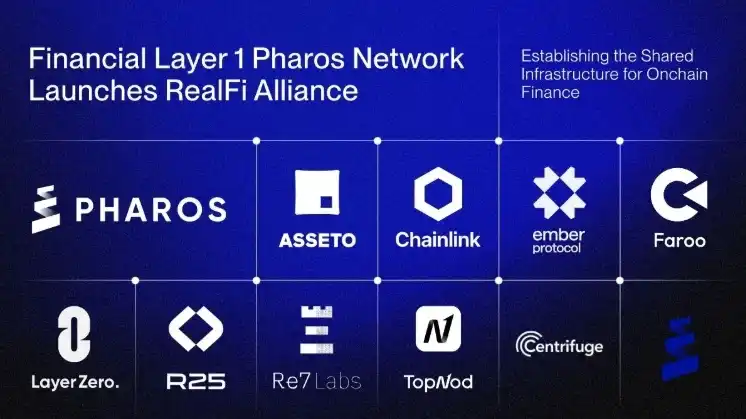
Pharos Network, a financial-grade Layer 1 public chain, today announced the establishment of the RealFi Alliance, a strategic ecosystem initiative aimed at uniting institutional-grade asset issuers, financial infrastructure providers, and on-chain builders. The alliance's goal is to advance the real-world asset (RWA) market from isolated pilot phases to a standardized, scalable, and executable operational framework. The inaugural members of the RealFi Alliance include: Chainlink, Asseto Finance, Ember, Faroo, LayerZero, R25, Re7 Labs, TopNod, and Centrifuge.

The RealFi Alliance aims to address systemic friction issues such as liquidity fragmentation, inconsistent infrastructure standards, and regulatory disconnects by coordinating assets and capital under a unified framework. Rather than viewing real-world assets (RWA) as static tokens, the alliance sees RealFi as a foundational financial infrastructure layer that keeps assets active, composable on-chain, and capable of supporting institutional-grade business processes at any time. The inaugural members form the core foundation of RealFi on Pharos, ensuring that the network has real-world partners building and implementing on it from the moment it enters the market.

The alliance operates under a framework of four core pillars designed to ensure long-term adoption and systemic robustness. Central to this initiative is Asset Enablement, focusing on bringing real-world value on-chain in a secure and composable form and optimizing its capacity for continuous participation. This foundation is further strengthened by rigorous infrastructure and compliance alignment, leveraging Pharos's deep parallel execution architecture and built-in compliance modules to meet the highest institutional security standards. To bridge the gap between asset issuance and practical use, the alliance prioritizes liquidity and utility design, creating clear functional pathways for assets through mechanisms like staking, yield, and application integration. The collaboration between Ember and Re7 Labs exemplifies this philosophy—embedding institutional-grade risk management and vault curation capabilities directly into the asset lifecycle. Finally, by establishing market transparency and clear benchmarks for risk and return sources, the alliance builds the necessary foundation of trust for sophisticated capital allocators to participate at scale within the ecosystem.

Wish Wu, Co-founder and CEO of Pharos Network, stated: "The core challenge in today's on-chain finance is not a lack of assets, but the absence of a unified environment where these assets can operate at scale. The RealFi Alliance is our commitment to building that environment. By aligning with industry-standard oracle platforms like Chainlink and specialized asset operators, we ensure that real value can flow on-chain with institutional-grade reliability."

This strategic synergy ensures that the upcoming Pharos mainnet will launch as a 'ready-to-use' financial environment with integrated liquidity and compliance standards. Moving forward, the RealFi Alliance will expand in structured batches, with new members selected based on asset quality, technical maturity, and ecosystem synergy. This long-term development path ensures that as the Pharos ecosystem matures, the quality and utility of its underlying assets remain industry-leading.

About Pharos Network

Pharos is an inclusive financial Layer 1 for RealFi, where real value and institutional-grade assets circulate on-chain and can be composably integrated with decentralized assets, serving as the next generation of financial-grade infrastructure for global finance. Pharos combines a modular architecture, deep parallel execution mechanism, and built-in compliance modules to power an asset-native ecosystem. The project is built by a team of management and engineering veterans from Ant Group and is backed by global investment firms such as Hack VC and Faction VC.


Trend Kriptolar

İlgili Sorular

QWhat is the main goal of the RealFi Alliance announced by Pharos Network?

AThe main goal of the RealFi Alliance is to advance the real-world asset (RWA) market from isolated pilot phases to a standardized, scalable, and executable operational framework by uniting institutional-grade asset issuers, financial infrastructure providers, and on-chain builders.

QWhich companies are among the founding members of the RealFi Alliance?

AThe founding members of the RealFi Alliance include Chainlink, Asseto Finance, Ember, Faroo, LayerZero, R25, Re7 Labs, TopNod, and Centrifuge.

QWhat are the four core pillars that the RealFi Alliance operates on?

AThe four core pillars are: Asset Enablement (bringing real-world assets on-chain), Infrastructure & Compliance Alignment (leveraging Pharos's architecture for institutional security), Liquidity & Utility Design (creating functional pathways for assets), and Market Transparency & Trust (building a foundation for mature capital allocators).

QAccording to Wish Wu, what is the core challenge facing on-chain finance today?

AWish Wu stated that the core challenge is not a lack of assets, but the absence of a unified environment that allows these assets to operate at scale.

QWhat is the background of the team behind Pharos Network, and which investors support it?

AThe project is built by a team of management and engineers from Ant Group and is backed by global investment firms such as Hack VC and Faction VC.

İlgili Okumalar

Can Generative Models Finally Be Trained End-to-End? The Core Is a For Loop

This article introduces a novel training paradigm for generative models called Explorative Modeling (XM), which enables true end-to-end training. Traditionally, powerful generative models like autoregressive and diffusion models are not trained end-to-end. They are trained to predict a single small step but require iterative multi-step sampling for inference. This "exposure bias" leads to error accumulation and limits performance. The core challenge XM addresses is "mode blurring." In generative tasks, a single input (e.g., "generate a dog") corresponds to many valid outputs (multiple modes). Standard training objectives like reconstruction loss force the model to average these modes, producing unrealistic, blurry outputs. To avoid this, existing models break generation into many small, almost deterministic steps, sacrificing end-to-end training. XM tackles this by restructuring the training loop itself. Its key insight is to amplify "generative expressivity." For each training input, instead of generating one sample, the model generates K candidate outputs. Only the candidate closest to the real data is used for computing the loss and updating the model via backpropagation. This simple "best-of-K" mechanism is implemented as a short for-loop. By exploring multiple possibilities, the model learns to distribute its guesses across different modes rather than collapsing to their uninformative average. The paper demonstrates that "exploration" acts as a new, powerful scaling axis. Gains from XM increase with model size, data scale, and compute. Experiments show improvements in FID scores for image generation and significant efficiency gains, sometimes outperforming larger models without exploration. When pushed to the limit, XM enables fully single-step, end-to-end generative models. In robotics tasks, an "Explorative Policy" matched the performance of a 100-step Diffusion Policy with a single forward pass, drastically improving inference speed. While the best-of-K concept is not entirely new, the authors' contribution lies in formally understanding it as a direct method to boost generative expressivity without fragmenting the generation process. This work suggests that as models scale, enhancing exploration during training may become crucial for overcoming fundamental performance bottlenecks.

marsbit49 dk önce

Can Generative Models Finally Be Trained End-to-End? The Core Is a For Loop

marsbit49 dk önce

Annual Salary of Millions Competing for Electricians, Meta Rushes to Open Its Own Technical School

The AI boom is facing an unexpected bottleneck: a severe shortage of skilled construction workers and electricians. As tech giants like Meta, OpenAI, and Alphabet race to build massive data centers—such as OpenAI's $16 billion "Stargate" project—they are hitting a critical labor wall. The U.S. needs an estimated 130,000 more electricians, 240,000 construction workers, and 150,000 supervisors by 2030 for AI infrastructure alone, but tens of thousands of electrician jobs go unfilled each year. While AI companies offer high premiums, with electricians earning up to $280,000 annually, worker scarcity still causes massive losses—delays on a single project can cost $14.2 million per month. The complexity of building AI data centers, which require immense power (equivalent to powering hundreds of thousands of homes), sophisticated electrical systems, and advanced liquid cooling solutions, demands highly skilled technicians who are in short supply. To combat this, companies are investing heavily in training. Meta has committed $115 million to a free training school offering tuition, housing, and stipends, targeting 5,000 new workers. OpenAI is partnering with unions to secure skilled labor. These efforts are paying off, with a significant rise in Gen Z interest in trade schools over college. However, the power demands are staggering. AI data centers are driving a rapid surge in electricity consumption, projected to account for up to 12% of U.S. power use by 2028 and raising costs for consumers. Furthermore, the construction boom is project-based, leading to a potential future glut of trained workers once building peaks, which could depress wages industry-wide. The race for AI supremacy now depends as much on skilled hands as on advanced chips.

marsbit2 saat önce

Annual Salary of Millions Competing for Electricians, Meta Rushes to Open Its Own Technical School

marsbit2 saat önce

İşlemler

Spot

Popüler Makaleler

LAYER Nasıl Satın Alınır

HTX.com’a hoş geldiniz! Solayer (LAYER) satın alma işlemlerini basit ve kullanışlı bir hâle getirdik. Adım adım açıkladığımız rehberimizi takip ederek kripto yolculuğunuza başlayın. 1. Adım: HTX Hesabınızı OluşturunHTX'te ücretsiz bir hesap açmak için e-posta adresinizi veya telefon numaranızı kullanın. Sorunsuzca kaydolun ve tüm özelliklerin kilidini açın. Hesabımı Aç2. Adım: Kripto Satın Al Bölümüne Gidin ve Ödeme Yönteminizi SeçinKredi/Banka Kartı: Visa veya Mastercard'ınızı kullanarak anında Solayer (LAYER) satın alın.Bakiye: Sorunsuz bir şekilde işlem yapmak için HTX hesap bakiyenizdeki fonları kullanın.Üçüncü Taraflar: Kullanımı kolaylaştırmak için Google Pay ve Apple Pay gibi popüler ödeme yöntemlerini ekledik.P2P: HTX'teki diğer kullanıcılarla doğrudan işlem yapın.Borsa Dışı (OTC): Yatırımcılar için kişiye özel hizmetler ve rekabetçi döviz kurları sunuyoruz.3. Adım: Solayer (LAYER) Varlıklarınızı SaklayınSolayer (LAYER) satın aldıktan sonra HTX hesabınızda saklayın. Alternatif olarak, blok zinciri transferi yoluyla başka bir yere gönderebilir veya diğer kripto para birimlerini takas etmek için kullanabilirsiniz.4. Adım: Solayer (LAYER) Varlıklarınızla İşlem YapınHTX'in spot piyasasında Solayer (LAYER) ile kolayca işlemler yapın.Hesabınıza erişin, işlem çiftinizi seçin, işlemlerinizi gerçekleştirin ve gerçek zamanlı olarak izleyin. Hem yeni başlayanlar hem de deneyimli yatırımcılar için kullanıcı dostu bir deneyim sunuyoruz.

440 Toplam GörüntülenmeYayınlanma 2025.02.11Güncellenme 2026.06.02

LAYER Nasıl Satın Alınır

Tartışmalar

HTX Topluluğuna hoş geldiniz. Burada, en son platform gelişmeleri hakkında bilgi sahibi olabilir ve profesyonel piyasa görüşlerine erişebilirsiniz. Kullanıcıların LAYER (LAYER) fiyatı hakkındaki görüşleri aşağıda sunulmaktadır.

活动图片