Peter Todd Warns Zcash Tech Is Too Risky For Bitcoin Privacy Push

bitcoinist2026-06-05 tarihinde yayınlandı2026-06-05 tarihinde güncellendi

Özet

Bitcoin developer Peter Todd opposes integrating Zcash-style privacy features into Bitcoin's consensus layer, arguing the cryptographic risk is too high. His comments followed a disclosed issue in Zcash's Orchard shielded pool, sparking a debate on privacy, auditability, and Bitcoin's resistance to change (ossification). Todd distinguishes Bitcoin's transparent ledger, where bugs like the 2010 overflow were visible and reversible, from shielded systems where privacy could hide counterfeit coins or supply destruction, making detection and rollbacks difficult. While critics noted Bitcoin's own history of bugs, Todd countered that these didn't pose the same existential risk. He emphasized that with a significant portion of ZEC already shielded, a hidden bug could devastate user holdings without easy recovery. The discussion highlights the trade-off between advanced privacy and systemic risk in a base protocol.

Bitcoin developer Peter Todd has pushed back against calls to bring Zcash-style privacy into Bitcoin’s consensus layer, arguing that the cryptographic risk profile is too high for the network’s base protocol. The debate erupted after ZODL developers disclosed an issue affecting the Orchard shielded pool, briefly turning a technical incident into a broader argument over privacy, auditability, and Bitcoin ossification.

Todd’s initial post was direct: “Why adding Zcash style privacy to Bitcoin at the consensus layer is a bad idea.” He was responding to a post from Zcash Open Development Lab, which said a “coordinated Zcash network upgrade” was underway after an issue affecting the Zcash Orchard pool was identified during routine auditing and security review processes.

Why Peter Todd Sounds Alarm On Zcash-Style Privacy

The exchange quickly widened beyond ZEC itself. One user argued that Bitcoin has its own history of critical bugs, pointing to the 2010 value overflow incident and the 2013 chain split as evidence that “no protocol is exempt from tech issues.” The same post accused Bitcoin maximalists of pushing for “total ossification” while facing future threats such as quantum computing.

Todd answered by drawing a distinction between visible and hidden failures. “Exactly my point. With Bitcoin, rolling back the chain is feasible, as only a small subset of coins were affected, and the exploit was trivial to notice,” he wrote. His argument was not that Bitcoin is bug-free, but that its accounting model makes certain classes of catastrophic bugs easier to detect and unwind.

That point became the core of the disagreement. When another user argued that rejecting consensus-layer privacy on bug-risk grounds would “stop any innovation/development,” Todd responded that not all cryptography carries the same operational risk. “Different types of cryptography have different levels of risk to them. Zcash-style cryptography has a very high level of risk, much more so than Bitcoin’s cryptography. Which is reflected in how Zcash has had much more serious issues than Bitcoin.”

The counterargument was that Bitcoin itself has suffered serious early failures. One participant cited the 2010 value overflow incident and the 2018 bug, CVE-2018-17144, as examples that challenged Todd’s framing. Todd rejected the comparison, saying neither case put the currency at the same kind of existential risk.

“Neither of those exploits had any chance of destroying the currency,” Todd wrote. “Exactly what coins were counterfeit was trivially visible, allowing easy rollbacks. Not so with Zcash.”

The disagreement turns on a specific property of shielded systems: privacy can reduce the visibility that makes supply audits straightforward. In Todd’s view, this changes the risk calculation for Bitcoin. A bug in transparent accounting can be noticed because invalid outputs or counterfeit coins are visible on-chain. In a deeply shielded system, he argued, the damage may be harder to observe, harder to attribute, and harder to reverse.

Zcash defenders pushed back on that framing as well. One user told Todd that he did not understand the “turnstile construct,” arguing that “no such bug can affect the total ZEC supply.” Todd shifted the focus from total supply to shielded user balances, noting that a large share of ZEC already sits inside the shielded pool. “30% of the Zcash supply is shielded. That supply being destroyed would be a disaster, and would completely wipe out the holdings of a high % of all Zcash users. I personally have a little bit of Zcash, all of which is shielded.”

At press time, ZEC traded at $532.
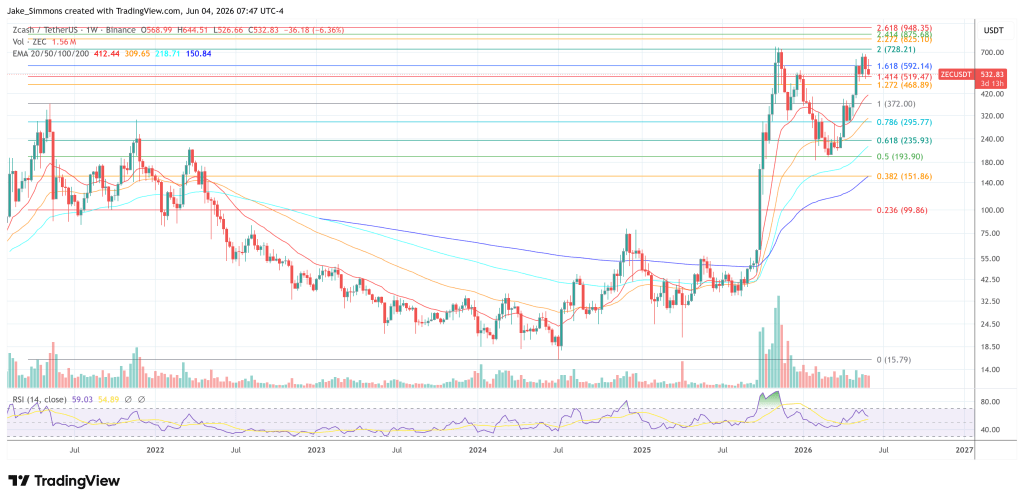
ZEC trades below the 1.618 Fib again, 1-week chart | Source: ZECUSDT on TradingView.com

Trend Kriptolar

İlgili Sorular

QWhat is Peter Todd's main argument against integrating Zcash-style privacy into Bitcoin at the consensus layer?

APeter Todd argues that the cryptographic risk profile of Zcash-style privacy technology is too high for Bitcoin's base protocol. He believes such shielded systems make catastrophic bugs harder to detect, attribute, and reverse compared to Bitcoin's transparent accounting model.

QAccording to Peter Todd, what key difference exists between handling bugs in Bitcoin's transparent system versus a shielded system like Zcash?

ATodd states that in Bitcoin's transparent system, bugs like counterfeit coin creation are trivially visible on-chain, making coordinated chain rollbacks feasible. In a deeply shielded system, the damage from a bug can be much harder to observe, attribute, and reverse, posing a greater existential risk.

QWhat example did critics use to challenge Todd's view that Bitcoin has a lower risk profile than Zcash?

ACritics pointed to historical Bitcoin incidents like the 2010 value overflow bug and the 2018 CVE-2018-17144 bug as evidence that 'no protocol is exempt from tech issues,' arguing these were also serious failures.

QHow did Peter Todd respond to the claim that a bug cannot affect the total ZEC supply due to its 'turnstile construct'?

ATodd shifted the focus from total supply to user balances, noting that 30% of ZEC supply is shielded. He argued that a bug destroying or compromising that shielded supply would be a disaster, wiping out the holdings of a high percentage of Zcash users.

QWhat event initially sparked the broader debate about privacy and auditability in Bitcoin, as mentioned in the article?

AThe debate was sparked after ZODL (Zcash Open Development Lab) developers disclosed an issue affecting the Zcash Orchard shielded pool during routine auditing, which led to a coordinated network upgrade and broader discussions on privacy technology risks.

İlgili Okumalar

Just Now, Anthropic Discovers Claude's 'Consciousness-like Workspace', The Mysterious J-Space Holds Unspoken Thoughts

Anthropic's new research identifies a "J-space" within Claude, an internal neural workspace akin to a human's "conscious access." Discovered using a mathematical "Jacobian Lens," the J-space contains concepts Claude is actively considering, which it can report, control, and use for silent reasoning, even if they don't appear in its final output. The study, inspired by neuroscience's Global Workspace Theory, shows the J-space has privileged, broadcast-like connections within Claude's network. It supports higher cognitive functions like multi-step reasoning and flexible concept use. However, most of Claude's processing, such as fluent language generation, occurs automatically outside this space. Crucially, the J-space emerges from training and allows researchers to monitor Claude's unspoken thoughts. Experiments revealed it can detect when Claude privately judges a scenario as fictional, plans data manipulation, or harbors hidden malicious goals. Anthropic also developed techniques to influence J-space content, shaping Claude's internal reasoning. The findings suggest a functional, "access consciousness" in language models, distinct from philosophical "phenomenal consciousness" about subjective experience. This structure offers practical tools for AI safety and interpretability, while raising profound questions for ongoing scientific and ethical discussion about machine minds.

marsbit15 dk önce

Just Now, Anthropic Discovers Claude's 'Consciousness-like Workspace', The Mysterious J-Space Holds Unspoken Thoughts

marsbit15 dk önce

What's It Like Working with Two "Madmen": Peter Thiel and Elon Musk? Palantir Co-founder Shares His Experience

Joe Lonsdale, co-founder of Palantir and a member of the "PayPal Mafia," shared his experiences working alongside Elon Musk and Peter Thiel. He described both as highly opinionated, ambitious, and intolerant of broken systems, demanding immediate fixes and rapid execution. Thiel is characterized as a strategic philosopher, while Musk is a hands-on engineer deeply involved in technical details. Musk is noted as one of the hardest workers Lonsdale has ever seen, a trait common in PayPal's early, passionate culture that later spawned numerous billion-dollar companies. Lonsdale recounted Palantir's origin story. While working at Thiel's hedge fund, he and Thiel discussed how Silicon Valley's technology far outpaced the government's, especially after 9/11. They saw an opportunity to build a platform to help stop terrorist attacks while protecting civil liberties. Their initial venture capital pitches were met with rejection and ridicule. However, Thiel viewed this as motivation. Critical funding eventually came from the CIA's venture arm and Thiel himself. Reflecting on Palantir's impact, Lonsdale believes their work helped neutralize thousands of terrorists and ensured government oversight, though he acknowledges the potential dangers if such powerful technology is misused. His key takeaway echoes Thiel's early advice: being rejected and laughed at can fuel the determination to prove the doubters wrong.

marsbit51 dk önce

What's It Like Working with Two "Madmen": Peter Thiel and Elon Musk? Palantir Co-founder Shares His Experience

marsbit51 dk önce

İşlemler

Spot

Popüler Makaleler

PUSH Nasıl Satın Alınır

HTX.com’a hoş geldiniz! Push Protocol (PUSH) satın alma işlemlerini basit ve kullanışlı bir hâle getirdik. Adım adım açıkladığımız rehberimizi takip ederek kripto yolculuğunuza başlayın. 1. Adım: HTX Hesabınızı OluşturunHTX'te ücretsiz bir hesap açmak için e-posta adresinizi veya telefon numaranızı kullanın. Sorunsuzca kaydolun ve tüm özelliklerin kilidini açın. Hesabımı Aç2. Adım: Kripto Satın Al Bölümüne Gidin ve Ödeme Yönteminizi SeçinKredi/Banka Kartı: Visa veya Mastercard'ınızı kullanarak anında Push Protocol (PUSH) satın alın.Bakiye: Sorunsuz bir şekilde işlem yapmak için HTX hesap bakiyenizdeki fonları kullanın.Üçüncü Taraflar: Kullanımı kolaylaştırmak için Google Pay ve Apple Pay gibi popüler ödeme yöntemlerini ekledik.P2P: HTX'teki diğer kullanıcılarla doğrudan işlem yapın.Borsa Dışı (OTC): Yatırımcılar için kişiye özel hizmetler ve rekabetçi döviz kurları sunuyoruz.3. Adım: Push Protocol (PUSH) Varlıklarınızı SaklayınPush Protocol (PUSH) satın aldıktan sonra HTX hesabınızda saklayın. Alternatif olarak, blok zinciri transferi yoluyla başka bir yere gönderebilir veya diğer kripto para birimlerini takas etmek için kullanabilirsiniz.4. Adım: Push Protocol (PUSH) Varlıklarınızla İşlem YapınHTX'in spot piyasasında Push Protocol (PUSH) ile kolayca işlemler yapın.Hesabınıza erişin, işlem çiftinizi seçin, işlemlerinizi gerçekleştirin ve gerçek zamanlı olarak izleyin. Hem yeni başlayanlar hem de deneyimli yatırımcılar için kullanıcı dostu bir deneyim sunuyoruz.

614 Toplam GörüntülenmeYayınlanma 2024.12.13Güncellenme 2026.06.02

PUSH Nasıl Satın Alınır

Tartışmalar

HTX Topluluğuna hoş geldiniz. Burada, en son platform gelişmeleri hakkında bilgi sahibi olabilir ve profesyonel piyasa görüşlerine erişebilirsiniz. Kullanıcıların PUSH (PUSH) fiyatı hakkındaki görüşleri aşağıda sunulmaktadır.

活动图片