Nvidia Vs. Dogecoin: A Historic Ratio Suggests A Possible Rotation, Says Trader

bitcoinist2026-01-21 tarihinde yayınlandı2026-01-21 tarihinde güncellendi

Özet

Cryptocurrency trader Cryptollica suggests a major capital rotation may be imminent from AI-related equities, like Nvidia, into meme coins, particularly Dogecoin. The key signal is the DOGE/NVIDIA ratio, which has returned to a long-term support level that previously preceded massive Dogecoin outperformance in 2017 (100x) and 2021 (50x). The trader frames this as a shift from "The World’s Most Valuable Company" to "The World’s Most Famous Meme," arguing that when the AI trade cools, liquidity rotates into high-beta crypto assets. Supporting this view, Dogecoin's weekly RSI has hit a historically oversold level, which has only occurred four times in 12 years, each marking a significant cycle bottom and a major buying opportunity. While no explicit price target is given, the trader previously forecasted a medium-term goal of $1.30 for DOGE. At the time of writing, Dogecoin was trading at $0.1258.

Trader Cryptollica (@Cryptollica) is arguing that an old relative-value signal is “back” in crypto markets, pointing to the DOGE/NVIDIA ratio and an unusually depressed Dogecoin RSI reading as evidence that capital could rotate from AI-linked equities into high-beta meme coins.

Dogecoin Vs. Nvidia: Rotation Incoming?

In a post on X, Cryptollica said the DOGE/NVIDIA chart has returned to a long-term support zone that previously preceded outsized Dogecoin outperformance versus Nvidia in prior cycles. “THE SIGNAL IS BACK. IT’S HAPPENING AGAIN (2017... 2021... NOW),” the trader wrote.

“The last two times this specific signal flashed on the DOGE/NVIDIA chart, we saw the biggest wealth transfer in history. The crowd is chasing the AI top. The algorithm is loading the Meme bottom. (Altcoin bottom).”
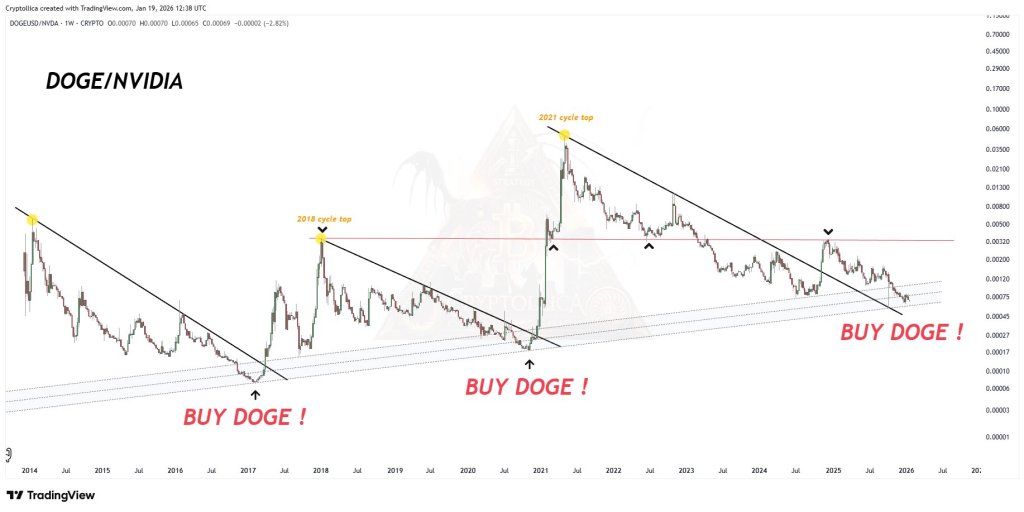
Dogecoin vs Nvidia chart | Source: X @Cryptollica

The core claim is less about Dogecoin in isolation and more about positioning on a ratio between what Cryptollica framed as two cultural extremes: “You are watching the wrong chart. This is the ratio of ‘The World’s Most Valuable Company’ (AI) vs. ‘The World’s Most Famous Meme’.” From that framing, the trader leans into a cycle-rhymes narrative, asserting that the ratio has repeatedly found channel support before a DOGE-led surge.

“Structure is repeating history,” Cryptollica wrote, attaching specific historical comparisons. “2017: Ratio hit channel support – DOGE outperformed NVDA by 100x. 2021: Ratio hit channel support – DOGE outperformed NVDA by 50x. NOW: We are back at the exact same support line.”

The posts also attach a broader liquidity-rotation story that has circulated in various forms across risk markets: when one trade stops working, capital seeks the next high-beta outlet: “When the AI Bubble exhales, that liquidity doesn’t vanish. It rotates into High-Beta Speculation,” the trader wrote. “The crowd is buying NVDA at the top. The algorithm is positioning for the DOGE reversal.”

Is Dogecoin An ‘Epic Buying Opportunity’?

In another post, Cryptollica shifted from the ratio to Dogecoin’s weekly momentum indicator, sharing a second chart highlighting RSI levels and labeling prior cycle lows. “Here you are witnessing an opportunity that only comes around once every 12 years,” the trader wrote. “Over the past 12 years (2014–2026), Dogecoin’s RSI has dropped this low only 4 times. Every single one was an epic buying opportunity.”

The post describes those four moments as a sequence of cycle bottoms, including an “all-time low” first cycle bottom, a “cycle bottom + COVID crash,” a “last cycle bottom,” and “RIGHT NOW!” Cryptollica concluded with a blunt decision frame: “Math or emotions — which one decides for you?”
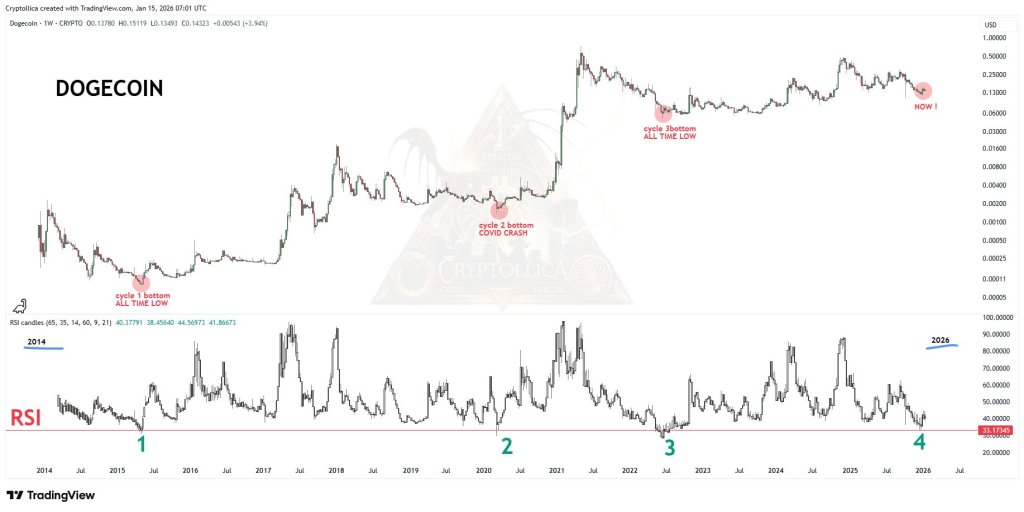
Dogecoin weekly RSI | Source: X @Cryptollica

While neither post includes an explicit price target, the analyst said in early December that he expects Dogecoin to reach $1.30 over the medium term, citing a parallel channel top on the 3-day DOGE/USD chart.

At press time, DOGE traded at $0.12581.
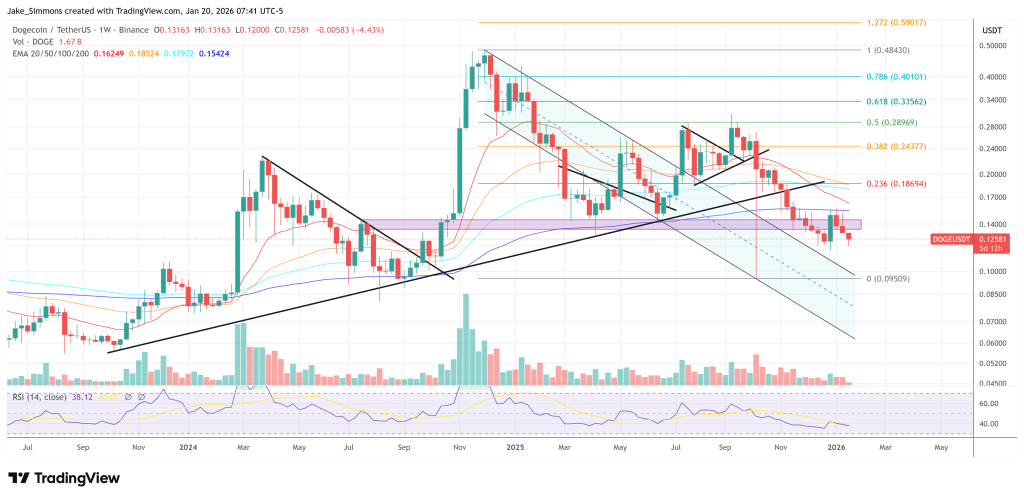
DOGE continues to fall after 200-week EMA rejection, 1-week chart | Source: DOGEUSDT on TradingView.com

İlgili Sorular

QWhat is the main argument presented by trader Cryptollica regarding the DOGE/NVIDIA ratio?

ACryptollica argues that the DOGE/NVIDIA ratio has returned to a long-term support zone, which historically preceded massive outperformance of Dogecoin versus Nvidia, suggesting a potential capital rotation from AI-linked equities into high-beta meme coins like Dogecoin.

QAccording to the trader, what were the historical outcomes when the DOGE/NVIDIA ratio hit this channel support in 2017 and 2021?

AIn 2017, when the ratio hit channel support, DOGE outperformed NVDA by 100x. In 2021, when it hit the same support, DOGE outperformed NVDA by 50x.

QWhat broader market narrative does Cryptollica attach to this potential rotation signal?

ACryptollica attaches a broader liquidity-rotation narrative, stating that when the AI bubble 'exhales,' the capital doesn't vanish but instead rotates into high-beta speculation, like meme coins.

QWhat does Cryptollica claim about Dogecoin's weekly RSI reading, and how does he frame it?

ACryptollica claims that Dogecoin's weekly RSI has dropped to a very low level only 4 times in the past 12 years (2014-2026), and he frames each of these instances as an 'epic buying opportunity' that marked a cycle bottom.

QWhat was Cryptollica's medium-term price target for Dogecoin mentioned in the article?

AIn early December, Cryptollica cited a parallel channel top on the 3-day DOGE/USD chart and expected Dogecoin to reach $1.30 over the medium term.

İlgili Okumalar

In-Depth Report on the On-Chain Lending Market: When Off-Chain Credit Meets On-Chain Liquidation

The on-chain lending market has evolved from a peripheral DeFi niche into core financial infrastructure. As of early 2026, total value locked (TVL) in on-chain lending protocols has reached $64.3 billion, accounting for 53.54% of total DeFi TVL, making it the largest and most mature vertical within decentralized finance. Aave dominates the sector with approximately $32.9 billion in TVL, commanding nearly half of the market—a leadership position that is unlikely to be challenged in the foreseeable future. However, the path of on-chain lending forward is not without risk. Liquidation cascades, credit defaults, and cross-chain vulnerabilities remain systemic threats hanging over the industry. At the same time, a deeper structural transformation is underway: on-chain lending is shifting from a “leverage tool for crypto-native users” to a “compliant gateway for institutional capital”. The scale of RWA (Real World Asset) lending has surpassed $18.5 billion, with U.S. Treasuries and government securities increasingly serving as core collateral. Institutional capital inflows are reshaping both the user base and risk appetite of the sector. This report systematically analyzes the evolution of on-chain lending definitions, competitive dynamics, core risks, and future trends, providing a comprehensive industry outlook for investors and trade practitioners. Key findings suggest that the “one dominant player with several strong challengers” structure will persist in the short term, while fixed-rate lending, compliant collateral, and institutional credit underwriting will define the next phase of competition. For investors focused on DeFi infrastructure, three key opportunity tracks stand out, namely, the Aave ecosystem (Morpho, Spark), RWA lending protocols (Ondo, Maple) and fixed-rate innovation (Notional, Pendle).

HTX Learn1 saat önce

In-Depth Report on the On-Chain Lending Market: When Off-Chain Credit Meets On-Chain Liquidation

HTX Learn1 saat önce

Fu Peng's First Public Speech in 2026: What Exactly Are Crypto Assets? Why Did I Join the Crypto Asset Industry?

Fu Peng, a renowned macroeconomist and now Chief Economist at New火 Group, delivered his first public speech of 2026 at the Hong Kong Web3 Festival. He explained his perspective on crypto assets and why he joined the industry, framing it within the context of macroeconomic trends and financial evolution. Fu emphasized that crypto assets are transitioning from an early, belief-driven phase to a mature, institutionally integrated asset class. He drew parallels to the 1970s-80s, when technological advances (like computing) revolutionized traditional finance, leading to the rise of FICC (Fixed Income, Currencies, and Commodities). Similarly, current advancements in AI, data, and blockchain are reshaping finance, with crypto assets becoming part of a new "FICC + C" (C for Crypto) framework. He noted that institutional capital, including traditional hedge funds, avoided early crypto due to its speculative nature but are now engaging as regulatory clarity emerges (e.g., stablecoin laws, CFTC classifying crypto as a commodity). Fu predicted that 2025-2026 marks a turning point where crypto becomes a standardized, financially viable asset for diversified portfolios, akin to commodities or derivatives in traditional finance. Fu defined Bitcoin not as "digital gold" in a simplistic sense but as a value-preserving, financially tradable asset. He highlighted that crypto's future lies in regulated, institutional adoption, moving away from retail-dominated trading. His entry into crypto signals this maturation, where traditional finance integrates crypto into mainstream asset management.

marsbit2 saat önce

Fu Peng's First Public Speech in 2026: What Exactly Are Crypto Assets? Why Did I Join the Crypto Asset Industry?

marsbit2 saat önce

Justin Sun Sues Trump Family: What $75 Million Bought Was Only a Blacklist

Justin Sun, founder of Tron, has filed a lawsuit in federal court against World Liberty Financial (WLF), alleging he was made the "primary target of a fraudulent scheme" after investing $75 million. Sun claims the investment secured him an advisor title and WLFI tokens, which were later frozen by WLF, causing "hundreds of millions in losses." The dispute began in late 2024 when Sun's investment helped revive WLF's struggling token sale, which ultimately raised $550 million. Shortly after, the SEC dropped its lawsuit against Sun following Donald Trump's inauguration. However, relations soured when Sun refused WLF's demands for additional funding. In August 2025, WLF added a "blacklist" function to its smart contract, allowing it to unilaterally freeze tokens. Sun's holdings, worth approximately $107 million, were frozen, and he was threatened with token destruction. The lawsuit highlights WLF's structure, which directs 75% of token sale profits to the Trump family, who had earned $1 billion by December 2025. WLF's CEO is Zach Witkoff, son of U.S. Middle East envoy Steve Witkoff. The project faces scrutiny for opaque operations, including a controversial loan arrangement on the Dolomite platform, co-founded by a WLF advisor. Despite Sun's history with the SEC, the case underscores centralization risks within DeFi, as WLF controls governance and holds powers to freeze assets arbitrarily. Sun's tokens remain frozen as legal proceedings begin.

marsbit2 saat önce

Justin Sun Sues Trump Family: What $75 Million Bought Was Only a Blacklist

marsbit2 saat önce

İşlemler

Spot
Futures
活动图片