Nikkei Above 57,000: Japanese Government Bond Risks Reshaping Global Asset Allocation

比推2026-02-11 tarihinde yayınlandı2026-02-11 tarihinde güncellendi

Özet

The Nikkei 225 surged past 57,000, a historic high, driven by political certainty after Japan’s ruling coalition secured a supermajority. This sparked expectations of aggressive fiscal stimulus and industrial policy, boosting equities like defense and tech stocks. However, Japanese government bonds (JGBs) faced heavy selling, with long-term yields spiking, reflecting concerns over fiscal sustainability and inflation. The Bank of Japan may be forced to hike rates to counter yen weakness and rising yields, creating a "fiscal dominance" dilemma. Globally, this shift interacts with China reducing U.S. Treasury holdings, U.S. tech rallies, and gold hitting $5,000 as a hedge against sovereign credit risks. Investors are advised to consider long volatility strategies, tactical yen rebounds, and allocations to hard assets like gold and Bitcoin amid heightened market uncertainty.

Author: Max.S

Original Title: Crisis or Feast? Unpacking JGB Risks Under Nikkei 57,000 and the New Logic of Global Asset Allocation


Just 24 hours ago, Japanese financial history was rewritten. The Nikkei 225 index surged violently by over 2,700 points, decisively breaking through the historic high of 57,000 points. This is not merely a numerical breakthrough; it is a direct pricing-in of the results of the House of Representatives election held after the shortest official campaign period (16 days) since the end of World War II — the ruling coalition of the Liberal Democratic Party (LDP) and Japan Innovation Party secured an absolute majority of two-thirds of the seats.

However, while equity traders were popping champagne corks, bond trading desks were on high alert. Japanese Government Bonds (JGBs) faced a fierce sell-off, with the yield on the 30-year bond soaring to 3.615%—a veritable tsunami in a country accustomed to low interest rates.

As financial professionals, we need to look beyond the surface of the price charts to decipher the logic behind this "Song of Ice and Fire": global markets are trading a new "Japan narrative," and this narrative is intertwining with the rebound in U.S. tech stocks, gold's push towards $5,000, and signals of China selling U.S. Treasuries to form a complex macroeconomic puzzle.

The core driver of the surge on February 9th was one thing only: expectations of fiscal expansion driven by political certainty.

According to the latest vote count, the LDP won 316 seats. Combined with the Innovation Party's 36 seats, the ruling coalition holds a dominant position within the 465-seat chamber. This grants the government unprecedented legislative power, including the ability to pass controversial constitutional amendments and, more importantly—aggressive fiscal stimulus policies.

The logic of this trade is very clear:

  • Political Backing: An absolute majority means the opposition's (e.g., the Constitutional Democratic Party) power to check the government is minimal.

  • Policy Expectations: While Finance Minister Takaichi Sanae explained the "temporary cut in food sales tax" as "limited to two years and not reliant on debt issuance," the market is clearly pricing in longer-term fiscal easing.

  • Industrial Policy: Defense and industry are at the core of the Takaichi policy. This explains why defense-related stocks like Mitsubishi Heavy Industries led the gains, while SoftBank Group's 8% surge was a direct reaction to expectations of liquidity easing and an improved environment for tech investment.

For quant funds, yesterday's strategy was simple: Long Nikkei, Short Yen, Short JGBs. This is a classic "Reflation" trade model.

If the stock market is trading "growth," then the bond market is trading the prelude to "default risk"—or at least a deterioration in fiscal sustainability.

The sell-off in the JGB market was not sudden. As early as January, global macro funds, including Schroders Plc and JPMorgan Asset Management, had begun reducing their holdings of ultra-long-term Japanese government bonds. Yesterday, the 10-year bond yield rose 4.5 basis points to 2.28%, and the 30-year yield climbed 6.5 basis points to 3.615%.
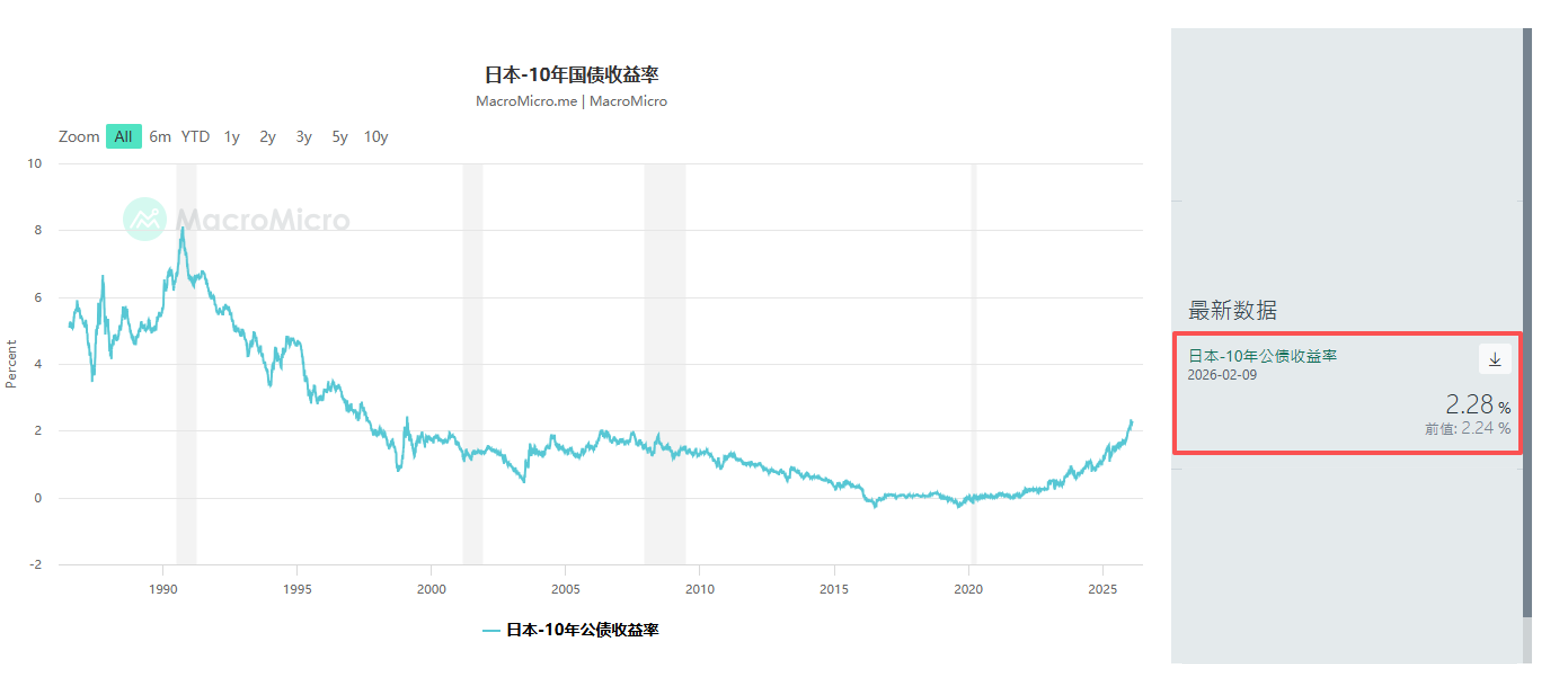
This sends a dangerous signal: the Term Premium is returning.

Investors fear that tax cuts, combined with an already heavy debt burden, will force the Japanese government to increase JGB issuance. Although officials have tried to reassure markets that the tax cuts will not rely on deficit financing, in the illiquid JGB market, any hint of trouble is magnified.

This also presents a huge dilemma for the Bank of Japan (BOJ). Overnight Index Swap (OIS) data shows the market is currently pricing in a 75% probability of a 25 basis point rate hike by the BOJ at its April meeting, with some traders even starting to bet on a March hike.
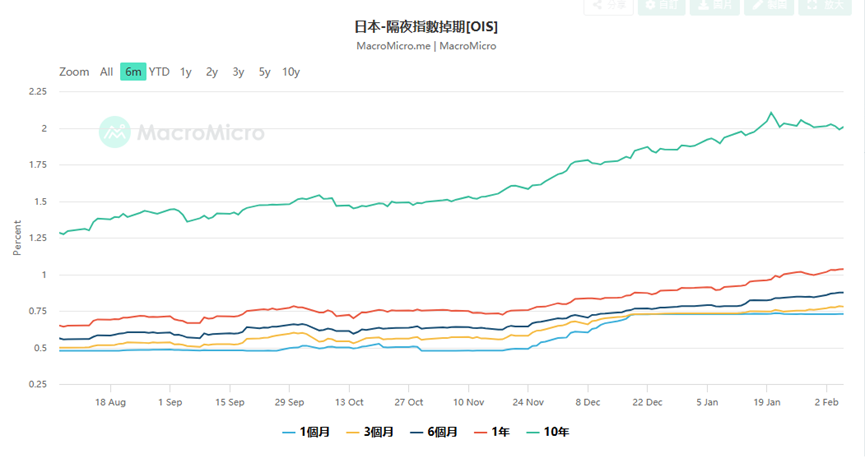
Why bet on a March hike? Because if the yen depreciates disorderly due to fiscal deterioration (yesterday it briefly broke through 157.76), the central bank must hike rates to defend the currency, even if this exacerbates debt servicing costs. This is a classic "fiscal dominance" dilemma. Yusuke Matsuo, senior market economist at Mizuho Bank, warned that we need to watch closely for hawkish comments from BOJ board members, as this could be verbal intervention to prevent a yen collapse.

The Japanese market is not an island. When we zoom out to a global perspective, we see that the February 9th market action is part of a broader return of risk appetite, but it also comes with deep structural fractures.

  • Chinese Market: This was one of the most intriguing macro news items yesterday: Chinese regulators advised financial institutions to control their holdings of U.S. Treasury bonds, citing "concentration risk and market volatility." Although the official wording was cautious, emphasizing this was not related to geopolitics, the move by the second-largest holder of U.S. debt undoubtedly puts upward pressure on U.S. Treasury yields (prices fall) amid global liquidity tightening. This is partly why U.S. Treasury yields rose in tandem with JGB yields yesterday. This essentially tells the market: the anchor of global sovereign credit is loosening.

  • U.S. Market: U.S. markets rebounded on Friday led by the semiconductor sector, with Nvidia, AMD, and Broadcom all gaining over 7%. This sentiment directly spilled over to Asia, where semiconductor equipment giants like Tokyo Electron and Advantest were the main drivers behind the Nikkei's charge. The capital expenditure (Capex) story for AI infrastructure continues, and although Amazon's massive spending raised profitability concerns, the logic of the hardware cycle remains intact as long as demand for Nvidia's GPUs persists.

  • Precious Metals Market: After experiencing sharp volatility, the gold price reclaimed the $5,000/oz level. This is not a safe-haven move; it's a "credit hedge." As Japan engages in fiscal expansion, U.S. debt ceiling issues persist, and China diversifies its reserves, gold becomes the only "supra-sovereign currency." U.S. Treasury Secretary Scott Bessent's accusation that Chinese traders are influencing gold price fluctuations itself exposes the U.S. Treasury's anxiety over dollar pricing power.

Faced with such a fragmented market—stock market狂欢 (狂欢,狂欢 means狂欢/carnival/celebration) vs. bond market暴跌 (暴跌 means暴跌/crash/plunge)—how should investors respond?

  • Equity Markets: Long Volatility. Even though the Nikkei hit a new high, the retreat in the VIX index might just be the calm before the storm. Key variables this week are Wednesday's U.S. labor market data and Friday's inflation data (CPI). If U.S. inflation rebounds, coupled with a hawkish pivot from the BOJ, global liquidity will face a double tightening.

In this environment, while holding core growth stocks (e.g., semiconductors, Japanese trading houses), it is wise to use put options for protection. Current Skew data shows put options are still expensive, indicating institutions are not completely off guard.

  • FX Market: Tactical Yen Rebound. The yen faces extremely high intervention risk around the 157 level. Finance Minister Takaichi Sanae explicitly stated she is in close contact with the U.S. Treasury Secretary, meaning the possibility of coordinated intervention cannot be ruled out. If the BOJ confirms a rate hike in March or April, the yen could see a rapid short squeeze. For carry traders, now is the time to gradually take profits.

  • Alternative Assets: Focus on "Hard Assets." In an era of shaky fiat currency credibility (be it concerns over Japan's fiscal health or U.S. debt worries), gold, silver, and some cryptocurrencies that have stabilized in this pullback (Bitcoin > $70k) possess long-term allocation value. Particularly silver, which, after a sharp 50% correction, could see a new short squeeze triggered by tight physical inventories.

February 9, 2026—Nikkei at 57,000 points is a milestone and a watershed. It marks Japan's complete departure from the deflationary era and its entry into a "new normal" of high growth, high inflation, and high interest rate volatility. Takaichi Sanae's supermajority is a double-edged sword: it can push stock prices higher through aggressive policies, but it can also destroy bond market confidence through runaway fiscal deficits.

For financial professionals, the gentle era of "stocks and bonds rising together" is over. We need to adapt to extreme scenarios where the negative stock-bond correlation breaks down, or even simultaneous stock and bond sell-offs. In this new era, watching central bank balance sheets might be more important than watching corporate income statements.


Twitter:https://twitter.com/BitpushNewsCN

Bitpush TG Discussion Group:https://t.me/BitPushCommunity

Bitpush TG Subscription: https://t.me/bitpush

Original article link:https://www.bitpush.news/articles/7610941

İlgili Sorular

QWhat was the main driver behind the Nikkei 225's surge to a historic high of 57,000 points?

AThe main driver was the political certainty brought by the ruling coalition (LDP and Japan Innovation Party) securing an absolute majority in the lower house election, which fueled expectations for aggressive fiscal expansion and stimulus policies.

QWhy did the Japanese Government Bond (JGB) market experience a sharp sell-off despite the stock market rally?

AThe JGB sell-off was driven by concerns over Japan's fiscal sustainability. Investors feared that tax cuts combined with the existing heavy debt burden would force the government to increase bond issuance, leading to higher yields, particularly in the long end (e.g., 30-year yield soaring to 3.615%).

QHow is the Bank of Japan (BOJ) expected to respond to the market dynamics, particularly regarding interest rates?

AMarket pricing indicates a high probability (75%) of a 25 basis point rate hike by the BOJ in April, with some traders even betting on a March hike. This is anticipated to prevent disorderly yen depreciation and address inflation concerns, despite the risk of increasing government debt servicing costs.

QWhat global macroeconomic factors are interacting with Japan's market movements according to the article?

AKey global factors include: China's advice to financial institutions to control holdings of U.S. Treasuries (adding upward pressure on yields), the rally in U.S. semiconductor stocks boosting Asian tech shares, and gold rising above $5000/oz as a 'credit hedge' amid concerns over sovereign debt sustainability in Japan and the U.S.

QWhat investment strategies does the article suggest for navigating the current volatile market environment?

AThe article recommends: Long volatility positions in equities (using put options for protection), tactical bullish bets on the yen due to intervention risks, and allocation to 'hard assets' like gold, silver, and Bitcoin as hedges against fiat currency credit concerns.

İlgili Okumalar

In-Depth Report on the On-Chain Lending Market: When Off-Chain Credit Meets On-Chain Liquidation

The on-chain lending market has evolved from a peripheral DeFi niche into core financial infrastructure. As of early 2026, total value locked (TVL) in on-chain lending protocols has reached $64.3 billion, accounting for 53.54% of total DeFi TVL, making it the largest and most mature vertical within decentralized finance. Aave dominates the sector with approximately $32.9 billion in TVL, commanding nearly half of the market—a leadership position that is unlikely to be challenged in the foreseeable future. However, the path of on-chain lending forward is not without risk. Liquidation cascades, credit defaults, and cross-chain vulnerabilities remain systemic threats hanging over the industry. At the same time, a deeper structural transformation is underway: on-chain lending is shifting from a “leverage tool for crypto-native users” to a “compliant gateway for institutional capital”. The scale of RWA (Real World Asset) lending has surpassed $18.5 billion, with U.S. Treasuries and government securities increasingly serving as core collateral. Institutional capital inflows are reshaping both the user base and risk appetite of the sector. This report systematically analyzes the evolution of on-chain lending definitions, competitive dynamics, core risks, and future trends, providing a comprehensive industry outlook for investors and trade practitioners. Key findings suggest that the “one dominant player with several strong challengers” structure will persist in the short term, while fixed-rate lending, compliant collateral, and institutional credit underwriting will define the next phase of competition. For investors focused on DeFi infrastructure, three key opportunity tracks stand out, namely, the Aave ecosystem (Morpho, Spark), RWA lending protocols (Ondo, Maple) and fixed-rate innovation (Notional, Pendle).

HTX Learn6 dk önce

In-Depth Report on the On-Chain Lending Market: When Off-Chain Credit Meets On-Chain Liquidation

HTX Learn6 dk önce

Fu Peng's First Public Speech in 2026: What Exactly Are Crypto Assets? Why Did I Join the Crypto Asset Industry?

Fu Peng, a renowned macroeconomist and now Chief Economist at New火 Group, delivered his first public speech of 2026 at the Hong Kong Web3 Festival. He explained his perspective on crypto assets and why he joined the industry, framing it within the context of macroeconomic trends and financial evolution. Fu emphasized that crypto assets are transitioning from an early, belief-driven phase to a mature, institutionally integrated asset class. He drew parallels to the 1970s-80s, when technological advances (like computing) revolutionized traditional finance, leading to the rise of FICC (Fixed Income, Currencies, and Commodities). Similarly, current advancements in AI, data, and blockchain are reshaping finance, with crypto assets becoming part of a new "FICC + C" (C for Crypto) framework. He noted that institutional capital, including traditional hedge funds, avoided early crypto due to its speculative nature but are now engaging as regulatory clarity emerges (e.g., stablecoin laws, CFTC classifying crypto as a commodity). Fu predicted that 2025-2026 marks a turning point where crypto becomes a standardized, financially viable asset for diversified portfolios, akin to commodities or derivatives in traditional finance. Fu defined Bitcoin not as "digital gold" in a simplistic sense but as a value-preserving, financially tradable asset. He highlighted that crypto's future lies in regulated, institutional adoption, moving away from retail-dominated trading. His entry into crypto signals this maturation, where traditional finance integrates crypto into mainstream asset management.

marsbit1 saat önce

Fu Peng's First Public Speech in 2026: What Exactly Are Crypto Assets? Why Did I Join the Crypto Asset Industry?

marsbit1 saat önce

Justin Sun Sues Trump Family: What $75 Million Bought Was Only a Blacklist

Justin Sun, founder of Tron, has filed a lawsuit in federal court against World Liberty Financial (WLF), alleging he was made the "primary target of a fraudulent scheme" after investing $75 million. Sun claims the investment secured him an advisor title and WLFI tokens, which were later frozen by WLF, causing "hundreds of millions in losses." The dispute began in late 2024 when Sun's investment helped revive WLF's struggling token sale, which ultimately raised $550 million. Shortly after, the SEC dropped its lawsuit against Sun following Donald Trump's inauguration. However, relations soured when Sun refused WLF's demands for additional funding. In August 2025, WLF added a "blacklist" function to its smart contract, allowing it to unilaterally freeze tokens. Sun's holdings, worth approximately $107 million, were frozen, and he was threatened with token destruction. The lawsuit highlights WLF's structure, which directs 75% of token sale profits to the Trump family, who had earned $1 billion by December 2025. WLF's CEO is Zach Witkoff, son of U.S. Middle East envoy Steve Witkoff. The project faces scrutiny for opaque operations, including a controversial loan arrangement on the Dolomite platform, co-founded by a WLF advisor. Despite Sun's history with the SEC, the case underscores centralization risks within DeFi, as WLF controls governance and holds powers to freeze assets arbitrarily. Sun's tokens remain frozen as legal proceedings begin.

marsbit1 saat önce

Justin Sun Sues Trump Family: What $75 Million Bought Was Only a Blacklist

marsbit1 saat önce

İşlemler

Spot
Futures
活动图片