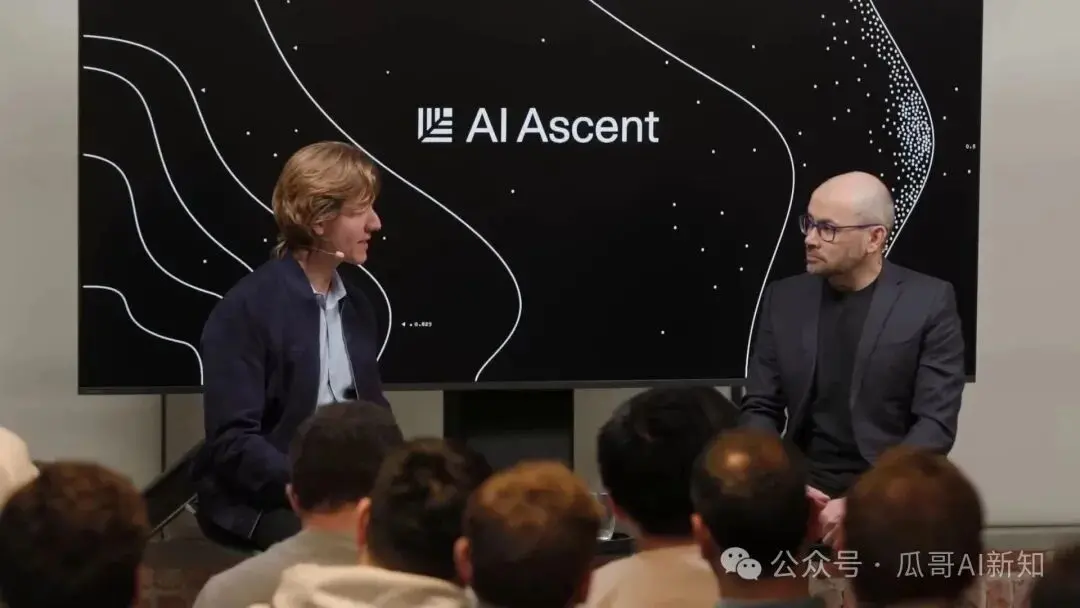
Netflix Founder Goes to His Most Feared Place

marsbit2026-04-20 tarihinde yayınlandı2026-04-20 tarihinde güncellendi

Özet

Netflix co-founder Reed Hastings is stepping down as chairman after nearly 30 years with the company, despite Netflix reporting its strongest-ever quarterly results with a 16% revenue increase and 83% surge in net profit. Hastings, who studied AI in the 1980s, has joined the board and donated $50 million to study AI’s impact on society. He now views AI as the biggest threat to Netflix, fearing that AI-generated content could eventually make free platforms like YouTube more appealing than paid services. While Netflix is using AI to improve production efficiency, Hastings is hedging his bets by engaging directly with AI governance, concerned that the rapid pace of AI development could disrupt the entire content industry.

Author: David

Netflix has never been as profitable as it is now, yet its founder chose this moment to leave.

On April 16, Netflix released its Q1 2026 earnings report, with revenue of $12.25 billion, up 16% year-over-year, and net profit surging 83% YoY. Earnings per share were $1.23, nearly 60% higher than Wall Street's expectation of $0.76.

But the earnings report also announced another thing: co-founder and current Chairman Reed Hastings will not seek re-election after his term ends in June.

Hastings founded Netflix in 1997, building it from a DVD-by-mail business into a streaming giant with over 325 million paid members worldwide, working for nearly 30 years. In 2023, he handed the CEO role to his successor and stepped back to Chairman. Now, he's leaving the Chairman role too.

In its filing with the U.S. Securities and Exchange Commission, Netflix specifically wrote: "This decision is not the result of any disagreement with the company."

But the more they emphasize no disagreement, the more it makes people wonder what he is actually going to do.

A little-known fact is that in May last year, Hastings had already joined the board of Anthropic. For almost 30 years, his business has essentially been about getting people to pay for content, while Anthropic's Claude, though not directly generating video, is changing the way content is produced.

From text to images to video, costs are getting lower and speeds faster.

Netflix's profitability relies on good content being worth paying for. If AI lowers the barrier to content creation enough, does that premise still hold?

Hastings is clearly already thinking about this.

What is he afraid of?

As a top global content producer and distributor, Netflix's founder has always had a conceptual concern about AI.

You might not know this, but in 1988, Hastings was studying for a master's in AI at Stanford. That's right, 40 years ago he was researching artificial intelligence. It's just that the AI of that era was nothing like the useful tool it is today...

In 2022, Hastings was invited as a speaker at Stanford's graduation ceremony.
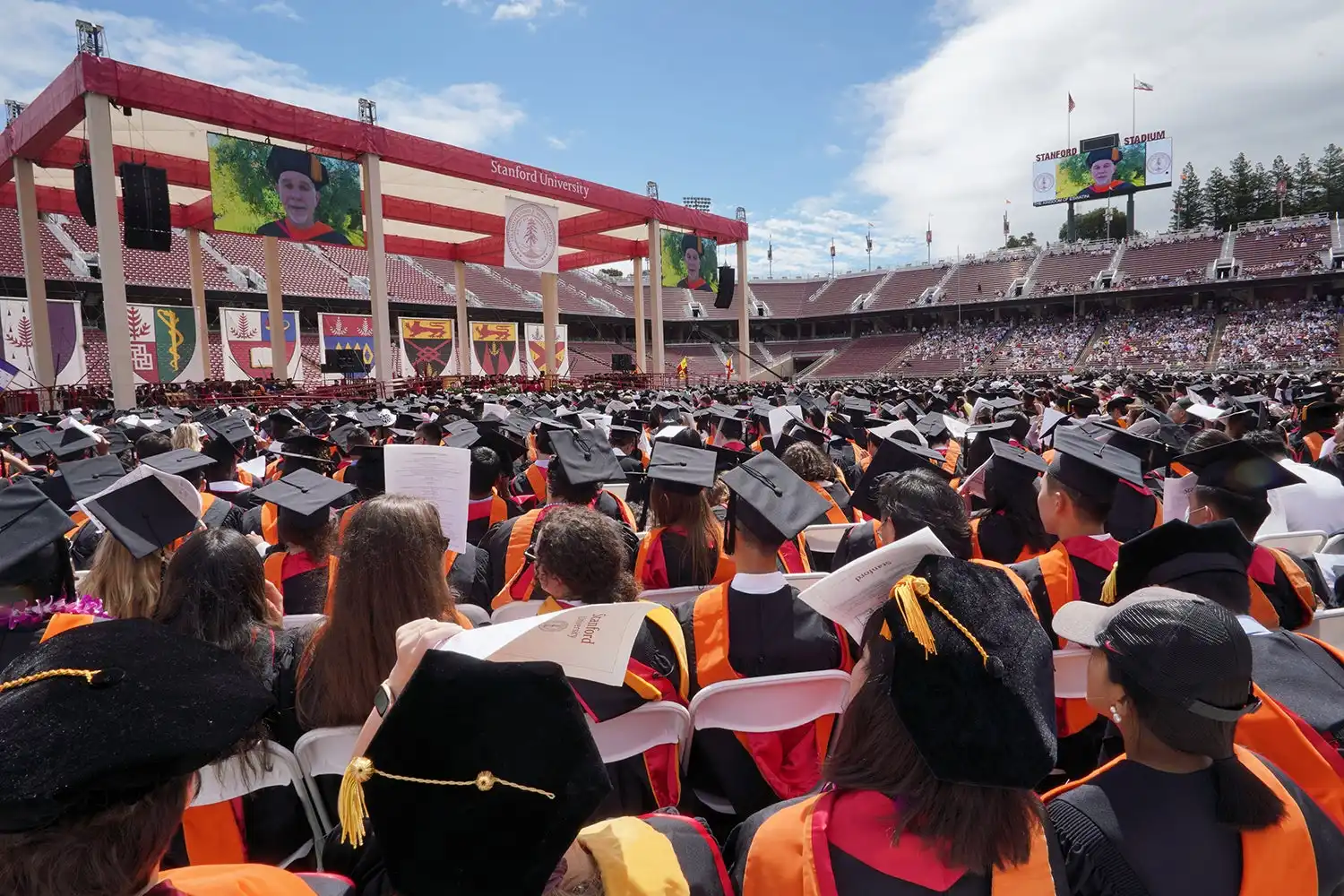
He later talked about it himself, sounding like he was telling a joke about a wrong turn in his youth. AI didn't work out, so he turned to starting a software company, and later founded Netflix, which he ran for nearly 30 years.

Someone who studied AI couldn't help but pay attention to the field.

In a 2024 interview, talking about AI, he was quite relaxed: "AI will help us become more creative, we can use these tools to make more shows." His attitude then was one of embrace. AI was a tool, there to help, not to take jobs.

In March 2025, he donated $50 million to his alma mater, Bowdoin College.

This liberal arts college in Maine doesn't work on large models; Hastings gave them money for a research initiative called "AI and Humanity," specifically studying the impact of AI on work, education, and human relationships.

On the day of the donation, he said something completely different from his relaxed tone a year earlier: "We are going to fight for the survival and flourishing of humanity."

In one year, AI progressed rapidly, and his stance shifted from AI helping work to AI being a threat to humanity.

Two months later, he joined the Anthropic board.

He was appointed by an independent body called the "Long-Term Benefit Trust," whose five members hold no Anthropic stock, with the sole duty of ensuring AI development aligns with humanity's long-term interests.

In March of this year, he spelled it out most clearly in another interview. The host asked him what the biggest risk facing Netflix was, and he skipped over competitors and subscriber growth, saying just two words:

AI.
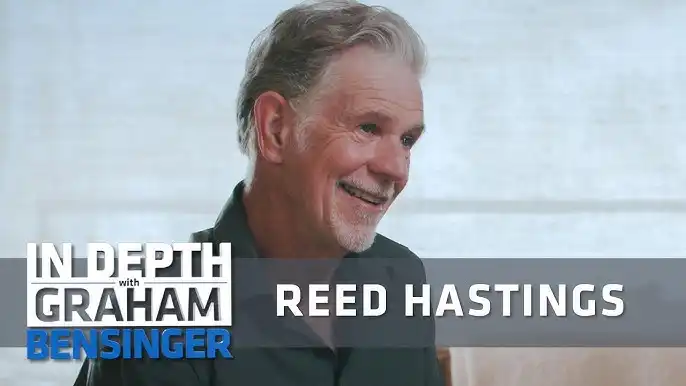
He said if AI makes the free content on YouTube cool and engaging enough, and all the young people go watch free content, then who will pay for Netflix?

From public information, you can find Hastings calling himself an "extreme techno-optimist." He doesn't think AI itself is bad, the problem is the speed gap.

AI technology is moving too fast, and humanity's moral and institutional systems can't keep up.

This explains his seemingly contradictory choices over the past year. Donating money not to a technical AI lab, but to a humanities college; joining a board, not any commercial AI company's advisory group, but Anthropic's safety committee.

In the author's opinion, Hastings is more qualified than most to be concerned about whether AI will disrupt the industry.

Netflix itself was the disruptor in the last cycle. It used streaming to kill DVD rentals, crippled cable TV, and forced all of Hollywood to rebuild its distribution system. He personally did the "use new technology to drive content and distribution costs low enough to kill the previous winners" thing once.

Now he's looking at AI, probably wondering who's next.

So, Hastings is simultaneously a major shareholder of Netflix and a director at Anthropic. Holding shares of the company he founded, he takes a seat in the industry that might disrupt it.

This might not be called retirement. It's called hedging.

Despite the AI impact, Netflix has actually never been better

Four years ago, Netflix was a company with just over $30 billion in annual revenue and less than 20% profit margins, being hounded by Wall Street asking "when will you make real money?" This earnings report four years later provides the answer.

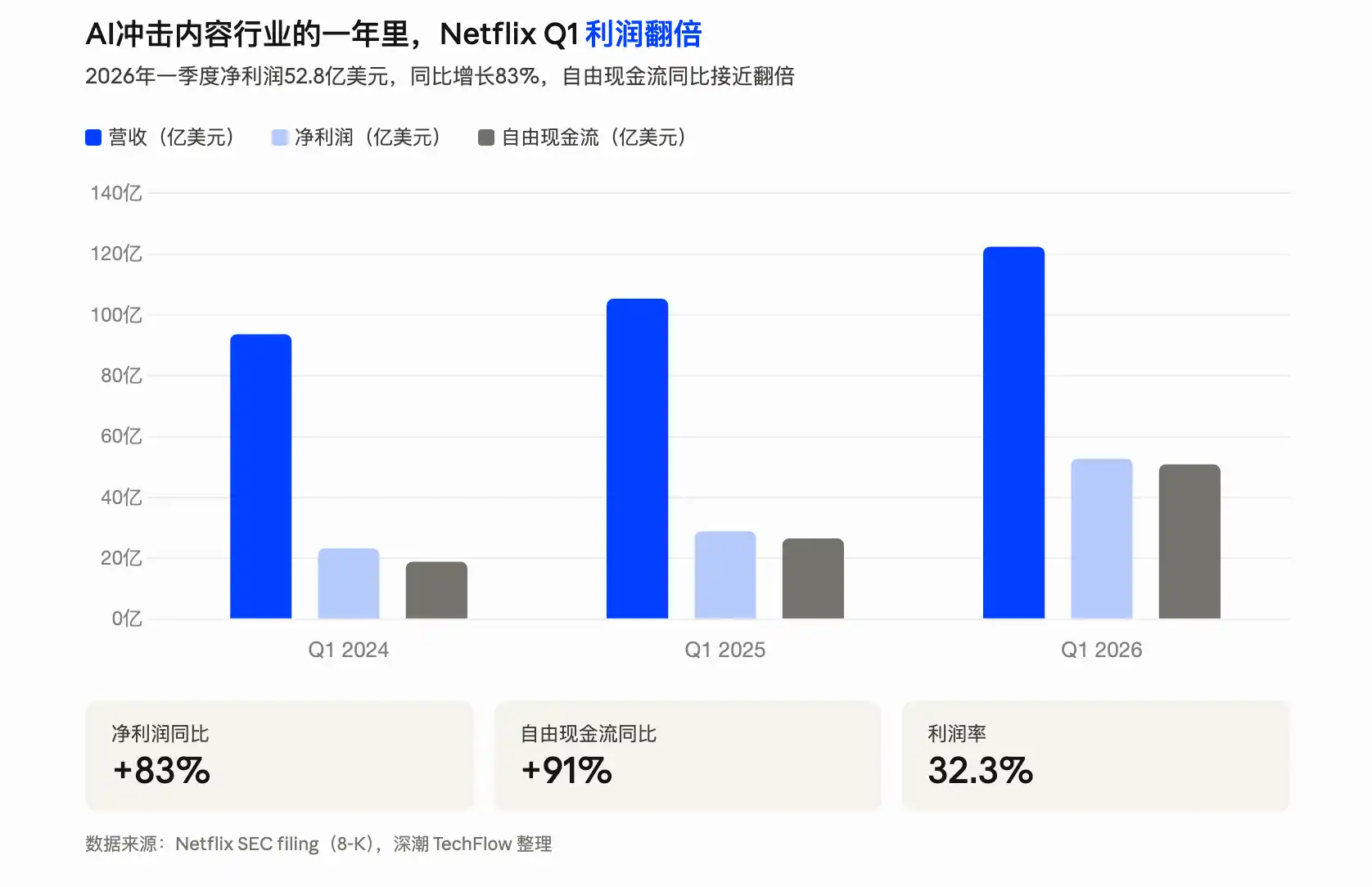
Q1 2026, net profit was $5.28 billion, up 83% YoY. Free cash flow was $5.09 billion, almost double that of the same period last year. Meanwhile, the profit margin reached 32%. The full-year revenue guidance is $50.7 to $51.7 billion. If they actually achieve it by year-end, it means Netflix's revenue has nearly doubled in three years.
Beyond daily operations, Netflix isn't blind to AI either.

A few weeks ago, it spent up to $600 million to acquire InterPositive, a company that makes AI-assisted film and TV production tools, using AI to accelerate script development, scene previews, and post-production. Netflix also specifically mentioned generative AI in its earnings letter, saying it will use it to improve content production and user experience.

Using AI to reduce production costs and improve efficiency is a sound approach. In fact, the entire Hollywood or content production industry is moving in this direction.

It's just that the concern founder Hastings expressed in the interview might be about a different problem.

In February of this year, ByteDance released its video generation model Seedance 2.0. Upload a photo, and it generates a 2K video with camera movement, sound effects, and lip-syncing in 60 seconds.

After testing it, Feng Ji, producer of Black Myth: Wukong, said four words: "The childhood era of AIGC is over." Director Jia Zhangke posted on Weibo saying he was preparing to use it to make a short film...

More concrete numbers come from within the industry. According to Securities Times reports, in the e-commerce advertising sector, one person using Seedance 2.0 can complete in 30 minutes what used to take 7 people 3 days, reducing costs by over 99%.

Extras in Hengdian, video editors, special effects producers—people across the entire industry chain are all saying the same thing—job anxiety.

Gong Yu, founder of iQiyi, publicly stated a judgment late last year: AI could reduce the costs of the film and television industry by an order of magnitude, increase creators by an order of magnitude, and increase works by two orders of magnitude.

Netflix using AI to reduce production costs is about improving efficiency within the existing model. But what Seedance and others are doing is lowering the barrier to "making video" from millions of dollars to a few dollars.

The future Hastings spoke of, where "free content on YouTube becomes good enough," is step by step becoming reality.

Of course, all this might not be directly related to his decision to leave Netflix now. He started handing over power in 2023—CEO, Chairman, step by step—with at least a three-year transition period.

It's just that the timing is indeed微妙 (subtle/interesting). Netflix delivered its best-ever earnings report, and the stock fell 8% after hours. On the same day, the founder announced his complete departure.

After June, Hastings' name will disappear from Netflix's board list.

His current titles are Director at Anthropic, Director at Bloomberg, and owner of a ski resort in Utah. He still holds Netflix stock; Forbes estimates his net worth at $5.8 billion, mostly tied to Netflix.

He holds Netflix's money, sitting at AI's table.

As for whether this choice is foresight or overcaution, we might only get the answer when AI can actually produce a movie that audiences are willing to watch to the end.

İlgili Sorular

QWhy did Reed Hastings decide to step down as Chairman of Netflix despite the company's strong financial performance?

AReed Hastings stepped down as Chairman of Netflix to focus on his role at Anthropic's board and to address the long-term risks and opportunities posed by AI, which he sees as a potential threat to the traditional content business model.

QWhat is Reed Hastings' background in AI, and how does it influence his current concerns?

AReed Hastings studied AI for his master's degree at Stanford in 1988. His early exposure to AI fuels his deep concern about its rapid advancement and potential to disrupt industries, including content creation and distribution.

QHow does AI pose a threat to Netflix's business model according to Hastings?

AHastings fears that AI could make free content on platforms like YouTube so compelling and high-quality that consumers may stop paying for Netflix, undermining its subscription-based revenue model.

QWhat actions has Hastings taken to address the challenges and opportunities of AI?

AHastings joined the board of Anthropic, a company focused on AI safety, and donated $50 million to Bowdoin College for a research program studying AI's impact on work, education, and human relationships.

QHow is Netflix itself responding to the rise of AI in content creation?

ANetflix acquired InterPositive, an AI-assisted film production tool company, for up to $600 million and is using generative AI to improve content production efficiency and user experience, aiming to reduce costs and enhance creativity.

İlgili Okumalar

Three Scenarios for BTC's Future Direction and a Duel Between Two Strong Forces | Special Invited Analysis

**Title: Three Scenarios for BTC's Future Trajectory and a Key Duel | Invited Analysis** The market remains at a critical juncture. Over the past week, Bitcoin (BTC) consolidated broadly between $79,500 and $80,600, validating previous technical analysis. The current focus is on whether this marks the start of a new uptrend or a pause within a larger correction. **BTC Multi-Cycle Analysis & Three Possible Scenarios** BTC's daily chart structure, following its peak at $126,200 in October 2025, presents three primary technical scenarios based on Elliott Wave theory: 1. **Bullish Scenario (End of Correction):** The corrective A-B-C wave from $126,200 ended at the $60,000 low in February 2026. The current price action is the start of a major Wave I uptrend. A subsequent Wave II pullback would not break below $60,000. 2. **Bearish Scenario 1 (Complex Correction):** The correction is unfolding as an A-B-C-D-E pattern. The current move from $60,000 is a D-wave rally. After its completion, a final E-wave decline could potentially breach the $60,000 level. 3. **Bearish Scenario 2 (Larger Correction):** The entire move down from $126,200 to $60,000 was a large A-wave. The current rally is a B-wave correction within a larger A-B-C structure, to be followed by a C-wave decline below $60,000. *Analysis suggests Scenario 2 is less probable due to time disproportions between waves. The battle is effectively between the Bullish Scenario (1) and Bearish Scenario (3).* **Key BTC Levels & Weekly Strategy** On the 4-hour chart, BTC trades above a crucial consolidation zone ("Central Pivot C"). * **Key Resistance:** $83,500-$84,500; $89,000-$90,500. * **Key Support:** $78,500-$79,500 (pivot upper bound); $73,500-$75,000; $69,500-$70,500. **Weekly Outlook:** The market direction hinges on BTC's ability to hold above or break below the $78,500-$79,500 support zone. * **Mid-term Strategy:** Neutral/Wait-and-see stance due to unclear direction. * **Short-term Tactics:** Two contingency plans using 30% max capital: * **Plan A (Bullish):** Look for long entries if price holds above $78,500-$79,500 with confirming signals. Initial stop-loss below $78,500. * **Plan B (Bearish):** Consider short positions if price breaks below $73,500-$75,000 with confirming signals. Initial stop-loss above $76,500. **HYPE Analysis & Strategy** HYPE's daily chart shows a seven-segment structure from its January low of $20.46, forming a "rising pivot" zone. * **Key Level to Watch:** $45.76 (previous high). A break above would confirm the bullish structure remains intact. * **Short-term Strategy:** Focus on pivot zone boundaries ($38.41 upper, $34.44 lower). * **Long:** Consider on support near $38.41 with bullish confirmation signals. * **Short:** Consider on a break below $34.44 with bearish confirmation signals. * Position size must be below 30% with strict stop-loss discipline. **Risk Management Reminder:** Always set an initial stop-loss upon entry. Move stop-loss to breakeven at +1% profit, then trail it upwards to lock in profits dynamically. All views are based on technical analysis for informational purposes only and do not constitute investment advice. The market is inherently risky.

Odaily星球日报2 dk önce

Three Scenarios for BTC's Future Direction and a Duel Between Two Strong Forces | Special Invited Analysis

Odaily星球日报2 dk önce

Sequoia Interview with Hassabis: Information is the Essence of the Universe, AI Will Open Up Entirely New Scientific Branches

Demis Hassabis, co-founder and CEO of Google DeepMind and Nobel laureate, discusses the path to AGI and its profound implications in a Sequoia Capital interview. He outlines his lifelong dedication to AI, tracing his journey from game development (e.g., *Theme Park*)—a perfect AI testing ground—to neuroscience and finally founding DeepMind in 2009. He emphasizes the critical lesson of being "5 years, not 50 years, ahead of time" for successful entrepreneurship. Hassabis reiterates DeepMind's two-step mission: first, solve intelligence by building AGI; second, use AGI to tackle other complex problems. He highlights the transformative potential of "AI for Science," particularly in biology where tools like AlphaFold have revolutionized protein folding. He envisions AI-powered simulations drastically shortening drug discovery from years to weeks and enabling personalized medicine. Furthermore, he predicts AI will spawn new scientific disciplines, such as an engineering science for understanding complex AI systems (mechanistic interpretability) and novel fields enabled by high-fidelity simulators for complex systems like economics. He posits a fundamental worldview where information, not just matter or energy, is the essence of the universe, making AI's information-processing core uniquely suited to understanding reality. He defends classical Turing machines as potentially sufficient for modeling complex phenomena, including quantum systems, as demonstrated by AlphaFold. On consciousness, Hassabis suggests first building AGI as a powerful tool, then using it to explore deep philosophical questions. He believes components like self-awareness and temporal continuity are necessary for consciousness but that defining it fully remains an open challenge. He predicts AGI could arrive around 2030 and, once achieved, would be used to probe the deepest questions of science and reality, much as envisioned in David Deutsch's *The Fabric of Reality*.

链捕手20 dk önce

Sequoia Interview with Hassabis: Information is the Essence of the Universe, AI Will Open Up Entirely New Scientific Branches

链捕手20 dk önce

Morgan Stanley 2026 Semiconductor Report: Buy Packaging, Buy Testing, Buy China Chips, Avoid Traditional Tracks

Morgan Stanley 2026 Semiconductor Report: Buy Packaging, Buy Testing, Buy Chinese Chips; Avoid Traditional Segments. The core theme is the shift in AI compute supply from NVIDIA dominance to a three-track system of GPU + ASIC + China-local chips. The key opportunity is capturing share in this expansion, while non-AI semiconductors face marginalization due to resource reallocation to AI. Key investment conclusions, in order of priority: 1. **Advanced Packaging (CoWoS/SoIC) - Highest Conviction**: TSMC is the primary beneficiary of explosive demand, driven by massive cloud capex. Its pricing power and AI revenue share are rising significantly. 2. **Test Equipment - Undervalued & High-Growth Certainty**: Chip complexity is causing test times to double generationally, structurally driving handler/socket/probe card demand. Companies like Hon Hai Precision (Foxconn), WinWay, and MPI offer compelling value. 3. **China AI Chips (GPU/ASIC) - Long-Term Irreversible Trend**: Export controls are accelerating domestic substitution. Companies like Cambricon, with firm customer orders and SMIC's 7nm capacity support, are positioned to benefit from lower TCO (30-60% vs NVIDIA) and growing local cloud demand. 4. **Avoid Non-AI Semiconductors (Consumer/Auto/Industrial)**: These segments face a weak, structurally hindered recovery due to AI's resource "crowding-out" effect on capacity and supply chains. 5. **Memory - Severe Internal Divergence**: Strongly favor HBM (Hynix primary beneficiary) and NOR Flash (Macronix). Be cautious on interpreting price rises in DDR4/NAND as true demand recovery. The report emphasizes a 2026-2027 time window, stating the AI capital expenditure cycle is far from over. Key macro variables include persistent export controls and AI's systemic "crowding-out" effect on traditional semiconductor supply chains.

marsbit1 saat önce

Morgan Stanley 2026 Semiconductor Report: Buy Packaging, Buy Testing, Buy China Chips, Avoid Traditional Tracks

marsbit1 saat önce

Circle:Sluggish Market? The Top Stablecoin Stock Continues to Expand

Circle, the issuer of the stablecoin USDC, reported its Q1 2026 earnings on May 11th, Eastern Time. Against a backdrop of weak crypto market sentiment, USDC's average circulation in Q1 was $752 billion, with a modest 2% sequential increase to $770 billion by quarter-end. New minting volumes declined due to the poor crypto market, but remained high, indicating demand expansion beyond crypto trading. USDC's market share remained stable at 28% of the total stablecoin market, while competition from Tether's USDT persists. A key highlight was "Other Revenue," which reached $42 million, more than doubling year-over-year, though sequential growth slowed to 13%. This revenue stream, including fees from services like Web3 software, the Cipher payment network (CPN), and the Arc blockchain, is critical for diversifying away from interest income. Circle's internally held USDC share increased to 18%, helping to improve gross margin by 130 basis points to 41.4% by reducing external sharing costs. However, profitability was pressured as total revenue growth slowed, primarily due to the significant weight of interest income, which is tied to USDC规模 and Treasury rates. Adjusted EBITDA was $133 million with a 19.2% margin. Management maintained its full-year 2026 guidance for adjusted operating expenses ($570-$585 million) and other revenue ($150-$170 million). The long-term target for USDC's CAGR remains 40%, though near-term volatility is expected. The article concludes that while Circle's current valuation of $28 billion appears reasonable after a recent recovery, further upside depends on the pace of stable币 adoption and potential positive sentiment from the advancement of regulatory clarity acts like CLARITY.

链捕手1 saat önce

Circle:Sluggish Market? The Top Stablecoin Stock Continues to Expand

链捕手1 saat önce

Tech Stocks' Narrative Is Increasingly Relying on Anthropic

The narrative of tech stocks is increasingly relying on Anthropic. Anthropic, the AI company behind Claude, has become central to the financial stories of major tech giants. Elon Musk dissolved xAI, merging it into SpaceX as SpaceXAI, and secured an exclusive deal to rent the massive "Colossus 1" supercomputing cluster to Anthropic. In return, Anthropic expressed interest in future space-based compute collaborations. Google and Amazon are also deeply invested. Google plans to invest up to $40 billion and provide significant compute power, while Amazon holds a 15-16% stake. Both companies reported massive quarterly profit surges largely due to valuation gains from their Anthropic holdings. Crucially, Anthropic has committed to multi-billion dollar cloud compute contracts with both Google Cloud and AWS. This creates a clear divide: the "A Camp" (Anthropic-Google-Musk) versus the "O Camp" (OpenAI-Microsoft). The A Camp's strategy intertwines equity, compute orders, and profits, making Anthropic a "systemic financial node." Its performance directly impacts its partners' financials and stock prices. In contrast, OpenAI, while leading in user traffic, faces commercialization challenges, lower per-user revenue, and a recently restructured relationship with Microsoft. The AI industry is shifting from a race for raw compute (symbolized by Nvidia) to a focus on monetizable applications, where Anthropic currently excels. However, this concentration of market hope on one company amplifies systemic risk. The rise of powerful open-source models like DeepSeek-V4 poses a significant threat, as they could undermine the value proposition of closed-source models like Claude. The article suggests ongoing geopolitical efforts to suppress such competitors will be a long-term strategic focus for Anthropic's allies.

marsbit1 saat önce

Tech Stocks' Narrative Is Increasingly Relying on Anthropic

marsbit1 saat önce

İşlemler

Spot
Futures
活动图片