Natural Gas Double Bottom Breaks Through Cloud, Approaches Key Resistance Zone Around 2.800

2026-08-19 tarihinde yayınlandı2026-08-19 tarihinde güncellendi

Özet

Natural Gas's 5-hour candlestick chart has just confirmed a double bottom pattern, with a short-term rally breaking through the Ichimoku Cloud, now approaching the key resistance zone of $2.800-$2.830 – however, bulls fear a 'bull trap' may be imminent. Structural reversal signals are evident, but the primary trend remains bearish, requiring precise entry and stop-loss points.

Natural Gas's 5-hour candlestick chart has just confirmed a double bottom pattern, with the short-term uptrend breaking through the Ichimoku cloud and now approaching the key resistance zone of $2.800-$2.830. However, what bulls fear most is a potential "bull trap" lying ahead. While structural reversal signals are evident, the primary trend remains bearish, requiring precise entry and stop-loss points.

Bullish Reversal or a Trap?

A Quick Look at the Situation:

Natural Gas has broken above both the SMA(50) and the upper edge of the Ichimoku cloud, indicating a strengthening short-term trend.

The SuperTrend indicator has turned green, establishing a pullback support level at $2.667.

However, the price remains below the long-term SMA(200) at $2.931, meaning the primary bearish trend is not broken.

The MFI reading is exceptionally high at 87.46, indicating extreme overbought conditions and suggesting potential profit-taking pressure at any moment.

Core Risk:

The $2.800~$2.830 zone is a high-risk area for a "bull trap" during this upward surge. This area coincides with the Fibonacci 23.6% retracement level and previous highs. A failure to break through followed by a pullback could form a classic bull trap signal.

The ADX reading is only 19.63, indicating limited overall trend strength and suggesting continued tug-of-war between bulls and bears.
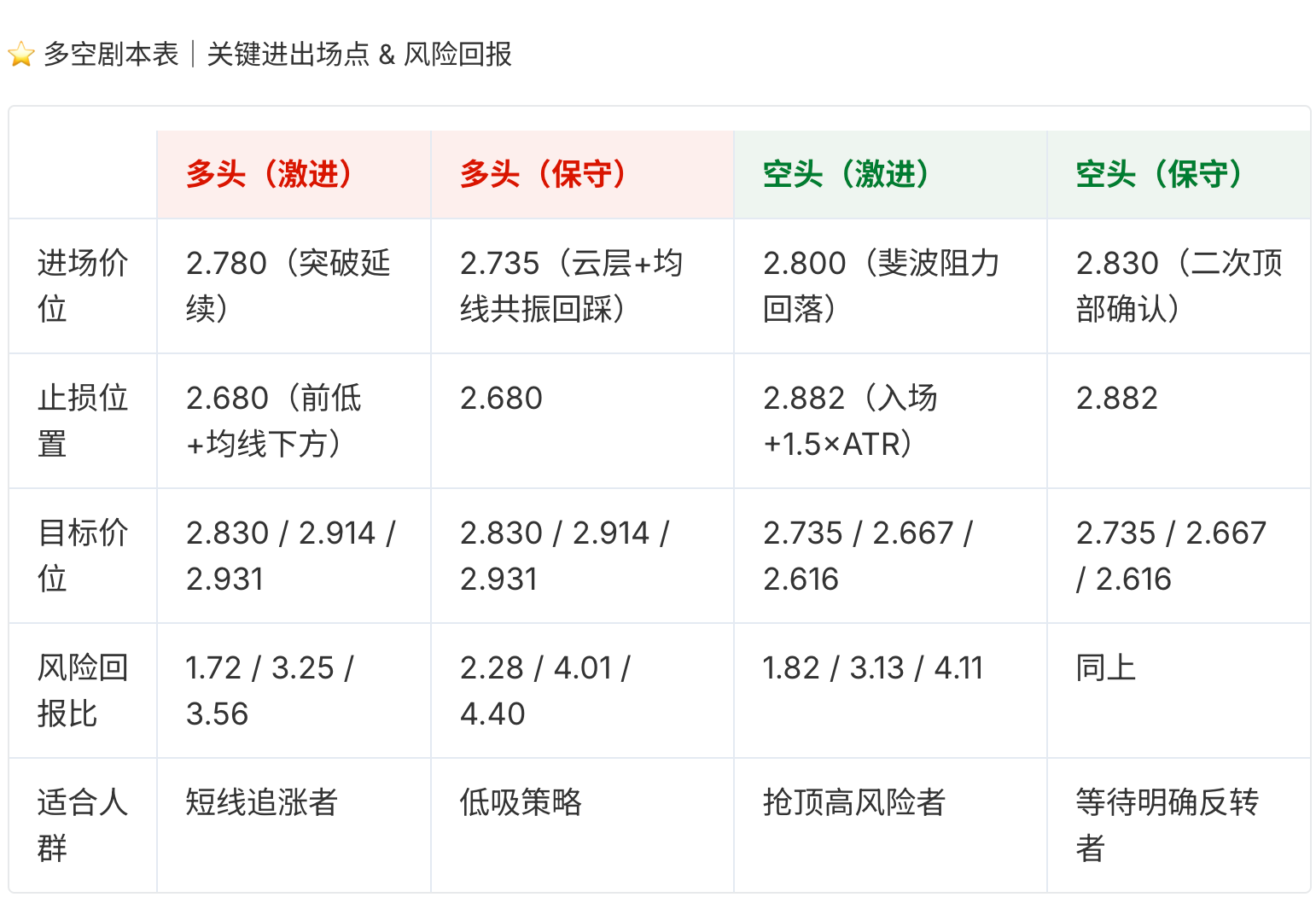
Note:

For long positions, it is recommended to move the stop-loss to the entry price (risk-free operation) once the first target is reached, and to use a trailing stop-loss after the second target is hit.

For short positions, monitor if the MFI falls significantly from the overbought zone as a potential signal for a top formation.

Technical Structure and Signal Breakdown

Double Bottom Pattern at $2.616: 100% complete, with higher lows supporting the uptrend.

Fibonacci 23.6% Retracement at $2.800: A short-term structural resistance level, difficult for bulls to overcome.

Volume Analysis: Volume has gradually increased during the rise, suggesting buying interest from major funds.

Risk of Churn: Repeated consolidation within the $2.735-$2.800 range could easily form a shakeout zone. Avoid chasing rallies or selling into weakness.

Risk and Operation Summary

Failure Criteria: The bullish structure is invalidated if the price falls below $2.667. For bears, a breach above $2.830 requires switching to defensive tactics; a breakout could target $2.931.

Range to Monitor: The $2.735-$2.800 zone is a "no-trade" consolidation area. Wait for a clear breakout or pullback before taking action.

Key Educational Point: Extreme MFI readings often precede sharp short-term volatility. However, a single indicator should not be used in isolation; always combine it with support/resistance zones and strictly control position size.

İlgili Okumalar

Q2 Wall Street Institutional Crypto Holdings: Most Institutions Increased Positions Against the Trend, ETH Exposure Outperformed BTC Across the Board

In Q2 2024, despite a roughly 14.2% decline in Bitcoin's price, many Wall Street institutions increased their crypto holdings, revealing a divergence from ETF flow trends. Overall institutional Bitcoin exposure grew by 7.5% to ~536k BTC, while aggregate spot Bitcoin ETF holdings declined. Notably, exposure concentration increased, with fewer reporting institutions holding larger positions. A key trend was the significant outperformance of Ethereum (ETH) exposure growth over Bitcoin (BTC) among major banks. For instance, JPMorgan's ETH exposure surged 67.3% versus 12.2% for BTC, and Morgan Stanley's ETH exposure grew 18.6% versus 3.7%. Individual bank holdings of Ethereum ETFs like ETHA saw dramatic increases, even as the overall Ethereum ETF market experienced net outflows during the quarter. Trading firms like Jane Street significantly rebuilt its iShares Bitcoin Trust (IBIT) position, while several hedge funds, including Brevan Howard and Graham Capital, reduced spot ETF holdings but added substantial option positions (both calls and puts), indicating more complex strategies. Institutions showed diverging views on crypto-related equities: some sold shares of MicroStrategy (MSTR) after its announced Bitcoin sales, while others like Renaissance Technologies and BlackRock were buyers. New entrants like Spain's Santander Bank disclosed initial crypto ETF positions. Meanwhile, long-term holders like Abu Dhabi's sovereign wealth funds paused their accumulation, and Harvard's endowment maintained a flat Bitcoin position. Key signals include the deepening institutionalization of crypto assets, a clear institutional preference for accumulating Ethereum, and growing divergence in views on crypto equities. This institutional buying in Q2 preceded a price recovery and renewed inflows into Ethereum ETFs in July and August.

marsbit17 dk önce

Q2 Wall Street Institutional Crypto Holdings: Most Institutions Increased Positions Against the Trend, ETH Exposure Outperformed BTC Across the Board

marsbit17 dk önce

TSMC, Another Winning Bet

TSMC Gains Another Strategic Advantage as Samsung Delays 1.4nm Process Samsung Foundry has adjusted its advanced process roadmap, postponing the mass production timeline for its 1.4nm process from 2027 to 2029. This two-year delay signals a strategic shift from aggressively pursuing the next node to focusing on maturing and scaling its 2nm platform. Samsung plans to extend the commercial lifespan of its 2nm technology through derivative versions optimized for different applications, including those incorporating backside power delivery for AI and HPC chips. A notable aspect of this shift is Samsung's cautious approach toward High-NA EUV lithography. The company views it as essential for 1nm-class nodes and beyond but not as an immediate necessity for 1.4nm, opting instead to refine its existing Low-NA EUV-based processes. This highlights a broader industry trend where the competition is evolving beyond simply reaching the next node. Success now depends on achieving high yield, managing soaring costs, integrating new transistor architectures like GAA, and delivering a compelling overall package of performance, power efficiency, and area (PPA) at a viable cost. While Samsung consolidates its 2nm efforts, TSMC continues its advance. Its N2 node is in production, and the A16 node (post-2nm, ~1.6nm) is scheduled for mass production in the second half of 2026. A16 introduces TSMC's Super Power Rail backside power delivery technology, which is expected to deliver significant performance and power efficiency gains. TSMC's previously stated cautious stance on High-NA EUV appears validated by Samsung's roadmap adjustment. The delay underscores that the competition in leading-edge semiconductor manufacturing is entering a new phase. It is no longer just a race to smaller node numbers but a multifaceted contest involving process maturity, yield, cost, design-technology co-optimization (DTCO), and advanced packaging. Samsung aims to solidify its 2nm platform over the next three years. However, as it targets 1.4nm for 2029, the industry will be watching how far ahead TSMC and Intel have moved by then.

marsbit23 dk önce

TSMC, Another Winning Bet

marsbit23 dk önce

The Top 'Doghead Strategist' in the Blind Date Scene: Doubao

"The 'First Dating Strategist': AI's New Role in Love and Deception This article explores the growing, and often troubling, reliance on AI, specifically tools like the chatbot 'Doubao', for navigating modern relationships. It begins by highlighting a cultural shift where having the social intelligence of an AI is seen as a compliment, and people increasingly turn to algorithms for solutions to romantic dilemmas, from analyzing chat histories to crafting responses. The piece then delves into a stark case study involving internet celebrity Han Anran, who was allegedly targeted in an 'AI-powered pig-butchering scam' by her ex-boyfriend. He reportedly used AI to create a detailed, coldly calculated manual from their very first day of dating. This document outlined strategies for emotional manipulation, psychological control, and resource extraction, setting a 10-billion-yuan financial goal over a decade. This incident underscores how AI can systematize deception, turning complex emotional exploitation into a scalable, efficient operation. Beyond high-stakes fraud, the article examines the pervasive, everyday use of AI 'proxy chatting' in dating. People outsource everything from flirty replies to breakup messages to AI, resulting in generic, awkward, and often easily detectable interactions. This 'outsourcing of love' creates a facade of connection while eroding genuine emotional effort and authenticity. While some users see it as a helpful crutch, it often reveals a lack of sincerity and a disrespect for the partner's intelligence. The commentary argues that we are entering a 'love cheating era'. While AI began as a benign tool to compensate for social awkwardness, its misuse is reshaping the rules of engagement. Relationships risk becoming data exchanges between systems, with humans as secondary players. The deeper crisis is not that AI is becoming more human-like, but the growing belief that humans are inferior to AI in providing perfect, calculated responses. The article concludes with a critical reflection: AI itself is amoral; it merely amplifies the intentions of its users. It did not invent deception but has made it more efficient and detached. In a world where affection can be algorithmic and intimacy can be a scam, the piece poses urgent questions: Do we still dare to love a flawed, specific person? And in an age of pervasive 'cheating', are those who offer their awkward, un-augmented genuine selves still worthy of love?"

marsbit27 dk önce

The Top 'Doghead Strategist' in the Blind Date Scene: Doubao

marsbit27 dk önce

İşlemler

Spot
活动图片