Mining Artificial Intelligence: Why Bitcoin Miners Are Changing Their Business Model

cryptonews.ru2026-08-15 tarihinde yayınlandı2026-08-15 tarihinde güncellendi

Özet

"Bitcoin miners pivot to AI: Economic pressures and new opportunities drive business model shift." Major publicly-traded US bitcoin mining companies are shifting their business model away from solely cryptocurrency mining. They are repurposing their infrastructure for artificial intelligence (AI) and high-performance computing (HPC). This move is driven by rising mining costs and declining profitability following the 2024 halving and a 2025 BTC price drop. According to a CoinShares report, the average cost to mine one BTC exceeded its market price in late 2025, making operations unprofitable for many. Companies like IREN, HUT 8, and TerraWulf are now leveraging their existing data centers, power access, and cooling systems to provide infrastructure for AI firms. This transition is facilitated by multi-billion dollar contracts with tech giants; for example, HUT 8 secured a $7 billion deal, and IREN partnered with Microsoft for $9.7 billion. While this pivot requires replacing specialized ASIC mining hardware with GPUs suitable for AI computations, it offers a more stable and potentially lucrative revenue stream. The shift has temporarily reduced Bitcoin's hash rate, but a recovery is expected. Most mining companies' stock prices have risen significantly since the announcement of their AI ventures. Analysts predict that AI-related income could soon constitute the majority of these firms' revenue, fundamentally changing their core business from cryptocurrency mining to AI inf...

Many large public American (and not only) mining companies are moving away from the model involving almost exclusively cryptocurrency mining. They have repurposed their activities towards developing infrastructure for artificial intelligence-based developments and high-performance computing (HPC). The largest players are IREN (formerly Iris Energy), HUT 8, TerraWulf, Riot Platforms, Bitdeer, and Cipher Digital.

The Rising Cost of Mining

Any business, including mining, must first and foremost be profitable. Certain difficulties with profitability have emerged in the Bitcoin mining market following the 2024 halving and the decline in the value of $BTC in late 2025.

According to a report from investment company CoinShares, mining the largest cryptocurrency by market capitalization was unprofitable for public American companies in the last quarter of last year. The average cost to mine 1 $BTC was $79,995, while the market price was around $70,000. For TerraWulf, mining one coin at a certain point even cost $385,000. In other words, revenue did not cover expenses at all.

No less telling data is shown by the Bitcoin Hash Price Index, which indicates the expected daily revenue for a miner from one petahash per second of computing power. As of August this year, the indicator is near its historically low values around $32. This is almost half of what it was a year earlier, more than ten times lower than the peak in 2021, and more than a hundred times lower than the 2017 peak. In short, the same amount of power brings less revenue to miners each year.
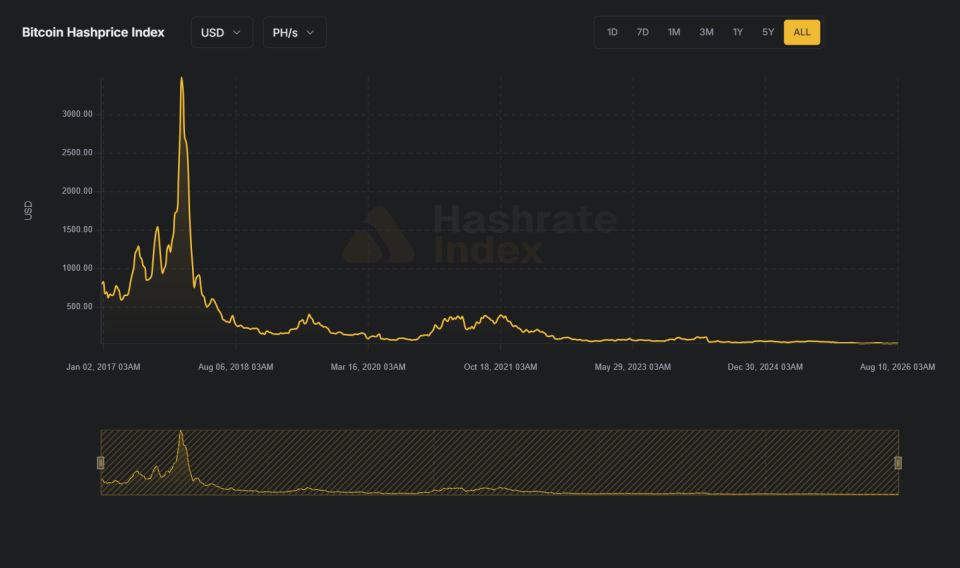
Source: hashrateindex.com

It turns out that large mining companies have faced realities where the economic feasibility of cryptocurrency mining has been called into question. Of course, the metrics above do not allow us to claim that Bitcoin mining suddenly became completely unprofitable everywhere. It's worth considering that miners in different countries and regions incur different costs: electricity and ASIC device prices vary, as do associated expenses like taxes, rent, and salaries for maintenance personnel. Equipment does not stand still and evolves, requiring timely replacement. Mining $BTC becomes less profitable for players unable to efficiently cover such costs.

However, there are other reasons for the shift to artificial intelligence.

Capital Availability

Let's clarify immediately: miners who previously mined Bitcoin do not themselves become AI operators. They merely provide their infrastructure to meet the needs of companies directly involved in artificial intelligence.

For providing their data centers, miners will receive very good money, which they did not have access to before. For example, HUT 8 signed a $7 billion deal to lease out its capacity, including the River Bend farm in Louisiana. The technical partners in the deal are the firm Anthropic, creator of the Claude neural network, and the cloud platform Fluidstack, with funding provided by tech giant Google and banks J.P. Morgan and Goldman Sachs.

IREN struck a deal with the world's largest software developer, Microsoft, for $9.7 billion. Microsoft thereby gains access to AI systems based on Nvidia GB-300 chips in Texas. And IREN will additionally purchase graphics processing units (GPUs) worth $5.8 billion from Dell Technologies, which is expected to bring in another $1.9 billion in annual revenue.

Economic Feasibility

Companies that have been exclusively mining cryptocurrency for years already have a certain infrastructure: specialized buildings, access to electricity, cooling systems. It's easier to repurpose a hypothetical data center from mining needs to AI needs than to build everything from scratch for the same Microsoft or Google. It's quite possible that fintech companies will someday switch to their own infrastructure, but that's not happening yet.

Speaking about converting mining farms for AI needs, it's necessary to understand that this doesn't happen in 100% of cases. New specialized data campuses will appear somewhere. Nevertheless, even here miners have it easier, as they know the specifics of data centers and have experience in organizational, operational-financial, and management issues. In other words, it is sometimes more profitable for large capital to delegate such matters to specialized companies.

Among the examples of infrastructure repurposing is the Bitdeer campus in the Norwegian municipality of Tydal.

ASIC Nuances

Modern large-scale cryptocurrency mining occurs primarily using highly specialized ASICs—equipment designed specifically for mining. Generally, an ASIC (Application Specific Integrated Circuit) is a special-purpose integrated circuit designed to solve one specific task. Such microchips can be implemented not only in mining but also in other fields where there is a need to minimize the cost of producing such equipment for specific needs.

ASIC miners themselves are different, which is related to the hashing algorithms used by specific coins. For example, Bitcoin uses the SHA-256 hashing algorithm, while Litecoin uses Scrypt. Manufacturers of such devices offer different and most often non-interchangeable units.

For instance, the manufacturer Bitmain releases the Antminer S21 model for the SHA-256 algorithm, the Antminer L9 for the Scrypt algorithm, and the Antminer D9—already for the X11 hashing algorithm. To explain in the simplest terms, an ASIC miner is a computing device from which everything unnecessary has been removed, increasing efficiency in mining cryptocurrencies and thereby reducing production costs.

On the other hand, advanced AI computations also require their own special technical capabilities. Moreover, even the efficiency of individual computations using graphics processing units (GPUs) varies depending on the manufacturer and specific model because their architectures differ fundamentally.

In other words, it's not enough to simply take down the "Mining" sign and hang up a new one—"Artificial Intelligence"—from a facility where coin mining previously took place and the corresponding ASICs stood. The equipment used will have to be replaced.

But did the reorientation of major American miners deal a decisive blow to Bitcoin?

What Happened to the Hashrate

The $BTC hashrate has definitely been influenced by miners moving into AI. From October 2025 to January 2026, the seven-day moving average of the hashrate fell by 28%, dropping from 1.15 EH/s to 0.83 EH/s. However, such dynamics shouldn't be too surprising, considering that American mining companies account for up to 40% of Bitcoin's total hashrate.
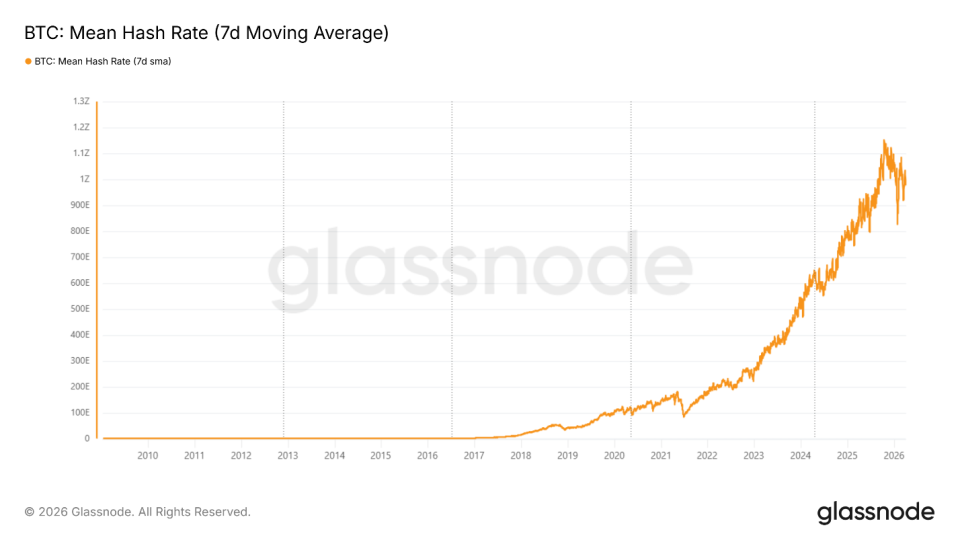
Source: studio.glassnode.com

By August 2026, some recovery in hashrate is already being observed. Its value fluctuates around 0.9 EH/s. Furthermore, according to CoinShares forecasts, the 1.8 EH/s mark should be broken by the end of the year, and by the end of 2027—2 EH/s.

It's worth remembering that reorienting towards AI does not mean miners are completely abandoning mining. In most cases, they are merely scaling back financial investments in this direction against the backdrop of expectations of greater profits from AI.

And how many bitcoins could miners potentially have mined if they hadn't reoriented to AI?

The Number of Missed Bitcoins

Actually, it's hardly possible to answer this question.

  • First, how to calculate it all? If miners had not started working on AI infrastructure, they would not have secured large contracts. Accordingly, this money cannot be factored into the potential expansion of the monetary base for mining. Similarly, the credit funds actively attracted by mining companies. From this angle—it seems the companies themselves may have earned even more than they could have without AI computing.

  • Second, the question: who missed out and how much? If we refer, for example, to Riot Platforms' report for the first quarter (data for the second quarter is not yet available), this company mined 1,473 $BTC. This is only 57 coins less than during the same period in 2025 (a 3.7% decrease). The change is more in the nature of a statistical error than a structural shift. Additionally, miners, without ceasing mining, are able to abandon further expansion in the field of mining and develop the AI direction as a short-term, highly profitable venture.

It is also worth considering here: if hypothetical IREN, TerraWulf, or HUT 8 did not mine $BTC, it means that only their balance sheets were not replenished. Bitcoin is still being mined as before, it's just that new coins went not to these companies' wallets but to other miners. The block reward remains fixed with predictable reduction during halvings and only the amount of network transaction fees changes. Moreover, if some major players suddenly switch off their power, it will become slightly easier for other participants to mine the cryptocurrency during the next network difficulty recalculation. In other words, these "bitcoins not mined by others" will still be mined somewhere in the world.

Miner Revenue

Amidst current economic/geopolitical instability, unfortunately, it's not yet possible to talk about exact figures. There are only forecast values. CoinShares believes that revenue from AI for mining companies will reach 70%, while at the beginning of the year it accounted for only 30%. In other words, the growth will be twofold. Essentially, if mining was the main activity for companies before, now it will become auxiliary. On the other hand, this doesn't mean mining will be abandoned for sure. Priorities will likely just be reassessed.

And how have such large-scale changes affected the stocks of cryptocurrency mining organizations?

Stocks and the Transition to AI

In most cases, the impact has been positive. Since the beginning of the year, the shares of five companies have shown price increases: IREN — 5.69%, Terra Wulf — 45.92%, MARA Holdings — 9.49%, Riot Platforms — 57.72%, Cipher Digital — 14.76%. The exception is Bitdeer, whose securities fell by 4.73%.

However, certain investor concerns regarding the transition to AI remain.

  • First, it's still unclear how successful this entire venture will be in the future. Will miners really be able to generate profits that cover all current and future costs?

  • Second, the transition from mining to developing infrastructure for artificial intelligence has forced a number of organizations to borrow huge sums. For TerraWulf — it's $5.7 billion, for IREN — $3.7 billion. Such a significant scale of debt load growth cannot but worry shareholders.

Conclusion

Large mining companies are transitioning from exclusively mining cryptocurrency to earning from AI due to economic feasibility and the availability of necessary infrastructure/management models. According to some forecasts, by the end of the year, the majority of their income will come from payments from AI operators, not from mining. The Bitcoin hashrate, after such companies reoriented their business, declined insignificantly and briefly but is already recovering. The stocks of most public miners are demonstrating price growth against the backdrop of business repurposing.

This material and the information in it are not individual or any other recommendation. The opinion of the editorial staff may not coincide with the opinions of analytical portals and experts.



end-content

Trend Kriptolar

İlgili Sorular

QWhy are major Bitcoin mining companies shifting their business model away from pure cryptocurrency mining?

AThey are shifting due to the decreasing profitability of Bitcoin mining after events like the 2024 halving and the 2025 price drop, and the emergence of more lucrative opportunities in providing infrastructure for artificial intelligence (AI) and high-performance computing (HPC) for companies like Microsoft and Google.

QWhat are the key financial challenges that made Bitcoin mining less profitable for public US companies, according to the article?

AAccording to a CoinShares report, the average cost to mine one Bitcoin in the last quarter of the past year was $79,995, while the market price was around $70,000, making it unprofitable. Companies like TerraWulf even faced costs as high as $385,000 per coin at one point.

QHow do Bitcoin mining companies benefit from providing infrastructure for AI development?

AThey secure large, lucrative contracts by leasing their data centers and expertise. For example, HUT 8 secured a $7 billion deal, and IREN secured a $9.7 billion deal with Microsoft, providing them with revenue streams that were previously unavailable from mining alone.

QWhat was the impact on Bitcoin's hashrate when major miners began transitioning to AI, and what is the forecast?

ABitcoin's seven-day moving average hashrate dropped by 28%, from 1.15 EH/s to 0.83 EH/s between October 2025 and January 2026. However, it has since recovered to around 0.9 EH/s by August 2026. Forecasts predict it will reach 1.8 EH/s by the end of 2026 and 2 EH/s by the end of 2027.

QHow has the stock performance of major mining companies been affected by their pivot towards AI infrastructure?

AThe stock performance has been largely positive. Since the beginning of the year, shares of IREN, TerraWulf, MARA Holdings, Riot Platforms, and Cipher Digital have increased by 5.69%, 45.92%, 9.49%, 57.72%, and 14.76% respectively. Only Bitdeer's stock decreased by 4.73%.

İlgili Okumalar

Robert Kiyosaki Shares His Mentor's Predictions About the Emergence of Bitcoin and AI

American entrepreneur and author of "Rich Dad Poor Dad," Robert Kiyosaki, discussed the influence of futurist R. Buckminster Fuller on his worldview, linking Fuller's past technological predictions to the emergence of Bitcoin and the development of artificial intelligence. In an X post, Kiyosaki also reflected on personal purpose, sharing his journey from the music business—where he worked with bands like The Police and Iron Maiden—to creating the "Cashflow" board game and writing his famous book. He described feeling an inner emptiness despite his success, a turning point that came after meeting Fuller, whom he studied with for three summers. Kiyosaki described Fuller as a "friendly genius" who foresaw world-changing developments like Bitcoin and AI. However, the core of his post focused on Fuller's philosophical impact, particularly a quote about belonging to the universe and finding purpose by dedicating one's life to the maximum benefit of others. The entrepreneur remains a vocal advocate for cryptocurrencies. He regularly advises buying Bitcoin during market panics, viewing it and assets like Ethereum, gold, and silver as hedges against traditional financial system failures. Kiyosaki has predicted a major market crash by 2026, seeing it as an opportunity for prepared investors, with long-term price targets including $750,000 for Bitcoin and $95,000 for Ethereum.

cryptonews.ru43 dk önce

Robert Kiyosaki Shares His Mentor's Predictions About the Emergence of Bitcoin and AI

cryptonews.ru43 dk önce

Etherealize CEO Calls Wall Street's Private Blockchains a 'Race to the Bottom'

Etherealize co-founder and CEO Vivek Raman criticized Wall Street's growing interest in private, permissioned blockchains, calling them a "race to the bottom." In an interview with CoinDesk, Raman argued that consortium networks fragment liquidity and return the industry to the siloed systems that blockchain technology was meant to overcome. He stated that closed networks do not interoperate, undermining two key advantages of the technology: system compatibility and liquidity concentration. Etherealize promotes Ethereum as an open, foundational layer for institutional players. Raman insists that privacy and access restrictions should be built on top of public infrastructure—at the application or L2 level—rather than creating separate, closed networks. He compared Ethereum to HTTP as a base layer, with additional permissioned and private layers akin to HTTPS. Examples of this new wave of "closed" solutions mentioned include Canton Network from Digital Asset, Circle's Arc project, and Stripe's Tempo. Raman termed this trend "consortium chains 2.0," recalling earlier initiatives like the R3 interbank consortium and the Hyperledger corporate ecosystem from 2016 that failed to gain significant traction. He reiterated his firm belief that a global, open, permissionless infrastructure is necessary as a foundational base layer. Raman previously noted in June that traditional financial institutions had begun implementing Ethereum-based solutions into real business processes.

cryptonews.ru45 dk önce

Etherealize CEO Calls Wall Street's Private Blockchains a 'Race to the Bottom'

cryptonews.ru45 dk önce

İşlemler

Spot

Popüler Makaleler

BITCOIN Nedir

HarryPotterObamaSonic10Inu (ERC-20)'yu ve Kripto Alanındaki Yerini Anlamak Son yıllarda, kripto para piyasası, hem ticaret yapanların hem de topluluk etkileşimi ve eğlence değeri arayanların ilgisini çeken meme coin'lerin popülaritesinde bir artış gördü. Bu benzersiz token'lar arasında, kripto para dokusuna kültürel referansları harmanlayan ilginç bir proje olan HarryPotterObamaSonic10Inu (ERC-20) bulunmaktadır. Bu makale, HarryPotterObamaSonic10Inu'nun temel yönlerini, mekanizmalarını, topluluk odaklı ethosunu ve daha geniş kripto manzarasıyla etkileşimini incelemektedir. HarryPotterObamaSonic10Inu (ERC-20) Nedir? Adından da anlaşılacağı gibi, HarryPotterObamaSonic10Inu, Ethereum blok zinciri üzerinde inşa edilen bir meme coin'dir ve ERC-20 standardı altında sınıflandırılmaktadır. Geleneksel kripto paraların pratik kullanılabilirlik veya yatırım potansiyeline odaklandığı durumların aksine, bu token eğlence değeri ve topluluğunun gücü üzerine kuruludur. Proje, bağlı kullanıcıların bir araya gelebileceği, fikirlerini paylaşabileceği ve çeşitli kültürel fenomenlerden ilham alan etkinliklere katılabileceği bir ortam yaratmayı hedeflemektedir. HarryPotterObamaSonic10Inu'nun dikkate değer özelliklerinden biri işlemlerde sıfır vergi olmasıdır. Bu çekici unsur, küçük ölçekli yatırımcıları caydırabilecek ek ücretlerden yoksun olarak ticareti ve topluluk katılımını teşvik etmeyi amaçlamaktadır. Coin'in toplam arzı bir milyar token olarak belirlenmiştir; bu, topluluk içinde önemli bir dolaşım sağlama niyetini göstermektedir. HarryPotterObamaSonic10Inu (ERC-20) Yaratıcısı HarryPotterObamaSonic10Inu'nun kökenleri bir miktar gizemlidir; yaratıcısı hakkında spesifik bilgilerin ne olduğu bilinmemektedir. Bu token'ın geliştirilmesi, belirli bir ekip veya açık bir plan eksikliği ile gerçekleşmiştir; bu durum, meme coin sektöründe oldukça yaygındır. Proje, topluluğunun heyecanı ve katılımına dayalı olarak organik bir şekilde ortaya çıkmıştır. HarryPotterObamaSonic10Inu (ERC-20) Yatırımcıları Dış yatırımlar ve destekler söz konusu olduğunda, HarryPotterObamaSonic10Inu da belirsiz kalmaktadır. Token, bilinen herhangi bir yatırım fonunu veya önemli bir kurumsal desteği listelememektedir. Bunun yerine, projenin can damarı, kolektif eylem ve kripto alanındaki katılım yoluyla büyüme ve sürdürülebilirlik sağlayan temel topluluğudur. HarryPotterObamaSonic10Inu (ERC-20) Nasıl Çalışır? Bir meme coin olarak, HarryPotterObamaSonic10Inu, genellikle varlık değerini yöneten geleneksel çerçevelerin dışında çalışmaktadır. Projenin nasıl çalıştığını tanımlayan birkaç özelliği vardır: Sıfır Vergi İşlemleri: İşlemlerde vergi ücreti olmadan, kullanıcılar gizli maliyet endişesi olmadan token'ı serbestçe alıp satabilirler. Topluluk Etkileşimi: Proje, topluluk etkileşimi üzerine kuruludur ve sosyal medya platformlarını kullanarak heyecan yaratarak katılımı kolaylaştırır. Tartışmalar, içerik paylaşımı ve katılım, projenin erişimini genişletmeye ve destekleyiciler arasında sadakat oluşturmaya yardımcı olan kritik unsurlardır. Pratik Kullanılabilirlik Yok: HarryPotterObamaSonic10Inu'nun mali ekosistem içinde somut bir kullanılabilirlik sunmadığı belirtilmelidir. Daha ziyade, eğlence ve topluluk etkinlikleri için bir token olarak sınıflandırılmaktadır. Kültürel Referans: Token, popüler kültürden unsurları zekice harmanlayarak ilgi çekmektedir ve hem meme meraklıları hem de kripto takipçileriyle bağlantı kurmaktadır. HarryPotterObamaSonic10Inu, meme coin'lerin, daha geleneksel kripto para projelerinden nasıl farklı çalıştığını örneklendirmektedir; bu projeler, utilitarist varlıklar yerine yenilikçi sosyal yapıların bir parçası olarak piyasaya girmektedir. HarryPotterObamaSonic10Inu (ERC-20) Zaman Çizelgesi HarryPotterObamaSonic10Inu'nun tarihi, birkaç dikkate değer kilometre taşı ile işaretlenmiştir: Oluşum: Token, birçok kripto meraklısının hayal gücünü yakalayan bir viral meme'den ortaya çıkmıştır. Spesifik yaratım tarihleri mevcut değildir ve bu onun organik yükselişini vurgulamaktadır. Borsa Listelemeleri: HarryPotterObamaSonic10Inu, topluluğun daha kolay erişim ve ticaret yapabilmesini sağlamak için çeşitli borsalarda yer bulmuştur. Topluluk Katılım İnisiyatifleri: Yarışmalar, sosyal medya kampanyaları ve hayranlar ile destekçilerden içerik üretimini içeren topluluk etkileşimini artırmayı amaçlayan devam eden etkinlikler. Gelecek Genişleme Planları: Projenin yol haritası, kültürel temalarına ilişkin bir NFT koleksiyonu, ticari ürünler ve bir e-ticaret sitesi başlatılmasını içermektedir; bu da topluluğun daha fazla katılımını sağlamayı ve ekosistemine daha fazla boyut kazandırmayı hedeflemektedir. HarryPotterObamaSonic10Inu (ERC-20) Hakkında Kilit Noktalar Topluluk Odaklı Doğası: Proje, kullanıcı katılımını geliştirme önceliği taşır ve böylece kullanıcıların sürecin en önünde yer almasını sağlar. Meme Coin Sınıflandırması: Eğlenceye dayalı kripto paranın doruk noktasıdır ve geleneksel yatırım araçlarından ayrılmaktadır. Bitcoin ile Doğrudan İlişki Yok: Ticker ismindeki benzeliğe rağmen, HarryPotterObamaSonic10Inu ayırt edicidir ve Bitcoin veya diğer yerleşik kripto paralarla herhangi bir ilişkisi yoktur. İşbirliğine Odaklanma: HarryPotterObamaSonic10Inu, sahipleri arasında işbirliği ve hikaye paylaşımı için bir alan oluşturmak üzere tasarlanmıştır ve bu da yaratıcılık ve topluluk bağlarını sağlamaktadır. Gelecek Beklentileri: Başlangıçta belirlendiği temalardan NFTs ve ticari ürünlere genişleme arzusu, projenin dijital kültürde daha ana akıma girebilmesi için bir yol haritası çizmektedir. Meme coin'ler, kripto para topluluğunun hayal gücünü çalmaya devam ederken, HarryPotterObamaSonic10Inu (ERC-20), kültürel bağları ve topluluk merkezli yaklaşımıyla öne çıkmaktadır. Geleneksel bir hizmet odaklı token modeliyle uyumlu olmasa da, özünde destekçileri arasında sağlanan neşe ve dostluğu vurgulayarak, giderek dijitalleşen bir çağda kripto paraların evrilen doğasını göstermektedir. Proje gelişmeye devam ettikçe, topluluk dinamiklerinin blockchain teknolojisi dünyasındaki seyrini nasıl etkilediğini izlemek önemli olacaktır.

2.7k Toplam GörüntülenmeYayınlanma 2024.04.01Güncellenme 2024.12.03

BITCOIN Nedir

BTC Nasıl Satın Alınır

HTX.com’a hoş geldiniz! Bitcoin (BTC) satın alma işlemlerini basit ve kullanışlı bir hâle getirdik. Adım adım açıkladığımız rehberimizi takip ederek kripto yolculuğunuza başlayın. 1. Adım: HTX Hesabınızı OluşturunHTX'te ücretsiz bir hesap açmak için e-posta adresinizi veya telefon numaranızı kullanın. Sorunsuzca kaydolun ve tüm özelliklerin kilidini açın. Hesabımı Aç2. Adım: Kripto Satın Al Bölümüne Gidin ve Ödeme Yönteminizi SeçinKredi/Banka Kartı: Visa veya Mastercard'ınızı kullanarak anında Bitcoin (BTC) satın alın.Bakiye: Sorunsuz bir şekilde işlem yapmak için HTX hesap bakiyenizdeki fonları kullanın.Üçüncü Taraflar: Kullanımı kolaylaştırmak için Google Pay ve Apple Pay gibi popüler ödeme yöntemlerini ekledik.P2P: HTX'teki diğer kullanıcılarla doğrudan işlem yapın.Borsa Dışı (OTC): Yatırımcılar için kişiye özel hizmetler ve rekabetçi döviz kurları sunuyoruz.3. Adım: Bitcoin (BTC) Varlıklarınızı SaklayınBitcoin (BTC) satın aldıktan sonra HTX hesabınızda saklayın. Alternatif olarak, blok zinciri transferi yoluyla başka bir yere gönderebilir veya diğer kripto para birimlerini takas etmek için kullanabilirsiniz.4. Adım: Bitcoin (BTC) Varlıklarınızla İşlem YapınHTX'in spot piyasasında Bitcoin (BTC) ile kolayca işlemler yapın.Hesabınıza erişin, işlem çiftinizi seçin, işlemlerinizi gerçekleştirin ve gerçek zamanlı olarak izleyin. Hem yeni başlayanlar hem de deneyimli yatırımcılar için kullanıcı dostu bir deneyim sunuyoruz.

8.8k Toplam GörüntülenmeYayınlanma 2024.12.12Güncellenme 2026.06.02

BTC Nasıl Satın Alınır

$BITCOIN Nedir

DİJİTAL ALTIN ($BITCOIN): Kapsamlı Bir Analiz DİJİTAL ALTIN ($BITCOIN) Tanıtımı DİJİTAL ALTIN ($BITCOIN), geleneksel değerli metallerin özelliklerini merkeziyetsiz teknolojilerin yeniliği ile birleştirmeyi amaçlayan Solana ağı üzerinde çalışan blockchain tabanlı bir projedir. Bitcoin ile aynı isme sahip olmasına rağmen, genellikle bir değer saklama aracı olarak algılandığı için “dijital altın” olarak anılmaktadır; DİJİTAL ALTIN, Web3 ortamında benzersiz bir ekosistem yaratmak için tasarlanmış ayrı bir tokendir. Hedefi, uygulanabilir bir alternatif dijital varlık olarak kendini konumlandırmaktır, ancak uygulamaları ve işlevleri ile ilgili ayrıntılar hala gelişmektedir. DİJİTAL ALTIN ($BITCOIN) Nedir? DİJİTAL ALTIN ($BITCOIN), Solana blockchain'inde kullanılmak üzere açıkça tasarlanmış bir kripto para tokenidir. Bitcoin'in yaygın olarak tanınan bir değer saklama rolü sağlamasının aksine, bu token daha geniş uygulamalara ve özelliklere odaklanıyor gibi görünmektedir. Dikkate değer yönler şunlardır: Blockchain Altyapısı: Token, yüksek hızlı ve düşük maliyetli işlemleri yönetme kapasitesi ile bilinen Solana blockchain'inde inşa edilmiştir. Arz Dinamikleri: DİJİTAL ALTIN'ın maksimum arzı 100 katrilyon token (100P $BITCOIN) ile sınırlıdır, ancak dolaşımdaki arzı ile ilgili ayrıntılar şu anda açıklanmamıştır. Kullanım Alanı: Kesin işlevler açıkça belirtilmemiş olsa da, token'ın merkeziyetsiz uygulamalar (dApps) veya varlık tokenizasyon stratejileri ile ilgili çeşitli uygulamalar için kullanılabileceğine dair işaretler bulunmaktadır. DİJİTAL ALTIN ($BITCOIN) Yaratıcısı Kimdir? Şu anda, DİJİTAL ALTIN ($BITCOIN) arkasındaki yaratıcıların ve geliştirme ekibinin kimliği bilinmemektedir. Bu durum, merkeziyetsiz finans ve meme coin fenomenleriyle uyumlu olan birçok yenilikçi proje arasında yaygındır. Böyle bir anonimlik, topluluk odaklı bir kültürü teşvik edebilirken, yönetişim ve hesap verebilirlik konusundaki endişeleri artırmaktadır. DİJİTAL ALTIN ($BITCOIN) Yatırımcıları Kimlerdir? Mevcut bilgiler, DİJİTAL ALTIN ($BITCOIN) için bilinen herhangi bir kurumsal destekçi veya önde gelen risk sermayesi yatırımı olmadığını göstermektedir. Proje, geleneksel finansman yolları yerine topluluk desteği ve benimsemeye odaklanan bir eşler arası modelde çalışıyor gibi görünmektedir. Faaliyetleri ve likiditesi esas olarak PumpSwap gibi merkeziyetsiz borsalarda (DEX'ler) yer almakta olup, bu da onun taban hareketine vurgu yapmaktadır. DİJİTAL ALTIN ($BITCOIN) Nasıl Çalışır DİJİTAL ALTIN ($BITCOIN) 'ın operasyonel mekanikleri, blockchain tasarımı ve ağ özellikleri temelinde açıklanabilir: Konsensüs Mekanizması: Solana'nın benzersiz tarih kanıtı (PoH) ile bir hisse kanıtı (PoS) modelini birleştirerek, proje ağın yüksek performansına katkıda bulunan verimli işlem doğrulamasını sağlar. Tokenomik: Belirli deflasyonist mekanizmalar kapsamlı bir şekilde detaylandırılmamış olsa da, geniş maksimum token arzı, henüz tanımlanmamış mikro işlemler veya niş kullanım durumlarına hitap edebileceğini ima etmektedir. Etkileşim: Solana'nın daha geniş ekosistemi ile entegrasyon potansiyeli bulunmaktadır; bu, çeşitli merkeziyetsiz finans (DeFi) platformlarını içermektedir. Ancak, belirli entegrasyonlarla ilgili ayrıntılar belirtilmemiştir. Önemli Olayların Zaman Çizelgesi DİJİTAL ALTIN ($BITCOIN) ile ilgili önemli kilometre taşlarını vurgulayan bir zaman çizelgesi: 2023: Token'ın Solana blockchain'inde ilk dağıtımı, sözleşme adresi ile işaretlenmiştir. 2024: DİJİTAL ALTIN, PumpSwap gibi merkeziyetsiz borsalarda işlem görmeye başladıkça görünürlük kazanır ve kullanıcıların bunu SOL karşısında ticaret yapmasına olanak tanır. 2025: Proje, topluluk odaklı etkileşimlere yönelik potansiyel ilgi ve ara sıra ticaret faaliyetleri görür, ancak şu ana kadar dikkate değer ortaklıklar veya teknik ilerlemeler belgelenmemiştir. Kritik Analiz Güçlü Yönler Ölçeklenebilirlik: Temel Solana altyapısı, yüksek işlem hacimlerini destekleyerek $BITCOIN'in çeşitli işlem senaryolarındaki faydasını artırabilir. Erişilebilirlik: Token başına potansiyel düşük ticaret fiyatı, perakende yatırımcıları çekebilir ve parçalı mülkiyet fırsatları sayesinde daha geniş katılımı kolaylaştırabilir. Riskler Şeffaflık Eksikliği: Kamuya açık olarak bilinen destekçilerin, geliştiricilerin veya bir denetim sürecinin olmaması, projenin sürdürülebilirliği ve güvenilirliği konusunda şüpheler doğurabilir. Piyasa Volatilitesi: Ticaret faaliyeti büyük ölçüde spekülatif davranışa dayanmakta olup, bu da yatırımcılar için önemli fiyat dalgalanmalarına ve belirsizliklere yol açabilir. Sonuç DİJİTAL ALTIN ($BITCOIN), hızla gelişen Solana ekosisteminde ilginç ama belirsiz bir proje olarak ortaya çıkmaktadır. “Dijital altın” anlatısını kullanmaya çalışırken, Bitcoin'in değer saklama rolünden ayrılması, amaçlanan faydasının ve yönetişim yapısının daha net bir şekilde tanımlanması gerekliliğini vurgulamaktadır. Gelecekteki kabul ve benimseme, mevcut belirsizliklerin giderilmesine ve operasyonel ile ekonomik stratejilerinin daha açık bir şekilde tanımlanmasına bağlı olacaktır. Not: Bu rapor, Ekim 2023 itibarıyla mevcut olan sentezlenmiş bilgileri kapsamaktadır ve araştırma döneminin ötesinde gelişmeler yaşanmış olabilir.

548 Toplam GörüntülenmeYayınlanma 2025.05.13Güncellenme 2025.05.13

$BITCOIN Nedir

Tartışmalar

HTX Topluluğuna hoş geldiniz. Burada, en son platform gelişmeleri hakkında bilgi sahibi olabilir ve profesyonel piyasa görüşlerine erişebilirsiniz. Kullanıcıların BTC (BTC) fiyatı hakkındaki görüşleri aşağıda sunulmaktadır.

活动图片