Mastercard Snags BVNK After Failed $2 Billion Coinbase Deal

bitcoinist2026-03-18 tarihinde yayınlandı2026-03-18 tarihinde güncellendi

Özet

Mastercard has acquired stablecoin infrastructure firm BVNK for up to $1.8 billion, including $300 million in contingent payments. This follows BVNK’s earlier failed $2 billion merger talks with Coinbase. The acquisition aims to expand Mastercard’s capabilities in digital assets and on-chain payments, integrating fiat rails with blockchain-based transactions. BVNK operates in over 130 countries and previously partnered with Visa to enable stablecoin payments. The deal, pending regulatory approval, is expected to close by year-end. Meanwhile, the stablecoin market has seen slowed growth recently but remains resilient despite broader crypto market volatility. Bitcoin is trading around $74,700, up 7% over the past week.

Mastercard has announced an acquisition of stablecoins infrastructure firm BVNK, which was previously in talks with Coinbase over a $2 billion deal.

Mastercard Will Be Acquiring BVNK For Up To $1.8 Billion

As announced in a press release, Mastercard has reached a definitive agreement to acquire BVNK for up to $1.8 billion, including $300 million in contingent payments.

BVNK is an enterprise stablecoins infrastructure solutions provider that operates across more than 130 countries. Last year, the company was in discussion with cryptocurrency exchange Coinbase over a merger, but in November, the deal fell through.

Now, it would appear that Mastercard has been successful in obtaining a signature from the stablecoins infrastructure firm. “The deal further expands Mastercard’s end-to-end support of digital assets and value movement across currencies, rails and regions,” noted the press release.

In January, another major payments card provider, Visa, also formed a partnership with BVNK, seeking its expertise to enable stablecoin payments on the Visa Direct platform.

Mastercard is also eyeing an integration of its fiat rails with on-chain payments in this acquisition. Jorn Lambert, Mastercard Chief Product Officer, said:

This acquisition reinforces what we have always done, using innovation and technology to power economies and empower people. Adding on-chain rails to our network will support speed and programmability for virtually every type of transaction.

Stablecoins, which are cryptocurrencies tied to fiat currencies, have been gaining adoption around the world in recent years, owing to positive regulation like the United States’ GENIUS Act. “We expect that most financial institutions and fintechs will in time provide digital currency services, be it with stablecoins or tokenized deposits,” noted Lambert.

Mastercard’s transaction with BVNK is expected to close before the end of the year, but according to the statement, it’s subject to regulatory review and other customary closing conditions.

Jesse Hemson-Struthers, BVNK co-founder and CEO, said:

This deal brings together complementary capabilities to define and deliver the future of money. Together, we’re able to deliver an unprecedented infrastructure for digital currency-based financial services.

During 2024 and most of 2025, the stablecoin sector enjoyed a notable uptrend, with the combined market cap of these tokens ballooning in size. Since October, however, the slowdown in the wider cryptocurrency market has also affected the fiat-pegged coins, as data from DefiLlama shows.
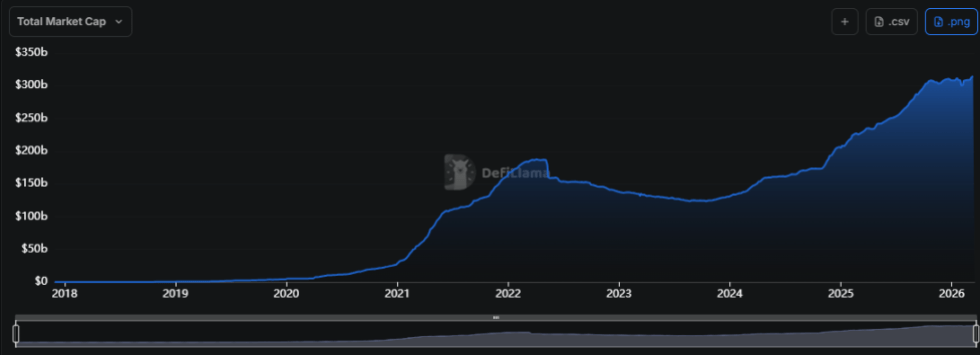
The value of the metric seems to have been moving sideways over the last few months | Source: DefiLlama

From the chart, it’s visible that the stablecoin market cap has seen its growth stall in recent months. However, unlike the rest of the sector, these assets haven’t actually faced any drawdown, at least not yet. As such, stablecoins have still been holding up relatively well in the wider context.

Bitcoin Price

At the time of writing, Bitcoin is trading around $74,700, up nearly 7% over the past week.

Looks like the price of the coin has shot up in the last couple of days | Source: BTCUSDT on TradingView


İlgili Sorular

QWhat company did Mastercard announce the acquisition of, and for how much?

AMastercard announced the acquisition of stablecoins infrastructure firm BVNK for up to $1.8 billion, including $300 million in contingent payments.

QWhy did the previous deal between BVNK and Coinbase not go through?

AThe previous merger deal between BVNK and cryptocurrency exchange Coinbase fell through in November of last year, though the specific reasons were not detailed in the article.

QHow does Mastercard's Chief Product Officer, Jorn Lambert, believe this acquisition will benefit their network?

AJorn Lambert stated that adding on-chain rails to Mastercard's network will support speed and programmability for virtually every type of transaction.

QWhat recent partnership did Visa, another major payments provider, form with BVNK?

AIn January, Visa formed a partnership with BVNK to leverage its expertise to enable stablecoin payments on the Visa Direct platform.

QWhat is the current trend in the stablecoin market cap according to data from DefiLlama?

AAccording to DefiLlama, the stablecoin market cap has seen its growth stall and has been moving sideways in recent months, though it has not faced a significant drawdown.

İlgili Okumalar

OpenAI Post-Training Engineer Weng Jiayi Proposes a New Paradigm Hypothesis for Agentic AI

OpenAI engineer Weng Jiayi's "Heuristic Learning" experiments propose a new paradigm for Agentic AI, suggesting that intelligent agents can improve not just by training neural networks, but also by autonomously writing and refining code based on environmental feedback. In the experiment, a coding agent (powered by Codex) was tasked with developing and maintaining a programmatic strategy for the Atari game Breakout. Starting from a basic prompt, the agent iteratively wrote code, ran the game, analyzed logs and video replays to identify failures, and then modified the code. Through this engineering loop of "code-run-debug-update," it evolved a pure Python heuristic strategy that achieved a perfect score of 864 in Breakout and performed competitively with deep reinforcement learning (RL) algorithms in MuJoCo control tasks like Ant and HalfCheetah. This approach, termed Heuristic Learning (HL), contrasts with Deep RL. In HL, experience is captured in readable, modifiable code, tests, logs, and configurations—a software system—rather than being encoded solely into opaque neural network weights. This offers potential advantages in explainability, auditability for safety-critical applications, easier integration of regression tests to combat catastrophic forgetting, and more efficient sample use in early learning stages, as demonstrated in broader tests on 57 Atari games. However, the blog acknowledges clear limitations. Programmatic strategies struggle with tasks requiring long-horizon planning or complex perception (e.g., Montezuma's Revenge), areas where neural networks excel. The future vision is a hybrid architecture: specialized neural networks for fast perception (System 1), HL systems for rules, safety, and local recovery (also System 1), and LLM agents providing high-level feedback and learning from the HL system's data (System 2). The core proposition is that in the era of capable coding agents, a significant portion of an AI's learned experience could be maintained as an auditable, evolving software system.

marsbit31 dk önce

OpenAI Post-Training Engineer Weng Jiayi Proposes a New Paradigm Hypothesis for Agentic AI

marsbit31 dk önce

Your Claude Will Dream Tonight, Don't Disturb It

This article explores the recent phenomenon of AI companies increasingly using anthropomorphic language—like "thinking," "memory," "hallucination," and now "dreaming"—to describe machine learning processes. Focusing on Anthropic's newly announced "Dreaming" feature for its Claude Agent platform, the piece explains that this function is essentially an automated, offline batch processing of an agent's operational logs. It analyzes past task sessions to identify patterns, optimize future actions, and consolidate learnings into a persistent memory system, akin to a form of reinforcement learning and self-correction. The article draws parallels to similar features in other AI agent systems like Hermes Agent and OpenClaw, which also implement mechanisms for reviewing historical data, extracting reusable "skills," and strengthening long-term memory. It notes a key difference from human dreaming: these AI "dreams" still consume computational resources and user tokens. Further context is provided by discussing the technical challenges of managing AI "memory" or context, highlighting the computational expense of large context windows and innovations like Subquadratic's new model claiming drastically longer contexts. The core critique argues that this strategic use of human-centric vocabulary does more than market products; it subtly reshapes user perception. By framing algorithms with terms associated with consciousness, companies blur the line between tool and autonomous entity. This linguistic shift can influence user expectations, tolerance for errors, and even perceptions of responsibility when systems fail, potentially diverting scrutiny from the companies and engineers behind the technology. The article concludes by speculating that terms like "daydreaming" for predictive task simulation might be next, continuing this trend of embedding the idea of an "inner life" into computational processes.

marsbit33 dk önce

Your Claude Will Dream Tonight, Don't Disturb It

marsbit33 dk önce

İşlemler

Spot
Futures
活动图片




