Making the Forbes Cover: Why Has It Become a Curse for Crypto Titans?

比推2026-02-06 tarihinde yayınlandı2026-02-06 tarihinde güncellendi

Özet

The article explores the so-called "Forbes Cover Curse" in the cryptocurrency industry, where major figures featured on the magazine’s often coincide with market peaks followed by sharp downturns. It highlights three key examples: - Binance’s CZ appeared in February 2018 when Bitcoin was around $7,600. Soon after, BTC fell 58%. - FTX’s SBF was featured in October 2021 near Bitcoin’s then-all-time high. Thirteen months later, FTX collapsed and SBF was sentenced to prison. - MicroStrategy’s Michael Saylor graced the cover in January 2025 with BTC above $104,000. Within a year, the price dropped 40%, and his company faced billions in unrealized losses. The piece references the “magazine cover indicator” — a classic Wall Street concept suggesting that when a trend makes it to the cover of a major publication, it’s often near its end. The author argues that Forbes covers are not the cause of the decline but a symptom of market euphoria and overexposure. A notable exception was Justin Sun’s feature in March 2025, after which Bitcoin continued to rally. However, the frequency of crypto-related covers itself was seen as a signal of overheating optimism. The conclusion urges caution: when mainstream media celebrates crypto success and public excitement peaks, it may be time to consider reducing exposure — because “bull markets end on magazine covers.”

Author: Curry, Deep Tide TechFlow

Original Title: Forbes Editorial Department, the Most Accurate Short Signal in Crypto?

Bitcoin recently plunged to $60,000, marking its largest single-day drop since the FTX collapse.

Michael Saylor's company, Strategy (formerly MicroStrategy), holds 713,000 bitcoins with an average cost of $76,052. As of last night, the unrealized loss reached $6.5 billion. The stock price has fallen from a peak of $457 last year to $110, wiping out over three-quarters of its value.

However, a year ago, Saylor graced the cover of the renowned magazine Forbes. The headline read:

"The Bitcoin Alchemist." At that time, Bitcoin was priced at $104,000, and Saylor's net worth was $9.4 billion.

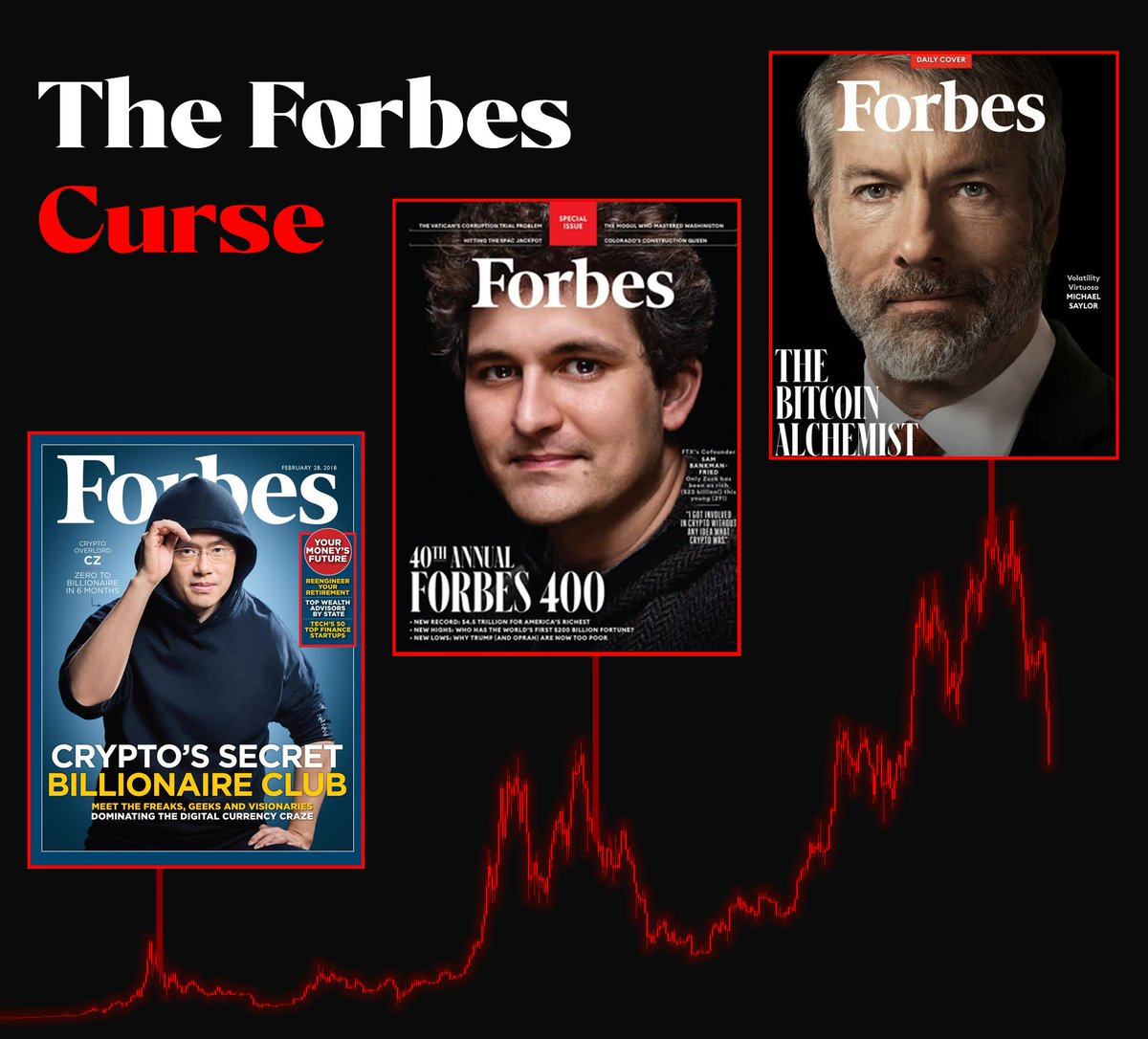
Now, a chart circulating on Twitter lines up three Forbes covers with Bitcoin's price chart below. Each cover perfectly marks the start of a sharp decline.

Of these three individuals, one has been to prison, one is currently in prison, and the third just lost $6.5 billion.

The Cover, Captured at the Peak of Hype

The first crypto figure to appear on Forbes' cover was CZ.

In February 2018, Forbes featured a cover titled "Crypto's Secret Billionaire Club," CZ stood in the center, hoodie up, exuding a rugged aura. The subtitle read:

From zero to billionaire in just 6 months.

At that time, Bitcoin had just fallen from nearly $20,000 at the end of 2017 to around $7,600. Forbes estimated CZ's net worth to be at least $1.1 billion. Binance, only six months old, was already the world's largest exchange by trading volume.

After the cover was released, Bitcoin briefly rebounded to $10,000. Then, it went nowhere but down.

By December 2018, Bitcoin had dropped to $3,156. From the day the cover was published, the decline was:

58%.

CZ's later story is well-known. On Forbes' 2025 global billionaires list, CZ's net worth was $62.9 billion, ranking first in the crypto industry.

But he hasn't been on the cover since.

The second crypto figure to appear on Forbes' cover was Sam Bankman-Fried.

In October 2021, Forbes released its 40th Forbes 400 Richest Americans list, featuring SBF on the cover. Under 30 years old, with a net worth of $26.5 billion, he was the 41st richest person in the U.S.

On the cover, he wore his signature gray T-shirt, with curly hair, looking like a college student who had just pulled an all-nighter playing League of Legends.

In hindsight, the magazine's tone was surreal. Forbes called him "the most powerful person in crypto," portraying him as a blend of Wall Street and Silicon Valley, building an exchange while donating to charity.

When the cover was released, Bitcoin was around $60,000, just a step away from its then-all-time high of $69,000.

Thirteen months later, FTX collapsed.

SBF had misappropriated over $8 billion in customer funds to cover losses at his other company, Alameda Research. In November 2022, users rushed to withdraw, and FTX couldn't meet the demand. Within a week, it went from the world's third-largest exchange to a bankrupt company. Bitcoin plummeted from $20,000 to $16,000.

Ultimately, SBF was arrested in his luxury apartment in the Bahamas.

Found guilty on all seven charges, he was sentenced to 25 years. Forbes later created a "30 Under 30 Hall of Shame," with SBF prominently featured.

From cover to handcuffs:

13 months.

The third was Michael Saylor.

On January 30, 2025, Forbes featured him on the cover with the title "The Bitcoin Alchemist." Bitcoin had just broken through $100,000, and Saylor's net worth surged from $1.9 billion the previous year to $9.4 billion, nearly quintupling. His company MicroStrategy's stock had risen 700% in a year and was newly included in the Nasdaq 100 index.

The Forbes piece included a detail:

On New Year's Eve, Saylor threw a 500-person party at his estate in Miami. Dancers waved orange Bitcoin glow balls, and outside waited a 154-foot yacht named Usher, ferrying institutional investors and crypto bigwigs to the event.

At the time, Saylor told Forbes:

"We've placed a crypto reactor in the middle of the company, sucking in capital and spinning it. Volatility drives everything." This statement was, of course, sincere. Saylor's alchemy boils down to one thing: issuing debt to buy Bitcoin.

When the Forbes cover was released, Bitcoin was at $104,000. One year and six days later, it's at $63,000. A decline of:

40%.

Saylor said on an earnings call that Strategy has built a "digital fortress."

The last crypto mogul to call his company a "fortress" was SBF. That was in June 2022. Five months later, FTX filed for bankruptcy.

The Cover: Both Praise and Curse

Wall Street has an old concept called the "magazine cover indicator":

When a trend makes it to the cover of a mainstream magazine, the trend is usually at its end.

The reasoning is simple. Forbes editors aren't prophets; like all retail investors, they only notice a story when it's at its most hyped.

The moment a magazine deems "someone in some industry worthy of a cover" is precisely the moment market frenzy peaks.

The cover isn't the cause of the curse; it's a symptom of the bubble.

However, there was one brief exception to this rule.

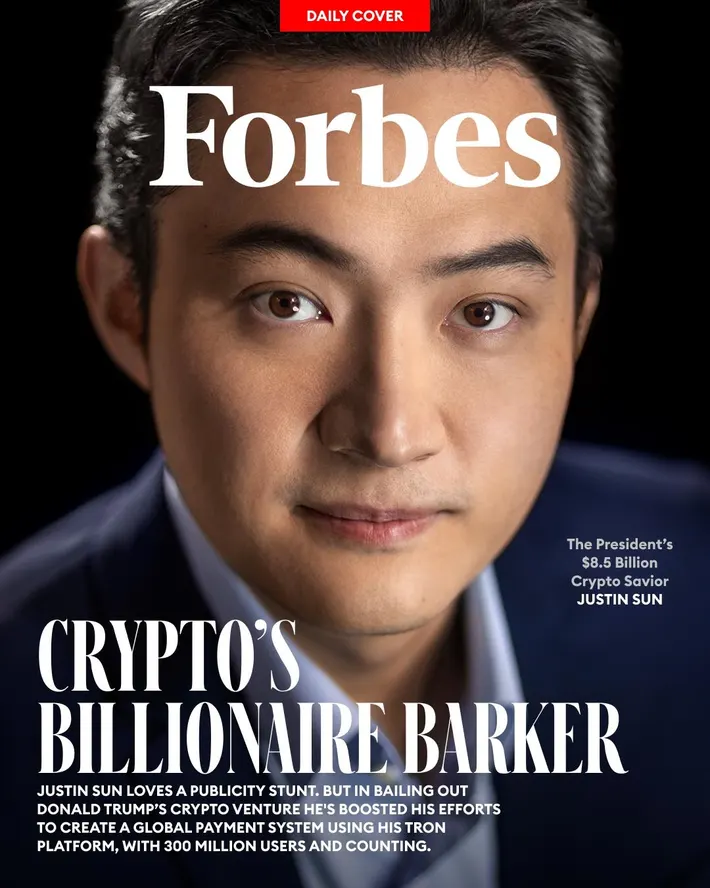
Last March, Justin Sun graced the Forbes cover with the title "The Crypto Billionaire Who Made the Trump Family $400 Million."

When the cover came out, Bitcoin was at $87,000. It didn't crash; instead, it rallied to an all-time high of $126,000 by October.
Did the curse fail?

Not entirely. When Sun appeared on the cover, it was only two months after Saylor's feature. One cover in January, another in March—the密集 appearance of crypto figures on mainstream magazine covers was itself a signal. It indicated the industry's narrative had become so hot that even Forbes editors felt one issue wasn't enough.

When covers start appearing in clusters, in hindsight, there might be a checklist of bull market top symptoms:

Forbes covers, taxi drivers discussing crypto, relatives asking how to open an account... If two out of three signals appear, it's time to reconsider your positions.

So, the real question isn't "Is the Forbes cover accurate?" but rather:

When everyone around you is telling the same story, when the story is so good even non-traders have heard of it, when mainstream media starts deifying figures in an industry...

Are you the one still buying, or the one already selling?

Bull markets don't end in panic. They end on the cover.

It's just that the cover stars may change, but the long bear market is always my bill to pay.


Twitter:https://twitter.com/BitpushNewsCN

Bitpush TG Group:https://t.me/BitPushCommunity

Bitpush TG Channel: https://t.me/bitpush

Original link:https://www.bitpush.news/articles/7609729

İlgili Sorular

QWhat is the 'magazine cover indicator' mentioned in the article, and how does it relate to the cryptocurrency market?

AThe 'magazine cover indicator' is an old Wall Street concept suggesting that when a trend makes the cover of a mainstream magazine, it has often reached its peak. In the context of the cryptocurrency market, it means that when a crypto figure like CZ, SBF, or Michael Saylor is featured on the Forbes cover, it signals the top of market euphoria and is often followed by a significant price decline.

QWhich three crypto figures were featured on Forbes covers, and what were the consequences for the market after their features?

AThe three crypto figures featured were CZ (2018), SBF (2021), and Michael Saylor (2025). After CZ's feature, Bitcoin fell 58%; after SBF's feature, FTX collapsed and Bitcoin dropped sharply; and after Saylor's feature, Bitcoin fell 40% from its high.

QWhy did the Forbes cover 'curse' seemingly not affect Justin Sun when he was featured in March?

AThe curse appeared not to affect Justin Sun immediately because his cover in March 2025 was followed by a continued bull run to a new all-time high of $126,000 in October. However, the article suggests that the high frequency of crypto covers (Saylor in January, Sun in March) was itself a symptom of peak market euphoria, a sign that the bull market was nearing its end.

QAccording to the article, what are some signals that might indicate the top of a bull market in cryptocurrency?

ASignals of a market top include a crypto figure being featured on the Forbes cover, taxi drivers talking about crypto, and relatives asking how to open a trading account. The article suggests that if two of these three signals appear, it might be time to reconsider one's investment position.

QWhat was the common outcome for the crypto billionaires who appeared on the Forbes cover, as described in the article?

AThe common outcome was a significant personal or professional downturn coinciding with a major market crash. CZ faced legal issues (though his wealth later grew), SBF was arrested and sentenced to 25 years in prison, and Michael Saylor's company faced massive paper losses on its Bitcoin holdings after the price declined.

İlgili Okumalar

Fu Peng's First Public Speech in 2026: What Exactly Are Crypto Assets? Why Did I Join the Crypto Asset Industry?

Fu Peng, a renowned macroeconomist and now Chief Economist at New火 Group, delivered his first public speech of 2026 at the Hong Kong Web3 Festival. He explained his perspective on crypto assets and why he joined the industry, framing it within the context of macroeconomic trends and financial evolution. Fu emphasized that crypto assets are transitioning from an early, belief-driven phase to a mature, institutionally integrated asset class. He drew parallels to the 1970s-80s, when technological advances (like computing) revolutionized traditional finance, leading to the rise of FICC (Fixed Income, Currencies, and Commodities). Similarly, current advancements in AI, data, and blockchain are reshaping finance, with crypto assets becoming part of a new "FICC + C" (C for Crypto) framework. He noted that institutional capital, including traditional hedge funds, avoided early crypto due to its speculative nature but are now engaging as regulatory clarity emerges (e.g., stablecoin laws, CFTC classifying crypto as a commodity). Fu predicted that 2025-2026 marks a turning point where crypto becomes a standardized, financially viable asset for diversified portfolios, akin to commodities or derivatives in traditional finance. Fu defined Bitcoin not as "digital gold" in a simplistic sense but as a value-preserving, financially tradable asset. He highlighted that crypto's future lies in regulated, institutional adoption, moving away from retail-dominated trading. His entry into crypto signals this maturation, where traditional finance integrates crypto into mainstream asset management.

marsbit35 dk önce

Fu Peng's First Public Speech in 2026: What Exactly Are Crypto Assets? Why Did I Join the Crypto Asset Industry?

marsbit35 dk önce

Justin Sun Sues Trump Family: What $75 Million Bought Was Only a Blacklist

Justin Sun, founder of Tron, has filed a lawsuit in federal court against World Liberty Financial (WLF), alleging he was made the "primary target of a fraudulent scheme" after investing $75 million. Sun claims the investment secured him an advisor title and WLFI tokens, which were later frozen by WLF, causing "hundreds of millions in losses." The dispute began in late 2024 when Sun's investment helped revive WLF's struggling token sale, which ultimately raised $550 million. Shortly after, the SEC dropped its lawsuit against Sun following Donald Trump's inauguration. However, relations soured when Sun refused WLF's demands for additional funding. In August 2025, WLF added a "blacklist" function to its smart contract, allowing it to unilaterally freeze tokens. Sun's holdings, worth approximately $107 million, were frozen, and he was threatened with token destruction. The lawsuit highlights WLF's structure, which directs 75% of token sale profits to the Trump family, who had earned $1 billion by December 2025. WLF's CEO is Zach Witkoff, son of U.S. Middle East envoy Steve Witkoff. The project faces scrutiny for opaque operations, including a controversial loan arrangement on the Dolomite platform, co-founded by a WLF advisor. Despite Sun's history with the SEC, the case underscores centralization risks within DeFi, as WLF controls governance and holds powers to freeze assets arbitrarily. Sun's tokens remain frozen as legal proceedings begin.

marsbit42 dk önce

Justin Sun Sues Trump Family: What $75 Million Bought Was Only a Blacklist

marsbit42 dk önce

$500 to Buy OpenAI Stock: Silicon Valley's Most Respectable Liquidity Invitation

Silicon Valley's largest venture capital platform, AngelList, has launched a new fund called USVC, allowing U.S. retail investors to buy into high-profile AI companies like OpenAI, Anthropic, and xAI with a minimum investment of $500—no accredited investor status required. Promoted by AngelList co-founder Naval Ravikant, the fund is framed as an opportunity for ordinary people to access high-growth private tech investments traditionally reserved for VCs. However, critics argue it functions more like an exit vehicle for early insiders. USVC acquires shares not through primary rounds but largely via secondary transactions—purchasing stakes from early investors, VC funds, and employees looking to cash out at peak valuations. With companies like xAI heavily weighted in the portfolio, the fund effectively channels retail money into providing liquidity for insiders who entered at much lower valuations. The fund’s structure raises concerns: shares are illiquid, with no secondary market, and buybacks are limited and discretionary. The actual annual fee reaches 3.61%, far above the advertised 1% management fee. This model parallels the "low float, high fully diluted valuation" strategy seen in crypto, where early investors profit by selling to latecomers at inflated prices. The timing—alongside similar moves by platforms like Robinhood—suggests that Silicon Valley’s sudden interest in retail inclusion may be less about democratizing access and more about securing exits for insiders.

marsbit1 saat önce

$500 to Buy OpenAI Stock: Silicon Valley's Most Respectable Liquidity Invitation

marsbit1 saat önce

İşlemler

Spot
Futures

Popüler Makaleler

T Nasıl Satın Alınır

HTX.com’a hoş geldiniz! Threshold Network Token (T) satın alma işlemlerini basit ve kullanışlı bir hâle getirdik. Adım adım açıkladığımız rehberimizi takip ederek kripto yolculuğunuza başlayın. 1. Adım: HTX Hesabınızı OluşturunHTX'te ücretsiz bir hesap açmak için e-posta adresinizi veya telefon numaranızı kullanın. Sorunsuzca kaydolun ve tüm özelliklerin kilidini açın. Hesabımı Aç2. Adım: Kripto Satın Al Bölümüne Gidin ve Ödeme Yönteminizi SeçinKredi/Banka Kartı: Visa veya Mastercard'ınızı kullanarak anında Threshold Network Token (T) satın alın.Bakiye: Sorunsuz bir şekilde işlem yapmak için HTX hesap bakiyenizdeki fonları kullanın.Üçüncü Taraflar: Kullanımı kolaylaştırmak için Google Pay ve Apple Pay gibi popüler ödeme yöntemlerini ekledik.P2P: HTX'teki diğer kullanıcılarla doğrudan işlem yapın.Borsa Dışı (OTC): Yatırımcılar için kişiye özel hizmetler ve rekabetçi döviz kurları sunuyoruz.3. Adım: Threshold Network Token (T) Varlıklarınızı SaklayınThreshold Network Token (T) satın aldıktan sonra HTX hesabınızda saklayın. Alternatif olarak, blok zinciri transferi yoluyla başka bir yere gönderebilir veya diğer kripto para birimlerini takas etmek için kullanabilirsiniz.4. Adım: Threshold Network Token (T) Varlıklarınızla İşlem YapınHTX'in spot piyasasında Threshold Network Token (T) ile kolayca işlemler yapın.Hesabınıza erişin, işlem çiftinizi seçin, işlemlerinizi gerçekleştirin ve gerçek zamanlı olarak izleyin. Hem yeni başlayanlar hem de deneyimli yatırımcılar için kullanıcı dostu bir deneyim sunuyoruz.

362 Toplam GörüntülenmeYayınlanma 2024.12.10Güncellenme 2025.03.21

T Nasıl Satın Alınır

Tartışmalar

HTX Topluluğuna hoş geldiniz. Burada, en son platform gelişmeleri hakkında bilgi sahibi olabilir ve profesyonel piyasa görüşlerine erişebilirsiniz. Kullanıcıların T (T) fiyatı hakkındaki görüşleri aşağıda sunulmaktadır.

活动图片