Make crypto games great again? ‘Trump Billionaires Club’ launches this month

cointelegraph2025-12-10 tarihinde yayınlandı2025-12-10 tarihinde güncellendi

Özet

A Trump-themed crypto mobile game, "Trump Billionaires Club," is set to launch on the Apple App Store by December 30. Created by Freedom 45 Games and linked to the TRUMP Coin, the game operates under a licensing agreement to use Trump’s name. It features a Monopoly-style board where players use dice rolls to earn funds for construction and other activities. The game integrates cryptocurrency and NFTs, allowing players to fund accounts with cash, crypto, or TRUMP Coin, and trade in-game items. A pre-launch airdrop of Trump tokens is offered to top performers. However, a disclaimer states the game is not affiliated with Donald Trump, his businesses, or any campaign, and collectibles are for enjoyment, not investment. This launch occurs as the Trump memecoin has dropped 92% from its all-time high, though it saw a slight uptick following the game's announcement.

A Trump-themed crypto mobile game, created by Bill Zanker, a member of the team that helped launch the official Trump memecoin and various NFT collections, is reportedly set to be released on the Apple App Store before the end of the year.

The game uses Trump’s name under a licensing agreement and is being created by Freedom 45 Games, according to the game’s website. It is also tied in with the Trump Coin.

The Apple App Store has an expected release date of Dec. 30, and the app is currently in pre-registration.

Zanker was already linked to a project blending gaming and cryptocurrency elements in April, with the project reportedly bearing some similar aspects to MONOPOLY GO; however, at the time, a spokesperson denied any similarity to Monopoly.

On the game’s website, it lists cash, cryptocurrency, or TRUMP Coin as ways to fund a game account and mentions trading non-fungible token statues and pins that can be used in the game.
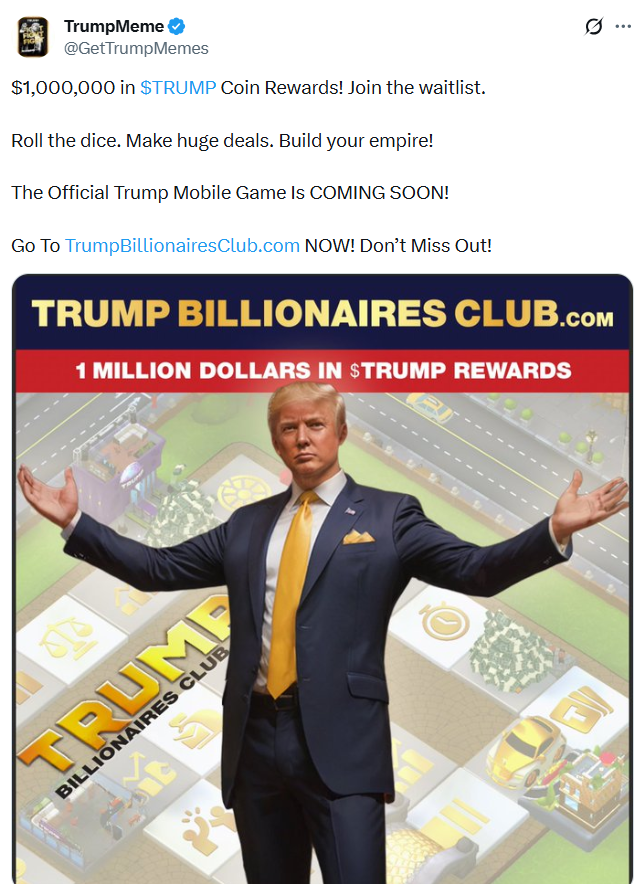
Source: TrumpMeme

However, a disclaimer outlines that it’s not designed, manufactured, or distributed by US President Donald Trump or any of his businesses or affiliates.

The Trump Billionaires Club didn’t immediately respond to a request for comment.

Trump game features crypto elements

A demo of Trump Billionaires Club on its website appear to feature a digital version of New York and show a player using dice rolls to move around a Monopoly-style gameboard, earning funds for constructions and other activities.

The game also offers an air drop of Trump tokens to whoever earns the most points pre-launch, which can be gained by opening an account, holding the TRUMP coin, and referring new users to the project.

Related: Trump’s national security strategy is silent on crypto, blockchain

Trump memecoin is down 92% from ATH

The new Trump-themed crypto game comes at a challenging time for Trump’s memecoin holders.

The Official Trump memecoin launched days before Donald Trump took office on Jan. 20. It surged to an all-time high of over $73 a day after launch — with its value reaching over $14.5 billion — but has since dropped over 92% to trade at $5.89 as of Wednesday, according to CoinGecko. Over the last 24 hours, since the game announcement, the token has seen a 3.4% increase.

Under the disclaimer, the game collectibles are said to be for “enjoyment only,” not for “investment purposes,” and are not connected to “any political campaign.”

Trump’s crypto ventures, and those bearing his name, have come under scrutiny from Democrat lawmakers in the US who have previously demanded an investigation from the financial regulators and the government ethics office.

Magazine: When privacy and AML laws conflict: Crypto projects’ impossible choice

İlgili Okumalar

AI "Transfer Station" Earning Millions Monthly? Five Questions Uncover the Truth of Token Arbitrage

The article "AI 'Transfer Station' Earns Millions Monthly? Five Questions Uncover the Truth of Token Arbitrage" explores the emerging business of API token transfer stations, which profit from global AI service price disparities and access barriers. These intermediaries purchase low-cost tokens from overseas AI providers (e.g., OpenAI, Claude) through grey-market methods—such as exploiting enterprise credits, bulk accounts, or subscription benefits—and resell them to Chinese users at a markup. Key drivers include the high cost of using top AI models (e.g., Claude Code costs ~$5 per million tokens), the performance gap between domestic and foreign models, and mismatches between subscription and API pricing. However, the practice carries significant risks: upstream token sources may be unstable or illegal; user data passing through intermediaries can be harvested or injected with hidden prompts; and models might be downgraded without disclosure. The market is evolving, with some operators now exporting cheaper Chinese models (e.g., Qwen3.5 at ~$0.11 per million tokens) to overseas users, leveraging price gaps. Yet, sustainability is low due to compliance crackdowns, instability, and reputational risks. Users are advised to employ detection methods (e.g., prompt adherence tests) and avoid sensitive data usage. The authors caution that while transfer stations offer short-term arbitrage, they lack long-term reliability and security compared to official APIs.

marsbit10 dk önce

AI "Transfer Station" Earning Millions Monthly? Five Questions Uncover the Truth of Token Arbitrage

marsbit10 dk önce

The Cost of an 11.5% Annualized Return: Will MicroStrategy's STRC Face a Moment of Reckoning?

This article analyzes the potential risks associated with MicroStrategy's (MSTR) use of structured financial products like STRC to leverage its BTC exposure. While these tools have enabled impressive returns (e.g., 11.5% annualized) and fueled significant capital inflows ($13.5B outstanding), they also create substantial annual dividend obligations (~$400M). The author argues that this structure, while effective in a bull market, could become a liability if BTC price stagnates or declines. The core risk is a potential negative feedback loop: the growing dividend burden from continued STRC issuance may eventually outweigh the benefits of increased BTC holdings. To meet these obligations, MicroStrategy might need to use new issuance proceeds for dividends instead of buying more BTC, which could disappoint equity investors. If the market capitalization (mNAV) falls below the value of its BTC holdings, the company could be forced to sell BTC instead of issuing new shares, potentially triggering a panic. The author estimates a potential inflection point in 6 months, where annual dividend costs reach $3-4B. At that stage, CEO Michael Saylor might face a difficult choice: sell BTC to meet obligations or sacrifice the credibility of the preferred shares by halting dividends. The article concludes that this financial engineering, while powerful, could ultimately "backfire" on MicroStrategy if market conditions turn.

marsbit1 saat önce

The Cost of an 11.5% Annualized Return: Will MicroStrategy's STRC Face a Moment of Reckoning?

marsbit1 saat önce

İşlemler

Spot
Futures
活动图片




