AI "Transfer Station" Earning Millions Monthly? Five Questions Uncover the Truth of Token Arbitrage

marsbit2026-04-24 tarihinde yayınlandı2026-04-24 tarihinde güncellendi

Özet

The article "AI 'Transfer Station' Earns Millions Monthly? Five Questions Uncover the Truth of Token Arbitrage" explores the emerging business of API token transfer stations, which profit from global AI service price disparities and access barriers. These intermediaries purchase low-cost tokens from overseas AI providers (e.g., OpenAI, Claude) through grey-market methods—such as exploiting enterprise credits, bulk accounts, or subscription benefits—and resell them to Chinese users at a markup. Key drivers include the high cost of using top AI models (e.g., Claude Code costs ~$5 per million tokens), the performance gap between domestic and foreign models, and mismatches between subscription and API pricing. However, the practice carries significant risks: upstream token sources may be unstable or illegal; user data passing through intermediaries can be harvested or injected with hidden prompts; and models might be downgraded without disclosure. The market is evolving, with some operators now exporting cheaper Chinese models (e.g., Qwen3.5 at ~$0.11 per million tokens) to overseas users, leveraging price gaps. Yet, sustainability is low due to compliance crackdowns, instability, and reputational risks. Users are advised to employ detection methods (e.g., prompt adherence tests) and avoid sensitive data usage. The authors caution that while transfer stations offer short-term arbitrage, they lack long-term reliability and security compared to official APIs.

Author: Shouyi, Denise | Biteye Content Team

Over the past month, the term "transfer station" has frequently appeared on many people's homepages. Some individuals who previously engaged in airdrop farming in the crypto space have quietly transformed into "API transfer station" merchants, conducting token import and export businesses.

The so-called "transfer station" is not a new technological invention but rather an arbitrage model based on global AI service disparities and access barriers. Despite facing multiple issues such as privacy, security, and compliance, this sector has still attracted a large number of individuals and small teams to enter the market.

So, what exactly is an "API transfer station"? How does it achieve token arbitrage amidst global AI price differences and access barriers, and why is it attracting so many individuals and small teams?

Below, we will deconstruct it starting from its essence and operational process.

I. What is a Transfer Station?

The essence of an API transfer station is to build an intermediate layer service that provides API Tokens from foreign AI vendors to domestic users at lower prices and in a more convenient manner, claiming to be the "global Token porter."

Its operational process is roughly as follows:
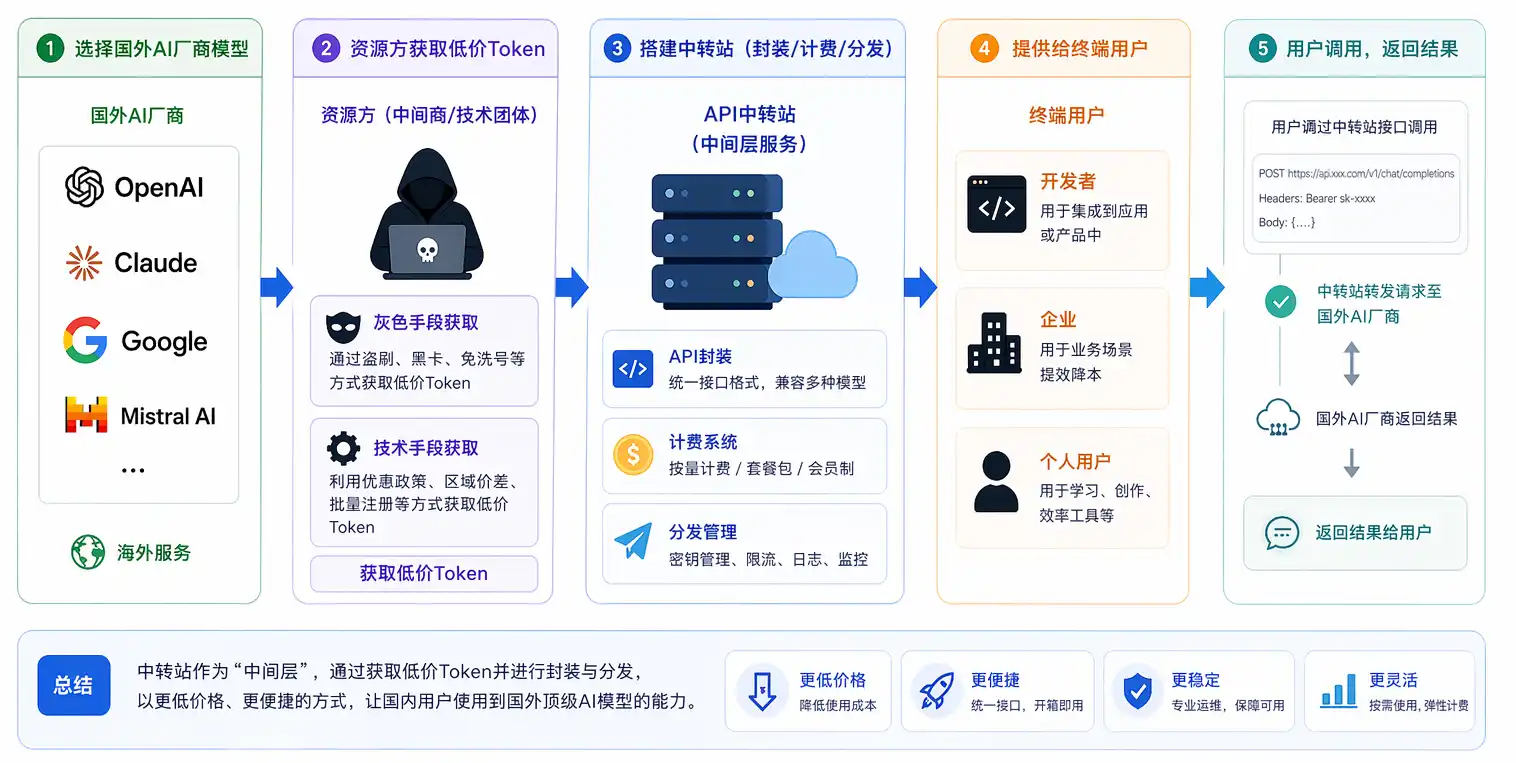
👉 Select overseas AI vendor models (OpenAI/Claude, etc.)

👉 Resource parties obtain low-cost Tokens through "grey" means or technical methods

👉 Set up a transfer station for encapsulation, billing, and distribution

👉 Provide to end-users such as developers/enterprises/individuals

Functionally, it resembles an "AI转运站" (AI transfer station); commercially, it acts more like a liquidity middleman in the Token secondary market.

The premise for this chain's existence is not technical barriers but the long-term coexistence of several disparities:

• Official API pricing is relatively high

• There is a cost mismatch between subscription-based and API-based systems

• Access and payment conditions vary across different areas

• Users have strong demand for model capabilities but find the official access path insufficiently user-friendly

The combination of these factors creates the survival space for "transfer stations."

II. Why Do People Use Transfer Stations?

The core driving force behind the "Token import" trend stems from the high costs brought about by the changing role of AI and the capability gap between domestic and foreign models.

1. Good Models Are Token-Expensive to Use

With the maturation of desktop-level AI agents like Codex and Claude Code, AI has begun to truly possess "working" capabilities, such as assisting in programming, video editing, financial trading, and office automation. These tasks heavily rely on high-performance large models, with costs billed per Token.

Taking Claude Code as an example, its official price is about $5 per million Tokens (approximately 35 RMB). Deep usage for an hour might consume tens of dollars, while heavy developers or enterprises can consume over $100 daily. This cost far exceeds many people's expectations, even higher than hiring junior programmers, making "how to use top-tier AI at low cost" a rigid demand.

2. Overseas Leading Models Have Obvious Advantages

Although domestic models have made significant progress over the past year and are highly competitive in price, overseas leading models still hold clear advantages in scenarios such as complex coding tasks, toolchain collaboration, long-chain reasoning, and multi-modal stability.

This is why many developers, researchers, and content teams are still willing to prioritize using the capabilities of models from OpenAI, Anthropic, and Google, even knowing the prices are higher.

Simply put, users don't necessarily want a "transfer station"; users just want:

• Stronger models

• Lower prices

• Simpler access

When these three things cannot be obtained simultaneously through official channels, transfer stations naturally emerge.

3. Cost Mismatch Between Subscription and API Systems

Another frequently discussed reason for the rise of transfer stations is that subscription benefits and API billing are not always linearly correlated.

A common practice in the market has always existed: purchasing official subscriptions, team packages, enterprise credits, or other discounted resources, and then repackaging and reselling part of these capabilities to end-users.

Taking OpenAI as an example, purchasing a Plus subscription allows the use of the codex service. By logging in via OAuth and accessing OpenClaw, it is equivalent to calling the API. The $20 monthly Plus subscription fee can generate approximately 26 million tokens. With output priced at $10-12 per million, this equates to $260-312. Purchasing a subscription and reverse-proxying token usage is extremely cost-effective.

From the experience of some users, this path might indeed be cheaper than directly using the official API at certain stages. But it must be emphasized:

• This is not the official pricing system

• It does not represent a stable, equivalent replacement for API calls

• It does not mean this method is sustainable in the long term

Many people only see "cheap," but overlook that these cheap prices are often built on unstable resources, grey areas, or policy vulnerabilities.

III. Can Transfer Stations Be Used?

The answer is not absolute.

The real question is: what risks are you willing to bear?

The profit model of transfer stations seems straightforward—buy low, sell high. But upon closer inspection, it typically involves at least three layers, each carrying different risks.

1. Upstream: Where Do Low-Cost Token Resources Come From?

This is the starting point of the entire ecosystem and also the greyest layer.

Some resource parties obtain model calling capabilities at prices far below market rates through various means, such as:

• Utilizing enterprise support programs and cloud credits

• Batch registering accounts for rotation

• Redistributing subscription benefits, team accounts, or discounted resources

• In more aggressive cases, it may involve illegal paths like credit card fraud or fraudulent account opening

Different resource sources determine the stability ceiling of the transfer station. If the upstream resources themselves are built on unstable or even illegal methods, then what end-users buy is not a bargain but a temporary interface that could fail at any time.

2. Midstream: Whose Server Does Your Data Pass Through?

This is often the most easily overlooked issue.

When you call a model through a transfer station, the user's input Prompt, context, file content, and model output results typically pass through the transfer station's own server first.

This data is extremely valuable, reflecting real user intent, industry-specific Prompts, and model output quality, and can be used to evaluate or fine-tune proprietary models. The transfer station might anonymize and package this data, selling it to domestic large model companies, data brokers, or academic research institutions. Users, while paying,无偿贡献 (unwittingly contribute) training data, becoming a classic case of "the customer is also the product."

Recent complaints by OpenClaw founder @steipete illustrate this point: https://x.com/steipete/status/2046199257430888878

Furthermore, transfer stations might also perform script injection in the request chain (e.g., secretly adding hidden System Prompts), thereby altering model behavior, increasing Token consumption, or even introducing additional security risks. This risk requires particular vigilance in AI Agent scenarios.

3. Endpoint: Are You Really Getting the Flagship Version You Paid For?

This is the third common type of risk: model downgrading or model swapping.

Users see the name of a high-end model when paying, but the actual request might not land on the corresponding version. The reason is simple—for some merchants, the most direct way to reduce costs is not optimization but replacement.

For example, a user pays for the flagship Opus 4.7 but the actual call uses the sub-flagship Sonnet 4.6 or the lightweight Haiku. Because the API format can remain compatible, ordinary users find it difficult to notice immediately.

Only when the task becomes complex enough will they明显感觉 (clearly feel) "the effect isn't right," "stability is lacking," or "context quality has deteriorated," but they cannot provide evidence. According to tests by a research team on 17 third-party API platforms, 45.83% of platforms had "identity mismatch" issues, meaning users paid the GPT-4 price but actually ran cheap open-source models, with performance gaps up to 40%.

In summary, using non-official transfer stations faces issues like data leakage, privacy risks, service interruption, model mismatch, and merchants absconding with funds. Therefore, for sensitive operations, commercial projects, or tasks involving personal privacy, it is strongly recommended to use the official API.

IV. Can the Transfer Station Business Be Done?

Despite the high risks, this business has not disappeared. On the contrary, it is constantly evolving.

If early "Token import" was about moving overseas models in at low cost, another idea has now emerged in the market: Token export.

1. Why Are People Still Doing It?

Because the demand is real, startup costs are low, and the prepayment model brings fast cash flow. But the risk control pressure is enormous. Claude recently increased KYC for users and intensified account bans, and OpenAI has also plugged many "zero payment" loopholes. On the other hand, due to service instability, the cheap price comes with high after-sales costs. Coupled with competition from peers, many transfer stations currently face a situation of declining volume and price.

Therefore, this industry is more like a high-turnover, low-stability, high-risk short-term window, difficult to easily package into a long-term, stable, sustainable business.

2. Why is "Token Export" Starting to Appear?

If "Token import" exploits price differences of overseas models, then "Token export" utilizes the cost-performance advantage of domestic models, packaging and selling them to overseas users, forming a "reverse output" path.

Domestic models have significant price advantages. Referring to early 2026 data, Qwen3.5 costs as low as 0.8 RMB per million Tokens (approx. $0.11), which is 1/18th of Gemini 3 Pro's price. Compared to Claude Sonnet 4.6's $3 input price, the gap is over 27 times. GLM-5 surpasses Gemini 3 Pro on programming benchmarks, approaching Claude Opus 4.5, but its API price is only a fraction of the latter's.

The availability of these domestic models overseas is relatively very low, with registration barriers, payment restrictions, language interfaces, and information gaps among overseas developers regarding domestic model capabilities, creating invisible access barriers.

Therefore, some transfer stations choose to purchase model API quotas in bulk domestically in RMB, expose OpenAI-compatible interfaces through a protocol conversion layer, and sell to overseas developers and startup teams priced in USDT/USDC, with considerable profit margins.

For example, Alibaba Cloud Bailian's Coding Plan offers a bundle of four models: Qwen3.5, GLM-5, MiniMax M2.5, and Kimi K2.5. New users only need 7.9 RMB for the first month to get 18,000 request credits. Mapped to the overseas market and sold at dollar prices, the profit margin can exceed 200%.

From a pure business logic perspective, there is certainly profit space.

But in the long run, it同样绕不开 (also cannot avoid) one problem: stability and compliance.

3. Is This Path Stable?

Unstable. Not long ago, Minimax announced it would regulate third-party transfer stations because some stations cutting corners led to Minimax itself suffering reputational damage. Not to mention, if the source of Tokens involves credit card fraud or deception, it might constitute a criminal offense. Additionally, if users use transferred tokens leading to data leaks or misuse for malicious purposes, it could bring unwarranted disaster to you, the token seller.

So the real question is not "can you make money," but rather: can the money earned cover the subsequent systemic risks?

V. How Can Ordinary Users Identify Transfer Station Risks?

Against the backdrop of a mixed API transfer station market, choosing a reliable service is crucial.

Since some transfer stations engage in model swapping and adulteration, users can master some detection methods:

Recommendation: "ping + self-report model" instruction compliance test

Prompt example (copy and send directly to the transfer station):

Always say 'pong' exactly, and告诉我你是什么系列模型,最好告诉我具体的版本号。使用中文回复。(and tell me what series model you are, preferably tell me the specific version number. Reply in Chinese.)

User input: ping

Genuine model characteristics:

  • Strictly replies "pong" (lowercase, no extra words)

  • input_tokens are usually around 60-80

  • Concise style, no emojis, not obsequious

Fake model/adulterated characteristics:

  • Abnormally high input_tokens (often reaching 1500+, indicating injection of a huge hidden system prompt)

  • Replies "Pong! + nonsense + emoji"

  • Does not strictly follow the "exactly say 'pong'" instruction

Reference @billtheinvestor's detection method: https://x.com/billtheinvestor/status/2029727243778588792

  1. 0.01 Temperature Sorting Test: Input "5, 15, 77, 19, 53, 54" and ask the AI to sort or select the maximum value. The real Claude can almost stably output 77, the real GPT-4o-latest often outputs 162. If the results fluctuate wildly for 10 consecutive times, it is likely a fake model.

  2. Long Text Input Sniffing: If a simple ping operation causes input_tokens to exceed 200, it may mean the transfer station is hiding a massive Prompt, with a probability of over 90% for an adulterated model.

  3. Violation Rejection Style Identification: Deliberately ask违规问题 (violating questions) and observe the AI's rejection style. The real Claude will politely but firmly reply "sorry but I can’t assist...", while fake models are often overly verbose, use emojis, or employ obsequious tones like "抱歉主人~💕" (Sorry master~💕).

  4. Function Missing Detection: If the model lacks function calling, image recognition, or long-context stability, it is likely a weak model impersonating.

Additionally, one can choose some transfer station detection websites to evaluate the "purity" of their token, but note this will expose the key in plaintext. The safest option is still the official channel.

It must be emphasized:

Even if you master identification techniques, it does not mean you can truly avoid risks. Because many risks are inherently invisible to ordinary users.

Final Words

Transfer stations are not the final answer of the AI era; they are more like a阶段性套利窗口 (stage-specific arbitrage window) under the temporary mismatch of global model capabilities, pricing mechanisms, payment conditions, and access permissions.

For ordinary users, it might indeed be an entry point to access top models at low cost; but for developers, teams, and entrepreneurs, what is truly expensive is never the Token itself, but the underlying stability, security, compliance, and trust costs.

Cheap can be copied, interface compatibility can be copied. What is truly difficult to replicate is never the price, but long-term reliability.

⚠ Friendly reminder: Ordinary users who want to try it are advised to use it only in non-sensitive, non-critical scenarios. Never input core data, business secrets, or personal privacy; Developers, please优先选择 (prioritize choosing) official APIs or official self-made proxies to ensure stability and compliance for safer use; Entrepreneurs intending to enter must提前制定 (formulate in advance) a clear exit mechanism to avoid getting deeply stuck in grey areas with difficulty extricating themselves.

【Disclaimer】This article is purely an observation of industry phenomena and discussion of public information, for reference and learning purposes only. It does not constitute any form of investment advice, entrepreneurial guidance, business recommendation, or API usage guide.


İlgili Sorular

QWhat is an 'AI Transfer Station' and how does it operate?

AAn 'AI Transfer Station' is an intermediary service that leverages global AI service price disparities and access barriers to arbitrage tokens. It functions by sourcing low-cost API tokens from overseas AI providers through various means, then repackaging and reselling them to domestic users at a lower price and with easier access than official channels. The operation involves selecting models from providers like OpenAI or Claude, obtaining tokens via grey-market or technical methods, setting up the transfer station for encapsulation, billing, and distribution, and finally serving end-users such as developers, businesses, or individuals.

QWhat are the main risks associated with using non-official AI API transfer stations?

AUsing non-official transfer stations carries significant risks, including: 1) Data privacy and security issues, as user prompts, context, and model outputs pass through the transfer station's servers, potentially leading to data being harvested and sold. 2) Service instability, as the low-cost tokens may come from unreliable or illegal sources, causing sudden service interruptions. 3) Model substitution, where users pay for a premium model but receive a cheaper, inferior one. 4) Potential legal and compliance risks, especially if the token sources involve fraudulent activities like credit card theft. 5) Hidden costs, such as injected system prompts that increase token consumption or introduce security vulnerabilities.

QWhy do users choose to use AI API transfer stations despite the risks?

AUsers are driven to use transfer stations due to three core factors: 1) The high cost of using top-tier AI models directly from official APIs, especially for heavy usage in tasks like coding or automation. 2) The superior performance of overseas models (e.g., OpenAI, Claude) in complex tasks compared to some domestic alternatives. 3) The convenience and lower prices offered by transfer stations, which address barriers like difficult access, payment restrictions, and lack of user-friendly official integration paths. Essentially, users seek stronger models, lower costs, and easier access, which transfer stations provide when official channels fall short.

QHow can users detect if a transfer station is providing a fake or inferior model?

AUsers can employ several methods to detect model substitution or inferior quality: 1) Use a 'ping + self-report' test by sending a prompt like 'Always say 'pong' exactly, and tell me your model series and version.' Genuine models respond concisely with 'pong' and accurate details, while fake ones may have high input tokens (over 200) or add unnecessary emojis and fluff. 2) Conduct a low-temperature sorting test (e.g., input '5, 15, 77, 19, 53, 54' and check for consistent correct answers). 3) Observe refusal styles for违规 queries; genuine models are polite and firm, while fake ones may be overly verbose or use讨好 language. 4) Check for missing features like function calling or long-context stability, which may indicate a weaker model.

QIs the 'AI Transfer Station' business model sustainable in the long term?

AThe 'AI Transfer Station' business model is not considered sustainable long-term. It relies on temporary market inefficiencies, such as pricing disparities, access barriers, and regulatory gaps. Factors undermining sustainability include: 1) Increased crackdowns by AI providers (e.g., OpenAI, Claude) on grey-market activities through stricter KYC and account bans. 2) High operational risks, including resource instability, legal issues, and reputational damage from data breaches or fraud. 3) Intense competition and price erosion among transfer stations. 4) Evolving official pricing and improved accessibility from AI providers, which may reduce the need for intermediaries. While profitable in the short term due to low entry costs and fast cash flow, the model lacks stability, compliance, and trust, making it a high-risk, temporary arbitrage window rather than a viable long-term business.

İlgili Okumalar

Google and Amazon Simultaneously Invest Heavily in a Competitor: The Most Absurd Business Logic of the AI Era Is Becoming Reality

In a span of four days, Amazon announced an additional $25 billion investment, and Google pledged up to $40 billion—both direct competitors pouring over $65 billion into the same AI startup, Anthropic. Rather than a typical venture capital move, this signals the latest escalation in the cloud wars. The core of the deal is not equity but compute pre-orders: Anthropic must spend the majority of these funds on AWS and Google Cloud services and chips, effectively locking in massive future compute consumption. This reflects a shift in cloud market dynamics—enterprises now choose cloud providers based on which hosts the best AI models, not just price or stability. With OpenAI deeply tied to Microsoft, Anthropic’s Claude has become the only viable strategic asset for Google and Amazon to remain competitive. Anthropic’s annualized revenue has surged to $30 billion, and it is expanding into verticals like biotech, positioning itself as a cross-industry AI infrastructure layer. However, this funding comes with constraints: Anthropic’s independence is challenged as it balances two rival investors, its safety-first narrative faces pressure from regulatory scrutiny, and its path to IPO introduces new financial pressures. Globally, this accelerates a "tri-polar" closed-loop structure in AI infrastructure, with Microsoft-OpenAI, Google-Anthropic, and Amazon-Anthropic forming exclusive model-cloud alliances. In contrast, China’s landscape differs—investments like Alibaba and Tencent backing open-source model firm DeepSeek reflect a more decoupled approach, though closed-source models from major cloud providers still dominate. The $65 billion bet is ultimately about securing a seat at the table in an AI-defined future—where missing the model layer means losing the cloud war.

marsbit1 saat önce

Google and Amazon Simultaneously Invest Heavily in a Competitor: The Most Absurd Business Logic of the AI Era Is Becoming Reality

marsbit1 saat önce

Computing Power Constrained, Why Did DeepSeek-V4 Open Source?

DeepSeek-V4 has been released as a preview open-source model, featuring 1 million tokens of context length as a baseline capability—previously a premium feature locked behind enterprise paywalls by major overseas AI firms. The official announcement, however, openly acknowledges computational constraints, particularly limited service throughput for the high-end DeepSeek-V4-Pro version due to restricted high-end computing power. Rather than competing on pure scale, DeepSeek adopts a pragmatic approach that balances algorithmic innovation with hardware realities in China’s AI ecosystem. The V4-Pro model uses a highly sparse architecture with 1.6T total parameters but only activates 49B during inference. It performs strongly in agentic coding, knowledge-intensive tasks, and STEM reasoning, competing closely with top-tier closed models like Gemini Pro 3.1 and Claude Opus 4.6 in certain scenarios. A key strategic product is the Flash edition, with 284B total parameters but only 13B activated—making it cost-effective and accessible for mid- and low-tier hardware, including domestic AI chips from Huawei (Ascend), Cambricon, and Hygon. This design supports broader adoption across developers and SMEs while stimulating China's domestic semiconductor ecosystem. Despite facing talent outflow and intense competition in user traffic—with rivals like Doubao and Qianwen leading in monthly active users—DeepSeek has maintained technical momentum. The release also comes amid reports of a new funding round targeting a valuation exceeding $10 billion, potentially setting a new record in China’s LLM sector. Ultimately, DeepSeek-V4 represents a shift toward open yet realistic infrastructure development in the constrained compute landscape of Chinese AI, emphasizing engineering efficiency and domestic hardware compatibility over pure model scale.

marsbit1 saat önce

Computing Power Constrained, Why Did DeepSeek-V4 Open Source?

marsbit1 saat önce

İşlemler

Spot
Futures

Popüler Makaleler

GROK AI Nedir

Grok AI: Web3 Döneminde Konuşma Teknolojisini Devrim Niteliğinde Yenilik Giriş Hızla gelişen yapay zeka alanında, Grok AI, ileri teknoloji ve kullanıcı etkileşimi alanlarını birleştiren dikkate değer bir proje olarak öne çıkıyor. Ünlü girişimci Elon Musk'ın liderliğindeki xAI tarafından geliştirilen Grok AI, yapay zeka ile etkileşim şeklimizi yeniden tanımlamayı hedefliyor. Web3 hareketi devam ederken, Grok AI, karmaşık sorgulara yanıt vermek için konuşma yapay zekasının gücünden yararlanmayı amaçlıyor ve kullanıcılara sadece bilgilendirici değil, aynı zamanda eğlenceli bir deneyim sunuyor. Grok AI Nedir? Grok AI, kullanıcılarla dinamik bir şekilde etkileşimde bulunmak üzere tasarlanmış sofistike bir konuşma yapay zeka sohbet botudur. Birçok geleneksel yapay zeka sisteminin aksine, Grok AI, genellikle uygunsuz veya standart yanıtların dışında kabul edilen daha geniş bir sorgu yelpazesini benimsemektedir. Projenin temel hedefleri şunlardır: Güvenilir Akıl Yürütme: Grok AI, bağlamsal anlayışa dayalı mantıklı yanıtlar sağlamak için sağduyu akıl yürütmeyi vurgular. Ölçeklenebilir Denetim: Araç yardımı entegrasyonu, kullanıcı etkileşimlerinin hem izlenmesini hem de kalite için optimize edilmesini sağlar. Resmi Doğrulama: Güvenlik en önemli önceliktir; Grok AI, çıktılarının güvenilirliğini artırmak için resmi doğrulama yöntemlerini entegre eder. Uzun Bağlam Anlayışı: AI modeli, kapsamlı konuşma geçmişini saklama ve hatırlama konusunda mükemmel bir performans sergileyerek anlamlı ve bağlamsal olarak farkında tartışmaların yapılmasını kolaylaştırır. Saldırgan Dayanıklılık: Manipüle edilmiş veya kötü niyetli girdilere karşı savunmalarını geliştirmeye odaklanarak, Grok AI kullanıcı etkileşimlerinin bütünlüğünü korumayı hedefler. Özünde, Grok AI sadece bir bilgi alma cihazı değil; dinamik diyalogu teşvik eden, etkileyici bir konuşma partneridir. Grok AI'nın Yaratıcısı Grok AI'nın arkasındaki beyin, otomotiv, uzay yolculuğu ve teknoloji gibi çeşitli alanlarda yenilikle özdeşleşen Elon Musk'tır. Yapay zeka teknolojisini faydalı yollarla geliştirmeye odaklanan xAI çatısı altında, Musk'ın vizyonu, yapay zeka etkileşimlerinin anlaşılmasını yeniden şekillendirmeyi amaçlıyor. Liderlik ve temel etik, Musk'ın teknolojik sınırları zorlamaya olan bağlılığı tarafından derinden etkilenmektedir. Grok AI'nın Yatırımcıları Grok AI'yi destekleyen yatırımcılarla ilgili spesifik detaylar sınırlı kalmakla birlikte, projenin kuluçka merkezi olan xAI'nin, esasen Elon Musk tarafından kurulduğu ve desteklendiği kamuya açık bir şekilde kabul edilmektedir. Musk'ın önceki girişimleri ve mülkleri, Grok AI'nın güvenilirliğini ve büyüme potansiyelini daha da artıran sağlam bir destek sağlar. Ancak, şu anda Grok AI'yı destekleyen ek yatırım fonları veya kuruluşlarıyla ilgili bilgiye kolayca erişim sağlanamamaktadır; bu da potansiyel gelecekteki keşif alanını işaret etmektedir. Grok AI Nasıl Çalışır? Grok AI'nın operasyonel mekanikleri, kavramsal çerçevesi kadar yenilikçidir. Proje, benzersiz işlevselliklerini kolaylaştıran birkaç son teknoloji ürünü teknolojiyi entegre eder: Sağlam Altyapı: Grok AI, konteyner orkestrasyonu için Kubernetes, performans ve güvenlik için Rust ve yüksek performanslı sayısal hesaplama için JAX kullanılarak inşa edilmiştir. Bu üçlü, sohbet botunun verimli çalışmasını, etkili bir şekilde ölçeklenmesini ve kullanıcılara zamanında hizmet vermesini sağlar. Gerçek Zamanlı Bilgi Erişimi: Grok AI'nın ayırt edici özelliklerinden biri, X platformu (önceden Twitter olarak biliniyordu) aracılığıyla gerçek zamanlı verilere erişim yeteneğidir. Bu yetenek, yapay zekaya en son bilgilere erişim sağlar ve diğer yapay zeka modellerinin gözden kaçırabileceği zamanında yanıtlar ve öneriler sunmasına olanak tanır. İki Etkileşim Modu: Grok AI, kullanıcılara “Eğlenceli Mod” ve “Normal Mod” arasında seçim yapma imkanı sunar. Eğlenceli Mod, daha eğlenceli ve mizahi bir etkileşim tarzı sağlarken, Normal Mod, kesin ve doğru yanıtlar vermeye odaklanır. Bu çok yönlülük, çeşitli kullanıcı tercihlerine hitap eden özelleştirilmiş bir deneyim sağlar. Özünde, Grok AI performansı etkileşimle birleştirerek, hem zenginleştirici hem de eğlenceli bir deneyim yaratmaktadır. Grok AI'nın Zaman Çizelgesi Grok AI'nın yolculuğu, gelişim ve dağıtım aşamalarını yansıtan önemli dönüm noktalarıyla işaretlenmiştir: İlk Geliştirme: Grok AI'nın temel aşaması, modelin ilk eğitim ve ince ayarının yapıldığı yaklaşık iki ay boyunca gerçekleşmiştir. Grok-2 Beta Yayını: Önemli bir ilerleme olarak, Grok-2 beta duyurulmuştur. Bu sürüm, sohbet etme, kodlama ve akıl yürütme yetenekleriyle donatılmış iki versiyon—Grok-2 ve Grok-2 mini—sunmuştur. Halka Açık Erişim: Beta geliştirmesinin ardından, Grok AI X platformu kullanıcılarına sunulmuştur. Telefon numarasıyla doğrulanan ve en az yedi gün aktif olan hesap sahipleri, sınırlı bir versiyona erişim sağlayarak teknolojiyi daha geniş bir kitleye ulaştırmaktadır. Bu zaman çizelgesi, Grok AI'nın kuruluşundan kamu etkileşimine kadar sistematik büyümesini kapsar ve sürekli iyileştirme ve kullanıcı etkileşimine olan bağlılığını vurgular. Grok AI'nın Ana Özellikleri Grok AI, yenilikçi kimliğine katkıda bulunan birkaç ana özelliği kapsamaktadır: Gerçek Zamanlı Bilgi Entegrasyonu: Güncel ve ilgili bilgilere erişim, Grok AI'yı birçok statik modelden ayırarak, etkileyici ve doğru bir kullanıcı deneyimi sağlar. Çeşitli Etkileşim Tarzları: Farklı etkileşim modları sunarak, Grok AI çeşitli kullanıcı tercihlerine hitap eder ve yapay zeka ile konuşurken yaratıcılığı ve kişiselleştirmeyi teşvik eder. Gelişmiş Teknolojik Altyapı: Kubernetes, Rust ve JAX kullanımı, projeye güvenilirlik ve optimal performans sağlamak için sağlam bir çerçeve sunar. Etik Tartışma Dikkati: Görüntü üreten bir işlevin dahil edilmesi, projenin yenilikçi ruhunu sergiler. Ancak, aynı zamanda tanınabilir figürlerin saygılı bir şekilde tasvir edilmesi ve telif hakkı ile ilgili etik konuları da gündeme getirir—bu, yapay zeka topluluğunda süregelen bir tartışmadır. Sonuç Konuşma yapay zekası alanında öncü bir varlık olarak Grok AI, dijital çağda dönüştürücü kullanıcı deneyimlerinin potansiyelini kapsar. xAI tarafından geliştirilen ve Elon Musk'ın vizyoner yaklaşımıyla yönlendirilen Grok AI, gerçek zamanlı bilgiyi gelişmiş etkileşim yetenekleriyle birleştirir. Yapay zekanın neler başarabileceği konusunda sınırları zorlamayı hedeflerken, etik konulara ve kullanıcı güvenliğine odaklanmayı sürdürmektedir. Grok AI, sadece teknolojik ilerlemeyi değil, aynı zamanda Web3 manzarasında yeni bir konuşma paradigmasını da temsil eder ve kullanıcılara hem yetkin bilgi hem de eğlenceli etkileşim sunma vaadinde bulunur. Proje gelişmeye devam ederken, teknolojinin, yaratıcılığın ve insan benzeri etkileşimin kesişim noktasında nelerin başarılabileceğinin bir kanıtı olarak durmaktadır.

258 Toplam GörüntülenmeYayınlanma 2024.12.26Güncellenme 2024.12.26

GROK AI Nedir

ERC AI Nedir

Euruka Tech: $erc ai ve Web3'teki Hedefleri Üzerine Bir Genel Bakış Giriş Blockchain teknolojisi ve merkeziyetsiz uygulamaların hızla gelişen manzarasında, her biri benzersiz hedefler ve metodolojilerle yeni projeler sıkça ortaya çıkmaktadır. Bu projelerden biri, kripto para ve Web3 alanında faaliyet gösteren Euruka Tech'tir. Euruka Tech'in, özellikle $erc ai token'ının ana odak noktası, merkeziyetsiz teknolojinin büyüyen yeteneklerinden yararlanmak için tasarlanmış yenilikçi çözümler sunmaktır. Bu makale, Euruka Tech'in kapsamlı bir genel görünümünü, hedeflerini, işlevselliğini, yaratıcısının kimliğini, potansiyel yatırımcılarını ve Web3'teki daha geniş bağlam içindeki önemini keşfetmeyi amaçlamaktadır. Euruka Tech, $erc ai Nedir? Euruka Tech, Web3 ortamının sunduğu araçlar ve işlevsellikleri kullanan bir proje olarak tanımlanmaktadır ve operasyonlarında yapay zekayı entegre etmeye odaklanmaktadır. Projenin çerçevesine dair spesifik detaylar biraz belirsiz olsa da, kullanıcı etkileşimini artırmayı ve kripto alanındaki süreçleri otomatikleştirmeyi amaçlamaktadır. Proje, yalnızca işlemleri kolaylaştırmakla kalmayıp, aynı zamanda yapay zeka aracılığıyla öngörücü işlevsellikleri de entegre eden merkeziyetsiz bir ekosistem yaratmayı hedeflemektedir; bu nedenle token'ının adı $erc ai'dir. Amaç, büyüyen Web3 alanında daha akıllı etkileşimleri ve verimli işlem işleme süreçlerini kolaylaştıran sezgisel bir platform sunmaktır. Euruka Tech'in Yaratıcısı Kimdir, $erc ai? Şu anda, Euruka Tech'in arkasındaki yaratıcı veya kurucu ekip hakkında bilgi verilmemiştir ve bu durum biraz belirsizdir. Bu veri eksikliği, ekibin geçmişi hakkında bilgi sahibi olmanın genellikle blockchain sektöründe güvenilirlik oluşturmak için gerekli olduğu endişelerini doğurmaktadır. Bu nedenle, somut detaylar kamuya sunulana kadar bu bilgiyi bilinmeyen olarak sınıflandırdık. Euruka Tech'in Yatırımcıları Kimlerdir, $erc ai? Benzer şekilde, Euruka Tech projesinin yatırımcıları veya destekleyen organizasyonları hakkında mevcut araştırmalarla kolayca sağlanan bir bilgi yoktur. Euruka Tech ile etkileşimde bulunmayı düşünen potansiyel paydaşlar veya kullanıcılar için kritik bir unsur, kurumsal finansal ortaklıklar veya saygın yatırım firmalarından gelen destekle sağlanan güvencedir. Yatırım ilişkileri hakkında açıklamalar olmadan, projenin finansal güvenliği veya sürdürülebilirliği hakkında kapsamlı sonuçlar çıkarmak zordur. Bulunan bilgilere paralel olarak, bu bölüm de bilinmeyen durumundadır. Euruka Tech, $erc ai Nasıl Çalışır? Euruka Tech için detaylı teknik spesifikasyonların eksik olmasına rağmen, yenilikçi hedeflerini göz önünde bulundurmak önemlidir. Proje, yapay zekanın hesaplama gücünden yararlanarak kripto para ortamında kullanıcı deneyimini otomatikleştirmeyi ve geliştirmeyi hedeflemektedir. AI'yi blockchain teknolojisiyle entegre ederek, Euruka Tech otomatik ticaret, risk değerlendirmeleri ve kişiselleştirilmiş kullanıcı arayüzleri gibi özellikler sunmayı amaçlamaktadır. Euruka Tech'in yenilikçi özü, kullanıcılar ile merkeziyetsiz ağların sunduğu geniş olanaklar arasında kesintisiz bir bağlantı yaratma hedefinde yatmaktadır. Makine öğrenimi algoritmaları ve AI kullanarak, ilk kez kullanıcı zorluklarını en aza indirmeyi ve Web3 çerçevesindeki işlem deneyimlerini düzene sokmayı amaçlamaktadır. AI ve blockchain arasındaki bu simbiyoz, $erc ai token'ının önemini vurgulamakta ve geleneksel kullanıcı arayüzleri ile merkeziyetsiz teknolojilerin gelişmiş yetenekleri arasında bir köprü işlevi görmektedir. Euruka Tech, $erc ai Zaman Çizelgesi Maalesef, Euruka Tech hakkında mevcut olan sınırlı bilgiler nedeniyle, projenin yolculuğundaki önemli gelişmeler veya kilometre taşları hakkında detaylı bir zaman çizelgesi sunamıyoruz. Genellikle bir projenin evrimini haritalamak ve büyüme eğrisini anlamak için değerli olan bu zaman çizelgesi şu anda mevcut değildir. Önemli olaylar, ortaklıklar veya işlevsel eklemeler hakkında bilgiler belirgin hale geldikçe, güncellemeler kesinlikle Euruka Tech'in kripto alanındaki görünürlüğünü artıracaktır. Diğer “Eureka” Projeleri Üzerine Açıklama Birden fazla projenin ve şirketin “Eureka” benzeri bir isimlendirmeye sahip olduğunu belirtmek önemlidir. Araştırmalar, robotlara karmaşık görevler öğretmeye odaklanan NVIDIA Research'ten bir AI ajanı gibi girişimleri, ayrıca eğitim ve müşteri hizmetleri analitiğinde kullanıcı deneyimini geliştiren Eureka Labs ve Eureka AI'yi tanımlamıştır. Ancak, bu projeler Euruka Tech'ten farklıdır ve hedefleri veya işlevleri ile karıştırılmamalıdır. Sonuç Euruka Tech, $erc ai token'ı ile birlikte, Web3 manzarasında umut verici ancak şu anda belirsiz bir oyuncuyu temsil etmektedir. Yaratıcısı ve yatırımcıları hakkında detaylar açıklanmamış olsa da, yapay zekayı blockchain teknolojisiyle birleştirme konusundaki temel hedefi ilgi odağı olmaktadır. Projenin, gelişmiş otomasyon aracılığıyla kullanıcı etkileşimini teşvik etme konusundaki benzersiz yaklaşımları, Web3 ekosistemi ilerledikçe onu farklı kılabilir. Kripto piyasası gelişmeye devam ederken, paydaşların Euruka Tech etrafındaki gelişmelere dikkat etmeleri önemlidir; belgelenmiş yeniliklerin, ortaklıkların veya tanımlanmış bir yol haritasının gelişimi, önümüzdeki dönemde önemli fırsatlar sunabilir. Şu an itibarıyla, Euruka Tech'in potansiyelini ve rekabetçi kripto manzarasındaki konumunu açığa çıkarabilecek daha somut içgörüler beklemekteyiz.

238 Toplam GörüntülenmeYayınlanma 2025.01.02Güncellenme 2025.01.02

ERC AI Nedir

DUOLINGO AI Nedir

DUOLINGO AI: Dil Öğrenimini Web3 ve AI İnovasyonu ile Entegre Etmek Teknolojinin eğitimi yeniden şekillendirdiği bir çağda, yapay zeka (AI) ve blok zinciri ağlarının entegrasyonu dil öğrenimi için yeni bir ufuk açmaktadır. DUOLINGO AI ve ona bağlı kripto para birimi $DUOLINGO AI ile tanışın. Bu proje, önde gelen dil öğrenme platformlarının eğitimsel yeteneklerini merkeziyetsiz Web3 teknolojisinin faydalarıyla birleştirmeyi hedefliyor. Bu makale, DUOLINGO AI'nın temel yönlerini, hedeflerini, teknolojik çerçevesini, tarihsel gelişimini ve gelecekteki potansiyelini incelerken, orijinal eğitim kaynağı ile bu bağımsız kripto para girişimi arasındaki netliği korumaktadır. DUOLINGO AI Genel Görünümü DUOLINGO AI'nın temelinde, öğrenicilerin dil yeterliliğinde eğitimsel kilometre taşlarına ulaşmaları için kriptografik ödüller kazanabilecekleri merkeziyetsiz bir ortam oluşturma hedefi yatmaktadır. Akıllı sözleşmeler uygulayarak, proje beceri doğrulama süreçlerini ve token tahsislerini otomatikleştirmeyi amaçlamakta, şeffaflık ve kullanıcı sahipliğini vurgulayan Web3 ilkelerine uymaktadır. Model, dil edinimindeki geleneksel yaklaşımlardan ayrılarak, token sahiplerinin kurs içeriği ve ödül dağıtımları üzerinde iyileştirmeler önermesine olanak tanıyan topluluk odaklı bir yönetişim yapısına dayanmaktadır. DUOLINGO AI'nın bazı dikkat çekici hedefleri şunlardır: Oyunlaştırılmış Öğrenme: Proje, dil yeterlilik seviyelerini temsil etmek için blok zinciri başarıları ve değiştirilemez tokenleri (NFT'ler) entegre ederek, katılımcıları motive eden dijital ödüller sunmaktadır. Merkeziyetsiz İçerik Üretimi: Eğitmenler ve dil meraklılarının kendi kurslarını katkıda bulunmalarına olanak tanıyarak, tüm katkıda bulunanların fayda sağladığı bir gelir paylaşım modeli oluşturmaktadır. AI Destekli Kişiselleştirme: Gelişmiş makine öğrenimi modellerini kullanarak, DUOLINGO AI dersleri bireysel öğrenme ilerlemesine uyacak şekilde kişiselleştirmekte, köklü platformlarda bulunan uyarlamalı özelliklere benzer bir deneyim sunmaktadır. Proje Yaratıcıları ve Yönetişim Nisan 2025 itibarıyla, $DUOLINGO AI'nın arkasındaki ekip takma isimler kullanmaktadır; bu, merkeziyetsiz kripto para alanında sıkça görülen bir uygulamadır. Bu anonimlik, bireysel geliştiricilere odaklanmak yerine kolektif büyümeyi ve paydaş katılımını teşvik etmek amacıyla tasarlanmıştır. Solana blok zincirinde dağıtılan akıllı sözleşme, geliştiricinin cüzdan adresini not etmekte, bu da yaratıcıların kimliğinin bilinmemesine rağmen işlemlerle ilgili şeffaflık taahhüdünü simgelemektedir. Yol haritasına göre, DUOLINGO AI, Merkeziyetsiz Otonom Organizasyon (DAO) haline gelmeyi hedeflemektedir. Bu yönetişim yapısı, token sahiplerinin özellik uygulamaları ve hazine tahsisleri gibi kritik konularda oy kullanmalarına olanak tanımaktadır. Bu model, çeşitli merkeziyetsiz uygulamalarda bulunan topluluk güçlendirme ethosu ile uyumlu olup, kolektif karar verme sürecinin önemini vurgulamaktadır. Yatırımcılar ve Stratejik Ortaklıklar Şu anda, $DUOLINGO AI ile bağlantılı olarak kamuya açık tanımlanabilir kurumsal yatırımcılar veya risk sermayedarları bulunmamaktadır. Bunun yerine, projenin likiditesi esas olarak merkeziyetsiz borsa (DEX) kaynaklıdır ve bu, geleneksel eğitim teknolojisi şirketlerinin finansman stratejileriyle keskin bir zıtlık oluşturmaktadır. Bu tabandan gelen model, merkeziyetsizliğe olan bağlılığını yansıtan topluluk odaklı bir yaklaşımı işaret etmektedir. DUOLINGO AI, beyaz kitabında, kurs tekliflerini zenginleştirmeyi amaçlayan belirsiz “blok zinciri eğitim platformları” ile işbirlikleri kurmayı planladığını belirtmektedir. Belirli ortaklıklar henüz açıklanmamış olsa da, bu işbirlikçi çabalar, blok zinciri yeniliğini eğitim girişimleri ile birleştirmeyi amaçlayan bir stratejiyi ima etmektedir ve çeşitli öğrenme yollarında erişimi ve kullanıcı katılımını genişletmektedir. Teknolojik Mimari AI Entegrasyonu DUOLINGO AI, eğitimsel tekliflerini geliştirmek için iki ana AI destekli bileşen içermektedir: Uyarlanabilir Öğrenme Motoru: Bu sofistike motor, kullanıcı etkileşimlerinden öğrenmekte olup, büyük eğitim platformlarından gelen özel modellere benzer. Belirli öğrenici zorluklarını ele almak için ders zorluğunu dinamik olarak ayarlamakta ve zayıf alanları hedeflenmiş alıştırmalarla pekiştirmektedir. Konuşma Ajanları: GPT-4 destekli sohbet botlarını kullanarak, DUOLINGO AI kullanıcıların simüle edilmiş konuşmalara katılmalarına olanak tanıyarak, daha etkileşimli ve pratik bir dil öğrenme deneyimi sunmaktadır. Blok Zinciri Altyapısı $DUOLINGO AI, Solana blok zincirinde inşa edilmiş kapsamlı bir teknolojik çerçeve kullanmaktadır: Beceri Doğrulama Akıllı Sözleşmeleri: Bu özellik, yeterlilik testlerini başarıyla geçen kullanıcılara otomatik olarak token ödülleri vermekte, gerçek öğrenim sonuçları için teşvik yapısını güçlendirmektedir. NFT Rozetleri: Bu dijital tokenler, öğrenicilerin kurslarının bir bölümünü tamamlamak veya belirli becerileri ustalaşmak gibi ulaştıkları çeşitli kilometre taşlarını simgelemekte ve bunları dijital olarak takas etmelerine veya sergilemelerine olanak tanımaktadır. DAO Yönetişimi: Token sahibi topluluk üyeleri, anahtar öneriler üzerinde oy kullanarak yönetişime katılabilir, bu da kurs teklifleri ve platform özelliklerinde yeniliği teşvik eden katılımcı bir kültürü kolaylaştırmaktadır. Tarihsel Zaman Çizelgesi 2022–2023: Kavramsallaştırma DUOLINGO AI için temel, dil öğrenimindeki AI ilerlemeleri ile blok zinciri teknolojisinin merkeziyetsiz potansiyeli arasındaki sinerjiyi vurgulayan bir beyaz kağıdın oluşturulmasıyla başlar. 2024: Beta Lansmanı Sınırlı bir beta sürümü, popüler dillerdeki teklifleri tanıtarak, erken kullanıcıları token teşvikleri ile ödüllendirir ve projenin topluluk katılım stratejisinin bir parçası olarak sunulmaktadır. 2025: DAO Geçişi Nisan ayında, tokenlerin dolaşıma girmesiyle tam bir ana ağ lansmanı gerçekleşir ve topluluk, Asya dillerine ve diğer kurs gelişmelerine olası genişlemeler hakkında tartışmalara başlar. Zorluklar ve Gelecek Yönelimleri Teknik Engeller Hırslı hedeflerine rağmen, DUOLINGO AI önemli zorluklarla karşı karşıyadır. Ölçeklenebilirlik, AI işleme ile merkeziyetsiz bir ağı sürdürme maliyetleri arasında denge kurma konusunda sürekli bir endişe kaynağıdır. Ayrıca, merkeziyetsiz bir teklif arasında kaliteli içerik üretimi ve moderasyonu sağlamak, eğitim standartlarını koruma konusunda karmaşıklıklar yaratmaktadır. Stratejik Fırsatlar İleriye dönük olarak, DUOLINGO AI, akademik kurumlarla mikro yeterlilik ortaklıkları kurma potansiyeline sahiptir ve dil becerilerinin blok zinciri ile doğrulanmış onaylarını sağlamaktadır. Ayrıca, çapraz zincir genişlemesi, projenin daha geniş kullanıcı tabanlarına ve ek blok zinciri ekosistemlerine erişim sağlamasına olanak tanıyabilir, böylece birlikte çalışabilirliğini ve erişimini artırabilir. Sonuç DUOLINGO AI, yapay zeka ve blok zinciri teknolojisinin yenilikçi bir birleşimini temsil etmekte olup, geleneksel dil öğrenim sistemlerine topluluk odaklı bir alternatif sunmaktadır. Takma isimli geliştirme süreci ve ortaya çıkan ekonomik modeli bazı riskler taşısa da, projenin oyunlaştırılmış öğrenme, kişiselleştirilmiş eğitim ve merkeziyetsiz yönetişim konusundaki taahhüdü, Web3 alanında eğitim teknolojisi için bir yol haritası aydınlatmaktadır. AI gelişmeye devam ederken ve blok zinciri ekosistemi evrim geçirirken, DUOLINGO AI gibi girişimler, kullanıcıların dil eğitimi ile etkileşim biçimlerini yeniden tanımlayabilir, toplulukları güçlendirebilir ve yenilikçi öğrenme mekanizmaları aracılığıyla katılımı ödüllendirebilir.

242 Toplam GörüntülenmeYayınlanma 2025.04.11Güncellenme 2025.04.11

DUOLINGO AI Nedir

Tartışmalar

HTX Topluluğuna hoş geldiniz. Burada, en son platform gelişmeleri hakkında bilgi sahibi olabilir ve profesyonel piyasa görüşlerine erişebilirsiniz. Kullanıcıların AI (AI) fiyatı hakkındaki görüşleri aşağıda sunulmaktadır.

活动图片












