On August 11th, US-based optical communications and photonics components manufacturer Lumentum announced its financial results for the fourth quarter and full fiscal year 2026, ended June 27th. Quarterly revenue surpassed $1 billion for the first time. According to the company's earnings announcement, AI data centers are driving demand for higher-speed, higher-bandwidth connections into the optical link.
Within the same report, there is a figure hard to miss. The company recorded a GAAP net loss of $7.162 billion, almost overshadowing the entire operational narrative of this earnings report. According to the company's announcement, the primary reason is a one-time, non-cash loss on debt extinguishment recognized upon settling a portion of convertible notes with common stock.
Reading this report solely as "AI optical communications surged again" would miss the latter half of the story. It simultaneously lays out three things: how optical interconnect demand translates into revenue, why profitability expanded faster as scale grew, and where exactly that massive GAAP loss was booked.
How Long Has This Revenue Trajectory Lasted?
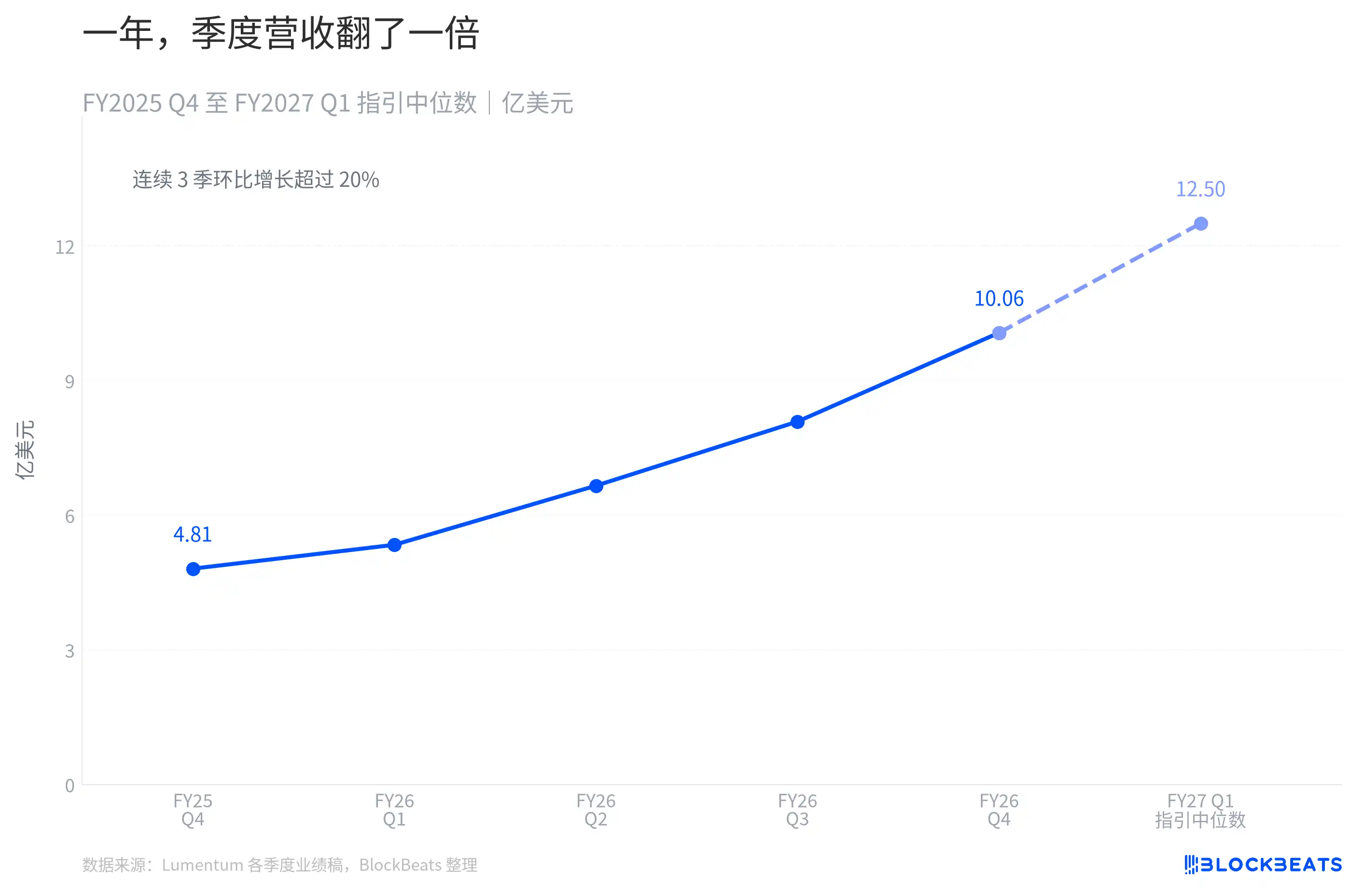
The key in the first chart is not any single particularly high point, but that the upward slope has not broken. Lumentum stated in its presentation materials that the fourth quarter marked the eighth consecutive quarter of revenue growth, with sequential growth rates exceeding 20% for the last three quarters of FY26.
According to the company's quarterly earnings announcements, revenue for the latest quarter increased 109.3% year-over-year.
The mid-point of the company's revenue guidance for the next fiscal quarter is $1.250 billion. This remains the management's forward-looking estimate, not yet recognized revenue, and cannot be taken as an exact substitute for orders. Judging by the continuously rising curve of recent quarters, the $1 billion mark is a milestone within an ongoing growth trajectory.
There's a subtle but important boundary in the report. While management lists optical circuit switching, cloud modules, co-packaged optics, and others as future growth drivers, the company does not break these items down into discrete, directly additive quarterly revenue figures. What readers can confirm from the statements is that revenue is growing; they cannot inversely deduce how much any single new product has contributed.
It's Not Just One Product Line Driving Revenue
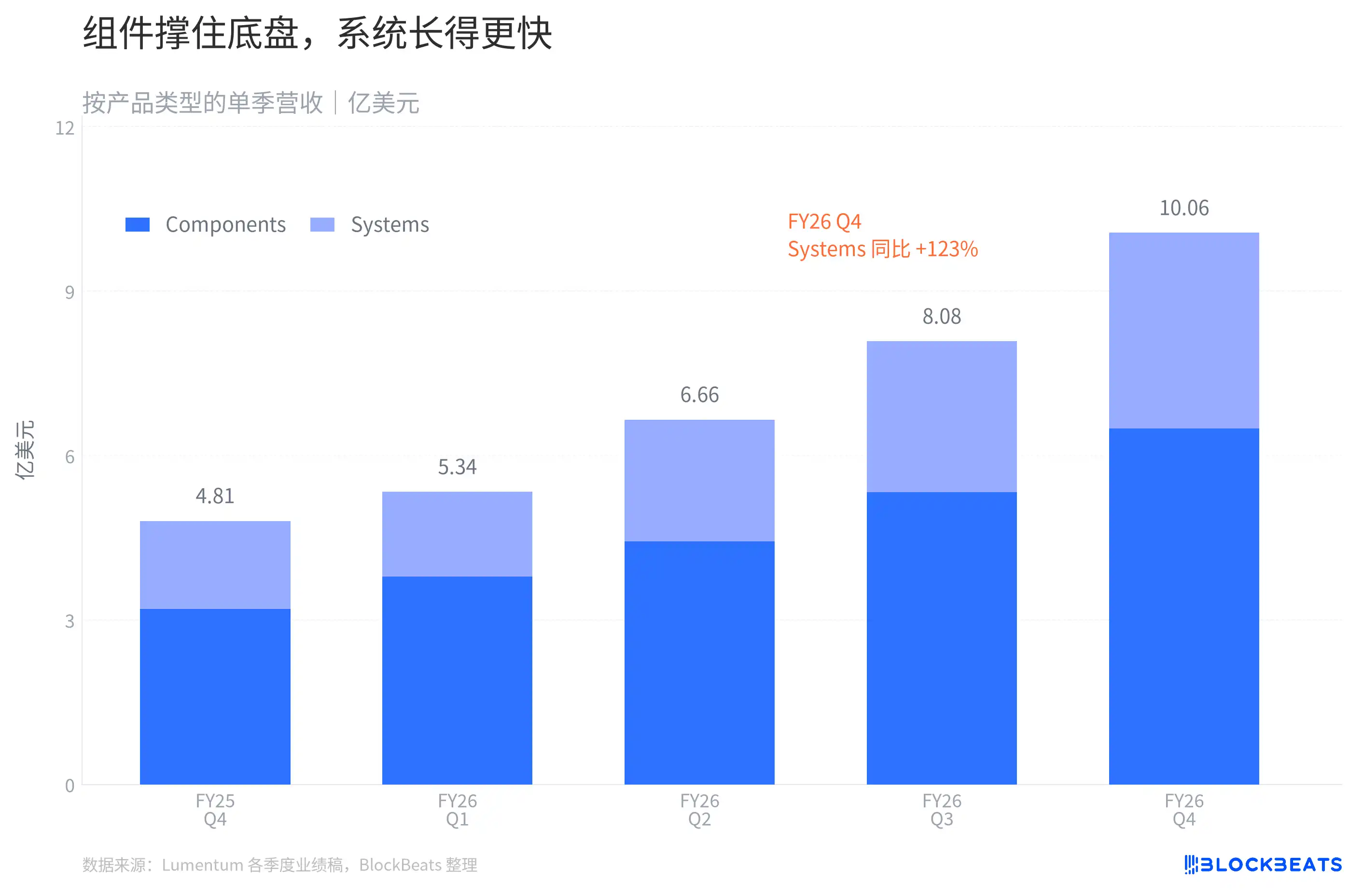
Lumentum categorizes its products into Components and Systems. According to the company's definitions, the former includes laser chips, sub-assemblies, and wavelength management systems, which customers integrate into larger systems. The latter includes cloud transceiver modules, optical circuit switching systems, and industrial lasers, which can be delivered as complete products.
Both lines are expanding. In the fourth quarter, the Systems business grew 122.6% year-over-year, while the Components business grew 102.7%, according to the earnings announcement. Systems grew faster, but Components still constituted nearly two-thirds of total revenue. This explains why the blue base in the chart is not being overshadowed by new business—new delivery forms are adding on top, while the established components base is also amplifying.
Management attributed the growth in Components to scale-out and scale-across of optical components, and the growth in Systems to record cloud transceiver module shipments. According to the Q4 presentation materials, 1.6T transceiver modules have begun shipping, and the ramp of Optical Circuit Switching (OCS) systems is progressing as planned, backed by sustained strong demand under its multi-year, multi-billion dollar purchase agreements. The key term here is "demand," not a line-item breakdown of recognized revenue.
This provides a more accurate reading of the structural change in the chart. It does not prove that a single cloud provider or a single new technology alone supports the growth. It illustrates that Lumentum is positioned on both the component supply and system delivery segments of the value chain, with the latter currently expanding at a faster rate.
Why Profitability is More Telling Than Revenue
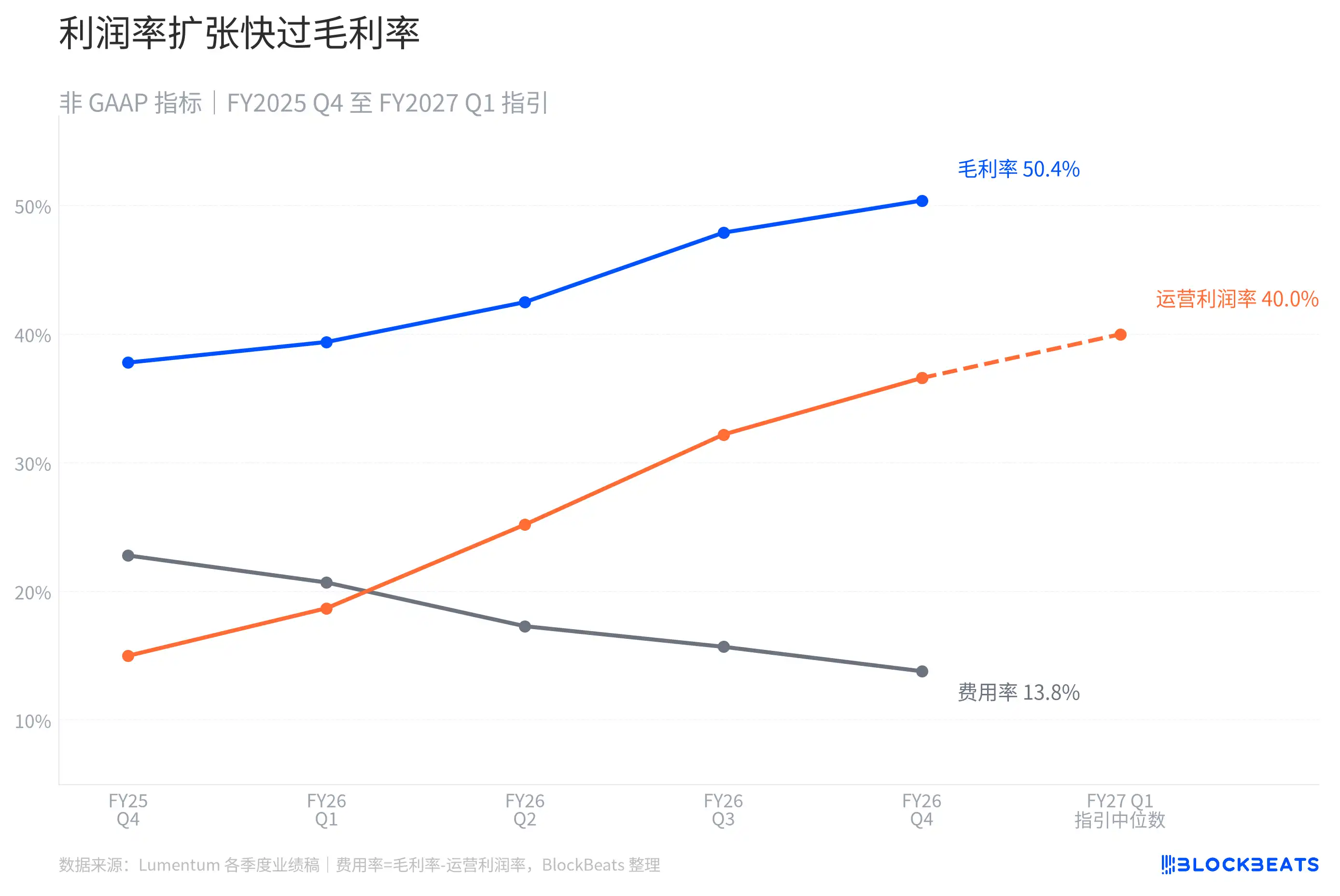
Revenue growth is the most visible, but the movement of profitability margins acts more like a thermometer for manufacturing and product mix. According to the company's quarterly reports, Lumentum's non-GAAP gross margin improved from 37.8% to 50.4%. This means the portion retained after subtracting direct costs from each dollar of revenue has become significantly thicker.
Operating margin climbed even more steeply. It rose from 15.0% to 36.6%, and calculating from the disclosed non-GAAP gross and operating margins, the operating expense ratio declined sequentially. Improving gross margins, combined with a decreasing share of expenses relative to revenue, allowed the orange line to climb faster than the blue one.
This chart is not equivalent to the GAAP income statement. The non-GAAP measure excludes items such as stock-based compensation, acquisition-related costs, amortization of intangibles, restructuring charges, and loss on debt extinguishment, according to the company's announcements. It is suitable for observing the company-defined ongoing operational performance but does not replace GAAP results. The next quarter's guidance of 39.5% to 40.5% for non-GAAP operating margin is also a forward-looking measure.
Putting it in simpler terms, revenue getting larger isn't the only change. The share of R&D, sales, and administrative costs allocated to each dollar of revenue is shrinking. For a company selling high-end optical components and systems, this type of shift often indicates more than just a slight increase in quarterly revenue—it suggests whether growth is beginning to permeate through to the operating results.
The $7.1 Billion Loss Largely Didn't Come from Core Operations
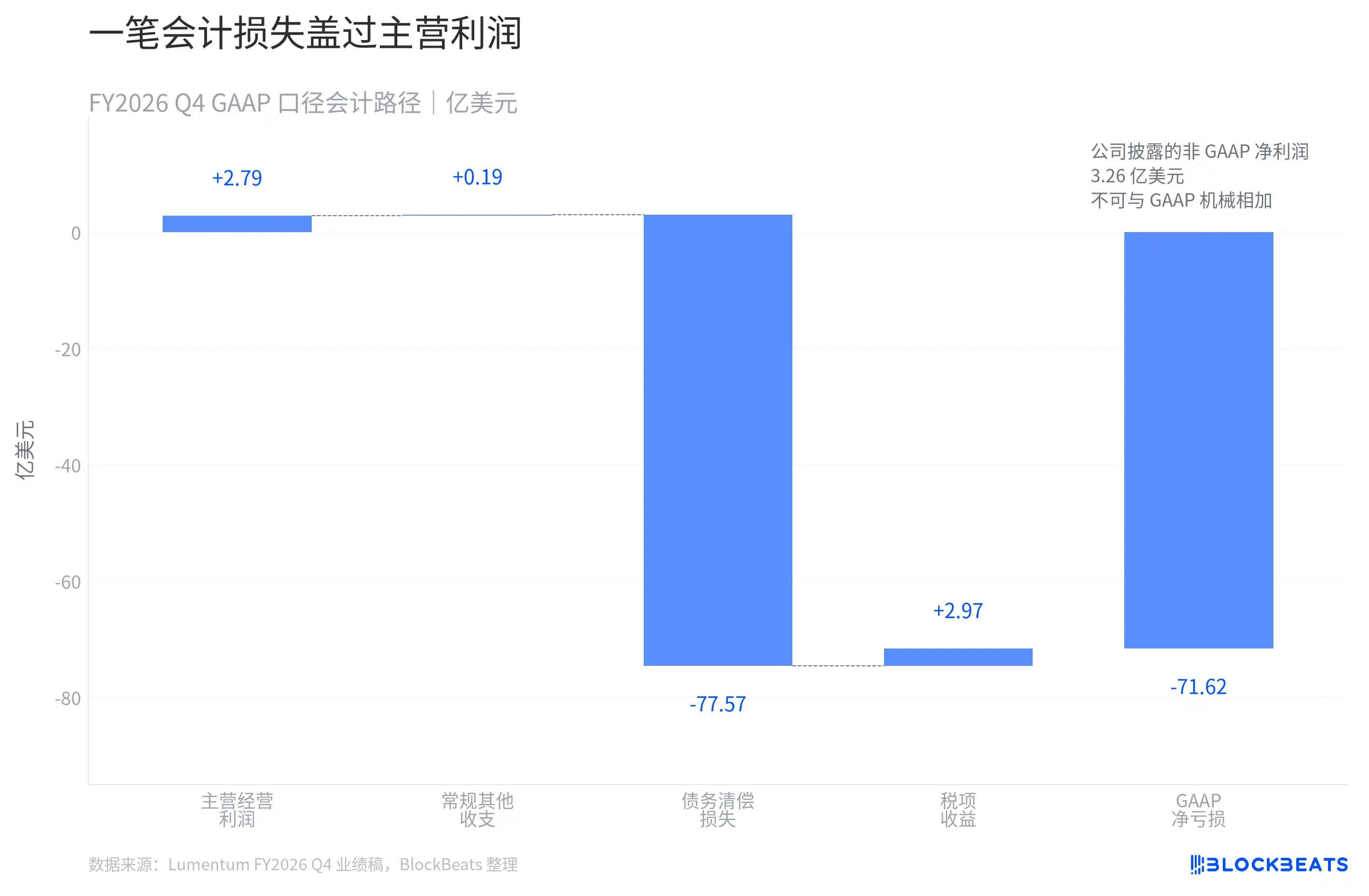
The fourth chart breaks down the most counterintuitive part of the accounts. Lumentum's GAAP operating profit for the quarter was $279 million. Subsequently, a $7.757 billion loss on debt extinguishment plunged the statement into deep negative territory. According to the company's 8-K filing and earnings announcement, this is a one-time, non-cash item stemming from the company settling a portion of its convertible notes with common stock. The majority of it represents an accounting loss arising when the conversion value exceeded the principal amount of the notes.
The usual other income/expense and tax benefit lines in the chart still exist but are insufficient to change the final result of a GAAP net loss of $7.162 billion. In the same announcement, the company reported a non-GAAP net income of $326 million. The two measures cannot be simply added, as the non-GAAP reconciliation includes other items like stock-based compensation, amortization, and tax adjustments.
"Non-cash" does not mean this event is irrelevant to shareholders or the balance sheet. The disclosed loss reflects the accounting treatment for the convertible note settlement; it cannot be directly translated into an equivalent cash outflow for the quarter, nor does it imply that all related settlements had no cash component. It is more akin to booking the change in capital structure into the income statement at once, rather than the core business losing over seven billion dollars in one quarter.
Therefore, Lumentum's latest earnings report requires reading two separate statements: one showing the operational performance driven by AI optical interconnect demand, and another reflecting the accounting impact from the equity conversion of convertible notes.