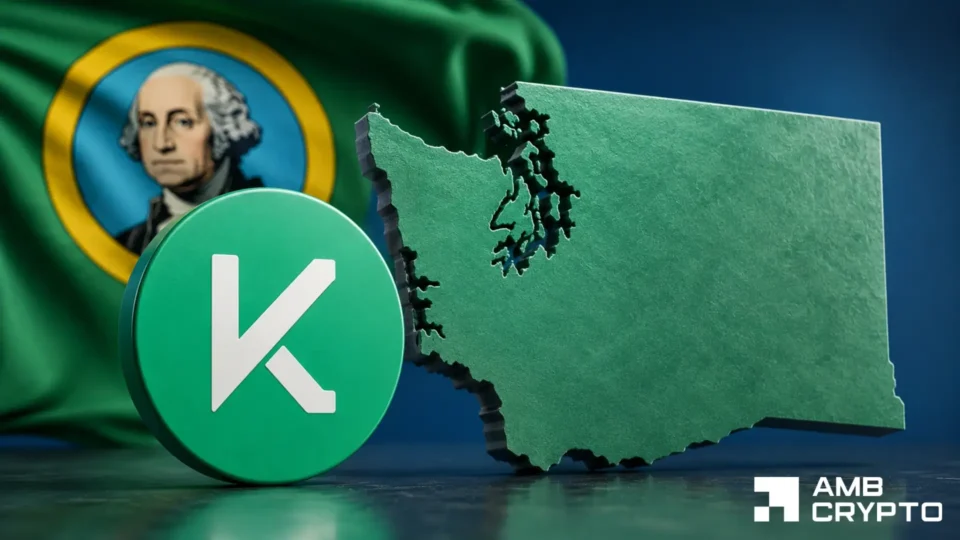
Kraken Backs Trump Accounts for Wyoming Newborns

TheNewsCrypto2026-02-17 tarihinde yayınlandı2026-02-17 tarihinde güncellendi

Özet

Kraken, a U.S.-based crypto exchange, has announced it will support President Donald Trump's "Trump Accounts" initiative by sponsoring accounts for every child born in Wyoming in 2025. Trump Accounts are tax-advantaged retirement accounts that allow parents to save for children under 18. Under a federal pilot program, each U.S. newborn from 2025–2028 will receive a one-time $1,000 contribution from the U.S. Treasury, invested in index funds to grow tax-deferred until adulthood. Kraken's co-CEO Arjun Sethi stated the move supports families and reinforces Wyoming's role in crypto leadership. Senator Cynthia Lummis praised the decision for giving children a financial head start. Kraken cited Wyoming’s favorable crypto regulations as a key reason for the sponsorship. The exact contribution amount was not disclosed.

Kraken, a US-based crypto exchange, has promised to back President Donald Trump’s “Trump Accounts” move in Wyoming. Kraken has officially announced on February 16 that the exchange will sponsor Trump Accounts for every child born in Wyoming in this year by making a financial contribution to each eligible account as part of the federal program.

Talking about Trump Accounts, it is a new type of tax-advantaged retirement account that permits parents or legal guardians to open and contribute funds for children under the age of 18.

As per the federal pilot program, each U.S. citizen newborn born between Jan 1, 2025, and Dec 31, 2028, will be given a one-time $1,000 seed contribution from the U.S. Treasury. The given funds are then invested in applicable market index funds and grow on a tax-deferred basis till the child hits adulthood.

The co-Chief Executive Officer of Kraken, Arjun Sethi, made a statement mentioning that, by seeding accounts for every newborn this year, we are supporting families from day one and reinforcing Wyoming’s role as the USA’s home for responsible crypto leadership.

The Appreciation from the Community

Senator Cynthia Lummis appreciated the decision of the exchange to back Trump accounts in the state and mentioned that the investment will make sure children in Wyoming have a financial head start.

She further added that I am thankful for their commitment to the upcoming generation of Wyoming and to the Cowboy State’s economic future. However, the contribution amount hasn’t been disclosed by the exchange yet.

Kraken also mentioned that the decision was influenced by Wyoming’s favourable regulatory climate, where it was capable of becoming the nation’s first Special Purpose Depository Institution under the state’s crypto-orientated banking framework.

Another co-CEO, Dave Ripley, posted on X (formerly Twitter) that we chose Wyoming as our global headquarters because it results in a thoughtful, responsible crypto policy.

Highlighted Crypto News Today:

Steak ‘n Shake Sees Sales Growth After Bitcoin Acceptance

TagsKrakenTRUMPUSA

İlgili Sorular

QWhat is Kraken's commitment regarding Trump Accounts for newborns in Wyoming?

AKraken has promised to sponsor Trump Accounts for every child born in Wyoming in the current year by making a financial contribution to each eligible account.

QWhat is a Trump Account and what are its benefits?

AA Trump Account is a tax-advantaged retirement account that allows parents or legal guardians to open and contribute funds for children under 18, with funds growing on a tax-deferred basis until adulthood.

QWhat is the federal government's role in the Trump Accounts pilot program?

AThe U.S. Treasury will provide a one-time $1,000 seed contribution to each U.S. citizen newborn born between January 1, 2025, and December 31, 2028.

QWhy did Kraken choose Wyoming for this initiative?

AKraken was influenced by Wyoming's favorable regulatory climate, which allowed it to become the nation's first Special Purpose Depository Institution under the state's crypto-oriented banking framework.

QHow did Senator Cynthia Lummis react to Kraken's decision?

ASenator Cynthia Lummis appreciated the decision, stating that the investment will ensure children in Wyoming have a financial head start and thanked Kraken for their commitment to the state's future generations.

İlgili Okumalar

OpenAI Post-Training Engineer Weng Jiayi Proposes a New Paradigm Hypothesis for Agentic AI

OpenAI engineer Weng Jiayi's "Heuristic Learning" experiments propose a new paradigm for Agentic AI, suggesting that intelligent agents can improve not just by training neural networks, but also by autonomously writing and refining code based on environmental feedback. In the experiment, a coding agent (powered by Codex) was tasked with developing and maintaining a programmatic strategy for the Atari game Breakout. Starting from a basic prompt, the agent iteratively wrote code, ran the game, analyzed logs and video replays to identify failures, and then modified the code. Through this engineering loop of "code-run-debug-update," it evolved a pure Python heuristic strategy that achieved a perfect score of 864 in Breakout and performed competitively with deep reinforcement learning (RL) algorithms in MuJoCo control tasks like Ant and HalfCheetah. This approach, termed Heuristic Learning (HL), contrasts with Deep RL. In HL, experience is captured in readable, modifiable code, tests, logs, and configurations—a software system—rather than being encoded solely into opaque neural network weights. This offers potential advantages in explainability, auditability for safety-critical applications, easier integration of regression tests to combat catastrophic forgetting, and more efficient sample use in early learning stages, as demonstrated in broader tests on 57 Atari games. However, the blog acknowledges clear limitations. Programmatic strategies struggle with tasks requiring long-horizon planning or complex perception (e.g., Montezuma's Revenge), areas where neural networks excel. The future vision is a hybrid architecture: specialized neural networks for fast perception (System 1), HL systems for rules, safety, and local recovery (also System 1), and LLM agents providing high-level feedback and learning from the HL system's data (System 2). The core proposition is that in the era of capable coding agents, a significant portion of an AI's learned experience could be maintained as an auditable, evolving software system.

marsbit30 dk önce

OpenAI Post-Training Engineer Weng Jiayi Proposes a New Paradigm Hypothesis for Agentic AI

marsbit30 dk önce

Your Claude Will Dream Tonight, Don't Disturb It

This article explores the recent phenomenon of AI companies increasingly using anthropomorphic language—like "thinking," "memory," "hallucination," and now "dreaming"—to describe machine learning processes. Focusing on Anthropic's newly announced "Dreaming" feature for its Claude Agent platform, the piece explains that this function is essentially an automated, offline batch processing of an agent's operational logs. It analyzes past task sessions to identify patterns, optimize future actions, and consolidate learnings into a persistent memory system, akin to a form of reinforcement learning and self-correction. The article draws parallels to similar features in other AI agent systems like Hermes Agent and OpenClaw, which also implement mechanisms for reviewing historical data, extracting reusable "skills," and strengthening long-term memory. It notes a key difference from human dreaming: these AI "dreams" still consume computational resources and user tokens. Further context is provided by discussing the technical challenges of managing AI "memory" or context, highlighting the computational expense of large context windows and innovations like Subquadratic's new model claiming drastically longer contexts. The core critique argues that this strategic use of human-centric vocabulary does more than market products; it subtly reshapes user perception. By framing algorithms with terms associated with consciousness, companies blur the line between tool and autonomous entity. This linguistic shift can influence user expectations, tolerance for errors, and even perceptions of responsibility when systems fail, potentially diverting scrutiny from the companies and engineers behind the technology. The article concludes by speculating that terms like "daydreaming" for predictive task simulation might be next, continuing this trend of embedding the idea of an "inner life" into computational processes.

marsbit32 dk önce

Your Claude Will Dream Tonight, Don't Disturb It

marsbit32 dk önce

İşlemler

Spot
Futures
活动图片