
Kalshi's First Research Report Released: How Collective Intelligence Outperforms Wall Street Think Tanks in Predicting CPI

marsbit2025-12-24 tarihinde yayınlandı2025-12-24 tarihinde güncellendi

Özet

Kalshi Research's inaugural report demonstrates that prediction markets significantly outperform Wall Street consensus forecasts in predicting year-over-year CPI data, particularly during economic shocks. The study, analyzing data from February 2023 to mid-2025, shows Kalshi’s predictions had a 40.1% lower mean absolute error (MAE) than consensus forecasts overall. During major shocks (deviations >0.2 percentage points), Kalshi’s MAE was 50–60% lower, and for moderate shocks (0.1–0.2 points), it was 50–56.2% lower. When market predictions diverged from consensus by over 0.1 points, they correctly signaled a shock about 81% of the time and were more accurate in 75% of cases. The outperformance is attributed to diverse participant insights, direct financial incentives for accuracy, and efficient aggregation of dispersed information. These findings suggest prediction markets provide a valuable complementary signal, especially in volatile periods where traditional models often fail.

This article is from:Kalshi Research

Compiled by | Odaily Planet Daily (@OdailyChina); Translator | Azuma (@azuma_eth)

Editor's Note: Leading prediction market platform Kalshi announced the launch of a new research report series, Kalshi Research, yesterday. It aims to provide Kalshi's internal data to scholars and researchers interested in topics related to prediction markets. The inaugural report has been published, originally titled "Kalshi Outperforms Wall Street in Predicting Inflation" (Beyond Consensus: Prediction Markets and the Forecasting of Inflation Shocks).

Below is the content of the original report, compiled by Odaily Planet Daily.

Overview

Typically, in the week leading up to the release of important economic statistics, analysts and senior economists from large financial institutions provide their estimates of the expected figures. These forecasts are aggregated to form what is known as the "consensus expectation," which is widely regarded as a crucial reference for gaining insights into market changes and adjusting portfolio positioning.

In this research report, we compare the performance of the consensus expectation with the implied pricing from Kalshi's prediction markets (sometimes referred to as "market forecast" below) in predicting the actual value of the same core macroeconomic indicator—the year-over-year headline inflation rate (YOY CPI).
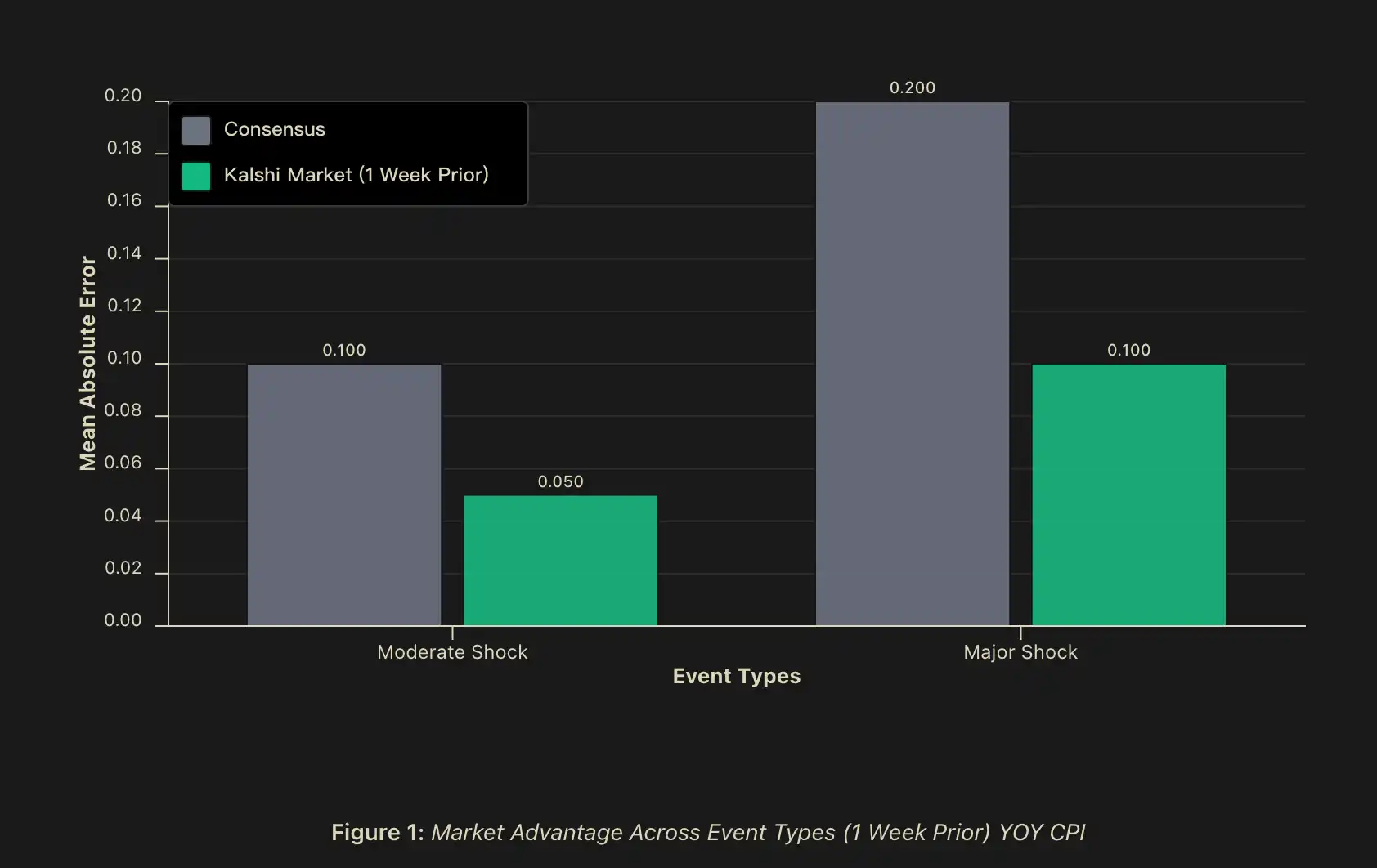
Key Highlights

  • Overall Superior Accuracy: Across all market environments (including normal and shock periods), Kalshi's predictions had a Mean Absolute Error (MAE) that was 40.1% lower than the consensus expectation.
  • "Shock Alpha": During significant shocks (greater than 0.2 percentage points), Kalshi's predictions had an MAE 50% lower than the consensus expectation in the one-week-ahead forecast window; this advantage expanded to 60% on the day before the data release. For moderate shocks (between 0.1 and 0.2 percentage points), Kalshi's predictions also had an MAE 50% lower than the consensus expectation one week ahead, which widened to 56.2% on the day before the release.
  • Predictive Signal: When the deviation between the market forecast and the consensus expectation exceeded 0.1 percentage points, the probability of a shock occurring was approximately 81.2%, rising to about 82.4% on the day before the data release. In cases where the market forecast differed from the consensus, the market forecast was more accurate in 75% of instances.

Background

Macroeconomic forecasters face an inherent challenge: the most critical times for forecasting—periods of market disorder, policy shifts, and structural breaks—are precisely when historical models are most likely to fail. Financial market participants typically release consensus forecasts for key economic data days in advance, aggregating expert opinions into market expectations. However, while valuable, these consensus views often share similar methodological approaches and information sources.

For institutional investors, risk managers, and policymakers, the stakes of forecasting accuracy are asymmetric. During uncontroversial periods, slightly better predictions offer limited value; but during periods of market turmoil—when volatility spikes, correlations break down, or historical relationships fail—superior accuracy can yield significant alpha returns and limit drawdowns.

Therefore, understanding how parameters behave during volatile market periods is crucial. We focus on a key macroeconomic indicator—the year-over-year headline inflation rate (YOY CPI)—a core reference for future interest rate decisions and an important signal of economic health.

We compared and evaluated forecasting accuracy across multiple time windows before the official data release. Our core finding is that "shock alpha" indeed exists—during tail events, market-based predictions can achieve additional forecasting precision compared to the consensus benchmark. This outperformance is not merely of academic interest; it significantly enhances signal quality precisely when forecasting errors carry the highest economic costs. In this context, the crucial question is not whether prediction markets are "always right," but whether they provide a differentiated signal worthy of inclusion in traditional decision-making frameworks.

Methodology

Data

We analyzed the daily implied predictions from traders on the Kalshi platform at three time points: one week before the data release (matching the timing of consensus expectation releases), one day before, and the morning of the release. Each market used was (or had been) a real, tradable, active market, reflecting real-money positions at varying liquidity levels. For the consensus, we collected institution-level YoY CPI consensus forecasts, typically published about a week before the official U.S. Bureau of Labor Statistics data release.

The sample period spans from February 2023 to mid-2025, covering over 25 monthly CPI release cycles across various macroeconomic environments.

Shock Classification

We categorized events into three types based on the "surprise magnitude" relative to historical levels. A "shock" was defined as the absolute difference between the consensus expectation and the actual published data:

  • Normal Events: YOY CPI forecast error below 0.1 percentage points;
  • Moderate Shocks: YOY CPI forecast error between 0.1 and 0.2 percentage points;
  • Major Shocks: YOY CPI forecast error exceeding 0.2 percentage points.

This classification allows us to examine whether predictive advantages vary systematically with the difficulty of the forecast.

Performance Metrics

To assess forecasting performance, we employed the following metrics:

  • Mean Absolute Error (MAE): The primary accuracy metric, calculated as the average of the absolute differences between predicted and actual values.
  • Win Rate: When the difference between the consensus expectation and the market forecast reached or exceeded 0.1 percentage points (rounded to one decimal place), we recorded which prediction was closer to the final actual result.
  • Forecast Horizon Analysis: We tracked how the accuracy of market valuations evolved from one week before the release to the release day, revealing the value of continuously incorporating information.

Results: CPI Forecasting Performance

Overall Superior Accuracy

Across all market environments, the market-based CPI forecasts had a Mean Absolute Error (MAE) that was 40.1% lower than the consensus forecasts. Across all time horizons, the MAE for market-based CPI forecasts was lower than the consensus by 40.1% (one week ahead) to 42.3% (one day ahead).

Furthermore, in cases where the consensus expectation and the market-implied value diverged, Kalshi's market-based forecasts demonstrated a statistically significant win rate, ranging from 75.0% one week ahead to 81.2% on release day. Including ties with the consensus (to one decimal place), the market-based forecast performed equally well or better than the consensus in approximately 85% of cases one week ahead.

Such a high directional accuracy rate indicates that when market forecasts diverge from the consensus expectation, the divergence itself carries significant informational value regarding the likelihood of a shock event.

"Shock Alpha" Exists

The difference in forecasting accuracy was particularly pronounced during shock events. During moderate shock events, the MAE of market forecasts was 50% lower than the consensus expectation at the same release time; this advantage expanded to 56.2% or more one day before the data release. During major shock events, the MAE of market forecasts was also 50% lower than the consensus at the same time, reaching 60% or more one day before release. In contrast, during normal, non-shock environments, market forecasts and consensus expectations performed roughly equally well.

Although the sample size for shock events is small (reasonable in a world where shocks are inherently highly unpredictable), the overall pattern is clear: the information aggregation advantage of markets is most valuable precisely when the forecasting environment is most challenging.

However, more importantly, it's not just that Kalshi's predictions perform better during shock periods, but also that the divergence between the market forecast and the consensus expectation can itself be a signal of an impending shock. In cases of divergence, the market forecast's win rate against the consensus expectation was 75% (within comparable time windows). Furthermore, threshold analysis indicated that when the market deviation from the consensus exceeded 0.1 percentage points, the probability of predicting a shock was approximately 81.2%, rising to about 84.2% on the day before the data release.

This practically significant difference suggests that prediction markets can serve not only as a competitive forecasting tool alongside consensus expectations but also as a "meta-signal" regarding forecast uncertainty, transforming market-consensus divergence into a quantifiable early warning indicator for potential unexpected outcomes.

Further Discussion

An obvious question follows: Why do market forecasts outperform consensus forecasts during shocks? We propose three complementary mechanisms to explain this phenomenon.

Market Participant Heterogeneity and "Wisdom of the Crowd"

Traditional consensus expectations, while aggregating views from multiple institutions, often share similar methodological assumptions and information sources. Econometric models, Wall Street research reports, and government data releases form a highly overlapping common knowledge base.

In contrast, prediction markets aggregate positions held by participants with diverse information bases: including proprietary models, industry-level insights, alternative data sources, and experience-based intuition. This participant diversity has a solid theoretical foundation in the "wisdom of crowds" theory. This theory suggests that when participants possess relevant information and their prediction errors are not perfectly correlated, aggregating independent predictions from diverse sources often yields a superior estimate.

The value of this informational diversity is particularly pronounced during "state shifts" in the macro environment—individuals with scattered, local information interact in the market, combining their informational fragments to form a collective signal.

Differences in Participant Incentive Structures

Institution-level consensus forecasters often operate within complex organizational and reputational systems that systematically deviate from the goal of "purely pursuing predictive accuracy." The career risks faced by professional forecasters create an asymmetric payoff structure—large forecasting errors incur significant reputational costs, while even extreme accuracy, especially achieved by deviating substantially from peer consensus, may not yield proportional career rewards.

This asymmetry induces "herding behavior," where forecasters tend to cluster their predictions near the consensus value, even if their private information or model outputs suggest different results. The reason is that in a professional context, the cost of "being wrong alone" often outweighs the benefits of "being right alone."

In stark contrast, the incentive structure faced by prediction market participants directly aligns forecasting accuracy with economic outcomes—accurate predictions mean profits, incorrect predictions mean losses. In this system, reputational factors are almost non-existent; the only cost of deviating from the market consensus is economic loss, solely dependent on the prediction's correctness. This structure imposes stronger selection pressure for predictive accuracy—participants who can identify consensus forecast errors systematically accumulate capital and increase their influence in the market through larger position sizes;而那些 mechanically following the consensus suffer continuous losses when the consensus proves wrong.

During periods of significantly heightened uncertainty, when the career cost for institutional forecasters to deviate from the expert consensus is at its peak, this divergence in incentive structures is often most pronounced and economically most important.

Information Aggregation Efficiency

A noteworthy empirical fact is: even one week before the data release—a time point matching the typical release window of consensus expectations—market forecasts still exhibit significant accuracy advantages. This suggests that the market advantage does not stem solely from the often-cited "information speed advantage" of prediction market participants.

Instead, market forecasts may more efficiently aggregate informational fragments that are too dispersed, too industry-specific, or too nebulous to be formally incorporated into traditional econometric forecasting frameworks. The relative advantage of prediction markets may lie not in earlier access to public information, but in their ability to synthesize heterogeneous information more effectively within the same time frame—a task that survey-based consensus mechanisms, even with the same time window, often struggle to perform efficiently.

Limitations and Caveats

Our findings require an important qualification. Since the overall sample covers only about 30 months, and major shock events are by definition rare, statistical power for larger tail events remains limited. A longer time series would enhance future inferential capabilities, although the current results strongly suggest the superiority and differentiated signal of market forecasts.

Conclusion

We document systematic and economically significant outperformance of prediction markets relative to expert consensus expectations, particularly during shock periods where forecasting accuracy is most critical. Market-based CPI forecasts exhibited approximately 40% lower error overall, with error reduction reaching around 60% during periods of major structural change.

Based on these findings, several future research directions become particularly important: First, investigating whether "shock alpha" events can be predicted themselves using volatility and forecast divergence indicators, across a larger sample size and multiple macroeconomic indicators; Second, determining the liquidity threshold above which prediction markets can stably outperform traditional forecasting methods; Third, exploring the relationship between prediction market forecast values and those implied by high-frequency trading financial instruments.

In an environment where consensus forecasts heavily rely on correlated model assumptions and shared information sets, prediction markets offer an alternative information aggregation mechanism, capable of capturing state switches earlier and processing heterogeneous information more efficiently. For entities needing to make decisions in an economic environment characterized by rising structural uncertainty and tail event frequency, "shock alpha" may represent not just an incremental improvement in forecasting ability, but a fundamental component of a robust risk management infrastructure.


İlgili Sorular

QWhat is the main finding of Kalshi Research's report regarding the prediction of CPI?

AKalshi's prediction market had a 40.1% lower Mean Absolute Error (MAE) than the Wall Street consensus forecast in predicting the year-over-year CPI, with the advantage being even greater (up to 60%) during significant economic shocks.

QHow does the performance of Kalshi's market prediction compare to consensus during 'shock' events?

ADuring medium shock events (0.1-0.2 percentage point error), Kalshi's MAE was 50% lower than consensus a week before the data release, widening to 56.2% the day before. For major shocks (>0.2 p.p.), the MAE was 50% lower a week before and over 60% lower the day before.

QWhat is the 'Predictive Signal' mentioned in the market and consensus forecasts diverge?

AWhen the market prediction and consensus forecast differed by more than 0.1 percentage points, the probability of a shock event occurring was about 81.2%. In these cases of disagreement, the market prediction was more accurate 75% of the time.

QWhat are the proposed reasons (mechanisms) for why prediction markets outperform consensus during shocks?

AThree complementary mechanisms are proposed: 1) Participant heterogeneity and the 'wisdom of crowds' aggregating diverse information, 2) Differing incentive structures that directly align accuracy with profit/loss in markets vs. herding behavior in consensus forecasts, and 3) Superior information aggregation efficiency, even with the same public information.

QWhat key macroeconomic indicator was the focus of this comparative study?

AThe study focused on comparing the accuracy of predicting the year-over-year (YoY) Consumer Price Index (CPI), a core indicator for future interest rate decisions and overall economic health.

İlgili Okumalar

The Second Half of Macro Influencer Fu Peng's Career

Fu Peng, a prominent Chinese macroeconomist and former chief economist of Northeast Securities, has joined Hong Kong-based digital asset management firm Bitfire Group (formerly New Huo Group) as its chief economist. This move, announced in April 2026, triggered an 11% surge in Bitfire's stock price. Fu, known for his accessible macroeconomic commentary and large social media following, will focus on integrating digital assets into global asset allocation frameworks, particularly combining FICC (fixed income, currencies, and commodities) with cryptocurrencies for institutional clients. His career includes roles at Lehman Brothers and Solomon International, with significant influence gained through public communication. However, in late 2024, Fu faced temporary social media bans after a controversial private speech at HSBC on China's economic challenges, though he denied regulatory sanctions. He later left Northeast Securities citing health reasons. Bitfire, a licensed virtual asset manager serving high-net-worth clients, seeks to build trust and attract traditional capital through Fu’s expertise and credibility. The partnership represents a strategic shift for both: Fu enters the crypto sector after a traditional finance peak, while Bitfire aims to leverage his macro framework for institutional adoption. Outcomes remain uncertain regarding capital inflows and compatibility within corporate structure.

marsbit38 dk önce

The Second Half of Macro Influencer Fu Peng's Career

marsbit38 dk önce

İşlemler

Spot
Futures

Popüler Makaleler

$S$ Nedir

SPERO'yu Anlamak: Kapsamlı Bir Genel Bakış SPERO'ya Giriş İnovasyonun manzarası gelişmeye devam ederken, web3 teknolojilerinin ve kripto para projelerinin ortaya çıkışı dijital geleceği şekillendirmede önemli bir rol oynamaktadır. Bu dinamik alanda dikkat çeken projelerden biri SPERO, $$s$$ olarak adlandırılmaktadır. Bu makale, SPERO hakkında ayrıntılı bilgi toplamak ve sunmak amacıyla, meraklılar ve yatırımcıların web3 ve kripto alanlarındaki temellerini, hedeflerini ve yeniliklerini anlamalarına yardımcı olmayı amaçlamaktadır. SPERO,$$s$$ Nedir? SPERO,$$s$$, kripto alanında merkeziyetsizlik ve blok zinciri teknolojisi ilkelerini kullanarak etkileşimi, faydayı ve finansal kapsayıcılığı teşvik eden bir ekosistem yaratmayı amaçlayan benzersiz bir projedir. Proje, kullanıcıların yenilikçi finansal çözümler ve hizmetler sunarak eşler arası etkileşimleri yeni yollarla kolaylaştırmayı hedeflemektedir. SPERO,$$s$$'nin temel amacı, bireyleri güçlendirmek ve kripto para alanındaki kullanıcı deneyimini artıran araçlar ve platformlar sağlamaktır. Bu, daha esnek işlem yöntemlerini mümkün kılmayı, topluluk odaklı girişimleri teşvik etmeyi ve merkeziyetsiz uygulamalar (dApp'ler) aracılığıyla finansal fırsatlar yaratmayı içermektedir. SPERO,$$s$$'nin temel vizyonu kapsayıcılık etrafında dönmekte olup, geleneksel finansal sistemlerdeki boşlukları kapatmayı ve blok zinciri teknolojisinin faydalarından yararlanmayı hedeflemektedir. SPERO,$$s$$'nin Yaratıcısı Kimdir? SPERO,$$s$$'nin yaratıcısının kimliği bir miktar belirsizdir, çünkü kurucusu(ları) hakkında ayrıntılı arka plan bilgisi sağlayan sınırlı kamuya açık kaynaklar bulunmaktadır. Bu şeffaflık eksikliği, projenin merkeziyetsizlik taahhüdünden kaynaklanabilir—birçok web3 projesinin paylaştığı bir etik anlayışı, bireysel tanınmanın yerine kolektif katkıları önceliklendirmektedir. Topluluk ve onun kolektif hedefleri etrafında tartışmaları merkezileştirerek, SPERO,$$s$$, belirli bireyleri öne çıkarmadan güçlendirme özünü taşımaktadır. Bu nedenle, SPERO'nun etik anlayışını ve misyonunu anlamak, tek bir yaratıcının kimliğini belirlemekten daha önemlidir. SPERO,$$s$$'nin Yatırımcıları Kimlerdir? SPERO,$$s$$, kripto sektöründe yeniliği teşvik etmeye adanmış girişim sermayedarlarından melek yatırımcılara kadar çeşitli yatırımcılar tarafından desteklenmektedir. Bu yatırımcıların odak noktası genellikle SPERO'nun misyonuyla uyumlu olup, toplumsal teknolojik ilerlemeyi, finansal kapsayıcılığı ve merkeziyetsiz yönetimi vaat eden projeleri önceliklendirmektedir. Bu yatırımcı temelleri, yalnızca yenilikçi ürünler sunan projelere değil, aynı zamanda blok zinciri topluluğuna ve ekosistemlerine olumlu katkılarda bulunan projelere de ilgi duymaktadır. Bu yatırımcıların desteği, SPERO,$$s$$'yi hızla gelişen kripto projeleri alanında dikkate değer bir rakip haline getirmektedir. SPERO,$$s$$ Nasıl Çalışır? SPERO,$$s$$, onu geleneksel kripto para projelerinden ayıran çok yönlü bir çerçeve kullanmaktadır. İşte benzersizliğini ve yeniliğini vurgulayan bazı temel özellikler: Merkeziyetsiz Yönetim: SPERO,$$s$$, kullanıcıların projenin geleceğiyle ilgili karar alma süreçlerine aktif olarak katılmalarını sağlayan merkeziyetsiz yönetim modellerini entegre etmektedir. Bu yaklaşım, topluluk üyeleri arasında sahiplik ve hesap verebilirlik duygusunu teşvik etmektedir. Token Kullanımı: SPERO,$$s$$, ekosistem içinde çeşitli işlevler sunmak üzere tasarlanmış kendi kripto para token'ını kullanmaktadır. Bu token'lar, işlemleri, ödülleri ve platformda sunulan hizmetlerin kolaylaştırılmasını sağlayarak genel etkileşimi ve faydayı artırmaktadır. Katmanlı Mimari: SPERO,$$s$$'nin teknik mimarisi, modülerlik ve ölçeklenebilirliği destekleyerek projenin evrimi sırasında ek özelliklerin ve uygulamaların sorunsuz bir şekilde entegrasyonuna olanak tanımaktadır. Bu uyum sağlama yeteneği, sürekli değişen kripto manzarasında geçerliliği sürdürmek için hayati öneme sahiptir. Topluluk Katılımı: Proje, işbirliği ve geri bildirim teşvik eden mekanizmalar kullanarak topluluk odaklı girişimlere vurgu yapmaktadır. Güçlü bir topluluk oluşturarak, SPERO,$$s$$, kullanıcı ihtiyaçlarını daha iyi karşılayabilir ve piyasa trendlerine uyum sağlayabilir. Kapsayıcılığa Odaklanma: Düşük işlem ücretleri ve kullanıcı dostu arayüzler sunarak, SPERO,$$s$$, daha önce kripto alanında yer almamış bireyler de dahil olmak üzere çeşitli bir kullanıcı tabanını çekmeyi hedeflemektedir. Bu kapsayıcılık taahhüdü, erişilebilirlik yoluyla güçlendirme misyonuyla uyumludur. SPERO,$$s$$ Zaman Çizelgesi Bir projenin tarihini anlamak, gelişim yolculuğu ve kilometre taşları hakkında kritik bilgiler sağlar. Aşağıda, SPERO,$$s$$'nin evriminde önemli olayları haritalayan önerilen bir zaman çizelgesi bulunmaktadır: Kavram Geliştirme ve Fikir Aşaması: SPERO,$$s$$'nin temelini oluşturan ilk fikirler, blok zinciri endüstrisindeki merkeziyetsizlik ve topluluk odaklılık ilkeleriyle yakından uyumlu olarak geliştirildi. Proje Beyaz Kağıdının Yayınlanması: Kavramsal aşamayı takiben, SPERO,$$s$$'nin vizyonunu, hedeflerini ve teknolojik altyapısını ayrıntılı bir şekilde açıklayan kapsamlı bir beyaz kağıt yayımlandı ve topluluk ilgisini ve geri bildirimini toplamak amacıyla sunuldu. Topluluk Oluşturma ve Erken Katılımlar: Projenin hedefleri etrafında tartışmalar yürüterek destek toplamak ve erken benimseyenler ile potansiyel yatırımcılar için bir topluluk oluşturmak amacıyla aktif iletişim çabaları gerçekleştirildi. Token Üretim Etkinliği: SPERO,$$s$$, yerel token'larını erken destekçilere dağıtmak ve ekosistem içinde başlangıç likiditesini sağlamak amacıyla bir token üretim etkinliği (TGE) gerçekleştirdi. İlk dApp'in Yayınlanması: SPERO,$$s$$ ile ilişkili ilk merkeziyetsiz uygulama (dApp) faaliyete geçti ve kullanıcıların platformun temel işlevleriyle etkileşimde bulunmalarını sağladı. Sürekli Gelişim ve Ortaklıklar: Projenin tekliflerine sürekli güncellemeler ve iyileştirmeler yapılmakta olup, blok zinciri alanındaki diğer oyuncularla stratejik ortaklıklar, SPERO,$$s$$'yi rekabetçi ve gelişen bir oyuncu haline getirmiştir. Sonuç SPERO,$$s$$, web3 ve kripto paranın finansal sistemleri devrim niteliğinde dönüştürme ve bireyleri güçlendirme potansiyelinin bir kanıtıdır. Merkeziyetsiz yönetime, topluluk katılımına ve yenilikçi tasarlanmış işlevselliğe olan bağlılığıyla, daha kapsayıcı bir finansal manzaraya doğru bir yol açmaktadır. Hızla gelişen kripto alanındaki herhangi bir yatırımda olduğu gibi, potansiyel yatırımcılar ve kullanıcılar, SPERO,$$s$$ içindeki devam eden gelişmelerle ilgili olarak kapsamlı bir araştırma yapmaları ve düşünceli bir şekilde katılmaları teşvik edilmektedir. Proje, kripto endüstrisinin yenilikçi ruhunu sergileyerek, sayısız olasılığını keşfetmeye davet etmektedir. SPERO,$$s$$'nin yolculuğu hala devam ederken, temel ilkeleri, teknoloji, finans ve birbirimizle etkileşim biçimimizi etkileyebilir.

89 Toplam GörüntülenmeYayınlanma 2024.12.17Güncellenme 2024.12.17

$S$ Nedir

AGENT S Nedir

Agent S: Web3'te Otonom Etkileşimin Geleceği Giriş Web3 ve kripto para dünyasında sürekli gelişen manzarada, yenilikler bireylerin dijital platformlarla etkileşim biçimlerini sürekli olarak yeniden tanımlıyor. Bu tür öncü projelerden biri olan Agent S, açık ajans çerçevesi aracılığıyla insan-bilgisayar etkileşimini devrim niteliğinde değiştirmeyi vaat ediyor. Otonom etkileşimlerin yolunu açarak, Agent S karmaşık görevleri basitleştirmeyi ve yapay zeka (AI) alanında dönüştürücü uygulamalar sunmayı hedefliyor. Bu detaylı inceleme, projenin karmaşıklıklarına, benzersiz özelliklerine ve kripto para alanındaki etkilerine dalacaktır. Agent S Nedir? Agent S, bilgisayar görevlerinin otomasyonunda üç temel zorluğu ele almak üzere özel olarak tasarlanmış çığır açıcı bir açık ajans çerçevesidir: Alan Spesifik Bilgi Edinimi: Çerçeve, çeşitli dış bilgi kaynaklarından ve iç deneyimlerden akıllıca öğrenir. Bu çift yönlü yaklaşım, alan spesifik bilgi açısından zengin bir veri havuzu oluşturmasını sağlar ve görev yürütmedeki performansını artırır. Uzun Görev Ufukları Üzerinde Planlama: Agent S, karmaşık görevlerin verimli bir şekilde parçalanmasını ve yürütülmesini kolaylaştıran deneyim artırımlı hiyerarşik planlama kullanır. Bu özellik, çoklu alt görevleri etkili ve verimli bir şekilde yönetme yeteneğini önemli ölçüde artırır. Dinamik, Homojen Olmayan Arayüzlerle Başlama: Proje, ajanlar ve kullanıcılar arasındaki etkileşimi geliştiren yenilikçi bir çözüm olan Ajan-Bilgisayar Arayüzü'ni (ACI) tanıtmaktadır. Çok Modlu Büyük Dil Modellerini (MLLM'ler) kullanarak, Agent S çeşitli grafik kullanıcı arayüzlerini sorunsuz bir şekilde gezinebilir ve manipüle edebilir. Bu öncü özellikler aracılığıyla, Agent S, makinelerle insan etkileşimini otomatikleştirmede karşılaşılan karmaşıklıkları ele alan sağlam bir çerçeve sunarak, AI ve ötesinde birçok uygulama için zemin hazırlıyor. Agent S'nin Yaratıcısı Kimdir? Agent S'nin kavramı temelde yenilikçi olsa da, yaratıcısı hakkında spesifik bilgiler belirsizliğini koruyor. Yaratıcı şu anda bilinmiyor, bu da projenin yeni aşamasını veya kurucu üyeleri gizli tutma stratejik tercihini vurguluyor. Anonimlikten bağımsız olarak, odak çerçevenin yetenekleri ve potansiyeli üzerinde kalıyor. Agent S'nin Yatırımcıları Kimlerdir? Agent S, kriptografik ekosistemde oldukça yeni olduğundan, yatırımcıları ve finansal destekçileri hakkında ayrıntılı bilgiler açıkça belgelenmemiştir. Projeyi destekleyen yatırım temelleri veya organizasyonları hakkında kamuya açık bilgilerdeki eksiklik, finansman yapısı ve gelişim yol haritası hakkında sorular doğuruyor. Destekleyicilerin anlaşılması, projenin sürdürülebilirliğini ve potansiyel pazar etkisini değerlendirmek için kritik öneme sahiptir. Agent S Nasıl Çalışır? Agent S'nin temelinde, çeşitli ortamlarda etkili bir şekilde çalışmasını sağlayan son teknoloji bir sistem yatmaktadır. İşleyiş modeli birkaç ana özellik etrafında inşa edilmiştir: İnsan Benzeri Bilgisayar Etkileşimi: Çerçeve, bilgisayarlarla etkileşimleri daha sezgisel hale getirmeyi amaçlayan gelişmiş AI planlaması sunar. Görev yürütmedeki insan davranışını taklit ederek, kullanıcı deneyimlerini yükseltmeyi vaat eder. Anlatı Belleği: Yüksek düzeyde deneyimlerden yararlanmak için kullanılan Agent S, görev geçmişlerini takip etmek amacıyla anlatı belleğini kullanarak karar verme süreçlerini geliştirir. Episodik Bellek: Bu özellik, kullanıcılara adım adım rehberlik sağlayarak, çerçevenin görevler gelişirken bağlamsal destek sunmasına olanak tanır. OpenACI Desteği: Yerel olarak çalışabilme yeteneği ile Agent S, kullanıcıların etkileşimleri ve iş akışları üzerinde kontrol sağlamasına olanak tanır ve Web3'ün merkeziyetsiz felsefesiyle uyumlu hale gelir. Dış API'lerle Kolay Entegrasyon: Çeşitli AI platformlarıyla uyumluluğu ve çok yönlülüğü, Agent S'nin mevcut teknolojik ekosistemlere sorunsuz bir şekilde entegre olmasını sağlar ve geliştiriciler ile organizasyonlar için cazip bir seçenek haline getirir. Bu işlevsellikler, Agent S'nin kripto alanındaki benzersiz konumuna katkıda bulunarak, karmaşık, çok aşamalı görevleri minimum insan müdahalesi ile otomatikleştirir. Proje geliştikçe, Web3'teki potansiyel uygulamaları dijital etkileşimlerin nasıl gelişeceğini yeniden tanımlayabilir. Agent S'nin Zaman Çizelgesi Agent S'nin gelişimi ve kilometre taşları, önemli olaylarını vurgulayan bir zaman çizelgesinde özetlenebilir: 27 Eylül 2024: Agent S'nin kavramı, “Bilgisayarları İnsan Gibi Kullanan Açık Bir Ajans Çerçevesi” başlıklı kapsamlı bir araştırma makalesi ile tanıtıldı ve projenin temelini sergiledi. 10 Ekim 2024: Araştırma makalesi arXiv'de kamuya açık olarak yayınlandı ve çerçevenin derinlemesine bir incelemesini ve OSWorld benchmark'ına dayalı performans değerlendirmesini sundu. 12 Ekim 2024: Agent S'nin yetenekleri ve özellikleri hakkında görsel bir içgörü sağlayan bir video sunumu yayımlandı ve potansiyel kullanıcılar ve yatırımcılarla daha fazla etkileşim sağlandı. Bu zaman çizelgesindeki işaretler, sadece Agent S'nin ilerlemesini değil, aynı zamanda şeffaflık ve topluluk katılımına olan bağlılığını da göstermektedir. Agent S Hakkında Ana Noktalar Agent S çerçevesi gelişmeye devam ederken, birkaç ana özellik öne çıkmakta ve yenilikçi doğasını ve potansiyelini vurgulamaktadır: Yenilikçi Çerçeve: İnsan etkileşimine benzer bir bilgisayar kullanımı sağlamak üzere tasarlanan Agent S, görev otomasyonuna yeni bir yaklaşım getiriyor. Otonom Etkileşim: GUI aracılığıyla bilgisayarlarla otonom olarak etkileşim kurabilme yeteneği, daha akıllı ve verimli hesaplama çözümlerine doğru bir sıçrama anlamına geliyor. Karmaşık Görev Otomasyonu: Sağlam metodolojisi ile karmaşık, çok aşamalı görevleri otomatikleştirerek süreçleri daha hızlı ve daha az hata payı ile gerçekleştirebilir. Sürekli İyileştirme: Öğrenme mekanizmaları, Agent S'nin geçmiş deneyimlerden öğrenmesini sağlar ve sürekli olarak performansını ve etkinliğini artırır. Çok Yönlülük: OSWorld ve WindowsAgentArena gibi farklı işletim ortamlarında uyumlu olması, geniş bir uygulama yelpazesine hizmet edebilmesini sağlar. Agent S, Web3 ve kripto alanında kendini konumlandırırken, etkileşim yeteneklerini artırma ve süreçleri otomatikleştirme potansiyeli, AI teknolojilerinde önemli bir ilerlemeyi temsil etmektedir. Yenilikçi çerçevesi aracılığıyla, Agent S dijital etkileşimlerin geleceğini örneklemekte ve çeşitli sektörlerde kullanıcılar için daha sorunsuz ve verimli bir deneyim vaat etmektedir. Sonuç Agent S, AI ve Web3'ün birleşiminde cesur bir sıçramayı temsil ediyor ve teknoloji ile etkileşim biçimimizi yeniden tanımlama kapasitesine sahip. Henüz erken aşamalarında olmasına rağmen, uygulama olanakları geniş ve çekici. Kritik zorlukları ele alan kapsamlı çerçevesi ile Agent S, otonom etkileşimleri dijital deneyimin ön plana çıkmasına taşımayı hedefliyor. Kripto para ve merkeziyetsizlik alanlarına daha derinlemesine girdikçe, Agent S gibi projelerin teknoloji ve insan-bilgisayar işbirliğinin geleceğini şekillendirmede önemli bir rol oynayacağı kesin.

418 Toplam GörüntülenmeYayınlanma 2025.01.14Güncellenme 2025.01.14

AGENT S Nedir

S Nasıl Satın Alınır

HTX.com’a hoş geldiniz! Sonic (S) satın alma işlemlerini basit ve kullanışlı bir hâle getirdik. Adım adım açıkladığımız rehberimizi takip ederek kripto yolculuğunuza başlayın. 1. Adım: HTX Hesabınızı OluşturunHTX'te ücretsiz bir hesap açmak için e-posta adresinizi veya telefon numaranızı kullanın. Sorunsuzca kaydolun ve tüm özelliklerin kilidini açın. Hesabımı Aç2. Adım: Kripto Satın Al Bölümüne Gidin ve Ödeme Yönteminizi SeçinKredi/Banka Kartı: Visa veya Mastercard'ınızı kullanarak anında Sonic (S) satın alın.Bakiye: Sorunsuz bir şekilde işlem yapmak için HTX hesap bakiyenizdeki fonları kullanın.Üçüncü Taraflar: Kullanımı kolaylaştırmak için Google Pay ve Apple Pay gibi popüler ödeme yöntemlerini ekledik.P2P: HTX'teki diğer kullanıcılarla doğrudan işlem yapın.Borsa Dışı (OTC): Yatırımcılar için kişiye özel hizmetler ve rekabetçi döviz kurları sunuyoruz.3. Adım: Sonic (S) Varlıklarınızı SaklayınSonic (S) satın aldıktan sonra HTX hesabınızda saklayın. Alternatif olarak, blok zinciri transferi yoluyla başka bir yere gönderebilir veya diğer kripto para birimlerini takas etmek için kullanabilirsiniz.4. Adım: Sonic (S) Varlıklarınızla İşlem YapınHTX'in spot piyasasında Sonic (S) ile kolayca işlemler yapın.Hesabınıza erişin, işlem çiftinizi seçin, işlemlerinizi gerçekleştirin ve gerçek zamanlı olarak izleyin. Hem yeni başlayanlar hem de deneyimli yatırımcılar için kullanıcı dostu bir deneyim sunuyoruz.

1.3k Toplam GörüntülenmeYayınlanma 2025.01.15Güncellenme 2025.03.21

S Nasıl Satın Alınır

Tartışmalar

HTX Topluluğuna hoş geldiniz. Burada, en son platform gelişmeleri hakkında bilgi sahibi olabilir ve profesyonel piyasa görüşlerine erişebilirsiniz. Kullanıcıların S (S) fiyatı hakkındaki görüşleri aşağıda sunulmaktadır.

活动图片