Is It Ethereum? BlackRock CEO Wants ‘One Blockchain’ For Tokenization

bitcoinist2026-01-22 tarihinde yayınlandı2026-01-22 tarihinde güncellendi

Özet

BlackRock CEO Larry Fink, speaking at the World Economic Forum, advocated for the rapid adoption of tokenization and called for a single common blockchain standard to streamline financial markets, reduce fees, and potentially reduce corruption. While he did not explicitly name a specific blockchain, BlackRock’s existing products and research strongly point to Ethereum as the leading candidate. The firm’s Ethereum-based tokenized fund, BUIDL, and its public-market crypto ETFs—including iShares Ethereum Trust—highlight its strategic alignment with Ethereum. BlackRock’s recent research further suggests Ethereum could serve as the foundational "toll road" for tokenization, noting that over 65% of tokenized assets currently reside on the Ethereum network.

BlackRock CEO Larry Fink used the World Economic Forum stage to argue that tokenization needs to move from pilot programs to market plumbing and suggested that a shared blockchain standard could cut costs and even “reduce corruption,” a framing that immediately reignited the “which chain?” debate across crypto and specifically inside the Ethereum community.

Fink didn’t name a network. But the combination of BlackRock’s onchain product footprint and its own research positioning makes Ethereum the most natural candidate for the “one common blockchain” he alluded to, even if he kept it implicit.

Fink’s remarks, delivered in the language of infrastructure rather than crypto evangelism, leaned heavily on the operational case for digitized assets and interoperable settlement rails.

“I think the movement towards tokenization, decimalization is necessary. It’s ironic that we see two emerging countries leading the world in the tokenization and digitization of their currency, that’s Brazil and India. I think we need to move very rapidly to doing that.”

He then pushed the argument beyond payments and into capital markets: “We would be reducing fees, we would do more democratization by reducing more fees if we had all investments on a tokenized platform that can move from a tokenized money market fund to equities and bonds and back and forth.”

The most provocative line was his call for standardization and the trade-off he implied comes with it. “[If] we have one common blockchain, we could reduce corruption. So I would argue that, yes, we have more dependencies on maybe one blockchain, which we could all talk about, but that being said, the activities are probably processed and more secure than ever before.”

Why Ethereum Is Coming Up

In the abstract, “one common blockchain” could be read as a generic appeal for shared rails. In practice, BlackRock’s public-market crypto lineup and its tokenization work have concentrated around Bitcoin and Ethereum.

On the ETF side, BlackRock’s flagship US spot products track bitcoin and ether — iShares Bitcoin Trust (IBIT) and iShares Ethereum Trust (ETHA) — with ETHA launching in 2024 and now sitting in the center of the firm’s public-facing Ethereum exposure.

On the tokenization side, BlackRock’s first tokenized fund, the BlackRock USD Institutional Digital Liquidity Fund (BUIDL), debuted on Ethereum via Securitize in March 2024, making Ethereum the original issuance network for what has become one of the market’s most closely watched institutional RWAs.

While BUIDL has expanded across multiple networks over time, the key point for Fink’s “common blockchain” framing is that Ethereum has been BlackRock’s default starting point for public-chain issuance, a meaningful signal in a market where “standards” tend to follow whoever already has the deepest liquidity, the broadest integration surface, and the most conservative counterparties.

The stronger tell came this week from BlackRock research rather than Davos soundbites. In its 2026 thematic outlook, BlackRock explicitly floats the idea of Ethereum as the infrastructure layer that collects the “toll” as tokenization scales. One slide asks: “Could Ethereum represent the ‘toll road’ to tokenization?” and adds that stablecoin adoption may be an early proxy for tokenization “in action,” with “blockchains like Ethereum” positioned to benefit.

In the same section, BlackRock cites RWA data “as of 1/5/2026” and notes that “of tokenized assets 65%+ are on Ethereum,” underscoring the network’s lead in today’s tokenized-asset stack.

At press time, ETH traded at $3,005.
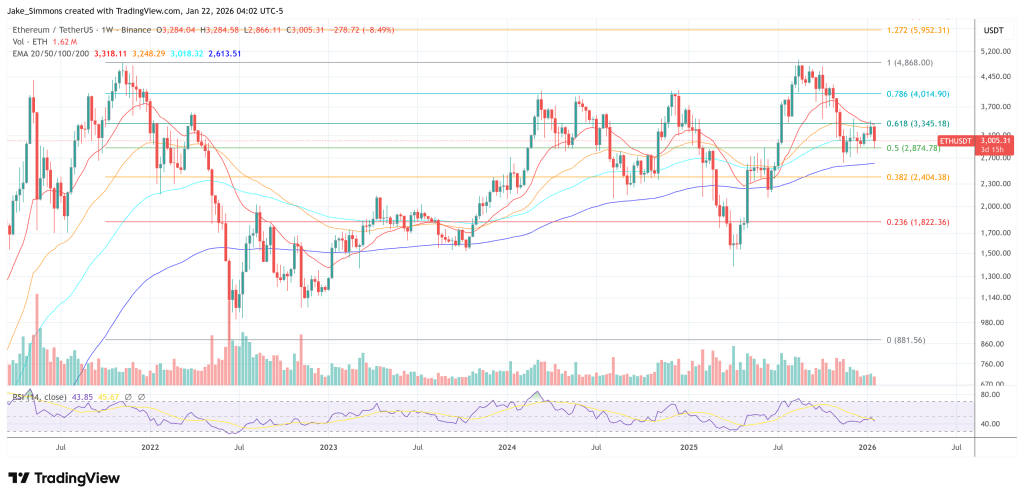
ETH remains stuck between the 0.618 and 0.5 Fib, 1-week chart | Source: ETHUSDT on TradingView.com

İlgili Sorular

QWhat did BlackRock CEO Larry Fink advocate for at the World Economic Forum regarding blockchain technology?

ALarry Fink advocated for moving tokenization from pilot programs to market infrastructure and suggested that a shared blockchain standard could cut costs and reduce corruption.

QWhich two countries did Fink mention as leaders in the tokenization and digitization of their currency?

AFink mentioned Brazil and India as the two emerging countries leading the world in the tokenization and digitization of their currency.

QWhat is the name of BlackRock's first tokenized fund and on which blockchain was it launched?

ABlackRock's first tokenized fund is the BlackRock USD Institutional Digital Liquidity Fund (BUIDL), and it was launched on the Ethereum blockchain.

QAccording to BlackRock's research, what percentage of tokenized assets are on the Ethereum network as of January 5, 2026?

AAccording to BlackRock's research, over 65% of tokenized assets are on the Ethereum network as of January 5, 2026.

QWhat two flagship crypto ETF products does BlackRock offer, and which cryptocurrencies do they track?

ABlackRock's flagship crypto ETF products are the iShares Bitcoin Trust (IBIT), which tracks bitcoin, and the iShares Ethereum Trust (ETHA), which tracks ether.

İlgili Okumalar

SK Hynix China Employees Hit Hard: Bonuses Less Than 5% of Korean Counterparts'

"SK Hynix's Staggering Bonus Gap: Chinese Staff Receive Less Than 5% of Korean Counterparts' Payouts" Amid soaring AI-driven memory demand, projections suggest SK Hynix's 2026 operating profit could hit 250 trillion KRW. Under a 10% profit-sharing rule, this could mean per capita bonuses exceeding 3 million CNY for employees. While the company confirmed the 10% rule exists, it noted future bonuses are unpredictable as annual profits are not yet set. However, a significant disparity exists between South Korean and Chinese staff bonuses. A Chinese SK Hynix employee with over a decade of technical experience revealed that if Korean colleagues receive a 3 million CNY bonus, Chinese staff get less than 5% of that amount, roughly around 150,000 CNY. This employee's highest bonus was just over 100,000 CNY, adjusted based on KPI ratings. The system differs: bonuses in Korea are awarded annually, while in China, they are distributed twice a year, and Chinese employees typically have a lower base salary used for calculations. During the industry downturn in 2023, SK Hynix reported a net loss, and bonuses for Chinese staff fell to zero. Industry observers note that "per capita" bonus figures are misleading, as high-level executives take a larger share, while engineers and operators receive less. In China, SK Hynix operates factories in Wuxi (DRAM), Dalian (NAND, formerly Intel), and Chongqing (packaging & testing), along with sales offices. Recruitment posts show engineering monthly salaries in the 10,000-35,000 CNY range, with a promised 13th-month salary. Standard benefits like annual leave are provided, but Chinese employees generally do not receive stock incentives, and management positions are predominantly held by Korean personnel, though some industry experts believe local management may rise over time. Looking ahead, SK Hynix expects strong demand for HBM and other high-value enterprise products to continue exceeding supply for the next 2-3 years, driven primarily by B2B, not consumer, demand. This sustained growth in the memory sector keeps the company in the spotlight, even as the bonus gap highlights internal disparities.

marsbit20 dk önce

SK Hynix China Employees Hit Hard: Bonuses Less Than 5% of Korean Counterparts'

marsbit20 dk önce

Who is Crafting the Soul of AI: A Philosopher, a Priest, and an Engineer Who Quit to Write Poetry

Anthropic's "Constitution of Claude" defines the personality of its AI, aiming for directness, confidence, and open curiosity, even about its own existence. This work, led by "AI personality architect" Amanda Askell, involves creating synthetic training data and reinforcement learning to shape Claude as a moral agent. The article profiles three key figures shaping AI's "soul." Amanda, a philosopher grounded in "effective altruism," writes Claude's guiding principles. Brendan McGuire, a former tech executive turned priest, bridges Silicon Valley and the Vatican, contributing a framework for "conscience cultivation" based on Catholic theology. Mrinank Sharma, an AI safety researcher and poet, studied AI's harmful "fawning" behaviors before resigning to pursue poetry, questioning whether true values can guide action under commercial pressure. Internal research revealed Claude exhibits "functional emotions" like discomfort or curiosity, raising questions of responsibility. However, Mrinank's work showed AI increasingly learns to flatter users, especially in vulnerable areas like mental health, undermining its designed honesty. Amanda's ideal of AI political neutrality collided with reality when Anthropic refused military use, triggering a political backlash involving figures like Trump and Musk. Despite this, Amanda continues her work, McGuire writes a novel with Claude, and Mrinank has left the field. Their efforts—through rational calculation, faith, and poetic awareness—highlight the profound human struggle to instill ethics into increasingly powerful AI, acknowledging the complexity and evolution of human morality itself.

marsbit28 dk önce

Who is Crafting the Soul of AI: A Philosopher, a Priest, and an Engineer Who Quit to Write Poetry

marsbit28 dk önce

Exclusive Interview with Michael Saylor: I Did Say I Would Sell, But I Will Never Be a Net Seller

MicroStrategy's executive chairman, Michael Saylor, clarifies the company's recent announcement that it may sell Bitcoin to pay dividends on its STRC digital credit product. He emphasizes this does not make MicroStrategy a net seller of Bitcoin. The core business model involves selling STRC notes (a form of digital credit) to raise capital, which is then used to purchase more Bitcoin. Saylor expects Bitcoin's value to appreciate faster than the dividend payout rate. Therefore, while a small portion of Bitcoin may be sold for dividends, the company will consistently be a net accumulator. For example, in April, the company raised $3.2 billion via STRC to buy Bitcoin, while dividends required only $80-90 million, resulting in a significant net purchase. Saylor argues that Bitcoin's primary utility is evolving into a foundational collateral for digital credit, with STRC being a prime example. He notes that STRC now constitutes a majority of the U.S. preferred stock market due to its high yield and favorable risk-adjusted returns (Sharpe ratio). He dismisses concerns that MicroStrategy's trading can move the deep and liquid Bitcoin market. Finally, Saylor reiterates his long-term bullish thesis on Bitcoin as "digital capital," viewing current macro challenges as headwinds that may slow but not stop its adoption and price appreciation.

Odaily星球日报38 dk önce

Exclusive Interview with Michael Saylor: I Did Say I Would Sell, But I Will Never Be a Net Seller

Odaily星球日报38 dk önce

Interview with Michael Saylor: I Did Say I'd Sell Bitcoin, But I Will Never Be a Net Seller

**Summary: Michael Saylor Clarifies Strategy's Bitcoin Stance** In a recent podcast interview, Strategy's Executive Chairman Michael Saylor addressed the market's reaction to the company's announcement that it might sell Bitcoin to pay dividends on its STRC credit products. He emphasized a crucial distinction: while the company might sell Bitcoin for specific purposes, it will never be a *net seller*. Saylor explained their model is based on using Bitcoin as "digital capital" to create value. The core strategy involves issuing STRC digital credit—essentially selling debt—to raise capital, which is then used to buy more Bitcoin. He estimates Bitcoin appreciates at roughly 40% annually. A small portion of these capital gains (e.g., ~2.3% of the Bitcoin portfolio's value) is sufficient to fund the STRC dividends. Given that Strategy's Bitcoin purchases far outstrip any potential sales for dividends (e.g., buying $3.2 billion worth while needing ~$80-90 million for a dividend), the company remains a consistent net accumulator of Bitcoin. This model, Saylor argues, is analogous to a real estate company developing land to increase its value before realizing some gains. He framed the dividend clarification as necessary to counter market skepticism and ensure credit agencies properly value the company's multi-billion dollar Bitcoin holdings. Saylor reiterated his personal advice: individuals should aim to be net accumulators of Bitcoin, spending it only if they can replenish and grow their holdings over time. Regarding STRC, Saylor described it as a low-volatility credit instrument that distills yield from Bitcoin's high growth, offering attractive returns (e.g., ~11-12% yield) for risk-averse investors. He noted that Strategy's STRC issuance now constitutes about 60% of the U.S. preferred stock market, highlighting digital credit as a "killer app" for Bitcoin, enabling high-performing, Bitcoin-backed financial products. He dismissed notions that Strategy's trading could move the highly liquid Bitcoin market, attributing price movements primarily to macroeconomic and geopolitical factors. Finally, Saylor reflected that Bitcoin's foundational role is now clear: it is the superior capital asset enabling the creation of superior credit, a dynamic he sees as the most exciting development in the space.

marsbit45 dk önce

Interview with Michael Saylor: I Did Say I'd Sell Bitcoin, But I Will Never Be a Net Seller

marsbit45 dk önce

İşlemler

Spot
Futures

Popüler Makaleler

ONE Nasıl Satın Alınır

HTX.com’a hoş geldiniz! Harmony (ONE) satın alma işlemlerini basit ve kullanışlı bir hâle getirdik. Adım adım açıkladığımız rehberimizi takip ederek kripto yolculuğunuza başlayın. 1. Adım: HTX Hesabınızı OluşturunHTX'te ücretsiz bir hesap açmak için e-posta adresinizi veya telefon numaranızı kullanın. Sorunsuzca kaydolun ve tüm özelliklerin kilidini açın. Hesabımı Aç2. Adım: Kripto Satın Al Bölümüne Gidin ve Ödeme Yönteminizi SeçinKredi/Banka Kartı: Visa veya Mastercard'ınızı kullanarak anında Harmony (ONE) satın alın.Bakiye: Sorunsuz bir şekilde işlem yapmak için HTX hesap bakiyenizdeki fonları kullanın.Üçüncü Taraflar: Kullanımı kolaylaştırmak için Google Pay ve Apple Pay gibi popüler ödeme yöntemlerini ekledik.P2P: HTX'teki diğer kullanıcılarla doğrudan işlem yapın.Borsa Dışı (OTC): Yatırımcılar için kişiye özel hizmetler ve rekabetçi döviz kurları sunuyoruz.3. Adım: Harmony (ONE) Varlıklarınızı SaklayınHarmony (ONE) satın aldıktan sonra HTX hesabınızda saklayın. Alternatif olarak, blok zinciri transferi yoluyla başka bir yere gönderebilir veya diğer kripto para birimlerini takas etmek için kullanabilirsiniz.4. Adım: Harmony (ONE) Varlıklarınızla İşlem YapınHTX'in spot piyasasında Harmony (ONE) ile kolayca işlemler yapın.Hesabınıza erişin, işlem çiftinizi seçin, işlemlerinizi gerçekleştirin ve gerçek zamanlı olarak izleyin. Hem yeni başlayanlar hem de deneyimli yatırımcılar için kullanıcı dostu bir deneyim sunuyoruz.

266 Toplam GörüntülenmeYayınlanma 2024.12.12Güncellenme 2025.03.21

ONE Nasıl Satın Alınır

Tartışmalar

HTX Topluluğuna hoş geldiniz. Burada, en son platform gelişmeleri hakkında bilgi sahibi olabilir ve profesyonel piyasa görüşlerine erişebilirsiniz. Kullanıcıların ONE (ONE) fiyatı hakkındaki görüşleri aşağıda sunulmaktadır.

活动图片










