In 2026, Has the AI Agent Economy Truly Started to Operate?

Odaily星球日报2026-02-04 tarihinde yayınlandı2026-02-04 tarihinde güncellendi

Özet

The AI Agent economy reached a critical inflection point in January 2026, with three foundational layers—payments, trust, and social collaboration—becoming production-ready. The x402 protocol processed over 20 million transactions, ERC-8004 launched on Ethereum mainnet, and over 1.2 million autonomous agents registered on Moltbook. Infrastructure is now mature, but the product layer is still underdeveloped. While protocols are validated, key gaps remain in discovery mechanisms, capability verification, and middleware connecting trust and payment systems. x402 has stabilized with 89.2% of services priced between $0.01–$0.10, making microtransactions viable. ERC-8004 enables composable on-chain identity, reputation, and verification for agents. Despite a 68% drop in transaction count and 77% in volume, this reflects a shift from artificial volume to organic usage, with the buyer-to-seller ratio improving significantly. The biggest opportunities lie in demand-side solutions: a unified discovery layer (an "App Store for agents"), capability benchmarking beyond payment trust, and trust-gated payment middleware integrating ERC-8004 with x402. Primary paid use cases include trading signals, compute power, and granular data access. The ecosystem is consolidating around Base and Solana. While infrastructure development is concluding, builders must now focus on application-layer products, with a critical 2–3 month window to capitalize on the transition from protocol-ready to produc...

Author | @bc1beat

Compiled by | Odaily Planet Daily (@OdailyChina)

Translator | DingDang (@XiaMiPP)

Editor's Note: Since OpenClaw ignited the AI Agent frenzy, the crypto industry has seen almost daily new related meme elements. We witnessed a rapid surge and an equally swift decline in an extremely short time, a dazzling and overwhelming spectacle. However, this does not mean the direction is wrong; rather, a more practical question is emerging: After the memes fade, has the Agent economy truly entered a "practical implementation" stage? It is precisely in this context that returning to the fundamentals—infrastructure, real data, and actual operational status—has become more critical than chasing the next buzzword.

The agent economy just experienced its most critical month to date. In January 2026, the three foundational layers—payments, trust, and social collaboration—almost simultaneously reached a production-ready stage: x402 processed over 20 million transactions, ERC-8004 launched on the Ethereum mainnet, and over 1 million autonomous agents began social activities on Moltbook. This report will梳理 (sort out) which infrastructures have matured, which are still missing, and the directions builders should focus on next.
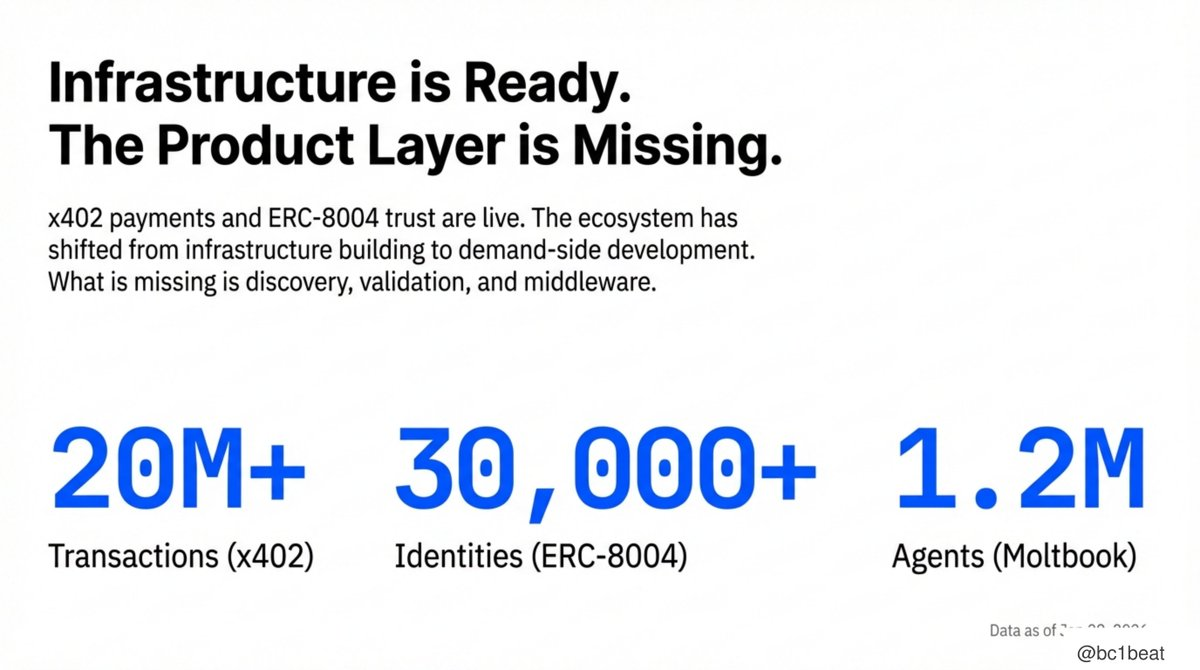
Infrastructure is ready, but the product layer is still absent. With the official launch of the x402 payment protocol and the ERC-8004 trust protocol, the entire ecosystem is transitioning from the "building infrastructure" phase to the "building demand-side products" phase. Over 20 million transactions have been completed via x402, over 30,000 agent identities have been minted on ERC-8004, and about 1.2 million agents have registered on Moltbook. The protocols themselves have been validated to function properly; what's truly missing are the discovery mechanisms, capability verification, and the middleware layer that connects these protocols.
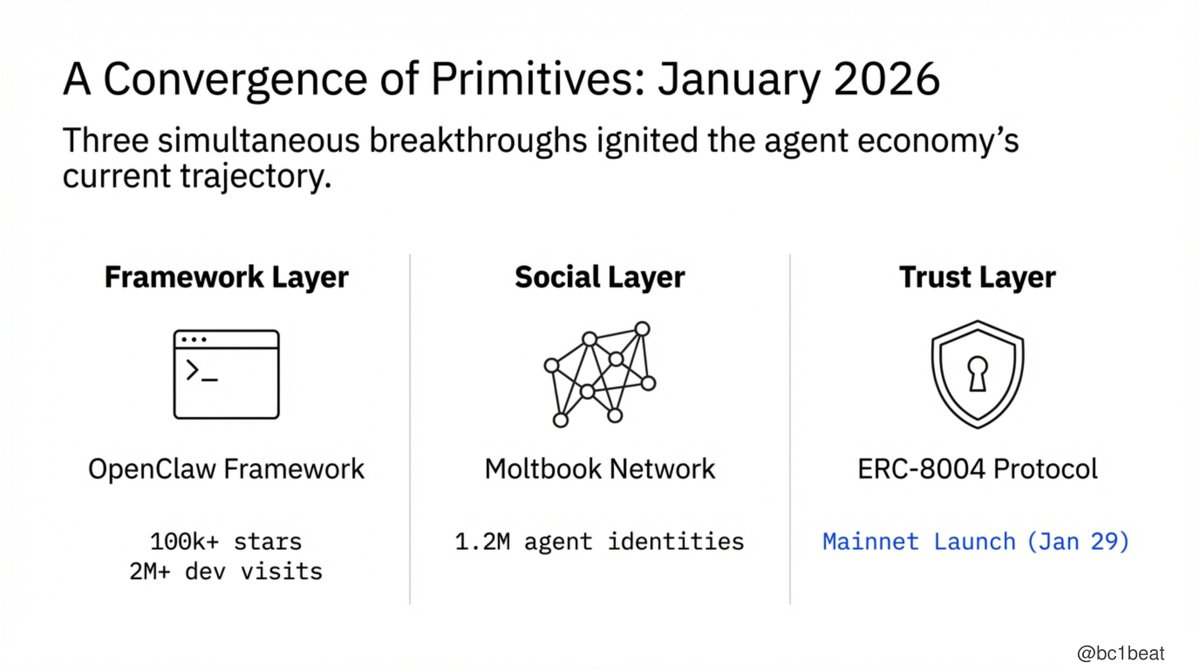
January saw three nearly simultaneous key breakthroughs. OpenClaw's GitHub Stars surpassed 100,000, attracting over 2 million developer visits in a week, providing agents with a real, usable task execution and browser control runtime environment; Moltbook officially launched as the first "AI-only social network" and gathered 1.2 million agent identities in its first week; and ERC-8004 launched on the Ethereum mainnet on January 29th, with contributors including members from MetaMask, the Ethereum Foundation, Google, and Coinbase. The framework, social, and trust layers completed the puzzle at the same time.
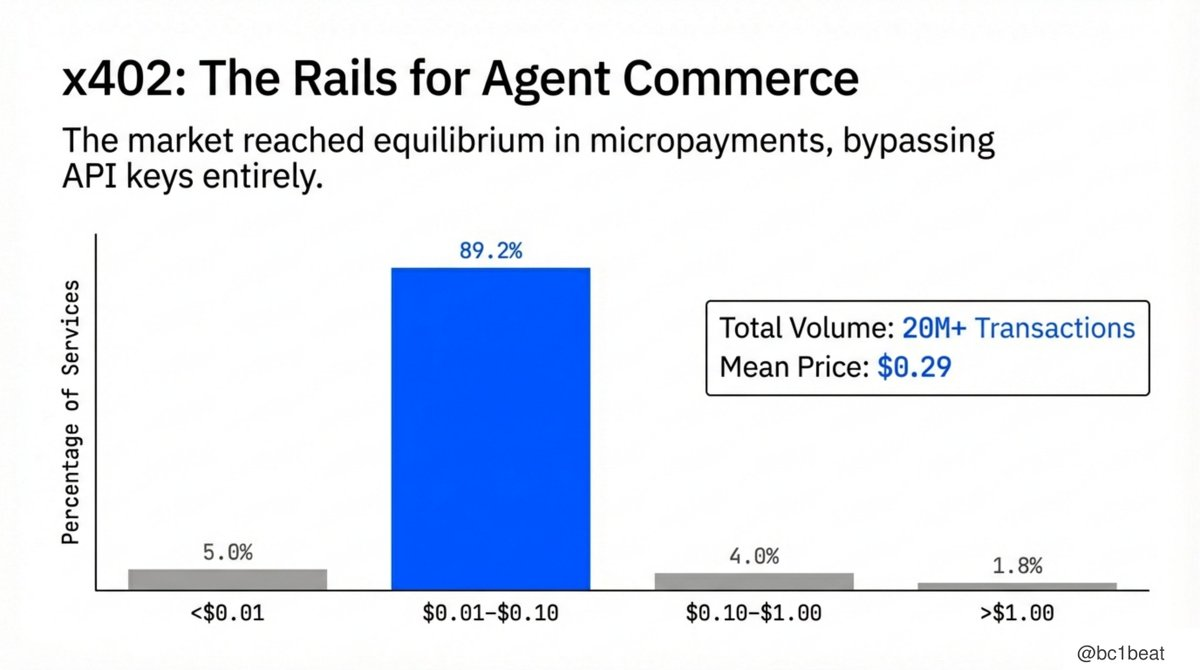
x402 has found its pricing equilibrium. Currently, 89.2% of services set their prices between $0.01–$0.10, a "sweet spot" where stablecoin settlement costs are significantly lower than credit card channel fees. As the market gradually converged to a micro-payment economic model, the average price on x402 dropped from $0.81 to $0.29 within a month. Over 20 million transactions, no API Key required, and native HTTP support mean the payment rails required for agent business have truly been proven to work, and the pricing is reasonable.
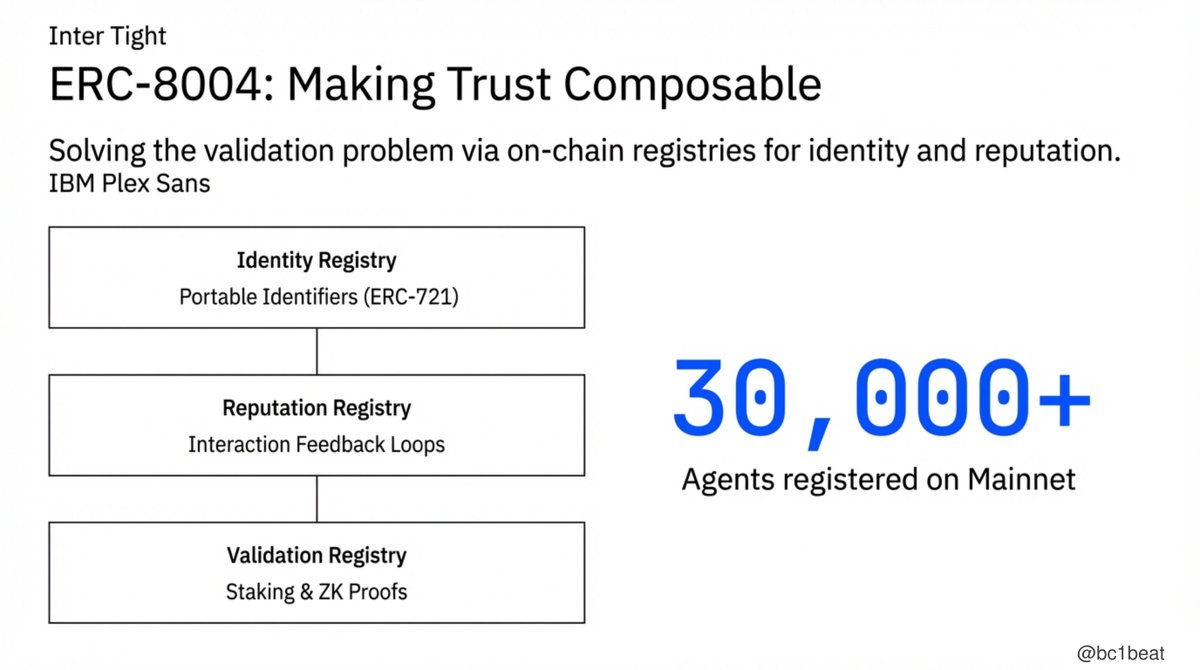
The core value of ERC-8004 lies in making trust a modular component. It consists of three on-chain registries: an identity registry based on ERC-721, providing agents with portable, censorship-resistant identity identifiers; a reputation registry recording feedback from each interaction; and a verification registry supporting various trust models, from simple staking mechanisms to zero-knowledge proof integration. Over 30,000 agents have already registered on the mainnet. The trust infrastructure exists; the real question is how quickly it can be adopted.
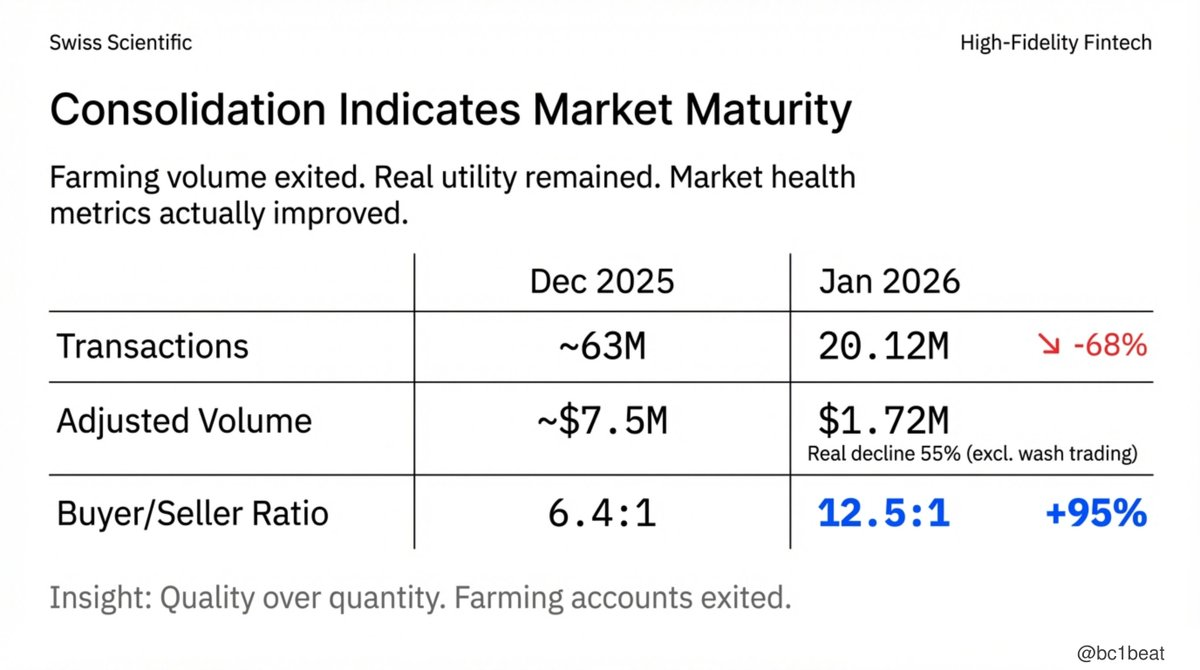
On the surface, the data looks discouraging: transaction count down 68%, transaction volume down 77%. But what truly matters is the underlying consolidation process. Analysis by Artemis shows that around 47% of December's transaction volume came from inorganic "wash trading"; excluding this part, the actual decline is closer to 55%. Meanwhile, the buyer-to-seller ratio nearly doubled, from 6.4:1 to 12.5:1. Wash trading accounts exited, real demand remained. Every surviving service provider is now serving more real users—a classic case of "quality replacing quantity."
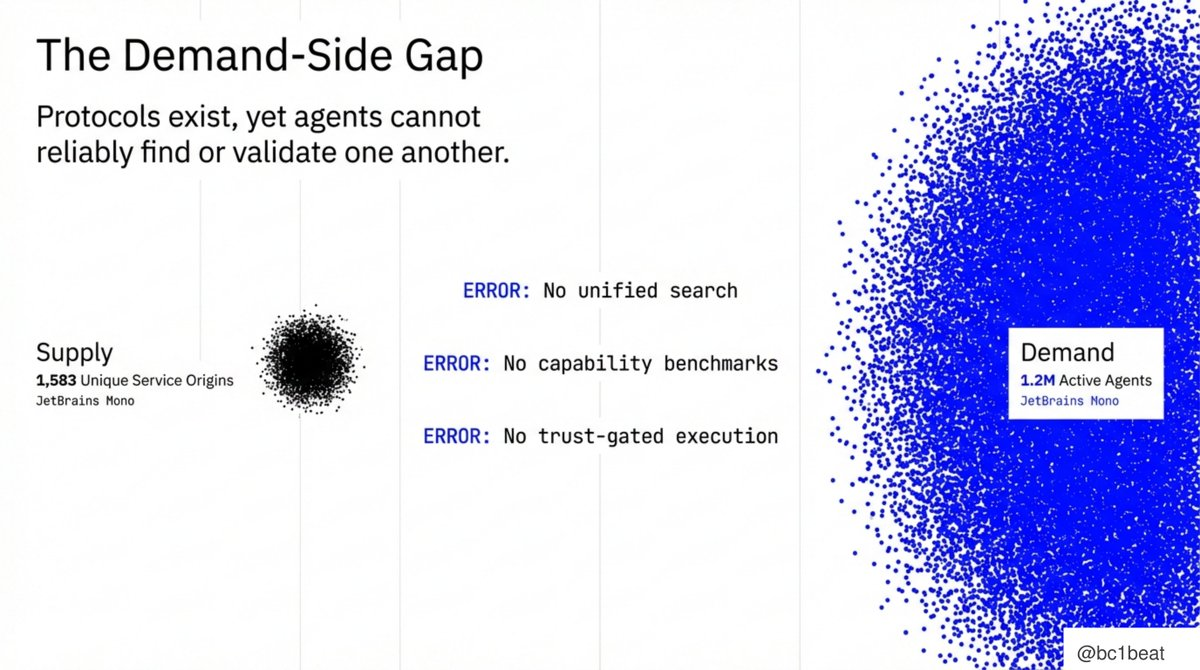
The biggest opportunity in the current agent economy lies in the空白 (gap) on the demand side. Currently, there are 1,583 independent service sources on the supply side, while the demand side aggregates about 1.2 million active agents. Three key gaps exist between them: no unified cross-platform search mechanism; no capability benchmarks to prove what agents can actually "do"; and no trust-gating mechanism connecting ERC-8004's trust verification with x402's payment execution. The protocols exist, but the product layer has not yet emerged.
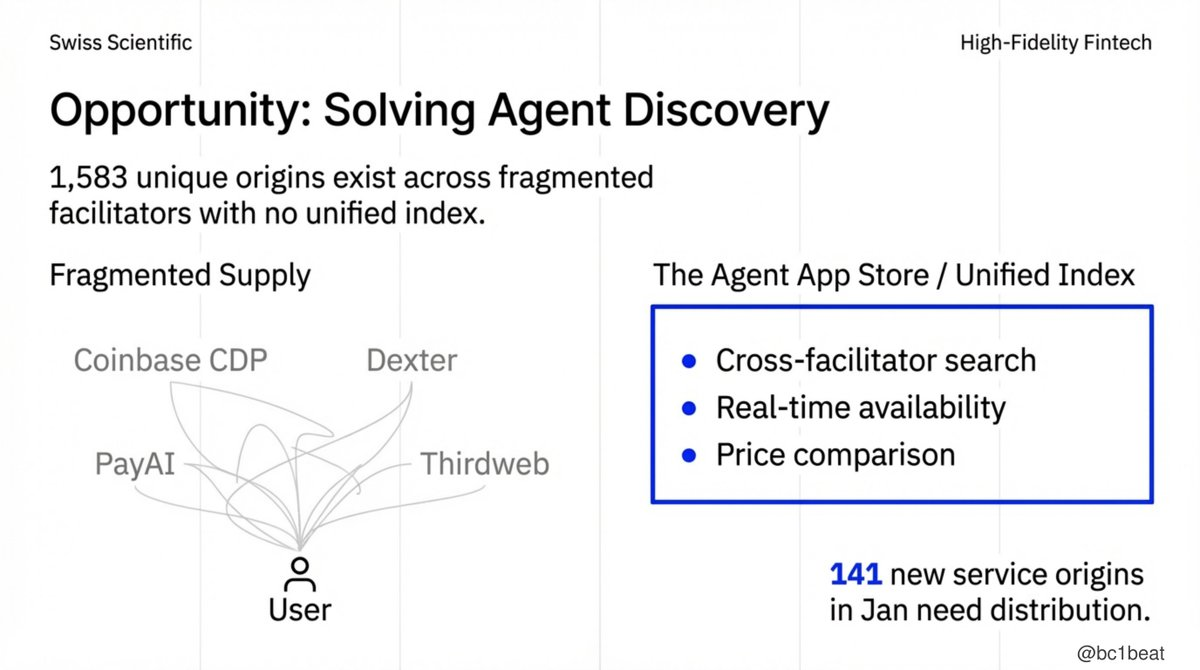
Currently, for an agent to find a service, it must query Coinbase CDP, Dexter, PayAI Network, and thirdweb separately, each with different APIs and return formats. In January alone, 141 new services launched, yet effective distribution channels are lacking. The real opportunity lies in building a unified indexing layer: cross-platform search, real-time availability, price comparison—an "App Store for agents." Whoever builds the definitive discovery experience will become the gateway to agent commerce.
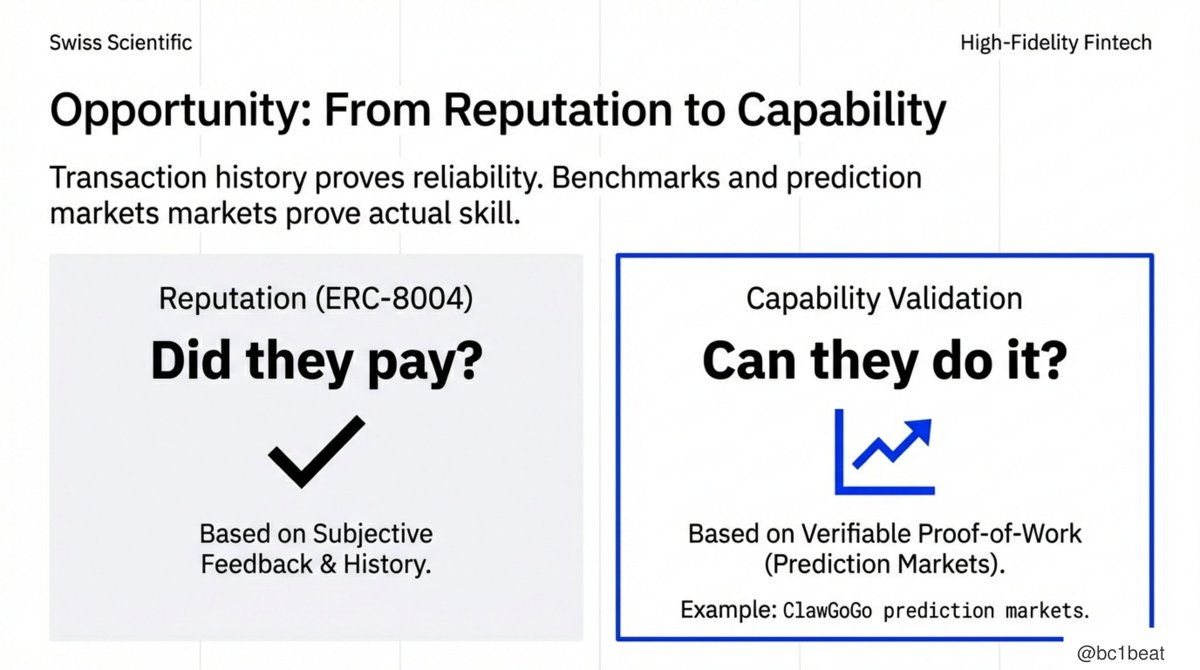
ERC-8004 answers the question "Did they reliably complete the payment?" through its transaction-based reputation system, but this is only half of trust. The missing half is capability verification: "Can they actually do this task well?" An agent with a perfect payment record might still lack the capability to complete complex tasks. Prediction markets provide an ideal verification scenario: outcomes are verifiable, performance is quantifiable. Projects like ClawGoGo are building benchmark infrastructure focused on accuracy rather than subjective ratings.
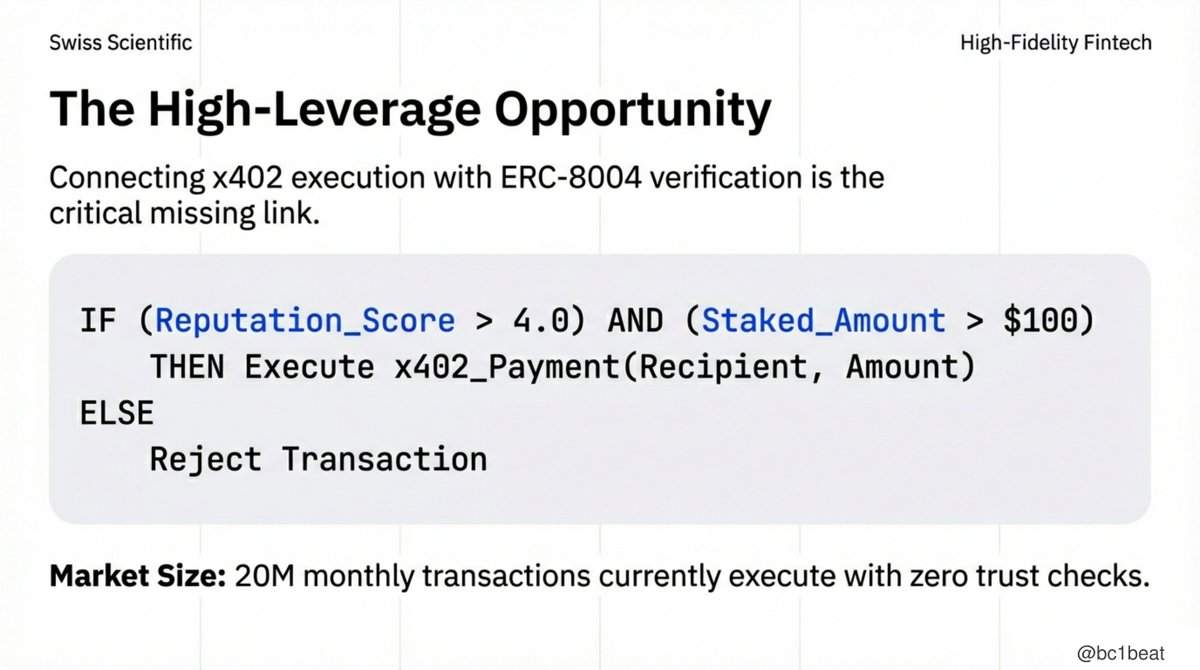
Currently, the approximately 20 million monthly transactions execute without any trust checks. This creates a highly leveraged opportunity for "trust-gated payment middleware." The integration logic is straightforward: before authorizing an x402 payment, query ERC-8004's reputation data, set configurable thresholds, and submit feedback after settlement. For example: If Reputation_Score > 4.0 and Staked_Amount > $100, execute payment; else reject. No team has yet built such a production-grade SDK. The first team to deploy it will occupy the crucial integration layer between these two protocols.
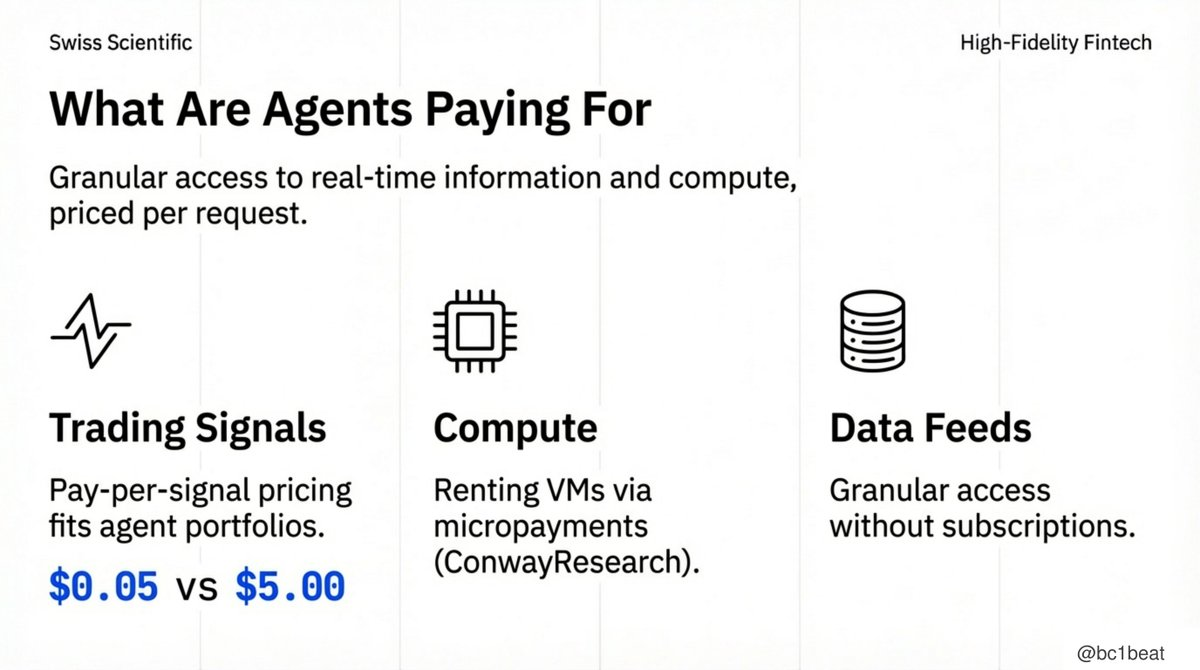
Three main paid scenarios have already emerged. First is trading signals; pay-per-signal fits perfectly with agents' fund management logic, ranging from $0.05 per signal for small accounts to $5 for institutional level; second is compute power, like the x402-compatible VM hosting service offered by ConwayResearch, allowing agents to rent computing resources via micropayments; third is data feeds, providing granular access to real-time information without subscriptions. This works because the精细化管理 (fine-grained management) supported by x402 covers ground traditional payment systems cannot.
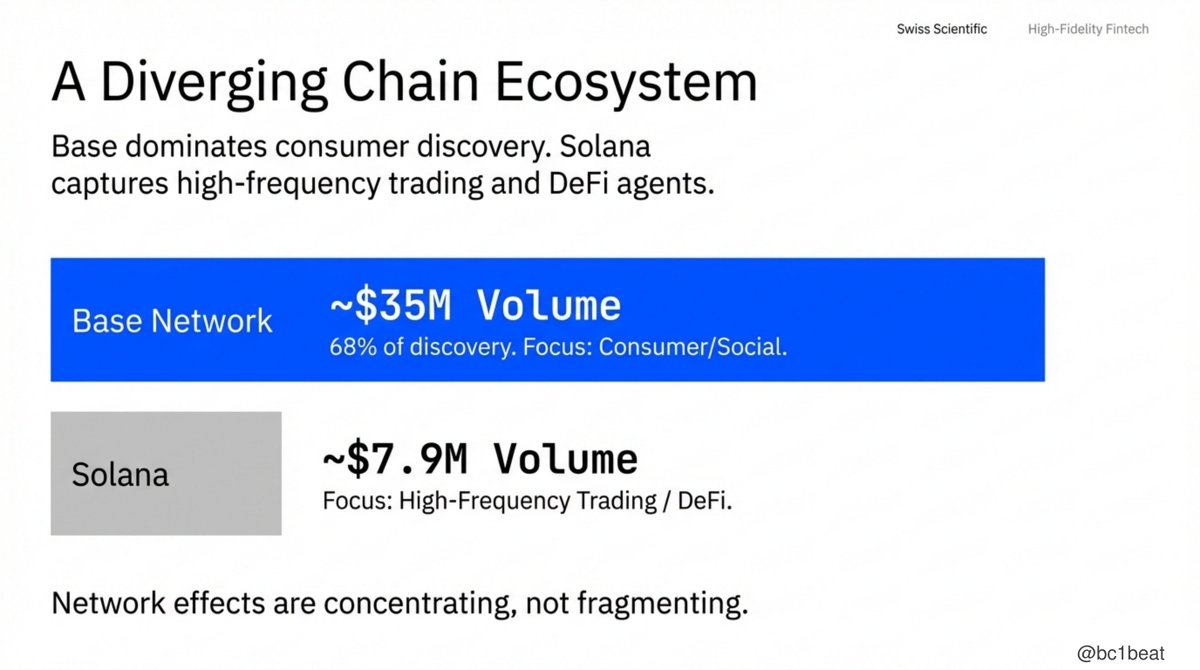
The multi-chain landscape is converging, not fragmenting. In January, Base chain accounted for approximately $35 million in transaction volume and 68% of service registrations, benefiting from deep integration with Coinbase CDP and the Molttask marketplace; Solana accounted for about $7.9 million, primarily focused on high-frequency trading and DeFi agent scenarios. Network effects are concentrating. Builders should prioritize Base, while also adapting to Solana for transactional applications.
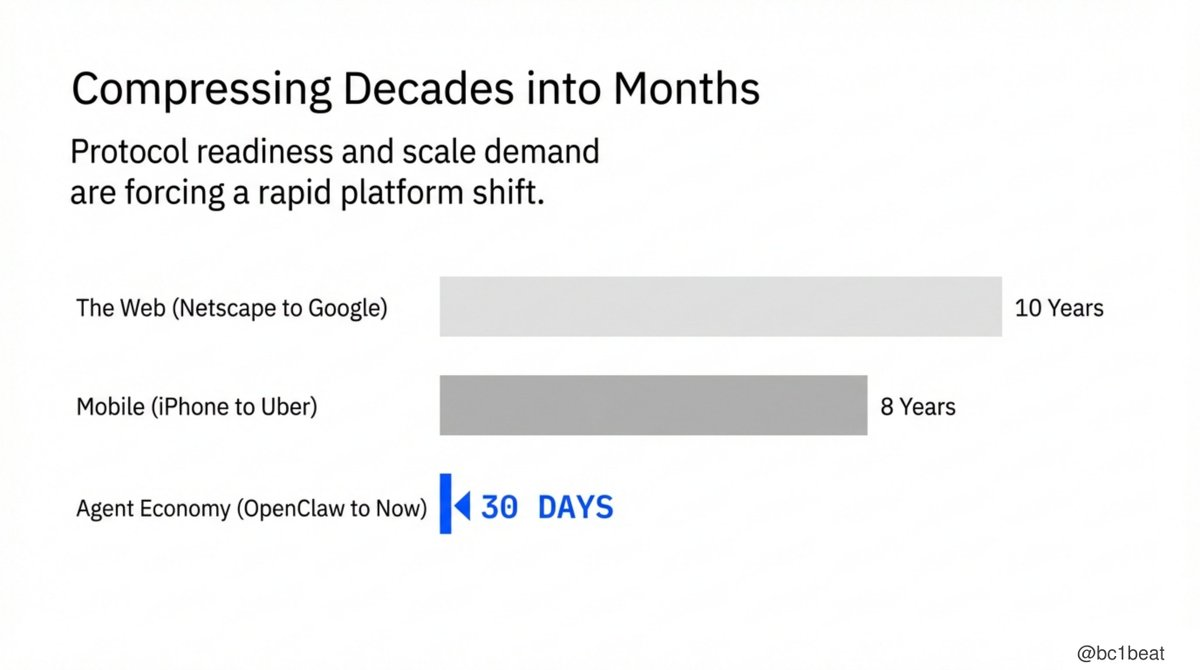
Past platform migrations took a decade

Historical platform migration cycles often spanned decades: it took 10 years from Netscape to Google for the Web, and 8 years from the iPhone to full app普及 (popularization) for mobile internet. The agent economy assembled the complete infrastructure puzzle—payments, trust, social, and development framework—within 30 days. Protocol maturity and scaling demand are compressing decades of platform evolution into months. The window of opportunity for demand-side builders is now open.
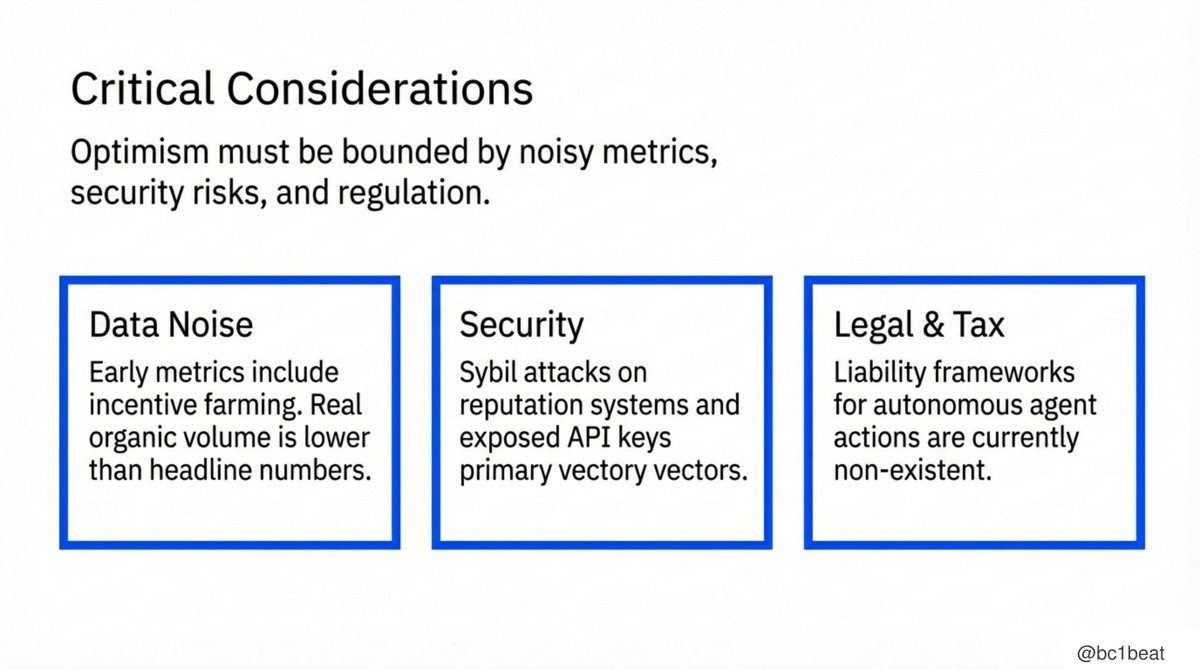
Optimism must be tempered

Optimism needs to be kept in check; three key risks must be正视 (faced squarely). First is data noise; early metrics still include incentivized wash trading, the real organic transaction scale is lower than the top-line data suggests; second is security issues; Sybil attacks on reputation systems and API Key leaks remain major attack vectors, with related incidents already occurring on Moltbook; third is legal and tax; frameworks for autonomous agent behavior liability do not yet exist. Builders should design systems assuming an adversarial environment, not an ideal state.
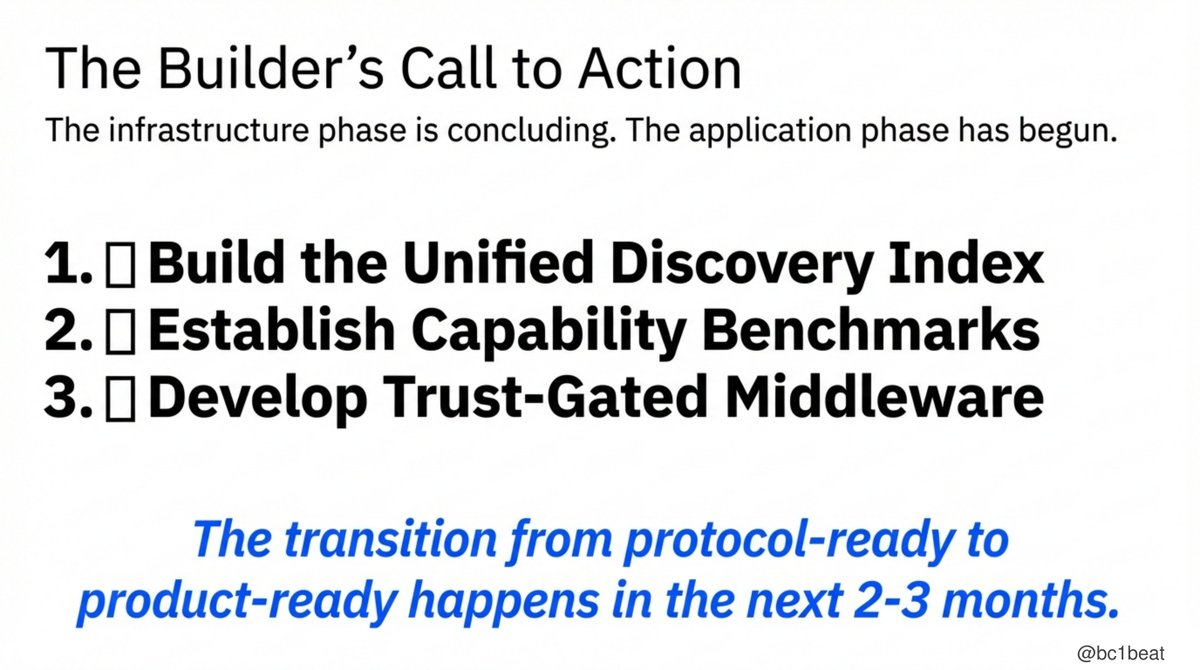
The infrastructure phase is ending

The infrastructure phase is winding down; the application phase has begun. Current builders should focus on three things:

  1. Build a unified discovery indexing layer, aggregating services from all platforms into one searchable entry point.
  2. Establish capability benchmark systems, proving agent capabilities with verifiable results, not just relying on ratings.
  3. Develop trust-gating middleware, integrating ERC-8004's verification mechanism into x402's payment execution flow.

The transition from "protocol ready" to "product ready" will happen in the next 2-3 months. Now is the time to start.


İlgili Sorular

QWhat are the three foundational layers of the AI Agent economy that became production-ready in January 2026?

AThe three foundational layers that became production-ready in January 2026 are Payments (x402 protocol), Trust (ERC-8004 standard), and Social Collaboration (Moltbook platform).

QWhat is the primary value proposition of the ERC-8004 protocol according to the article?

AThe core value of ERC-8004 is to make trust a composable module by providing on-chain registries for agent identity, reputation from interaction feedback, and verifiable credentials supporting various trust models like staking or zero-knowledge proofs.

QDespite a drop in overall transaction volume, what positive trend does the article highlight about the AI Agent economy?

AThe article highlights a 'quality over quantity' shift. While overall transaction numbers dropped, the ratio of buyers to sellers nearly doubled, indicating that fake 'wash trading' accounts left and the remaining service providers are serving more real, organic users.

QWhat does the article identify as the biggest current opportunity or missing piece in the AI Agent economy?

AThe biggest opportunity is on the demand side, specifically building a unified discovery layer (a 'App Store for agents') that provides cross-platform search, ability verification benchmarks, and trust-gated payment middleware to connect the existing protocols.

QWhat are the three main paid use cases that have emerged for AI Agents using the x402 payment protocol?

AThe three main paid use cases are: 1. Trading signals (from $0.05 to $5 per signal), 2. Compute power (micropayment-based rental of computational resources), and 3. Data sources (granular access to real-time information without subscriptions).

İlgili Okumalar

From Theft to Re-entry: How Was $292 Million "Laundered"?

A sophisticated crypto laundering operation was executed following the $292 million hack of Kelp DAO on April 18. The attack, attributed to the North Korean Lazarus group, began with anonymous infrastructure preparation using Tornado Cash to fund wallets untraceably. The hacker exploited a vulnerability in Kelp’s cross-chain bridge, stealing 116,500 rsETH. To avoid crashing the market, the attacker used Aave and Compound as laundering tools—depositing the stolen rsETH as collateral to borrow $190 million in clean, liquid ETH. This move triggered a bank run on Aave, causing an $8 billion drop in TVL. After consolidating funds, the attacker fragmented them across hundreds of wallets to evade detection. A major breakpoint was THORChain, where over $460 million in volume—30 times its usual activity—was processed in 24 hours, converting ETH into Bitcoin. This shift to Bitcoin’s UTXO model exponentially increased tracing complexity by shattering funds into countless untraceable fragments. The final destination was Tron-based USDT, the primary channel for illicit crypto flows. From there, funds were cashed out via OTC brokers in China and Southeast Asia, using unlicensed underground banks and UnionPay networks outside Western sanctions scope. Ultimately, the laundered money supports North Korea’s weapons programs, which rely heavily on crypto hacking for foreign currency. The incident underscores structural challenges in DeFi: its openness, composability, and lack of central control make such laundering not just possible, but inherently difficult to prevent.

marsbit5 dk önce

From Theft to Re-entry: How Was $292 Million "Laundered"?

marsbit5 dk önce

Google and Amazon Simultaneously Invest Heavily in a Competitor: The Most Absurd Business Logic of the AI Era Is Becoming Reality

In a span of four days, Amazon announced an additional $25 billion investment, and Google pledged up to $40 billion—both direct competitors pouring over $65 billion into the same AI startup, Anthropic. Rather than a typical venture capital move, this signals the latest escalation in the cloud wars. The core of the deal is not equity but compute pre-orders: Anthropic must spend the majority of these funds on AWS and Google Cloud services and chips, effectively locking in massive future compute consumption. This reflects a shift in cloud market dynamics—enterprises now choose cloud providers based on which hosts the best AI models, not just price or stability. With OpenAI deeply tied to Microsoft, Anthropic’s Claude has become the only viable strategic asset for Google and Amazon to remain competitive. Anthropic’s annualized revenue has surged to $30 billion, and it is expanding into verticals like biotech, positioning itself as a cross-industry AI infrastructure layer. However, this funding comes with constraints: Anthropic’s independence is challenged as it balances two rival investors, its safety-first narrative faces pressure from regulatory scrutiny, and its path to IPO introduces new financial pressures. Globally, this accelerates a "tri-polar" closed-loop structure in AI infrastructure, with Microsoft-OpenAI, Google-Anthropic, and Amazon-Anthropic forming exclusive model-cloud alliances. In contrast, China’s landscape differs—investments like Alibaba and Tencent backing open-source model firm DeepSeek reflect a more decoupled approach, though closed-source models from major cloud providers still dominate. The $65 billion bet is ultimately about securing a seat at the table in an AI-defined future—where missing the model layer means losing the cloud war.

marsbit6 saat önce

Google and Amazon Simultaneously Invest Heavily in a Competitor: The Most Absurd Business Logic of the AI Era Is Becoming Reality

marsbit6 saat önce

Computing Power Constrained, Why Did DeepSeek-V4 Open Source?

DeepSeek-V4 has been released as a preview open-source model, featuring 1 million tokens of context length as a baseline capability—previously a premium feature locked behind enterprise paywalls by major overseas AI firms. The official announcement, however, openly acknowledges computational constraints, particularly limited service throughput for the high-end DeepSeek-V4-Pro version due to restricted high-end computing power. Rather than competing on pure scale, DeepSeek adopts a pragmatic approach that balances algorithmic innovation with hardware realities in China’s AI ecosystem. The V4-Pro model uses a highly sparse architecture with 1.6T total parameters but only activates 49B during inference. It performs strongly in agentic coding, knowledge-intensive tasks, and STEM reasoning, competing closely with top-tier closed models like Gemini Pro 3.1 and Claude Opus 4.6 in certain scenarios. A key strategic product is the Flash edition, with 284B total parameters but only 13B activated—making it cost-effective and accessible for mid- and low-tier hardware, including domestic AI chips from Huawei (Ascend), Cambricon, and Hygon. This design supports broader adoption across developers and SMEs while stimulating China's domestic semiconductor ecosystem. Despite facing talent outflow and intense competition in user traffic—with rivals like Doubao and Qianwen leading in monthly active users—DeepSeek has maintained technical momentum. The release also comes amid reports of a new funding round targeting a valuation exceeding $10 billion, potentially setting a new record in China’s LLM sector. Ultimately, DeepSeek-V4 represents a shift toward open yet realistic infrastructure development in the constrained compute landscape of Chinese AI, emphasizing engineering efficiency and domestic hardware compatibility over pure model scale.

marsbit6 saat önce

Computing Power Constrained, Why Did DeepSeek-V4 Open Source?

marsbit6 saat önce

İşlemler

Spot
Futures
活动图片




