Huawei Cloud Rejects Token Price War, Zhou Yuefeng Seeks a New Winning Formula for AI Cloud

marsbit2026-06-06 tarihinde yayınlandı2026-06-06 tarihinde güncellendi

Özet

At the 2026 Huawei Cloud INSPIRE Creator Conference, CEO Zhou Yuefeng outlined Huawei Cloud's distinct strategy in the competitive AI cloud market. Instead of engaging in price wars based on token volume or Maas revenue—a common focus for rivals like Alibaba Cloud and ByteDance's Volcano Engine—Huawei Cloud is shifting the competition towards real-world productivity gains. Zhou highlighted three core differentiators: a fully domestic computing stack (Ascend, Kunpeng), a focus on government and enterprise clients rather than consumer internet, and a deep commitment to open-source ecosystems. To this end, Huawei Cloud launched a suite of new products under the "Agentic Infra" paradigm, including the AICS Lingqu computing cluster, AMS memory storage, and the ModelArts Next platform. These aim to solve enterprise challenges in deploying AI agents, such as latency, memory, scheduling, and security. The strategy further involves creating specialized industry zones ("AI Dream Factories") for sectors like healthcare and embodied intelligence. For example, a smart medical zone developed with Shanghai Ruijin Hospital aims to democratize expert-level diagnostic capabilities. In essence, Huawei Cloud is positioning itself not as a commodity token provider, but as the foundational infrastructure for industrial AI, leveraging its domestic supply chain and hybrid cloud solutions to serve sectors where productivity, not just scale, is the ultimate measure of value.

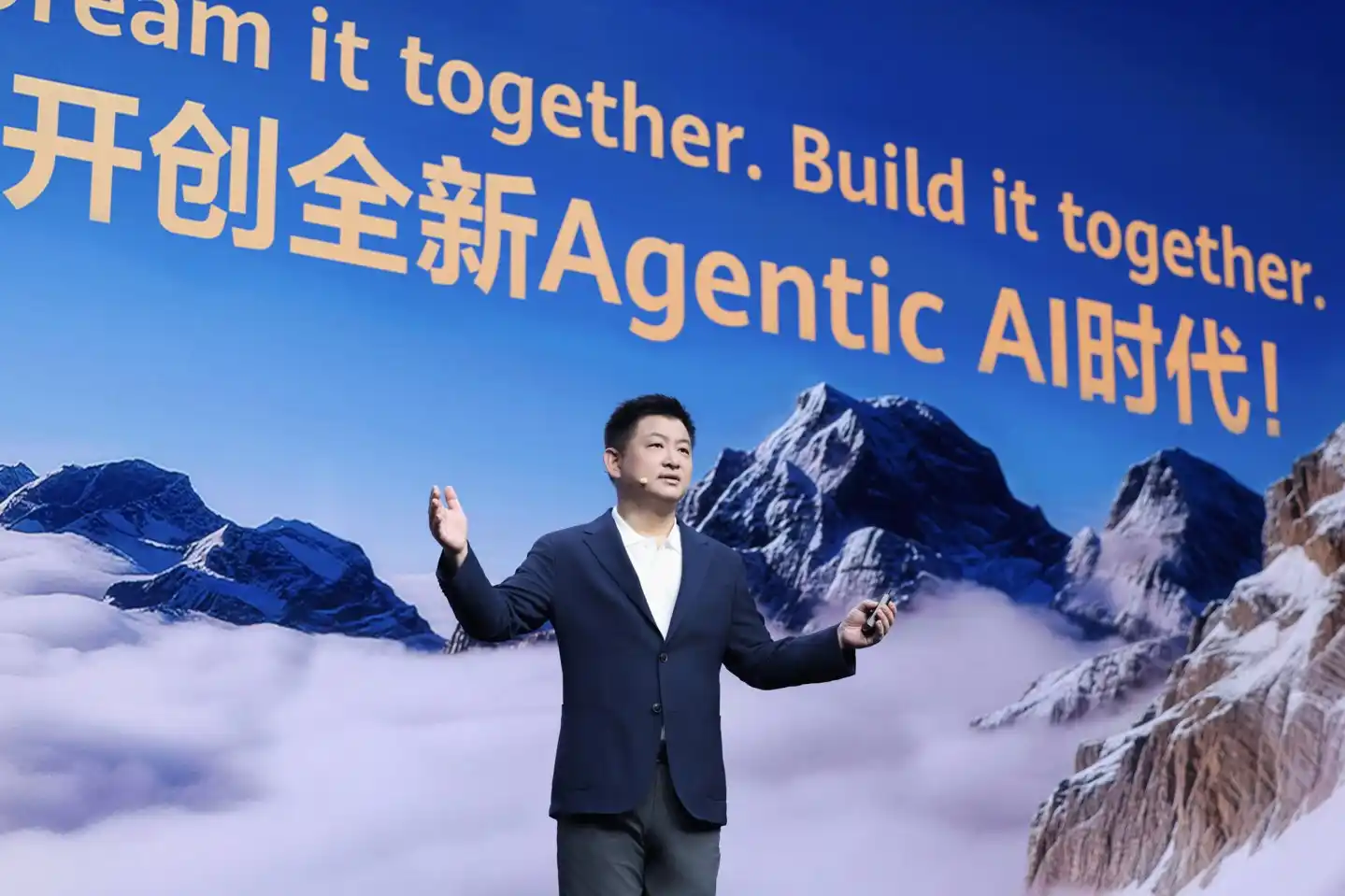
"I don't care much about the total amount of Tokens, nor do I care much about the total revenue." At the Huawei Cloud INSPIRE Creator Conference held on June 5, 2026, Zhou Yuefeng, Director of Huawei and CEO of Huawei Cloud, gave his first media interview since taking office, clearly and unequivocally conveying the current strategic focus of Huawei Cloud.

This is a rare statement in the current Chinese AI cloud market.

Over the past six months, cloud vendors represented by Alibaba Cloud and Volcano Engine have continuously emphasized the narrative of AI cloud, using daily Token call volume and MaaS revenue scale as new growth anchors. Even large model vendors like MoonShot AI, DeepSeek, and Zhipu have repeatedly lowered inference prices. The industry's key focus has been model call volume and scale.

Huawei Cloud is choosing a different way to enter this crowded battlefield. Huawei Cloud released its most intensive batch of new products oriented towards AI since last year in one go: AICS Lingqu Intelligent Computing Cluster, AMS Agentic Memory Storage, CCE Volcano Next - Integrated General-Purpose & AI Scheduling Engine, AgentSphere Secure Autonomous Operation Foundation, as well as ModelArts Next, the enterprise-grade intelligent agent platform AgentArts (open-source version openJiuwen), and collectively proposed a new "Agentic Infra" paradigm.

The KPI Zhou Yuefeng defined for Huawei Cloud is not Token count, but "whether each Token truly enhances productivity." During the window period of limited domestic computing power supply and a reshaping business model, Huawei Cloud has extracted itself from the "competition for second place in the AI cloud" race.
Not Competing on Token Scale

Zhou Yuefeng, at the press meeting, made a rare direct response regarding the differences with Alibaba Cloud and Volcano Engine. He said Huawei Cloud differs from other cloud vendors for three reasons.

First, the computing power route is different. Huawei Cloud uses an entirely domestically developed computing power hardware and software system, including Ascend, Kunpeng, CANN, Euler, etc. This path is more challenging because Huawei cannot use others' computing power; it can only turn domestic solutions into an industry-grade answer.

Consequently, Huawei Cloud must build a second computing plane, offering another ecological choice alongside the globally dominant path formed by NVIDIA + mainstream public clouds. Huawei Cloud cannot and does not intend to use hardware from "all nations" to compete with peers on computing power scale. Zhou Yuefeng said, "I am not willing to compare revenue or scale rankings with other cloud companies, it's meaningless."

Second, the commercial focus is different. Internet-based cloud vendors naturally rely on C-end traffic and developer ecosystems, whereas Huawei Cloud places its main focus on government & enterprise sectors and industries vital to the national economy and people's livelihood. For example, Huawei Hybrid Cloud has held the top market share in government, finance, and central & state-owned enterprises for multiple consecutive years, serving over 5,500 customers globally.

Zhou Yuefeng stated that the iteration speed of models and computing power is too fast; models could become outdated soon after deployment. Therefore, he advises that government and enterprise clients should not build their own 10,000-card clusters. Instead, they should combine local data with remote public cloud AI computing power/model services, leveraging technologies like confidential inference, confidential training, and confidential computing to balance data sovereignty and computing power sharing. Essentially, this delivers the iteration benefits of the public cloud to clients who cannot fully migrate to the public cloud.

Third, the ecosystem approach is different. Huawei Cloud has embraced open-source quite thoroughly: Ascend CANN, Euler operating system, CCE Volcano scheduling, and the ModelArts toolchain are all open-source. The open-source version of the intelligent agent platform AgentArts, openJiuwen, shares over 90% codebase commonality with its commercial version.

The conference also jointly launched the "Hundred Models, Thousand Forms, Gather on Cloud for Win-Win" plan with over 20 leading model vendors including Zhipu, DeepSeek, MiniMax, Kimi, StepFun, Baidu, Meituan LongCat, iFLYTEK Spark, etc.

When domestic computing power is still limited in capability and supply, expanding the ecosystem and increasing model choices is the way to solidify the second computing plane.

Agentic Infra: Shifting the Battlefield from Selling Tokens to Selling Productivity

If the computing power route determines what Huawei Cloud "does not fight," then Agentic Infra determines what it "wants to fight."

Zhou Yuefeng presented a judgment on the evolution of the AI industry: four years ago, doing AI meant buying computing power cards; three years ago, it was training large models; this year, it is using intelligent agents. Computing power and models are receding to the background, while intelligent agents are stepping to the forefront.

The competitive focus of AI cloud is shifting from Token throughput to whether intelligent agents can truly run effectively within enterprises.

Huawei Cloud's product matrix is also realigned according to this judgment. The "four components" of Agentic Infra — efficient Token factory, continuous learning, integrated general-purpose & AI scheduling, and secure autonomy — each address critical engineering challenges enterprises face when deploying intelligent agents.

AICS Lingqu reduces the Token latency for a 100,000-card cluster to under 10 milliseconds; AMS provides petabyte-level memory space via NPU-direct CMS, solving the Agent's long-term task memory bottleneck; CCE Volcano Next improves resource utilization by over 30% through shared training and inference pools; AgentSphere achieves 100-millisecond-level startup and hundreds of thousands of batch creations per minute with its lightweight sandbox.

ModelArts Next restructures the MaaS playbook. Its model routing supports cost-priority, effect-priority, and balanced strategies, already integrated with over 15 SOTA models, achieving scheduling accuracy over 95%, and reducing average calling costs by 20%.

But Huawei Cloud's truly differentiated bet lies in the industry zones. At this conference, Huawei Cloud launched four "Industry AI Dream Factory" zones at once: Smart Healthcare, Embodied AI, Smart Manufacturing, and Scientific Computing.

The Smart Healthcare zone, co-developed with Shanghai Ruijin Hospital, features the RuiPath large model. Over 20 hospitals including Handan, Rui'an, Qianxinan, and Wu'an, ranging from top-tier to municipal and county-level, have collectively joined. This marks the first time that capabilities like pathological diagnosis, highly dependent on expert experience, are being delivered as a "cloud service" to county-level hospitals at scale.

The Embodied AI zone launched the world's first full-process embodied AI development platform, CloudRobo, aiming to meet the full-link toolchain demands of over 300 embodied AI startups in China.

Zhou Yuefeng stated that healthcare and finance are the most mature and data-rich industries in China's digitalization, "If AI cannot succeed in these industries, it will be even harder in others." In these fields, the yardstick for measuring AI value should not be daily active users or Token counts, but rather the proportion of financial risk prevention, the improvement in credit efficiency, the probability of accurate diagnoses for remote patients.

Connecting these threads, the strategic outline of Huawei Cloud becomes clear: using a domestically developed computing power + open-source ecosystem as the foundation; covering government and enterprise sectors with hybrid cloud + confidential computing; and shifting the competition from "selling Tokens" to "selling productivity" through Agentic Infra + industry zones.

This path is much slower than chasing MaaS revenue and harder to present attractive year-on-year data, but it circumvents the current intense price war in the AI cloud. It bets on a market not yet priced: who can secure the underlying infrastructure position when intelligent agents truly enter the industry.

On the AI cloud track, Huawei Cloud can only adopt a different solution. Zhou Yuefeng concluded, "I cannot build a silicon-based 'black land' made of hardware from all nations." While other cloud vendors compare whose Tokens offer higher cost-performance, Huawei Cloud is striving to see if this domestic computing power system can meet the real future needs of China's industrial AI.(Author | Zhang Shuai, Editor | Yang Lin)


Trend Kriptolar

İlgili Sorular

QAccording to the article, what is Huawei Cloud's strategic focus, and how does it differ from other major AI cloud providers in China?

AHuawei Cloud's strategic focus is not on maximizing token volume or revenue, but on ensuring that 'every token truly enhances productivity.' This contrasts with other major Chinese AI cloud providers like Alibaba Cloud and Volcano Engine, who emphasize daily token calls and MaaS revenue scale as key growth metrics and engage in intense price competition on inference costs.

QWhat are the three key reasons CEO Zhou Yuefeng gives for Huawei Cloud's different approach compared to other cloud companies?

AZhou Yuefeng cites three reasons: 1. Different compute path: Huawei Cloud relies entirely on a domestic R&D system (Ascend, Kunpeng, CANN, Euler), creating a 'second compute plane' distinct from the dominant NVIDIA path. 2. Different commercial focus: Huawei Cloud heavily targets government and enterprise (G/ICT) and key national industries, rather than relying on consumer internet traffic. 3. Different ecosystem strategy: Huawei Cloud employs a thorough open-source approach for its core technologies and collaborates broadly with model vendors through initiatives like the 'Hundred Models, Thousand Forms' plan.

QWhat is 'Agentic Infra,' and what role does it play in Huawei Cloud's strategy for the AI cloud market?

A'Agentic Infra' (Agentic Infrastructure) is a new paradigm introduced by Huawei Cloud. It represents a shift in the AI cloud competition focus from token throughput to enabling agents to operate effectively within enterprises. It consists of a 'four-piece suite' addressing key engineering challenges: efficient token factories (AICS), continuous learning/memory (AMS), integrated scheduling for training and inference (CCE Volcano Next), and secure autonomous operation (AgentSphere). This moves the battlefield from 'selling tokens' to 'selling productivity.'

QWhat are 'Industry AI Dream Factory' zones, and can you name two specific examples mentioned in the article?

A'Industry AI Dream Factory' zones are specialized platforms launched by Huawei Cloud to provide AI solutions and tools tailored to specific vertical industries. Two examples mentioned are: 1. The Smart Healthcare Zone, which features the RuiPath large model co-developed with Shanghai Ruijin Hospital and serves over 20 hospitals. 2. The Embodied Intelligence Zone, which introduced CloudRobo, a full-process development platform aimed at serving over 300 embodied AI startups in China.

QHow does Huawei Cloud propose to serve government and enterprise clients who cannot fully migrate to the public cloud, according to Zhou Yuefeng?

AZhou Yuefeng suggests a hybrid approach for such clients. He advises against them building large-scale AI clusters themselves due to the rapid iteration of models and compute. Instead, he recommends keeping data locally while leveraging remote public cloud AI compute/model services. This is combined with technologies like confidential inference, training, and computing to balance data sovereignty with access to shared compute power. This model essentially delivers the iteration benefits of the public cloud to clients with stricter data requirements.

İlgili Okumalar

Report Analysis: What Is Coherent Planning as CPO Booms?

Title: Report Interpretation: What Moves Is Coherent Making Amid the CPO Boom? Summary: JP Morgan analyst Samik Chatterjee reiterates an Overweight rating on Coherent (COHR), citing undervalued growth potential across three core areas: data center optical transceivers, co-packaged optics (CPO) chips, and industrial lasers/thermal management. COHR's 1.6T data center transceivers are in high demand, with pricing remaining firm. The rise of CPO is seen not as a threat but as a catalyst, creating higher demand for sophisticated optical components, an area where COHR holds a competitive edge with its comprehensive portfolio (lasers, isolators, VCSELs, thermoelectric coolers). Each CPO chip offers significantly greater revenue potential than traditional transceivers. Furthermore, its Optical Circuit Switch (OCS) technology targets a potential $4B market with reliability and power advantages. The company is expanding its InP (Indium Phosphide) device capacity fourfold within two years, securing substrate supply and transitioning to more cost-effective 6-inch wafers. As one of only two major suppliers of high-quality pump lasers—currently in severe shortage—COHR can now move up the value chain from components to complete line cards/systems, boosting ASP over tenfold. Gross margin targets (>42%) may be revised upward due to high-end product premiums, cost improvements from the wafer transition, and contributions from new high-margin products like CPO and OCS. Its efficient thermadite thermal material also offers long-term growth. Industrial segment revenue grows at a steady 5-10%, supported by semiconductor equipment orders. Changes in Apple's Face ID protocol present a re-competition opportunity for 3D sensing. Overall, Coherent is positioned as a key infrastructure provider, with AI-driven compute demand fueling the need for high-speed optical interconnectivity. Growth from CPO/OCS, stable industrial performance, and margin improvement support the bullish thesis. *Disclaimer: This summary interprets a third-party analyst report from JP Morgan. It does not constitute investment advice.*

marsbit5 dk önce

Report Analysis: What Is Coherent Planning as CPO Booms?

marsbit5 dk önce

After Laying Off 20% of Staff, What Are the Key Points of EF's New Structure?

Following the completion of a months-long organizational restructuring, the Ethereum Foundation (EF) announced a 20% workforce reduction (approximately 54 employees) on June 23rd. It reorganized its teams into five new core clusters: Protocol, Access, User, Community, and Institutional (plus Operations/Management support units). Officially, this move implements the EF's 2026 Mandate and 2025 Treasury Management Policy, aiming to create a more focused and "self-sovereign" organization. The restructuring prioritizes the CROPS principles—Censorship Resistance, Openness & Freedom, Privacy, and Security—as foundational organizational tenets. The Protocol cluster will focus on core protocol R&D, including MEV reduction and zkEVM. The Access cluster emphasizes preserving user "zero option" for non-custodial, permissionless interaction. The User, Community, and Institutional clusters will manage external engagement, with the latter handling institutional and regulatory matters. While offering enhanced severance and transition support for affected employees, the EF did not disclose budget allocations or specific KPIs for the new clusters. This has led to market uncertainty about the impact on project funding and development priorities. Analysts note the announcement's positive tone of mission focus contrasts with a backdrop of recent EF leadership changes and broader ecosystem pressures. The true impact—whether this signifies strategic realignment or reactive contraction—will become clearer as the new structure's resource allocation and project prioritization are revealed in the coming months.

marsbit15 dk önce

After Laying Off 20% of Staff, What Are the Key Points of EF's New Structure?

marsbit15 dk önce

Top-Tier MEV Bot Loses $7.5 Million: Is 'Approval' the Most Overlooked Fatal Risk On-Chain?

The article discusses a sophisticated attack on a prominent Ethereum MEV (Miner Extractable Value) bot, Jaredfromsubway.eth, resulting in a loss exceeding $7.5 million. Unlike typical exploits involving key leaks or smart contract bugs, this attack was a carefully orchestrated "reverse hunt." The attacker spent weeks deploying fake tokens and liquidity pools that mimicked legitimate assets like WETH and USDC. These pools were designed to appear as profitable arbitrage opportunities, tricking the automated bot's trading logic. During its normal operation, the bot was induced to grant ERC-20 token approvals to the malicious contracts. Once sufficient permissions were accumulated, the attacker drained the bot's funds by calling these pre-approved allowances. This incident highlights the often-underestimated risks associated with token approvals in Web3. The article explains that approvals are a fundamental mechanism, allowing smart contracts (like DEXs) to move a user's tokens on their behalf. However, risks arise from practices like granting infinite approvals, the persistence of approvals even after disconnecting from a dApp, and the potential for a once-trusted contract to become compromised later. The piece concludes with advice for managing approval risks: users should adopt the principle of least privilege (approving only the needed amount), use separate wallets for storage versus interactions, and regularly audit and revoke unnecessary approvals using tools like Revoke.cash. It also emphasizes the role of wallets like imToken in providing proactive defenses, such as risk warnings and clear, readable transaction signing interfaces, to help users make informed decisions. Ultimately, wallet security must extend beyond private key protection to include active management of token approvals.

marsbit20 dk önce

Top-Tier MEV Bot Loses $7.5 Million: Is 'Approval' the Most Overlooked Fatal Risk On-Chain?

marsbit20 dk önce

Precious Metals Decline Alongside, What Signal is Gold Sending to the Market?

Gold and silver prices have declined recently, moving in tandem with a sell-off in risk assets like South Korean semiconductor stocks. This is unusual, as gold typically rises when equities fall due to its safe-haven status. The synchronized drop signals a shift in market focus: it's not about finding safety, but about the rising cost of holding assets that do not yield interest. This cost is the real interest rate. The key driver is a change in Federal Reserve policy expectations under new Chair Kevin Warsh. Despite holding rates steady, the Fed's rhetoric has turned more hawkish, emphasizing persistent inflation risks. This has led markets to price in a "higher for longer" rate environment, increasing the appeal of cash and bonds while pressuring zero-yield assets like gold and tech stocks with high future cash flow valuations. Technically, gold breached the $4,100/oz support level, approaching the critical $4,000 psychological and technical zone. A break below could trigger accelerated selling from momentum traders and ETFs. While long-term supportive factors like central bank buying and geopolitical risks remain, short-term price action is dominated by liquidity and opportunity cost dynamics. The South Korean market meltdown, driven by crowded AI-trade unwinding, is a symptom—not the cause—of this broader macro repricing. Both markets are reacting to the same pressures: higher real rates and a stronger US dollar. In summary, the concurrent decline in equities and precious metals highlights that diverse assets can share exposure to a common macro variable—the price of money. The near-term path for gold and silver depends primarily on the persistence of Fed hawkishness, dollar strength, and real yields, which currently override their traditional safe-haven narratives.

marsbit30 dk önce

Precious Metals Decline Alongside, What Signal is Gold Sending to the Market?

marsbit30 dk önce

İşlemler

Spot
Futures

Popüler Makaleler

WAR Nasıl Satın Alınır

HTX.com’a hoş geldiniz! WAR (WAR) satın alma işlemlerini basit ve kullanışlı bir hâle getirdik. Adım adım açıkladığımız rehberimizi takip ederek kripto yolculuğunuza başlayın. 1. Adım: HTX Hesabınızı OluşturunHTX'te ücretsiz bir hesap açmak için e-posta adresinizi veya telefon numaranızı kullanın. Sorunsuzca kaydolun ve tüm özelliklerin kilidini açın. Hesabımı Aç2. Adım: Kripto Satın Al Bölümüne Gidin ve Ödeme Yönteminizi SeçinKredi/Banka Kartı: Visa veya Mastercard'ınızı kullanarak anında WAR (WAR) satın alın.Bakiye: Sorunsuz bir şekilde işlem yapmak için HTX hesap bakiyenizdeki fonları kullanın.Üçüncü Taraflar: Kullanımı kolaylaştırmak için Google Pay ve Apple Pay gibi popüler ödeme yöntemlerini ekledik.P2P: HTX'teki diğer kullanıcılarla doğrudan işlem yapın.Borsa Dışı (OTC): Yatırımcılar için kişiye özel hizmetler ve rekabetçi döviz kurları sunuyoruz.3. Adım: WAR (WAR) Varlıklarınızı SaklayınWAR (WAR) satın aldıktan sonra HTX hesabınızda saklayın. Alternatif olarak, blok zinciri transferi yoluyla başka bir yere gönderebilir veya diğer kripto para birimlerini takas etmek için kullanabilirsiniz.4. Adım: WAR (WAR) Varlıklarınızla İşlem YapınHTX'in spot piyasasında WAR (WAR) ile kolayca işlemler yapın.Hesabınıza erişin, işlem çiftinizi seçin, işlemlerinizi gerçekleştirin ve gerçek zamanlı olarak izleyin. Hem yeni başlayanlar hem de deneyimli yatırımcılar için kullanıcı dostu bir deneyim sunuyoruz.

259 Toplam GörüntülenmeYayınlanma 2024.12.11Güncellenme 2026.06.02

WAR Nasıl Satın Alınır

Tartışmalar

HTX Topluluğuna hoş geldiniz. Burada, en son platform gelişmeleri hakkında bilgi sahibi olabilir ve profesyonel piyasa görüşlerine erişebilirsiniz. Kullanıcıların WAR (WAR) fiyatı hakkındaki görüşleri aşağıda sunulmaktadır.

活动图片