How Did the Idealism of Western Founders Get 'Taken Over' by Chinese Buyers?

比推2026-01-22 tarihinde yayınlandı2026-01-22 tarihinde güncellendi

Özet

Over the course of two days, two major decentralized social protocols, Lens Protocol and Farcaster, were acquired—by Mask Network and Neynar, respectively. Combined, these protocols had raised over $200 million, with Farcaster recently valued at $1 billion. This follows the earlier acquisition of Steem by Tron in 2020, meaning two out of three prominent decentralized social protocols are now been taken over by Chinese-led teams. The author explores why Chinese buyers are stepping in. One reason may be pricing: these acquisitions often target once-prominent projects now in decline. For instance, Farcaster’s monthly revenue has dropped over 95%, and Lens has only 50,000 monthly active users. Another factor is cultural: while Western founders often approach decentralized social with idealism—emphasizing user-owned data and censorship resistance—Chinese acquirers tend to view it as a business opportunity, prioritizing usability and growth over ideology. Suji Yan, founder of Mask Network, explicitly aims to move “decentralized social from the lab to daily life.” However, past acquisitions like Steem—which led to a community fork—highlight risks when new ownership clashes with original values. The piece questions whether true decentralization is possible when protocols can be sold, suggesting that technical decentralization doesn’t prevent centralized commercial control. Ultimately, the piece argues that the vision for a better social infrastructure remains, but the builders a...

Author: David, Deep Tide TechFlow

Original Title: Web3 Social, Still Dominated by the Chinese


Within two days, two decentralized social protocols changed hands.

On January 20th, Lens Protocol announced it was being taken over by Mask Network. On January 21st, Farcaster announced it was acquired by Neynar, one of its clients.

These two protocols raised over $200 million combined. Farcaster was valued at $1 billion last year, with investors including a16z and Paradigm. Lens is backed by DeFi giant Aave.

Now, the founders have "stepped back from daily operations to work on new projects."
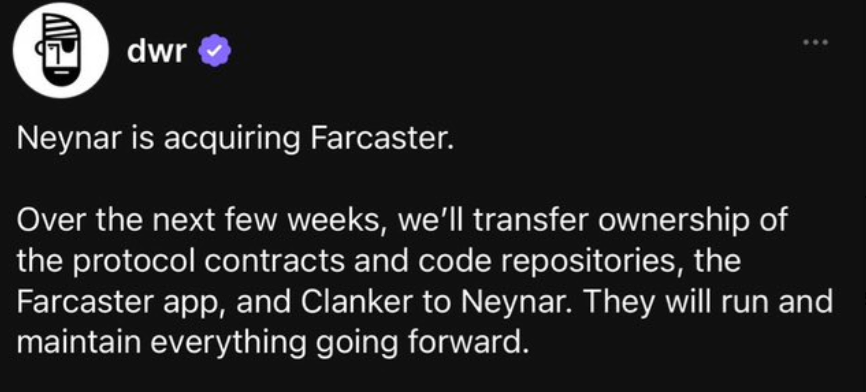
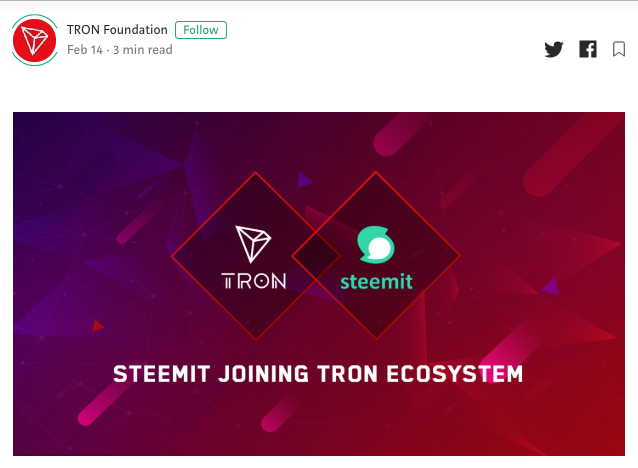
Including Steem, another well-known project acquired by Tron in 2020, two out of these three phenomenal decentralized social protocols have now been taken over by Chinese teams.

You might have forgotten about Steem. It was the pioneer of "writing to earn" launched in 2016, a benchmark project for the entire Web3 social track at its peak. After being acquired by Justin Sun, the community forked and left, which we'll discuss later.

The founder of Mask Network, which took over Lens, is Suji Yan. Chinese, dropped out of UIUC at 20 to start a business, previously wrote articles for Caixin and Jiemian.

Founded Mask in 2017, focusing on overlaying Web3 features on traditional social platforms like Twitter.

Mask has been on an acquisition spree: acquired two large Japanese instances of Mastodon in 2022, bought Orb, the most active client on Lens, last year, and now has taken over Lens itself.

Suji Yan positions himself as the "Tencent of Web3".

On the Farcaster side, the two founders of Neynar, which took it over, are of Indian descent, both former Coinbase employees. But the reality that two out of three protocols were taken over by Chinese teams still holds.

Why the Chinese?

One possible explanation is capability endowment. The two most successful countries globally in making social products are the United States and China. WeChat, Douyin (TikTok), Xiaohongshu (Little Red Book) – Chinese teams have proven they can scale social products to billions of users.

But this explanation has a problem. Building products and acquiring protocols are not the same thing. Protocols are infrastructure, not directly facing users. You can build products on them, but the protocol itself doesn't generate the user experience.

Another reasonable explanation is price.

Looking at Brother Sun's (Justin Sun) acquisition list: bought BitTorrent for $140 million in 2018, Poloniex in 2019, Steemit in 2020, and HTX (formerly Huobi) in 2022.

These targets have a common trait:

They were all once glorious but are on a downward trend. BitTorrent was the pioneer of P2P downloading, Poloniex was once a top US exchange, HTX was once one of China's top three exchanges.

Justin Sun isn't buying the best; he's buying the cheapest good stuff.

Now Farcaster is valued at $1 billion but its monthly revenue has dropped to $10,000, down over 95% year-over-year. Founder Dan Romero admitted last month in a post that "after 4.5 years of trying the social-first approach, it didn't work";

Lens has only 50,000 monthly active users, and the Aave team wants to offload it to focus on its DeFi core business.

The most valuable time for these protocols has passed, but the technical foundation and brand remain. In A-share market terms, this is called:

Fallen out of value (Undervalued).

There's a more subtle line of thought: decentralized social is a belief in the West, but a business in China.

Western founders in this space often carry a degree of idealism. Users should own their data, social graphs should be portable, platforms shouldn't have censorship power... Farcaster's slogan is "sufficiently decentralized", Lens's is "user-owned social".

But after five years, users don't care.

Ordinary people don't care who owns the data, or whether the social graph can be taken away. They care if there are people to chat with, if there is interesting content, if there are associated assets that can skyrocket.

Chinese buyers taking over is, in a way, taking this business from the idealists and handing it to the pragmatists.

Suji Yan says what Mask wants to do is "bring decentralized social from the lab into daily life". Translating that:

Stop talking about ideals, first make people willing to use it.

Of course, the last time a Chinese entity acquired a decentralized social protocol, the outcome wasn't pretty.

In 2020, Justin Sun bought Steem. After the acquisition, he collaborated with exchanges to take control of Steem's network governance. The original community's reaction was a collective fork to create a new chain, Hive, using code to exclude Justin Sun's wallet.
A fork is the most extreme form of protest in the blockchain world – we're not playing with you anymore, we'll copy everything and leave on our own.

Steemit is still running, but more active users have long since moved to Hive.

So the question is, will it be different this time?

Regarding Mask taking over Lens, the official term is "stewardship", not the word "acquisition". The founders will continue as advisors, and the protocol remains open.

But the fact that a "decentralized protocol" can be acquired itself already says something. Contracts can be transferred, codebases can be transferred, Apps can be transferred. So where is the "decentralization"?

After the disillusionment, decentralization is just a technical architecture, not a business model. Technically decentralized does not prevent someone from having the final say commercially.

After Lens changed leadership, Vitalik posted. He said every post he made in 2026 was through Firefly, which is precisely the multi-platform client under Mask Network.

He also said: "If we want a better society, we need better tools for mass communication."

This is true. But who builds this tool, who operates it, who decides what it looks like – decentralization doesn't answer these questions.

The answer now might be: the Chinese will build it.


Twitter:https://twitter.com/BitpushNewsCN

Bitpush TG Discussion Group:https://t.me/BitPushCommunity

Bitpush TG Subscription: https://t.me/bitpush

Original link:https://www.bitpush.news/articles/7605174

İlgili Sorular

QWhat are the two decentralized social protocols that recently changed ownership, and who acquired them?

ALens Protocol was acquired by Mask Network, and Farcaster was acquired by Neynar, one of its clients.

QWhy are Chinese buyers particularly interested in acquiring these Western-founded decentralized social protocols?

AChinese buyers see these protocols as undervalued assets with strong technical foundations and brand recognition, and they approach them from a pragmatic, business-oriented perspective rather than idealistic beliefs in decentralization.

QWhat was the outcome of the previous acquisition of a decentralized social platform by a Chinese buyer, specifically Tron's acquisition of Steem?

AAfter Tron acquired Steem, the original community forked the chain to create Hive, effectively excluding Tron's wallets and moving most active users away from Steemit.

QHow does the acquisition of decentralized protocols like Lens and Farcaster challenge the notion of 'decentralization'?

AThe ability to acquire these protocols highlights that decentralization is primarily a technical architecture rather than a governance model, as ownership and control can still be centralized in the hands of a few entities.

QWhat is Mask Network's stated goal for Lens Protocol, as mentioned in the article?

AMask Network aims to move decentralized social protocols 'from the laboratory into daily life,' focusing on practicality and user adoption rather than idealistic principles.

İlgili Okumalar

OpenAI's Largest Internal Wealth Creation: 600 People Cash Out a Total of $6.6 Billion, 75 Take Home the Maximum $30 Million Each

A Wall Street Journal report reveals OpenAI's unprecedented pre-IPO wealth creation. In a single employee stock sale last October, over 600 current and former employees sold shares, collectively cashing out approximately $6.6 billion. Due to high investor demand, the company tripled the individual sale cap to $30 million, with about 75 employees selling the maximum amount. This event represents the largest such transaction in tech industry history for a private company. OpenAI's valuation was $500 billion for this tender offer. Employees with over two years of tenure were eligible, allowing many post-ChatGPT hires their first liquidity event. The company's stock has reportedly grown over 100-fold in seven years. Following a restructuring, employees collectively hold about 26% of OpenAI. The scale of executive wealth is also staggering. In court testimony related to Elon Musk's lawsuit, President and co-founder Greg Brockman confirmed his OpenAI stake is worth around $30 billion. Analysis indicates about 165 current and former employees hold a combined ~$164.9 billion in equity, averaging nearly $1 billion per person in paper wealth. OpenAI's per-employee stock-based compensation is estimated to be 34 times the average of major tech firms before their IPOs. OpenAI continues its rapid ascent, closing a $122 billion funding round at an $852 billion valuation in March. With monthly revenue hitting $2 billion, over 900 million weekly ChatGPT users, and plans for a potential trillion-dollar IPO in late 2026, this wealth-creation engine shows no signs of stopping.

链捕手22 dk önce

OpenAI's Largest Internal Wealth Creation: 600 People Cash Out a Total of $6.6 Billion, 75 Take Home the Maximum $30 Million Each

链捕手22 dk önce

Understanding CPO (Co-Packaged Optics) in One Article: Why Nvidia Is Willing to Spend $3.2 Billion on a Fiber?

NVIDIA and Corning announced a multi-year strategic partnership on May 6, 2026, with NVIDIA committing up to $3.2 billion to support Corning's U.S. expansion. This investment will triple Corning's manufacturing plants and significantly boost its optical fiber and communications production capacity. The core driver behind this massive investment is the fundamental shift from copper to optical interconnect technology within AI data centers. As GPU clusters scale, copper wires face critical limitations: severe signal attenuation over distance, high energy consumption for signal integrity, and excessive heat generation. Optical fiber, transmitting light instead of electrical signals, solves these issues with minimal loss, near-light speed, and lower power needs. The article outlines a three-stage evolution of data center interconnect: 1. **Traditional Copper Interconnects:** The mainstream solution of the 2010s, now being phased out due to scaling bottlenecks. 2. **Pluggable Optical Modules:** The current mainstream, where modules convert electrical signals to light externally. This process still introduces energy loss and latency. 3. **CPO (Co-Packaged Optics):** The next-generation technology where the optical engine is integrated directly with the GPU chip package. This drastically reduces the electrical signal travel distance to mere millimeters, slashing power consumption and latency while boosting data density. NVIDIA CEO Jensen Huang has identified CPO as an essential core technology for AI infrastructure. NVIDIA's investment signifies a strategic shift from being a buyer to actively controlling its supply chain for critical components. With demand for specialized optical fiber far outstripping supply—evidenced by soaring prices—securing long-term manufacturing capacity has become a competitive necessity. While Corning's expansion may pressure some suppliers, a projected global fiber supply gap of 5-15% over the next few years creates a significant opportunity window, particularly for Chinese manufacturers competitive in optical preforms, chips, and modules. Ultimately, NVIDIA's move is not about chasing a trend but an engineering imperative. The transition to light-based interconnects like CPO is driven by the physical limits of copper, marking a definitive step in the ongoing AI computing revolution.

marsbit47 dk önce

Understanding CPO (Co-Packaged Optics) in One Article: Why Nvidia Is Willing to Spend $3.2 Billion on a Fiber?

marsbit47 dk önce

KOL's Perspective: Why Is SOL Set to Rise from This Point?

**Summary: Why SOL is Positioned for Growth at This Level** The article argues that SOL is poised for an upward move from its current price point, citing several key factors. Primarily, SOL has just broken out of a 4-month consolidation phase. This breakout signals a return of risk appetite to the broader crypto market, as SOL is seen as a key indicator of overall crypto health. The token's ownership has reportedly shifted from short-term traders and tourists to long-term accumulators, leading to low volume. Any meaningful increase in trading activity could thus trigger significant upward momentum. Fundamental strengths include strong institutional adoption, integration with DeFi and RWAs (Real-World Assets), and the potential benefits from the Clarity Act. Despite its high volatility—having dropped 70% from its all-time high but still up 12x from its bear market low—SOL is highlighted as one of the few tokens from the last cycle to reach new highs. It boasts a robust ecosystem of applications, users, and protocols. Future catalysts include the expected influx of AI developers following the Miami Accelerate conference, which focused on AI on Solana. Furthermore, Solana is positioned as the premier chain for memecoin activity, a trend expected to continue and drive network usage and fees. The article concludes that recent price action reflects a healthy transfer to long-term holders, setting the stage for growth.

marsbit1 saat önce

KOL's Perspective: Why Is SOL Set to Rise from This Point?

marsbit1 saat önce

İşlemler

Spot
Futures
活动图片