Hoskinson Warns Of Cardano ‘Wave of Failures’ After TapTools Shutdown

bitcoinist2026-06-03 tarihinde yayınlandı2026-06-03 tarihinde güncellendi

Özet

Cardano founder Charles Hoskinson warns the ecosystem could face a "wave of failures" following the shutdown announcement of data and analytics platform TapTools. Citing leadership departures and unsustainable platform economics, TapTools is winding down operations despite serving over a million users. Hoskinson framed this not as an isolated incident but as a symptom of broader funding, coordination, and incentive problems within Cardano. He predicts more project failures in the second half of the year due to difficult market conditions. Hoskinson expressed frustration that proposed solutions, like a sovereign wealth fund or strategic acquisitions, have failed to gain sufficient support or faced criticism for centralization. He emphasized his lack of unilateral control over Cardano's governance, treasury, or direction, shifting responsibility to DReps and delegators to choose a clear growth strategy. The livestream concluded with a critique of Cardano's political culture and a discussion of potential extreme measures, including governance reform or even a new chain, if the current structure cannot support builders.

Charles Hoskinson warned that Cardano could face a broader “wave of failures” across its ecosystem after TapTools said it is preparing to wind down operations over the next two weeks, citing leadership departures and difficult platform economics.

The June 2 livestream marked one of Hoskinson’s sharpest public interventions on Cardano’s current governance and commercialization debate. Responding to TapTools’ shutdown statement, the Cardano founder framed the episode not as an isolated project failure, but as a symptom of deeper funding, coordination and incentive problems inside the ecosystem.

TapTools, a widely used Cardano data, analytics and discovery platform, said it had become difficult to responsibly keep operating after the departure of multiple senior team members. According to the statement read by Hoskinson, two co-founders, including the CTO and COO, had left earlier this year. A back-end developer had stepped into the CTO role, but that person has now also decided to move on.

“The technical knowledge required to responsibly operate and maintain TapTools cannot be replaced overnight,” the team said. “At the same time, the economics of running a platform like this remain challenging. Infrastructure costs are real. Development costs are real. Support costs are real.”

TapTools said it had served more than one million users, supported hundreds of projects through its API, published hundreds of articles, generated hundreds of millions of social impressions and helped bring visibility to builders across Cardano. The team said it would remain open to acquisition talks or other resources that could allow the platform to continue sustainably.

Hoskinson Says More Cardano Projects Could Follow

Hoskinson said TapTools had been part of his “daily ritual” and argued that its exit reflected a problem he had warned about earlier in the year: ecosystem projects running out of runway in poor market conditions.

“This is where we’re at as an ecosystem,” Hoskinson said. “I said at the beginning of the year, we’re going to see a lot of people collapse because the markets are really bad and we need some way to bail out our ecosystem and get them the lifeblood that they need to get to the next level.”

He pointed to JPEG Store and TapTools as examples of projects already affected, adding that he expects more failures in the second half of the year. “I would suspect others are coming very soon,” he said. “There’s going to be a wave of failures in the ecosystem.”

Hoskinson said he had previously proposed several mechanisms to address the issue, including a Cardano sovereign wealth fund, an ecosystem index and strategic acquisitions. He argued that these ideas either failed to gain sufficient support or were criticized as attempts to centralize the ecosystem. He cited his acquisitions of Nami and Blockfrost as examples of infrastructure he had tried to preserve and commercialize, while saying similar interventions often drew backlash.

The broader frustration, according to Hoskinson, is that Cardano governance has not yet produced an effective mechanism for deploying treasury resources into commercial infrastructure. He said Draper had received a large amount of ADA, but suggested that venture capital funding would likely flow mostly into new ventures rather than distressed existing platforms that may not be in an investable state.

Governance, Treasury And Commercialization

Hoskinson repeatedly rejected the idea that he has unilateral control over Cardano’s direction. He said he does not have governance keys, cannot initiate a hard fork or protocol parameter change, does not control the treasury and does not own the Cardano trademark.

“I’d really like to understand what my agency is here,” he said. “I don’t have any special powers with Cardano. I don’t have any governance keys. I don’t have any ability to even initiate a hard fork, much less a protocol parameter change.”

The livestream then turned into a wider critique of Cardano’s political culture. Hoskinson accused parts of the ecosystem of opposing commercialization while also blaming leadership when commercial infrastructure fails. He directed much of his message at DReps and delegators, arguing they need to evaluate whether their representatives are enabling growth or blocking it.

“You need to pick a leader. You need to pick a vision. You need to pick a strategy and fix it,” Hoskinson said. “You need to or you cannot and let it die. That’s your choice.”

He also floated more extreme options, including constitutional changes, treasury reform, changes to executive function and, at the outer edge, a new Cardano launched through a proof-of-burn mechanism. Hoskinson described that as the “nuclear option,” while presenting it as one of several possible responses if the current governance structure cannot support builders.

At press time, ADA traded at $0.2177.
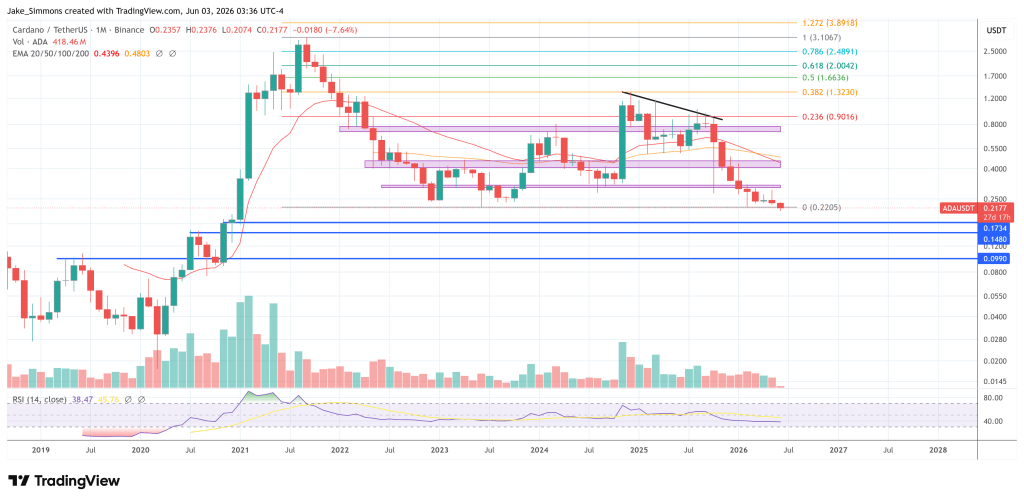
ADA drops below key support, 1-day chart | Source: ADAUSDT on TradingView.com

İlgili Sorular

QWhat is the main reason TapTools gave for shutting down operations according to the article?

ATapTools cited the departure of multiple senior team members, including two co-founders (the CTO and COO) and a back-end developer who had stepped into the CTO role, as well as difficult platform economics involving high infrastructure, development, and support costs.

QHow does Charles Hoskinson frame the shutdown of TapTools in relation to the Cardano ecosystem?

AHoskinson frames it not as an isolated project failure, but as a symptom of deeper funding, coordination, and incentive problems within the ecosystem. He warns it could signal the start of a broader 'wave of failures' for projects running out of financial runway in poor market conditions.

QWhat mechanisms has Hoskinson previously proposed to address ecosystem funding issues, and what was the outcome?

AHe proposed mechanisms like a Cardano sovereign wealth fund, an ecosystem index, and strategic acquisitions. He stated these ideas either failed to gain sufficient support or were criticized as attempts to centralize control over the ecosystem.

QAccording to Hoskinson, what is a key frustration regarding Cardano's governance and treasury?

AHis key frustration is that Cardano's governance has not yet produced an effective mechanism for deploying treasury resources to support commercial infrastructure projects within the ecosystem.

QWhat extreme 'nuclear option' did Hoskinson mention as a possible response if current governance cannot support builders?

AHe mentioned the possibility of launching a new version of Cardano through a proof-of-burn mechanism as the most extreme 'nuclear option' among several potential responses to governance failure.

İlgili Okumalar

Fei-Fei Li's Team Clarifies the Concept of 'World Models', Sora Merely a Renderer

"World Models" has become a widely used yet confusing term in AI. To address this, a team led by Fei-Fei Li and World Labs proposed a functional taxonomy based on the Partially Observable Markov Decision Process framework. This taxonomy categorizes systems called "world models" into three distinct projections: Renderers, Simulators, and Planners. Renderers, like OpenAI's Sora and other video generation models, focus on producing photorealistic visual outputs for human perception. They prioritize visual fidelity over physical accuracy. Simulators, such as NVIDIA Omniverse, aim to compute precise future environmental states for computational tasks like engineering analysis or digital twins. Planners, like Vision-Language-Action models, take in observations and goals to output executable actions for robots or agents. The article clarifies that most current "world models," including Sora, are primarily Renderers. They generate convincing visuals but lack the core ability to simulate state transitions based on actions, a key requirement for a true world model in classic reinforcement learning definitions. This conceptual confusion has practical implications, leading to potential misalignment in technology selection, investment, and public understanding of AI capabilities. Clear categorization is crucial. It helps enterprises avoid costly mistakes (e.g., using a renderer for robot training), allows investors to accurately assess markets, and enables researchers to build comparable benchmarks. While future systems may integrate these functions, recognizing current boundaries is essential for honest assessment and progress.

marsbit6 dk önce

Fei-Fei Li's Team Clarifies the Concept of 'World Models', Sora Merely a Renderer

marsbit6 dk önce

Bloomberg Uncovered: How Do China's Wealthy Circumvent the Annual $50,000 Limit to Transfer Assets?

**Summary: How Wealthy Chinese Circumvent $50,000 Annual Foreign Exchange Limits** Despite China's strict capital controls, including an annual $50,000 per person foreign exchange quota, an estimated $150 billion in funds still leaves the country annually via various gray and underground channels. This report outlines the evolution of China's "capital wall" and the methods used to bypass it. **The Evolving Capital Controls:** * **Foundation (1994):** The system of "current account convertibility with strict capital account controls" was established. * **Quota Set (2007):** The $50,000 individual annual forex purchase limit was formalized. * **Crackdown Begins (2015-2017):** Following market volatility, enforcement tightened. Banks were required to scrutinize transactions, and channels like using UnionPay cards for Hong Kong insurance premiums or buying overseas property were blocked. * **Digital & Legal Upgrades (2024-2026):** Enhanced algorithms now flag suspicious patterns (e.g., "smurfing"). The Common Reporting Standard (CRS) provides Chinese tax authorities with data on citizens' offshore accounts. Unlicensed cross-border brokers have been targeted. **Five Primary Methods for Moving Capital:** 1. **Underground Banking / "Hawala" (Duiqiao):** The largest-scale method. No money crosses borders. Clients pay RMB to a domestic account; an overseas associate deposits equivalent foreign currency into the client's offshore account. Risks include high fees, account freezes, and legal penalties. 2. **"Smurfing" or "Ant Moving":** Using multiple individuals' $50,000 quotas to pool funds for one offshore recipient. Increasingly detected by anti-money laundering algorithms. 3. **Trade Invoice Manipulation:** Businesses over-invoice imports or under-invoice exports via offshore shell companies, creating a pretext to transfer excess funds abroad under the guise of trade. 4. **Channel Migration:** After a crackdown on internet brokers, funds flow toward more compliant but costly channels like major banks' cross-border wealth management services or Qualified Domestic Institutional Investor (QDII) quotas. 5. **Structural Arrangements:** High-net-worth individuals use complex, high-cost legal structures involving offshore trusts, insurance, and investment migration programs to transfer asset ownership. **Regulatory Response: Focusing on People, Not Just Money** The current strategy extends oversight from enterprises to **individual residents**. Tools like CRS allow retroactive visibility into offshore assets. Cryptocurrencies, once seen as a potential loophole, are now actively monitored and prosecuted as an illegal channel. The underlying driver remains: with significant wealth concentrated among millions of affluent households seeking diversification amid domestic economic shifts, the incentive to move assets offshore persists despite regulatory barriers.

marsbit25 dk önce

Bloomberg Uncovered: How Do China's Wealthy Circumvent the Annual $50,000 Limit to Transfer Assets?

marsbit25 dk önce

Ethereum's Ballmer Moment: As Everyone Is Bearish, the Circulating Supply Is Disappearing

"Ethereum's Ballmer Moment: Circulation Shrinks Amid Bearish Sentiment" Amid widespread bearish sentiment, with prominent figures like Bankless founder David Hoffman selling ETH and young developers flocking to Solana, some argue Ethereum is entering its "Ballmer era"—akin to Microsoft's perceived stagnation under Steve Ballmer. While surface-level criticisms about slow protocol development, cautious leadership, and competitive pressure are valid, underlying fundamentals tell a different story. Approximately 30% of ETH is staked, major holders like BitMine are accumulating, and spot ETFs continue to absorb supply. Regulatory clarity, including the SEC/CFTC's March ruling on staking rewards and the potential passage of the CLARITY Act, is transforming crypto from a regulatory threat into a legitimized framework. This institutionalization, alongside a shrinking circulating supply (with net issuance around 0.23% annually), creates significant buy-side pressure independent of fee-based value capture. The broader crypto total addressable market is expanding through regulated stablecoins, tokenized assets, and institutional adoption. While public chains face competition from permissioned alternatives, the winning model appears to be permissioned assets settling on public chains like Ethereum and Solana. The author advocates a non-maximalist, barbell strategy: holding ETH for its institutional role and supply squeeze, SOL for consumer/throughput trends, BTC as a macro hedge, and a basket of next-gen L1s. Key bullish drivers for ETH include rapid circulation shrinkage, potential Q2 staked ETF approvals, regulatory tailwinds solidifying its role as a default settlement layer, and the optionality of an eventual "Satya moment" leadership shift. Despite bearish consensus, the current setup—where crypto is "not hot" and regulatory groundwork is being laid—presents a compelling investment opportunity. The crypto cycle's focus may have shifted to AI, but blockchain infrastructure is gaining a legal and institutional foothold precisely while attention is elsewhere.

marsbit26 dk önce

Ethereum's Ballmer Moment: As Everyone Is Bearish, the Circulating Supply Is Disappearing

marsbit26 dk önce

İşlemler

Spot
Futures

Popüler Makaleler

ADA Nasıl Satın Alınır

HTX.com’a hoş geldiniz! Cardano (ADA) satın alma işlemlerini basit ve kullanışlı bir hâle getirdik. Adım adım açıkladığımız rehberimizi takip ederek kripto yolculuğunuza başlayın. 1. Adım: HTX Hesabınızı OluşturunHTX'te ücretsiz bir hesap açmak için e-posta adresinizi veya telefon numaranızı kullanın. Sorunsuzca kaydolun ve tüm özelliklerin kilidini açın. Hesabımı Aç2. Adım: Kripto Satın Al Bölümüne Gidin ve Ödeme Yönteminizi SeçinKredi/Banka Kartı: Visa veya Mastercard'ınızı kullanarak anında Cardano (ADA) satın alın.Bakiye: Sorunsuz bir şekilde işlem yapmak için HTX hesap bakiyenizdeki fonları kullanın.Üçüncü Taraflar: Kullanımı kolaylaştırmak için Google Pay ve Apple Pay gibi popüler ödeme yöntemlerini ekledik.P2P: HTX'teki diğer kullanıcılarla doğrudan işlem yapın.Borsa Dışı (OTC): Yatırımcılar için kişiye özel hizmetler ve rekabetçi döviz kurları sunuyoruz.3. Adım: Cardano (ADA) Varlıklarınızı SaklayınCardano (ADA) satın aldıktan sonra HTX hesabınızda saklayın. Alternatif olarak, blok zinciri transferi yoluyla başka bir yere gönderebilir veya diğer kripto para birimlerini takas etmek için kullanabilirsiniz.4. Adım: Cardano (ADA) Varlıklarınızla İşlem YapınHTX'in spot piyasasında Cardano (ADA) ile kolayca işlemler yapın.Hesabınıza erişin, işlem çiftinizi seçin, işlemlerinizi gerçekleştirin ve gerçek zamanlı olarak izleyin. Hem yeni başlayanlar hem de deneyimli yatırımcılar için kullanıcı dostu bir deneyim sunuyoruz.

1.4k Toplam GörüntülenmeYayınlanma 2024.12.10Güncellenme 2026.06.02

ADA Nasıl Satın Alınır

Tartışmalar

HTX Topluluğuna hoş geldiniz. Burada, en son platform gelişmeleri hakkında bilgi sahibi olabilir ve profesyonel piyasa görüşlerine erişebilirsiniz. Kullanıcıların ADA (ADA) fiyatı hakkındaki görüşleri aşağıda sunulmaktadır.

活动图片













