HongKongDoll Reveals Conditions of Opinion's $100 Million Valuation KOL Round; Hot Project Mired in 'Rug' Controversy

marsbit2026-03-04 tarihinde yayınlandı2026-03-04 tarihinde güncellendi

Özet

The prediction market project Opinion (OPN), one of the most anticipated TGEs in early 2026, faced significant backlash from the community following its token distribution announcement. Despite strong backing from top VCs including YZi Labs (formerly Binance Labs), Hack VC, and Jump Crypto, and its position as a leading platform in the prediction market niche, the airdrop allocation disappointed many users. Although 23.5% of the total 1 billion OPN supply was designated for airdrops, only 3.5% was unlocked at TGE, with the remainder vested over 7 months. In contrast, insiders—including the team, advisors, and investors—collectively held over 54% of tokens. Many users reported losses, with some estimating that their airdropped tokens were worth far less than their initial investment. High-profile KOLs like HongKongDoll publicly shared their negative returns, further fueling community anger. Additional frustration arose from last-minute Sybil account purges and the perception that Binance received disproportionately favorable treatment, with its Launchpool allocation fully unlocked at TGE. While the project's fundamentals remain strong, the incident has severely damaged community trust, with many labeling the event a "rug" or "scam." Rebuilding user confidence is now Opinion's most pressing challenge.

If we were to vote for the most anticipated TGE in the crypto space in early 2026, the prediction market Opinion (OPN) would likely be a top contender.

This project has almost all the elements to become a market sensation: top-tier VC backing, a hot sector, strong ties to the Binance ecosystem, and the prediction market narrative, which has been one of the hottest trends in recent years, attracting immense attention even before its launch.

The funding lineup is nothing short of stellar. Opinion Labs has raised a total of $25 million across three rounds: an initial angel round in August 2024, a $5 million Seed round led by YZi Labs (formerly Binance Labs) in March 2025, and a $20 million Pre-Series A round in February this year, attracting top-tier institutions like Hack VC, Jump Crypto, and Primitive Ventures.

Hack VC is a well-known fund in the crypto space focused on AI and DeFi, having early investments in Anthropic; Jump Crypto is a key pillar of the Solana ecosystem with assets under management in the tens of billions. The simultaneous backing from these two institutions is itself a strong market signal. Meanwhile, YZi Labs (formerly Binance Labs) participated in both the angel and Seed rounds without missing a beat, directly paving the way for Opinion's listing within the Binance ecosystem.

The timing of the sector choice is impeccable. Continuous funding for Polymarket and Kalshi, partnerships with mainstream media, and soaring trading volumes have made prediction markets one of the hottest crypto narratives since 2025. Opinion, deeply entrenched in the BSC ecosystem, has long ranked among the top three prediction markets by TVL, emerging as an early leader in this wave.

The market's high expectations for prediction markets are also evident in the resource allocation. Binance set up a dedicated Launchpool for OPN, allocating 2% of the supply for BNB/USDC staking mining. Pre-market trading saw prices surge over 30%, hitting a high of $0.57. Binance's endorsement solidified OPN's market position even before its official launch.

With all these positive factors combined, Opinion was listed by many as a must-farm project for Season 1 airdrops, with numerous users investing real money in hopes of a substantial return from this highly anticipated project.

However, when the airdrop query page went live, community expectations turned to disappointment, which quickly escalated into anger.
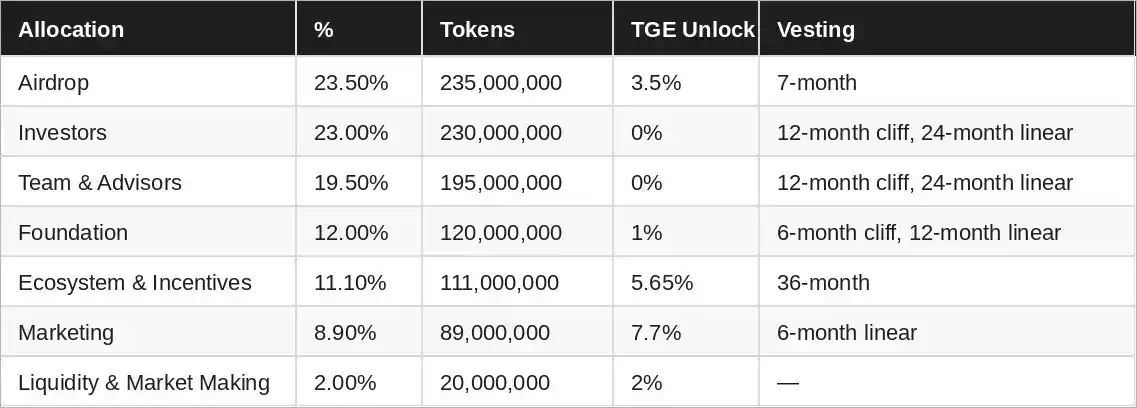
OPN has a total supply of 1 billion tokens. On the surface, the airdrop allocation of 23.5% (235 million tokens) doesn’t seem low. The problem, however, is that only 3.5% (35 million tokens) were unlocked on TGE day, with the remainder to be released over 7 months linearly. For the vast majority of farming users, the immediate rewards were far less than expected.

Meanwhile, another set of data pushed community sentiment over the edge: the team and advisors hold a combined 19.5%, investors hold 23%, and the foundation holds 12%—insiders collectively hold over 54% of the tokens, while all the hardworking community users only get 3.5% on TGE day.

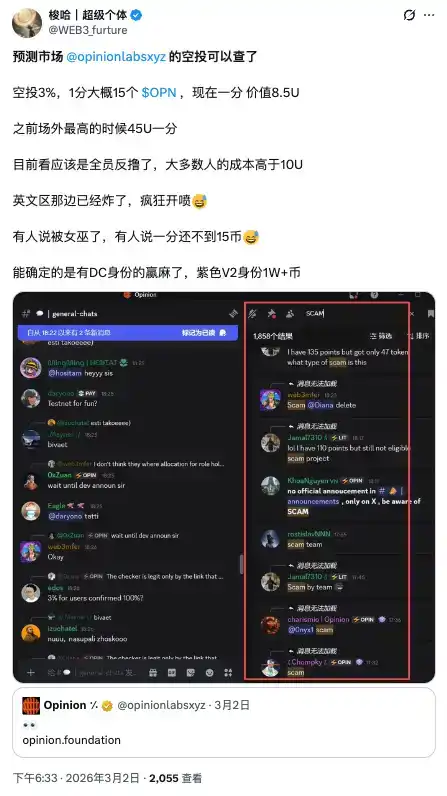
Actual user returns were dismal. Multiple participants publicly shared their scores and earnings. Influencer Suoha (@WEB3_furture) summarized: "Airdrop 3%, one point is about 15 OPN, now worth $8.5 per point. At its peak OTC, it was $45 per point. It looks like everyone got rugged; most people's costs were above $10 per point."
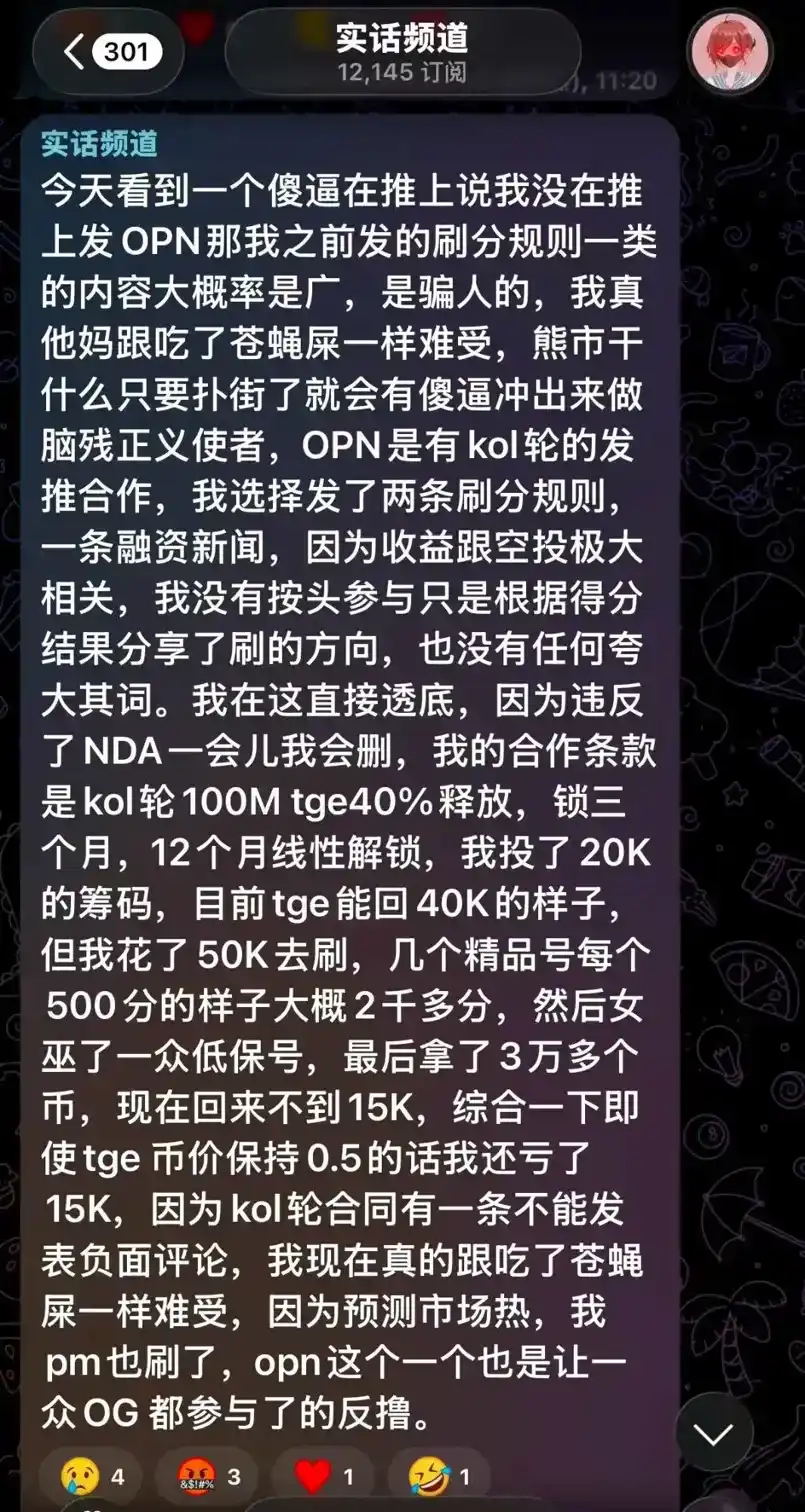
HongKongDoll, who has participated in many crypto projects, complained about her Telegram channel regarding her KOL round cooperation terms and farming data. Although the KOL round cooperation yielded definite returns, she invested $50,000 in farming. Each premium account had about 500 points, and she ultimately received just over 30,000 OPN. Calculated at the TGE price of $0.5, she recouped less than $15,000. Even including the unlocked returns from the investment, she overall lost $15,000. She bluntly stated: "I feel as disgusted as if I’d eaten fly droppings."
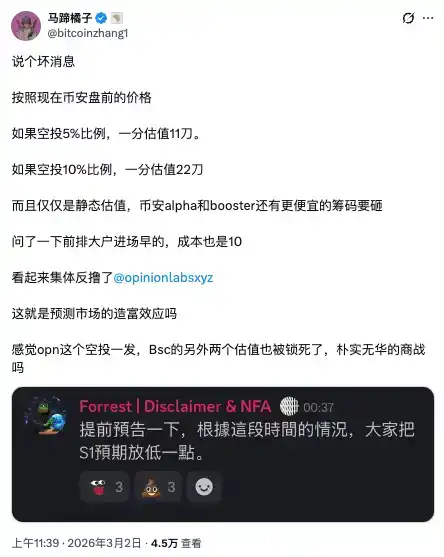
Another KOL, Mati Orange (@bitcoinzhang1), pointed out: "Based on Binance’s pre-listing price, if the airdrop ratio were 5%, one point would be valued at $11; if it were 10%, one point would be $22. And that’s just the static valuation; Binance alpha and booster have even cheaper筹码 to dump...... It seems like a collective rug."
Sybil attacks sparked a new wave of controversy. Beyond the allocation ratio itself, the project team’s large-scale crackdown on Sybil accounts and multi-account operations just before TGE led to many farming users having their points slashed or disqualified. While this move is justified in principle, the execution method and timing left the community feeling dissatisfied: during the farming period, the project team tacitly allowed or even encouraged high-frequency participation, only to start a concentrated crackdown on the eve of TGE. This was interpreted by many as a "use and discard" strategy, further deepening the impression of a "rug pull."

Binance’s allocation became a major point of criticism. Compared to the community’s mere 3.5% unlocked at TGE, the Binance Launchpool directly received 2% of the supply, with the marketing portion having a 7.7% TGE unlock ratio, and the liquidity portion being 100% unlocked. This contrast led many to conclude directly: "Opinion only airdropped 3% to users but gave a huge amount of筹码 to Binance." The community widely perceives this as a typical allocation method that "favors the exchange at the expense of the community."

On Discord and Twitter, discussions about Opinion were quickly filled with intense words like "scam" and "rug." The English-speaking community also erupted. KOLs publicly shared their loss statements, and negative sentiment continued to ferment.

It is worth noting that the project’s fundamentals are not fundamentally problematic—$25 million in funding, backing from Hack VC and Jump Crypto, and a leading position in the BSC prediction market are all objective advantages. However, even the strongest funding lineup can hardly弥补 the damage once community trust collapses.

When "welcoming data farming initially, then pulling the rug after launch" becomes the community consensus, the biggest challenge Opinion faces may no longer be market cap management, but how to rebuild basic trust with its users.


İlgili Sorular

QWhat is the total supply of Opinion (OPN) tokens and what percentage was allocated for the airdrop?

AThe total supply of Opinion (OPN) tokens is 1 billion. The airdrop allocation was 23.5% (235 million tokens).

QWhy did the community become angry about the OPN airdrop distribution?

AThe community was angry because only 3.5% (35 million tokens) of the total airdrop allocation was unlocked at TGE, with the rest vested over 7 months. This was a much lower immediate distribution than expected, especially compared to the 54% of tokens allocated to insiders (team, advisors, and investors) who received a larger share.

QWhich major venture capital firms invested in Opinion Labs?

AMajor venture capital firms that invested in Opinion Labs include YZi Labs (formerly Binance Labs), Hack VC, Jump Crypto, and Primitive Ventures.

QWhat was the financial outcome for the KOL HongKongDoll (玩偶姐姐) from her participation in the OPN airdrop?

AHongKongDoll invested $50,000 to farm points and received just over 30,000 OPN tokens. At the TGE price of $0.50 per token, her return was less than $15,000, resulting in an overall loss of approximately $15,000, even when including returns from her KOL partnership.

QWhat was a major point of controversy regarding Binance's role in the OPN token launch?

AA major controversy was the perceived unfair allocation favoring Binance. The Binance Launchpool received 2% of the total token supply, and the marketing allocation had a 7.7% TGE unlock, while the community airdrop only had a 3.5% unlock at TGE. This led to accusations that the project favored the exchange over its community users.

İlgili Okumalar

OpenAI Post-Training Engineer Weng Jiayi Proposes a New Paradigm Hypothesis for Agentic AI

OpenAI engineer Weng Jiayi's "Heuristic Learning" experiments propose a new paradigm for Agentic AI, suggesting that intelligent agents can improve not just by training neural networks, but also by autonomously writing and refining code based on environmental feedback. In the experiment, a coding agent (powered by Codex) was tasked with developing and maintaining a programmatic strategy for the Atari game Breakout. Starting from a basic prompt, the agent iteratively wrote code, ran the game, analyzed logs and video replays to identify failures, and then modified the code. Through this engineering loop of "code-run-debug-update," it evolved a pure Python heuristic strategy that achieved a perfect score of 864 in Breakout and performed competitively with deep reinforcement learning (RL) algorithms in MuJoCo control tasks like Ant and HalfCheetah. This approach, termed Heuristic Learning (HL), contrasts with Deep RL. In HL, experience is captured in readable, modifiable code, tests, logs, and configurations—a software system—rather than being encoded solely into opaque neural network weights. This offers potential advantages in explainability, auditability for safety-critical applications, easier integration of regression tests to combat catastrophic forgetting, and more efficient sample use in early learning stages, as demonstrated in broader tests on 57 Atari games. However, the blog acknowledges clear limitations. Programmatic strategies struggle with tasks requiring long-horizon planning or complex perception (e.g., Montezuma's Revenge), areas where neural networks excel. The future vision is a hybrid architecture: specialized neural networks for fast perception (System 1), HL systems for rules, safety, and local recovery (also System 1), and LLM agents providing high-level feedback and learning from the HL system's data (System 2). The core proposition is that in the era of capable coding agents, a significant portion of an AI's learned experience could be maintained as an auditable, evolving software system.

marsbit50 dk önce

OpenAI Post-Training Engineer Weng Jiayi Proposes a New Paradigm Hypothesis for Agentic AI

marsbit50 dk önce

Your Claude Will Dream Tonight, Don't Disturb It

This article explores the recent phenomenon of AI companies increasingly using anthropomorphic language—like "thinking," "memory," "hallucination," and now "dreaming"—to describe machine learning processes. Focusing on Anthropic's newly announced "Dreaming" feature for its Claude Agent platform, the piece explains that this function is essentially an automated, offline batch processing of an agent's operational logs. It analyzes past task sessions to identify patterns, optimize future actions, and consolidate learnings into a persistent memory system, akin to a form of reinforcement learning and self-correction. The article draws parallels to similar features in other AI agent systems like Hermes Agent and OpenClaw, which also implement mechanisms for reviewing historical data, extracting reusable "skills," and strengthening long-term memory. It notes a key difference from human dreaming: these AI "dreams" still consume computational resources and user tokens. Further context is provided by discussing the technical challenges of managing AI "memory" or context, highlighting the computational expense of large context windows and innovations like Subquadratic's new model claiming drastically longer contexts. The core critique argues that this strategic use of human-centric vocabulary does more than market products; it subtly reshapes user perception. By framing algorithms with terms associated with consciousness, companies blur the line between tool and autonomous entity. This linguistic shift can influence user expectations, tolerance for errors, and even perceptions of responsibility when systems fail, potentially diverting scrutiny from the companies and engineers behind the technology. The article concludes by speculating that terms like "daydreaming" for predictive task simulation might be next, continuing this trend of embedding the idea of an "inner life" into computational processes.

marsbit52 dk önce

Your Claude Will Dream Tonight, Don't Disturb It

marsbit52 dk önce

İşlemler

Spot
Futures
活动图片




