Grayscale Discloses Potential Investment Candidates: Which Crypto Assets Are Under Consideration?

marsbit2026-01-15 tarihinde yayınlandı2026-01-15 tarihinde güncellendi

Özet

Grayscale, a leading crypto asset manager, has disclosed its list of potential digital assets under consideration for future investment products, alongside an updated list of assets currently held in its existing products. These lists are organized using Grayscale's proprietary crypto sector classification framework. The "Asset Candidate List" features digital assets not currently held but identified as potential candidates. The "Existing Grayscale Product Assets" list details holdings as of January 12, 2026. The firm plans to update these lists quarterly. Grayscale emphasizes that the inclusion of an asset on the candidate list does not guarantee a product will be launched, as the process is complex and depends on internal controls, custody arrangements, and regulatory considerations. Assets may also be added to products without first appearing on the candidate list. The announcement includes a reminder that new products may not receive approval for secondary market trading. This information is for informational purposes only and not an offer to sell or buy securities.

Author: Grayscale

Compiled by: Deep Tide TechFlow
As a leading crypto asset management company, introducing a diverse range of investable digital assets to investors is a crucial part of our mission.

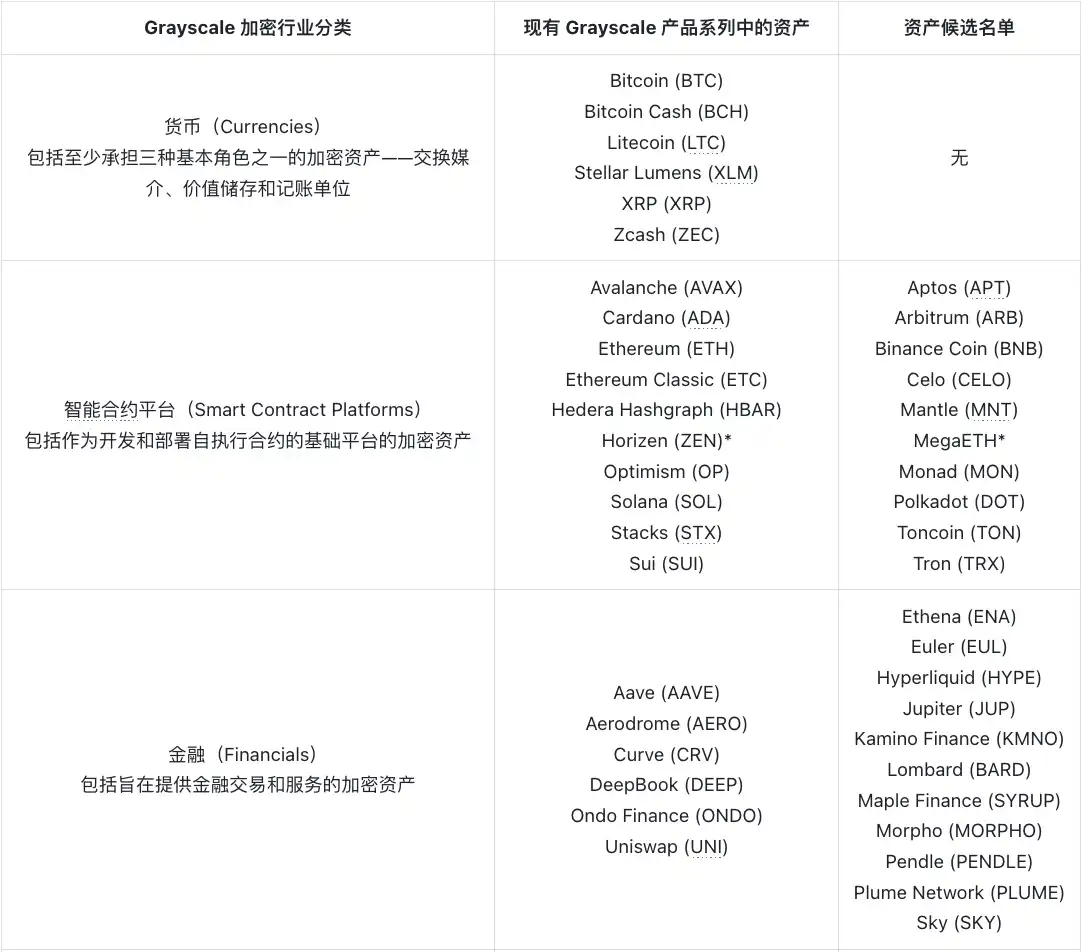
Therefore, we are pleased to share this candidate list of assets that may potentially be included in Grayscale investment products in the future, along with an updated list of assets currently in our existing product lineup. Both lists are categorized according to the Grayscale Crypto Sector Classification Framework we designed, which aims to set the standard for organizing crypto asset categories.

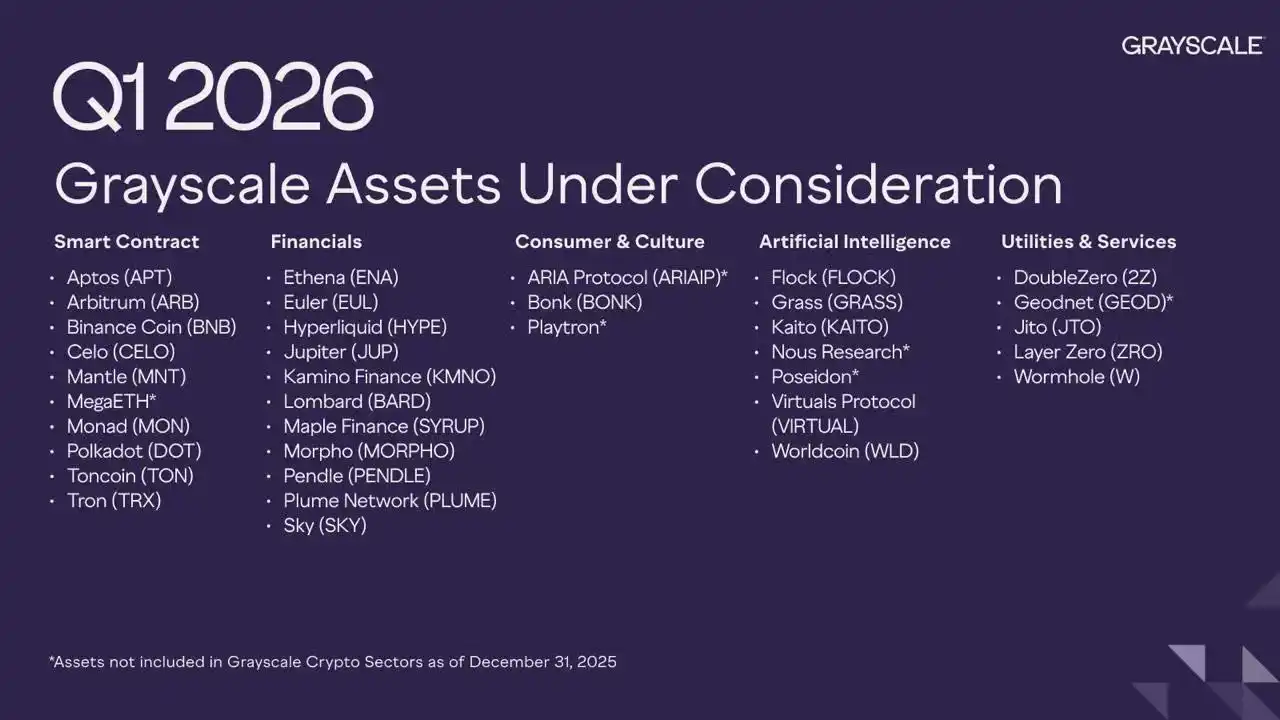
The "Asset Candidate List" includes digital assets that are not currently part of Grayscale investment products but have been identified by our team as potential candidates for future products.

The "Assets in Existing Grayscale Product Lineup" lists the digital assets held by Grayscale products as of January 12, 2026, which may be part of either single-asset products or multi-asset products.

As the crypto ecosystem expands and the Grayscale team reviews or re-evaluates additional assets, we plan to update this list as frequently as possible within 15 days after the end of each quarter. The following lists are as of January 12, 2026, and may change during the quarter as some multi-asset funds rebalance their compositions and we launch new single-asset products.
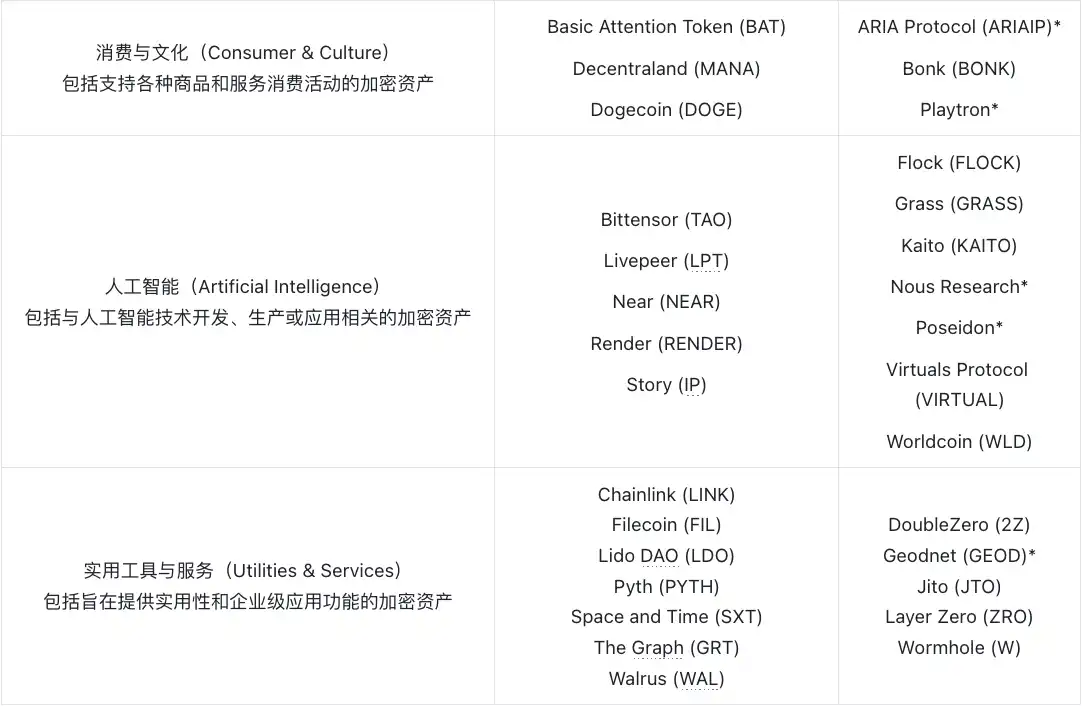
*As of December 31, 2025, assets not included in the Grayscale Crypto Sector Classification.

1 Assets may be directly included in the Grayscale product lineup without first being listed in this table, for example, if a decision is made to include an asset in a Grayscale product during the quarter.

The process of creating investment products similar to our existing ones is complex and multifaceted. It requires in-depth review and consideration and is influenced by various factors such as internal controls, custody arrangements, and regulatory requirements. It is important to note that this table is for informational purposes only, and not all candidate assets will be converted into our investment products. Grayscale may also explore other assets not listed in the table for inclusion in its product lineup. Similarly, assets may be directly included in the Grayscale product lineup without first being listed in this table.

Grayscale may attempt to have shares of new products quoted on secondary markets. Although shares of certain Grayscale products are approved for trading on secondary markets (such as OTCQX), for investors in new products, it cannot be assumed that such shares will receive similar approval due to potential concerns from the U.S. Securities and Exchange Commission (SEC) and/or the Financial Industry Regulatory Authority (FINRA) regarding the status of the underlying digital assets under federal securities laws.

This article does not constitute an offer to sell or a solicitation to buy any securities in any jurisdiction, nor should it be considered as legal to make such an offer, solicitation, or sale without registration or qualification under the securities laws of that jurisdiction. Grayscale, its affiliates, and clients may hold positions in the digital assets or securities discussed herein.


İlgili Sorular

QWhat is the purpose of Grayscale's 'asset candidate list'?

AThe 'asset candidate list' identifies digital assets not currently included in Grayscale investment products but have been identified by their team as potential candidates for future products.

QHow often does Grayscale plan to update its list of potential investment assets?

AGrayscale plans to update the list as frequently as possible, aiming for within 15 days after the end of each quarter.

QAs of the article's date, what framework does Grayscale use to categorize crypto assets for its products?

AGrayscale uses its own designed 'Grayscale Crypto Sector Classification Framework' to categorize crypto assets for its products.

QDoes inclusion on the candidate list guarantee an asset will be turned into a Grayscale investment product?

ANo, inclusion on the candidate list does not guarantee an asset will be turned into a product. It is for informational purposes only, and not all candidate assets will be converted.

QWhat is a significant regulatory consideration mentioned for new Grayscale products seeking secondary market trading?

AA significant consideration is that the SEC and/or FINRA may have concerns about the status of the product's underlying digital asset under federal securities laws, so approval for secondary market trading cannot be assumed.

İlgili Okumalar

DeepSeek Funding: Liang Wenfeng's 'Realist' Pivot

DeepSeek, a leading Chinese AI company, has initiated its first external funding round, aiming to raise at least $300 million at a valuation of no less than $10 billion. This move marks a significant shift from its founder Liang Wenfeng’s previous idealistic stance of rejecting external capital to maintain independence. Despite strong financial backing from its parent company, quantitative trading firm幻方量化 (Huanfang Quant), which provided an estimated $700 million in revenue in 2025 alone, DeepSeek faces mounting challenges. Key issues include a 15-month gap in major model updates, delays in its flagship V4 release, and the loss of several core researchers to competitors offering significantly higher compensation. The company is also undergoing a strategic pivot by migrating its infrastructure from NVIDIA’s CUDA to Huawei’s Ascend platform, a move aligned with China’s push for technological self-reliance amid U.S. export controls. However, DeepSeek lags behind rivals like智谱AI and MiniMax—both now publicly listed—in areas such as product ecosystem, multimodal capabilities, and commercialization. The funding round, though relatively small in scale, is seen as a way to establish a market-validated valuation anchor, making employee stock options more competitive and facilitating talent retention. It also signals DeepSeek’s transition from a pure research-oriented organization to a commercially-driven player in the global AI ecosystem.

marsbit29 dk önce

DeepSeek Funding: Liang Wenfeng's 'Realist' Pivot

marsbit29 dk önce

Solana Q1 Report: Revenue Plunges 68% Year-on-Year, Developers Decrease by 30%

Solana Q1 2026 Report: Key Metrics Show Significant Decline Amid Market Reset Solana experienced a substantial downturn in Q1 2026, with key performance indicators reflecting a broader market cooling. Total network revenue (REV) fell to $89.9 million, down 68% year-over-year (YoY) and 1.4% quarter-over-quarter (QoQ). This decline was driven by reduced speculative activity, which had previously fueled the network during the 2024/2025 bull market. Key revenue components saw mixed results: base fees dropped 8.7% QoQ, Jito tips (MEV) fell 19.7%, priority fees rose 23%, and vote fees declined 44.5%. The annualized real yield for stakers was just 0.17%, down 67% YoY. Network GDP, generated by top applications, fell 7% QoQ to $451 million. Pump Fun emerged as a standout, generating $103 million (up 3% QoQ), surpassing Solana's L1 revenue. However, daily active addresses averaged 2.4 million, down 4.8% YoY. Stablecoin supply on Solana reached $15.9 billion, down 2.7% QoQ but up 18% YoY. USDC and USDT remained dominant. DEX volumes averaged $3.2 billion daily, with private DEXs now accounting for 60% of all volume. The network's net dilution rate was 4.38%, while the cost to produce $1 of REV was $8.10, up 93% YoY. The number of new tokens created on launchpads grew 42% QoQ to 3 million, with Pump Fun dominating 85% of this market. Despite the downturn, Solana's core strengths remain: its position as a hub for retail trading apps, potential in perpetual markets, and growing use in stablecoin-based fintech applications, particularly in Latin America. However, developer activity declined 32% YoY, slightly worse than Ethereum's 29% drop. The network must now focus on attracting traditional finance, competing in perpetual markets, and sustaining developer ecosystem growth to drive the next expansion cycle.

marsbit1 saat önce

Solana Q1 Report: Revenue Plunges 68% Year-on-Year, Developers Decrease by 30%

marsbit1 saat önce

İşlemler

Spot
Futures
活动图片