6,000 CEOs Admit AI 'Did Nothing', Yet It Was Used to Lay Off 40,000 People in Q1 This Year

marsbit2026-04-20 tarihinde yayınlandı2026-04-20 tarihinde güncellendi

Özet

A study by the National Bureau of Economic Research (NBER) surveying 6000 executives across four countries reveals that nearly 90% of businesses report AI has had "no measurable impact" on employment or productivity over the past three years. Despite global AI investments exceeding $250 billion in 2024, only 12% of CEOs reported both cost reductions and revenue growth from AI. Contrastingly, in Q1 2026, the industry saw 78,557 tech job cuts, with 47.9% attributed to AI and automation. Critics label this contradiction an "AI version of the Solow Paradox," referencing the visible lack of AI's effect in productivity data amid widespread adoption. While some leaders, like Anthropic’s CEO, predict AI will eliminate half of entry-level white-collar jobs, others accuse firms of "AI washing"—using AI as a pretext for layoffs originally planned due to over-hiring or weak demand. However, companies like IBM and Cognizant are bucking the trend by increasing entry-level hiring and retraining staff to work alongside AI. Economists suggest a "J-curve" effect may be underway, where initial productivity stagnation is followed by significant gains, as was seen with IT in the 1990s. The transition remains challenging, with true productivity improvements expected within 6–12 months.

Author: Claude, Deep Tide TechFlow

Deep Tide Guide: A survey of 6,000 executives in four countries by the National Bureau of Economic Research (NBER) shows that nearly 90% of companies believe AI has had "no impact" on employment and productivity over the past three years. However, in Q1 2026, the tech industry laid off 78,557 people, with 47.9% attributed to AI. While productivity data remains blank, a wave of layoffs is surging in the name of AI. Economists compare this contradiction to an AI version of the "computer paradox" proposed by Robert Solow, winner of the 1987 Nobel Prize in Economics.
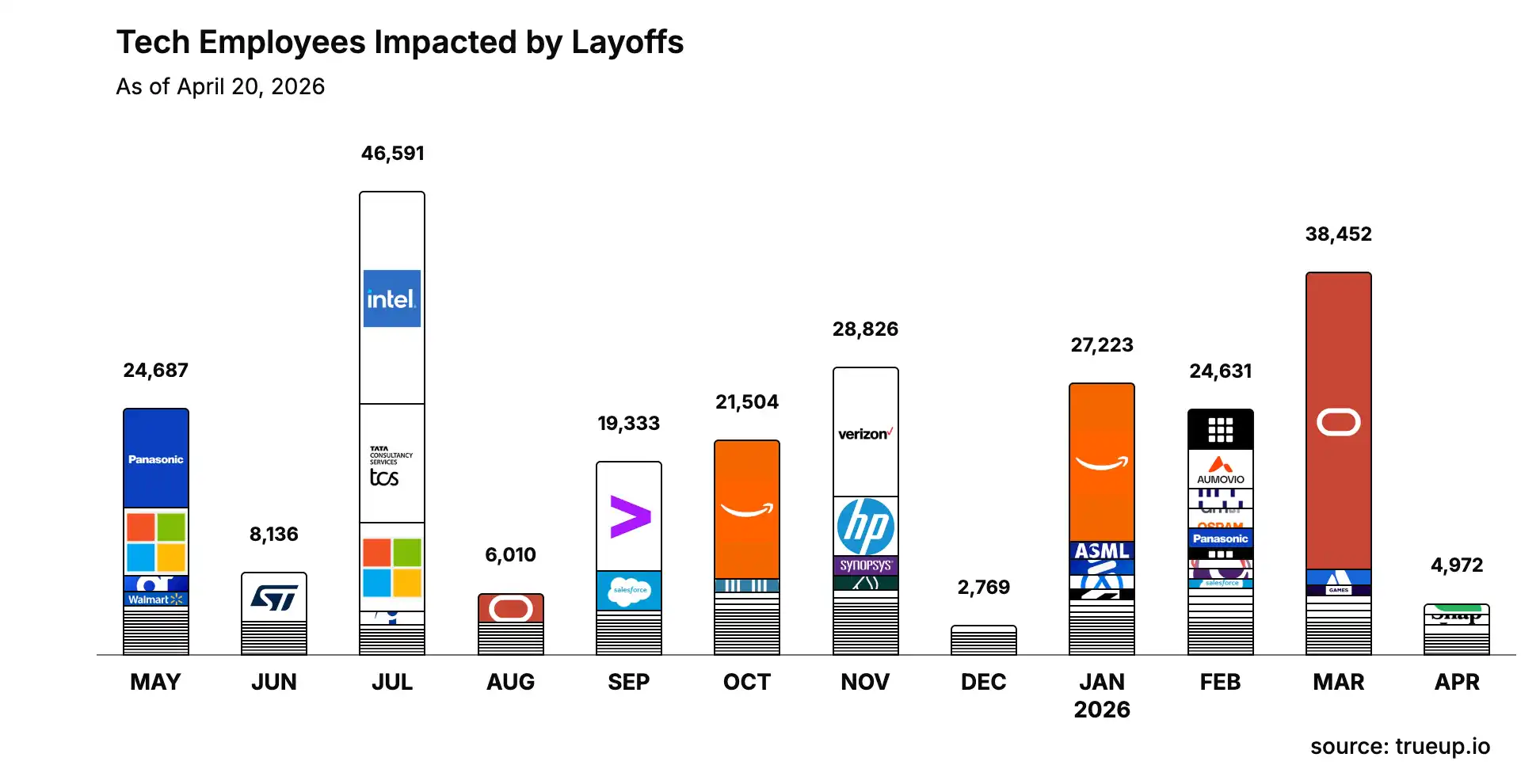
$250 billion invested, nearly 90% of companies say AI hasn't brought any productivity improvements. Meanwhile, tech companies are conducting large-scale layoffs in the name of AI.

This is the most absurd scene in the current AI industry.

According to a Fortune magazine report on April 19, a study published by NBER in February covering 6,000 corporate executives in the US, UK, Germany, and Australia found that nearly 90% of respondent companies said AI had no measurable impact on their employment and productivity over the past three years. Although two-thirds of executives are using AI, their average weekly usage is only 1.5 hours, and 25% of respondents said they don't use AI at work at all.

On the other hand, according to Nikkei Asia citing RationalFX data, from January 1 to early April 2026, the tech industry has laid off 78,557 people, with 37,638 (47.9%) explicitly attributed to AI and workflow automation. Over 76% of the layoffs occurred in the United States.

Apollo chief economist Torsten Slok directly quoted the classic statement of Robert Solow, winner of the 1987 Nobel Prize in Economics, summarizing the current situation as the AI version of the "Solow Paradox." Solow's original words were: "You can see the computer age everywhere but in the productivity statistics."

Slok's judgment almost exactly maps to today. AI is nowhere to be found in employment data, productivity data, or inflation data.

90% of Companies See No AI Effect, $250 Billion Investment Return Questioned

The data from this NBER study is quite solid. Among the four countries, 69% of companies use AI to some extent, with the US highest (78%) and Germany lowest (65%). But using it is one thing, effectiveness is another: over 90% of managers said AI had no impact on their company's employment size, and 89% said it had no impact on labor productivity (measured by sales per capita).

According to Stanford University's 2025 AI Index Report, global AI investment in 2024 exceeded $250 billion. PwC's 2026 Global CEO Survey shows that only 12% of CEOs said AI brought both cost reduction and revenue growth, while 56% of CEOs reported no significant financial benefits.

Slok pointed out in his blog post that aside from the "Magnificent Seven," AI has no visible impact on profit margins and earnings expectations.

This is not an isolated opinion. A 2024 MIT study predicted that AI would only boost productivity by 0.5% over the next decade. The study's author, Nobel laureate Daron Acemoglu, said at the time: "0.5% is better than zero. But relative to the promises of the industry and tech media, it is indeed disappointing."

A study published by Boston Consulting Group (BCG) in March this year revealed a counterintuitive phenomenon: when employees use fewer than three AI tools, productivity increases; but after using four or more tools, self-rated productivity drops significantly, with employees reporting "brain fog" and more minor errors. BCG calls this "AI Brain Overload."

ManpowerGroup's 2026 Global Talent Barometer shows that among nearly 14,000 employees in 19 countries, the routine use rate of AI rose by 13% in 2025, but confidence in AI's practicality plummeted by 18%.

Nearly 80,000 Layoffs in Q1, Is AI the Biggest "Scapegoat" or the Real Culprit?

While productivity data remains blank, the layoff wave is advancing at an alarming rate.

According to Nikkei Asia, the tech industry laid off 78,557 people in Q1 2026, with 47.9% attributed to AI implementation and workflow automation. Oracle recently quietly laid off over 10,000 people, with the saved funds redirected to data center construction. Anthropic CEO Dario Amodei and Ford CEO Jim Farley have both publicly stated that AI will eliminate half of US entry-level white-collar jobs within the next five years. Stanford University research also shows that junior programming and customer service positions are already being impacted, with related job postings dropping 13% over three years.
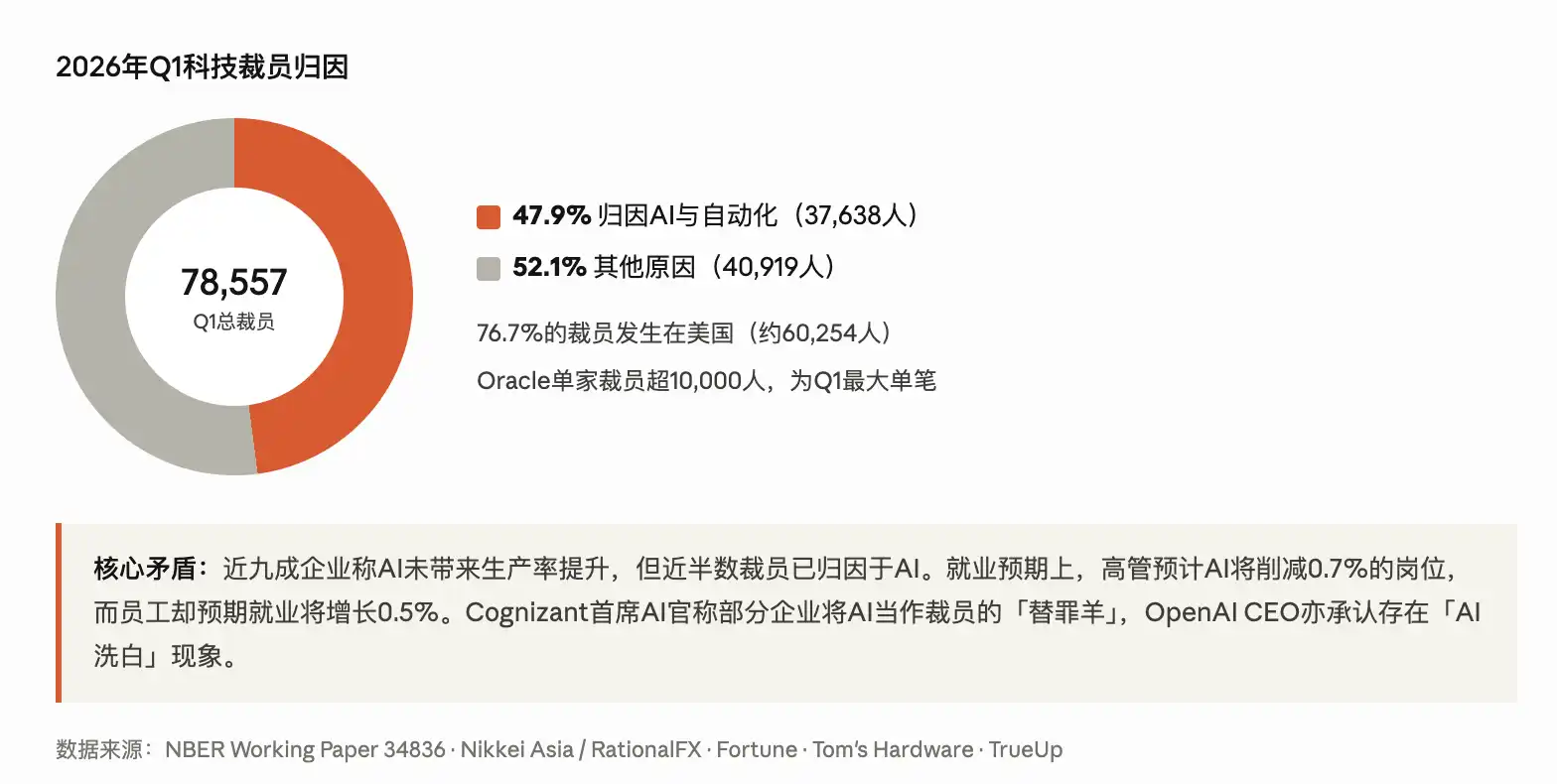
An MIT simulation study provided even more startling numbers: AI could replace 11.7% of the US workforce, involving approximately $1.2 trillion in total wages.

But how many of these layoffs are truly driven by AI?

Cognizant Chief AI Officer Babak Hodjat was blunt with Nikkei Asia: "I'm not sure if these layoffs are directly related to actual productivity gains. Sometimes, AI is just a scapegoat on the financial level—companies overstaffed, want to downsize, and then blame it on AI."

OpenAI CEO Sam Altman also acknowledged the existence of "AI washing" at the India AI Impact Summit, "There's a certain percentage of 'AI washing,' where people blame layoffs that were going to happen anyway on AI, but there are also some jobs that are being genuinely replaced by AI."

Deutsche Bank analysts directly named this phenomenon "AI redundancy washing," believing companies attribute layoffs to AI because "it sends a more positive signal to investors than admitting weak demand or previous over-hiring."

IBM Increases Entry-Level Hiring Against the Trend, Cognizant Refuses Layoffs

Not all companies are following the trend.

IBM tripled its entry-level hiring in 2026. The company's Chief Human Resources Officer, Nickle LaMoreaux, logic is: while AI can perform many entry-level tasks, eliminating these positions would destroy the talent pipeline for cultivating future middle managers, endangering the company's long-term leadership reserves.

Cognizant—a process outsourcing giant highly dependent on human resources—also stated it will not lay off people because of AI. The company has established AI labs in San Francisco and Bangalore to develop custom AI agents for clients (as off-the-shelf generic AI products don't perform well in enterprise environments, with performance and security issues), but its employees will be trained to work alongside AI, not be replaced by it.

Hodjat emphasized: "There will be a large number of young graduates who can't find jobs and lack domain expertise. You have to hire them and let them learn on the job how to use AI in various fields."

Data from the European Central Bank also supports this view from another angle: companies that deploy and invest in AI on a large scale are more likely to be expanding hiring.

J-Curve or Mirage: When Will the AI Productivity Inflection Point Arrive?

Historical experience offers some hope.

IT investment in the 1970s and 80s also seemed ineffective, but from 1995 to 2005, IT-driven productivity growth reached 1.5%. Stanford University Digital Economy Lab Director Erik Brynjolfsson wrote in the Financial Times that the AI productivity inflection point may have begun to appear: US productivity grew 2.7% last year, Q4 GDP tracking growth was 3.7%, but only 181,000 new jobs were added in the same period—this decoupling of job growth from GDP growth might be a signal that AI is starting to work. Former Pimco CEO Mohamed El-Erian also noticed the same decoupling phenomenon.

A study by the Stanford Institute for Economic Policy Research, using web browsing data from 200,000 US households, found that AI improved efficiency in online tasks like job searching, travel planning, and shopping by 76% to 176%. However, researchers found that users spent the saved time socializing and watching TV instead of working or learning new skills.

Apollo's Slok describes AI's future impact as a "J-curve": first a period of declining performance, followed by an exponential leap. But he also points out that unlike the IT era of the 80s, where innovators had monopoly pricing power, today's AI tools face fierce competition and continuously falling prices. Therefore, AI's value creation lies not in the product itself, but in "how generative AI is used and deployed across economic sectors."

Hodjat's judgment is perhaps the most practical: in another 6 to 12 months, companies will begin to see the real productivity improvements brought by AI, and "this transition period will be painful for all of us."


İlgili Sorular

QWhat is the main contradiction highlighted in the article regarding AI's impact on businesses?

AThe main contradiction is that while nearly 90% of surveyed companies report that AI has had no measurable impact on employment or productivity over the past three years, tech companies have attributed 47.9% of their Q1 2026 layoffs (37,638 jobs) to AI and workflow automation.

QWhat historical economic concept is used to describe the current AI productivity paradox?

AThe current situation is described as an AI version of the 'Solow Paradox,' a concept from Nobel laureate Robert Solow, who in 1987 stated, 'You can see the computer age everywhere but in the productivity statistics.'

QAccording to the article, what is 'AI redundancy washing'?

A'AI redundancy washing' is a term used by Deutsche Bank analysts to describe the phenomenon where companies attribute layoffs to AI implementation to present a more positive signal to investors, rather than admitting to weak demand or previous over-hiring.

QWhich companies are cited as examples of not following the trend of AI-driven layoffs?

AIBM and Cognizant are cited as examples. IBM tripled its entry-level hiring to preserve its future leadership pipeline, while Cognizant refuses to lay off employees and instead trains them to work alongside AI.

QWhat does the 'J curve' refer to in the context of AI's future impact?

AThe 'J curve' describes the predicted trajectory of AI's impact: an initial period of underwhelming performance and productivity data, followed by a future period of exponential growth and significant productivity gains as the technology is more effectively deployed across the economy.

İlgili Okumalar

Crypto Market Makers Are Collectively Seeking Change as Money Becomes Harder to Earn

**Summary: Crypto Market Makers Adapt as Margins Shrink** Leading crypto market maker GSR exemplifies a broader industry shift, moving beyond traditional market-making to become a full-service "Web3 investment bank." Its recent strategic acquisitions—including an SEC-registered broker-dealer, rebranded as GSR Securities—and purchases of token advisory firms aim to create an integrated platform covering token design, fundraising, listing, liquidity provision, and asset management. This includes launching an ETF and investing in tokenization platforms like Libeara, backed by a strategic investment from Standard Chartered's SC Ventures. This transformation is not unique to GSR. Other major players like Keyrock, B2C2, Wintermute, and DWF Labs are also expanding geographically, pursuing regulatory licenses (especially under frameworks like MiCA in the EU), and diversifying into over-the-counter (OTC) trading, asset management, and real-world asset tokenization. The driving force behind this collective pivot is a rapidly changing market. Profits from traditional altcoin market-making are declining due to fewer viable projects, reduced client budgets, increased competition, and smarter, more demanding clients. Simultaneously, regulatory pressures are mounting, making compliance a baseline cost. Extreme market events further expose teams lacking robust risk controls. Consequently, the crypto market-making business model is evolving from one reliant on information asymmetry and volatility to a more institutionalized, regulated, and service-diverse industry. Survival now depends on building systemic capabilities beyond mere liquidity provision.

marsbit36 dk önce

Crypto Market Makers Are Collectively Seeking Change as Money Becomes Harder to Earn

marsbit36 dk önce

Market Adjusts Following Google's $84.7 Billion Fundraising, AI Valuations Now Focus on Payback Speed

After Alphabet's announcement of an $84.75 billion equity financing round, market focus for AI investment is shifting from pure growth narratives to capital efficiency and payback periods. The core argument is that AI is being re-priced from a software-like growth story into a heavy-asset infrastructure cycle, requiring massive capital expenditure (CapEx) on chips, data centers, and power grids. While Alphabet's financing itself is not a distress signal—part of it is for administrative purposes like tax obligations on stock compensation—it highlights the enormous capital demands of AI infrastructure. This demand extends beyond tech giants to pure-play AI model companies (like OpenAI, Anthropic), data center REITs, and utilities. Major tech firms are projected to spend heavily on AI data centers in 2026, signaling a broad-based capital cycle the market must absorb. Consequently, valuation logic is changing. Investors are moving away from questions about who has the strongest AI narrative and are now prioritizing clear visibility into orders, stable cash flows, and the cost of capital. This has led to recent pressure on high-multiple AI software and semiconductor stocks, while "picks-and-shovels" hardware, data center, and power assets with firmer near-term demand may see relative support. The key going forward will be monitoring whether rising CapEx guidance across companies is matched by a timely monetization of AI investments into revenue and cash flow. The market's tolerance for high spending depends on demonstrable returns. While the long-term AI thesis remains intact, the valuation framework has fundamentally shifted to emphasize capital discipline and payback speed.

marsbit43 dk önce

Market Adjusts Following Google's $84.7 Billion Fundraising, AI Valuations Now Focus on Payback Speed

marsbit43 dk önce

İşlemler

Spot
Futures

Popüler Makaleler

PEOPLE Nasıl Satın Alınır

HTX.com’a hoş geldiniz! ConstitutionDAO (PEOPLE) satın alma işlemlerini basit ve kullanışlı bir hâle getirdik. Adım adım açıkladığımız rehberimizi takip ederek kripto yolculuğunuza başlayın. 1. Adım: HTX Hesabınızı OluşturunHTX'te ücretsiz bir hesap açmak için e-posta adresinizi veya telefon numaranızı kullanın. Sorunsuzca kaydolun ve tüm özelliklerin kilidini açın. Hesabımı Aç2. Adım: Kripto Satın Al Bölümüne Gidin ve Ödeme Yönteminizi SeçinKredi/Banka Kartı: Visa veya Mastercard'ınızı kullanarak anında ConstitutionDAO (PEOPLE) satın alın.Bakiye: Sorunsuz bir şekilde işlem yapmak için HTX hesap bakiyenizdeki fonları kullanın.Üçüncü Taraflar: Kullanımı kolaylaştırmak için Google Pay ve Apple Pay gibi popüler ödeme yöntemlerini ekledik.P2P: HTX'teki diğer kullanıcılarla doğrudan işlem yapın.Borsa Dışı (OTC): Yatırımcılar için kişiye özel hizmetler ve rekabetçi döviz kurları sunuyoruz.3. Adım: ConstitutionDAO (PEOPLE) Varlıklarınızı SaklayınConstitutionDAO (PEOPLE) satın aldıktan sonra HTX hesabınızda saklayın. Alternatif olarak, blok zinciri transferi yoluyla başka bir yere gönderebilir veya diğer kripto para birimlerini takas etmek için kullanabilirsiniz.4. Adım: ConstitutionDAO (PEOPLE) Varlıklarınızla İşlem YapınHTX'in spot piyasasında ConstitutionDAO (PEOPLE) ile kolayca işlemler yapın.Hesabınıza erişin, işlem çiftinizi seçin, işlemlerinizi gerçekleştirin ve gerçek zamanlı olarak izleyin. Hem yeni başlayanlar hem de deneyimli yatırımcılar için kullanıcı dostu bir deneyim sunuyoruz.

473 Toplam GörüntülenmeYayınlanma 2024.12.12Güncellenme 2026.06.02

PEOPLE Nasıl Satın Alınır

Tartışmalar

HTX Topluluğuna hoş geldiniz. Burada, en son platform gelişmeleri hakkında bilgi sahibi olabilir ve profesyonel piyasa görüşlerine erişebilirsiniz. Kullanıcıların PEOPLE (PEOPLE) fiyatı hakkındaki görüşleri aşağıda sunulmaktadır.

活动图片












