Google's Deep Think Dominates Eight-Language Olympiads, Autonomously Solves Four Unsolved Problems, Research Barriers Collapse

marsbit2026-04-08 tarihinde yayınlandı2026-04-08 tarihinde güncellendi

Özet

Google DeepMind's "Deep Think" AI system has demonstrated exceptional performance across eight languages in regional academic competitions, including mathematics and informatics Olympiads. It achieved perfect scores in Japanese and French contests, and high results in Chinese, Korean, Hindi, Vietnamese, Russian, and Portuguese exams. This multi-language capability aims to reduce linguistic barriers in scientific research, enabling non-English-speaking researchers to access advanced AI tools equally. Beyond competitions, Deep Think has solved four previously unsolved mathematical problems and contributed to breakthroughs in computer science, physics, and economics. It powers the Aletheia agent, which autonomously generates and verifies research-level mathematical solutions. Despite these achievements, the results are based on internal evaluations without third-party verification or detailed methodology disclosure. Google positions Deep Think as a "human intelligence multiplier," expanding AI's role in global scientific collaboration beyond English-dominated benchmarks.

"Deep Think has defeated/matched competitors in all competitions"!

Just now, Google DeepMind senior researcher Conglong Li posted 12 messages on the X platform, revealing an unprecedented scorecard.
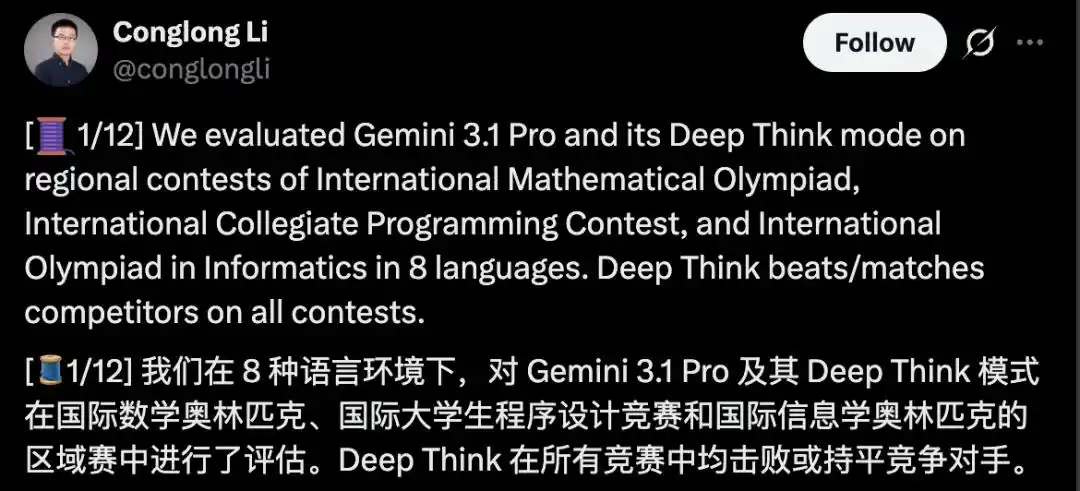
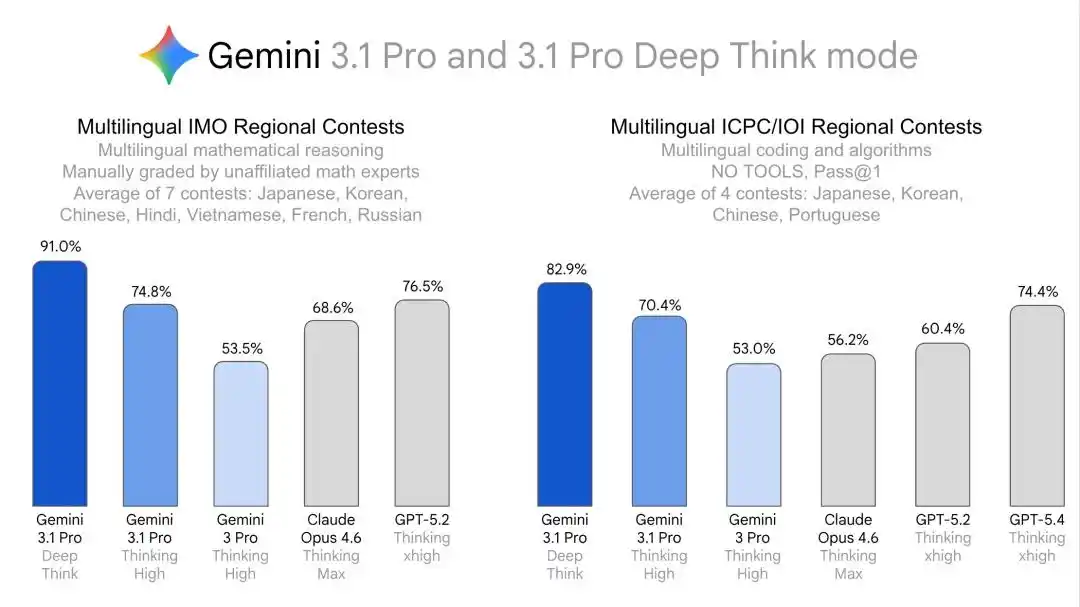
One AI, the same brain, eight exam papers in different languages, all submitted with high scores.

Such results are rare for any model.

From IMO Gold Medals to Full Coverage of Regional Competitions

Deep Think's high scores across multiple leaderboards are not a sudden breakthrough but part of a nearly year-long evolution of capabilities.

First, it topped the most rigorous reasoning competitions.

In July 2025, Gemini Deep Think achieved the gold medal standard at the International Mathematical Olympiad (IMO) for the first time, scoring 35 out of 42 points. It also achieved similarly high-level performance at the ICPC World Finals around the same time.

These two achievements have been officially announced in the DeepMind blog.

Google DeepMind subsequently included these two results in its official blog, marking Deep Think's crossing of the "world-class competition threshold" in mathematics and programming.

Next, Deep Think began moving from "world-champion-level individual breakthroughs" to "systematic validation across languages, disciplines, and scenarios."

In February 2026, Google published three blog posts.

One introduced the Gemini 3.1 Pro model itself, one detailed a major upgrade to the Deep Think specialized reasoning mode, and one from the DeepMind scientific discovery team directly positioned Deep Think as a "human intelligence multiplier."

The upgraded Deep Think delivered a series of hard metrics:

48.4% on Humanity's Last Exam (without tool assistance), 84.6% on ARC-AGI-2 (officially verified by the ARC Prize Foundation), a Codeforces competitive programming Elo rating of 3455, and gold medal-level performance on the written portions of the 2025 International Physics and Chemistry Olympiads.
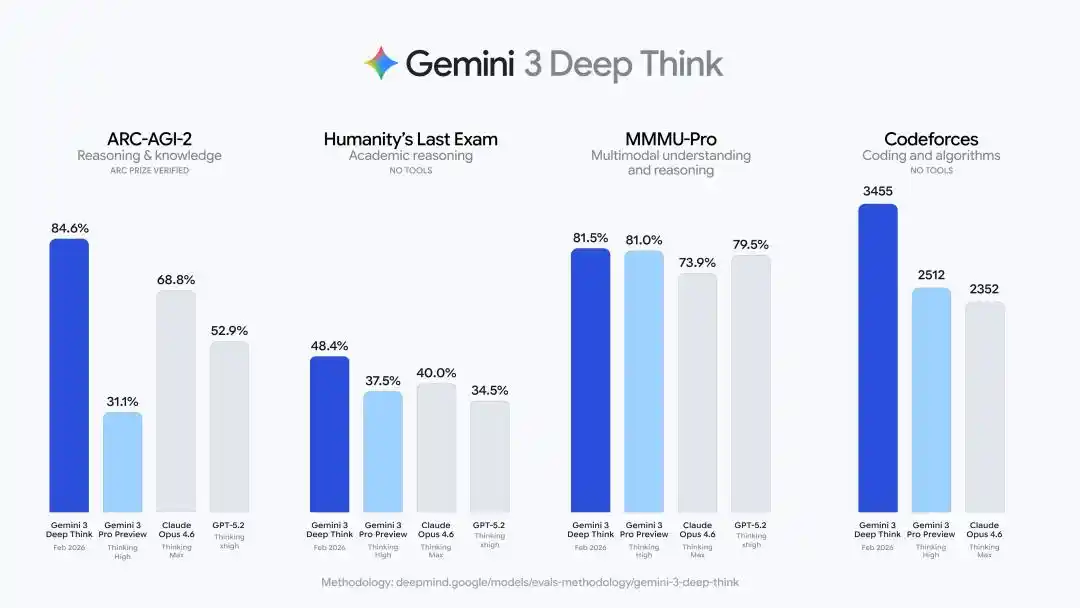
The strategy is very clear: first use world-class competitions like the IMO and ICPC to prove its powerful reasoning abilities, then use multi-language, regional competition, and cross-disciplinary Olympiad results to prove its general, deep reasoning ability that stably transfers across languages and domains.
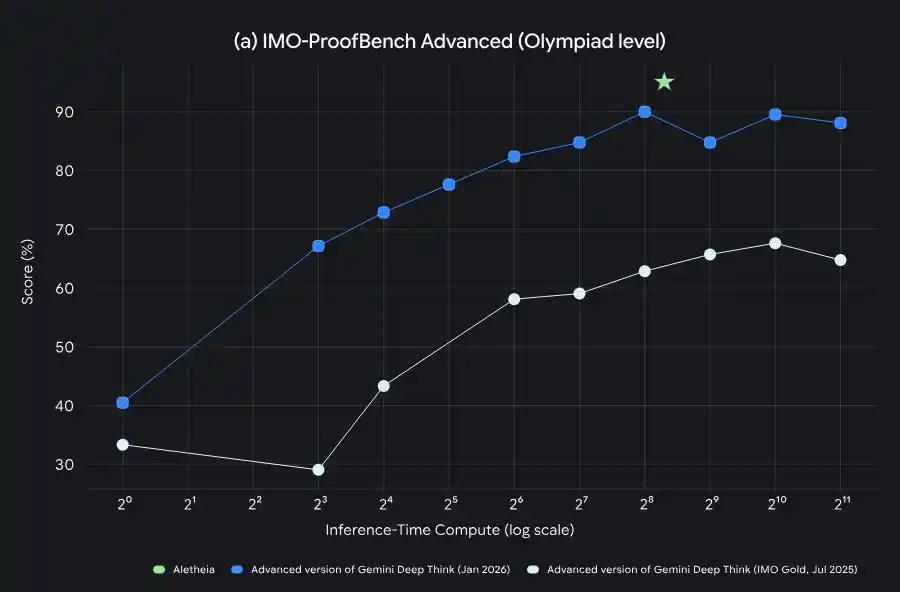
Gemini Deep Think's capability evolution from IMO gold medals to PhD-level research acceleration

A Detailed Look at the 8-Language Scorecard

Now, let's take a closer look at this scorecard.

Japanese results are the most impressive.

2025 35th Japanese Mathematical Olympiad Finals (JMO Finals), perfect score.

ICPC Asia Japan Preliminary Contest, perfect score.
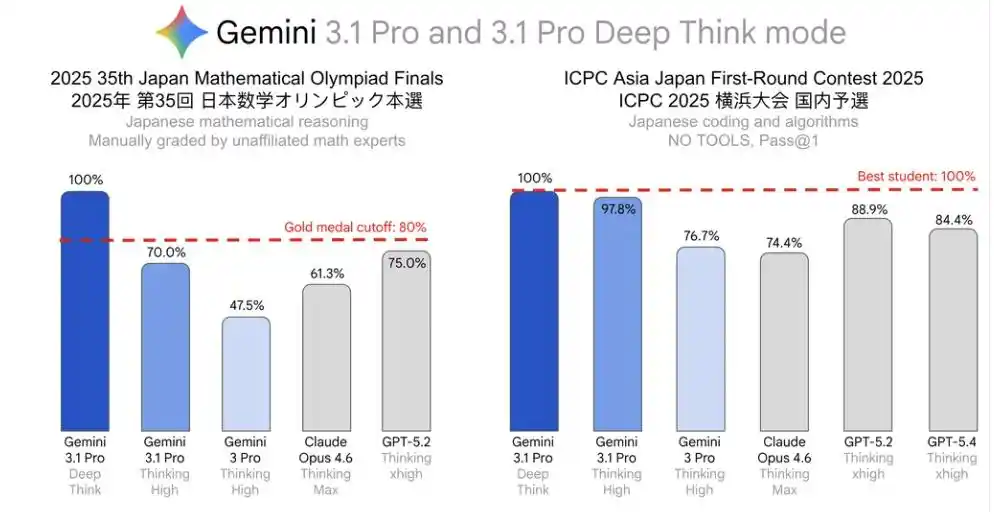
Among these, the JMO Finals score even exceeded the level corresponding to the top 80% of scores that year, meeting the official "gold medal equivalent" standard.

French results were also a perfect 100%.

The Chinese results are interesting.

At the 41st Chinese Mathematical Olympiad (CMO), Deep Think scored 86.3%, which is quite outstanding. But at the Chinese National Olympiad in Informatics (NOI), it only scored 63.3%.

The gap between 86.3% and 63.3% outlines the real boundaries of AI reasoning ability.

In math competitions, the model faces abstract deduction, proof construction, and multi-step reasoning, which happens to be Deep Think's strongest suit.

But in informatics competitions, the problem is not just "figuring it out," but also translating logic into executable code, controlling boundary conditions, considering complexity constraints, and avoiding implementation errors.

The former is closer to pure reasoning, while the latter requires "reasoning + algorithm design + engineering implementation" to be successful simultaneously.

In the other languages—Korean, Hindi, Vietnamese, Russian, Portuguese—Deep Think also achieved results that either defeated competitors or at least matched them.

Looking at Japanese, French, and Chinese together, the most unusual aspect this time is not necessarily scoring a perfect mark in any single subject, but rather that the same model, the same Deep Think reasoning system, delivered first-tier results on exam papers in multiple languages.

Is This Scorecard Reliable?

But there is a key omission:

Conglong Li did not list specific comparative data from competitors: all results come from Google evaluations. There is no independent third-party replication, no official certification from the competitions, and the evaluation methodology is completely undisclosed.

Was each problem attempted once or many times with the best score taken? How much computational power was used during reasoning? Was there any manual prompt engineering involved?

These details, which directly affect the credibility of the results, were also not mentioned.

Another easily overlooked point: these exams are all regional selection competitions, not international finals.

There is an order of magnitude difference in difficulty between regional competition problems and international finals.

The researcher explicitly stated that these results "will be included in the model card." As of publication, the model card has not been officially updated.

So, for now, this still seems like a scorecard graded by the examinee themselves, announced by themselves, and not yet stamped by the academic affairs office.

Multilingual Research Equity: The Overlooked Real Battlefield

Why did Google specifically invest effort in evaluating 8 different regional languages?

Current evaluations of AI reasoning ability are almost entirely based on English.

MATH, GSM8K, HumanEval, ARC-AGI... these are all in English.

Mathematicians, physicists, and engineers worldwide whose native language is not English must first overcome a language barrier when using AI research tools.

Google's selection of these 8 languages is not random.

Japanese, Korean, and Chinese cover East Asian research powerhouses; Hindi and Vietnamese cover emerging markets; French, Russian, and Portuguese cover Europe and South America.

Together, this represents the majority of global research output.

In its official blog, DeepMind positioned Deep Think as a "human intelligence multiplier," saying it can "handle knowledge retrieval and rigorous verification, allowing scientists to focus on conceptual depth and creative direction."

Combined with these multi-language results, the subtext of this statement is not hard to understand: this multiplier is not just for scientists who use English.

More notably is how far Deep Think has already gone in research落地 (landing/application).

DeepMind announced a mathematical research agent called Aletheia, powered by Deep Think, capable of autonomously generating, verifying, and revising solutions to research-level mathematical problems.
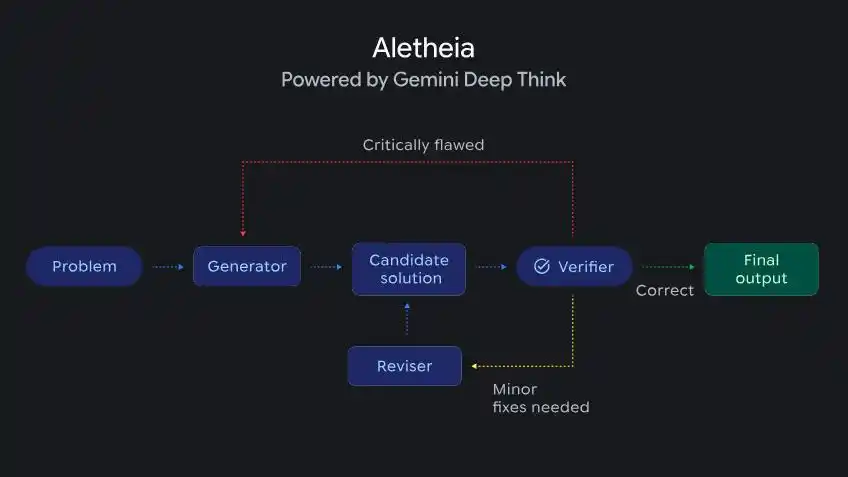
Aletheia, driven by Deep Think, capable of iterative generation, verification, and correction for research-level mathematical problems

Aletheia has already contributed to multiple research papers, one of which was completed entirely autonomously by the AI, calculating specific structural constants in arithmetic geometry.
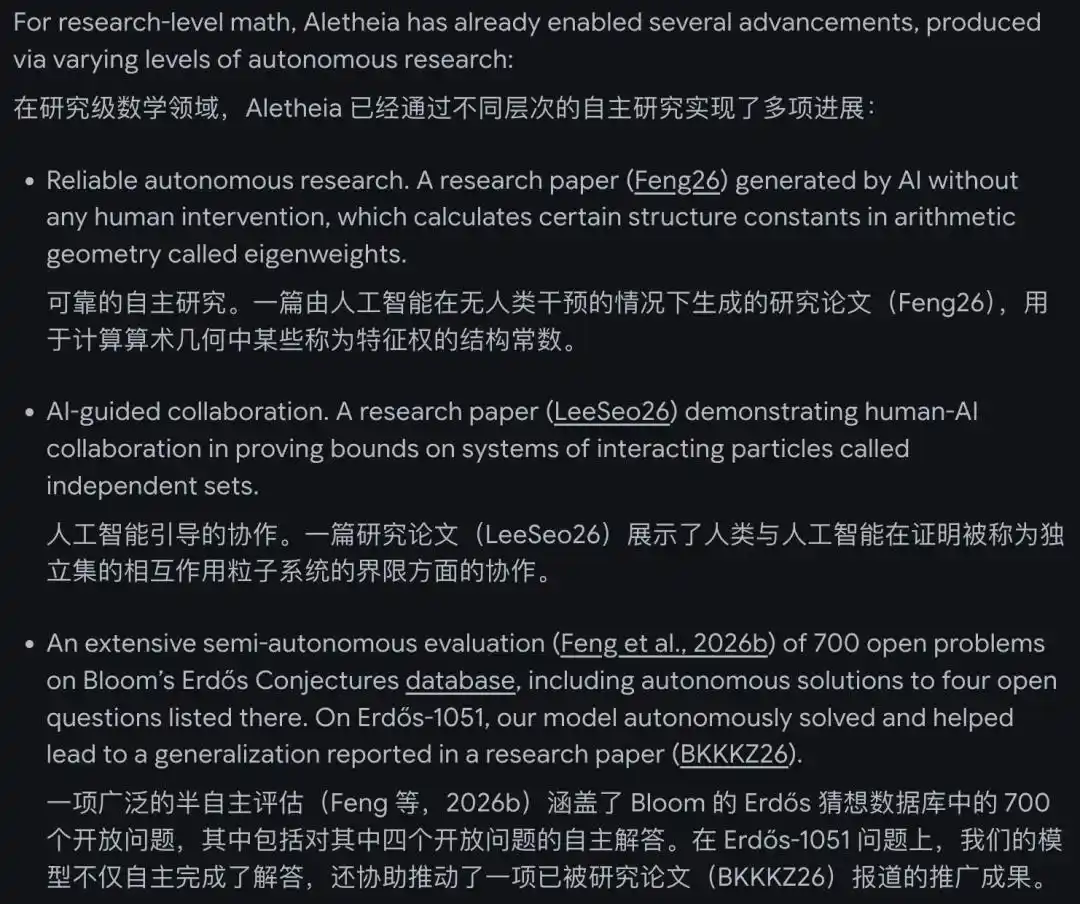
Furthermore, in a semi-autonomous evaluation of 700 open mathematical problems, it independently solved 4 previously unsolved problems.

The Gemini Deep Think mode also shows great potential in computer science, physics, economics, and other fields.

In computer science, Deep Think helped refute a conjecture that had remained open for a decade; in physics, it found a new analytical solution for gravitational radiation from cosmic strings; in economics, it extended an auction theory theorem.
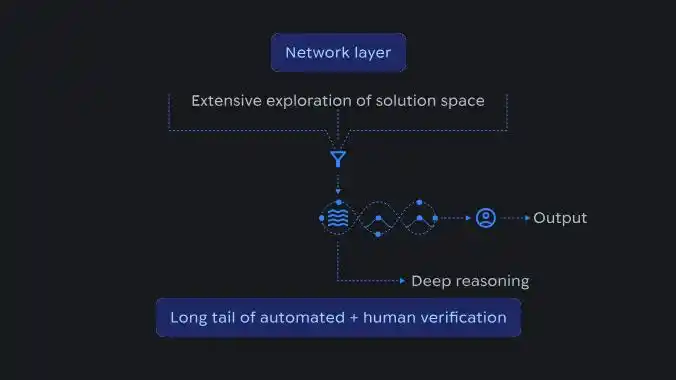
Schematic diagram of the AI reasoning process, showing how large-scale exploration of the solution space at the network layer is aggregated into structured reasoning and confirmed through automated and manual verification.

By collaborating with experts to solve 18 research challenges, the advanced version of Gemini Deep Think helped break through long-standing bottlenecks in algorithms, machine learning and combinatorial optimization, information theory, and economics.

This goes far beyond "solving competition problems."

While competitors are still competing on English benchmark leaderboards, Google has already found a new battlefield in the "AI research accelerator" field.

The most important thing about this is not the scores; the real signal behind it is: the language barrier for AI research tools is being treated as an engineering problem to be solved.

If this path succeeds, scientists conducting research in Japanese, Korean, Chinese, Hindi, and other languages will, for the first time, stand on the same starting line as native English speakers.

This time, Google has laid its cards on the table.

As for which competitors will follow suit, we believe we will see soon.

References:

https://blog.google/intl/ja-jp/company-news/technology/gemini-31-pro-gemini-31-pro-deep-think/%20

https://deepmind.google/blog/accelerating-mathematical-and-scientific-discovery-with-gemini-deep-think/%20

https://blog.google/innovation-and-ai/models-and-research/gemini-models/gemini-3-1-pro/%20

https://blog.google/innovation-and-ai/models-and-research/gemini-models/gemini-3-deep-think/

This article is from the WeChat public account "新智元" (New Zhiyuan), author: 新智元

İlgili Sorular

QWhat is the key achievement of Google's Deep Think AI model as reported in the article?

ADeep Think achieved top-tier results in eight different language versions of academic competitions, including perfect scores in Japanese and French math and programming contests, and high performance in Chinese, Korean, Hindi, Vietnamese, Russian, and Portuguese exams.

QWhich specific world-class competitions did Deep Think first demonstrate its reasoning capabilities in?

ADeep Think first demonstrated its reasoning capabilities by reaching gold medal standards in the International Mathematical Olympiad (IMO) with a score of 35 out of 42 in July 2025, and achieving similarly high performance in the ICPC World Finals.

QWhat is the significance of Deep Think's performance across multiple languages according to the article?

AIts performance across multiple languages signifies a breakthrough in breaking down language barriers in AI research tools, potentially allowing non-English speaking scientists worldwide to access advanced AI research assistance on equal footing.

QWhat are some research breakthroughs mentioned that were achieved using Deep Think?

ADeep Think autonomously solved 4 previously unsolved mathematical problems, refuted a decade-old conjecture in computer science, found new analytical solutions for cosmic string gravitational radiation in physics, and extended an auction theory theorem in economics.

QWhat concerns does the article raise about the reliability of Deep Think's reported results?

AThe article notes that all results are from internal Google evaluations without third-party verification, official contest authentication, or disclosure of testing methods such as attempt counts, computational resources used, or potential human prompt engineering involvement.

İlgili Okumalar

Near Returns to the AI Stage: Transformation into a Public Chain Due to 'Payroll Difficulties,' Agent and Privacy Emerge as New Growth Narratives

NEAR Returns to AI Origins: From Payroll Struggles to Blockchain, Now Focusing on AI Agents and Privacy NEAR Protocol's journey began not with grand blockchain ambitions, but from a practical hurdle: its AI startup founders, including Transformer paper co-author Illia Polosukhin, couldn't efficiently pay international developers in 2017. This led them to pivot and build a high-performance, scalable blockchain. After years navigating various crypto narratives like sharding and cross-chain interoperability, NEAR is now leveraging its AI roots to re-enter the AI arena. A key driver is its "NEAR Intents" layer, which abstracts complex cross-chain transactions. Users simply state their goal (e.g., swap BTC for ETH), and a solver network finds the optimal route. This system has processed over $20B in cross-chain volume, generating significant fee revenue. A major growth area is private transactions via "Confidential Intents/Swaps," which hide trade details until settlement to protect against MEV and front-running. Remarkably, private swaps recently accounted for over 40% of NEAR's transaction volume, highlighting strong demand but also potential regulatory scrutiny. With its AI-founder pedigree, NEAR is positioning itself at the intersection of blockchain, AI agents, and privacy, aiming to become infrastructure for the emerging agent economy while navigating the challenges of its rapid adoption.

marsbit3 dk önce

Near Returns to the AI Stage: Transformation into a Public Chain Due to 'Payroll Difficulties,' Agent and Privacy Emerge as New Growth Narratives

marsbit3 dk önce

From Ethereum to AI's 'CROPS': What Exactly is This Set of 'Slow Variables' That Vitalik Repeatedly Emphasizes?

In recent discussions, Vitalik Buterin has frequently emphasized the concept of "CROPS," a framework defining core values for Ethereum's development. CROPS stands for Censorship Resistance, Capture Resistance, Open Source, Privacy, and Security. Initially outlined in the Ethereum Foundation's "EF Mandate," it represents a commitment to user sovereignty, ensuring that the network resists external control, remains open, protects privacy, and prioritizes security. The relevance of CROPS extends beyond Ethereum's foundational principles, becoming crucial in the context of AI integration. As AI agents begin handling wallet operations and automated transactions, the risk increases that users may cede control over their digital assets, privacy, and intentions to centralized AI service providers. A "CROPS AI" would therefore emphasize local execution where possible, privacy-preserving remote model calls (e.g., using zero-knowledge proofs), and transparent, verifiable processes to maintain user agency. Vitalik highlights a significant convergence between "CROPS Ethereum access layer" and "CROPS AI." Both address the same fundamental challenge: how users can access powerful services—be it blockchain data via RPCs or AI models—without exposing sensitive information or relinquishing ultimate control. This intersection points toward a future digital entry point that is more private, secure, and user-controlled. Ultimately, CROPS is not merely an abstract ideal but a practical guidepost. It steers development—from protocol resilience and wallet design to AI agent safety—towards a future where users retain self-sovereignty even as digital systems grow more complex and powerful. In an era of accelerating AI adoption, these "slow variables" of censorship resistance, openness, privacy, and security may define Ethereum's enduring value.

marsbit13 dk önce

From Ethereum to AI's 'CROPS': What Exactly is This Set of 'Slow Variables' That Vitalik Repeatedly Emphasizes?

marsbit13 dk önce

Silicon Valley 'Startup Guru' Steve Hoffman: Web3 + AI Could Be a Trap

Silicon Valley investor and "Godfather of Startups" Steve Hoffman warns that combining Web3 with AI is likely a trap, not a promising venture. In an interview, Hoffman argues that while AI is a foundational technology touching all industries, Web3 adds complexity, friction, and regulatory risk without solving mainstream consumer or business needs. He advises founders to focus on deep, specialized applications where startups can out-iterate giants, rather than on generic features easily replicated by large tech companies. Hoffman observes that Silicon Valley will lead foundational AI research, while China excels at rapid, large-scale application and commercialization, particularly in robotics. He stresses that AI-driven autonomous agents capable of collaborative, multi-step tasks are 2-4 years away, which will cause significant job displacement. The solution is not to slow AI but to redesign business models around human-AI collaboration and reform social systems like education and retraining. For startups, Hoffman recommends focusing on vertical, expertise-heavy domains to build defensibility. He sees major opportunities in AI fraud detection and cybersecurity. Key founder mindsets include systemic thinking over feature-focus, relentless customer centricity, building adaptive teams, and deeply understanding AI's capabilities and limits. Hoffman is also leading a non-profit initiative to establish university centers aimed at training future leaders in responsible, human-value-aligned AI innovation.

marsbit1 saat önce

Silicon Valley 'Startup Guru' Steve Hoffman: Web3 + AI Could Be a Trap

marsbit1 saat önce

Token Inefficient, Economy Tokenless

The article "Tokens Aren't Economical, Economics Aren't Tokenized" analyzes a pivotal shift in the AI industry from a technology-driven narrative to one dominated by capital efficiency. It highlights two concurrent trends: a severe capital shortage due to the exorbitant and recurring costs of compute (e.g., OpenAI's high burn rate) and a wave of corporate spin-offs where major tech companies are separating their AI units (like Kuaishou's Kling and Baidu's Kunlunxin). The core argument is that AI's "anti-internet" business model, where user growth increases costs rather than profits, has created a disconnect between high valuations and actual cash flow. Spin-offs address this by allowing AI assets to be valued independently. Within a parent company, they are seen as cost centers, but as standalone entities, they are priced based on their growth potential and scarcity in the primary market, leading to massive valuation premiums (e.g., Kling's estimated value tripling post-spin-off). The industry is at an inflection point, moving from "model worship" to "value realization." The competition is evolving from a pure compute (GPU) race to a broader focus on systemic efficiency and full-stack engineering (involving CPUs and orchestration) to achieve viable commercialization. The year 2026 is framed as a critical moment where the industry must definitively answer how to economically translate AI capability into tangible business value, reshaping the sector's future power structure.

marsbit1 saat önce

Token Inefficient, Economy Tokenless

marsbit1 saat önce

İşlemler

Spot
Futures
活动图片