Global Shift Towards Easing, ETH May Have Taken the 'Best Offensive Position'

比推2025-12-12 tarihinde yayınlandı2025-12-12 tarihinde güncellendi

Özet

Global monetary policy is shifting towards easing, creating a favorable environment for risk assets. Despite a significant market decline in October, the long-term trend of crypto integration with traditional finance continues. A key narrative is emerging: U.S. political and economic elites are building a capital network connecting U.S. Treasury bonds, stablecoins, and Ethereum-based RWA (Real World Assets) protocols. This chain funnels dollar credit into assets ultimately settled on Ethereum and its Layer 2s. Ethereum's recent Fusaka upgrade is a milestone, addressing the issue of L1 value capture diminished by L2 growth. By introducing a dynamic floor price for data blobs (EIP-7918), it ensures L2 activity consistently contributes to ETH burning. Post-upgrade, blob fees have become the primary source of ETH burn, potentially returning ETH to a deflationary state. Technically, ETH appears strong. Leverage in the market is at historically low levels (~4%), and the Long BTC/Short ETH trade has been failing since November. ETH exchange reserves are at a multi-year low, suggesting a potential short squeeze. With anticipated friendly monetary policy from both the U.S. and China, ETH is positioned in a favorable accumulation zone.

Author: Trend Research

Original Title: Under Global Easing Expectations, ETH Has Entered the Value 'Sweet Spot'


Since the market crash on October 11, the entire cryptocurrency market has been sluggish, with market makers and investors suffering heavy losses. The recovery of capital and sentiment will take time.

However, the cryptocurrency market is never short of new fluctuations and opportunities, and we remain optimistic about the future market.

This is because the trend of mainstream crypto assets integrating with traditional finance to form new ecosystems has not changed; instead, it has rapidly built moats during the market downturn.

I. Wall Street Consensus Strengthens

On December 3, U.S. SEC Chairman Paul Atkins stated in an exclusive interview with FOX on the New York Stock Exchange: "In the coming years, the entire U.S. financial market may migrate to the blockchain."

Atkins said:

  1. The core advantage of tokenization is that if assets exist on the blockchain, the ownership structure and asset attributes will be highly transparent. Currently, listed companies often do not know who their shareholders are, where they are located, or where the shares are held.

  2. Tokenization is also expected to achieve "T+0" settlement, replacing the current "T+1" trading settlement cycle. In principle, the delivery versus payment (DVP)/receive versus payment (RVP) mechanism on-chain can reduce market risks and improve transparency. The time gap between clearing, settlement, and fund delivery is currently a source of systemic risk.

  3. Tokenization is seen as an inevitable trend in financial services, with mainstream banks and brokerages already moving toward tokenization. The world may not even take 10 years... perhaps it will become a reality in just a few years. We are actively embracing new technologies to ensure the U.S. remains at the forefront in areas like cryptocurrency.

In reality, Wall Street and Washington have already built a capital network deeply embedded in crypto, forming a new narrative chain: U.S. political and economic elites → U.S. bonds (Treasury bonds) → Stablecoins / Crypto treasury companies → Ethereum + RWA + L2
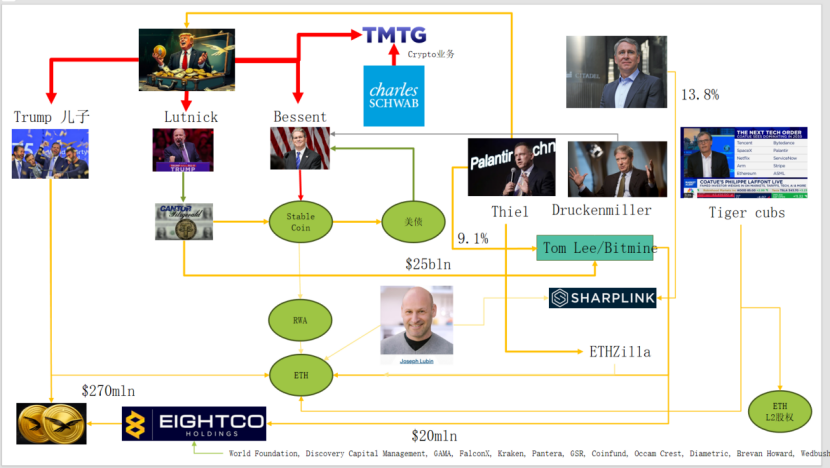
From this chart, we can see the intricate connections between the Trump family, traditional bond market makers, the Treasury, tech companies, and crypto companies, with the green elliptical links forming the backbone:

(1) Stable Coins (USDT, USDC, dollar assets behind WLD, etc.)

The majority of reserve assets are short-term U.S. bonds + bank deposits, held through brokers like Cantor.

(2) U.S. Bonds (U.S. Treasuries)

Issued and managed by the Treasury / Bessent side.

Used by Palantir, Druckenmiller, Tiger Cubs, etc., as low-risk interest rate base holdings.

Also the yield assets pursued by stablecoins / treasury companies.

(3) RWA (Real World Assets)

From U.S. bonds, mortgages, accounts receivable to housing finance.

Tokenized through Ethereum L1 / L2 protocols.

(4) ETH & ETH L2 Equity

Ethereum is the main chain承接 RWA, stablecoins, DeFi, and AI-DeFi.

L2 equity / Token represents a claim on future trading volume and fee cash flows.

This chain expresses:

U.S. dollar credit → U.S. bonds → Stablecoin reserves → Various crypto treasury / RWA protocols → Ultimately沉淀 on ETH / L2.

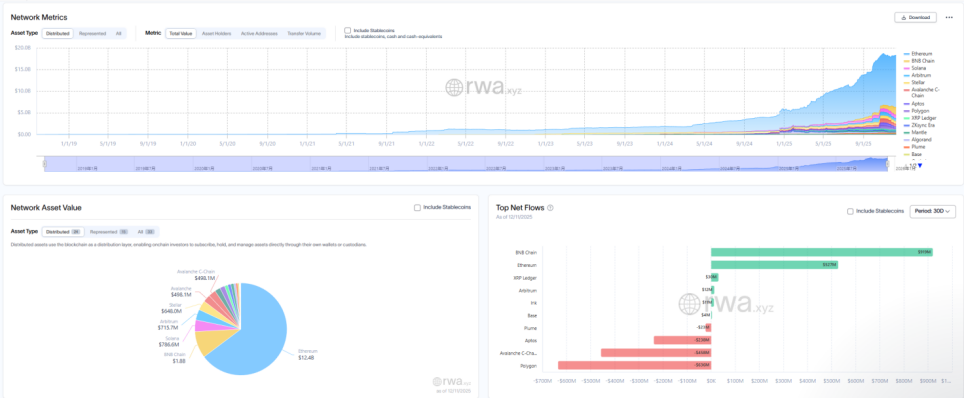
In terms of RWA TVL, compared to other public chains that declined after the October 11 crash, ETH is the only public chain that quickly recovered and rose. Its current TVL is $12.4 billion, accounting for 64.5% of the total crypto market.
II. Ethereum Explores Value Capture

The recent Ethereum Fusaka upgrade did not cause much stir in the market, but from the perspective of network structure and economic model evolution, it is a "milestone event." Fusaka is not just about scaling through EIPs like PeerDAS but also attempts to address the issue of insufficient value capture by the L1 mainnet due to L2 development.
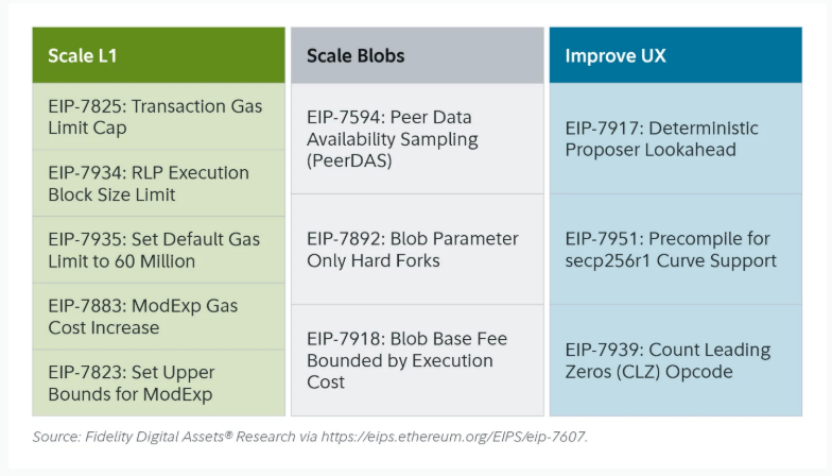
Through EIP-7918, ETH introduces a "dynamic floor price" for blob base fees, binding its lower limit to the L1 execution layer base fee, requiring blobs to pay at least about 1/16 of the L1 base fee unit price for DA fees. This means Rollups can no longer occupy blob bandwidth at near-zero cost for extended periods, and the corresponding fees will be burned and回流 to ETH holders.
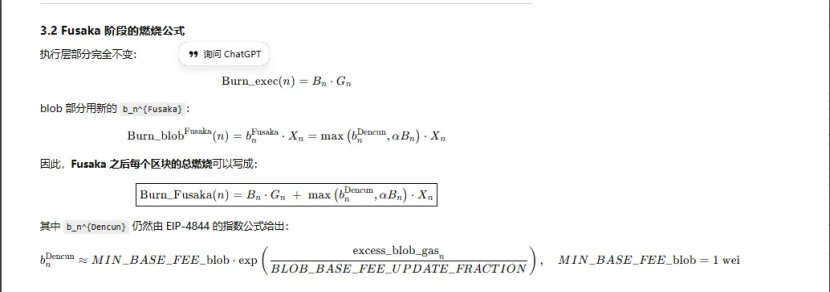
There have been three upgrades related to "burning" in Ethereum:

(1) London (Single-dimension): Only burned the execution layer; ETH began to experience structural burning due to L1 usage.

(2) Dencun (Dual-dimension + independent blob market): Burned execution layer + blob; L2 data写入 blob also burned ETH, but during low demand, the blob portion was almost 0.

(3) Fusaka (Dual-dimension + blob bound to L1): To use L2 (blob), one must pay at least a fixed proportion of the L1 base fee, which is burned. L2 activity is more stably mapped to ETH burning.
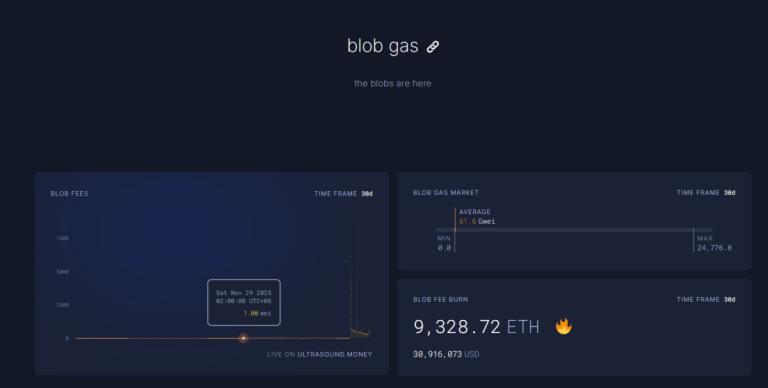
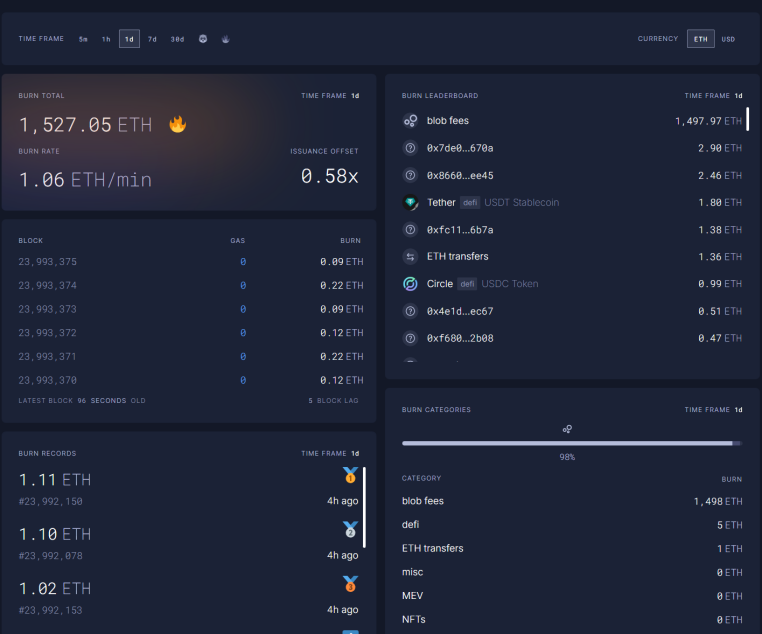
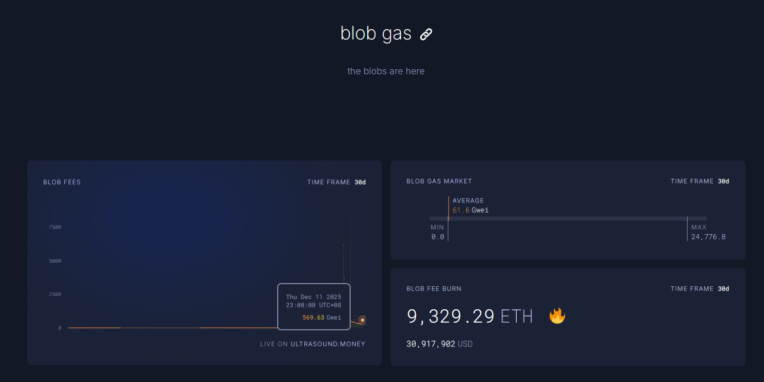
As of December 11, 23:00, the 1-hour blob fees have reached 569.63 billion times the pre-Fusaka upgrade level, burning 1,527 ETH in one day. Blob fees now contribute the highest proportion to burning,高达 98%. As ETH L2 becomes more active, this upgrade is expected to return ETH to deflation.

III. Ethereum Technicals Strengthen

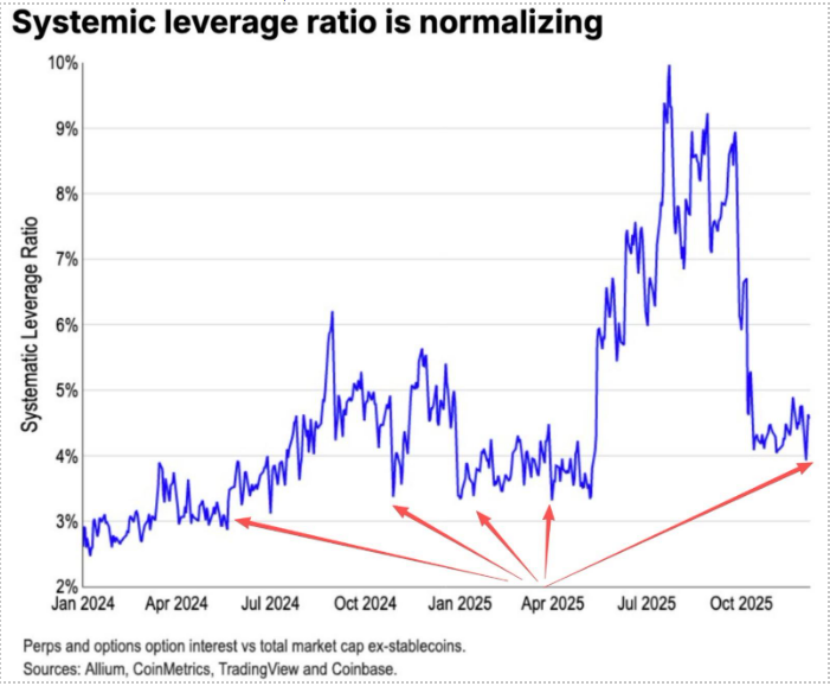
During the October 11 crash, ETH's futures leverage was thoroughly cleared, eventually reaching the spot leverage盘. At the same time, many with insufficient faith in ETH led to many early OG investors reducing their holdings and fleeing. According to Coinbase data, speculative leverage in the crypto圈 has dropped to a historically low region of 4%.
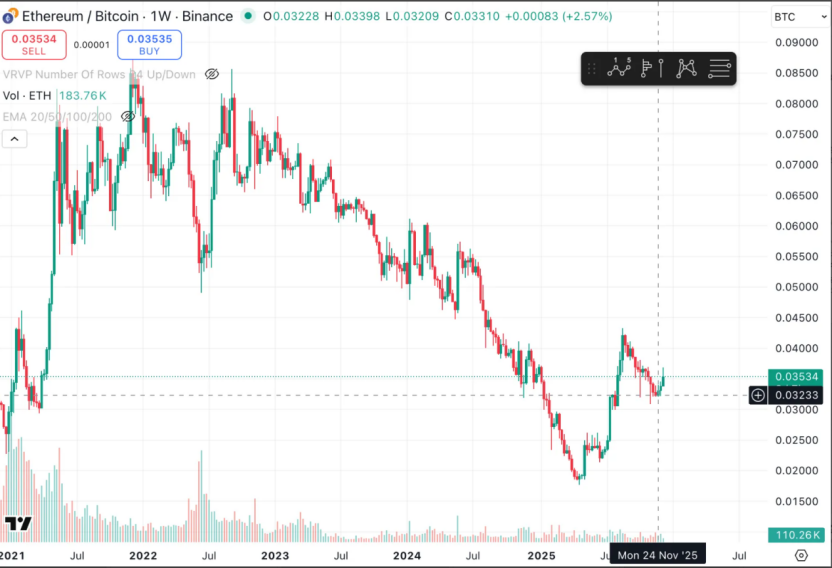
In the past, a significant portion of ETH short positions came from traditional Long BTC/Short ETH paired trades, which generally performed very well during bear markets. However, this time an意外 occurred. The ETH/BTC ratio has maintained a sideways resistance trend since November.
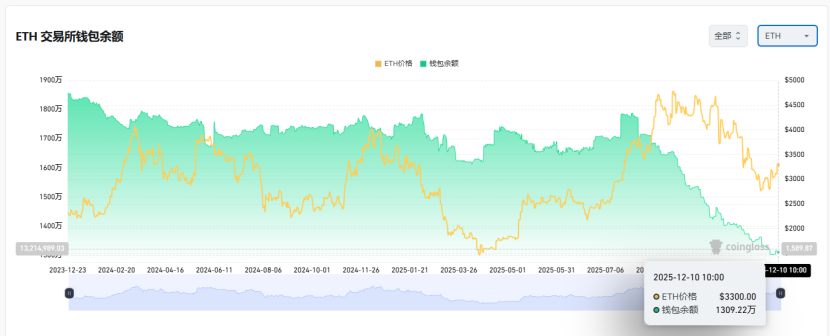
ETH's current存量 on exchanges is 13 million coins, about 10% of the total supply, at a historical low. As the Long BTC/Short ETH pairing has failed since November, during extreme panic, a "short squeeze" opportunity may gradually emerge.
As we approach the interaction between 2025 and 2026, future monetary and fiscal policies from both China and the U.S. have released friendly signals:

The U.S. will actively pursue tax cuts, interest rate reductions, and relaxed crypto regulations. China will implement appropriate easing and financial stability (suppressing volatility).

Under the expectations of relative easing in China and the U.S., and scenarios suppressing downward asset volatility, during extreme panic when capital and sentiment have not fully recovered, ETH is still in a good buying "sweet spot."


Twitter:https://twitter.com/BitpushNewsCN

Bitpush TG Discussion Group:https://t.me/BitPushCommunity

Bitpush TG Subscription: https://t.me/bitpush

Original Link:https://www.bitpush.news/articles/7595197

İlgili Sorular

QWhat is the new narrative chain formed by Wall Street and Washington in the crypto space according to the article?

AThe narrative chain is: U.S. political and economic elites → U.S. Treasury bonds (national debt) → Stablecoins / crypto treasury companies → Ethereum + RWA + L2.

QHow does the Fusaka upgrade aim to address the issue of L1 value capture on Ethereum?

AThe Fusaka upgrade introduces EIP-7918, which binds the blob base fee to a 'dynamic floor price' linked to the L1 execution layer base fee. This requires Rollups to pay at least approximately 1/16 of the L1 base fee for data availability, ensuring fees are burned and value flows back to ETH holders.

QWhat advantage does tokenization bring to asset ownership and settlement as highlighted by SEC Chairman Paul Atkins?

ATokenization provides high transparency in ownership structure and asset attributes, and enables 'T+0' settlement, replacing the current 'T+1' cycle, thereby reducing market risk and improving transparency.

QWhy is ETH considered to be in a good 'buying zone' or 'best offensive position' according to the article?

AETH is in a favorable position due to low leverage in the market (4%), reduced exchange supply (10% of total supply), the failure of Long BTC/Short ETH paired trades, and expectations of宽松 monetary policies from both the U.S. and China in 2025-2026.

QWhat role does Ethereum play in the RWA (Real World Assets) ecosystem based on the article?

AEthereum is the main chain hosting RWA protocols, stablecoins, and DeFi, with its L1/L2 used for tokenizing assets like U.S. Treasury bonds, mortgages, and accounts receivable. It holds 64.5% of the total crypto TVL in RWA.

İlgili Okumalar

In-Depth Report on the On-Chain Lending Market: When Off-Chain Credit Meets On-Chain Liquidation

The on-chain lending market has evolved from a peripheral DeFi niche into core financial infrastructure. As of early 2026, total value locked (TVL) in on-chain lending protocols has reached $64.3 billion, accounting for 53.54% of total DeFi TVL, making it the largest and most mature vertical within decentralized finance. Aave dominates the sector with approximately $32.9 billion in TVL, commanding nearly half of the market—a leadership position that is unlikely to be challenged in the foreseeable future. However, the path of on-chain lending forward is not without risk. Liquidation cascades, credit defaults, and cross-chain vulnerabilities remain systemic threats hanging over the industry. At the same time, a deeper structural transformation is underway: on-chain lending is shifting from a “leverage tool for crypto-native users” to a “compliant gateway for institutional capital”. The scale of RWA (Real World Asset) lending has surpassed $18.5 billion, with U.S. Treasuries and government securities increasingly serving as core collateral. Institutional capital inflows are reshaping both the user base and risk appetite of the sector. This report systematically analyzes the evolution of on-chain lending definitions, competitive dynamics, core risks, and future trends, providing a comprehensive industry outlook for investors and trade practitioners. Key findings suggest that the “one dominant player with several strong challengers” structure will persist in the short term, while fixed-rate lending, compliant collateral, and institutional credit underwriting will define the next phase of competition. For investors focused on DeFi infrastructure, three key opportunity tracks stand out, namely, the Aave ecosystem (Morpho, Spark), RWA lending protocols (Ondo, Maple) and fixed-rate innovation (Notional, Pendle).

HTX Learn41 dk önce

In-Depth Report on the On-Chain Lending Market: When Off-Chain Credit Meets On-Chain Liquidation

HTX Learn41 dk önce

Fu Peng's First Public Speech in 2026: What Exactly Are Crypto Assets? Why Did I Join the Crypto Asset Industry?

Fu Peng, a renowned macroeconomist and now Chief Economist at New火 Group, delivered his first public speech of 2026 at the Hong Kong Web3 Festival. He explained his perspective on crypto assets and why he joined the industry, framing it within the context of macroeconomic trends and financial evolution. Fu emphasized that crypto assets are transitioning from an early, belief-driven phase to a mature, institutionally integrated asset class. He drew parallels to the 1970s-80s, when technological advances (like computing) revolutionized traditional finance, leading to the rise of FICC (Fixed Income, Currencies, and Commodities). Similarly, current advancements in AI, data, and blockchain are reshaping finance, with crypto assets becoming part of a new "FICC + C" (C for Crypto) framework. He noted that institutional capital, including traditional hedge funds, avoided early crypto due to its speculative nature but are now engaging as regulatory clarity emerges (e.g., stablecoin laws, CFTC classifying crypto as a commodity). Fu predicted that 2025-2026 marks a turning point where crypto becomes a standardized, financially viable asset for diversified portfolios, akin to commodities or derivatives in traditional finance. Fu defined Bitcoin not as "digital gold" in a simplistic sense but as a value-preserving, financially tradable asset. He highlighted that crypto's future lies in regulated, institutional adoption, moving away from retail-dominated trading. His entry into crypto signals this maturation, where traditional finance integrates crypto into mainstream asset management.

marsbit1 saat önce

Fu Peng's First Public Speech in 2026: What Exactly Are Crypto Assets? Why Did I Join the Crypto Asset Industry?

marsbit1 saat önce

Justin Sun Sues Trump Family: What $75 Million Bought Was Only a Blacklist

Justin Sun, founder of Tron, has filed a lawsuit in federal court against World Liberty Financial (WLF), alleging he was made the "primary target of a fraudulent scheme" after investing $75 million. Sun claims the investment secured him an advisor title and WLFI tokens, which were later frozen by WLF, causing "hundreds of millions in losses." The dispute began in late 2024 when Sun's investment helped revive WLF's struggling token sale, which ultimately raised $550 million. Shortly after, the SEC dropped its lawsuit against Sun following Donald Trump's inauguration. However, relations soured when Sun refused WLF's demands for additional funding. In August 2025, WLF added a "blacklist" function to its smart contract, allowing it to unilaterally freeze tokens. Sun's holdings, worth approximately $107 million, were frozen, and he was threatened with token destruction. The lawsuit highlights WLF's structure, which directs 75% of token sale profits to the Trump family, who had earned $1 billion by December 2025. WLF's CEO is Zach Witkoff, son of U.S. Middle East envoy Steve Witkoff. The project faces scrutiny for opaque operations, including a controversial loan arrangement on the Dolomite platform, co-founded by a WLF advisor. Despite Sun's history with the SEC, the case underscores centralization risks within DeFi, as WLF controls governance and holds powers to freeze assets arbitrarily. Sun's tokens remain frozen as legal proceedings begin.

marsbit1 saat önce

Justin Sun Sues Trump Family: What $75 Million Bought Was Only a Blacklist

marsbit1 saat önce

İşlemler

Spot
Futures

Popüler Makaleler

MAY Nasıl Satın Alınır

HTX.com’a hoş geldiniz! Mayflower (MAY) satın alma işlemlerini basit ve kullanışlı bir hâle getirdik. Adım adım açıkladığımız rehberimizi takip ederek kripto yolculuğunuza başlayın. 1. Adım: HTX Hesabınızı OluşturunHTX'te ücretsiz bir hesap açmak için e-posta adresinizi veya telefon numaranızı kullanın. Sorunsuzca kaydolun ve tüm özelliklerin kilidini açın. Hesabımı Aç2. Adım: Kripto Satın Al Bölümüne Gidin ve Ödeme Yönteminizi SeçinKredi/Banka Kartı: Visa veya Mastercard'ınızı kullanarak anında Mayflower (MAY) satın alın.Bakiye: Sorunsuz bir şekilde işlem yapmak için HTX hesap bakiyenizdeki fonları kullanın.Üçüncü Taraflar: Kullanımı kolaylaştırmak için Google Pay ve Apple Pay gibi popüler ödeme yöntemlerini ekledik.P2P: HTX'teki diğer kullanıcılarla doğrudan işlem yapın.Borsa Dışı (OTC): Yatırımcılar için kişiye özel hizmetler ve rekabetçi döviz kurları sunuyoruz.3. Adım: Mayflower (MAY) Varlıklarınızı SaklayınMayflower (MAY) satın aldıktan sonra HTX hesabınızda saklayın. Alternatif olarak, blok zinciri transferi yoluyla başka bir yere gönderebilir veya diğer kripto para birimlerini takas etmek için kullanabilirsiniz.4. Adım: Mayflower (MAY) Varlıklarınızla İşlem YapınHTX'in spot piyasasında Mayflower (MAY) ile kolayca işlemler yapın.Hesabınıza erişin, işlem çiftinizi seçin, işlemlerinizi gerçekleştirin ve gerçek zamanlı olarak izleyin. Hem yeni başlayanlar hem de deneyimli yatırımcılar için kullanıcı dostu bir deneyim sunuyoruz.

327 Toplam GörüntülenmeYayınlanma 2025.07.01Güncellenme 2025.07.01

MAY Nasıl Satın Alınır

Tartışmalar

HTX Topluluğuna hoş geldiniz. Burada, en son platform gelişmeleri hakkında bilgi sahibi olabilir ve profesyonel piyasa görüşlerine erişebilirsiniz. Kullanıcıların MAY (MAY) fiyatı hakkındaki görüşleri aşağıda sunulmaktadır.

活动图片