From Pizza to Unit of Account: A Prehistory of Bitcoin Price Discovery

marsbit2026-05-19 tarihinde yayınlandı2026-05-19 tarihinde güncellendi

Özet

From Pizza to Unit of Account: The Prehistory of Bitcoin Price Discovery This article traces Bitcoin's earliest price discovery mechanisms, focusing on its functional evolution as a unit of account rather than its price trajectory. The analysis centers on a nine-month period from October 2009 to July 2010, identifying three distinct, sequential layers of price formation. The narrative begins with the cost-of-production anchor established by NewLibertyStandard in October 2009, which calculated a unilateral USD/BTC exchange rate based on the electricity cost of mining. This constituted a posted rate, not a market-discovered price. The second layer emerged with peer-to-peer (P2P) discovery mechanisms starting in March 2010. This included Dustin Dollar's Bitcoin Market platform, which introduced a basic public order book, and forum-based实物 trades. The pivotal event in this phase was Laszlo Hanyecz's purchase of two pizzas for 10,000 BTC on May 22, 2010. Critically, the offer was made exclusively in BTC ("10,000 bitcoins for a couple of pizzas"), marking the first documented instance where Bitcoin functionally acted as a unit of account to price another good in a real transaction, 21 days before Hanyecz later provided a USD anchor (~$25). The third layer commenced in July 2010 with Jed McCaleb's launch of the Mt.Gox exchange. Its continuous order book, with last price, highs, lows, and volume, provided the first standardized, externally referenceable format for BTC/USD prices....

Prologue

On May 22, 2010, Laszlo Hanyecz exchanged 10,000 BTC for two pizzas. This day was later dubbed Bitcoin Pizza Day, commemorated annually by the crypto community in a specific way—multiplying the value of 10,000 BTC from that day by the current fiat price to produce a starkly contrasting figure, captioned "the most expensive pizza in history."

This article does not calculate that compound interest.

This article discusses something else: on May 22, 2010, Bitcoin (BTC) was, for the first time, used as a unit to price another commodity in a real transaction. This is the verifiable moment when BTC first functionally played the "unit of account" role among the three functions of money (medium of exchange / unit of account / store of value). This moment sits at the midpoint of a longer timeline of mechanisms—from cost-of-production anchoring (NewLibertyStandard), to P2P matching and discovery (Bitcoin Market), to centralized matching with continuous quotes (Mt.Gox). What Bitbase Research aims to reconstruct is this nine-month prehistory and its comparable forms with the evolutionary paths of price discovery mechanisms for various asset classes throughout history.

Chapter One · What is a "Price"—The Birth of a Unit of Account

1.1 The Three Functions of Money and the Conceptual Boundary of "Price"

The functions of money are standardly defined in financial economics textbooks. Frederic Mishkin, in Chapter 3 of the 13th edition of "The Economics of Money, Banking, and Financial Markets," divides monetary functions into three items [1]: medium of exchange, unit of account, store of value. John Hicks's judgment in the opening of "Critical Essays in Monetary Theory" (Oxford, 1967) is more concise—"money is what money does"; money is defined by its functions, not its physical form [2].

This distinction has specific methodological significance for this article. Something "having an exchange rate" is not the same as "having a price." An exchange rate can be unilaterally published—a third-party observer calculates the conversion ratio between two assets and then announces it; it does not require market participants to conclude transactions based on it, nor does it require others to reference this ratio to price their goods. Price is different. Price is the product of market matching; it requires at least two parties to agree on a conversion ratio for a specific transaction at a specific moment, and this ratio can be recognized, referenced, and reused by third parties.

By this distinction, before May 22, 2010, BTC was in a specific semantic state: it had an exchange rate, but it did not have a market price in the market sense.

1.2 The Functional Performance of "Unit of Account"

Among the three functions of money, medium of exchange and unit of account are often intuitively conflated, but they are not equivalent. The former describes "using this thing as an intermediary in a transaction"—as long as both parties are willing, anything can perform this function. The latter describes "using this thing as the unit for pricing other things." A commodity being used as a payment instrument in a transaction does not necessarily mean it simultaneously functions to price that commodity.

On May 18, 2010, Laszlo Hanyecz wrote in the initiating post of Bitcointalk topic=137: "I'll pay 10,000 bitcoins for a couple of pizzas," and explicitly allowed the other party to order Papa John's pizzas on his behalf [3]. No US Dollar (USD) amount appears in the entire initiating post—he did not say "pizzas worth how many dollars"; he said "10,000 bitcoins for two pizzas." When the completion of this transaction was reported at 19:17:26 UTC on May 22 [4], something happened at the functional level: two pizzas were priced in units of "10,000 BTC."

This is the verifiable moment when BTC was first functionally performed as a unit of account. "Functionally performing this role" and "fully satisfying this function in monetary definition" are two different things. The latter requires this unit to be consistently used as a pricing identifier across groups of traders, a condition only partially met after Mt.Gox's continuous quoting. May 22 is the first time this function appeared in an actual transaction.

Notably, the figure "about $25" does not appear in the initiating post of May 18. Hanyecz gave this fiat anchor for the first time in a subsequent reply in the same thread on June 12, 2010, at 20:14:44 UTC [5]. BTC first assumed the function of pricing pizzas in a transaction; the semantic act of "reverse identification between BTC and USD" occurred 21 days later. This temporal sequence has methodological significance: BTC's functional performance as a unit of account occurred before the bidirectional identification between BTC and USD was completed.

Chapter Two · Mechanism Timeline

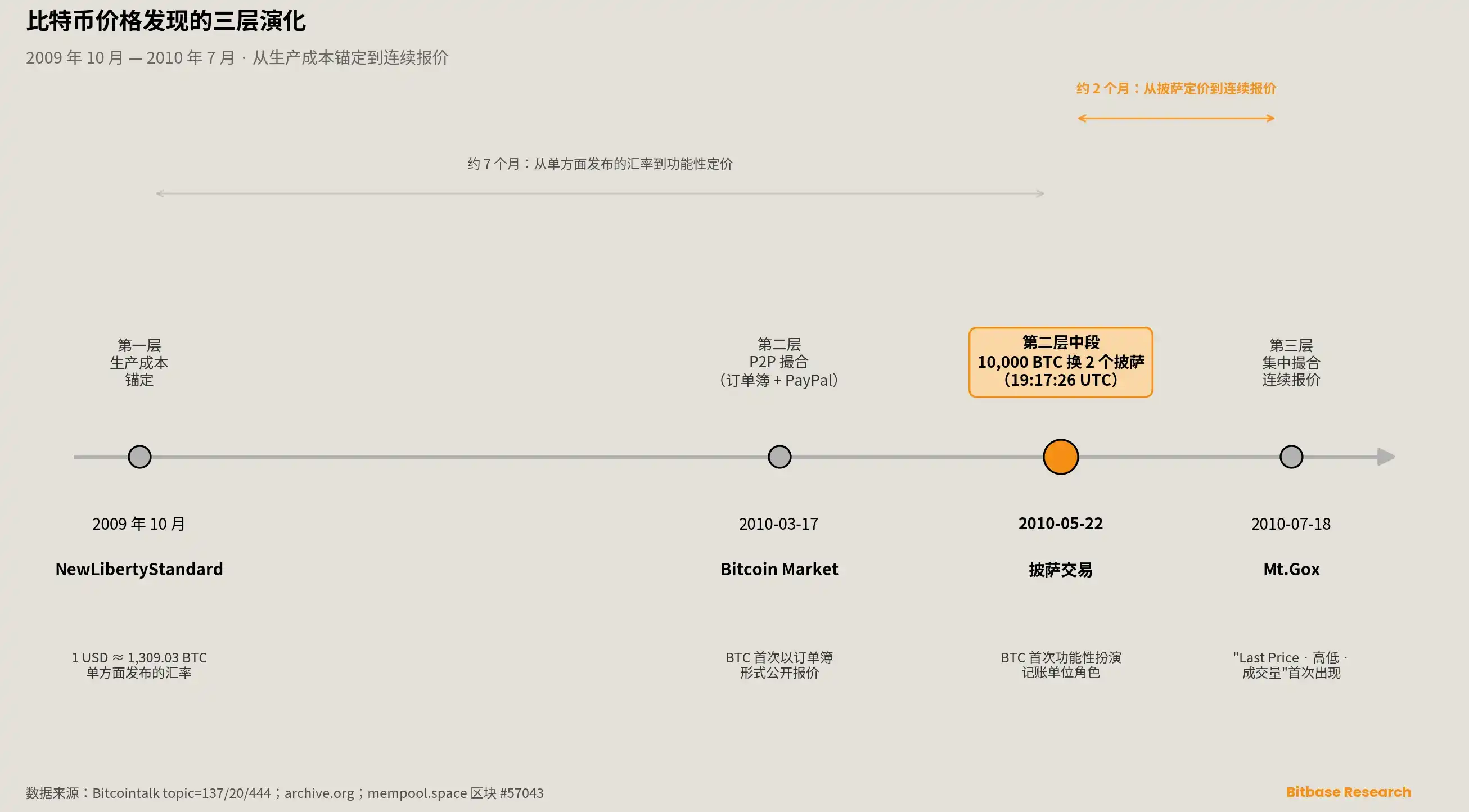
This chapter reconstructs the three-tier mechanism evolution from October 2009 to July 2010 in chronological order. Each section provides firsthand timestamps, firsthand post IDs, and a description of the mechanism itself.
2.1 Tier One · Cost-of-Production Anchoring (From October 2009)

NewLibertyStandard (hereafter NLS) published a BTC-to-USD exchange rate formula on its webpage newlibertystandard.wetpaint.com in October 2009. The website is now offline. As of May 14, 2026, the earliest recorded archive.org snapshot is from December 29, 2009, 13:26:10 UTC [6]. The formula on the snapshot reads:

During 2009 my exchange rate was calculated by dividing $1.00 by the average amount of electricity required to run a computer with high CPU for a year, 1,331.5 kWh, multiplied by the average residential cost of electricity in the United States for the previous year, $0.1136, divided by 12 months divided by the number of bitcoins generated by my computer over the past 30 days.

The methodology of this formula is to anchor BTC's value to the "marginal production cost of running a miner"—electricity cost divided by BTC output per unit time. It is essentially an extension of the classical labor-energy theory of value to digital assets: BTC had no market; it was priced by the electric meter. This is a "unilaterally published exchange rate," not a market-matched price.

The first exchange rate figure publicized by NLS, 1 USD ≈ 1,309.03 BTC, has been widely reused in secondary narratives, but there is no original post by NLS himself on the Bitcointalk forum citing this number [7]. This study adopts the archived snapshot data and honestly notes: as of May 14, 2026, this specific number is only available from the first-hand source of the archive snapshot.

Separate from NLS, the earliest recorded BTC-to-USD transaction was conducted by Martti Malmi, an early Bitcoin core contributor—on October 12, 2009, Malmi transferred 5,050 BTC to NLS, received $5.02 via PayPal, and confirmed it in a tweet on January 15, 2014 [8].

2.2 Tier Two · P2P Matching and Discovery (From March 2010)

The second tier mechanism was initiated by dwdollar (real identity Dustin Dollar). On January 15, 2010, at 09:42:18 UTC, dwdollar initiated a motion in Bitcointalk topic=20 msg=100 [9]: "I'm in the process of building an exchange. ... It will be a real market where people will be able to buy and sell Bitcoins with each other."

The platform Bitcoin Market began service on March 17, 2010. dwdollar's update post that day read: "Looks like we had our first real trade around noon!"—this was the first BTC-to-USD transaction matched via a quasi-public order book.

The matching mechanism of Bitcoin Market needs to be stated factually: it was not the complete form of order book matching. dwdollar self-described in msg=265 on February 6, 2010, at 22:37:44 UTC: "ONLY the limit orders work. Market orders will come later." [10]—the platform only supported limit orders, market orders were not implemented; settlement relied on PayPal intermediation, not pure on-chain settlement. Nevertheless, Bitcoin Market was the first platform to publicly display BTC quotes in an order book form; this form itself has mechanistic significance.

Parallel to Bitcoin Market during the same period was P2P physical matching on Bitcointalk. Hanyecz's pizza event is a representative case of this form. The two paths coexisted in parallel from March to July 2010—the dwdollar path proved BTC could be matched with USD to produce quotes, the Hanyecz path proved BTC could be matched with physical goods to produce quotes.

2.3 Midpoint · The Pizza Transaction (May 22, 2010)

Hanyecz's pizza transaction sits at the midpoint of the second tier in the mechanism timeline. Reconstructed in UTC chronological order:

  • 2010-05-18 00:35:20 UTC: Hanyecz issued the invitation in Bitcointalk topic=137 msg=1141 [3]. Hanyecz was located in Jacksonville, Florida, USA (EDT, UTC−4), corresponding to the local time of 2010-05-17 20:35. This timezone conversion explains why some secondary narratives date the initiation to May 17.

  • 2010-05-22 18:16:31 UTC: txid a1075db55d416d3ca199f55b6084e2115b9345e16c5cf302fc80e9d5fbf5d48d was included in block #57043 [11].

  • 2010-05-22 19:17:26 UTC: Hanyecz reported completion in msg=1195—"I just want to report that I successfully traded 10,000 bitcoins for pizza. Thanks jercos!" [4]

The 61-minute difference between the on-chain block time and the Bitcointalk confirmation post time is consistent with the narrative of "posting confirmation after pizza delivery." This time difference also independently confirms that the Bitcointalk forum displays timestamps in UTC, not Eastern Time.

The real identity and location of the counterparty jercos are often misstated in secondary narratives. jercos is Jeremy Sturdivant, who stated in a written interview with Bitcoin Who's Who on January 30, 2016: "I have yet to travel outside of the US, and am living on the west coast, near Santa Cruz, California." [12] According to Sturdivant's own account, he is an American, living near Santa Cruz, California, was 19 years old on May 22, 2010, and had never left the United States. The widely circulated description of a "19-year-old British person" is inconsistent with firsthand records.

Hanyecz withdrew the open invitation on June 4, 2010, at 17:51:05 UTC [13], stating "I can't afford that many more." Eight days later, on June 12, he reopened the invitation in msg=1526 and gave the USD anchor for the first time: two pizzas costing about $25, maybe $30 with a tip [5].

2.4 Tier Three · Centralized Matching with Continuous Quotes (From July 2010)

On July 18, 2010, at 01:57:19 UTC, username mtgox posted an announcement in Bitcointalk topic=444 msg=3866: "Hi Everyone, I just put up a new bitcoin exchange." [14] The operator behind this account was Jed McCaleb—founder of eDonkey, the original holder of the mtgox.com domain (an acronym for Magic: The Gathering Online eXchange). The Wayback Machine's earliest recorded capture of mtgox.com is August 17, 2007 [15], about 17 months before the BTC genesis block; this domain was repurposed as a BTC exchange in July 2010.

McCaleb described the platform's quoting architecture in msg=3873 (2010-07-18 02:15:09 UTC) of the same thread [14]: "Last Price ... High ... Low ... Volume ... Current Lowest Buy Price; Current Highest Sell Price ... All trades are between users."—"Last Price," "24-hour high/low," "volume," "best bid/ask"; this set of terms appeared for the first time in the Bitcoin context, marking that BTC now had a standard format for continuous quoting. The mechanistic difference was structural: matching between users rather than intermediary settlement, automatic continuous operation of the order book, 24/7 availability.

From this moment, BTC gained external referentiality in the unit of account dimension—others could say "my thing is worth X BTC," and X BTC had an uninterrupted USD identifier. Mt.Gox was announced to be transferred by McCaleb to MagicalTux (later Mark Karpelès) on March 6, 2011 [16]; its subsequent fate is another independent timeline not expanded here.

Chapter Three · Structural Similarity—The Same Curve Across Three Hundred Years

The proposition of this chapter is: The three-tier mechanism evolution completed by BTC between October 2009 and July 2010—cost-of-production anchoring → P2P matching and discovery → centralized matching with continuous quotes—has comparable structural forms with the evolutionary paths of various asset classes throughout history. This chapter presents two cases for structural comparison and does not construct a quantifiable cross-asset comparison model.

3.1 Amsterdam · The 17th-Century VOC Secondary Market

The Dutch East India Company (VOC) was established in 1602, issuing shares to 1,143 subscribers; share transfers required in-person registration by the company bookkeeper at the East India House [17]. This is generally regarded as the earliest identifiable scenario of an equity secondary market [17].

The maturation of its price discovery mechanism occurred about half a century later. Lodewijk Petram, in his 2011 PhD dissertation "The world's first stock exchange" at the University of Amsterdam, states: the stock market "evolved into a modern securities market" between 1630 and 1650, and "a continuous price discovery process took shape in that period" [17]. Petram's judgment is based on 851 sets of 17th-century stock price observation data. These data were not from official exchange records—neither the VOC nor the exchange systematically recorded prices; data were scattered in merchant correspondence, notarial deeds, and occasional newspapers. The very "dataset" of 17th-century VOC share prices grew from private bookkeeping and oral exchange rates.

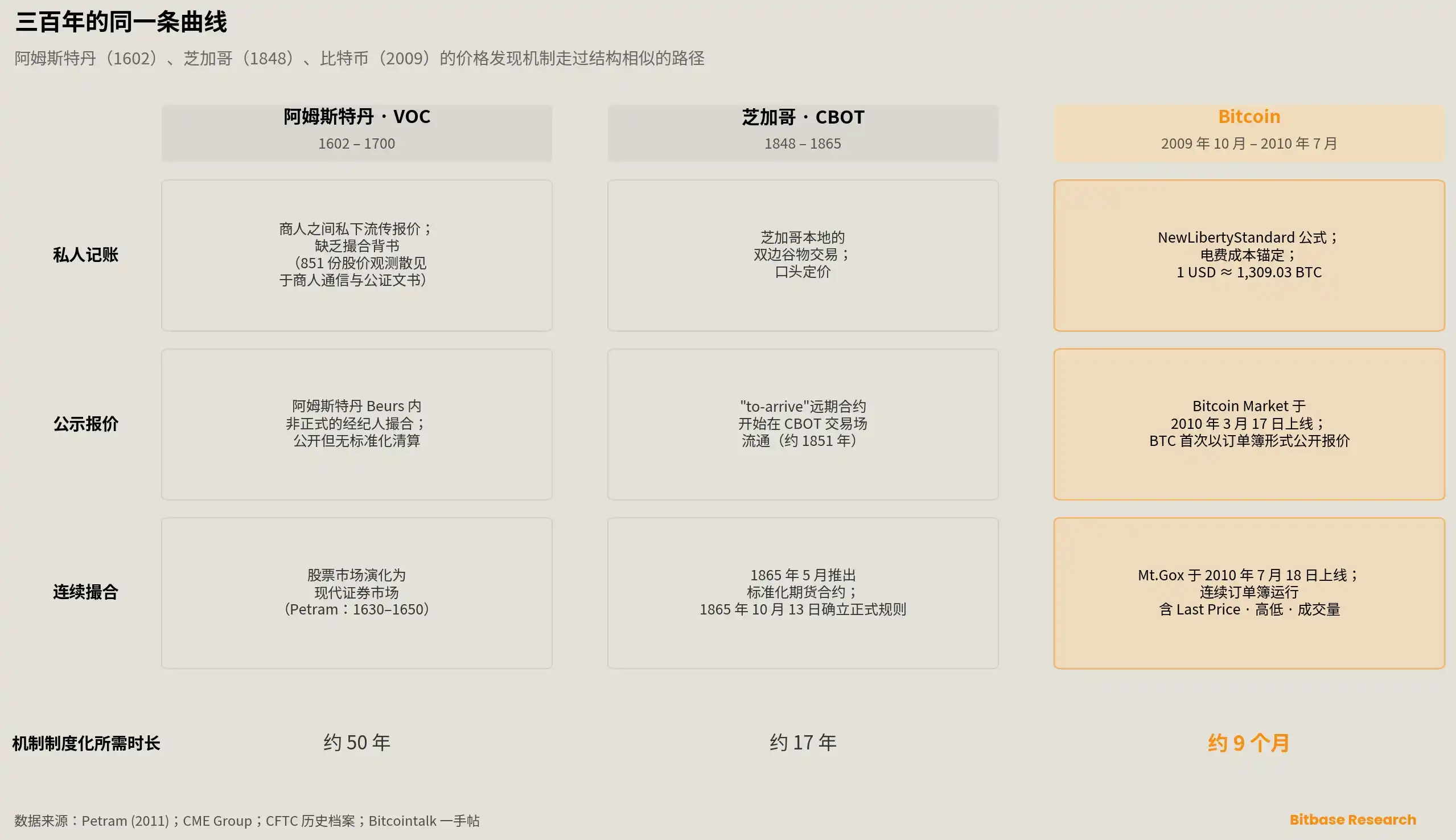
The structural similarity with BTC's early path is specific. The NLS formula is to BTC what privately circulated VOC quotes among 17th-century merchants were: unilaterally published, private bookkeeping, lacking matching endorsement. Bitcoin Market is to BTC what informal broker matching within the Amsterdam Beurs was: public but lacking standardized clearing. Mt.Gox is to BTC the starting point of continuous quoting institutionalization—not the end point.

3.2 Chicago · 19th-Century CBOT Standardized Futures Contracts

The second comparison comes from 19th-century American grain trading. The Chicago Board of Trade (CBOT) was founded in 1848, initially as a spot market for commodities [18]. Around 1851, "to-arrive" forward contracts began circulating at CBOT—traders promised to deliver grain at a future date at a specified price [18].

The key institutionalization date for the price discovery mechanism is 1865. CME Group historical archives and the official history of the U.S. Commodity Futures Trading Commission (CFTC) both record [18][19]: CBOT introduced standardized futures contracts in May 1865 and established formal trading rules on October 13, 1865. There is academic controversy over this—one view holds that mature futures trading did not appear until around 1874 [18]. This study adopts 1865 as the starting point and acknowledges this periodization dispute.

The structural similarity between the CBOT path and the BTC path lies in this: the evolution from dispersed bilateral forward contracts to standardized, tradable futures contracts with margin and delivery rules follows the same curve of price discovery mechanism institutionalization. Chicago took 17 years, Bitcoin took 9 months. The difference in time scale does not dissolve the structural similarity. Price discovery in all markets does not start from an exchange; it grows from specific bilateral transactions, oral exchange rates, and private bookkeeping.
3.3 The Explanatory Power and Boundaries of Structural Similarity

Placing BTC's early path within the three-hundred-year sequence of Amsterdam–Chicago–Bitcoin yields a judgment at the mechanism level, not a quantitative model. Three assets, three institutional environments, three technological conditions, yet the price discovery mechanisms all follow the same coarse-grained path: private bookkeeping → publicized quotes → continuous matching. In other words, crypto derivatives infrastructure was not invented out of thin air; it lies on a financial institution evolution line spanning centuries.

This structural similarity argument is not a causal argument. It does not claim "BTC inevitably followed the same path as VOC and grain futures," nor does it claim "all future digital assets will follow the same curve." It claims that: when an observer faces a new asset class, the "prehistory of price discovery mechanisms" is a more enduring subject of study than "asset price trends."

Chapter Four · Acknowledging Limitations and Leaving Gaps

This piece does not expand on contemporary price discovery mechanism comparisons. ETF fund flows, CME open interest, Perpetual Futures funding rates, on-chain market-making—these are the current forms of this 16-year path, but the space and methodology required to expand on them are left for subsequent research.

There are three reverse signals for this article's core argument. First, if academic or on-chain archaeology research reveals an earlier effective entity publishing exchange rates before NewLibertyStandard, the positioning of the "first externally publicized exchange rate" needs revision. Second, if the timestamps of the three core Bitcointalk threads—topic=20, topic=137, topic=444—are proven false at the archival layer, the event anchors need resetting. Third, if the "semantic transition of unit of account" framework is replaced by a more precise monetary function evolution theory, the core argument requires revision.

This article acknowledges the following boundaries. First, "BTC's first functional performance as a unit of account" is an interpretive proposition, not the full establishment of the function in monetary definition. Second, labeling Bitcoin Market as "P2P matching and discovery" is a simplification. Third, the structural similarity argument with Amsterdam and Chicago serves only as a mechanism-level comparison and does not construct a quantifiable cross-asset comparison model. This article does not predict BTC price movements and makes no statements regarding BTC's investment attributes as a single asset.


Trend Kriptolar

İlgili Sorular

QWhat was the key significance of the Bitcoin Pizza Day transaction on May 22, 2010, according to the article?

AThe transaction marked the first documented instance where Bitcoin (BTC) functionally acted as a unit of account, pricing the two pizzas at 10,000 BTC, distinct from its use merely as a medium of exchange.

QDescribe the three-layer evolution of Bitcoin's price discovery mechanism in its first nine months as outlined in the article.

AThe evolution comprised: 1) Cost-of-production anchoring (NewLibertyStandard, October 2009), 2) P2P matching discovery (Bitcoin Market platform and Bitcointalk bartering, starting March 2010), and 3) Centralized continuous matching and quoting (Mt.Gox, starting July 2010).

QHow does the article distinguish between 'having an exchange rate' and 'having a price' in the context of early Bitcoin?

A'Having an exchange rate' refers to a unilaterally published conversion ratio that doesn't require market consensus or real transactions. 'Having a price' refers to a ratio resulting from market matching where at least two parties agree on a specific transaction, making the ratio identifiable and reusable by third parties.

QWhat structural similarity does the article draw between Bitcoin's early price discovery and the 17th-century Amsterdam VOC stock market?

ABoth followed a similar path: starting with private valuations or unilaterally published rates (NLS formula/merchant quotes), moving to informal public matching (Bitcoin Market/Beurs brokerages), and eventually evolving towards a formalized system of continuous, standardized quoting (Mt.Gox/VOC's mature price discovery process in the 1630s-1650s).

QAccording to the article, what are the potential signals that would require a revision of its core arguments?

AThe core arguments would need revision if: 1) An entity earlier than NewLibertyStandard publishing a valid exchange rate is discovered. 2) The timestamps in the core Bitcointalk threads (topics 20, 137, 444) are proven false. 3. A more precise theoretical framework for the evolution of monetary functions replaces the 'semantic leap as a unit of account' framework.

İlgili Okumalar

Just Now, The World's First Ultra-High-Frame World Model Was Born, Nvidia Content 0, Racing to 50 FPS

Just Now, Global First Ultra-High-Frame World Model Born, 0% NVIDIA, Speeds to 50 FPS A Chinese team has developed MoWorld, the world's first Flash World Model, achieving real-time interactive inference exceeding 50 FPS. Crucially, it is entirely built on domestic NPUs (National Processing Units), bypassing NVIDIA GPUs. Developed by Moxin Technology in collaboration with Zhejiang University's Pan Yunhe academician team, MoWorld represents a complete, closed-loop system from training and distillation to deployment on domestic computing power. The model tackles the critical industry bottleneck of real-time performance, essential for applications like robotics, gaming, and digital worlds. MoWorld achieves this through a full-stack redesign for NPUs, including a proprietary 3D-annotated data pipeline, system-level optimizations for long-sequence training (up to 2000 frames), and inference optimizations like dynamic mixed-precision quantization. On a Huawei Ascend 910C platform, a 14B MoE parameter model achieves over 50 FPS, reducing typical inference costs by 70% compared to equivalent GPU solutions. This breakthrough lowers the deployment barrier, potentially accelerating the industrialization of world models. Key application areas include gaming/entertainment (offering 6-DoF camera control for immersive exploration), embodied AI/autonomous driving (providing a high-fidelity digital training ground), film pre-visualization, and 3D reconstruction/digital twins due to its strong geometric consistency. MoWorld demonstrates that a full-stack domestic compute ecosystem can support cutting-edge, real-time world models, positioning China at a competitive starting line in defining next-generation spatial intelligence standards. The project underscores a shift in competition from model scale to real-world usability and cost-effective deployment.

marsbit1 dk önce

Just Now, The World's First Ultra-High-Frame World Model Was Born, Nvidia Content 0, Racing to 50 FPS

marsbit1 dk önce

Pacific 'Fever': How Extreme Weather Becomes Wall Street's Cash Machine?

"Pacific Fever": How Extreme Weather Becomes Wall Street's ATM? The summer of 2026 sees unusually fierce weather across China and globally. The common driver behind this global pattern is a powerful El Niño event, potentially the strongest since 1950, as declared by NOAA. This phenomenon, characterized by warming central/eastern Pacific waters, disrupts global atmospheric circulation, raising risks of floods, droughts, and heatwaves, further intensified by climate change. For financial markets, especially commodities, El Niño is not just weather but a major trading theme. History shows its price impact is profound. In the 1970s, El Niño-driven anchovy collapse in Peru fueled a soybean boom, giving Richard Dennis his first million. Anthony Ward's cocoa empire was built on superior weather intelligence. Most recently in 2024, West African droughts caused cocoa prices to soar over 400%, delivering huge gains for trend-following hedge funds. In 2026, markets are again pricing in future El Niño-induced supply shocks. Despite high current inventories, prices for palm oil, rubber, and sugar have rallied on anticipation of upcoming Southeast Asian droughts and weak Indian monsoons. Analysts identify key indicators to watch: the Niño3.4 index, Indian monsoon rainfall, Malaysian palm oil stocks, and the fundraising scale of specialized weather funds like Moreton Capital. Beyond trading opportunities, a concerning narrative is gaining traction online, linking El Niño with fertilizer shortages and energy supply disruptions to warn of potential global food crises within months. While alarmist, it highlights a deeper truth: the cascading effects of climate-driven weather extremes ultimately translate into higher costs of living for everyone, far beyond the trading floor.

marsbit5 dk önce

Pacific 'Fever': How Extreme Weather Becomes Wall Street's Cash Machine?

marsbit5 dk önce

Pacific 'Fever': How Extreme Weather Becomes Wall Street's ATM?

"Pacific 'Fever': How Extreme Weather Becomes Wall Street's Piggy Bank" The article examines how the 2026-2027 El Niño, potentially the strongest since 1950, is not only disrupting global weather but also creating major financial opportunities. It links recent extreme events in China and worldwide to this climate phenomenon, which alters atmospheric patterns, increasing risks of floods, droughts, and heatwaves. The core narrative explores how financial markets capitalize on these disruptions. A hedge fund is raising $500 million specifically to bet on El Niño-affected crops like South African corn and Malaysian palm oil. Historically, such strategies have yielded massive profits. Examples include Richard Dennis ("Turtle Trader") making his first fortune in the 1970s soy boom triggered by El Niño's impact on Peruvian anchovies (a key fishmeal source), and Anthony Ward's cocoa empire built on superior weather intelligence. The 2024 cocoa price surge, driven by West African drought, enriched quantitative trend-following funds. Currently, markets are preemptively bidding up palm oil, rubber, and sugar futures based on anticipated future supply shocks, despite high current inventories. The article details El Niño's asymmetric global impacts: causing drought in Southeast Asia (hurting palm oil/rubber) and India (affecting sugar/cotton), but bringing beneficial rains to South American soy and sugarcane. Key metrics to watch include the Niño3.4 index, Indian monsoon data, and Malaysian palm oil stocks. The true price effects often materialize *after* the El Niño peaks, suggesting 2027 may see the real volatility. The conclusion warns that beyond trading gains, the convergence of El Niño, energy shortages, and fertilizer scarcity poses a systemic risk, potentially raising the cost of living for everyone, turning a climate event into a global economic story.

链捕手14 dk önce

Pacific 'Fever': How Extreme Weather Becomes Wall Street's ATM?

链捕手14 dk önce

Just Now, OpenAI's Chief Futurist Departed, Once Called a Jackass by Musk

Just now, OpenAI's Chief Futurist, Joshua Achiam, announced his departure from the company via X. Having joined as a 25-year-old intern in 2017, he spent nine years at OpenAI, evolving from an AI safety research scientist to leading the Mission Alignment team. Earlier this year, that team was dissolved, and Achiam transitioned to the newly created role of Chief Futurist, positioned at the intersection of AI safety and policy to study AGI's long-term risks and opportunities. In his departure statement, Achiam called his time a "graduation," reflecting on the immense progress from AI that couldn't converse to systems solving scientific problems. He expressed optimism about a future of peace, prosperity, and possibility, closing with "To safe AGI." His tenure was notably marked by a 2018 incident where he publicly challenged Elon Musk—then still with OpenAI—on safety compromises if Musk pursued AGI at Tesla, leading Musk to call him a "jackass." This became an internal legend, with colleagues later giving him a trophy inscribed, "To safety, never stop being that jackass." Achiam's exit follows a pattern of prominent safety and alignment experts leaving OpenAI, including Jan Leike and others who joined rivals like Anthropic or started non-profits. His departure coincides with OpenAI's internal efforts to more tightly integrate its research and policy teams, and the recent hiring of former White House AI advisor Dean Ball. Achiam did not cite a specific reason for leaving but indicated it was a long-considered decision, stating the mission to ensure AGI benefits humanity can now be advanced beyond the "frontier lab's" walls.

marsbit16 dk önce

Just Now, OpenAI's Chief Futurist Departed, Once Called a Jackass by Musk

marsbit16 dk önce

Anthropic Drops $19 Billion to 'Sponsor' a Bitcoin Miner

On July 6, 2026, Bitcoin mining company TeraWulf (NASDAQ: WULF) saw its stock surge 15% pre-market following the announcement of a landmark 20-year agreement with AI giant Anthropic. The deal grants Anthropic 401 MW of IT load capacity at TeraWulf's "Justified Data" campus in Kentucky and is projected to generate approximately $19 billion in contracted revenue for the miner over its duration. On the same day, TeraWulf also sold its 50.1% stake in a Texas joint venture for about $530 million. This dual move signals a strategic pivot: divesting non-core assets to fund its fully-owned Kentucky project and shifting focus from cryptocurrency mining to becoming a specialized infrastructure provider for AI. The agreement highlights a key advantage for Bitcoin miners transitioning to AI: their pre-existing access to land and critical power grid capacity, which is becoming a major bottleneck for data center expansion. Unlike peers who operate AI clouds, TeraWulf is adopting a "landlord" model, leasing only the physical space and power for clients' own servers. However, a significant gap exists between the deal's announcement and revenue generation, with the first phase of the Kentucky site not operational until late 2027. The $19 billion figure represents a long-term bet on both TeraWulf's execution and Anthropic's financial durability in the capital-intensive AI race. The market's positive reaction reflects the growing value of fundamental infrastructure—secured land and reliable electricity—in the era of AI compute scarcity.

marsbit19 dk önce

Anthropic Drops $19 Billion to 'Sponsor' a Bitcoin Miner

marsbit19 dk önce

İşlemler

Spot

Popüler Makaleler

BITCOIN Nedir

HarryPotterObamaSonic10Inu (ERC-20)'yu ve Kripto Alanındaki Yerini Anlamak Son yıllarda, kripto para piyasası, hem ticaret yapanların hem de topluluk etkileşimi ve eğlence değeri arayanların ilgisini çeken meme coin'lerin popülaritesinde bir artış gördü. Bu benzersiz token'lar arasında, kripto para dokusuna kültürel referansları harmanlayan ilginç bir proje olan HarryPotterObamaSonic10Inu (ERC-20) bulunmaktadır. Bu makale, HarryPotterObamaSonic10Inu'nun temel yönlerini, mekanizmalarını, topluluk odaklı ethosunu ve daha geniş kripto manzarasıyla etkileşimini incelemektedir. HarryPotterObamaSonic10Inu (ERC-20) Nedir? Adından da anlaşılacağı gibi, HarryPotterObamaSonic10Inu, Ethereum blok zinciri üzerinde inşa edilen bir meme coin'dir ve ERC-20 standardı altında sınıflandırılmaktadır. Geleneksel kripto paraların pratik kullanılabilirlik veya yatırım potansiyeline odaklandığı durumların aksine, bu token eğlence değeri ve topluluğunun gücü üzerine kuruludur. Proje, bağlı kullanıcıların bir araya gelebileceği, fikirlerini paylaşabileceği ve çeşitli kültürel fenomenlerden ilham alan etkinliklere katılabileceği bir ortam yaratmayı hedeflemektedir. HarryPotterObamaSonic10Inu'nun dikkate değer özelliklerinden biri işlemlerde sıfır vergi olmasıdır. Bu çekici unsur, küçük ölçekli yatırımcıları caydırabilecek ek ücretlerden yoksun olarak ticareti ve topluluk katılımını teşvik etmeyi amaçlamaktadır. Coin'in toplam arzı bir milyar token olarak belirlenmiştir; bu, topluluk içinde önemli bir dolaşım sağlama niyetini göstermektedir. HarryPotterObamaSonic10Inu (ERC-20) Yaratıcısı HarryPotterObamaSonic10Inu'nun kökenleri bir miktar gizemlidir; yaratıcısı hakkında spesifik bilgilerin ne olduğu bilinmemektedir. Bu token'ın geliştirilmesi, belirli bir ekip veya açık bir plan eksikliği ile gerçekleşmiştir; bu durum, meme coin sektöründe oldukça yaygındır. Proje, topluluğunun heyecanı ve katılımına dayalı olarak organik bir şekilde ortaya çıkmıştır. HarryPotterObamaSonic10Inu (ERC-20) Yatırımcıları Dış yatırımlar ve destekler söz konusu olduğunda, HarryPotterObamaSonic10Inu da belirsiz kalmaktadır. Token, bilinen herhangi bir yatırım fonunu veya önemli bir kurumsal desteği listelememektedir. Bunun yerine, projenin can damarı, kolektif eylem ve kripto alanındaki katılım yoluyla büyüme ve sürdürülebilirlik sağlayan temel topluluğudur. HarryPotterObamaSonic10Inu (ERC-20) Nasıl Çalışır? Bir meme coin olarak, HarryPotterObamaSonic10Inu, genellikle varlık değerini yöneten geleneksel çerçevelerin dışında çalışmaktadır. Projenin nasıl çalıştığını tanımlayan birkaç özelliği vardır: Sıfır Vergi İşlemleri: İşlemlerde vergi ücreti olmadan, kullanıcılar gizli maliyet endişesi olmadan token'ı serbestçe alıp satabilirler. Topluluk Etkileşimi: Proje, topluluk etkileşimi üzerine kuruludur ve sosyal medya platformlarını kullanarak heyecan yaratarak katılımı kolaylaştırır. Tartışmalar, içerik paylaşımı ve katılım, projenin erişimini genişletmeye ve destekleyiciler arasında sadakat oluşturmaya yardımcı olan kritik unsurlardır. Pratik Kullanılabilirlik Yok: HarryPotterObamaSonic10Inu'nun mali ekosistem içinde somut bir kullanılabilirlik sunmadığı belirtilmelidir. Daha ziyade, eğlence ve topluluk etkinlikleri için bir token olarak sınıflandırılmaktadır. Kültürel Referans: Token, popüler kültürden unsurları zekice harmanlayarak ilgi çekmektedir ve hem meme meraklıları hem de kripto takipçileriyle bağlantı kurmaktadır. HarryPotterObamaSonic10Inu, meme coin'lerin, daha geleneksel kripto para projelerinden nasıl farklı çalıştığını örneklendirmektedir; bu projeler, utilitarist varlıklar yerine yenilikçi sosyal yapıların bir parçası olarak piyasaya girmektedir. HarryPotterObamaSonic10Inu (ERC-20) Zaman Çizelgesi HarryPotterObamaSonic10Inu'nun tarihi, birkaç dikkate değer kilometre taşı ile işaretlenmiştir: Oluşum: Token, birçok kripto meraklısının hayal gücünü yakalayan bir viral meme'den ortaya çıkmıştır. Spesifik yaratım tarihleri mevcut değildir ve bu onun organik yükselişini vurgulamaktadır. Borsa Listelemeleri: HarryPotterObamaSonic10Inu, topluluğun daha kolay erişim ve ticaret yapabilmesini sağlamak için çeşitli borsalarda yer bulmuştur. Topluluk Katılım İnisiyatifleri: Yarışmalar, sosyal medya kampanyaları ve hayranlar ile destekçilerden içerik üretimini içeren topluluk etkileşimini artırmayı amaçlayan devam eden etkinlikler. Gelecek Genişleme Planları: Projenin yol haritası, kültürel temalarına ilişkin bir NFT koleksiyonu, ticari ürünler ve bir e-ticaret sitesi başlatılmasını içermektedir; bu da topluluğun daha fazla katılımını sağlamayı ve ekosistemine daha fazla boyut kazandırmayı hedeflemektedir. HarryPotterObamaSonic10Inu (ERC-20) Hakkında Kilit Noktalar Topluluk Odaklı Doğası: Proje, kullanıcı katılımını geliştirme önceliği taşır ve böylece kullanıcıların sürecin en önünde yer almasını sağlar. Meme Coin Sınıflandırması: Eğlenceye dayalı kripto paranın doruk noktasıdır ve geleneksel yatırım araçlarından ayrılmaktadır. Bitcoin ile Doğrudan İlişki Yok: Ticker ismindeki benzeliğe rağmen, HarryPotterObamaSonic10Inu ayırt edicidir ve Bitcoin veya diğer yerleşik kripto paralarla herhangi bir ilişkisi yoktur. İşbirliğine Odaklanma: HarryPotterObamaSonic10Inu, sahipleri arasında işbirliği ve hikaye paylaşımı için bir alan oluşturmak üzere tasarlanmıştır ve bu da yaratıcılık ve topluluk bağlarını sağlamaktadır. Gelecek Beklentileri: Başlangıçta belirlendiği temalardan NFTs ve ticari ürünlere genişleme arzusu, projenin dijital kültürde daha ana akıma girebilmesi için bir yol haritası çizmektedir. Meme coin'ler, kripto para topluluğunun hayal gücünü çalmaya devam ederken, HarryPotterObamaSonic10Inu (ERC-20), kültürel bağları ve topluluk merkezli yaklaşımıyla öne çıkmaktadır. Geleneksel bir hizmet odaklı token modeliyle uyumlu olmasa da, özünde destekçileri arasında sağlanan neşe ve dostluğu vurgulayarak, giderek dijitalleşen bir çağda kripto paraların evrilen doğasını göstermektedir. Proje gelişmeye devam ettikçe, topluluk dinamiklerinin blockchain teknolojisi dünyasındaki seyrini nasıl etkilediğini izlemek önemli olacaktır.

2.1k Toplam GörüntülenmeYayınlanma 2024.04.01Güncellenme 2024.12.03

BITCOIN Nedir

BTC Nasıl Satın Alınır

HTX.com’a hoş geldiniz! Bitcoin (BTC) satın alma işlemlerini basit ve kullanışlı bir hâle getirdik. Adım adım açıkladığımız rehberimizi takip ederek kripto yolculuğunuza başlayın. 1. Adım: HTX Hesabınızı OluşturunHTX'te ücretsiz bir hesap açmak için e-posta adresinizi veya telefon numaranızı kullanın. Sorunsuzca kaydolun ve tüm özelliklerin kilidini açın. Hesabımı Aç2. Adım: Kripto Satın Al Bölümüne Gidin ve Ödeme Yönteminizi SeçinKredi/Banka Kartı: Visa veya Mastercard'ınızı kullanarak anında Bitcoin (BTC) satın alın.Bakiye: Sorunsuz bir şekilde işlem yapmak için HTX hesap bakiyenizdeki fonları kullanın.Üçüncü Taraflar: Kullanımı kolaylaştırmak için Google Pay ve Apple Pay gibi popüler ödeme yöntemlerini ekledik.P2P: HTX'teki diğer kullanıcılarla doğrudan işlem yapın.Borsa Dışı (OTC): Yatırımcılar için kişiye özel hizmetler ve rekabetçi döviz kurları sunuyoruz.3. Adım: Bitcoin (BTC) Varlıklarınızı SaklayınBitcoin (BTC) satın aldıktan sonra HTX hesabınızda saklayın. Alternatif olarak, blok zinciri transferi yoluyla başka bir yere gönderebilir veya diğer kripto para birimlerini takas etmek için kullanabilirsiniz.4. Adım: Bitcoin (BTC) Varlıklarınızla İşlem YapınHTX'in spot piyasasında Bitcoin (BTC) ile kolayca işlemler yapın.Hesabınıza erişin, işlem çiftinizi seçin, işlemlerinizi gerçekleştirin ve gerçek zamanlı olarak izleyin. Hem yeni başlayanlar hem de deneyimli yatırımcılar için kullanıcı dostu bir deneyim sunuyoruz.

8.0k Toplam GörüntülenmeYayınlanma 2024.12.12Güncellenme 2026.06.02

BTC Nasıl Satın Alınır

$BITCOIN Nedir

DİJİTAL ALTIN ($BITCOIN): Kapsamlı Bir Analiz DİJİTAL ALTIN ($BITCOIN) Tanıtımı DİJİTAL ALTIN ($BITCOIN), geleneksel değerli metallerin özelliklerini merkeziyetsiz teknolojilerin yeniliği ile birleştirmeyi amaçlayan Solana ağı üzerinde çalışan blockchain tabanlı bir projedir. Bitcoin ile aynı isme sahip olmasına rağmen, genellikle bir değer saklama aracı olarak algılandığı için “dijital altın” olarak anılmaktadır; DİJİTAL ALTIN, Web3 ortamında benzersiz bir ekosistem yaratmak için tasarlanmış ayrı bir tokendir. Hedefi, uygulanabilir bir alternatif dijital varlık olarak kendini konumlandırmaktır, ancak uygulamaları ve işlevleri ile ilgili ayrıntılar hala gelişmektedir. DİJİTAL ALTIN ($BITCOIN) Nedir? DİJİTAL ALTIN ($BITCOIN), Solana blockchain'inde kullanılmak üzere açıkça tasarlanmış bir kripto para tokenidir. Bitcoin'in yaygın olarak tanınan bir değer saklama rolü sağlamasının aksine, bu token daha geniş uygulamalara ve özelliklere odaklanıyor gibi görünmektedir. Dikkate değer yönler şunlardır: Blockchain Altyapısı: Token, yüksek hızlı ve düşük maliyetli işlemleri yönetme kapasitesi ile bilinen Solana blockchain'inde inşa edilmiştir. Arz Dinamikleri: DİJİTAL ALTIN'ın maksimum arzı 100 katrilyon token (100P $BITCOIN) ile sınırlıdır, ancak dolaşımdaki arzı ile ilgili ayrıntılar şu anda açıklanmamıştır. Kullanım Alanı: Kesin işlevler açıkça belirtilmemiş olsa da, token'ın merkeziyetsiz uygulamalar (dApps) veya varlık tokenizasyon stratejileri ile ilgili çeşitli uygulamalar için kullanılabileceğine dair işaretler bulunmaktadır. DİJİTAL ALTIN ($BITCOIN) Yaratıcısı Kimdir? Şu anda, DİJİTAL ALTIN ($BITCOIN) arkasındaki yaratıcıların ve geliştirme ekibinin kimliği bilinmemektedir. Bu durum, merkeziyetsiz finans ve meme coin fenomenleriyle uyumlu olan birçok yenilikçi proje arasında yaygındır. Böyle bir anonimlik, topluluk odaklı bir kültürü teşvik edebilirken, yönetişim ve hesap verebilirlik konusundaki endişeleri artırmaktadır. DİJİTAL ALTIN ($BITCOIN) Yatırımcıları Kimlerdir? Mevcut bilgiler, DİJİTAL ALTIN ($BITCOIN) için bilinen herhangi bir kurumsal destekçi veya önde gelen risk sermayesi yatırımı olmadığını göstermektedir. Proje, geleneksel finansman yolları yerine topluluk desteği ve benimsemeye odaklanan bir eşler arası modelde çalışıyor gibi görünmektedir. Faaliyetleri ve likiditesi esas olarak PumpSwap gibi merkeziyetsiz borsalarda (DEX'ler) yer almakta olup, bu da onun taban hareketine vurgu yapmaktadır. DİJİTAL ALTIN ($BITCOIN) Nasıl Çalışır DİJİTAL ALTIN ($BITCOIN) 'ın operasyonel mekanikleri, blockchain tasarımı ve ağ özellikleri temelinde açıklanabilir: Konsensüs Mekanizması: Solana'nın benzersiz tarih kanıtı (PoH) ile bir hisse kanıtı (PoS) modelini birleştirerek, proje ağın yüksek performansına katkıda bulunan verimli işlem doğrulamasını sağlar. Tokenomik: Belirli deflasyonist mekanizmalar kapsamlı bir şekilde detaylandırılmamış olsa da, geniş maksimum token arzı, henüz tanımlanmamış mikro işlemler veya niş kullanım durumlarına hitap edebileceğini ima etmektedir. Etkileşim: Solana'nın daha geniş ekosistemi ile entegrasyon potansiyeli bulunmaktadır; bu, çeşitli merkeziyetsiz finans (DeFi) platformlarını içermektedir. Ancak, belirli entegrasyonlarla ilgili ayrıntılar belirtilmemiştir. Önemli Olayların Zaman Çizelgesi DİJİTAL ALTIN ($BITCOIN) ile ilgili önemli kilometre taşlarını vurgulayan bir zaman çizelgesi: 2023: Token'ın Solana blockchain'inde ilk dağıtımı, sözleşme adresi ile işaretlenmiştir. 2024: DİJİTAL ALTIN, PumpSwap gibi merkeziyetsiz borsalarda işlem görmeye başladıkça görünürlük kazanır ve kullanıcıların bunu SOL karşısında ticaret yapmasına olanak tanır. 2025: Proje, topluluk odaklı etkileşimlere yönelik potansiyel ilgi ve ara sıra ticaret faaliyetleri görür, ancak şu ana kadar dikkate değer ortaklıklar veya teknik ilerlemeler belgelenmemiştir. Kritik Analiz Güçlü Yönler Ölçeklenebilirlik: Temel Solana altyapısı, yüksek işlem hacimlerini destekleyerek $BITCOIN'in çeşitli işlem senaryolarındaki faydasını artırabilir. Erişilebilirlik: Token başına potansiyel düşük ticaret fiyatı, perakende yatırımcıları çekebilir ve parçalı mülkiyet fırsatları sayesinde daha geniş katılımı kolaylaştırabilir. Riskler Şeffaflık Eksikliği: Kamuya açık olarak bilinen destekçilerin, geliştiricilerin veya bir denetim sürecinin olmaması, projenin sürdürülebilirliği ve güvenilirliği konusunda şüpheler doğurabilir. Piyasa Volatilitesi: Ticaret faaliyeti büyük ölçüde spekülatif davranışa dayanmakta olup, bu da yatırımcılar için önemli fiyat dalgalanmalarına ve belirsizliklere yol açabilir. Sonuç DİJİTAL ALTIN ($BITCOIN), hızla gelişen Solana ekosisteminde ilginç ama belirsiz bir proje olarak ortaya çıkmaktadır. “Dijital altın” anlatısını kullanmaya çalışırken, Bitcoin'in değer saklama rolünden ayrılması, amaçlanan faydasının ve yönetişim yapısının daha net bir şekilde tanımlanması gerekliliğini vurgulamaktadır. Gelecekteki kabul ve benimseme, mevcut belirsizliklerin giderilmesine ve operasyonel ile ekonomik stratejilerinin daha açık bir şekilde tanımlanmasına bağlı olacaktır. Not: Bu rapor, Ekim 2023 itibarıyla mevcut olan sentezlenmiş bilgileri kapsamaktadır ve araştırma döneminin ötesinde gelişmeler yaşanmış olabilir.

167 Toplam GörüntülenmeYayınlanma 2025.05.13Güncellenme 2025.05.13

$BITCOIN Nedir

Tartışmalar

HTX Topluluğuna hoş geldiniz. Burada, en son platform gelişmeleri hakkında bilgi sahibi olabilir ve profesyonel piyasa görüşlerine erişebilirsiniz. Kullanıcıların BTC (BTC) fiyatı hakkındaki görüşleri aşağıda sunulmaktadır.

活动图片