Pacific 'Fever': How Extreme Weather Becomes Wall Street's ATM?

链捕手2026-07-08 tarihinde yayınlandı2026-07-08 tarihinde güncellendi

Özet

"Pacific 'Fever': How Extreme Weather Becomes Wall Street's Piggy Bank" The article examines how the 2026-2027 El Niño, potentially the strongest since 1950, is not only disrupting global weather but also creating major financial opportunities. It links recent extreme events in China and worldwide to this climate phenomenon, which alters atmospheric patterns, increasing risks of floods, droughts, and heatwaves. The core narrative explores how financial markets capitalize on these disruptions. A hedge fund is raising $500 million specifically to bet on El Niño-affected crops like South African corn and Malaysian palm oil. Historically, such strategies have yielded massive profits. Examples include Richard Dennis ("Turtle Trader") making his first fortune in the 1970s soy boom triggered by El Niño's impact on Peruvian anchovies (a key fishmeal source), and Anthony Ward's cocoa empire built on superior weather intelligence. The 2024 cocoa price surge, driven by West African drought, enriched quantitative trend-following funds. Currently, markets are preemptively bidding up palm oil, rubber, and sugar futures based on anticipated future supply shocks, despite high current inventories. The article details El Niño's asymmetric global impacts: causing drought in Southeast Asia (hurting palm oil/rubber) and India (affecting sugar/cotton), but bringing beneficial rains to South American soy and sugarcane. Key metrics to watch include the Niño3.4 index, Indian monsoon data, and Mal...

Author: Jia Liu, Zhangsheng Beatz

It rained heavily and unexpectedly for several days in Tianjin. You'd leave home in sunshine only to get soaked halfway. A friend's flight to Shenzhen in the evening was canceled due to a typhoon, and all high-speed train tickets to Zhejiang direction were suspended.

Checking the news on the phone: rainfall exceeded 329 mm in just a few hours in Fushun, Liaoning. Residents in Fangchenggang, Guangxi, said it was the most severe flood in 20 years. Daily precipitation records were broken at seven national meteorological stations. The largest high-temperature warning in northern China was issued, with ground temperatures approaching 50°C in some places. In the first week of July, two to three typhoons were queuing up to form in the Western Pacific, with super typhoon 'Bavi' approaching the southeast coast.

Since the start of summer in 2026, the weather in China has clearly become more restless.

And it's not just us. Sea temperatures off the coast of Peru remain persistently warm, limiting anchovy catches, with fishmeal prices rising about 80% over the past year. As Southeast Asia enters the dry season, drought signals are strengthening, putting palm oil producing regions in Malaysia and Indonesia on edge. The crucial window for the Indian monsoon hasn't arrived yet, but markets are already betting it will be weak. Analysts have flagged Australian wheat planting area as potentially shrinking significantly.

These extreme weather changes are scattered across different continents, seemingly unrelated. But in fact, beyond the direct trigger mechanisms like monsoon moisture, tropical storm peripheral circulation, location, and topography, they most likely have all been influenced by the same storm:

ENSO, El Niño.

El Niño: The Pacific is Running a Fever

ENSO, translated in Chinese as El Niño–Southern Oscillation, is the largest interannual signal in Earth's climate system. Simply put, it describes the periodic changes between Pacific sea temperatures and atmospheric circulation.

Under normal conditions, the eastern equatorial Pacific is relatively cool, and the western part is relatively warm. Trade winds push warm water toward the western Pacific. But if the trade winds weaken, warm water flows back eastward, abnormally raising sea temperatures in the central and eastern Pacific, resulting in an El Niño.

Meteorological agencies judge whether an El Niño is occurring mainly by looking at a key region: the Niño3.4 region (a critical area in the equatorial central Pacific, understood as the "thermometer" for judging El Niño strength). If this region's temperature remains 0.5°C above the normal for several consecutive months, it's considered an El Niño state; if it's 2°C above, it's a super-strong level. 1997 and 2015 were two typical super-strong El Niño events.

This year's El Niño could become the strongest one since 1950.

On June 11, the U.S. National Oceanic and Atmospheric Administration (NOAA) officially issued an El Niño watch, confirming that El Niño conditions have emerged and are expected to strengthen through late 2026 to early 2027. They estimate a 63% probability of a super-strong El Niño occurring from November this year to January next year. The judgment from the Chinese Academy of Sciences' Institute of Atmospheric Physics is slightly more conservative, with a probability of over 70% for a moderate event and about 10% for a super-strong one.
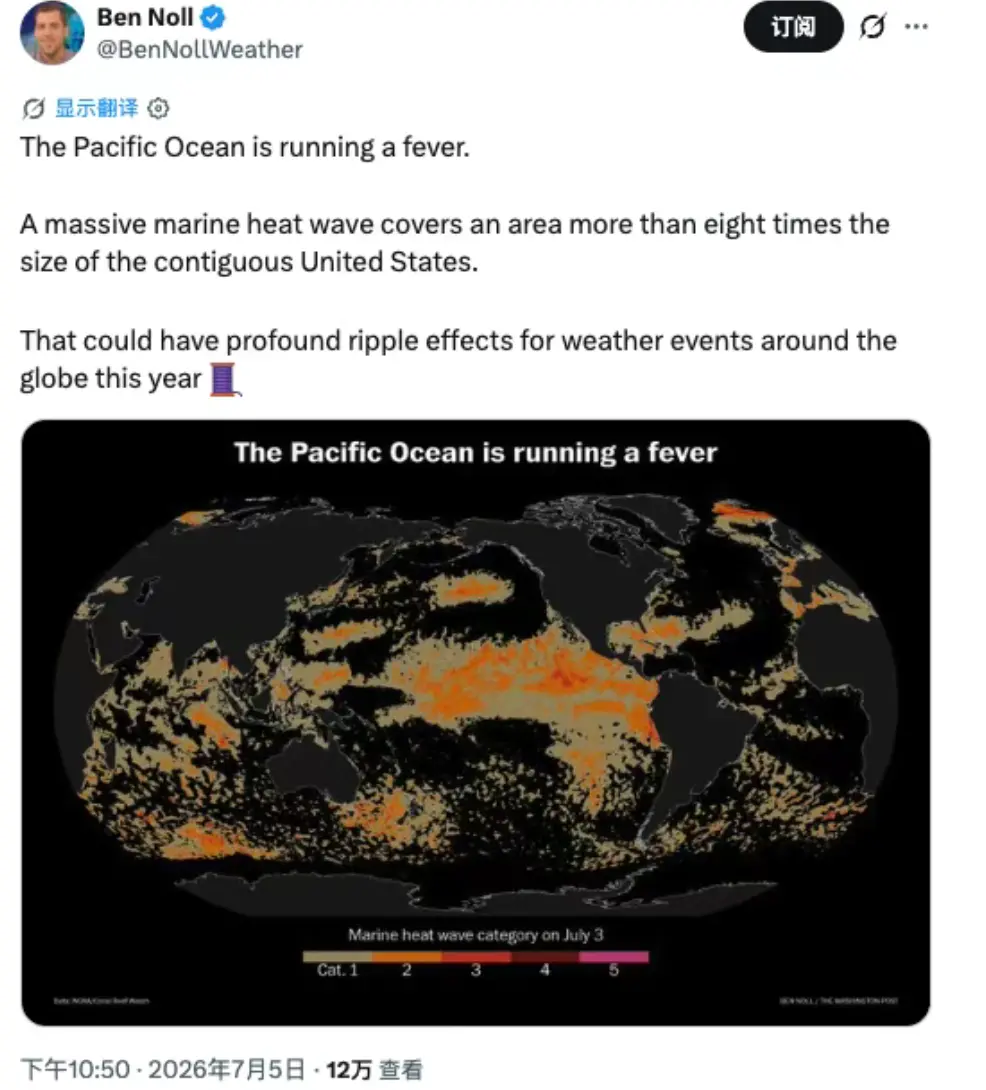
Meteorologist Ben Noll posted a Pacific sea temperature map on X with the caption "Pacific fever." Deep orange and red cover most of the Pacific on the map, showing the area of this marine heatwave exceeds 8 times the size of the contiguous United States.

For us, its impact is not "directly creating a specific rainstorm," but rather altering the underlying tone of atmospheric circulation. It influences the position of the Western Pacific Subtropical High, changes the path of water vapor transported by the East Asian Summer Monsoon, making rain belts more likely to deviate from their normal positions, and increasing the risk of high temperatures, droughts, and severe convection.

Compounded with global warming, for every 1°C increase in atmospheric temperature, its capacity to hold water vapor increases by about 7%. So today's El Niño isn't happening in a normal climate but against a backdrop that is already hotter, wetter, and more prone to extremes.

Here we have monsoons and typhoons, but over there in financial markets, some have already caught the scent, and funds are stirring.

On June 24, Bloomberg reported that hedge fund Moreton Capital Partners is raising $500 million for a dedicated vehicle. The assets targeted are agricultural products affected by El Niño, such as South African corn, Malaysian palm oil, and Australian wheat. Co-founder Les Finemore's rationale was simply: the market is vastly underestimating the risks brought by this year's El Niño.

Weather is no longer just background noise in a commodity portfolio; to some extent, it can stand alone as a separate theme for capital raising.

How can Finemore raise $500 million? Because profiting from extreme weather like El Niño isn't theoretical; people have been making big money from it for decades.

The First Fortune of the 'Turtle Trading' Founder

In 1972, the anchovies off the coast of Peru suddenly disappeared.

This tiny fish, about a dozen centimeters long, is something most people in the world will never eat, but when ground into fishmeal, it's one of the most important protein sources in global animal feed.

The disappearance of the anchovies was precisely because the equatorial Pacific waters suddenly warmed up. Cold water no longer upwelled, breaking the plankton chain. Meteorologists later named this phenomenon: El Niño.

With no fishmeal, feed manufacturers had to find substitutes, pushing up the price of soybean meal, which in turn drove up the price of soybeans.

At the Chicago Mercantile Exchange, a young trader not yet 26, Richard Dennis, saw prices hitting new highs and kept buying soybeans. In 1974, he made about $500,000 on soybeans and became a millionaire by year-end.

Richard Dennis in his youth

And this young trader, Richard Dennis, who made his first fortune, would later become the famous founder of the "Turtle Traders," his name enshrined as one of the patriarchs of trend trading.

Another classic story is that of Anthony Ward, nicknamed Chocfinger. He founded Armajaro in London in 1998, specializing in cocoa and coffee. What set this company apart was not its trading desk but its meteorology department: a proprietary weather station network, employing full-time meteorologists, and a research team of over 20 people in West African producing regions.

His logic: small weather changes could cause crop yields to fluctuate by 10%; whoever knows the weather first knows the price first. In 2002, he took three-quarters of the London exchange's cocoa delivery for the month, with a pre-tax profit of £10.4 million. On July 17, 2010, he received 240,100 tonnes of physical cocoa in one go, valued at £658 million, about 7% of global annual production, essentially all visible inventory in Europe at the time, pushing cocoa prices to their highest since 1977.

Let's look at some more recent examples.

In 2024, cocoa was the craziest commodity globally. West Africa's Côte d'Ivoire and Ghana, producers of 70% of the world's cocoa, suffered from abnormally high temperatures and dry Harmattan winds (a dry, hot wind blowing from the Sahara to the West African coast). Cocoa pods rotted on a large scale, compounded by disease, old trees, and low inventories. Cocoa futures rose over 400% in two years, briefly surpassing $10,000 per tonne.

Those who captured the bulk of this move weren't just cocoa industry players, but a group of quantitative trend funds. Razvan Remsing of Aspect Capital said it was their best first quarter in 25 years. AQR's managed futures strategy rose about 17.4% in Q1. Capital Fund Management's trend fund rose about 17.5%. Aspect's flagship fund was up 21.4% by late April. Winton, founded by David Harding, saw its diversified macro fund rise about 13% in Q1.

During the same period, besides making significant money on cocoa, Winton also made a lot on another front: El Niño typically brings warmer winters to parts of the U.S. A less cold winter means weaker heating demand for natural gas, inventories build up, and the U.S. natural gas benchmark price, Henry Hub (equivalent to Brent in the oil market), fell to near 30-year lows.

Bottom-Fishing Cocoa, or Sugar?

Back to 2026. This round of El Niño hasn't peaked yet, but the market has already front-run one wave.

Palm oil futures surged from 9400 yuan in late April to 9993 yuan before retreating. Rubber rose from its April low, briefly breaking 18300 yuan in mid-May. Sugar fluctuated repeatedly between 5200 and 5450 yuan. Peanuts rallied for seven consecutive sessions, supported by drought conditions and cost factors.

The strange thing is, the actual fundamentals of these commodities don't support the rise. Malaysian palm oil inventories were still increasing month-on-month by the end of May. Domestic sugar inventories in China were 1.83 million tonnes higher year-on-year. Domestic palm oil inventories were up 25.68% year-on-year. Production hasn't started falling yet, but prices rose first. The only reason for the rise is the anticipation of reduced yields 6 to 12 months later due to El Niño.

Over the past fifty years, every round of moderate or stronger El Niño has left its mark on commodity markets. In the 1982 round, palm oil rose 169%. From 2009 to 2010, Indonesian rubber production fell 11.3%, and spot prices rose 157.79% over two years. From 2015 to 2016, sugar rose 65%.
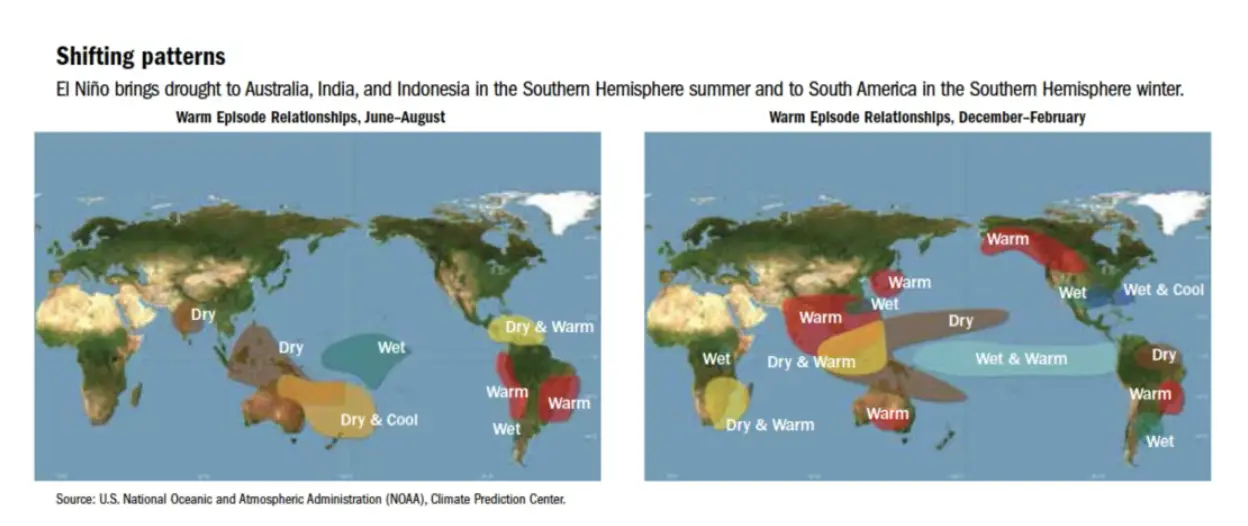
In Southeast Asia, it brings drought, suppressing palm oil and rubber yields. In India, it weakens the monsoon, affecting sugar and cotton. In Peru, it makes anchovies disappear, pushing up fishmeal prices. But at the other end of South America, it brings more rain, potentially improving soybean and sugarcane conditions in Brazil and Argentina. In the mining regions of Chile and Peru, heavy rainfall impacts not farmland but copper mines. In the U.S., a warm winter suppresses natural gas demand.

Overseas community discussions about this El Niño are still fermenting.
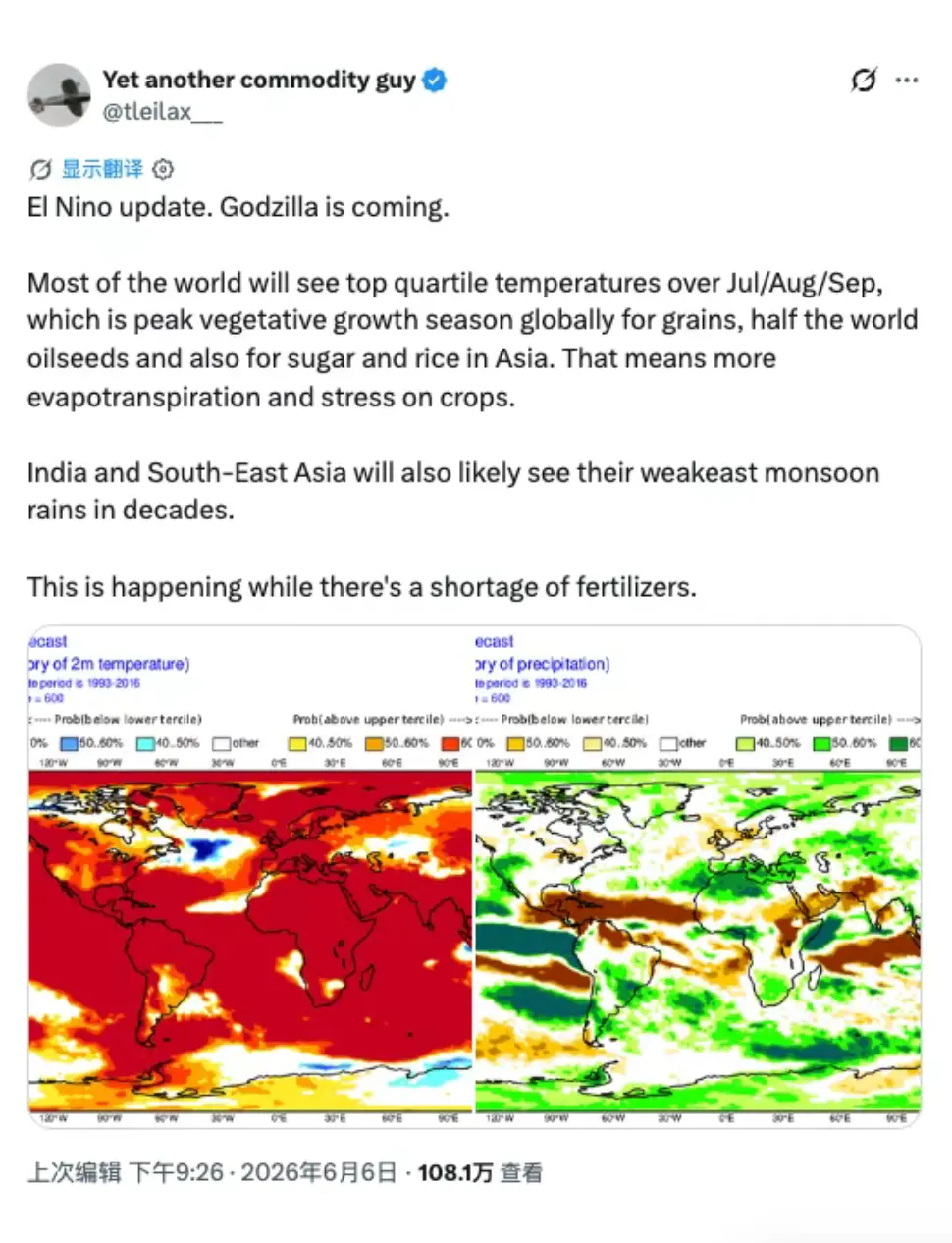
Commodities blogger @tleilax__ posted with two forecast maps. One map shows how much higher global temperatures from July to September this year are expected to be compared to the same period in previous years. The map is almost entirely red, and this timeframe coincides with the crucial growing period for grains, oilseeds, Asian rice, and sugar.

The other map shows whether rainfall will be higher or lower than the historical average for the same period. It shows large swathes of India and Southeast Asia as drier than usual, precisely matching the market's biggest fear: a weak monsoon.

His conclusion: India and Southeast Asia could experience the weakest monsoon rainfall in decades, and this is happening against a backdrop of a global fertilizer shortage. This post has garnered over 1.08 million views so far.

A commodities column on Substack listed palm oil, cotton, and cocoa as the cluster with the clearest risk-reward profile for the next 6 to 12 months. The Singapore investment community is scrutinizing Malaysian plantation stocks one by one, concluding that pure upstream planters capture the full elasticity, while companies like Wilmar International, focused on midstream and downstream processing, get their margins squeezed by rising palm oil prices. The U.S. stock community is circulating an even more nuanced argument: Adecoagro, an agricultural company in Brazil and Argentina, is a "weather hedge for tech-heavy portfolios" because El Niño brings rain, not drought, to South America; its output expands while Asia's production declines, pushing up prices.

The script for this round's market move is still largely unwritten, so it's not necessarily better to buy earlier. There aren't many hard indicators that can change position direction, but each is crucial:

  • Whether the Niño3.4 index breaks above 2.0°C in autumn/winter. This is the dividing line between moderate and super-strong, and the switch for overall agricultural volatility to step up.

  • Indian monsoon rainfall data from June to September. The steering wheel for the sugar, cotton, and rice group of commodities.

  • Monthly inventory reports from the Malaysian Palm Oil Board. The speed at which high inventories are drawn down determines when the expected market move connects with the actual market move.

  • Rainfall in Guangxi, China, in July and the consecutive days of high temperatures in North China. The former governs sugar, the latter electricity.

  • The subsequent fundraising scale of weather-focused funds like Moreton. The volume of institutional capital determines whether weather trading is a short-lived pulse or a year-long theme.

The experiences of 1972 and 2024 point to the same time lag: the real price effects of El Niño mostly occur after the event's peak. Dennis made his money two years after the anchovy collapse. Cocoa truly exploded after ENSO turned neutral. In the second half of 2026, the market is trading on expectations; in 2027, it will trade on the actual production shortfall itself.

At First, No One Cared About This Storm

Beyond these trading opportunities, what's more thought-provoking are two highly shared posts on X by finance blogger @FinanceLancelot.
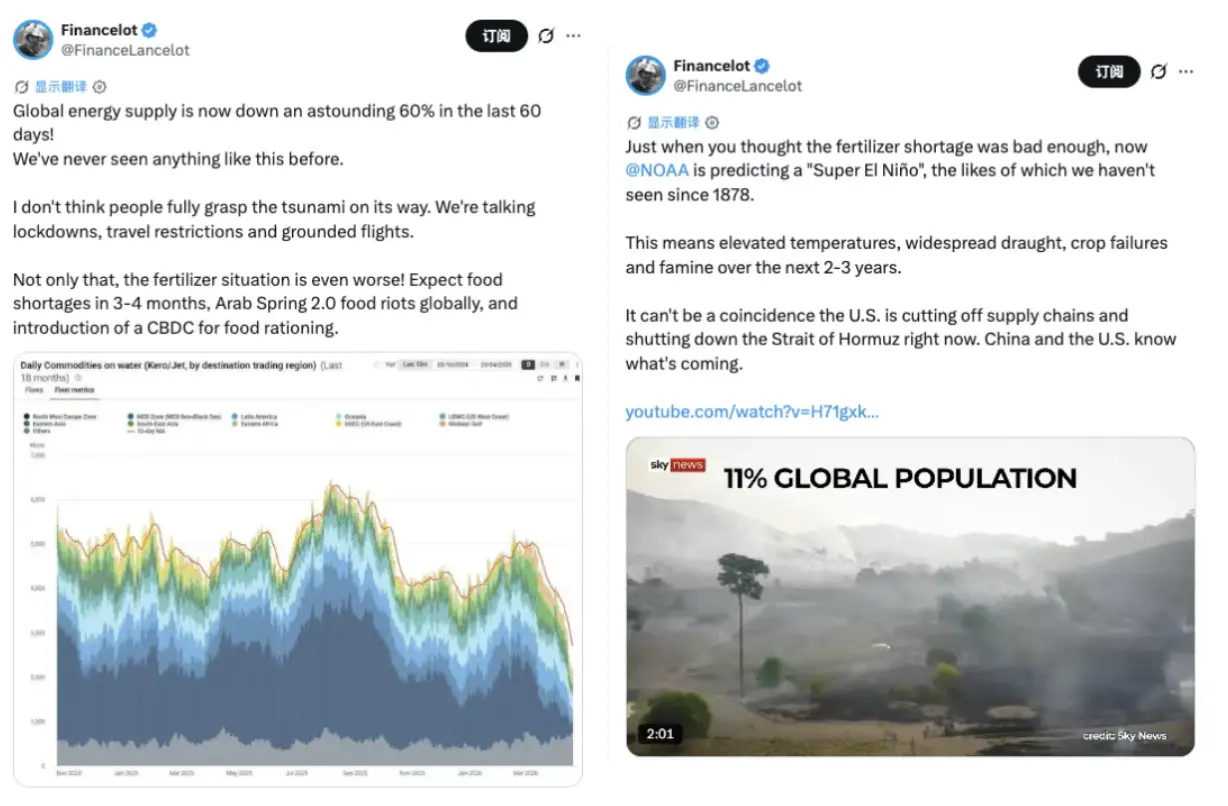
One said NOAA (the U.S. National Oceanic and Atmospheric Administration, one of the world's most frequently cited climate monitoring agencies) is predicting a "super El Niño" unseen since 1878, implying warming, widespread drought, crop failures, and famine risks over the next two to three years. It was accompanied by a Sky News video titled "11% of the global population."

Another post expressed a similar view: global energy and maritime supply has fallen 60% in the past 60 days, accompanied by a shipping oil product flow chart showing a cliff-like drop from the start of the year. His conclusion: fertilizer shortages coupled with El Niño could lead to food shortages globally within 3 to 4 months.

The wording of these posts carries obvious doomsday overtones and shouldn't be taken at face value.

But they reflect one thing: a group of people in the market are already weaving a narrative connecting El Niño, energy supply disruptions, fertilizer shortages, and tensions in the Strait of Hormuz. And this narrative is gaining traction and attention.

More importantly, this narrative points not just to gains and losses in futures accounts, but to potential impacts on the lives of ordinary people, adding to everyone's cost of living.

At first, no one cared about this storm. It was just a typhoon, a downpour, a slight rise in sea temperature.

But the storm doesn't stop just because no one cares. The heavy rains around the world, the canceled flights, the disappearing anchovies in Peru, the rotting cocoa pods in Ghana, the sugar shortages—these are already part of the storm, destined to land in the lives of different people.


Trend Kriptolar

İlgili Sorular

QWhat is ENSO (El Niño-Southern Oscillation) and how does it act as a 'fever' for the Pacific, according to the article?

AENSO describes the periodic variation in sea surface temperatures and atmospheric circulation in the Pacific Ocean. During an El Niño event, weakened trade winds allow warm water to flow back east, causing abnormally high sea temperatures in the central-eastern Pacific. The article metaphorically calls this a 'fever' for the Pacific, referencing a scientist's post showing a vast area of deep orange and red on a sea temperature map, indicating a massive oceanic heatwave.

QWho was Richard Dennis and how did his first major profit relate to an El Niño event?

ARichard Dennis was a young trader who later became famous as a founder of the 'Turtle Traders.' His first major profit came in the 1970s by trading soybeans. The price surge was indirectly caused by an El Niño event off Peru, which devastated the anchovy population. As fishmeal (made from anchovies) became scarce and expensive, feed manufacturers switched to soybean meal, driving up soybean prices. Dennis capitalized on this trend, making around $500,000 and becoming a millionaire by the end of 1974.

QWhat are some of the key financial indicators or data points that traders are watching to gauge the impact of the 2026 El Niño on commodity markets?

ATraders are monitoring several key indicators: 1) Whether the Niño3.4 index exceeds 2.0°C in autumn/winter, marking a shift to a strong El Niño. 2) India's monsoon rainfall data from June to September, crucial for sugar, cotton, and rice. 3) Monthly stock reports from the Malaysian Palm Oil Board to see if high inventories are decreasing. 4) Rainfall in Guangxi, China, and the duration of heatwaves in North China, affecting sugar and electricity demand. 5) The fundraising scale of weather-focused funds like Moreton Capital Partners, indicating institutional interest.

QHow does the article illustrate the time lag between an El Niño event and its full impact on commodity prices?

AThe article highlights that the most significant price effects often occur after the El Niño peaks, not during its initial development. For example, Richard Dennis profited from the 1972-73 El Niño's impact on soybeans in 1974. Similarly, the 2024 cocoa price explosion happened after the ENSO cycle had turned neutral. The article suggests that for the 2026 event, the market in late 2026 is trading on anticipation, while 2027 will likely trade on the actual supply shortages and减产 (yield reduction) itself.

QBeyond specific trades, what broader, more alarming narrative is emerging in some financial communities regarding the 2026 El Niño, according to the article's conclusion?

AA broader, more alarming narrative is forming that connects several crises: the potential 'super El Niño,' a reported 60% drop in global energy and maritime shipping supplies, fertilizer shortages, and geopolitical tensions like those around the Strait of Hormuz. This narrative, promoted by some financial commentators, warns of widespread drought, crop failures, and the risk of global food shortages impacting '11% of the global population' within a few months, ultimately affecting the cost of living for ordinary people worldwide.

İlgili Okumalar

Bitcoin’s path to $80K may hinge on THIS hidden trend

Bitcoin's potential path toward $80,000 is influenced by conflicting market signals. Data shows the Coinbase Bitcoin Premium Index has recorded its longest-ever streak of consecutive negative premiums, indicating muted institutional demand or net selling from U.S. institutions. While such a trend often signals short-term weakness, it doesn't necessarily forecast a long-term bear market. Additionally, a bearish crossover occurred in Bitcoin's Net Unrealized Profit/Loss (NUPL), with its short-term average falling below the longer-term average, suggesting declining investor profitability and waning market momentum. Historically, major bear market bottoms saw the 100-day NUPL drop below zero, but this cycle it remains positive, implying either an unprecedented bottom or a further decline is needed. Currently trading around $63,148, Bitcoin has seen weekly gains but remains below its May peak. Technical indicators present a mixed picture: the MACD shows bullish momentum, while the RSI signals bearish pressure. A positive development is the return of inflows to Bitcoin ETFs after eight weeks of outflows. Analysts hold divergent views; some highlight a key liquidity zone between $48,000-$50,000 where a market bottom could form, while others maintain a more optimistic long-term outlook. Ultimately, while some bullish signs exist, a strong push from institutional investors appears crucial for Bitcoin to challenge the $80,000 level.

ambcrypto13 dk önce

Bitcoin’s path to $80K may hinge on THIS hidden trend

ambcrypto13 dk önce

Unexpected Weak Non-Farm Payrolls Data Pushes BTC to Rebound 11%, FOMC Minutes to Test the Narrative of This Rally

Bitcoin has rebounded 11% from its 21-month low, but the sustainability of this rally hinges entirely on the Federal Reserve's release of the June FOMC meeting minutes. The bounce was triggered by a weaker-than-expected US jobs report, which showed only 57,000 jobs added in June—about half of economists' forecasts. This data prompted traders to scale back bets on further Fed rate hikes, fueling a rally in Bitcoin alongside gold and stocks. The upcoming minutes are critical. They will reveal whether Fed officials, in their mid-June meeting, were already expressing concerns about a weakening labor market, tight credit conditions, or the risks of overtightening—factors that would support the market's recent dovish shift. Conversely, if the discussion focused on persistent inflation and the conditions for more rate hikes, the rally's foundational narrative would crumble. Market indicators show the rebound's fragility. While US spot Bitcoin ETFs saw a significant single-day inflow, it followed a prolonged period of outflows. On-chain data indicates a substantial increase in Bitcoin being moved to exchanges, creating potential sell pressure. Options market positioning suggests key price levels around $60,000 and $62,000 that could either stabilize or accelerate price movement. In essence, Bitcoin's 11% gain is built on speculation about the Fed's private deliberations three weeks ago. The FOMC minutes will replace that speculation with concrete details, and the discrepancy between market expectations and the actual record will determine whether Bitcoin holds above $64,000 or falls back toward $58,000.

marsbit24 dk önce

Unexpected Weak Non-Farm Payrolls Data Pushes BTC to Rebound 11%, FOMC Minutes to Test the Narrative of This Rally

marsbit24 dk önce

Just Now, The World's First Ultra-High-Frame World Model Was Born, Nvidia Content 0, Racing to 50 FPS

Just Now, Global First Ultra-High-Frame World Model Born, 0% NVIDIA, Speeds to 50 FPS A Chinese team has developed MoWorld, the world's first Flash World Model, achieving real-time interactive inference exceeding 50 FPS. Crucially, it is entirely built on domestic NPUs (National Processing Units), bypassing NVIDIA GPUs. Developed by Moxin Technology in collaboration with Zhejiang University's Pan Yunhe academician team, MoWorld represents a complete, closed-loop system from training and distillation to deployment on domestic computing power. The model tackles the critical industry bottleneck of real-time performance, essential for applications like robotics, gaming, and digital worlds. MoWorld achieves this through a full-stack redesign for NPUs, including a proprietary 3D-annotated data pipeline, system-level optimizations for long-sequence training (up to 2000 frames), and inference optimizations like dynamic mixed-precision quantization. On a Huawei Ascend 910C platform, a 14B MoE parameter model achieves over 50 FPS, reducing typical inference costs by 70% compared to equivalent GPU solutions. This breakthrough lowers the deployment barrier, potentially accelerating the industrialization of world models. Key application areas include gaming/entertainment (offering 6-DoF camera control for immersive exploration), embodied AI/autonomous driving (providing a high-fidelity digital training ground), film pre-visualization, and 3D reconstruction/digital twins due to its strong geometric consistency. MoWorld demonstrates that a full-stack domestic compute ecosystem can support cutting-edge, real-time world models, positioning China at a competitive starting line in defining next-generation spatial intelligence standards. The project underscores a shift in competition from model scale to real-world usability and cost-effective deployment.

marsbit1 saat önce

Just Now, The World's First Ultra-High-Frame World Model Was Born, Nvidia Content 0, Racing to 50 FPS

marsbit1 saat önce

Pacific 'Fever': How Extreme Weather Becomes Wall Street's Cash Machine?

"Pacific Fever": How Extreme Weather Becomes Wall Street's ATM? The summer of 2026 sees unusually fierce weather across China and globally. The common driver behind this global pattern is a powerful El Niño event, potentially the strongest since 1950, as declared by NOAA. This phenomenon, characterized by warming central/eastern Pacific waters, disrupts global atmospheric circulation, raising risks of floods, droughts, and heatwaves, further intensified by climate change. For financial markets, especially commodities, El Niño is not just weather but a major trading theme. History shows its price impact is profound. In the 1970s, El Niño-driven anchovy collapse in Peru fueled a soybean boom, giving Richard Dennis his first million. Anthony Ward's cocoa empire was built on superior weather intelligence. Most recently in 2024, West African droughts caused cocoa prices to soar over 400%, delivering huge gains for trend-following hedge funds. In 2026, markets are again pricing in future El Niño-induced supply shocks. Despite high current inventories, prices for palm oil, rubber, and sugar have rallied on anticipation of upcoming Southeast Asian droughts and weak Indian monsoons. Analysts identify key indicators to watch: the Niño3.4 index, Indian monsoon rainfall, Malaysian palm oil stocks, and the fundraising scale of specialized weather funds like Moreton Capital. Beyond trading opportunities, a concerning narrative is gaining traction online, linking El Niño with fertilizer shortages and energy supply disruptions to warn of potential global food crises within months. While alarmist, it highlights a deeper truth: the cascading effects of climate-driven weather extremes ultimately translate into higher costs of living for everyone, far beyond the trading floor.

marsbit1 saat önce

Pacific 'Fever': How Extreme Weather Becomes Wall Street's Cash Machine?

marsbit1 saat önce

Just Now, OpenAI's Chief Futurist Departed, Once Called a Jackass by Musk

Just now, OpenAI's Chief Futurist, Joshua Achiam, announced his departure from the company via X. Having joined as a 25-year-old intern in 2017, he spent nine years at OpenAI, evolving from an AI safety research scientist to leading the Mission Alignment team. Earlier this year, that team was dissolved, and Achiam transitioned to the newly created role of Chief Futurist, positioned at the intersection of AI safety and policy to study AGI's long-term risks and opportunities. In his departure statement, Achiam called his time a "graduation," reflecting on the immense progress from AI that couldn't converse to systems solving scientific problems. He expressed optimism about a future of peace, prosperity, and possibility, closing with "To safe AGI." His tenure was notably marked by a 2018 incident where he publicly challenged Elon Musk—then still with OpenAI—on safety compromises if Musk pursued AGI at Tesla, leading Musk to call him a "jackass." This became an internal legend, with colleagues later giving him a trophy inscribed, "To safety, never stop being that jackass." Achiam's exit follows a pattern of prominent safety and alignment experts leaving OpenAI, including Jan Leike and others who joined rivals like Anthropic or started non-profits. His departure coincides with OpenAI's internal efforts to more tightly integrate its research and policy teams, and the recent hiring of former White House AI advisor Dean Ball. Achiam did not cite a specific reason for leaving but indicated it was a long-considered decision, stating the mission to ensure AGI benefits humanity can now be advanced beyond the "frontier lab's" walls.

marsbit1 saat önce

Just Now, OpenAI's Chief Futurist Departed, Once Called a Jackass by Musk

marsbit1 saat önce

İşlemler

Spot

Popüler Makaleler

$S$ Nedir

SPERO'yu Anlamak: Kapsamlı Bir Genel Bakış SPERO'ya Giriş İnovasyonun manzarası gelişmeye devam ederken, web3 teknolojilerinin ve kripto para projelerinin ortaya çıkışı dijital geleceği şekillendirmede önemli bir rol oynamaktadır. Bu dinamik alanda dikkat çeken projelerden biri SPERO, $$s$$ olarak adlandırılmaktadır. Bu makale, SPERO hakkında ayrıntılı bilgi toplamak ve sunmak amacıyla, meraklılar ve yatırımcıların web3 ve kripto alanlarındaki temellerini, hedeflerini ve yeniliklerini anlamalarına yardımcı olmayı amaçlamaktadır. SPERO,$$s$$ Nedir? SPERO,$$s$$, kripto alanında merkeziyetsizlik ve blok zinciri teknolojisi ilkelerini kullanarak etkileşimi, faydayı ve finansal kapsayıcılığı teşvik eden bir ekosistem yaratmayı amaçlayan benzersiz bir projedir. Proje, kullanıcıların yenilikçi finansal çözümler ve hizmetler sunarak eşler arası etkileşimleri yeni yollarla kolaylaştırmayı hedeflemektedir. SPERO,$$s$$'nin temel amacı, bireyleri güçlendirmek ve kripto para alanındaki kullanıcı deneyimini artıran araçlar ve platformlar sağlamaktır. Bu, daha esnek işlem yöntemlerini mümkün kılmayı, topluluk odaklı girişimleri teşvik etmeyi ve merkeziyetsiz uygulamalar (dApp'ler) aracılığıyla finansal fırsatlar yaratmayı içermektedir. SPERO,$$s$$'nin temel vizyonu kapsayıcılık etrafında dönmekte olup, geleneksel finansal sistemlerdeki boşlukları kapatmayı ve blok zinciri teknolojisinin faydalarından yararlanmayı hedeflemektedir. SPERO,$$s$$'nin Yaratıcısı Kimdir? SPERO,$$s$$'nin yaratıcısının kimliği bir miktar belirsizdir, çünkü kurucusu(ları) hakkında ayrıntılı arka plan bilgisi sağlayan sınırlı kamuya açık kaynaklar bulunmaktadır. Bu şeffaflık eksikliği, projenin merkeziyetsizlik taahhüdünden kaynaklanabilir—birçok web3 projesinin paylaştığı bir etik anlayışı, bireysel tanınmanın yerine kolektif katkıları önceliklendirmektedir. Topluluk ve onun kolektif hedefleri etrafında tartışmaları merkezileştirerek, SPERO,$$s$$, belirli bireyleri öne çıkarmadan güçlendirme özünü taşımaktadır. Bu nedenle, SPERO'nun etik anlayışını ve misyonunu anlamak, tek bir yaratıcının kimliğini belirlemekten daha önemlidir. SPERO,$$s$$'nin Yatırımcıları Kimlerdir? SPERO,$$s$$, kripto sektöründe yeniliği teşvik etmeye adanmış girişim sermayedarlarından melek yatırımcılara kadar çeşitli yatırımcılar tarafından desteklenmektedir. Bu yatırımcıların odak noktası genellikle SPERO'nun misyonuyla uyumlu olup, toplumsal teknolojik ilerlemeyi, finansal kapsayıcılığı ve merkeziyetsiz yönetimi vaat eden projeleri önceliklendirmektedir. Bu yatırımcı temelleri, yalnızca yenilikçi ürünler sunan projelere değil, aynı zamanda blok zinciri topluluğuna ve ekosistemlerine olumlu katkılarda bulunan projelere de ilgi duymaktadır. Bu yatırımcıların desteği, SPERO,$$s$$'yi hızla gelişen kripto projeleri alanında dikkate değer bir rakip haline getirmektedir. SPERO,$$s$$ Nasıl Çalışır? SPERO,$$s$$, onu geleneksel kripto para projelerinden ayıran çok yönlü bir çerçeve kullanmaktadır. İşte benzersizliğini ve yeniliğini vurgulayan bazı temel özellikler: Merkeziyetsiz Yönetim: SPERO,$$s$$, kullanıcıların projenin geleceğiyle ilgili karar alma süreçlerine aktif olarak katılmalarını sağlayan merkeziyetsiz yönetim modellerini entegre etmektedir. Bu yaklaşım, topluluk üyeleri arasında sahiplik ve hesap verebilirlik duygusunu teşvik etmektedir. Token Kullanımı: SPERO,$$s$$, ekosistem içinde çeşitli işlevler sunmak üzere tasarlanmış kendi kripto para token'ını kullanmaktadır. Bu token'lar, işlemleri, ödülleri ve platformda sunulan hizmetlerin kolaylaştırılmasını sağlayarak genel etkileşimi ve faydayı artırmaktadır. Katmanlı Mimari: SPERO,$$s$$'nin teknik mimarisi, modülerlik ve ölçeklenebilirliği destekleyerek projenin evrimi sırasında ek özelliklerin ve uygulamaların sorunsuz bir şekilde entegrasyonuna olanak tanımaktadır. Bu uyum sağlama yeteneği, sürekli değişen kripto manzarasında geçerliliği sürdürmek için hayati öneme sahiptir. Topluluk Katılımı: Proje, işbirliği ve geri bildirim teşvik eden mekanizmalar kullanarak topluluk odaklı girişimlere vurgu yapmaktadır. Güçlü bir topluluk oluşturarak, SPERO,$$s$$, kullanıcı ihtiyaçlarını daha iyi karşılayabilir ve piyasa trendlerine uyum sağlayabilir. Kapsayıcılığa Odaklanma: Düşük işlem ücretleri ve kullanıcı dostu arayüzler sunarak, SPERO,$$s$$, daha önce kripto alanında yer almamış bireyler de dahil olmak üzere çeşitli bir kullanıcı tabanını çekmeyi hedeflemektedir. Bu kapsayıcılık taahhüdü, erişilebilirlik yoluyla güçlendirme misyonuyla uyumludur. SPERO,$$s$$ Zaman Çizelgesi Bir projenin tarihini anlamak, gelişim yolculuğu ve kilometre taşları hakkında kritik bilgiler sağlar. Aşağıda, SPERO,$$s$$'nin evriminde önemli olayları haritalayan önerilen bir zaman çizelgesi bulunmaktadır: Kavram Geliştirme ve Fikir Aşaması: SPERO,$$s$$'nin temelini oluşturan ilk fikirler, blok zinciri endüstrisindeki merkeziyetsizlik ve topluluk odaklılık ilkeleriyle yakından uyumlu olarak geliştirildi. Proje Beyaz Kağıdının Yayınlanması: Kavramsal aşamayı takiben, SPERO,$$s$$'nin vizyonunu, hedeflerini ve teknolojik altyapısını ayrıntılı bir şekilde açıklayan kapsamlı bir beyaz kağıt yayımlandı ve topluluk ilgisini ve geri bildirimini toplamak amacıyla sunuldu. Topluluk Oluşturma ve Erken Katılımlar: Projenin hedefleri etrafında tartışmalar yürüterek destek toplamak ve erken benimseyenler ile potansiyel yatırımcılar için bir topluluk oluşturmak amacıyla aktif iletişim çabaları gerçekleştirildi. Token Üretim Etkinliği: SPERO,$$s$$, yerel token'larını erken destekçilere dağıtmak ve ekosistem içinde başlangıç likiditesini sağlamak amacıyla bir token üretim etkinliği (TGE) gerçekleştirdi. İlk dApp'in Yayınlanması: SPERO,$$s$$ ile ilişkili ilk merkeziyetsiz uygulama (dApp) faaliyete geçti ve kullanıcıların platformun temel işlevleriyle etkileşimde bulunmalarını sağladı. Sürekli Gelişim ve Ortaklıklar: Projenin tekliflerine sürekli güncellemeler ve iyileştirmeler yapılmakta olup, blok zinciri alanındaki diğer oyuncularla stratejik ortaklıklar, SPERO,$$s$$'yi rekabetçi ve gelişen bir oyuncu haline getirmiştir. Sonuç SPERO,$$s$$, web3 ve kripto paranın finansal sistemleri devrim niteliğinde dönüştürme ve bireyleri güçlendirme potansiyelinin bir kanıtıdır. Merkeziyetsiz yönetime, topluluk katılımına ve yenilikçi tasarlanmış işlevselliğe olan bağlılığıyla, daha kapsayıcı bir finansal manzaraya doğru bir yol açmaktadır. Hızla gelişen kripto alanındaki herhangi bir yatırımda olduğu gibi, potansiyel yatırımcılar ve kullanıcılar, SPERO,$$s$$ içindeki devam eden gelişmelerle ilgili olarak kapsamlı bir araştırma yapmaları ve düşünceli bir şekilde katılmaları teşvik edilmektedir. Proje, kripto endüstrisinin yenilikçi ruhunu sergileyerek, sayısız olasılığını keşfetmeye davet etmektedir. SPERO,$$s$$'nin yolculuğu hala devam ederken, temel ilkeleri, teknoloji, finans ve birbirimizle etkileşim biçimimizi etkileyebilir.

163 Toplam GörüntülenmeYayınlanma 2024.12.17Güncellenme 2024.12.17

$S$ Nedir

AGENT S Nedir

Agent S: Web3'te Otonom Etkileşimin Geleceği Giriş Web3 ve kripto para dünyasında sürekli gelişen manzarada, yenilikler bireylerin dijital platformlarla etkileşim biçimlerini sürekli olarak yeniden tanımlıyor. Bu tür öncü projelerden biri olan Agent S, açık ajans çerçevesi aracılığıyla insan-bilgisayar etkileşimini devrim niteliğinde değiştirmeyi vaat ediyor. Otonom etkileşimlerin yolunu açarak, Agent S karmaşık görevleri basitleştirmeyi ve yapay zeka (AI) alanında dönüştürücü uygulamalar sunmayı hedefliyor. Bu detaylı inceleme, projenin karmaşıklıklarına, benzersiz özelliklerine ve kripto para alanındaki etkilerine dalacaktır. Agent S Nedir? Agent S, bilgisayar görevlerinin otomasyonunda üç temel zorluğu ele almak üzere özel olarak tasarlanmış çığır açıcı bir açık ajans çerçevesidir: Alan Spesifik Bilgi Edinimi: Çerçeve, çeşitli dış bilgi kaynaklarından ve iç deneyimlerden akıllıca öğrenir. Bu çift yönlü yaklaşım, alan spesifik bilgi açısından zengin bir veri havuzu oluşturmasını sağlar ve görev yürütmedeki performansını artırır. Uzun Görev Ufukları Üzerinde Planlama: Agent S, karmaşık görevlerin verimli bir şekilde parçalanmasını ve yürütülmesini kolaylaştıran deneyim artırımlı hiyerarşik planlama kullanır. Bu özellik, çoklu alt görevleri etkili ve verimli bir şekilde yönetme yeteneğini önemli ölçüde artırır. Dinamik, Homojen Olmayan Arayüzlerle Başlama: Proje, ajanlar ve kullanıcılar arasındaki etkileşimi geliştiren yenilikçi bir çözüm olan Ajan-Bilgisayar Arayüzü'ni (ACI) tanıtmaktadır. Çok Modlu Büyük Dil Modellerini (MLLM'ler) kullanarak, Agent S çeşitli grafik kullanıcı arayüzlerini sorunsuz bir şekilde gezinebilir ve manipüle edebilir. Bu öncü özellikler aracılığıyla, Agent S, makinelerle insan etkileşimini otomatikleştirmede karşılaşılan karmaşıklıkları ele alan sağlam bir çerçeve sunarak, AI ve ötesinde birçok uygulama için zemin hazırlıyor. Agent S'nin Yaratıcısı Kimdir? Agent S'nin kavramı temelde yenilikçi olsa da, yaratıcısı hakkında spesifik bilgiler belirsizliğini koruyor. Yaratıcı şu anda bilinmiyor, bu da projenin yeni aşamasını veya kurucu üyeleri gizli tutma stratejik tercihini vurguluyor. Anonimlikten bağımsız olarak, odak çerçevenin yetenekleri ve potansiyeli üzerinde kalıyor. Agent S'nin Yatırımcıları Kimlerdir? Agent S, kriptografik ekosistemde oldukça yeni olduğundan, yatırımcıları ve finansal destekçileri hakkında ayrıntılı bilgiler açıkça belgelenmemiştir. Projeyi destekleyen yatırım temelleri veya organizasyonları hakkında kamuya açık bilgilerdeki eksiklik, finansman yapısı ve gelişim yol haritası hakkında sorular doğuruyor. Destekleyicilerin anlaşılması, projenin sürdürülebilirliğini ve potansiyel pazar etkisini değerlendirmek için kritik öneme sahiptir. Agent S Nasıl Çalışır? Agent S'nin temelinde, çeşitli ortamlarda etkili bir şekilde çalışmasını sağlayan son teknoloji bir sistem yatmaktadır. İşleyiş modeli birkaç ana özellik etrafında inşa edilmiştir: İnsan Benzeri Bilgisayar Etkileşimi: Çerçeve, bilgisayarlarla etkileşimleri daha sezgisel hale getirmeyi amaçlayan gelişmiş AI planlaması sunar. Görev yürütmedeki insan davranışını taklit ederek, kullanıcı deneyimlerini yükseltmeyi vaat eder. Anlatı Belleği: Yüksek düzeyde deneyimlerden yararlanmak için kullanılan Agent S, görev geçmişlerini takip etmek amacıyla anlatı belleğini kullanarak karar verme süreçlerini geliştirir. Episodik Bellek: Bu özellik, kullanıcılara adım adım rehberlik sağlayarak, çerçevenin görevler gelişirken bağlamsal destek sunmasına olanak tanır. OpenACI Desteği: Yerel olarak çalışabilme yeteneği ile Agent S, kullanıcıların etkileşimleri ve iş akışları üzerinde kontrol sağlamasına olanak tanır ve Web3'ün merkeziyetsiz felsefesiyle uyumlu hale gelir. Dış API'lerle Kolay Entegrasyon: Çeşitli AI platformlarıyla uyumluluğu ve çok yönlülüğü, Agent S'nin mevcut teknolojik ekosistemlere sorunsuz bir şekilde entegre olmasını sağlar ve geliştiriciler ile organizasyonlar için cazip bir seçenek haline getirir. Bu işlevsellikler, Agent S'nin kripto alanındaki benzersiz konumuna katkıda bulunarak, karmaşık, çok aşamalı görevleri minimum insan müdahalesi ile otomatikleştirir. Proje geliştikçe, Web3'teki potansiyel uygulamaları dijital etkileşimlerin nasıl gelişeceğini yeniden tanımlayabilir. Agent S'nin Zaman Çizelgesi Agent S'nin gelişimi ve kilometre taşları, önemli olaylarını vurgulayan bir zaman çizelgesinde özetlenebilir: 27 Eylül 2024: Agent S'nin kavramı, “Bilgisayarları İnsan Gibi Kullanan Açık Bir Ajans Çerçevesi” başlıklı kapsamlı bir araştırma makalesi ile tanıtıldı ve projenin temelini sergiledi. 10 Ekim 2024: Araştırma makalesi arXiv'de kamuya açık olarak yayınlandı ve çerçevenin derinlemesine bir incelemesini ve OSWorld benchmark'ına dayalı performans değerlendirmesini sundu. 12 Ekim 2024: Agent S'nin yetenekleri ve özellikleri hakkında görsel bir içgörü sağlayan bir video sunumu yayımlandı ve potansiyel kullanıcılar ve yatırımcılarla daha fazla etkileşim sağlandı. Bu zaman çizelgesindeki işaretler, sadece Agent S'nin ilerlemesini değil, aynı zamanda şeffaflık ve topluluk katılımına olan bağlılığını da göstermektedir. Agent S Hakkında Ana Noktalar Agent S çerçevesi gelişmeye devam ederken, birkaç ana özellik öne çıkmakta ve yenilikçi doğasını ve potansiyelini vurgulamaktadır: Yenilikçi Çerçeve: İnsan etkileşimine benzer bir bilgisayar kullanımı sağlamak üzere tasarlanan Agent S, görev otomasyonuna yeni bir yaklaşım getiriyor. Otonom Etkileşim: GUI aracılığıyla bilgisayarlarla otonom olarak etkileşim kurabilme yeteneği, daha akıllı ve verimli hesaplama çözümlerine doğru bir sıçrama anlamına geliyor. Karmaşık Görev Otomasyonu: Sağlam metodolojisi ile karmaşık, çok aşamalı görevleri otomatikleştirerek süreçleri daha hızlı ve daha az hata payı ile gerçekleştirebilir. Sürekli İyileştirme: Öğrenme mekanizmaları, Agent S'nin geçmiş deneyimlerden öğrenmesini sağlar ve sürekli olarak performansını ve etkinliğini artırır. Çok Yönlülük: OSWorld ve WindowsAgentArena gibi farklı işletim ortamlarında uyumlu olması, geniş bir uygulama yelpazesine hizmet edebilmesini sağlar. Agent S, Web3 ve kripto alanında kendini konumlandırırken, etkileşim yeteneklerini artırma ve süreçleri otomatikleştirme potansiyeli, AI teknolojilerinde önemli bir ilerlemeyi temsil etmektedir. Yenilikçi çerçevesi aracılığıyla, Agent S dijital etkileşimlerin geleceğini örneklemekte ve çeşitli sektörlerde kullanıcılar için daha sorunsuz ve verimli bir deneyim vaat etmektedir. Sonuç Agent S, AI ve Web3'ün birleşiminde cesur bir sıçramayı temsil ediyor ve teknoloji ile etkileşim biçimimizi yeniden tanımlama kapasitesine sahip. Henüz erken aşamalarında olmasına rağmen, uygulama olanakları geniş ve çekici. Kritik zorlukları ele alan kapsamlı çerçevesi ile Agent S, otonom etkileşimleri dijital deneyimin ön plana çıkmasına taşımayı hedefliyor. Kripto para ve merkeziyetsizlik alanlarına daha derinlemesine girdikçe, Agent S gibi projelerin teknoloji ve insan-bilgisayar işbirliğinin geleceğini şekillendirmede önemli bir rol oynayacağı kesin.

647 Toplam GörüntülenmeYayınlanma 2025.01.14Güncellenme 2025.01.14

AGENT S Nedir

S Nasıl Satın Alınır

HTX.com’a hoş geldiniz! Sonic (S) satın alma işlemlerini basit ve kullanışlı bir hâle getirdik. Adım adım açıkladığımız rehberimizi takip ederek kripto yolculuğunuza başlayın. 1. Adım: HTX Hesabınızı OluşturunHTX'te ücretsiz bir hesap açmak için e-posta adresinizi veya telefon numaranızı kullanın. Sorunsuzca kaydolun ve tüm özelliklerin kilidini açın. Hesabımı Aç2. Adım: Kripto Satın Al Bölümüne Gidin ve Ödeme Yönteminizi SeçinKredi/Banka Kartı: Visa veya Mastercard'ınızı kullanarak anında Sonic (S) satın alın.Bakiye: Sorunsuz bir şekilde işlem yapmak için HTX hesap bakiyenizdeki fonları kullanın.Üçüncü Taraflar: Kullanımı kolaylaştırmak için Google Pay ve Apple Pay gibi popüler ödeme yöntemlerini ekledik.P2P: HTX'teki diğer kullanıcılarla doğrudan işlem yapın.Borsa Dışı (OTC): Yatırımcılar için kişiye özel hizmetler ve rekabetçi döviz kurları sunuyoruz.3. Adım: Sonic (S) Varlıklarınızı SaklayınSonic (S) satın aldıktan sonra HTX hesabınızda saklayın. Alternatif olarak, blok zinciri transferi yoluyla başka bir yere gönderebilir veya diğer kripto para birimlerini takas etmek için kullanabilirsiniz.4. Adım: Sonic (S) Varlıklarınızla İşlem YapınHTX'in spot piyasasında Sonic (S) ile kolayca işlemler yapın.Hesabınıza erişin, işlem çiftinizi seçin, işlemlerinizi gerçekleştirin ve gerçek zamanlı olarak izleyin. Hem yeni başlayanlar hem de deneyimli yatırımcılar için kullanıcı dostu bir deneyim sunuyoruz.

1.7k Toplam GörüntülenmeYayınlanma 2025.01.15Güncellenme 2026.06.02

S Nasıl Satın Alınır

Tartışmalar

HTX Topluluğuna hoş geldiniz. Burada, en son platform gelişmeleri hakkında bilgi sahibi olabilir ve profesyonel piyasa görüşlerine erişebilirsiniz. Kullanıcıların S (S) fiyatı hakkındaki görüşleri aşağıda sunulmaktadır.

活动图片