From "National Shrimp Farming" to the Intelligent Economy: The 2026 Hong Kong Web3 Carnival AI x Web3 Summit Agenda Unveiled!

marsbit2026-04-08 tarihinde yayınlandı2026-04-08 tarihinde güncellendi

Özet

The 2026 Hong Kong Web3 Carnival will host a pivotal forum titled "Web3×AI: Value Reconstruction in the Intelligent Era" on the afternoon of April 20. This event brings together global pioneers in AI and Web3 to explore the deep integration of these transformative technologies. Discussions will cover topics ranging from Silicon Valley’s innovative uses of AI lobsters to practical implementation of AI and Web3 beyond the lab. Industry leaders from TON Foundation, Qtum, Cobo, MaxQuant, and Anoma will share insights on security, financial applications, and decentralized AI ecosystems. Key roundtables will address critical questions: Does AI truly need Web3? Experts will debate issues like data privacy, decentralized computing, and value attribution. Another session will focus on AI Agents and the future of human-computer interaction, examining how agentic AI could reshape industries by moving beyond traditional interfaces. This forum aims to cut through the hype and provide actionable insights into how AI and Web3 can move from technological overlap to symbiotic value creation.

The explosive popularity of OpenClaw has ignited a "national shrimp farming" trend. When the "intelligent emergence" of artificial intelligence meets the "trust machine" of Web3 head-on, what we are ushering in is far more than just a technological overlay—it is a profound revolution in value creation, distribution, and revaluation. When AI Agents make interfaces "disappear," what is the ultimate form of human-computer interaction? Does AI really need Web3?

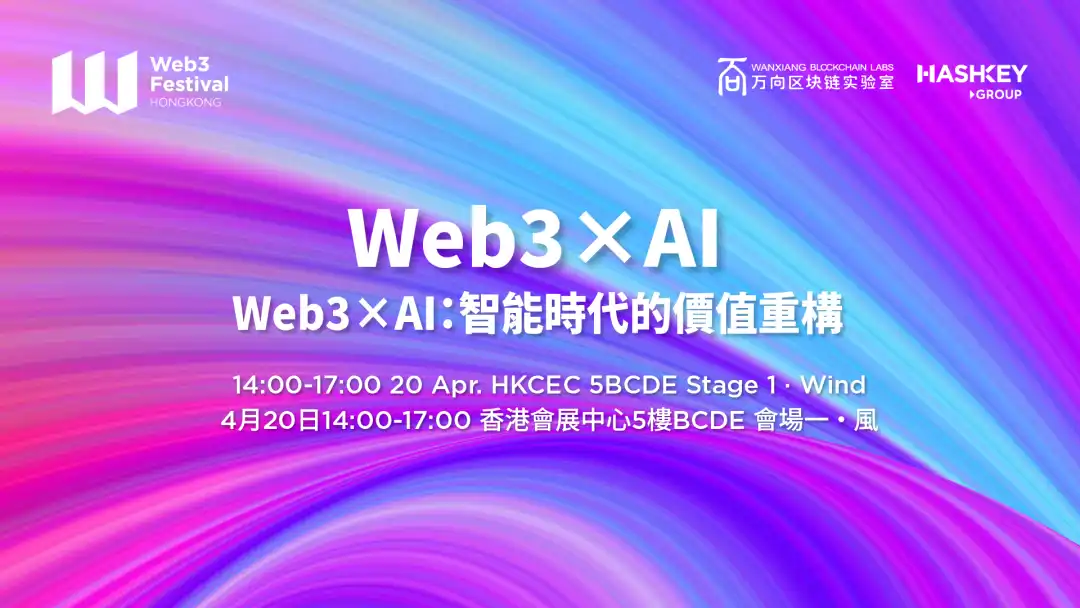
On the afternoon of April 20th, Venue 1·Feng at the 2026 Hong Kong Web3 Carnival will host the "Web3 x AI: Value Reconstruction in the Intelligent Era" thematic forum. It will bring together pioneering forces from the global AI and Web3 fields, from the "lobster secrets" at the Silicon Valley frontier to the underlying logic of enterprise practice, from practical experience in security collaboration to future previews of human-machine symbiosis. It will provide in-depth analysis and forward-looking insights, exploring the new possibilities of Web3 and AI integration in the intelligent era.

Silicon Valley AI tech blogger Lang Hanwei will reveal what Silicon Valley is using lobsters for, decoding the wildest cutting-edge trends overseas from a unique tech blogger's perspective. John, Head of Asia-Pacific at TON Foundation, will share innovative explorations of TON ecosystem and AI collaboration. Qtum Co-founder Miguel Palencia will break down how to drive AI and Web3 from the "lab" to the "application field," building efficient and collaborative technical bridges for developers and enterprises.

Cobo Co-founder and CTO Changhao Jiang, based on practical experience, will thoroughly explain the collaboration between Web3 security and AI, safeguarding the steady progress of the integrated ecosystem. MaxQuant CEO Jeffery Zeng will focus on the innovative application of AI technology in asset analysis and risk control, showcasing the new value of finance and technology integration. Anoma Co-founder Adrian Brink will also explore the future blueprint of AI and Web3 symbiosis, leading the decentralized ecosystem to new intelligent heights.

In addition to keynote speeches that address core issues, high-quality roundtable discussions will bring together industry elites to discuss the central topics of current AI and Web3 integration.

On one side is AI's centralized reliance on data, computing power, and models; on the other is Web3's pursuit of decentralization, privacy, and rights confirmation. Are the two naturally complementary, or is it a "forced match"? Hosted by Gen Labs Limited CEO He Xiaoyang, alongside guests including Keywolf, Partner and Product Head of SlowMist, and Michael Yung, Strategic Advisor at Google Cloud, the roundtable discussion "Does AI Really Need Web3?" will take place. From data privacy and decentralized computing power to value rights, it will dissect the complementary space between AI and Web3, explore possible paths from "technological overlay" to "value symbiosis," and interpret the new changes in Web3 security in the AI era.

As AI Agents rapidly penetrate various industries, human-computer interaction is undergoing a revolution of "disappearing interfaces." From the "you-click, I-search" GUI, to the "you-say, I-do" conversational interface, and further to the "you-think, I-act" autonomous Agent, what exactly does the ultimate form of human-computer interaction look like? Guests including Zolo Xiong, Co-founder of Deep Chao TechFlow, KK, COO of Virtuals Protocol, Cindy Shi, CMO of Kite AI, and Bob, CEO of Questflow, will discuss topics such as the autonomy of AI Agents, user incentives, and experience. They will break down how AI Agents are breaking the boundaries of traditional human-computer interaction and reconstructing new paradigms for production, life, and industrial operations.

Value reconstruction in the intelligent era does not wait for bystanders; the best opportunities are always reserved for those who are present. This time, stand shoulder-to-shoulder with top global tech guests, penetrate the fog of technology, decode the core secrets of Web3 and AI integration, and jointly discover new possibilities for value in the intelligent era.


İlgili Sorular

QWhat is the main theme of the 'Web3×AI: Value Reconstruction in the Intelligent Era' forum at the 2026 Hong Kong Web3 Festival?

AThe forum focuses on the convergence of AI and Web3 technologies, exploring how their integration can revolutionize value creation, distribution, and re-evaluation, featuring discussions on AI agents, decentralized ecosystems, security, and practical applications.

QWhich speakers will discuss the practical implementation of AI and Web3 technologies moving from 'laboratory to application field'?

AMiguel Palencia, Co-founder of Qtum, will address how to drive AI and Web3 from the 'laboratory' to the 'application field,' building efficient technical bridges for developers and enterprises.

QWhat specific topic will Changhao Jiang, CTO of Cobo, cover regarding AI and Web3 integration?

AChanghao Jiang will share practical experiences on the synergy between Web3 security and AI, focusing on safeguarding the robust development of the integrated ecosystem.

QWhat is the central debate question in the roundtable discussion 'Does AI Really Need Web3?'

AThe roundtable debates whether AI's centralized reliance on data, computing power, and models is naturally complementary or fundamentally incompatible with Web3's pursuit of decentralization, privacy, and value attribution.

QHow will the panel on AI Agents address the evolution of human-computer interaction?

AThe panel, featuring experts like Zolo Xiong and KK, will discuss how AI Agents are transforming interaction from GUI to conversational interfaces and autonomous agents, breaking traditional boundaries and reshaping paradigms in production and daily life.

İlgili Okumalar

Who Decides the Rules of Bitcoin? BIP-110 Ignites Governance Debate

Bitcoin's governance is once again at the center of a heated debate, this time ignited by BIP-110, the "Reduced Data Temporary Softfork." This proposal aims to curb non-monetary data (like inscriptions and Runes) by introducing seven new consensus-layer restrictions over a year, such as limiting new output scripts to 34 bytes and restoring the OP_RETURN cap to 83 bytes. The controversy stems from BIP-110's fundamental shift: it moves the battle against "spam" from node relay and miner policies to the consensus layer, rendering currently valid transactions invalid. Supporters, arguing that default policy governance has failed (highlighted by Bitcoin Core v30's relaxation of OP_RETURN limits), see this as necessary to protect node resources and Bitcoin's monetary focus. Opponents, led by figures like Michael Saylor and Adam Back, warn it dangerously centralizes governance. Saylor listed 110 reasons against it, criticizing its low 55% miner activation threshold and potential for chain splits. Back emphasized Bitcoin's "permissionless" ethos, arguing no single group should impose value judgments via consensus rules. Further complicating matters, technical critiques suggest BIP-110 may be technically circumventable, and a "BlockSlop" vulnerability in its upgrade path poses a consensus risk. The debate has drawn in diverse stakeholders: miners (with pools like Ocean signaling support and Foundry polling clients), node operators (like Bitcoin Knots), and new players like corporate treasury holder MicroStrategy (Saylor), whose market influence adds a novel dimension. Ultimately, BIP-110 acts as a governance stress test, exposing the unresolved question: who decides Bitcoin's rules? It pits the authority of miners, node operators, developers, and capital holders against each other, with each side claiming to defend Bitcoin's core principles of neutrality and security.

marsbit7 dk önce

Who Decides the Rules of Bitcoin? BIP-110 Ignites Governance Debate

marsbit7 dk önce

Who Decides Bitcoin's Rules? BIP-110 Ignites Governance Debate

Title: Who Decides Bitcoin's Rules? BIP-110 Ignites Governance Debate A new technical proposal, BIP-110 (Reduced Data Temporary Softfork), has sparked a fundamental governance debate within the Bitcoin community. It aims to impose new consensus rules for one year to limit non-financial data (like inscriptions and Runes) on-chain, moving beyond simple node and miner policy filters to invalidate currently valid transactions. Supporters argue that default policies have failed due to workarounds, necessitating consensus-layer changes to protect Bitcoin's core monetary function from data spam. Critics, including Michael Saylor and Adam Back, contend this dangerously centralizes judgment, undermines permissionlessness, and sets a risky governance precedent. They advocate for market-based solutions like fees or Layer 2s instead. The debate exposes deeper tensions: miners are divided on activation; node operators assert their sovereignty; Bitcoin Core developers influence defaults without direct accountability; and large corporate holders like MicroStrategy now wield narrative influence. Technically, BIP-110 may not fully block data and carries a disclosed consensus bug risk. Ultimately, BIP-110 acts as a stress test, forcing the community to confront the unresolved question: who legitimately decides what Bitcoin is and how it evolves, amidst competing claims from miners, nodes, developers, and capital holders.

链捕手19 dk önce

Who Decides Bitcoin's Rules? BIP-110 Ignites Governance Debate

链捕手19 dk önce

Zcash's New Node Zakura Goes Live: Privacy Payments Can Reach 50,000 TPS, Aiming to Rival Visa and Mastercard

Zcash, a privacy-focused cryptocurrency, has launched a new full node software called Zakura version 1.0.0. Developed by Zcash co-founder Sean Bowe and Dev Ojha, with private ZEC donations, its goal is to enable Zcash to process over 50,000 transactions per second (TPS)—matching the scale of Visa and Mastercard—while maintaining full transaction privacy and verifiability. This addresses a key bottleneck, as Zcash currently handles only about 1 private transaction per second. Zakura is a fork of the Zcash Foundation's Zebra node. It features chain pruning and snapshots, reducing disk usage and allowing new nodes to sync in under two minutes. It also offers compatibility with the legacy `zcashd` client interface. The scalability challenge stems from the large data size of privacy proofs. Bowe's Tachyon project aims to use recursive proofs to reduce consensus-layer data needs from ~500 MB/s to ~100 MB/s. For wallet scalability, Valar Group is researching Private Information Retrieval (PIR) tech to allow wallets to fetch their data privately. Zakura supports fast block propagation and the upcoming "Ironwood" network upgrade (NU6.3), scheduled for activation around July 28th. Ironwood was created to contain a critical inflation bug discovered in the Orchard shielded pool in May 2024. The fix uses "turnstiles" to trap any counterfeit ZEC created during the vulnerability period within the shielded pool, preventing it from entering circulation and restoring supply integrity.

marsbit33 dk önce

Zcash's New Node Zakura Goes Live: Privacy Payments Can Reach 50,000 TPS, Aiming to Rival Visa and Mastercard

marsbit33 dk önce

Replicating the "DeepSeek Moment"? Wall Street Unanimously Says: Kimi K3 Instead Strengthens Computing Power Demand

Title: Wall Street Sees Kimi K3 as a Catalyst for Compute Demand, Not a "DeepSeek Moment 2.0" Summary: Following the release of Moonshot AI's powerful open-source model Kimi K3, initial market reaction mirrored the "DeepSeek moment" that sparked a sell-off in compute stocks earlier in 2025, fearing reduced demand for AI infrastructure. However, major Wall Street banks including UBS, Nomura, BofA, and Citi argue the opposite: K3 will accelerate, not weaken, demand for compute, memory, storage, and networking. Their analysis centers on K3's specifications—2.8 trillion parameters, 1M token context, and MoE architecture—which represent a "scale" story rather than a pure "efficiency" one like DeepSeek R1. These features increase pressure on inference, memory (especially KV cache), and storage. Analysts invoke Jevons Paradox: as high-quality models become more affordable (K3 is cheaper than top closed models but not the cheapest), usage and token volumes expand, ultimately increasing total compute consumption. The reports highlight that competition will force leading US AI labs (OpenAI, Anthropic, Google) to invest more in training and iteration to maintain their edge. Furthermore, the rise of capable open-source models like K3 is expanding the global AI developer ecosystem, with Chinese models now accounting for over 45% of developer traffic. Key beneficiaries identified across the AI infrastructure chain include memory/storage players (e.g., Micron, Samsung), compute leaders (Nvidia, TSMC), networking suppliers (due to "super-node" cluster needs for deploying K3), and cloud platforms (e.g., Alibaba) that host diverse model ecosystems. The consensus is that stronger open-source models are an entry point for the next wave of infrastructure demand diffusion, provided workload growth outpaces efficiency gains.

链捕手37 dk önce

Replicating the "DeepSeek Moment"? Wall Street Unanimously Says: Kimi K3 Instead Strengthens Computing Power Demand

链捕手37 dk önce

İşlemler

Spot
活动图片