Author: David, Shenchao TechFlow
Original Title: From 6000 Points to Two "Circuit Breakers": South Korea's Semiconductor Myth Paused by a Middle Eastern Missile
As the US-Iran conflict continues, global capital markets are panicking, with the South Korean stock market performing particularly badly.
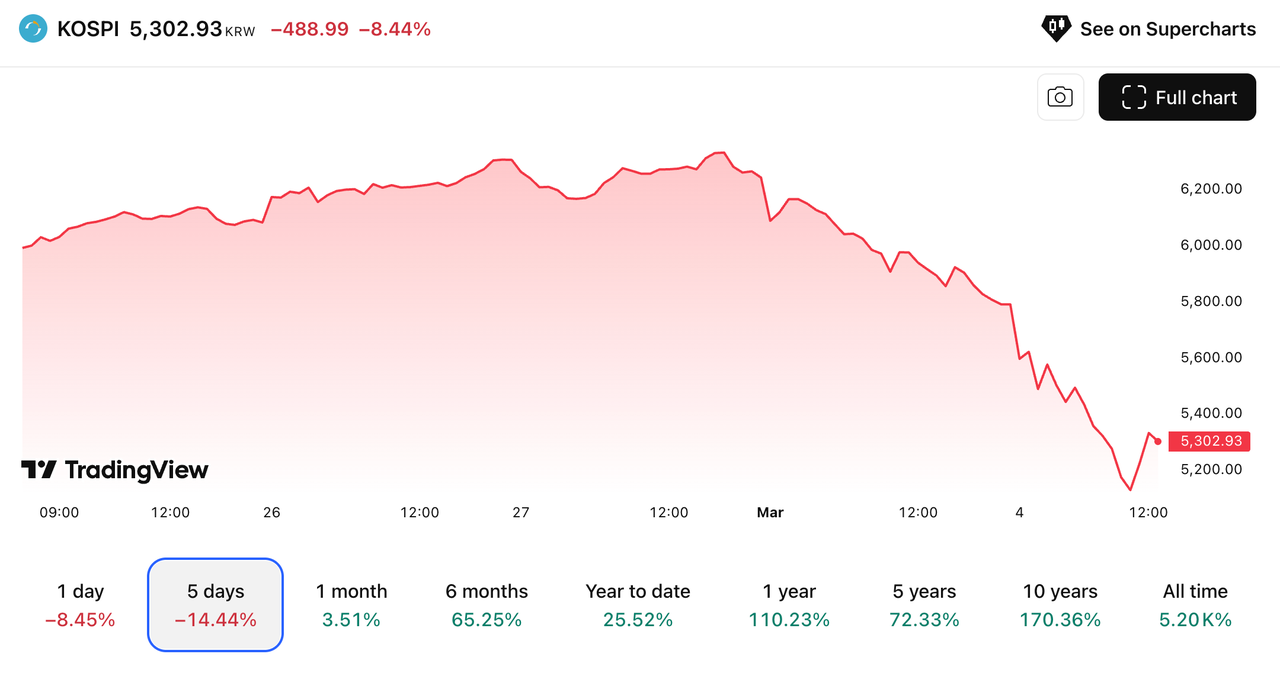
On March 3, the Korea Composite Stock Price Index (KOSPI) fell 7.24%, triggering trading limits. Samsung Electronics fell nearly 10%, and SK Hynix fell 11.5%;
On March 4, which is today, the KOSPI fell over 8% during the session, triggering another circuit breaker and halting trading for 20 minutes. It closed down about 6% at 5440 points. Samsung fell another 5.1%, and Hynix fell another 3.9%.
Two trading days, two circuit breakers. The South Korean stock market fell from 6244 to 5440, a drop of nearly 13%. This is the worst consecutive plunge since 2008.
Yet just a week earlier, on February 25, the KOSPI had just broken through 6000 points. The total market capitalization of the South Korean stock market rose to 3.76 trillion USD, surpassing France to rank ninth globally; Samsung and Hynix were still the most recommended stocks by investment bloggers.
The Middle East is at war, global markets are falling, but why is South Korea falling the hardest?
Buying Korean Stocks is Buying Memory
The bull market in the South Korean stock market over the past year is, simply put, the story of two companies.
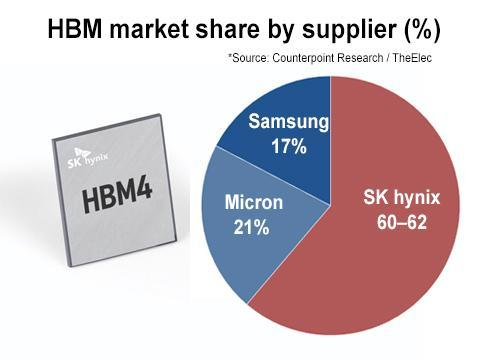
Global AI training requires GPUs, and GPUs require a type of high-bandwidth memory called HBM. The production barrier for this is extremely high, and there are essentially only three companies in the world that can mass-produce it: SK Hynix, Samsung, and Micron.
Among them, SK Hynix alone captures over half of the market share, Samsung about 30%. Combined, the two South Korean companies control over 80% of the global HBM market capacity.
Nvidia is their biggest customer. Every H100, every B200 shipped requires Korean memory. In 2025, Nvidia's quarterly revenue reached 68.1 billion USD, a significant portion of which ultimately flowed into the pockets of SK Hynix and Samsung.
Reflected in the stock prices: in 2025, SK Hynix rose 274%, Samsung rose 125%. The entire KOSPI index rose 75.6%, with nearly half of the gains contributed by these two stocks.
Buying the Korean大盘 (broad market) is essentially buying memory chips.
This year is even more intense. In the first 20 days of February, South Korea's chip export value surged 134% year-on-year to 15.1 billion USD, accounting for over one-third of total exports. Goldman Sachs said that in 2026, South Korean stock market profit growth is expected to be 120%, with 88 percentage points coming from tech hardware.
Translated: remove chips, and the growth of the South Korean stock market is just a fraction.
It took KOSPI 34 days to go from 5000 to 6000 points. During these 34 days, Nomura Securities called for a target price of 8000, J.P. Morgan said 7500, Goldman Sachs adjusted to 6400. Behind each number is the same assumption:
AI computing power demand has no ceiling, so Korean chips have no ceiling.
Close the Strait, Where Does the Power Come From
But making chips requires electricity.
Where does South Korea's electricity come from? Natural gas and coal each account for about 27%, nuclear power about 30%. South Korea produces neither natural gas nor coal itself; it relies entirely on imports. South Korea is the world's third-largest liquefied natural gas (LNG) importer, after China and Japan.
On February 28, the US and Israel jointly launched airstrikes on Iran. After Khamenei's death was confirmed, Iran announced the closure of the Strait of Hormuz.
This strait is 33 km wide at its narrowest point. About one-fifth of the world's oil and a large amount of LNG pass through it. Qatar is one of the world's largest LNG exporters and a major source for South Korea; its ships must pass through this strait to leave port.
Close the strait, oil prices soar first, natural gas follows; the global energy market has always been interconnected.
Public information shows European natural gas prices rose nearly 50%, Asian natural gas prices rose nearly 40%. Major supplier Qatar Energy suspended LNG production after its facilities were attacked.
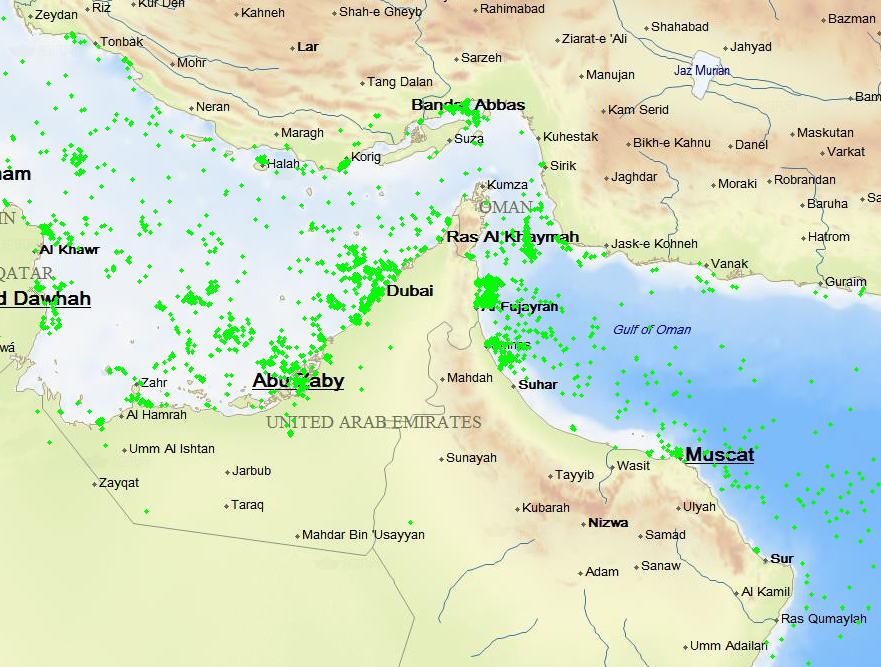
Fig: Ship tracking data shows the number of vessels transiting the Strait of Hormuz dropped significantly on March 1 local time | Source: Ship Search Network
Samsung and Hynix chips are not created out of thin air. One HBM goes through thousands of processes from wafer to packaging, each consuming electricity. Semiconductor manufacturing is one of the most energy-intensive industries in the world.
Theoretically, the chain is like this:
Nvidia places an order, SK Hynix starts work, the factory needs electricity, power generation needs natural gas, natural gas needs to pass through the Strait of Hormuz, the strait is now closed.
The Korean market was closed on March 1, coinciding with their Samiljeol holiday. Other markets panicked all weekend, Korean investors could only watch.
Tuesday opening, three days of panic compressed into one bearish candlestick. Samsung fell nearly 10%, Hynix fell 11.5%. Gas prices rise, electricity prices must rise, chip margins are eaten into, factory utilization rates are also in doubt.
Wednesday was worse. Iran moved from threat to action, actually interfering with strait shipping. Brent crude rose above 82 USD, natural gas also began to soar. Samsung fell nearly 15% over two days, Hynix fell 15%.
But in the same Korean exchange, Hanwha Aerospace rose nearly 20% on March 3, LIG Nex1 rose 30% hitting the upper limit.
These two companies, the former makes fighter jets and missile engines, the latter makes air defense systems and precision-guided weapons. The Middle East is at war, the whole world needs to replenish inventories.
On one side, chip makers are falling; on the other, missile makers are rising.
Has the Korea Discount Disappeared?
The South Korean stock market has a nickname: the "Korea Discount".
It means the same company, listed in South Korea, is cheaper than if listed in the US or Japan. Samsung Electronics and TSMC are both chip giants with similar profitability, but TSMC's price-to-book ratio has long been two to three times that of Samsung.
You can understand it as the same dish being cheaper in Seoul than in New York.
Why? Because South Korea's large companies are almost all controlled by chaebol families. Samsung, Hyundai, SK, LG—the founding families use pyramid-style cross-shareholdings to control the entire group with very few shares.
Earnings aren't paid as dividends, treasury shares aren't canceled, the board is filled with their own people, independent directors haven't cast a single dissenting vote in five years. Foreign investors look at this and think investing money is just working for someone else, forget it.
How long has this discount lasted? Over the past decade, the S&P 500 rose 179%, the Nikkei rose 155%, India rose 255%, even Brazil rose 167%.
KOSPI rose only 35%.
In 2025, the new president, Lee Jae-myung, took office, amended commercial law, forced dividends, mandated cancellation of treasury shares, and flew to the New York Stock Exchange to tell Wall Street: the Korea Discount will become the Korea Premium.
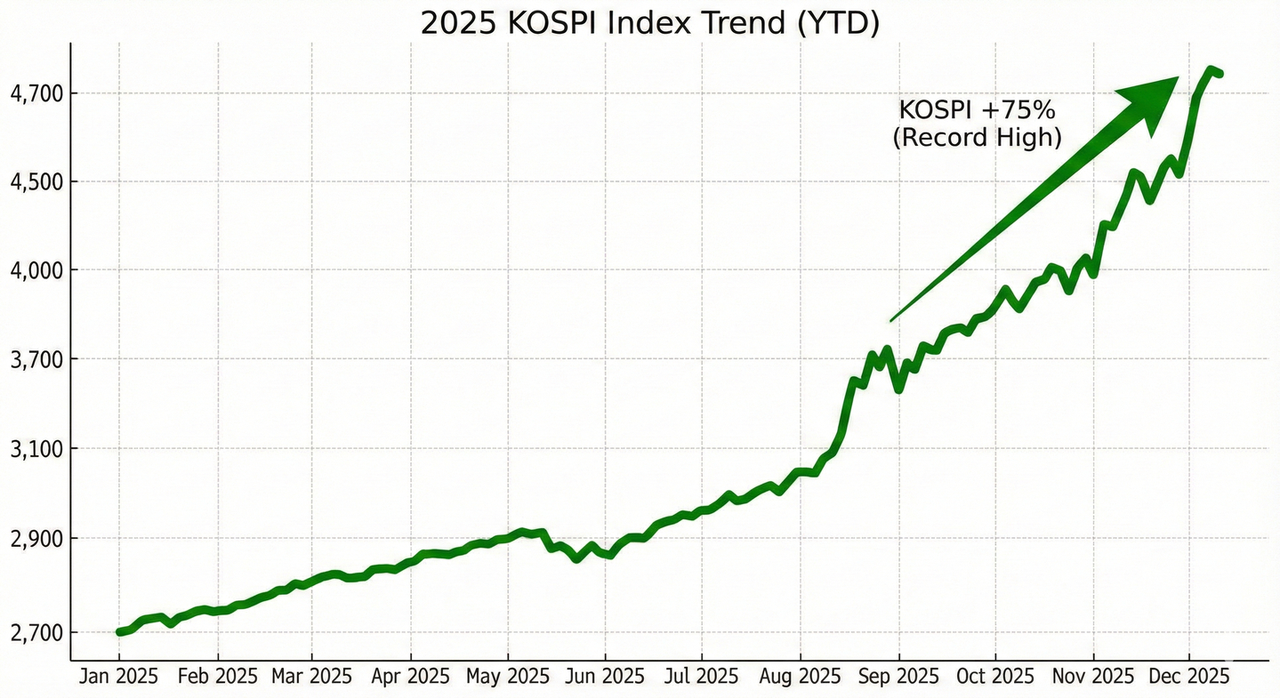
At the same time, AI completely rewrote the valuation logic for Samsung and Hynix. The two things collided, foreign capital poured in, KOSPI rose 75.6% in a year, number one globally.
A discount of over twenty years seemed to be erased in one year.
But two consecutive days of暴跌 (plunge) reveal another problem: the previous discount was due to poor corporate governance in Korean listed companies, and governance is indeed being reformed.
But there is another layer of discount, hidden deeper.
In South Korea, two stocks carry half the market's gains, power generation relies on imported natural gas and coal, the entire market is bet on one industry.
When the world outside this industry has an incident, it results in consecutive circuit breakers. The fragility written into South Korea's geography and industrial structure is difficult to change just by amending commercial law.
Foreign Capital Withdraws, Retail Investors Buy the Dip
On February 27, foreign capital net sold 6.8 trillion won in the Korean market,刷新 (refreshing/breaking) the single-day record. On March 3, they sold another 5.1 trillion won. Two days合计 (combined) nearly 12 trillion won, equivalent to 8.5 billion USD, half of the inflow over 6 weeks, gone in less than two days.
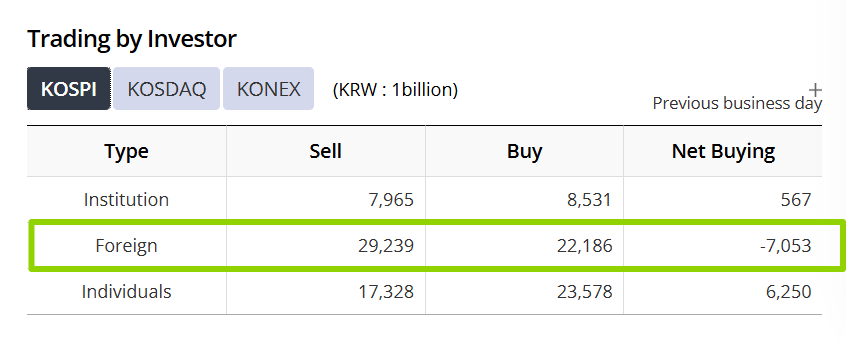
Foreign capital's affection for emerging markets has always been conditional. When conditions are good, they call you the core of the global AI supply chain; when conditions change, you are the most liquid, most convenient item to sell in the portfolio.
The Korean stock market is active and has high trading volume. Precisely because it's easy to sell, it's the first to be sold.
So who is buying?
On March 3, retail investors net bought 5.8 trillion won. Foreign capital fled, South Korean retail investors rushed in. Someone on a Seoul forum said Samsung at this price is a once-in-a-decade opportunity.
The next day it fell another 6%,一度 (at one point) falling 8% during the session triggering a circuit breaker. Those who rushed in on March 3 lost another chunk within 24 hours. On March 4, retail investors continued to bottom-fish, but could not stop the foreign selling pressure.
The last time Korean retail investors大规模 (large-scale) bottom-fishing was during the August 2024 Yen carry trade collapse. That time they were right, it came back in a month. Whether they are right this time may depend on a variable they完全控制不了 (have no control over whatsoever):
When the Strait of Hormuz will reopen.
Sentiment is More Important Than Facts
KOSPI took 34 days to go from 5,000 to 6,000, and 2 days to fall from 6,000 to 5,440.
Two days, two circuit breakers.
The energy chain is real: natural gas needs to pass through the Strait of Hormuz, chips rely on electricity from natural gas.
But a 13% drop in two days is no longer pricing in natural gas. A market where 75% of the gains are supported by two stocks, everyone crowded in the same direction, the exit is only so big.
It rose too much before. When panic strikes, whoever runs fast survives first.
SK Hynix will likely rise again. AI's computing power demand is real, the HBM shortage is real, Nvidia's orders next quarter won't disappear because of a Middle East war.
But these two days tell everyone one thing: the rise back depends on fundamentals, the fall depends on sentiment. Fundamentals move slowly, sentiment moves fast. Gains made over 34 days can be mostly lost in 2 days.
Everyone who buys Korean stocks thinks they are buying the红利 (dividend/benefit) of AI chips.
But for South Korea, the chips are grown on an economy that relies on imported natural gas for power, sold to a customer who might impose tariffs at any time, with a nuclear-armed neighbor next door.
All research reports will tell you what a stock is worth.
No research report will tell you what will happen in the world during the time you hold it.
Twitter:https://twitter.com/BitpushNewsCN
Bitpush TG Discussion Group:https://t.me/BitPushCommunity
Bitpush TG Subscription: https://t.me/bitpush