Blockchain Is South Korea’s New Fiscal Weapon — A Blow To Privacy?

bitcoinist2026-04-16 tarihinde yayınlandı2026-04-16 tarihinde güncellendi

Özet

South Korea is launching a pilot program to replace government expense credit cards with blockchain-based deposit tokens for treasury fund execution. This initiative, led by the Ministry of Finance and Economy, builds on a previous project with the Ministry of Environment. Deposit tokens are digital representations of bank deposits on permissioned blockchains, enabling programmable settlement, transparent tracking, and real-time reporting. Unlike CBDCs, they are issued by commercial banks. The pilot aims to enhance spending transparency, reduce intermediaries, and eliminate card-processing fees for small merchants. While improving efficiency, it raises privacy concerns. If successful, South Korea could become a model for blockchain-based fiscal systems.

South Korea is kicking off a pilot that will replace government expense credit cards with blockchain‐based deposit tokens.

Blockchain Goes TradFi?

The Ministry of Finance and Economy announced on an official press release that the pilot project for the execution of national treasury funds using blockchain‐based digital currency has been approved.

This new official venture marks the second time in which South Korea’s government uses digital currency and deposit tokens for the execution of national treasury funds, following another pilot project for building electric‐vehicle charging facilities and paying national subsidies together with the Ministry of Environment.

Deposit tokens are digital claims on commercial bank deposits, issued on permissioned blockchain rails, spendable by citizens and companies at participating merchants and service providers.

In simpler words, deposit tokens are digital versions of the money already kept in a normal bank account. The bank “wraps” those deposits into tokens on a private (permissioned) blockchain, and you can then spend those tokens at approved shops or service providers, just like using a card or mobile wallet.

In contrast with Central Bank Digital Currencies (CBDCs), that are digital versions of a country’s official money, created and managed directly by its central bank, deposit tokens have programmable settlement, transparent tracking of public money, and real‐time reporting for the state.

Pilot Details

The press release states that under the current National Treasury Funds Management Act, business promotion costs and related operating expenses are required to be paid with government purchase cards, effectively blocking the use of deposit tokens. Thanks to the new regulatory sandbox, those same payments can now be made with deposit tokens, creating a real‐world testbed for a new government payment and settlement method.

The new pilot is expected to serve as an opportunity to put blockchain‐based fiscal execution on a full footing and eliminate frictions in the current card‐payment setup by using blockchain’s built‐in transparency.

Quoting the press release, translated by Bitcoinist:

This pilot will allow us to preset and manage in advance the spending time and permitted business categories when business promotion expenses are executed using deposit tokens that leverage blockchain technology. This is not only expected to improve the transparency of spending but, by eliminating intermediaries in the payment structure, completely remove card‐processing fees borne by small merchants.

A Trade-Off For Traders

South Korea continues moving ahead with its Digital Asset Basic Act, a broad crypto rulebook that will set standards for stablecoins, tokenized real‐world assets, and crypto ETFs in the local market. A few weeks ago, the National Policy Committee of Korea pushed the “second‐phase” of the debate until after the June 3 local elections.

The trade‐off for South Korean traders is evident: they gain efficiency and control vs. losing some privacy and risking potential overreach. It is safe to expect tailwind for bank‐chain infrastructure, permissioned blockchain providers, and tokenization narratives.

Future “state money on chain” flows may favor bank‐issued tokens over fully open stablecoins, which could reshape liquidity, FX corridors, and on‐chain yield strategies.

If the pilot scales, South Korea could become the reference model for how blockchains handle real‐world fiscal flows.
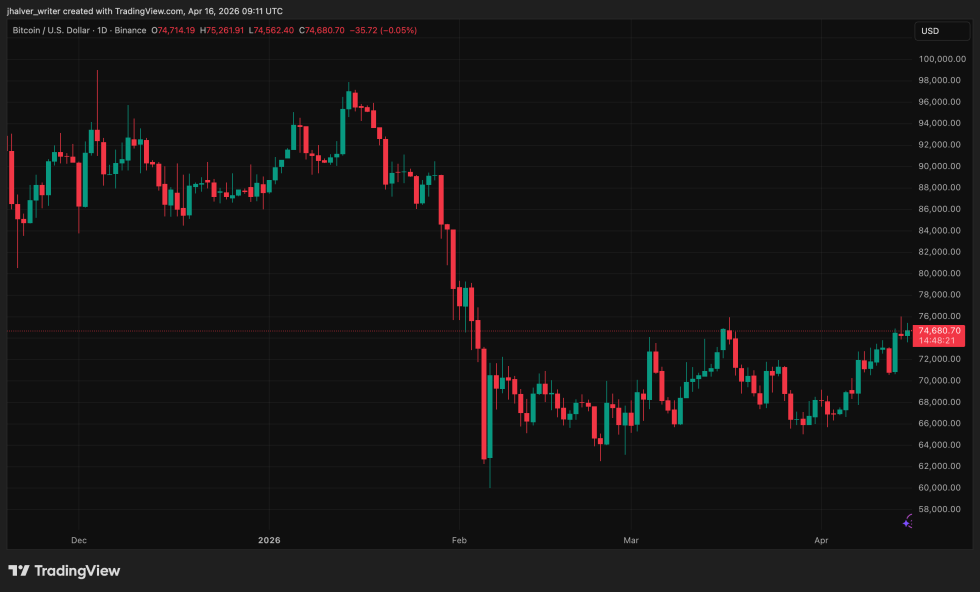
At the moment of writing, BTC trades for the highs $74ks on the daily chart. Source: BTCUSD on Tradingview.

Cover image from Perplexity. BTCUSD chart from Tradingview.

İlgili Sorular

QWhat is the South Korean government piloting to replace government expense credit cards?

AThe South Korean government is piloting the use of blockchain-based deposit tokens to replace government expense credit cards.

QHow do deposit tokens differ from Central Bank Digital Currencies (CBDCs)?

ADeposit tokens are digital claims on commercial bank deposits issued on permissioned blockchains, while CBDCs are digital versions of a country's official money created and managed directly by its central bank. Deposit tokens offer programmable settlement, transparent tracking, and real-time reporting.

QWhat are the expected benefits of using blockchain-based deposit tokens for government spending according to the press release?

AThe benefits include improved spending transparency by allowing preset management of spending time and permitted business categories, and the elimination of card-processing fees for small merchants by removing intermediaries.

QWhat is the potential trade-off mentioned for South Korean traders in adopting this system?

AThe trade-off is that traders gain efficiency and control but may lose some privacy and risk potential government overreach.

QWhat broader legislative framework is South Korea advancing alongside this pilot project?

ASouth Korea is advancing the Digital Asset Basic Act, a comprehensive crypto rulebook that will set standards for stablecoins, tokenized real-world assets, and crypto ETFs in the local market.

İlgili Okumalar

In Jinjiang, Fujian, a Storage Super Unicorn Lies Quiet

In Fujian's Jinjiang, a city known for sportswear, lies a quiet semiconductor giant: Fujian Jinhua Integrated Circuit Co. (JHICC). Once a promising domestic DRAM manufacturer alongside Yangtze Memory and ChangXin Memory Technologies (CXMT), its journey was derailed in 2018 when the U.S. placed it on an Entity List and filed criminal charges for alleged trade secret theft. This halted production for years. A turning point came in February 2024 when a U.S. federal court found JHICC not guilty. However, it had lost crucial time. While CXMT soared to become a top-valued A-share company in 2024, JHICC, with an estimated valuation of 80 billion RMB, was just restarting. Its current output is primarily customized DDR4 chips, not the advanced DDR5/HBM demanded for AI, but it still benefits from the broader memory chip upcycle. JHICC's story is tied to Chen Zhengkun, a veteran engineer who left Micron to lead the venture. Founded in 2016 with state-backed funding, JHICC partnered with Taiwan's UMC to develop DRAM technology. Rapid progress was cut short by the U.S. actions, which Micron initiated, partly due to its heavy reliance on the Chinese market. Post-sanctions, Chen's team worked to rebuild the production line with reduced reliance on U.S. technology. According to its records, JHICC achieved small-scale production and revenue growth under immense pressure. It now focuses on the stable "niche" DRAM market (e.g., TVs, routers) with a monthly capacity of ~40,000 wafers, aiming for 60,000 by 2026. It holds over 1,000 patents but remains on the Entity List. For Jinjiang, investing in JHICC was a bold industrial leap. The local government provided unwavering financial and logistical support during the crisis, helping the company survive. JHICC has become the anchor for a growing local semiconductor cluster. Though its scale lags behind domestic peers, JHICC's persistence symbolizes a hard-won foothold in a global market long dominated by Samsung, SK Hynix, and Micron. Having missed one boom, it seeks a place in the new AI-driven memory supercycle.

marsbit1 saat önce

In Jinjiang, Fujian, a Storage Super Unicorn Lies Quiet

marsbit1 saat önce

İşlemler

Spot
活动图片





