Original fromEli5DeFi
Compiled by | Odaily Planet Daily Golem(@web 3_golem)

As 2025 draws to a close, major crypto research institutions are releasing reports and making predictions on industry trends for the coming year, forming a new consensus: the era of pure speculation is fading, replaced by structural maturation, driven not by short-term profit motives but by liquidity convergence, infrastructure development, and integration.
Odaily Planet Daily has compiled the core predictions for 2026 from five research institutions—Coinbase, A16Z Crypto, Four Pillars, Messari, and Delphi Digital:
- End of the Four-Year Cycle: Research institutions unanimously agree that the four-year speculative halving cycle is fading. It is being replaced by structural maturation, where value will flow to "ownership tokens" with profit-sharing models and projects with practical utility, rather than being driven by short-term gains.
- Rise of the Agent Economy: Major research institutions (Delphi Digital, a16z, Coinbase) predict that AI agents will become primary economic actors. Market focus may shift to KYA (Know Your Agent) identity protocols and machine-native settlement layers.
- Super Apps: With the clarification of US regulatory policies (Four Pillars, Messari), complex crypto experiences will be simplified into user-friendly "super apps" and privacy-preserving blockchains, thus abstracting away the technology to enable mass adoption.
Delphi Digital 2026 Outlook
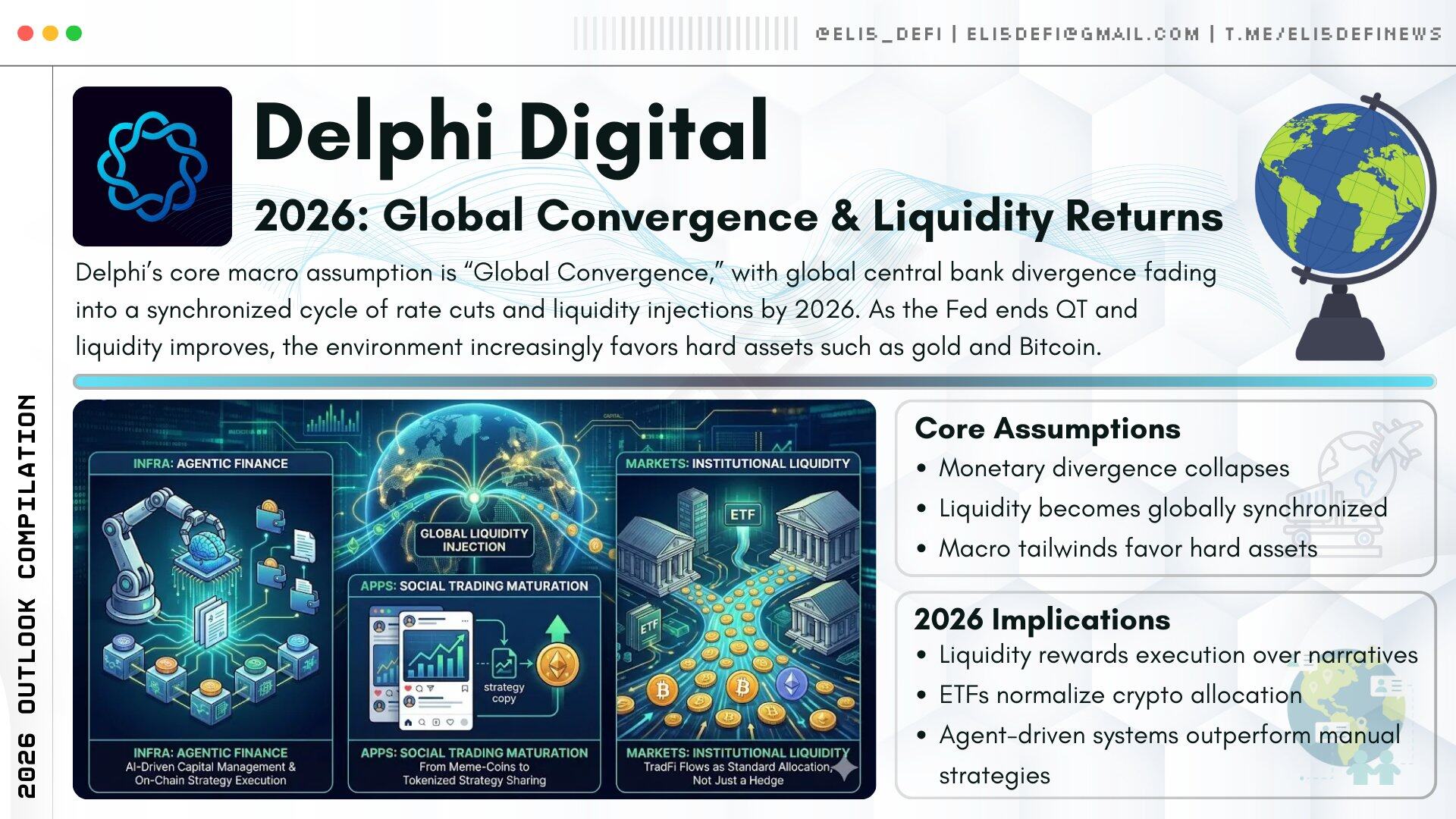
Delphi Digital bases its outlook on a "global convergence" macro assumption. They predict that by 2026, the divergence in global central bank policies will end, shifting towards a unified cycle of interest rate cuts and liquidity injection. As the Federal Reserve ends quantitative tightening (QT) and global liquidity improves, the market environment will favor hard assets like gold and Bitcoin.
Agent Economy
A major expansion of infrastructure is the rise of the "agent economy." AI agents will no longer be just chatbots but will actively manage funds, execute complex DeFi strategies, and optimize on-chain yields without human intervention.
Social Trading and the "Pump" Economy
On the consumer application front, Delphi highlighted the user stickiness of platforms like pump.fun and predicts that "social trading" will mature. This trend will evolve from simple meme coin gambling to complex copy-trading tiers, with strategy sharing becoming a tokenized product.
Institutional Liquidity
Market structure will be altered by the deepening adoption of ETFs, with traditional finance liquidity flowing into the crypto market not just as a hedge but as a standard portfolio allocation driven by macro liquidity easing.
Full report link: https://members.delphidigital.io/reports/the-year-ahead-for-infra-2026
Messari 2026 Outlook
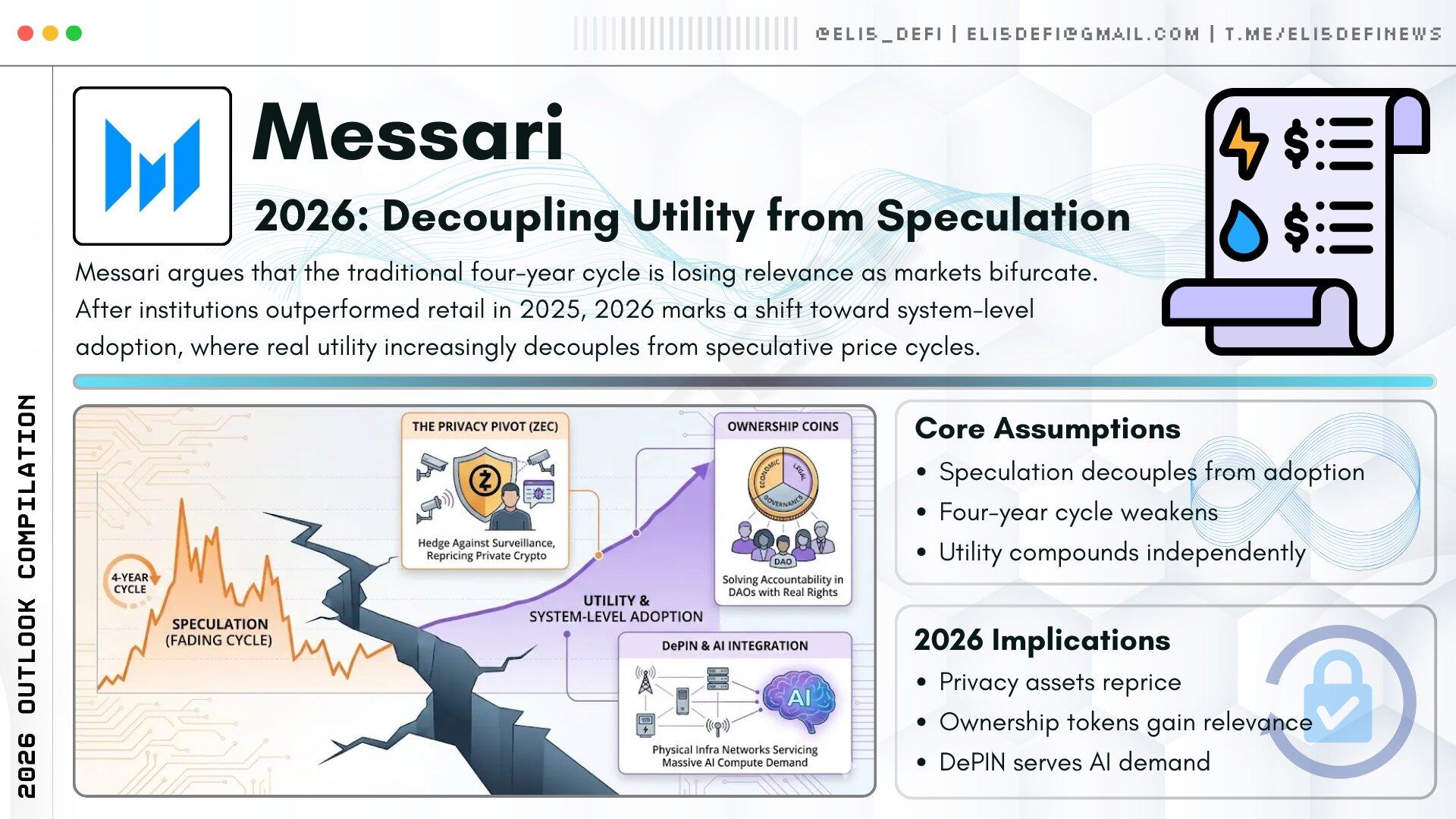
Messari's core thesis is the "decoupling of utility and speculation." They argue that as the market bifurcates, the relevance of the "four-year cycle" model is diminishing. They posit that 2025 was a year where institutional investors won and retail investors struggled, setting the stage for 2026 to be about "system-level adoption" rather than mere asset price speculation.
Rise of Privacy Coins ($ZEC)
A contrarian expansion trend is the renaissance of privacy. Messari emphasizes that Zcash (ZEC) and similar assets are not just "privacy coins" but necessary hedges against growing surveillance and corporate control, predicting a repricing of "private cryptocurrencies."
Ownership Tokens
2026 will see the emergence of a new category—"ownership tokens"—which combine economic, legal, and governance rights. Messari believes ownership tokens can address the accountability crisis in DAOs and potentially spawn the first billion-dollar projects in this specific niche.
DePIN and AI Convergence
This thesis focuses on DePIN (Decentralized Physical Infrastructure Networks), expecting these protocols to find real product-market fit by meeting the massive computational and data demands of the AI sector.
Full report link: https://messari.io/report/the-crypto-theses-2026
Four Pillars 2026 Outlook
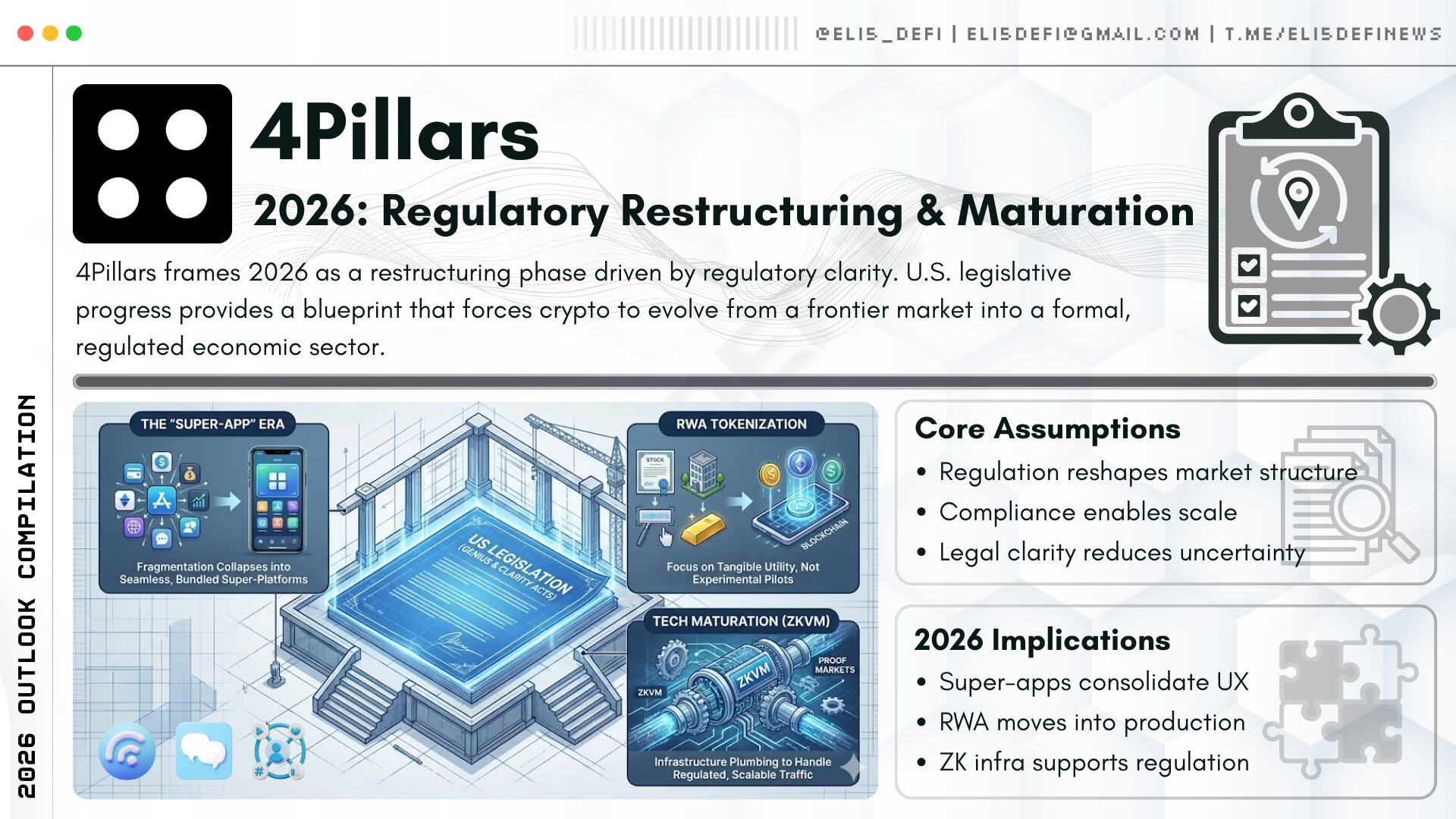
Four Pillars' outlook centers on "regulatory restructuring." Their core assumption is that US legislative initiatives (specifically mentioning the "GENIUS Act" and "CLARITY Act" in their predictions) will provide a blueprint for a comprehensive market overhaul.
This regulatory clarity is the catalyst for restructuring the market from a "Wild West" frontier into a formal economic sector.
The Era of "Super Apps"
Four Pillars predict that the fragmentation of crypto applications will finally coalesce into "super apps"—stablecoin-powered platforms that seamlessly integrate payment, investment, and lending functions. The complexity of blockchain will be completely abstracted away.
RWA Tokenization
Restructuring will drive the tokenization of equities and traditional assets, but the focus will be on actual utility, not experimental pilot programs.
Crypto Tech Maturation
On the technology side, they delve into the role of Zero-Knowledge Virtual Machines (ZKVM) on Ethereum and proof markets, seeing them as necessary infrastructure to handle the scale of this new, regulated institutional flow.
Full report link: https://4pillars.io/en/articles/2026-outlook-restructuring-100ys-perspective
Coinbase 2026 Outlook

Coinbase's report predicts the "end of the four-year cycle." They state clearly that 2026 will mark the end of the traditional Bitcoin halving cycle theory. Instead, the market will be driven by structural factors, macro demand for alternative stores of value, and the formalization of crypto as a mid-sized alternative asset class.
Tokenomics 2.0
A shift from "governance-only" tokens to "revenue-linked" models. Protocols will increasingly implement buyback-and-burn or fee-sharing mechanisms (compliant with new regulations) to align token holder incentives with platform success.
DAT 2.0 (Digital Asset Trading)
A move towards professionalized trading and "sovereign block space" procurement, treating block space as a key commodity for the digital economy.
AI and Crypto Intersection
Coinbase anticipates significant growth in AI agents using crypto payment rails. They predict the market will need "crypto-native settlement layers" capable of handling persistent micro-transactions between machines, which traditional payment rails cannot support.
Full report link: https://www.coinbase.com/en-sg/institutional/research-insights/research/market-intelligence/2026-crypto-market-outlook
a16z Crypto 2026 Outlook
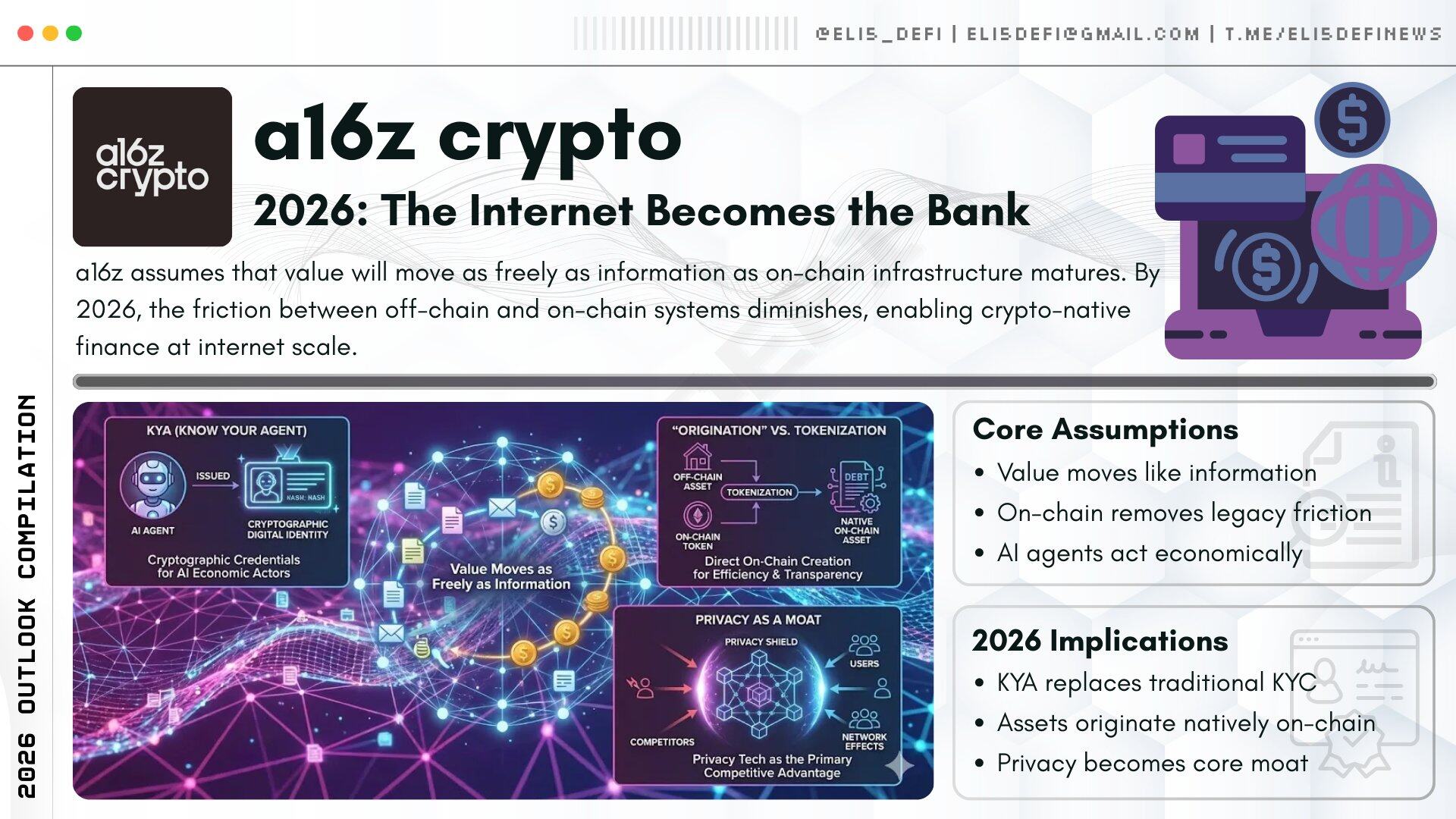
a16z crypto's outlook is that "the internet will become the bank." Their foundational belief is that value is beginning to flow as freely as information. They see the friction between the "off-chain" and "on-chain" worlds as the primary bottleneck, and 2026 will see this friction removed through better infrastructure.
KYA (Know Your Agent)
A key expansion is the shift from KYC (Know Your Customer) to KYA. As AI agents become primary economic participants, they will need cryptographically signed credentials to transact, creating a new layer of identity infrastructure.
"Native Bonds" vs. Tokenization
a16z predicts a future where instead of tokenizing off-chain assets as in the past (e.g., buying a treasury bill and putting it on-chain), debt and assets will be originated directly on-chain to lower the cost of service and increase transparency.
Privacy Tech Moat
They argue that in the era of open-source code, privacy technology (and the ability to protect state privacy) will become the most important competitive moat for blockchains, creating powerful network effects for privacy-enabled chains.
Wealth Management for All
The combination of AI and crypto infrastructure will democratize complex wealth management (e.g., asset rebalancing, tax-loss harvesting), previously accessible only to high-net-worth individuals, for the masses.
Full report link: https://a16zcrypto.com/posts/article/big-ideas-things-excited-about-crypto-2026/


















