Farewell to Buying Houses and Stocks: The Younger Generation Embraces Cryptocurrency as the Main Battlefield for Wealth

marsbit2025-12-17 tarihinde yayınlandı2025-12-17 tarihinde güncellendi

Özet

For decades, the traditional American wealth-building playbook—securing a good job, buying a home, and investing in stocks—has remained largely unchanged. However, a new report reveals that younger generations are increasingly skeptical of this path and are shifting their investment strategies accordingly. A survey of U.S. adults shows that younger investors, particularly Gen Z and millennials, are more proactive, open to non-traditional assets, and more likely to view cryptocurrency as a core component of their financial future. Nearly three-quarters (73%) believe it is harder to build wealth through conventional means compared to their parents' generation. This sentiment is reflected in their portfolios: younger investors allocate 25% of their investments to non-traditional assets like cryptocurrency, derivatives, and NFTs—three times the allocation of older investors. Almost half (45%) of young investors already hold crypto, compared to only 18% of older investors. Younger investors see crypto not as a speculative side investment but as a vital tool for wealth accumulation. Eighty percent believe it offers financial opportunities outside the traditional system and that it will play a significantly larger role in the future of finance. They are also more eager to explore emerging crypto-related products like derivatives, prediction markets, and DeFi. This generational shift is driving demand for more dynamic, internet-native financial platforms that operate around the c...

For decades, the path to wealth accumulation for Americans has remained almost unchanged: find a good job, buy property, invest in stocks, and wait for the power of compounding to work its magic. However, our latest "Cryptocurrency Industry Report" reveals that the younger generation of investors no longer believes in this traditional path and is adjusting their investment behavior accordingly.

To understand the market strategies of different generations and the role cryptocurrency plays in their investment portfolios, Coinbase partnered with Ipsos to conduct a specialized survey. The study interviewed 4,350 American adults, including 2,005 investors with investment accounts. The core findings are as follows: Younger investors, such as Gen Z and Millennials, are more inclined to actively manage their investments, more open to non-traditional assets, and more likely to view cryptocurrency as a core component of their financial future than any previous generation.
A Generation Shut Out of the Traditional Wealth Ladder

Younger investors are far more optimistic about the economy than older generations, but they believe the existing financial system is not designed for them. Survey data shows that nearly seven out of ten (73%) young people say it is more difficult for their generation to accumulate wealth through traditional means compared to their parents' generation; only 57% of older generations share this view.

They have witnessed soaring housing costs, overwhelming student debt, and sluggish wage growth. In this context, more and more young people are seeking alternative ways to accumulate wealth beyond the traditional model of "home equity + stock portfolio."

Non-Traditional Asset Allocation Three Times Higher Than Older Generations

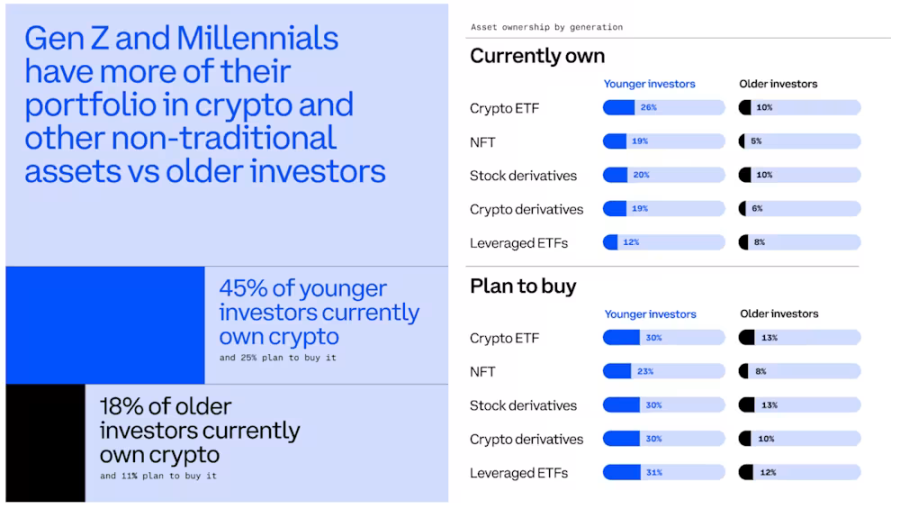
This anxiety is directly reflected in their asset allocation strategies. The survey shows that younger investors allocate 25% of their investment portfolios to non-traditional asset classes such as cryptocurrencies, financial derivatives, non-fungible tokens (NFTs), and other emerging products. This is three times the proportion allocated by older investors, who only allocate 8% to non-traditional assets.

The proportion of stock holdings is roughly similar across generations, but the key difference is that younger investors diversify their portfolios beyond stocks. They are more actively seeking returns beyond traditional stock dividends and are more willing to experiment with new investment tools and emerging markets to narrow the wealth gap.

Cryptocurrency Is Not a Side Hustle but a Core Allocation

This generational shift in investment philosophy is most evident in the acceptance of cryptocurrency. The report shows that 45% of young investors already hold cryptocurrency, compared to only 18% of older investors. Additionally, nearly half (47%) of young investors want to gain exposure to new crypto assets ahead of the general market, while only 16% of older investors share this desire.

In the eyes of the younger generation, cryptocurrency is not merely a speculative trade but an important tool to help them catch up in wealth accumulation. Eighty percent of young people believe that cryptocurrency provides their generation with more financial opportunities outside the traditional financial system. At the same time, another 80% are convinced that cryptocurrency will play a significantly larger role in the future financial system. Among older investors, only about 60% share this view.

The younger generation's enthusiasm for exploring emerging markets extends beyond spot cryptocurrencies; they are eager to engage with more non-traditional assets. Data shows that 80% of young investors are willing to try new investment opportunities ahead of others, while less than half of older generations share this attitude. Young investors consistently show strong interest in emerging non-traditional products such as cryptocurrency derivatives, prediction markets, 24/7 stock trading, early token offerings, altcoins, and decentralized finance (DeFi) lending.

The Impact of This Trend on Future Markets

The younger generation of investors has already demonstrated distinct characteristics: they trade more frequently, are willing to take greater risks for higher returns, and are shifting a significant portion of their investment portfolios to non-traditional assets centered around cryptocurrency. At the same time, they are driving the entire financial industry toward a transformation that meets the needs of the internet-native generation, creating platforms that operate around the clock and support diverse asset trading.


İlgili Sorular

QWhat is the main finding of the Coinbase and Ipsos survey regarding young investors' approach to wealth accumulation?

AThe survey found that young investors, particularly Gen Z and millennials, are more likely to actively manage their investments, are more open to non-traditional assets, and are more inclined to view cryptocurrency as a core component of their financial future, moving away from the traditional path of buying a home and investing in stocks.

QWhy do young investors feel the traditional financial system is not designed for them?

AYoung investors feel this way because they have witnessed rising housing costs, high student debt burdens, and stagnant wage growth, making it more difficult for them to accumulate wealth through traditional means like their parents did.

QHow does the allocation to non-traditional assets differ between younger and older investors?

AYounger investors allocate 25% of their portfolio to non-traditional assets like cryptocurrency, derivatives, and NFTs, which is three times the allocation of older investors, who only allocate 8% to such assets.

QWhat percentage of young investors hold cryptocurrency, and how do their views on its role differ from older investors?

A45% of young investors hold cryptocurrency, compared to only 18% of older investors. Additionally, 80% of young investors believe crypto provides more financial opportunities outside the traditional system and that its role in the future financial system will be significantly greater, a view shared by about 60% of older investors.

QWhat broader impact are young investors having on the financial industry according to the report?

AYoung investors are driving the financial industry to transform towards platforms that are better suited for the internet-native generation, featuring 24/7 operation and support for trading a diverse range of assets, due to their higher trading frequency, greater risk tolerance, and significant allocation to non-traditional assets like crypto.

İlgili Okumalar

Vitalik: We Need to Create Sanctuaries, Not Fight AI

In a recent interview, Vitalik Buterin, founder of Ethereum, addresses the central anxiety of the AI era. He argues the primary risk isn't AI's intelligence, but human passivity—ceding decisions, privacy, and agency to centralized systems or "super AIs" for a sense of "disempowering safety." His solution is not to fight AI, but to build "sanctuary technologies." These are optional, non-totalizing spaces that protect users while preserving their sovereignty and privacy. Ethereum is presented as a prime example, offering a parallel financial system one can freely choose, not a fix for the old one. Reflecting on his journey from a 19-year-old on "autopilot" to an active "pilot," Vitalik notes the world reinvents itself every 5-10 years. To keep up, individuals must actively pilot their lives, not be passive passengers. He stresses that active learning vastly outperforms passive learning, even with equal time invested. His practical advice for builders and individuals in the AI age includes: periodically forcing oneself to do tasks manually to keep the mind engaged; prioritizing active learning and verification over outsourcing answers; building tools that help retain human agency; not outsourcing all strategic thinking to AI; and preserving serendipity through real-world interactions. Ultimately, Buterin redefines Ethereum/crypto's role: not to win against or fix the old world, but to provide a free, optional alternative. The core message is that as AI grows more powerful, the truly scarce resource will be proactive humans who retain their sovereignty, privacy, and capacity for independent thought. The era demands not less tool use, but more intentional and active use of technology.

链捕手2 saat önce

Vitalik: We Need to Create Sanctuaries, Not Fight AI

链捕手2 saat önce

Conversation with Patagon Founder: Revealing the Inside Story of Anthropic's Secondary Market

**Summary: Inside Anthropic's Massive, Opaque Secondary Market** In a revealing interview, Patagon founder Dio Casares pulls back the curtain on the booming, high-risk secondary market for shares in companies like Anthropic. This private market, fueled by companies staying private longer and massive funding rounds, is estimated to involve hundreds of billions of dollars. Casares distinguishes between two types of "secondary" trading: 1. **Company-approved SPV (Special Purpose Vehicle) sales:** Where new capital flows into the company, often facilitated by select private equity firms. Anthropic supports this to manage liquidity and pre-IPO selling pressure. 2. **The "gray" market:** Platforms like Hive and Forge that match buyers and sellers, often creating pricing confusion and competing with official funding rounds. These intermediaries are widely disliked by companies. The market structure is complex and fragmented, relying heavily on personal connections. Brokers connect buyers and sellers, often layering multiple SPVs to pool capital, with single transaction fees as high as 10%. Strikingly, some finance professionals earn more from this trading than from their primary investment roles. **Key risks highlighted include:** * **High Fraud Rates:** An estimated 10-20% of transactions involve fake stock certificates or sellers who take payment without having the shares. * **Complex, Risky Structures:** Nested SPVs, "forward contracts" on employee equity, and tokenized private equity create layers of opacity. This is exemplified by a recent incident where an xAI employee's shares were revoked after an espionage allegation, leaving buyers empty-handed. * **Post-IPO "Settlement Hell":** After an IPO, delays in distributing shares through multiple SPV layers and decisions by fund managers to hold onto shares could trigger years of lawsuits as downstream investors are locked out. **For small investors** holding positions through tokenized vehicles or layered SPVs, it's often impossible to verify the underlying asset. Casares advises caution: if the investment feels wrong, consider exiting. As the private market now surpasses IPO fundraising, this "wild west" ecosystem faces a looming reckoning. While it will likely professionalize, the post-IPO period for a company like Anthropic could unleash a wave of disputes, exposing the vulnerabilities built into this frenzied, largely unregulated marketplace.

marsbit4 saat önce

Conversation with Patagon Founder: Revealing the Inside Story of Anthropic's Secondary Market

marsbit4 saat önce

İşlemler

Spot
Futures
活动图片




