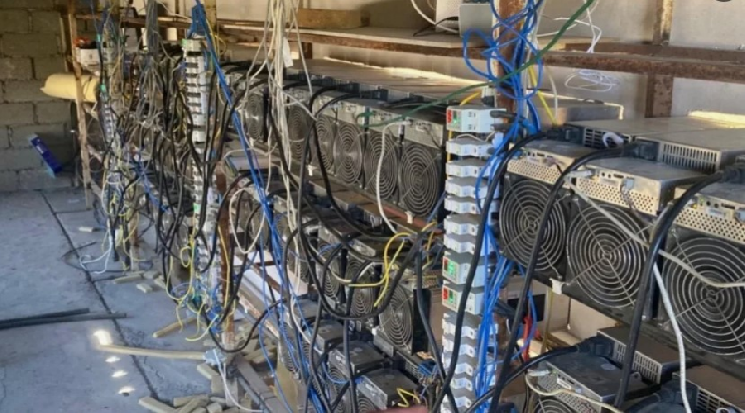
Ethereum Reduced to a Chinese Concept Stock

marsbit2026-05-26 tarihinde yayınlandı2026-05-26 tarihinde güncellendi

Özet

The article titled "Ethereum Becomes a Chinese Concept Stock" presents a critical analysis of Ethereum's perceived decline in market confidence and its structural parallels to Chinese companies listed on US stock exchanges. It begins by noting significant sell-offs by early investors like Wanxiang and key figures like Bankless's Hoffman in 2026, despite Ethereum's strong fundamental activity. The piece questions the erosion of trust in Vitalik Buterin and the Ethereum Foundation (EF), arguing that while other ecosystems have faced founder controversies, Ethereum's issues stem from its internal governance model. The author draws a direct comparison to "China concept stocks," which are Chinese businesses operating globally but reliant on foreign capital and listings. Similarly, Ethereum, funded early by Chinese capital like Wanxiang, developed a strong institutional framework from its IXO to its PoS transition. The core problem, according to the article, is a leadership vacuum regarding price and direction. Vitalik's move to make the EF smaller and less active is framed as a mistake. While he advocates for ETH as a "commodity," the ecosystem lacks a clear entity to steward its price stability, creating tension within the PoS system, as seen with Lido's challenges. The narrative suggests that excessive abstraction and a hands-off approach from the EF have left the community adrift, contrasting with more proactive foundations like Solana's. The article then examines emerging t...

In 2023, early Ethereum investor Wanxiang sold tokens multiple times, at an average price of $2,047. In May 2026, Bankless founder Hoffman fully liquidated his ETH holdings, also at an average price of around $2,000.

Bankless can be considered Ethereum's external propaganda department, single-handedly amplifying the top-tier meme concept of 'ETH is Money.' During the 2021 bull market, fervor for ETH equated to a firm bullish stance on the future of blockchain.

Perhaps due to its importance, or perhaps due to eight consecutive departures from the Ethereum Foundation, Ethereum's founder and spiritual leader, Vitalik Buterin, wrote a long confessional article. He candidly stated that the EF (Ethereum Foundation) controls only 0.16% of the ETH supply and should not hold a position superior to other ecosystem nodes. He also mentioned he would gradually withdraw from operations, returning freedom to Ethereum.

Ethereum Has No Killer

ETH is Money?

Whether you believe it or not, I certainly do.

But how did all this vanish? I'm referring to the market's confidence in $ETH's price, and holders' trust in the Ethereum Foundation and Vitalik. In terms of fundamental activity, now is arguably Ethereum's strongest period of dominance. So why is there so much discontent? Is it just because of the token price?

If $BTC plunges, it's seen as a good buying opportunity. If $SOL drops sharply, its extreme rebound post-FTX has proven its value. If $HYPE falls, one can trade the waves with Arthur Hayes.

Attributing it to Vitalik personally is a convenient reason. However, there's no shortage of abstract public chain founders and foundations. Solana founder Anatoly proactively hard-pitches Perp DEX concepts within the Hyperliquid community. Multiple Ripple founders engaged in wholesale dumping of $XRP. Let alone the proliferation of L2 founders in this era, mostly ego-inflated masters of TGE, seen with the Movement clique.

Upon careful comparison, while Vitalik might be abstract and the EF might be 'inefficient,' it's hard to say they created Ethereum's current predicament. If they are not the problem themselves, then perhaps the broader environment is.
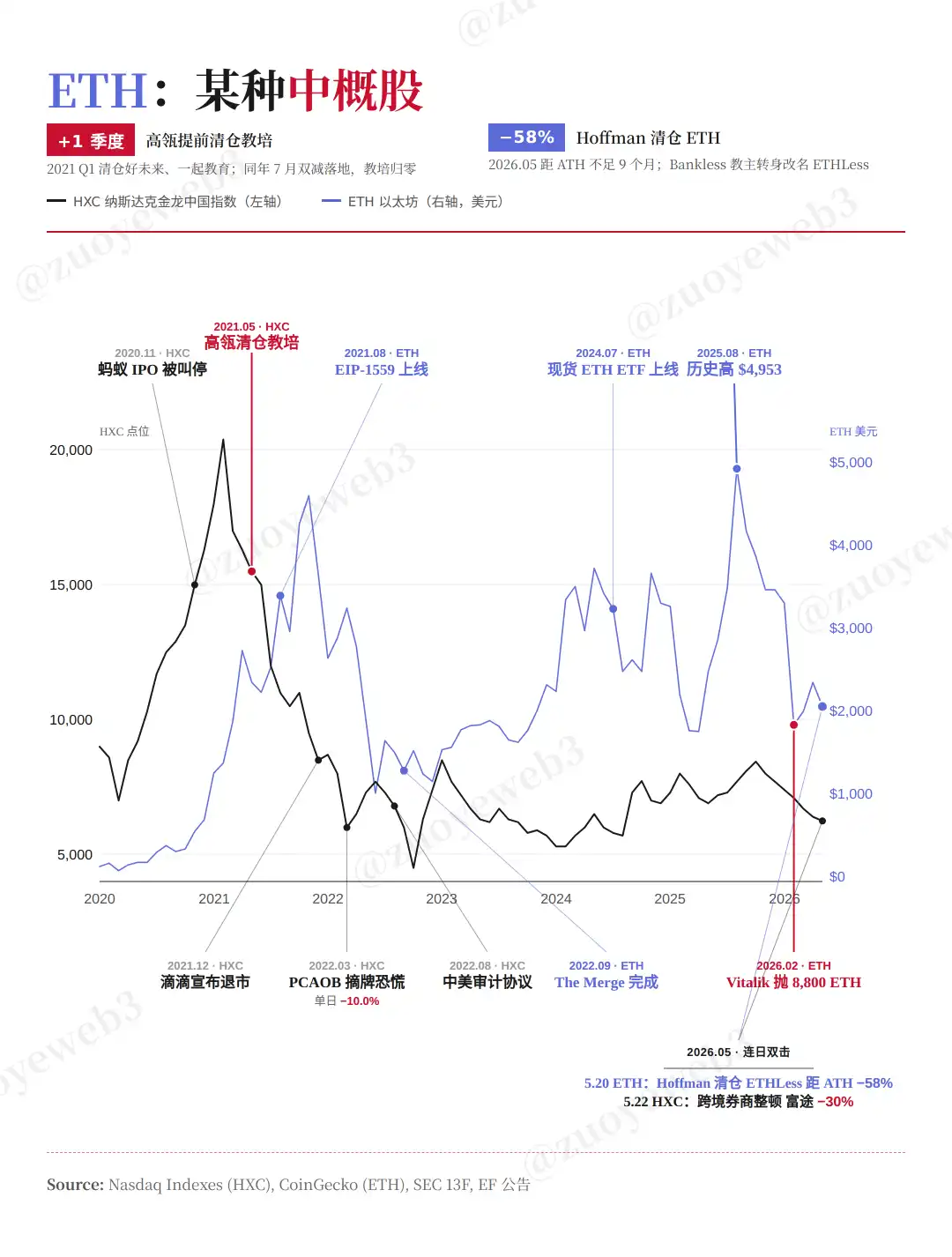
Image Caption: ETH is Money?

Image Source: @zuoyeweb3

The most typical case is Chinese concept stocks. Offshore structures + dollar funds + US IPO created a wealth myth over the past 20 years. Setting aside trial products like Brilliance Auto and China.com, the true first Chinese concept stock was Sina.com in 2000, formally initiating the wave.

The division of labor model of 'US concept + Chinese implementation' we see today is a legacy of this system. Even Ethereum itself is the last remnant of a certain type of Chinese implementation that went global.

In 2014/15, Vitalik first became a guest of Shen Bo and then received a $500,000 investment from Wanxiang, led by Xiao Feng. Unlike Bitcoin's mining model, Ethereum's IXO fundraising, PoW mining, and later PoS staking pulled three waves of passengers onto one vehicle.

In other words, ETH has been a system with relatively strong institutional involvement from the start. I don't mean to say ETH is a heavily manipulated token, and Vitalik indeed wishes for the EF to be just an ordinary node. However, within the Ethereum ecosystem, there absolutely does not exist a state of equal status uniformly distributed among all nodes. It wasn't before, isn't now, and won't be in the future.

Under these circumstances, the public chain founder and foundation actually need to take on more functions. This is unrelated to the token price. Precisely because Ethereum is fragmented with competing powers, someone must stand up and use relatively strong appeal to curb the system's disorderly entropy increase.

But Vitalik chose to first let the EF become bloated, from 'Infinite Garden' to the 'Ladder' theory. Excessive abstraction has left token holders at a loss, especially during the rsETH incident where Aave founder Stani essentially became the 'Duke Huan of Qi,' acting in the name of the king to pacify the lords.

Even the Solana Foundation set aside past grievances to actively endorse DeFi United, only to be met with the EF's routine token sales and Vitalik's personal silence.

Doing too much is centralization. But doing nothing, being overly restrained, is also an abuse of a dominant position—deliberately suppressing oneself, premised on 'the self believing it is important.'

Therefore, Vitalik's choice to make the EF smaller is a mistake. The correct approach would be for Vitalik to recede into the background as a mysterious figure and hand the foundation over to strong institutional players, more pragmatically focused on Ethereum's future.

Apart from Bitcoin, all other public chains need to face the practical demands of ecosystem development and adoption rates. On this point, the Ethereum Foundation holds no special status. The enthusiasm for DeFi and ETH is precisely a memory of past times, not pure wealth effect.

In terms of ecological prosperity and real-world adoption, Ethereum's 'killers' have never succeeded. Solana might be anxious about Hyperliquid, but Ethereum is not, just as BTC isn't anxious about Ethereum.

But this preferential treatment is fading. The crisis does not come from external forces but from within. The real distinction lies in: who is responsible for ETH's price, and who is responsible for Ethereum's direction?

Now, Vitalik is choosing to go all-in on privacy, but he should not 'prevent' others from taking responsibility for the token price.

New Narratives Await the Right Price

Commodity or Productive money?

After the $rsETH incident and the approval of staking ETFs, players like BitMine are rapidly building their own Staking services. Meanwhile, LST players like Lido are increasingly focusing on the 'productive ETH' narrative, with protocols like Spark only recognizing Lido's $wstETH product.

Everything is being reassessed. Lido is not as comfortable as it claims. With ETH prices lingering around $2,000, the marginal effect of continuing to scale diminishes, while the pressure to maintain APR returns increases, casting a shadow over the productivity narrative as well.

This highlights the importance of price—or rather, who is responsible for ETH's price. Currently, the situation is that the EF is not responsible, Lido cannot be responsible, and the entire Ethereum PoS system operates in this awkward environment.

Drawing another parallel to Chinese concept stocks: after US stock markets effectively ceased to be viable exit channels, ChangXin Memory Storage latched onto the AI concept, DeepSeek transformed with state capital taking the lead, and aerospace/robotics concepts oscillate between A-shares and H-shares. Whether you like it or not, this is the new narrative framework.
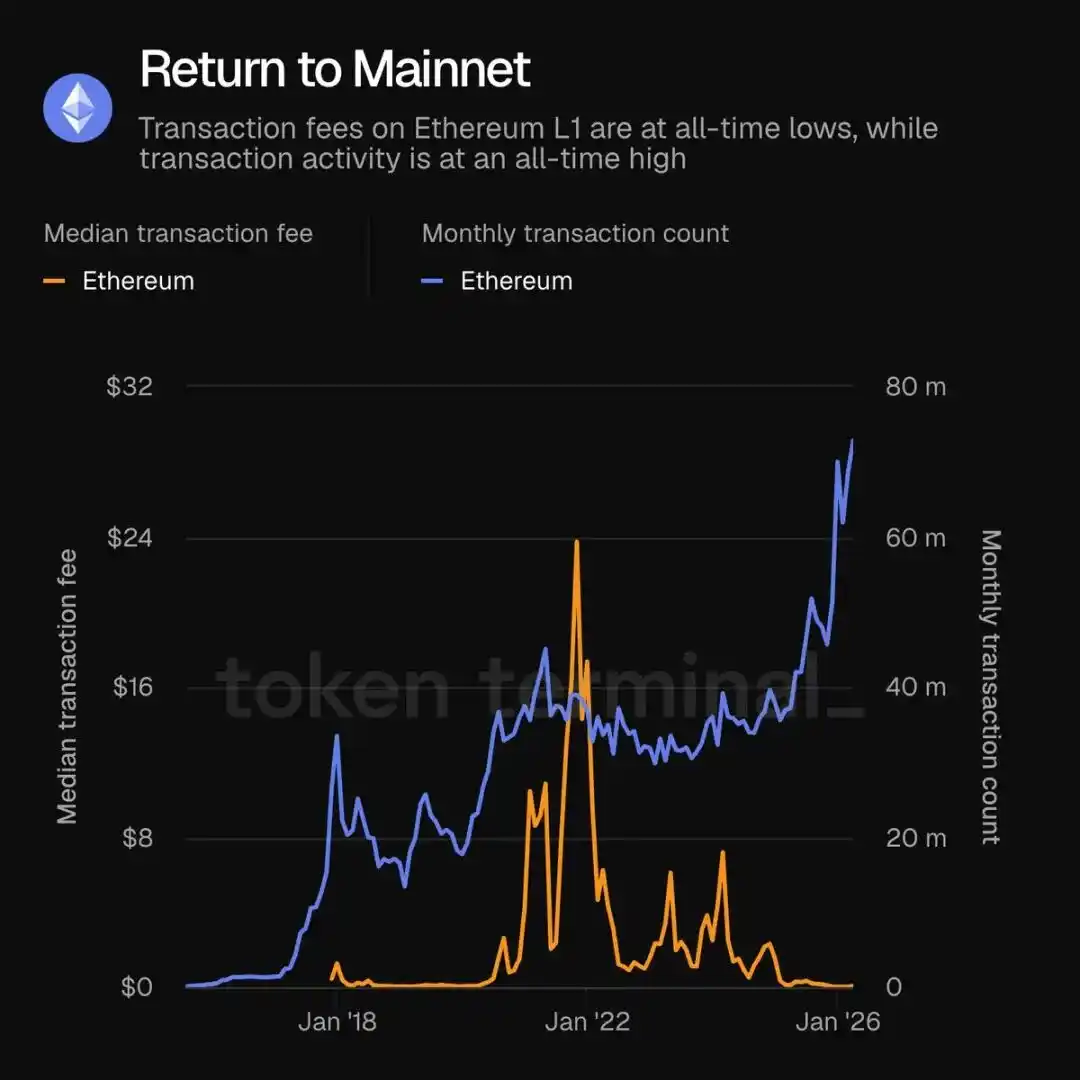
Image Caption: Return to Mainnet.

Image Source: @tokenterminal

With Ethereum's shift back to focusing on L1, mainnet activity exploded. Yet, you don't feel the Ethereum ecosystem is genuinely improving, let alone the token price rising. Something is clearly wrong, but people can't define the problem.

So, what about the current Ethereum technical narratives?

  1. Privacy: Everything can be ZK, the last bastion of decentralization ideals.
  2. AI: Teams like dAI are migrating centralized architectures on-chain, focusing on small model on-device deployment and Agent invocation.
  3. L1: Complete abandonment of the L2-centric model, with all competition over speed and revenue returning to L1.

Compared to the 'world computer' and smart contract technical synergy, Ethereum now needs to forge more connections with reality. Beyond the three above, there are stablecoins, RWA, and many other narratives. But these are not how Ethereum views the world; rather, it's Ethereum's place *within* the world.

The subject and object are inverted, or rather, its position in the new world is unclear. The grand ambition of 'everything can go on-chain' and 'blockchain fights for the future' is gone. Yet, there's always a feeling blockchain can do more. This contradiction, entanglement, and repetition form the threefold chorus of current market sentiment. People hope to see a better Ethereum, but seeing a good Ethereum seems unlikely.

After over a decade of striving, Ethereum did not become the world computer, but it is truly an open computer. Any activity or idea can be experimented with and run on it. While Bankless promoted 'ETH is Money,' Vitalik insisted 'ETH is a Commodity,' a digital product carrying specific functions.

On this point, no one can accuse Vitalik of lying. When Vitalik sold 8,800 tokens in February 2026, he did so slowly via CowSwap. He didn't follow Curve's founder by staking $CRV for stablecoins, nor did he emulate Justin Sun's tactics with $USDD to fleece retail investors.

But as in the Chiang Mai dialogue in January 2026, when asked if given a chance to turn back time ten years, would one choose blockchain or AI, Vitalik didn't give a firm answer. Yet, the reality is set: more and more crypto project teams are pivoting to AI, skillfully applying Go-To-Market methodologies.

  • Hermes Agent broke into the mainstream AI developer circle, with the founding team from Nous Research.
  • xBubble is developed by DappOS, combining AI + intent execution frameworks.
  • OpenRouter founder Alex Atallah is from OpenSea.

You'll find crypto project teams' marketing capabilities aren't limited to on-chain activities. Even in the globally watched AI trend, they can repeatedly keep pace. Even the transit hub model intertwines with stablecoins, traffic distribution, and operations.

But all this has a weak connection to Ethereum. Although dAI and virtuals jointly proposed ERC-8183, attempting to define an autonomous Agent economic activity framework, it's not that the team isn't working. It feels more like active adaptation rather than a leading posture.

If we consider the present a moment for narrative bottom-fishing, the core question is: what value does a public chain hold in the AI era?

Claude repeatedly attacks SaaS, security, and external Agent frameworks. Imagine an absurd scenario: if Claude created its own chain, what would happen to Ethereum?

Under the PoS mechanism, asset migration costs are low enough. But in terms of compliance costs, Claude would still be bound by human legal constraints. An unrestricted free financial testing ground might be Ethereum's most unique value proposition.

Just as when Mythos hammered Palantir's stock, QiAnXin would surge against the trend because hitting the opponent triggers an arms race among counterparts across the ocean, creating an infinite loop.

In other words, in a world of increasing polarization, the demand for connecting the globe will persist long-term. Canton belongs to Wall Street, but Ethereum belongs to all humanity. Just as people in the Sahara have no shoes, pessimists exit, and optimists rejoice.

However, the golden age of $ETH will not return. Wanxiang, the EF, and other institutions will continue to sell. But ETH at $2,000 is at least ten times $200. We stand at a new starting point; we just need a course to sail.

Conclusion

Destined to be alike, ETH truly shares a fate similar to Chinese concept stocks. Both are assets from Country A, invested in by Country B's capital, and exited on Country B's secondary markets. Country A only bears market and channel value.

This is the best of times. Under such fragmentation, new markets will be born. Following Country B's dynamics, similar assets in Country A will experience analogous cycles. Amidst the fragmentation, both A and B still need new connection points. Ethereum remains the best choice.

İlgili Sorular

QWhat is the main argument presented in the article regarding Ethereum's current predicament?

AThe article argues that Ethereum's core problem is not its technology or competitors, but a lack of clear leadership and responsibility for its price and direction. It draws a parallel to Chinese concept stocks (中概股), suggesting Ethereum suffers from a similar disconnect where its primary value accrual (price/exit) happens in a market (B country/crypto speculation) separate from its core development and user base (A country/decentralized ethos). Vitalik Buterin and the Ethereum Foundation's move towards excessive abstraction and minimal intervention, rather than proactive stewardship, has created a leadership vacuum and eroded confidence.

QAccording to the article, how does the 'ETH is Money' narrative conflict with Vitalik Buterin's own view?

AThe 'ETH is Money' narrative, heavily promoted by entities like Bankless, positioned ETH as a form of currency or sound money during the 2021 bull market. However, the article states that Vitalik Buterin himself has consistently viewed ETH not as 'money' but as a 'Commodity'—a digital product designed to carry specific functions (like paying for gas fees) within the Ethereum ecosystem.

QWhat three key technical narratives is Ethereum currently pursuing, as mentioned in the article?

AThe article lists three key technical narratives for Ethereum: 1. Privacy: Focusing on zero-knowledge (ZK) proofs as the last bastion of decentralization. 2. AI: Projects like dAI aim to bring centralized AI architectures on-chain, focusing on small model on-device deployment and Agent invocation. 3. L1 Focus: Shifting away from an L2-centric roadmap and refocusing competition on Layer-1 speed and revenue generation.

QWhat analogy does the article make between Ethereum and Chinese concept stocks (中概股)?

AThe article draws a direct analogy, stating Ethereum has become like a Chinese concept stock. Both are seen as 'A-country assets' (Ethereum's tech/decentralized ideals / China's companies) funded by 'B-country capital' (global crypto VCs / US dollar funds) with their primary exit and valuation mechanism in the 'B-country secondary market' (global crypto exchanges / US stock markets). The 'A-country' (core ecosystem/China) mainly provides market access and utility, but doesn't fully capture the financial value creation.

QWhat does the article suggest is Ethereum's unique and enduring value proposition in the current landscape?

AThe article suggests Ethereum's unique value is as a 'limitless financial testing ground' and a global, permissionless linking layer. In an increasingly fragmented world with rising geopolitical tensions, the need for a neutral, global financial and coordination platform persists. While projects like Canton Network serve institutional Wall Street, Ethereum belongs to 'all of humanity,' offering a space for uncensored experimentation that centralized entities or AI models like Claude, bound by human laws, cannot replicate.

İlgili Okumalar

Metrics Ventures Market Watch: The Brewing Storm

In the past month, the market has been actively trading contrasting expectations, balancing global supply chain disruptions fueling re-inflation against both actual and anticipated (Walsh) interest rate hikes. This volatility has impacted commodities and most equities, though tech has temporarily benefited from concentrated short-term liquidity. Fundamentally, as previously analyzed regarding the Strait of Hormuz situation, the US faces deep-seated balance sheet issues beyond what any single Fed chair can resolve. Hypotheses around a figure like Walsh could only materialize if AI fundamentally reshapes production relations. Until then, most non-AI-leading nations (effectively all except the US and China) risk fiscal and monetary policy collapse, rendering the identity of the Fed chair ultimately irrelevant. For crypto assets, there is currently no clear role in these dominant narratives. The market remains strongly capped by the 200-day moving average. While trends may shift from "anything but AI" to "anything but mines," this phase is dominated by the silicon vs. carbon (AI vs. traditional) dichotomy, leaving little room for crypto—though its time will come. **Market Overview & Commentary** The crypto market lacks significant catalysts beyond hype, plagued by low volume and scarce innovation, with clear technical resistance. Currently, crypto struggles for attention as global focus lies elsewhere. Assets like gold, oil, and grains are more direct hedges against supply-chain-driven inflation/stagflation. Bitcoin needs more time for capitulation and consolidation; this reset is expected to last until at least Q4 2026. Looking ahead, three factors will likely drive future market volatility: 1. Whether Walsh repeats the patterns of predecessors like Bassant or Musk, shifting stance into a new policy cycle. 2. The market underestimates the severity of global supply chain damage and the prolonged time needed for repair, which will eventually lead to recognition of acute resource shortages and price swings. 3. AI non-beneficiary, high-inflation nations (e.g., UK, Japan) will face severe fiscal and monetary crises. Rapid AI-driven displacement could trigger a collapse of existing credit and welfare systems. Ultimately, the market may realize that an AI bubble burst could spark contagious sovereign credit crises. The monetary and fiscal responses to such a scenario could serve as the ultimate catalyst for Bitcoin's next major bull run.

marsbit34 dk önce

Metrics Ventures Market Watch: The Brewing Storm

marsbit34 dk önce

Insiders Betting on Musk Are Reaping 'Historic Returns'

The largest IPO in history is imminent as SpaceX, led by Elon Musk, is set to price its offering on June 12. At a targeted valuation near $2 trillion, this event will mint new billionaires from Musk's inner circle of long-time allies, rewarding their loyalty with unprecedented returns. Key beneficiaries include Antonio Gracias, Musk's close friend and confidant, who holds a 7.3% stake potentially worth over $140 billion, making him the second-largest individual shareholder. Gwynne Shotwell, President and COO since 2002, holds shares valued at roughly $2 billion. Bret Johnsen, the CFO, holds stock worth approximately $1.4 billion. Luke Nosek, a PayPal co-founder and early investor, stands to gain about $5.3 billion. The IPO filing also reveals complex and controversial financial arrangements. SpaceX has guaranteed nearly $20 billion in payments from xAI's subsidiary to Gracias's Valor Equity Partners for AI hardware leases—deals auditors flagged as "failed sale-leaseback" transactions, forcing SpaceX to record them as debt. Despite rapid revenue growth, SpaceX is not profitable, posting a $49 billion loss in 2025 and a $4.3 billion loss in Q1 2026. Capital expenditures are soaring, with over 60% directed toward AI. Public investors will inherit these losses, significant debts, and a governance structure heavily controlled by insiders, including a provision granting Musk up to a billion additional shares if one million people live on Mars.

链捕手36 dk önce

Insiders Betting on Musk Are Reaping 'Historic Returns'

链捕手36 dk önce

AI Agents Fundamentally Transform Web3 Gaming: From the Rugpull Bakery Bot Controversy to the New Agent Paradigm in 2026

AI Agents Are Redefining Web3 Gaming: From the Rugpull Bakery Bot Controversy to the 2026 Agentic Paradigm The recent controversy in Rugpull Bakery, a competitive baking game on Abstract chain, highlighted a pivotal shift. Player complaints about unfair bot automation in Season 2 led developers to not ban them, but instead formally integrate AI agents as core gameplay in Season 3, providing official guides (skill.md, agent.json). This move signals Web3 gaming's transition into the "Agentic Gaming" era, where AI agents are sovereign entities with independent strategy and economic rights, moving beyond simple automation. By 2026, AI agent integration has evolved into three core models reshaping the ecosystem: 1. **Autonomous Competitors & Economic Entities:** Agents act as independent players. Examples include TEN Protocol's poker-playing agents, AI Arena's trainable NFT fighters, Satoshi Strike Force's "Digital Athletes" trained on player data, and Somnia's "Agentic L1" blockchain providing native infrastructure for millions of autonomous agents. 2. **Modular Infrastructure & Programmable Environments:** Games like EVE Frontier enable "server-side modding," allowing AI agents to program game world logic directly into structures like smart storage, turrets, and stargates via Smart Assemblies. Coupled with standards like ERC-8183, which enables autonomous job creation and payment between agents, in-game infrastructure gains a "commercial soul." 3. **Hybrid Companions & Dynamic Adaptive Worlds:** This model focuses on human-AI collaboration. In Parallel Colony, players guide highly autonomous AI Avatars with unique personalities and goals. Illuvium plans to use AI to transform NPCs into dynamic, context-aware entities that create personalized, emergent narratives. The conclusion is clear: blocking automation is futile. The future lies in leveraging blockchain's transparency and programmability to empower AI agents as first-class citizens. Web3 gaming is shifting from inefficient human labor to efficient algorithmic interplay and emergent intelligence, creating a "post-human" digital frontier where players become commanders and symbiotic partners in a new socioeconomic experiment.

marsbit1 saat önce

AI Agents Fundamentally Transform Web3 Gaming: From the Rugpull Bakery Bot Controversy to the New Agent Paradigm in 2026

marsbit1 saat önce

Where Did China's Q1 AI Funding Exceeding 100 Billion RMB Go?

In Q1 2026, China's AI sector raised over 110 billion yuan (approximately $152 billion) across nearly 600 financing deals, a 185.4% year-on-year increase. Major recipients included large model companies and embodied AI firms. Approximately 30-50% of funding was allocated to computing power (GPU procurement and cloud services), highlighting its critical role as a barrier to entry. Significant portions also went to R&D and global talent acquisition. In the large model sector, three key players emerged with distinct strategies: Moonshot AI (valued at $20 billion) pursued an open-source route, achieving rapid commercialization with its Kimi K2.5 model. StepFun (raising billions) focused on a trillion-parameter foundation model and terminal device integration, backed by smartphone supply chain capital. DeepSeek, launching its first funding round at a $45 billion valuation, maintained its open-source, cost-effective approach, now attracting state fund interest. The embodied AI sector saw over 50 deals totaling around 20 billion yuan, creating over 10 unicorns with valuations exceeding 10 billion yuan each. Leading companies like Galaxy General, Qianxun AI, Independent Variable Robotics, and Zhi Jian Power secured major funding, with some beginning initial product deliveries. However, a gap between high valuations and actual revenue poses bubble risks. Key trends identified include: a shift from VC-dominated funding to mixed industrial and state capital; rapidly rising valuations intensifying the "Matthew Effect"; accelerating IPO pipelines; the competitive advantage of open-source strategies; and embodied AI transitioning from proof-of-concept to small-batch delivery. Ultimately, the massive capital influx is pushing China's AI competition into a high-stakes phase where sustaining cash flow and operational endurance may be as decisive as technological breakthroughs.

marsbit1 saat önce

Where Did China's Q1 AI Funding Exceeding 100 Billion RMB Go?

marsbit1 saat önce

İşlemler

Spot
Futures

Popüler Makaleler

ETH 2.0 Nedir

ETH 2.0: Ethereum için Yeni Bir Dönem Giriş ETH 2.0, Ethereum 2.0 olarak da bilinir, Ethereum blok zincirinde önemli bir yükseltmeyi işaret eder. Bu geçiş yalnızca bir yüz değiştirme değil; ağın ölçeklenebilirliğini, güvenliğini ve sürdürülebilirliğini temelinden geliştirmeyi hedeflemektedir. Enerji yoğun Proof of Work (PoW) konsensüs mekanizmasından daha verimli olan Proof of Stake (PoS) mekanizmasına geçişle birlikte, ETH 2.0 blok zinciri ekosistemine dönüştürücü bir yaklaşım vaat etmektedir. ETH 2.0 Nedir? ETH 2.0, Ethereum'un yeteneklerini ve performansını optimize etmeye odaklanmış özel, birbirine bağlı güncellemelerin bir derlemesidir. Yenileme, mevcut Ethereum mekanizmasının karşılaştığı kritik zorlukları, özellikle işlem hızı ve ağ tıkanıklığı ile ilgili sorunları ele almak üzere tasarlanmıştır. ETH 2.0'ın Amaçları ETH 2.0'ın ana amaçları, üç temel unsuru geliştirmeye odaklanmaktadır: Ölçeklenebilirlik: Ağın saniye başına işleyebileceği işlem sayısını önemli ölçüde artırmayı hedefleyen ETH 2.0, mevcut yaklaşık 15 işlem/saniye sınırlamasını aşmayı ve potansiyel olarak binlerce işleme ulaşmayı planlamaktadır. Güvenlik: Geliştirilmiş güvenlik önlemleri, özellikle siber saldırılara karşı daha iyi direnç sağlama ve Ethereum'un merkeziyetsiz görünümünü koruma açısından ETH 2.0 için hayati öneme sahiptir. Sürdürülebilirlik: Yeni PoS mekanizması, sadece verimliliği artırmakla kalmayıp aynı zamanda enerji tüketimini de önemli ölçüde azaltma hedefiyle tasarlanmış olup, Ethereum'un operasyonel çerçevesini çevresel kaygılarla uyumlu hale getirmektedir. ETH 2.0'ın Yaratıcısı Kimdir? ETH 2.0'ın yaratılması Ethereum Vakfı'na atfedilebilir. Ethereum'un gelişimini destekleme konusunda kritik bir rol oynayan bu kar amacı gütmeyen kuruluş, dikkat çekici kurucu ortağı Vitalik Buterin tarafından yönetilmektedir. Daha ölçeklenebilir ve sürdürülebilir bir Ethereum vizyonu, bu yükseltmenin arkasındaki itici güç olmuştur ve protokolü geliştirmek için kendini adamış küresel bir geliştici ve meraklı topluluğunun katkılarını içermektedir. ETH 2.0'ın Yatırımcıları Kimlerdir? ETH 2.0 yatırımcıları ile ilgili detaylar kamuoyuna açıklanmamış olsa da, Ethereum Vakfı'nın blok zinciri ve teknoloji alanında çeşitli kuruluşlar ve bireyler tarafından desteklendiği bilinmektedir. Bu ortaklar arasında merkeziyetsiz teknolojilerin ve blok zinciri altyapısının geliştirilmesine karşılıklı ilgi duyan girişim sermayesi şirketleri, teknoloji firmaları ve hayır kurumları yer almaktadır. ETH 2.0 Nasıl Çalışır? ETH 2.0, onu öncüsünden ayıran bir dizi önemli özelliği tanıtmasıyla dikkat çekmektedir. Proof of Stake (PoS) PoS konsensüs mekanizmasına geçiş, ETH 2.0'ın en belirgin değişikliklerinden biridir. İşlem doğrulama için enerji yoğun madenciliğe dayanmak yerine, PoS kullanıcıların ağa yatırdıkları ETH miktarına göre işlemleri doğrulayıp yeni bloklar oluşturmalarına olanak tanır. Bu, enerji verimliliğinin artırılmasına yol açarak tüketimi yaklaşık %99,95 oranında azaltmakta ve Ethereum 2.0'ı önemli ölçüde daha çevre dostu bir alternatif haline getirmektedir. Shard Zincirleri Shard zincirleri, ETH 2.0'ın diğer bir kritik yeniliğidir. Bu daha küçük zincirler, ana Ethereum zinciri ile paralel olarak çalışarak birden fazla işlemin aynı anda işlenmesine olanak tanır. Bu yaklaşım, ağın genel kapasitesini artırarak Ethereum'u rahatsız eden ölçeklenebilirlik sorunlarını ele alır. Beacon Zinciri ETH 2.0'ın temelinde, ağı koordine eden ve PoS protokolünü yöneten Beacon Zinciri yer almaktadır. Bu, bir tür organizatör olarak işlev görür: doğrulayıcıları denetler, shard'ların ağa bağlı kalmasını sağlar ve blok zinciri ekosisteminin genel sağlığını izler. ETH 2.0 Zaman Çizelgesi ETH 2.0'ın yolculuğu, bu önemli yükseltmenin evrimini gösteren birkaç önemli dönüm noktası ile tanımlanmıştır: Aralık 2020: Beacon Zinciri'nin başlatılması, PoS'un tanıtımını işaret etmiş ve ETH 2.0’a geçiş için sahneyi hazırlamıştır. Eylül 2022: "The Merge" tamamlanması, Ethereum ağının başarılı bir şekilde PoW'den PoS çerçevesine geçiş yaptığı kritik bir anı temsil etmekte ve Ethereum için yeni bir dönemi müjdelemektedir. 2023: Shard zincirlerinin beklenen dağıtımı, Ethereum ağının ölçeklenebilirliğini daha da artırmayı hedeflemekte ve ETH 2.0'ı merkeziyetsiz uygulamalar ve hizmetler için sağlam bir platform haline getirmeyi pekiştirmektedir. Ana Özellikler ve Faydalar Geliştirilmiş Ölçeklenebilirlik ETH 2.0'ın en önemli avantajlarından biri, geliştirilmiş ölçeklenebilirliğidir. PoS ve shard zincirlerinin kombinasyonu, ağın kapasitesini artırarak, eski sistemle kıyaslandığında çok daha fazla işlem hacmi karşılayabilmesini sağlamaktadır. Enerji Verimliliği PoS'un uygulanması, blok zinciri teknolojisinde enerji verimliliği yönünde büyük bir adım teşkil etmektedir. Enerji tüketimini ciddi şekilde azaltarak, ETH 2.0 yalnızca işletme maliyetlerini düşürmekle kalmaz, aynı zamanda küresel sürdürülebilirlik hedefleriyle daha yakın bir uyum sağlar. Geliştirilmiş Güvenlik ETH 2.0'ın güncellenmiş mekanizmaları, ağ genelinde güvenliğin artırılmasına katkıda bulunmaktadır. PoS'un uygulanması ve shard zincirleri ile Beacon Zinciri aracılığıyla geliştirilen yenilikçi kontrol önlemleri, potansiyel tehditlere karşı daha yüksek bir koruma sağlar. Kullanıcılar için Düşük Maliyetler Ölçeklenebilirlik geliştikçe, işlem maliyetleri üzerindeki etkiler de belirgin hale gelecektir. Artan kapasite ve azalan tıkanıklığın, kullanıcılar için düşük ücretler anlamına gelmesi beklenmekte ve Ethereum'u günlük işlemler için daha erişilebilir hale getirmektedir. Sonuç ETH 2.0, Ethereum blok zinciri ekosisteminde önemli bir evrimi işaret etmektedir. Ölçeklenebilirlik, enerji tüketimi, işlem verimliliği ve genel güvenlik gibi temel sorunları ele alırken, bu güncellemenin önemi abartılamaz. Proof of Stake'e geçiş, shard zincirlerinin tanıtımı ve Beacon Zinciri'nin altyapı çalışmaları, Ethereum'un merkeziyetsiz piyasalarının artan taleplerini karşılayabileceği bir geleceği göstermektedir. Yenilik ve ilerleme ile şekillenen bir sektörde, ETH 2.0, blok zinciri teknolojisinin daha sürdürülebilir ve verimli bir dijital ekonomi için yol açmadaki yeteneklerinin bir kanıtıdır.

170 Toplam GörüntülenmeYayınlanma 2024.04.04Güncellenme 2024.12.03

ETH 2.0 Nedir

ETH 3.0 Nedir

ETH3.0 ve $eth 3.0: Ethereum'un Geleceği Üzerine Derinlemesine Bir İnceleme Giriş Hızla evrilen kripto para ve blok zinciri teknolojisi ortamında, ETH3.0, sıklıkla $eth 3.0 olarak adlandırılmakta, önemli bir ilgi ve spekülasyon konusu haline gelmiştir. Bu terim, netleştirilmesi gereken iki temel kavramı kapsamaktadır: Ethereum 3.0: Bu, mevcut Ethereum blok zincirinin yeteneklerini artırmayı hedefleyen olası bir gelecekteki güncellemeyi temsil eder, özellikle ölçeklenebilirlik ve performansı iyileştirmeye odaklanmaktadır. ETH3.0 Meme Token: Bu ayrı kripto para projesi, Ethereum blok zincirini kullanarak meme merkezli bir ekosistem oluşturmayı amaçlamakta ve kripto para topluluğu içinde etkileşimi artırmaktadır. ETH3.0'ün bu yönlerini anlamak, yalnızca kripto meraklıları için değil, aynı zamanda dijital alandaki daha geniş teknolojik trendleri gözlemleyenler için de hayati öneme sahiptir. ETH3.0 Nedir? Ethereum 3.0 Ethereum 3.0, zaten kurulmuş olan Ethereum ağına önerilen bir güncelleme olarak duyurulmaktadır; bu ağ, kuruluşundan bu yana birçok merkeziyetsiz uygulamanın (dApp'ler) ve akıllı sözleşmelerin belkemiği olmuştur. Tasarlanan iyileştirmeler, esasen ölçeklenebilirlik üzerine yoğunlaşmakta – shardlama ve sıfır bilgi kanıtları (zk-proofs) gibi ileri teknolojileri entegre etmektedir. Bu teknolojik yenilikler, saniyede eşi benzeri görülmemiş sayıda işlem (TPS) gerçekleştirmeyi kolaylaştırmayı amaçlamakta olup, muhtemelen milyonlara ulaşarak mevcut blok zinciri teknolojisinin karşılaştığı en büyük sınırlamalardan birine çözüm getirmektedir. İyileştirme yalnızca teknik değil, aynı zamanda stratejiktir; Ethereum ağını, merkeziyetsiz çözümlere olan artan talep ile belirginleşen bir geleceğe hazırlamak için tasarlanmıştır. ETH3.0 Meme Token Ethereum 3.0'ın aksine, ETH3.0 Meme Token, internet meme kültürünü kripto para dinamikleriyle birleştirerek daha hafif ve eğlenceli bir alanda hareket etmektedir. Bu proje, kullanıcıların Ethereum blok zincirinde meme alım, satım ve ticaret yapmalarına izin vererek, yaratıcılık ve ortak ilgi alanları aracılığıyla topluluk etkileşimini teşvik eden bir platform sunmaktadır. ETH3.0 Meme Token, blok zinciri teknolojisinin dijital kültürle nasıl kesişebileceğini göstererek, hem eğlenceli hem de finansal olarak sürdürülebilir kullanım senaryoları oluşturmayı hedeflemektedir. ETH3.0'un Yaratıcısı Kimdir? Ethereum 3.0 Ethereum 3.0'a yönelik girişim, esas olarak Ethereum topluluğundaki bir geliştirici ve araştırmacı konsorsiyumu tarafından yönlendirilmektedir ve bunlar arasında Justin Drake de bulunmaktadır. Ethereum'un evrimine yönelik içgörüleri ve katkılarıyla tanınan Drake, Ethereum'u “Beam Chain” olarak adlandırılan yeni bir konsensüs katmanına geçirme konusundaki tartışmalarda öne çıkan bir figür olmuştur. Geliştirmeye yönelik bu iş birliği yaklaşımı, Ethereum 3.0'ın tek bir yaratıcının ürünü olmadığını, aksine blok zinciri teknolojisini ilerletmeye odaklanmış kolektif bir dehanın tezahürü olduğunu göstermektedir. ETH3.0 Meme Token ETH3.0 Meme Token'ın yaratıcısına dair detaylar şu anda izlenemez durumdadır. Meme tokenların doğası, genellikle daha merkeziyetsiz ve topluluk odaklı bir yapıya yol açmakta olup, bu da spesifik bir atıf eksikliğini açıklayabilir. Bu durum, yeniliğin genellikle iş birliği yerine bireysel çabalardan ortaya çıktığı kripto topluluğunun genel felsefesiyle uyumludur. ETH3.0 Yatırımcıları Kimlerdir? Ethereum 3.0 Ethereum 3.0'a olan destek, esasen Ethereum Vakfı ve hevesli bir geliştirici ve yatırımcı topluluğu tarafından sağlanmaktadır. Bu temel birliktelik, yıllar süren ağ operasyonlarıyla inşa edilen güven ve itibarından yararlanarak önemli bir meşruiyet sağlamaktadır. Kripto para dünyasının hızla değişen ikliminde, topluluk desteği, gelişim ve benimsemeyi yönlendirmede kritik bir rol oynamakta ve Ethereum 3.0'ı gelecekteki blok zinciri ilerlemeleri için ciddi bir rakip haline getirmektedir. ETH3.0 Meme Token Mevcut kaynaklar, ETH3.0 Meme Token'ı destekleyen yatırım temelleri veya kuruluşları hakkında net bilgiler sağlamasa da, bu durum meme tokenlar için tipik olan finansman modelini göstermektedir; bu model genellikle tabandan destek ve topluluk katılımına dayanır. Bu tür projelerdeki yatırımcılar genellikle toplum odaklı yenilik potansiyeli ve kripto topluluğunda bulunan iş birliği ruhuyla motive olmuş bireylerden oluşmaktadır. ETH3.0 Nasıl Çalışır? Ethereum 3.0 Ethereum 3.0'ın ayırt edici özellikleri, önerilen shardlama ve zk-proof teknolojisinin uygulanmasında yatmaktadır. Shardlama, blok zincirini daha küçük, yönetilebilir parçalara veya “parçalara” ayırma yöntemidir; bu parçalar işlemleri ardışık değil, eşzamanlı olarak işleyebilir. Bu işlem yükünün merkeziyetsizliği, tıkanıklığı önlemeye yardımcı olur ve ağın yoğun yük altında bile yanıt verebilir olmasını sağlar. Sıfır bilgi kanıtı (zk-proof) teknolojisi, işleme katılan temel verileri ifşa etmeden işlem doğrulaması sağlamasıyla başka bir sofistike katman ekler. Bu yön, sadece gizliliği artırmakla kalmaz, aynı zamanda ağın genel verimliliğini de artırır. Bu güncellemeye, ağın yeteneklerini ve faydasını daha da artırarak sıfır bilgi Ethereum Sanal Makinesi (zkEVM) entegrasyonunun da eklenmesi gündeme gelmektedir. ETH3.0 Meme Token ETH3.0 Meme Token, meme kültürünün popülaritesinden yararlanarak kendini farklılaştırmaktadır. Kullanıcıların sadece eğlence için değil, aynı zamanda potansiyel ekonomik kazançlar için meme ticareti yapmalarına olanak tanıyacak bir pazar yeri oluşturur. Stake etme, likidite sağlama ve yönetim mekanizmaları gibi özelliklerin entegrasyonu sayesinde, proje topluluk etkileşimini ve katılımını teşvik eden bir ortam oluşturur. Eğlence ve ekonomik fırsatların eşsiz bir karışımını sunarak, ETH3.0 Meme Token, kripto tutkunlarından gündelik meme meraklılarına kadar çeşitli bir kitleyi çekmeyi hedeflemektedir. ETH3.0 Zaman Çizelgesi Ethereum 3.0 11 Kasım 2024: Justin Drake, ölçeklenebilirlik iyileştirmeleri etrafında şekillenen yaklaşan ETH 3.0 güncellemesine işaret ediyor. Bu duyuru, Ethereum'un gelecekteki mimarisi hakkında resmi tartışmaların başlangıcını simgeliyor. 12 Kasım 2024: Ethereum 3.0'a yönelik beklenen önerinin, Bangkok'taki Devcon'da açıklanması planlanıyor ve bu, daha geniş topluluk geri bildirimi ve gelişim için olası sonraki adımların zeminini hazırlıyor. ETH3.0 Meme Token 21 Mart 2024: ETH3.0 Meme Token, CoinMarketCap'ta resmi olarak listeleniyor, bu da kamusal kripto alanına adım atarak meme merkezli ekosisteminin görünürlüğünü artırıyor. Ana Noktalar Sonuç olarak, Ethereum 3.0, gelişmiş teknolojiler aracılığıyla ölçeklenebilirlik ve performansla ilgili sınırlamaların üstesinden gelmeye odaklanan Ethereum ağındaki önemli bir evrimi temsil etmektedir. Önerilen güncellemeleri, gelecekteki talepler ve kullanılabilirlik için proaktif bir yaklaşımı yansıtmaktadır. Öte yandan, ETH3.0 Meme Token, kripto para alanındaki topluluk odaklı kültürün özünü kapsamakta, meme kültürünü kullanarak kullanıcı yaratıcılığını ve katılımını teşvik eden etkileşimli platformlar oluşturmayı hedeflemektedir. ETH3.0 ve $eth 3.0'un farklı amaçlarının ve işlevlerinin anlaşılması, kripto alanındaki gelişmeleri takip eden herkes için hayati öneme sahiptir. Her iki girişim de benzersiz yollar çizerek, blok zinciri yeniliğinin dinamik ve çok yönlü doğasını birlikte vurgulamaktadır.

171 Toplam GörüntülenmeYayınlanma 2024.04.04Güncellenme 2024.12.03

ETH 3.0 Nedir

ETH Nasıl Satın Alınır

HTX.com’a hoş geldiniz! Ethereum (ETH) satın alma işlemlerini basit ve kullanışlı bir hâle getirdik. Adım adım açıkladığımız rehberimizi takip ederek kripto yolculuğunuza başlayın. 1. Adım: HTX Hesabınızı OluşturunHTX'te ücretsiz bir hesap açmak için e-posta adresinizi veya telefon numaranızı kullanın. Sorunsuzca kaydolun ve tüm özelliklerin kilidini açın. Hesabımı Aç2. Adım: Kripto Satın Al Bölümüne Gidin ve Ödeme Yönteminizi SeçinKredi/Banka Kartı: Visa veya Mastercard'ınızı kullanarak anında Ethereum (ETH) satın alın.Bakiye: Sorunsuz bir şekilde işlem yapmak için HTX hesap bakiyenizdeki fonları kullanın.Üçüncü Taraflar: Kullanımı kolaylaştırmak için Google Pay ve Apple Pay gibi popüler ödeme yöntemlerini ekledik.P2P: HTX'teki diğer kullanıcılarla doğrudan işlem yapın.Borsa Dışı (OTC): Yatırımcılar için kişiye özel hizmetler ve rekabetçi döviz kurları sunuyoruz.3. Adım: Ethereum (ETH) Varlıklarınızı SaklayınEthereum (ETH) satın aldıktan sonra HTX hesabınızda saklayın. Alternatif olarak, blok zinciri transferi yoluyla başka bir yere gönderebilir veya diğer kripto para birimlerini takas etmek için kullanabilirsiniz.4. Adım: Ethereum (ETH) Varlıklarınızla İşlem YapınHTX'in spot piyasasında Ethereum (ETH) ile kolayca işlemler yapın.Hesabınıza erişin, işlem çiftinizi seçin, işlemlerinizi gerçekleştirin ve gerçek zamanlı olarak izleyin. Hem yeni başlayanlar hem de deneyimli yatırımcılar için kullanıcı dostu bir deneyim sunuyoruz.

3.4k Toplam GörüntülenmeYayınlanma 2024.12.10Güncellenme 2025.03.21

ETH Nasıl Satın Alınır

Tartışmalar

HTX Topluluğuna hoş geldiniz. Burada, en son platform gelişmeleri hakkında bilgi sahibi olabilir ve profesyonel piyasa görüşlerine erişebilirsiniz. Kullanıcıların ETH (ETH) fiyatı hakkındaki görüşleri aşağıda sunulmaktadır.

活动图片