Ethena jumps 11.35% – As THIS turns positive, will ENA see a stronger breakout?

ambcrypto2026-04-10 tarihinde yayınlandı2026-04-10 tarihinde güncellendi

Özet

ENA surged 11.35% to $0.09702, rebounding from below $0.09 and signaling early recovery strength, though it remains within a broader weak structure. The price faces key resistance at $0.10, a historical supply zone where upward momentum has slowed. Technical indicators like the MACD turning positive and Parabolic SAR flipping bullish suggest improving short-term sentiment. Persistent outflows reduced sell-side pressure, but limited inflows indicate weak demand. The funding rate turned slightly positive, reflecting growing long positioning without overcrowding. Overall, ENA shows signs of recovery but lacks strong confirmation for a sustained breakout above $0.10.

ENA surged 11.35% in 24 hours to $0.09702, rebounding sharply from recent lows and signaling early recovery strength. Price pushed higher after holding sub-$0.09 demand, which had previously acted as a consistent reaction zone.

This rebound reflected renewed buyer interest following a prolonged decline phase. However, the move has developed within a broader weak structure, which still lacks strong continuation signals.

The ENA rally has started to rebuild short-term strength, yet it has not fully shifted the larger trend.

Can ENA clear the $0.10 barrier?

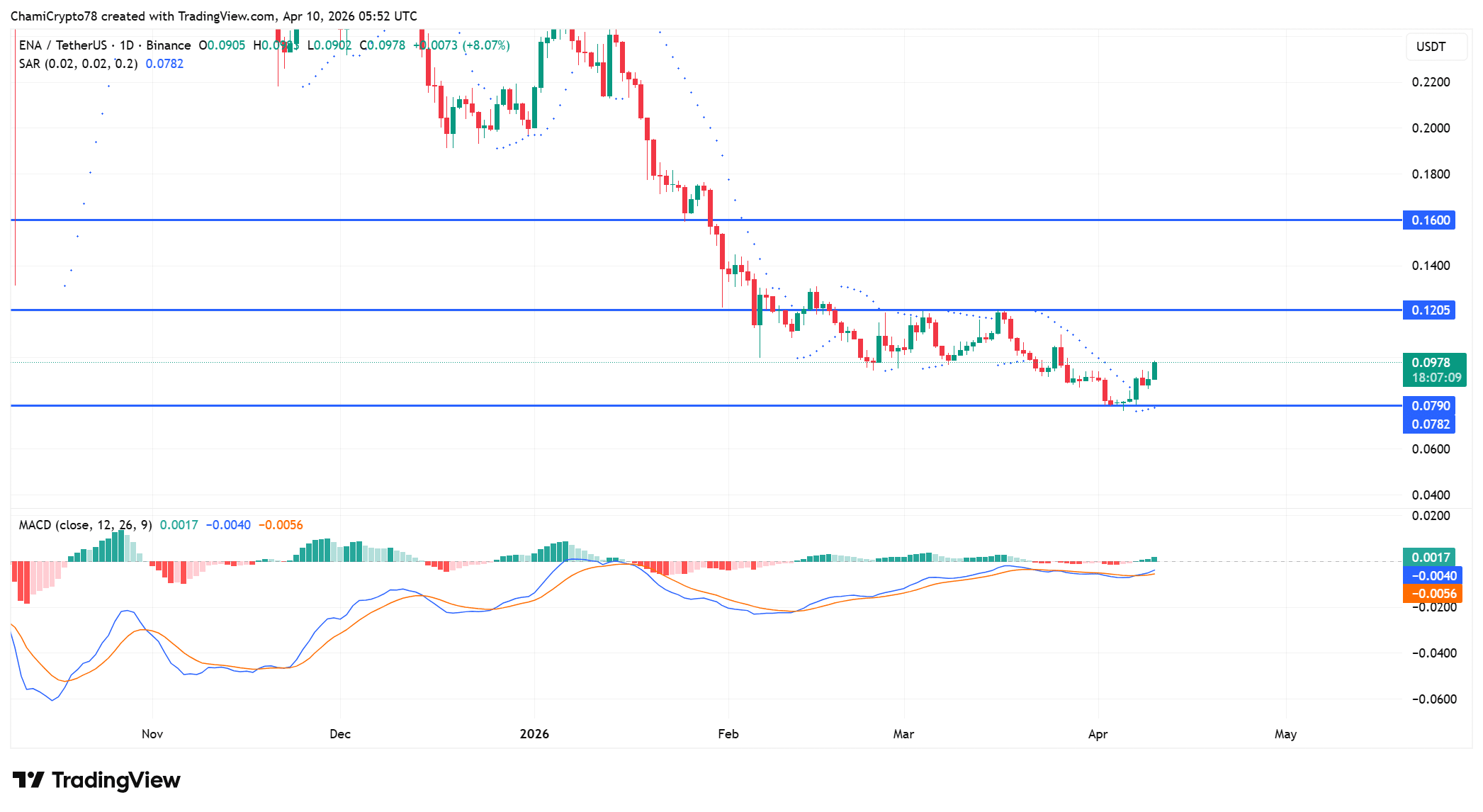
ENA rebounded cleanly from below $0.09 and moved toward the $0.10 psychological resistance. This level has historically acted as a supply zone, where sellers have consistently stepped in.

As price approached this region, upward progress began to slow, which indicated hesitation among buyers. The structure showed a developing recovery leg, yet it lacked strong breakout confirmation above resistance.

Buyers managed to stabilize the price above recent lows, which supported the short-term trend. However, failure to decisively break above $0.10 kept the structure in a recovery phase rather than a confirmed reversal.

The current positioning suggested that further upside depended on sustained demand strength at these levels.

The MACD line had crossed above the signal line, while the histogram turned positive, signaling improving directional strength. This crossover emerged after an extended bearish phase, which reinforced the idea of a developing reversal.

In addition, the Parabolic SAR flipped below price, confirming a transition toward short-term bullish control. This shift suggested that downward pressure had weakened as buyers regained influence.
Source: TradingView

Outflows dominate as sell pressure eases

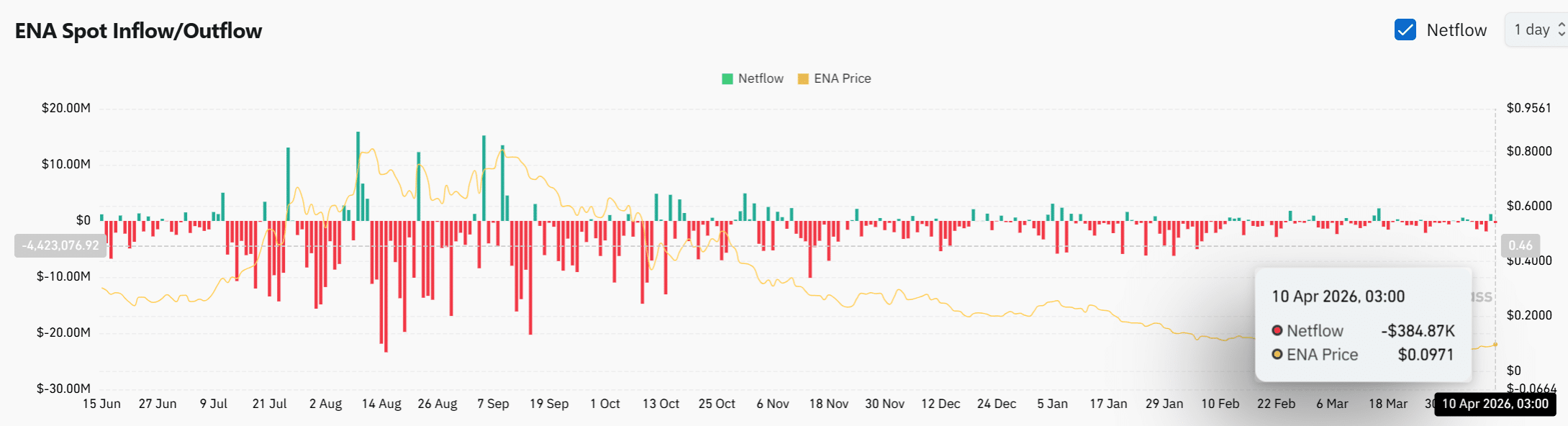
Spot flow data continued to reflect persistent outflows, with netflows recorded at -$384.87K. This consistent negative trend indicated that tokens had been leaving exchanges over time.

Such behavior reduced the available supply for immediate selling, which helped ease sell-side pressure.

As a result, the recent price rebound aligned with this reduction in exchange-held liquidity.

However, inflow activity remained limited, which suggested that strong demand had not yet fully returned. The structure pointed toward a supply-driven move, where reduced selling supported price rather than aggressive accumulation.
Source: CoinGlass

Are longs stepping in as funding flips positive?

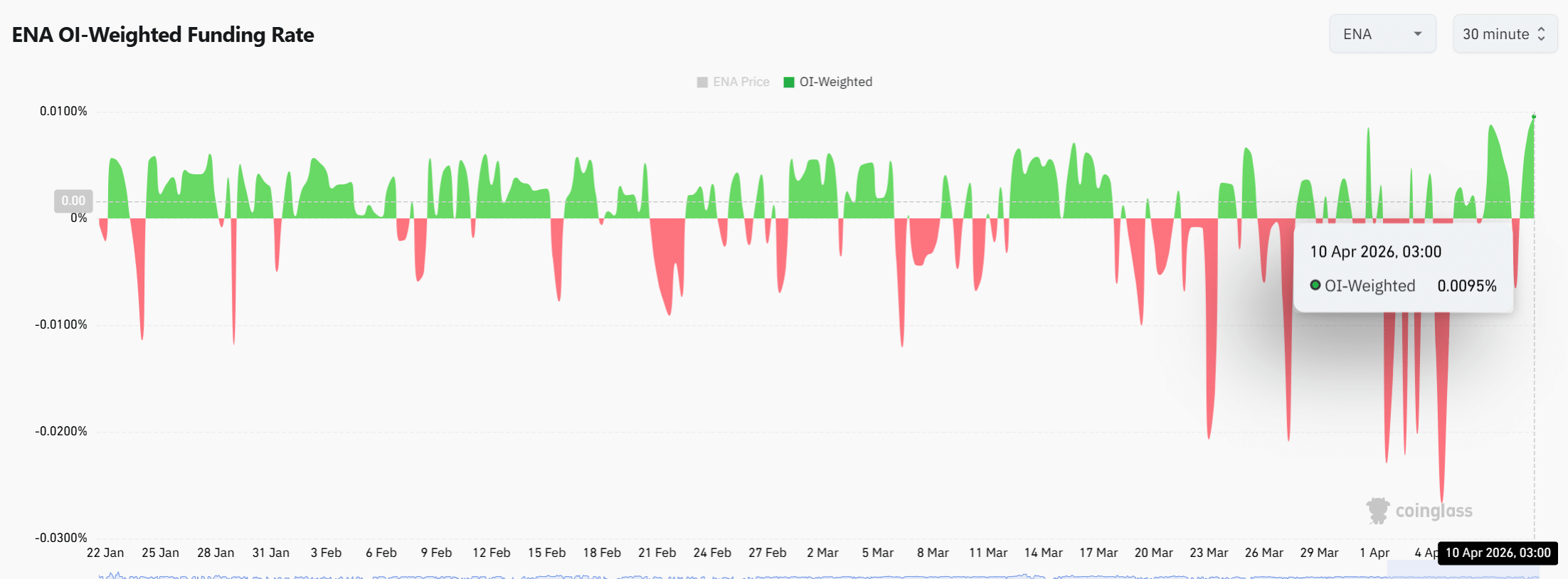
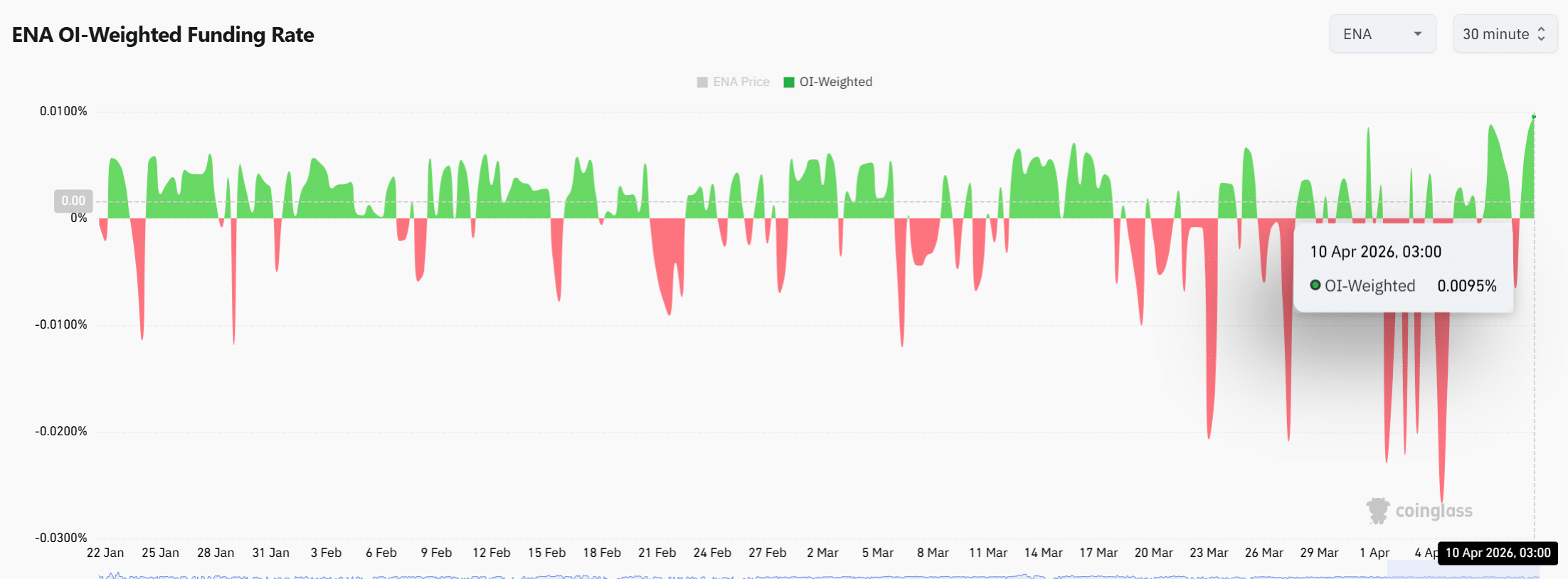
Ethena’s OI-Weighted Funding Rate shifted into positive territory, reaching approximately 0.0095%. This change indicated that long traders had started paying to maintain positions, reflecting a growing bullish bias in derivatives markets.

The shift aligned with the recent price increase, which suggested that leverage had begun to support the upward move. However, the Funding Rate remained moderate, which showed that positioning had not yet become overcrowded.

This balance reduced the risk of sharp liquidation-driven reversals in the short term.

The gradual increase in long positioning suggested improving sentiment, although it still lacked the intensity typically seen during strong trend expansions.
Source: CoinGlass

Final Summary

  • ENA has rebounded strongly, but the price still struggled below the key $0.10 resistance level.
  • Outflows reduced selling pressure, while funding turns positive, showing an early bullish positioning shift.


İlgili Sorular

QWhat was the 24-hour price increase for ENA and what price level did it reach?

AENA surged 11.35% in 24 hours to reach a price of $0.09702.

QWhat key psychological resistance level is ENA currently struggling to break above?

AENA is struggling to break above the key psychological resistance level of $0.10.

QWhat two technical indicators signaled a shift towards a bullish trend for ENA?

AThe MACD line crossed above the signal line with a positive histogram, and the Parabolic SAR flipped below the price, both signaling a shift towards a bullish trend.

QAccording to the spot flow data, what was the trend and how did it affect selling pressure?

ASpot flow data showed persistent outflows of -$384.87K, meaning tokens were leaving exchanges. This reduced the available supply for selling, which helped ease sell-side pressure.

QWhat does a positive OI-Weighted Funding Rate of 0.0095% indicate for the Ethena market?

AA positive OI-Weighted Funding Rate indicates that long traders are paying to maintain their positions, reflecting a growing bullish bias and leverage starting to support the upward price move in the derivatives market.

İlgili Okumalar

In-Depth Report on the On-Chain Lending Market: When Off-Chain Credit Meets On-Chain Liquidation

The on-chain lending market has evolved from a peripheral DeFi niche into core financial infrastructure. As of early 2026, total value locked (TVL) in on-chain lending protocols has reached $64.3 billion, accounting for 53.54% of total DeFi TVL, making it the largest and most mature vertical within decentralized finance. Aave dominates the sector with approximately $32.9 billion in TVL, commanding nearly half of the market—a leadership position that is unlikely to be challenged in the foreseeable future. However, the path of on-chain lending forward is not without risk. Liquidation cascades, credit defaults, and cross-chain vulnerabilities remain systemic threats hanging over the industry. At the same time, a deeper structural transformation is underway: on-chain lending is shifting from a “leverage tool for crypto-native users” to a “compliant gateway for institutional capital”. The scale of RWA (Real World Asset) lending has surpassed $18.5 billion, with U.S. Treasuries and government securities increasingly serving as core collateral. Institutional capital inflows are reshaping both the user base and risk appetite of the sector. This report systematically analyzes the evolution of on-chain lending definitions, competitive dynamics, core risks, and future trends, providing a comprehensive industry outlook for investors and trade practitioners. Key findings suggest that the “one dominant player with several strong challengers” structure will persist in the short term, while fixed-rate lending, compliant collateral, and institutional credit underwriting will define the next phase of competition. For investors focused on DeFi infrastructure, three key opportunity tracks stand out, namely, the Aave ecosystem (Morpho, Spark), RWA lending protocols (Ondo, Maple) and fixed-rate innovation (Notional, Pendle).

HTX Learn32 dk önce

In-Depth Report on the On-Chain Lending Market: When Off-Chain Credit Meets On-Chain Liquidation

HTX Learn32 dk önce

Fu Peng's First Public Speech in 2026: What Exactly Are Crypto Assets? Why Did I Join the Crypto Asset Industry?

Fu Peng, a renowned macroeconomist and now Chief Economist at New火 Group, delivered his first public speech of 2026 at the Hong Kong Web3 Festival. He explained his perspective on crypto assets and why he joined the industry, framing it within the context of macroeconomic trends and financial evolution. Fu emphasized that crypto assets are transitioning from an early, belief-driven phase to a mature, institutionally integrated asset class. He drew parallels to the 1970s-80s, when technological advances (like computing) revolutionized traditional finance, leading to the rise of FICC (Fixed Income, Currencies, and Commodities). Similarly, current advancements in AI, data, and blockchain are reshaping finance, with crypto assets becoming part of a new "FICC + C" (C for Crypto) framework. He noted that institutional capital, including traditional hedge funds, avoided early crypto due to its speculative nature but are now engaging as regulatory clarity emerges (e.g., stablecoin laws, CFTC classifying crypto as a commodity). Fu predicted that 2025-2026 marks a turning point where crypto becomes a standardized, financially viable asset for diversified portfolios, akin to commodities or derivatives in traditional finance. Fu defined Bitcoin not as "digital gold" in a simplistic sense but as a value-preserving, financially tradable asset. He highlighted that crypto's future lies in regulated, institutional adoption, moving away from retail-dominated trading. His entry into crypto signals this maturation, where traditional finance integrates crypto into mainstream asset management.

marsbit1 saat önce

Fu Peng's First Public Speech in 2026: What Exactly Are Crypto Assets? Why Did I Join the Crypto Asset Industry?

marsbit1 saat önce

Justin Sun Sues Trump Family: What $75 Million Bought Was Only a Blacklist

Justin Sun, founder of Tron, has filed a lawsuit in federal court against World Liberty Financial (WLF), alleging he was made the "primary target of a fraudulent scheme" after investing $75 million. Sun claims the investment secured him an advisor title and WLFI tokens, which were later frozen by WLF, causing "hundreds of millions in losses." The dispute began in late 2024 when Sun's investment helped revive WLF's struggling token sale, which ultimately raised $550 million. Shortly after, the SEC dropped its lawsuit against Sun following Donald Trump's inauguration. However, relations soured when Sun refused WLF's demands for additional funding. In August 2025, WLF added a "blacklist" function to its smart contract, allowing it to unilaterally freeze tokens. Sun's holdings, worth approximately $107 million, were frozen, and he was threatened with token destruction. The lawsuit highlights WLF's structure, which directs 75% of token sale profits to the Trump family, who had earned $1 billion by December 2025. WLF's CEO is Zach Witkoff, son of U.S. Middle East envoy Steve Witkoff. The project faces scrutiny for opaque operations, including a controversial loan arrangement on the Dolomite platform, co-founded by a WLF advisor. Despite Sun's history with the SEC, the case underscores centralization risks within DeFi, as WLF controls governance and holds powers to freeze assets arbitrarily. Sun's tokens remain frozen as legal proceedings begin.

marsbit1 saat önce

Justin Sun Sues Trump Family: What $75 Million Bought Was Only a Blacklist

marsbit1 saat önce

İşlemler

Spot
Futures
活动图片