Source: When Shift Happens
Compiled by: Felix, PANews
Dragonfly Managing Partner Haseeb Qureshi recently appeared on When Shift Happens. In the interview, Haseeb revealed a key rule that separates truly wealthy investors from average ones: staying in the market when everyone advises you to leave.
Haseeb, who transitioned from a professional poker player to a venture capitalist, shared how he survived the 2018 crash and the FTX collapse, and why he continued to defend Ethereum and Solana when everyone else gave up on them.
PANews has compiled the highlights of the interview.
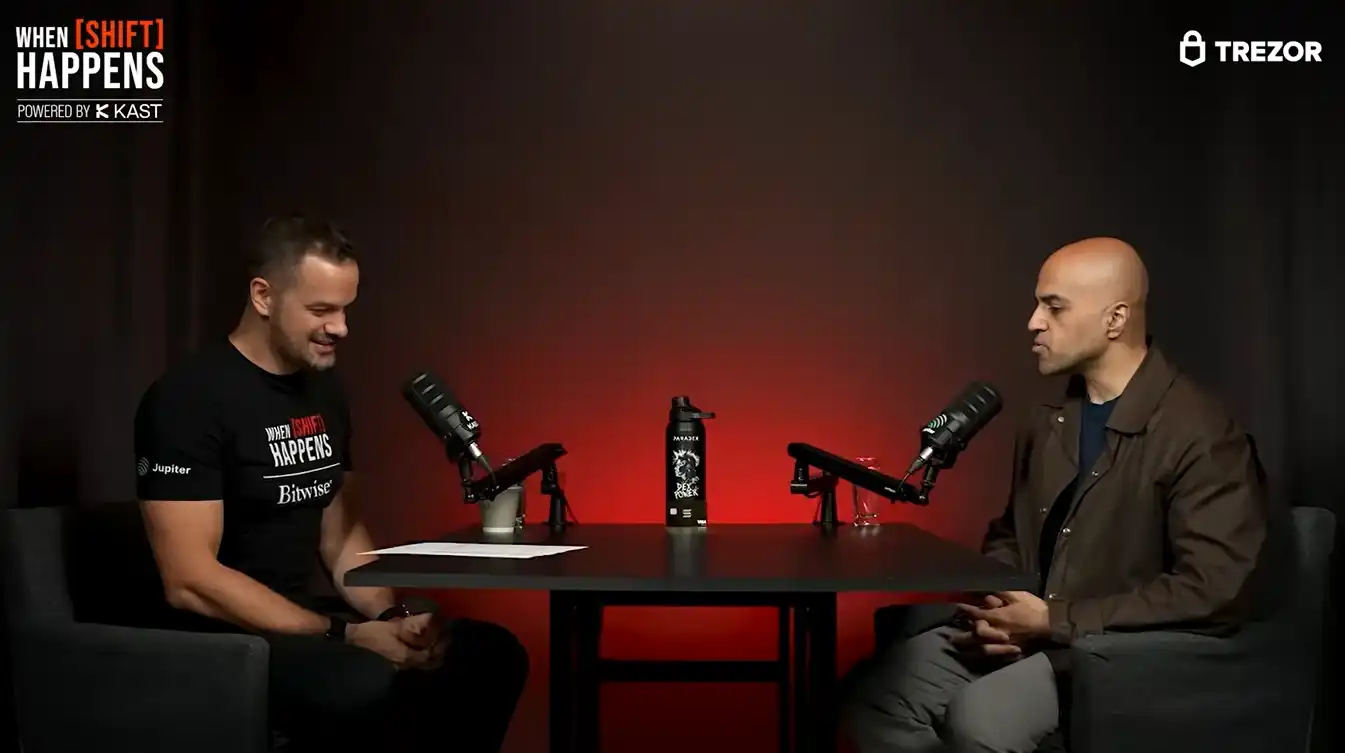
Host: How have you been feeling lately? How's life?
Haseeb: Tired, really tired. It's not just the market; there's a lot of internal work too, a lot of unseen hardship. Most people think VC is an easy job, like taking summers off, investing, and waiting ten years. But I think that's a terrible way to do VC. We stand out because we work harder than others. I'm extremely responsive, always ready to take calls. That's how Dragonfly operates, and not everyone can sustain that for years.
Host: There's a lot of talk about "exiting" now, like Kyle Samani leaving Multicoin, many industry OGs leaving crypto. What's your take?
Haseeb: I think it's exaggerated. Every price drop sees people leaving. This is classic "recency bias"—because it's happening now, it feels worse than the FTX collapse, which is nonsense. After FTX collapsed, how many people were forced out because they lost everything? And those in the metaverse, Web3 gaming—they all left when the hype died, but people forgot about them.
On the other hand, careers have natural tenures. It's normal for someone in the space for 10 years to move on. Especially someone like Kyle, who knows how much money he's made. He's a hugely successful VC who built a massive multibillion-dollar platform. It's not surprising he chose to leave. This happens in every industry.
Also, there's a big difference between pioneers and settlers. They're always different. It's a law of human nature. The people who forged west to find California, to propagate into the new world, are not the same people who eventually build the towns. The psychology and mindset are very different. The first 10 employees at a startup are vastly different from the 50th or 100th, especially the 1000th. The people who helped build Google at the beginning are a completely different type of builder from those who built Google Shopping or Google Drive later. This is happening in crypto now, and it's normal.
Host: How have you stuck with it?
Haseeb: You need to have more to prove. For someone like Kyle, he's obviously very successful; he doesn't need more money. Maybe he does, I don't know his lifestyle. But at a certain point, it's not about money anymore. It's about needing to prove something. If you're Kyle, I guess you feel you've proven yourself. You feel everyone doubted you. We just talked about FTX; Multicoin was one of FTX's biggest investors. That was their near-death experience. After FTX collapsed, one of their biggest, most successful investments went to zero, revealed as the fraud of the century. And Solana, their heavy investment, dropped from over $200 to $8. They survived all that, believed they were right when everyone was wrong, and ultimately were "vindicated." That's an absolutely incredible career pinnacle. I don't know what that feels like, but it must feel amazing. Leaving after that, I'd say, yeah, I get why you'd leave. If you have a few championship rings, no one begrudges you for deciding "not to play the game."
Host: You mentioned recency bias. What other biases try to trick investors' minds but are actually unhelpful?
Haseeb: Good question. For an investor, the most insidious is status quo bias. It's the preference or expectation that the status quo will continue because, if it weren't resilient, how did it become the status quo? Today, I find it hard to find people very attached to the status quo because sentiment across tech is "everything is changing." The AI revolution really makes people think, "Wow, anything can change." A few years ago, there was a feeling that maybe nothing would change; people talked about "The Great Stagnation." Peter Thiel had a famous essay about how we had lots of innovation in bits (information) but none in atoms (the physical world). I think we've broken through that malaise to some degree. Now there's longevity research, CRISPR, AI, drones, quantum computing, nuclear reactors... It really feels like there's movement in science and tech again, which is healthy for society. But even so, the most common failure mode among investors is still not believing that real change can happen.
Host: You've spent a lot of time in Silicon Valley. What did you learn there that you couldn't learn elsewhere?
Haseeb: It's hard to describe. It's not propositional knowledge, not a set of facts you can't learn elsewhere. It's a way of operating, a mindset unique to Silicon Valley. Many cities worldwide say, "We want to be the next Silicon Valley." But almost every time I hear that, it's a joke. Like in Germany, people ask how Berlin can be the next Silicon Valley. I think, bro, don't kid yourself. The uniqueness of Silicon Valley, I think only two places have replicated it: China and Israel. Few others know how to build that model.
First, celebrating failure. In Silicon Valley, failure is normal and not pathologized in any way. You can "fail upward" in Silicon Valley. In most places, that's unheard of.
Host: In most places, they'll tell you, "Failure is good." But in reality, people think you're a loser and won't hire you. The reality is, if you go to a startup, especially if it fails, that's a stain on you forever. They'll ask why you left a good job at Deutsche Bank or SK Telecom to do a startup.
Haseeb: Exactly. That mindset obviously cannot create a vibrant startup ecosystem. The second thing about Silicon Valley many don't understand is that it's an extremely high-trust society. Despite being in the US, a famously litigious society, in Silicon Valley, there's not much litigation, not many people suing each other or getting into bitter fights. The reason is, we understand this is a bubbling cauldron of ideas. Someone will always step on toes, someone will always steal an idea, but it's okay. Because we're all building towards the same direction, not sweating the small stuff, for the greater good. In many other places, people become extremely short-sighted—if you want to look at my startup, sign an NDA; if you do this, I'll sue you. If you want to build the future, you have to move fast, and it must be trust-driven.
The final thing Silicon Valley gets right and others get wrong is its extremely close-knit fluidity. California does not enforce non-compete agreements. In New York, Boston, or any other country, non-competes are the norm. If you leave a company, you can't work elsewhere for one to three years. That effectively takes talent offline, making people extremely unwilling to leave their current company. Silicon Valley understands from a global perspective that even if my company suffers because someone takes knowledge elsewhere, it's better for society overall to have efficient transfer of information. Look at all the AI labs; almost all of them, except China's, are in Silicon Valley. We used to think one company would crack AGI and have an insurmountable advantage. But three years later, all labs are basically at the same frontier, models are free. Why aren't they expensive? Competition. Why is there competition? Because all labs leak information like sieves. Engineers all over Silicon Valley meet at cafes, on walks, at house parties, telling each other what they're doing and trade secrets. Knowledge spreads incredibly fast, and everyone catches up immediately. This doesn't happen anywhere else in the world.
Host: You often compare crypto to tech. Because you have a Silicon Valley mindset, you're a long-term, big-picture, future-oriented person. In this podcast, we try to filter signal from noise, but when crypto does well, there's too much noise; when it does poorly, people are angry and lose direction. Why do you compare crypto and tech so frequently?
Haseeb: Crypto is tech. It's software people run on computers (like Bitcoin). Sure, it doesn't necessarily act like Microsoft. But in terms of building effective teams, how technology gets adopted, sustainable growth curves, we can learn a lot from the tech industry. At the same time, crypto isn't just tech; it's also about money, society, and governance. If you don't understand its financial element (like learning from the dot-com bubble where money flows), you won't see the whole "elephant."
Host: What frustrates me is, because it's about money, there are a lot of traders. They don't understand it, or they're in it for the wrong reasons. I can't understand how they can be angry all day about small things.
Haseeb: David Hoffman had a great line: "The point of crypto isn't to get rich. The point of crypto is to get free." That's a profound insight. At the same time, I don't want to pathologize people who enter crypto to make money. I want to make money too; there's nothing wrong with that. The philosophy of crypto is about freedom, and freedom includes the freedom to make money. No market demands people not be greedy. When something goes wrong in crypto, people say it's because someone was greedy (Three Arrows Capital, etc.). My response is, that's too shallow. Are people in tech selfless? No. If everyone is greedy, but you're creating value and doing it sustainably, that's fine. Not everyone can make money, but everyone can be greedy.
But there still needs to be a pull bigger than just making money. If everyone only cares about money, the industry would be destroyed. There have to be people who truly care about the long-term value we're creating. Greed and extraction are two different things. Goldman Sachs has the famous phrase "long-term greedy." Short-term greedy looks like greed but is actually stupidity, like King Midas turning things to gold and starving because he couldn't eat. Long-term greedy means decisions you make in the short term might not make you money immediately, but you'll make more in the long run. Because that's reputation, that's a career. If you only want to make the most money as fast as possible, go sell drugs. That's definitely not a long-term greedy strategy.
Host: You're a long-term greedy person, an investor. Let's talk about long-term greed. When you say just believe in exponential growth, what do you mean? How does it relate to making a lot of money?
Haseeb: I entered this space full-time at the end of 2017, the peak of the ICO bubble. I started doing VC in early 2018, right as the bubble was bursting. 2018 was the worst sentiment I've seen in crypto, maybe worse than FTX. Because at least during FTX, there was someone to blame (Sam lied, defrauded). In 2018, there was no one to blame; it just felt like we collectively were fools, everything we built was worthless. Bitcoin dropped from $19k to $4k, Ethereum under $100. The right decision then was: stay in the market, hold those assets, and bet on what you believe in long-term. From 2018 to pre-pandemic 2020, nothing happened, no price action, just a faint light in the dark (like DeFi's MakerDAO and Compound beginning to form). In crypto, you have to believe in exponential growth, believe this technology will impact far more than those 100,000 people.
Host: After the FTX collapse in 2022, Bitcoin fell below $20k. What made you step in and buy assets after that complete washout?
Haseeb: The answer is still believing in exponential growth. Telling people back then the US government would buy Bitcoin was unimaginable; we were wondering if the US would ban crypto because of the disaster. You have to believe; if you don't, you'll make the wrong decision at every turn. I was a professional poker player. In poker, you learn you can't win every hand; you have to think from a strategy perspective. You can't always think about buying low and selling high because you can't time it perfectly. All you can choose is strategy, and my strategy is to believe in exponential growth, understand crypto will be much bigger in 10 years than it is today.
Host: In hindsight it's obvious, but it wasn't then. Now we have a feeling that most people might think, "What juice is left to squeeze?" (How much growth is left?) Now we have Trump, US government, institutional involvement; people might feel they missed out. How do you see a future bigger than now?
Haseeb: Look at how many institutions actually own this stuff. As a large VC fund managing lots of assets and institutional LPs, most institutions have zero crypto exposure. Those that invest in us might have less than 1% of their portfolio in crypto. Morgan Stanley recently announced starting to approve its wealth management division to recommend digital assets to high-net-worth clients (suggesting a few percent allocation). Before that, every wealth manager's advice was: this isn't investable, don't touch it. Institutions are just beginning to embrace crypto. Vanguard (the largest ETF provider in the US) just said they're not ready to approve Bitcoin ETFs yet.
Another thing to understand is that crypto adoption is largely generational. The FIT21 bill passed the House; the biggest predictor of who voted for it was "age." Older people don't know what's happening, think crypto is scary, while their kids use it. As boomers age and pass power to the next generation, everything will change. Kids entering college now don't remember a time before Bitcoin (it's 18 years old), Ethereum was created when they were 10. Changing society's mind takes time.
Host: It's like the shift to the cloud. In 2015-2016, enterprises were scared of cloud services, thought data not in their building was unsafe. But as a new generation of executives took over, what company doesn't use cloud now? It's too good, it's a no-brainer. That took only a few years. And now we're talking about money.
Haseeb: Yes, this is most obvious for Bitcoin. People have a deep attachment to gold, saying it's ancient, can't be replaced. I think they overstate this. For young people, their perception of value is already digital. Why is a rock dug from the ground more valuable than a digital asset? SpaceX plans to mine asteroids; if they find one with gold, Earth's gold supply could double, forever changing the dynamics around gold. All the gold fits in a cube smaller than a football field. Bitcoin is software; you can't find Bitcoin on an asteroid. For a software civilization, it makes sense for our money to also be software-based.
Host: Would you sell your personally-believed main tokens?
Haseeb: My personal finances are very simple; I mostly hold. I'm heavily invested in all our funds. I personally own some crypto and some ETFs; basically, buy and hold. I only liquidate for taxes or donations.
Host: In the context of exponential growth, can you talk about your logic for Bitcoin?
Haseeb: As a VC, aside from my personal Bitcoin holdings, I wouldn't invest in Bitcoin because it's not a venture asset. Bitcoin's logic is entirely about Schelling points, about social consensus that society needs to build consensus that Bitcoin will be the future non-sovereign unit of account. People complaining Bitcoin doesn't act like gold, or correlation issues, that's silly. Bitcoin and crypto are protean, they have different operating mechanisms. People don't actually want it to act like gold or be uncorrelated; people just want it to go up. As long as it goes up, everything is forgiven.
Host: What does saturated Bitcoin look like?
Haseeb: Saturated means Bitcoin gets very boring. Young people don't talk about it; it's what old people institutions do. When you feel awkward talking to kids about it, then it's truly mainstream. By then, you might see Bitcoin perform like gold did in the past.
Host: Since you're in the VC circle, some large crypto assets seem more aligned with VC thinking. When many lost confidence, you've been actively defending ETH and SOL. Why?
Haseeb: I generally like defending positions that are "undefended." On platform X, the zeitgeist at the time was saying these assets are just memes, have no cash flow, shouldn't have valuation. I think that's a mistake. The market assigns multi-billion dollar valuations, reflecting deeper wisdom: the market thinks they're valuable and will become much bigger than today.
Host: Like Tesla? Because Tesla's P/E is sky-high, but it's a growth story.
Haseeb: Yes. Markets have two modes: cash flow mode and growth mode. Cash flow mode is "don't tell me stories, show me the money." Growth mode cares less about cash flow and more about growth. Which mode is Ethereum in? The market clearly treats it as a growth mode. Ethereum's price moves not because its fees increase or burn increases; it's a reaction to growth expectations, to narratives about the future.
Host: How often does the market get this growth story wrong over long periods?
Haseeb: Often, like WeWork, Peloton, the metaverse. During the pandemic, people thought we'd work from home forever, but then returned to normal. But crypto is special. It's gone through boom, bust, then boom, bust, boom again. That's extremely rare. It tells you something deeper, more resilient is happening in crypto, and speculation around it is intrinsic to the product itself.
Host: Where does Hyperliquid fit?
Haseeb: It's both, which is rare. It has massive cash flow (buying back and burning tokens) and a compelling growth story (expanding into commodities, index derivatives).
Host: When AI is sucking up talent and capital, why should people stay in crypto?
Haseeb: This answer might surprise you: I don't know if they should stay. First, it's absolutely correct that AI is swallowing lots of talent. AI is undoubtedly the most important technology of the 21st century. If you can't find the value you're creating in crypto, maybe it's time to leave. The reallocation of capital and talent is what capitalism does.
The OGs we talk about leaving are the pioneers. Pioneers are the crazy ones attracted to the "Wild West." Now crypto isn't the Wild West anymore. We have the technology and forms; now we need to build civilization on top, do a lot of infrastructure building. In social media, all the important apps were built before 2010 (except TikTok). The ideas were there; after 2010, it was all execution and building, resulting in 10x to 30x financial growth, creating the world's most powerful companies.
We're now in crypto's infrastructure phase (execution phase). If you need the Wild West craziness, it's not here anymore (maybe in AI). You can lament that, but this has its own rewards and excitement. If you don't want that, you should leave. But that doesn't mean crypto is over. There are still insane potential returns, just like social media after 2010.
Related Reading: Dialogue with Investor Andrew Kang: The Investment Logic Shifting from Crypto to Humanoid Robots