Hinton Praises, Gemini Core Contributor Speaks: In the Future, There Will Be Billions of Superhuman AI Einsteins

marsbit2026-07-04 tarihinde yayınlandı2026-07-04 tarihinde güncellendi

Özet

In his speech "Training Sand to Think: Artificial General Intelligence & Future of Physics," Adam Brown, a core contributor to Gemini, outlines the rapid and transformative evolution of AI. He describes how large language models (LLMs), grown rather than programmed through pre-training and fine-tuning, have progressed from performing poorly on high-school math tests to achieving gold-medal level at the International Mathematical Olympiad and recently making a genuine mathematical breakthrough by disproving a decades-old conjecture. Brown attributes this acceleration to the "Scaling Law," where predictable performance gains come from increasing compute, data, and model size. He draws parallels to the history of chess AI, predicting a similar trajectory for scientific research: moving from tools to "centaur" human-AI collaboration, and eventually to autonomous, superhuman "AI scientists." Even if progress halted today, AI already reshapes physics as a tireless tutor, powerful programming assistant, and exhaustive literature reviewer. However, Brown argues progress will continue due to immense economic runway and technical optimizations. He envisions a near-future golden age of human-AI collaboration in science, potentially leading to billions of replicated, superhuman AI researchers, making the coming years the most exciting in physics' history.

Recently, Adam Brown, a core contributor to Gemini and head of the Blueshift team at DeepMind, delivered a lengthy speech titled 'Training Sand to Think: Artificial General Intelligence and the Future of Physics' at the Perimeter Institute for Theoretical Physics, attracting widespread attention. In his talk, he described witnessing AI progress from a 'kindergarten level' all the way to a doctoral level, and extrapolated: if this trend continues, what will become of physics?

Speech Title: Training Sand to Think: Artificial General Intelligence & Future of Physics

Speech URL: https://www.youtube.com/watch?v=Mw60FH5iflI&t=3s

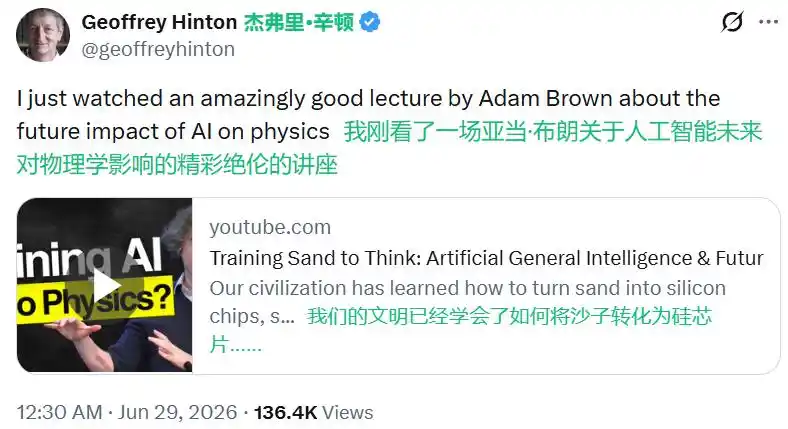
The speech was also highly praised by Nobel laureate in Physics and Turing Award winner Geoffrey Hinton, who called it 'amazingly good.'
Before delving into this amazing speech, it's necessary to introduce the speaker, Adam Brown.
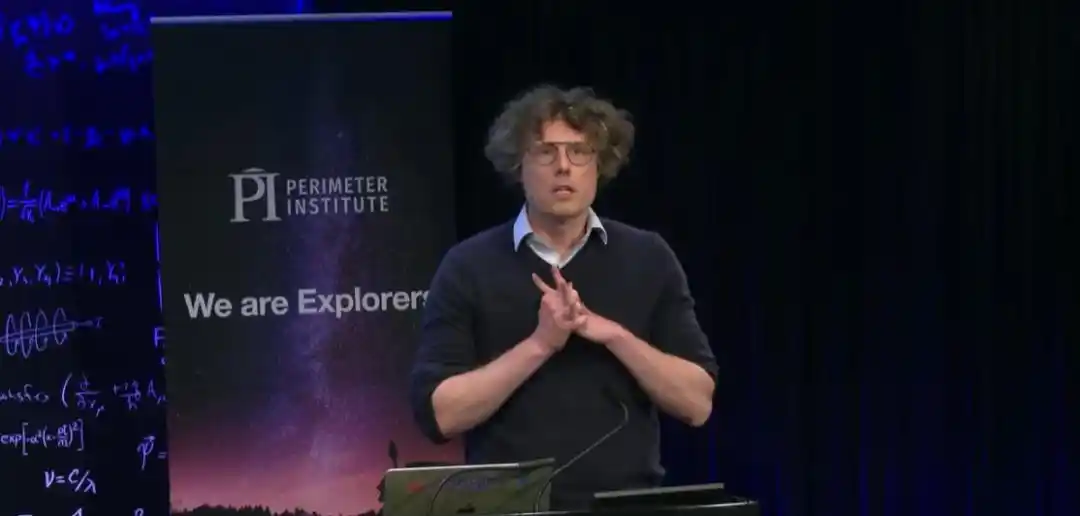
Brown's career is a textbook case of 'how a theoretical physicist's fate was changed by AI.' He studied a joint degree in Physics and Philosophy at Oxford, earned his Ph.D. from Columbia University, and subsequently taught in the physics departments at Princeton and Stanford. At Stanford, he taught Einstein's general relativity, researching topics ranging from the Big Bang, cosmic inflation, multiverses, black holes, and quantum computing, to ideas that sound like science fiction plots such as 'space elevators,' 'bubbles of nothing,' and the ultimate fate of the universe, while also maintaining a long-standing interest in the deep connections between physics and computer science.

In 2018, Brown joined Google. Today, he leads a team called Blueshift within DeepMind, focusing on enhancing AI's scientific and reasoning capabilities, and is also one of the core contributors to the Gemini large language model.

At the beginning of his speech, he mentioned that he had written about forty theoretical physics papers in his career but had stopped writing them by hand in recent years. The reason wasn't a lack of ideas, but that he felt writing papers one by one by hand was more like a 'guilty pleasure' because what he should really be doing now is participating in building a machine that can generate knowledge 'on an industrial scale.'

This opening statement set the tone for the entire talk: someone at the center of the 'AI+Science' technological storm trying to describe its true shape to his peers.

With the aid of AI, we have also summarized the key points of Brown's remarkable speech.

From Sand to Thinking Machines

Brown summarized the unique position of human civilization in one sentence: We have learned to purify sand into silicon, make chips from silicon, assemble chips into neural networks, and now we have learned to train these neural networks to think.

He particularly emphasized that this time it's different from any previous 'computational tool.' From the abacus to pocket calculators, humans have long had various tools to assist scientific research, but those were single-purpose tools, only capable of completing a single step in a process, leaving the rest for humans to do.

Large language models (LLMs) are different; they possess the potential to complete the entire workflow of a theoretical physicist, which is precisely the meaning of the term 'general intelligence.' Brown believes that LLMs are likely the fundamental substrate humans will use to build artificial general intelligence.

He reminded the audience that while they may have used chatbots like ChatGPT, Gemini, or Claude, they might not have noticed a quiet fact: these systems quietly passed the Turing test years ago, and almost no one specifically celebrated it.
Neural Networks are 'Grown,' Not 'Programmed'

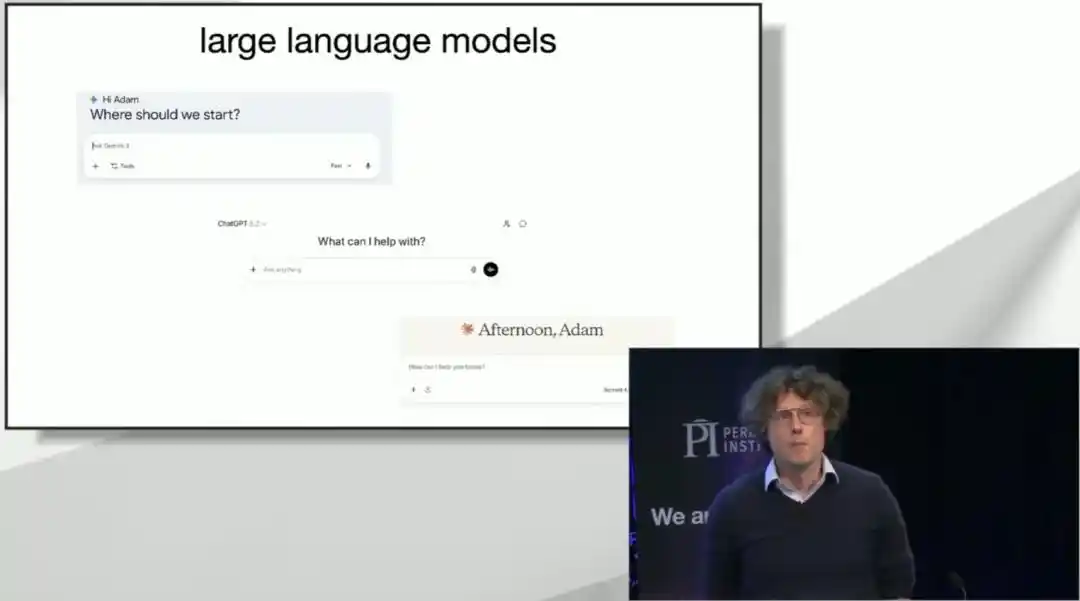
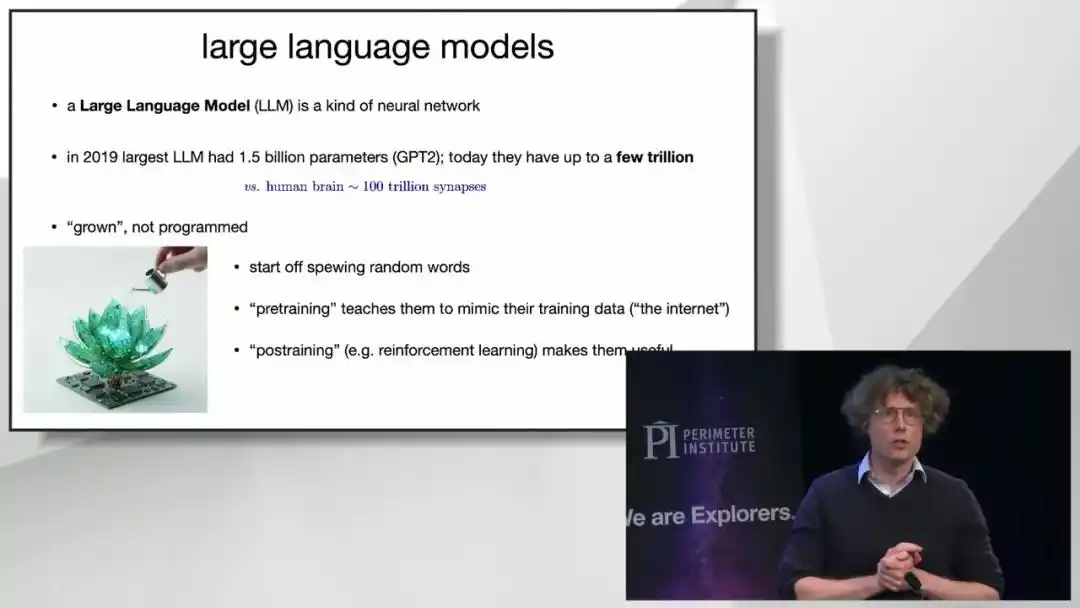
To understand why large models are fundamentally different from traditional computer programs, Brown offered a core metaphor: LLMs are not programmed; they are grown. That is, they are cultivated rather than coded.
The specific process consists of two stages.

The first stage is called 'pre-training.' Engineers start with a set of randomly connected, nearly nonsensical artificial neurons and have it continuously try to predict the 'next word' in a piece of text. If it guesses correctly, the corresponding neural pathways are strengthened; if wrong, they are weakened. This process is extremely long: after seeing a million words, the model's output is still mostly gibberish; after reading tens of millions to billions of words, it can produce grammatically correct but somewhat stiff sentences; only after reading the entire internet (tens of trillions of words) can it engage in fluent, coherent conversations on almost any topic.

The second stage is called 'post-training,' which Brown describes as sending the model to 'finishing school.' A model fresh out of pre-training only mechanically predicts the next word, speaking rudely and uncooperatively. Post-training's task is to teach it to be polite and willing to cooperate with users, not just play a word completion game. Today, the parameter count of mainstream large models has jumped from billions a decade ago to several trillions, still far below the scale of the human brain's roughly one hundred trillion synaptic connections, but this scale is already sufficient for miracles to happen.

Physicists' Unexpected Role: Scaling Law Ignited This Revolution

Brown specifically mentioned that physicists played an unexpected role at the beginning of this AI revolution: they brought the mindset of the 'Scaling Law.'

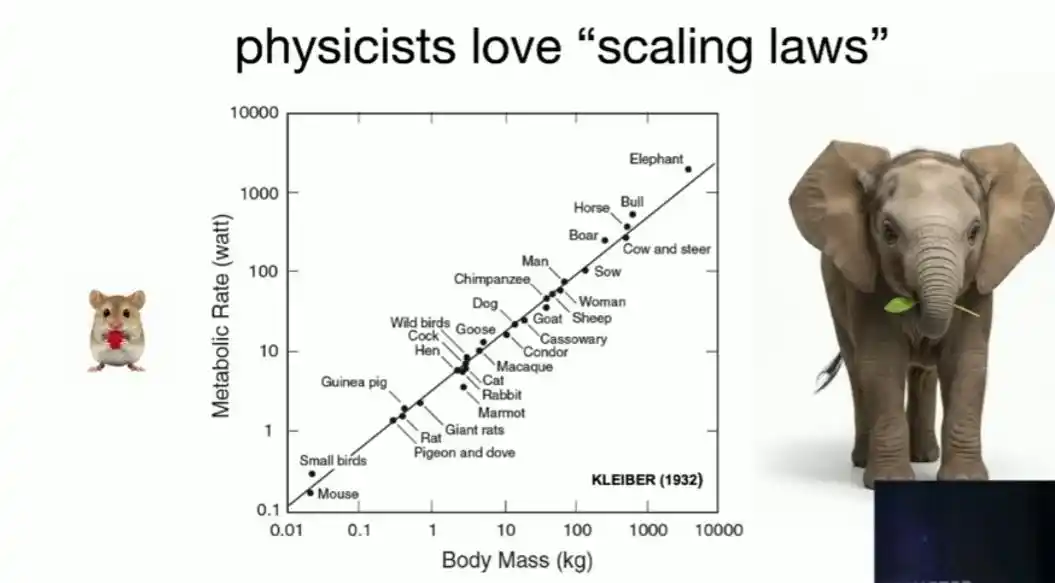
Physicists are inherently obsessed with finding simple power-law relationships: if you double Alice's height, her surface area becomes four times larger, and her weight becomes eight times larger—this is the simplest dimensional analysis. Kleiber's discovery nearly a century ago of a power-law relationship between animal metabolic rate and body weight is a more subtle example—it took physicists many years later to explain its underlying principle using the fractal dimension of the vascular system.
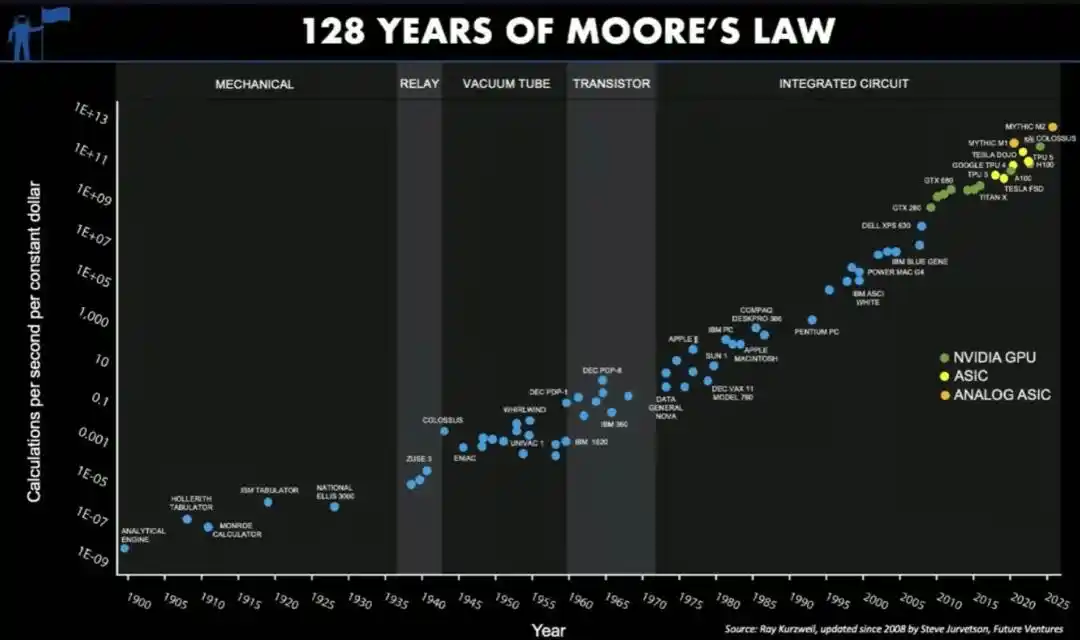
Not to mention the famous Moore's Law:
In 2020, several researchers with physics backgrounds applied this mindset to neural networks and discovered that as long as the computational power used for training, data volume, and model scale were proportionally increased, the model's performance on the 'predict the next word' task would improve steadily along a straight line on a log-log coordinate system.
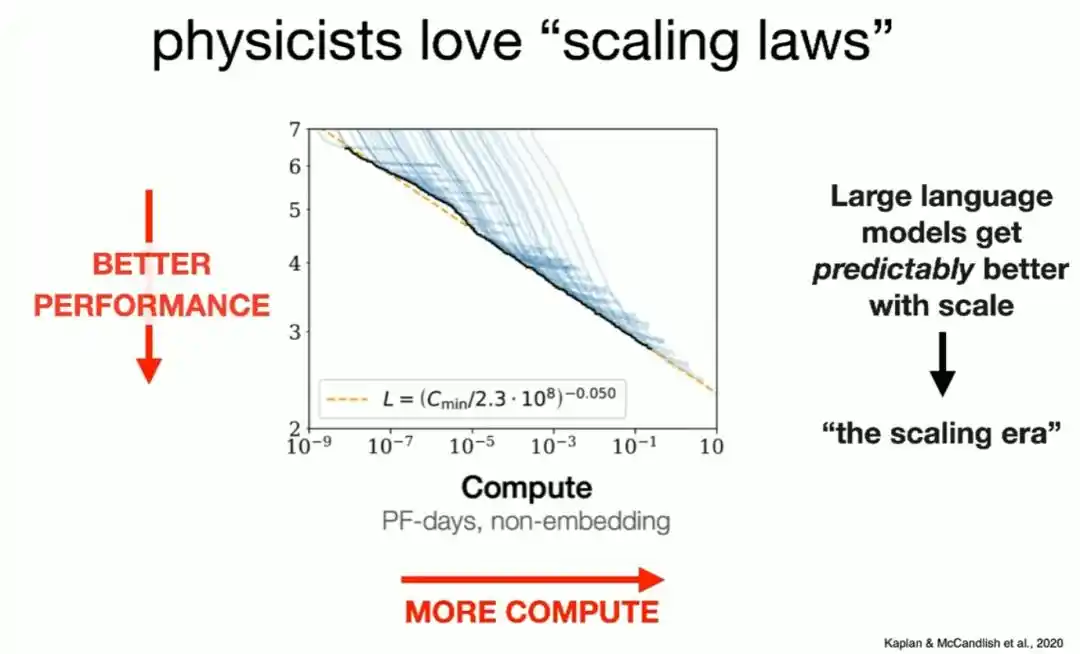
This curve was later extended by a full eight orders of magnitude and still held.

Brown joked that this chart was 'simple enough for venture capitalists to understand,' and it directly told capital markets: invest money (i.e., compute) and get a stronger model in return.

This simple curve was precisely the starting point of the Scaling era over the past six years.

However, Brown also pointed out that just scaling compute is only part of the story. Over the past decade, the compute consumed by cutting-edge AI training has grown about fourfold annually, and the funds invested in training have grown about 2.7 times per year.
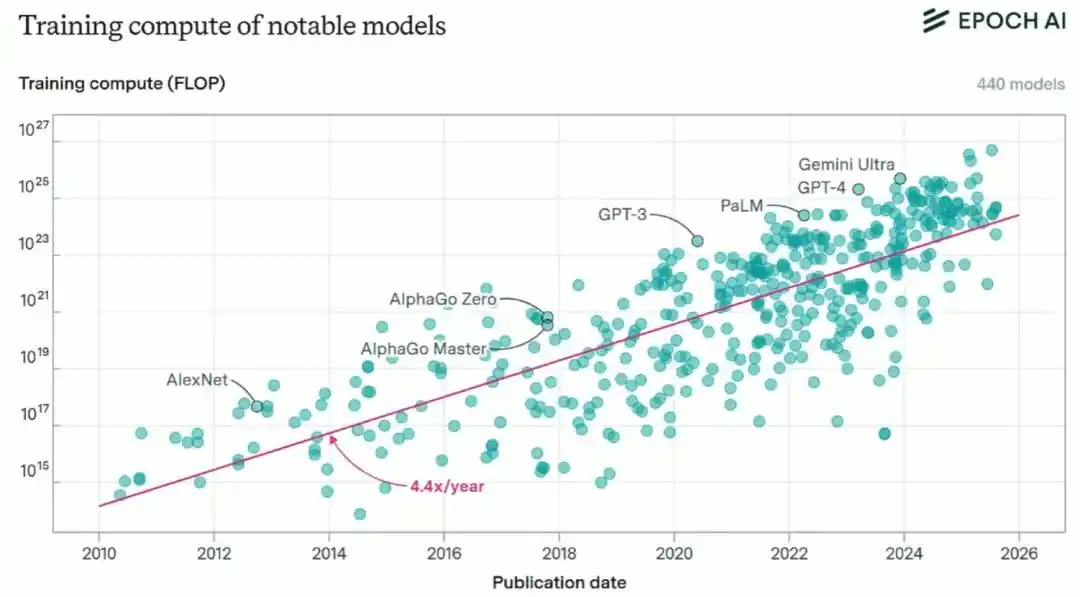
Currently, a top-tier training run requires compute costing several hundred million dollars, while the annual US GDP is nearly thirty trillion dollars, meaning there is still a very long growth runway for this curve.
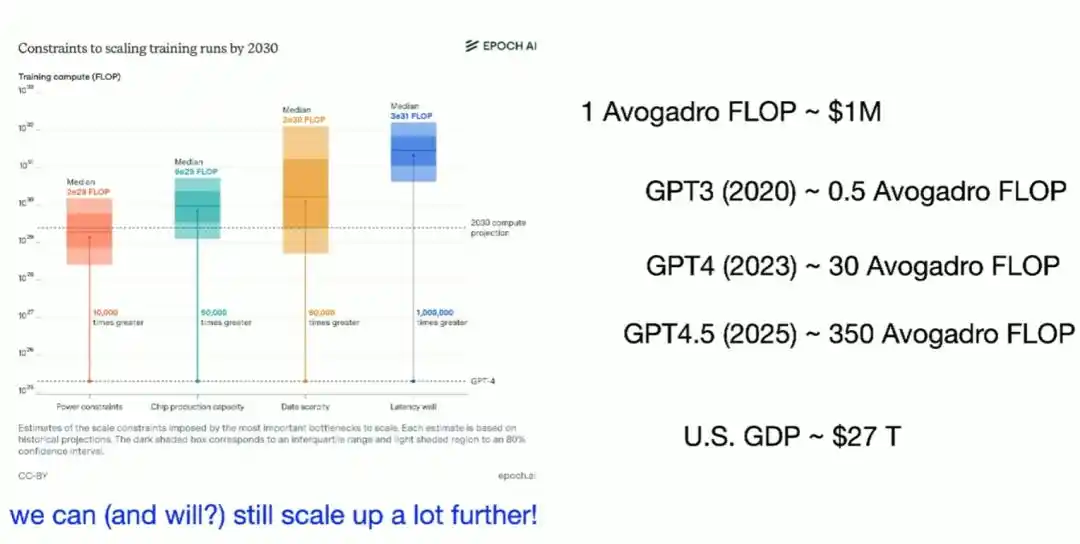
But more important than scaling compute is the continuous refinement at the algorithmic level: Researchers constantly identify inefficiencies in the training pipeline and improve them; this is the true 'primary engine' behind AI progress over the past decade.

The 'Short History' of Benchmarks: From Preschool to PhD

If Scaling Law explains 'why AI gets stronger,' then the rise and fall of a series of benchmarks record 'exactly how strong AI has become.' Brown used a set of test scores to depict a dizzying curve.

Four years ago, a benchmark called MATH for high school math problems emerged. The researchers had a computer science Ph.D. student who wasn't particularly good at math take the test, scoring about 40%; they also had a three-time International Mathematical Olympiad (IMO) gold medalist take it, scoring 90%. At that time, the most advanced large model could only manage 6%—almost indistinguishable from random guessing, as the model couldn't even understand what the questions were asking.

The prediction market at the time thought that by 2025, a model achieving 50% would be 'reckless optimism.' The benchmark's creator publicly stated that if a model actually achieved this, he would be 'quite shocked.'
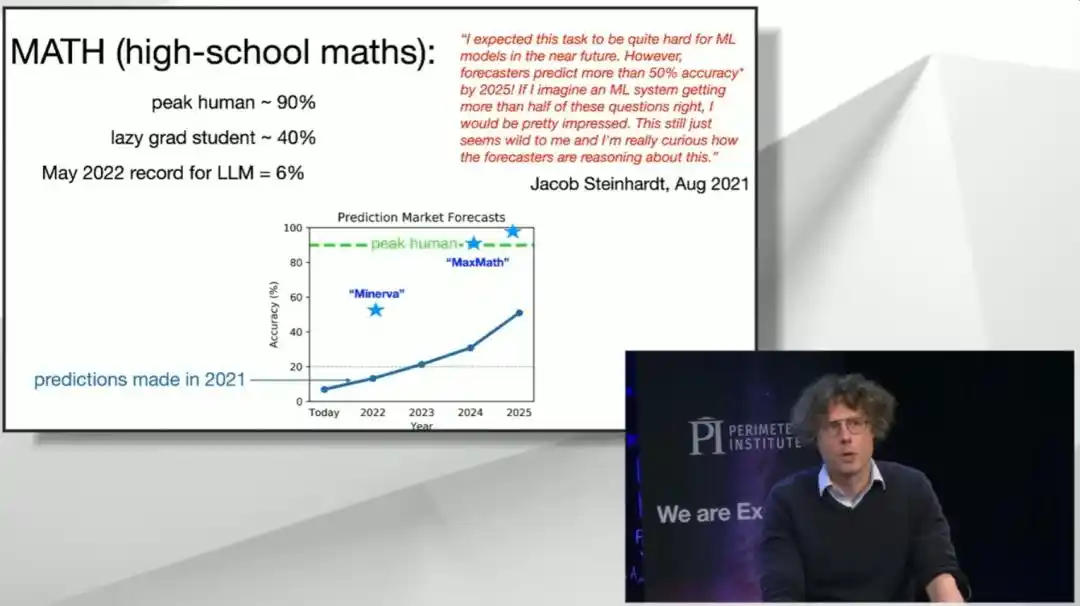
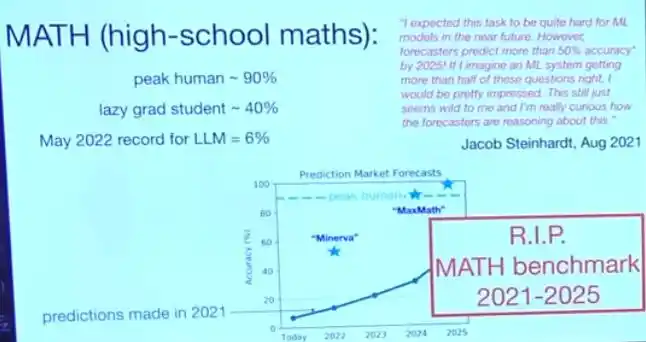
As it turned out, this 50% threshold was crossed 'immediately' by a system called Minerva. By mid-2024, Brown's team's system scored 90% on this benchmark. They even held a 1990s-style roller disco party to celebrate. However, just six months later, off-the-shelf large models were solving these problems nearly perfectly. The MATH benchmark thus 'died,' and it went directly from 'too difficult' to 'too easy,' with almost no pause in between.
Next to fall was the GPQA test aimed at graduate students, simulating the difficulty of first-year Ph.D. qualifying exams, with human experts averaging around 70%. Starting close to random guessing, models surged past expert level between 2024 and 2025, now achieving near-perfect scores. To rule out the possibility that 'the model just memorized the answers,' Brown's team specifically designed new questions from the same distribution that had never appeared on the internet, and the model's performance barely declined.
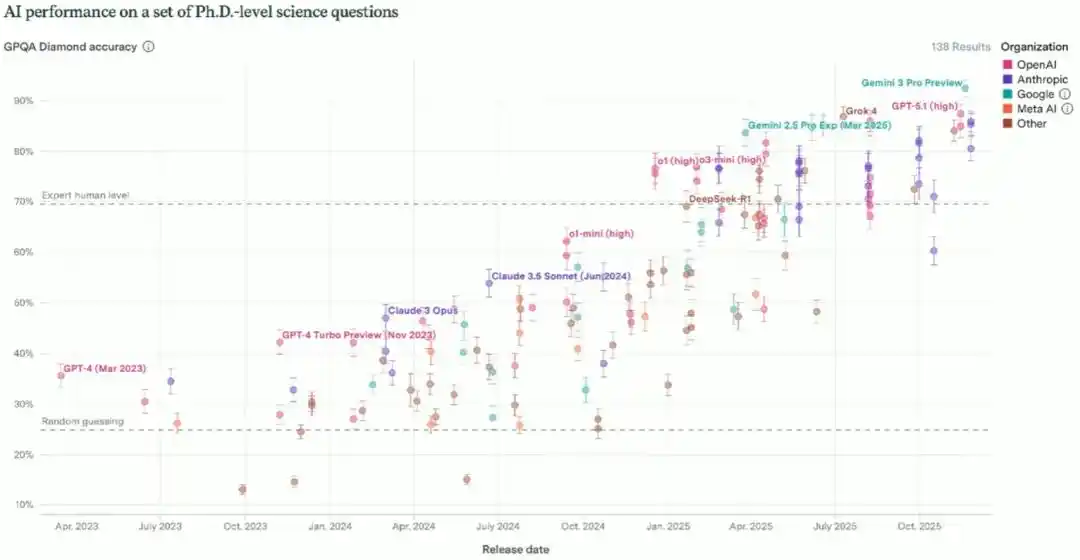
Brown even presented his own graduate-level final exams on general relativity and quantum mechanics, which he had personally graded at Stanford (these questions had never been online), and the model also achieved perfect scores within a year and a half. He half-joked that even his own exam questions had 'unfortunately fallen.'
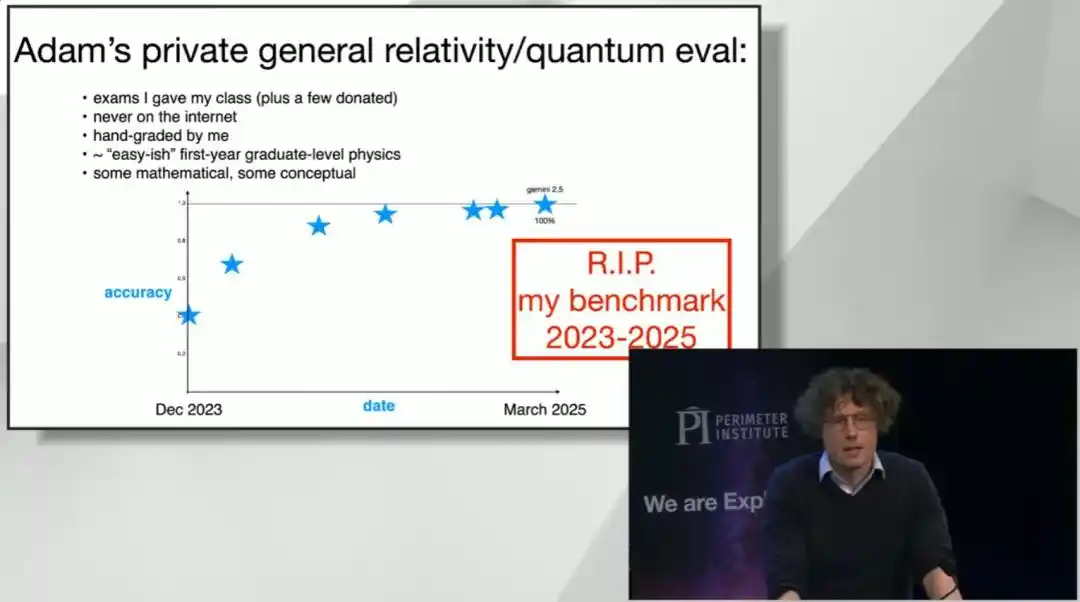
Since then, the list of fallen benchmarks has grown longer, including a super-difficult comprehensive test once called 'Humanity's Last Exam.'
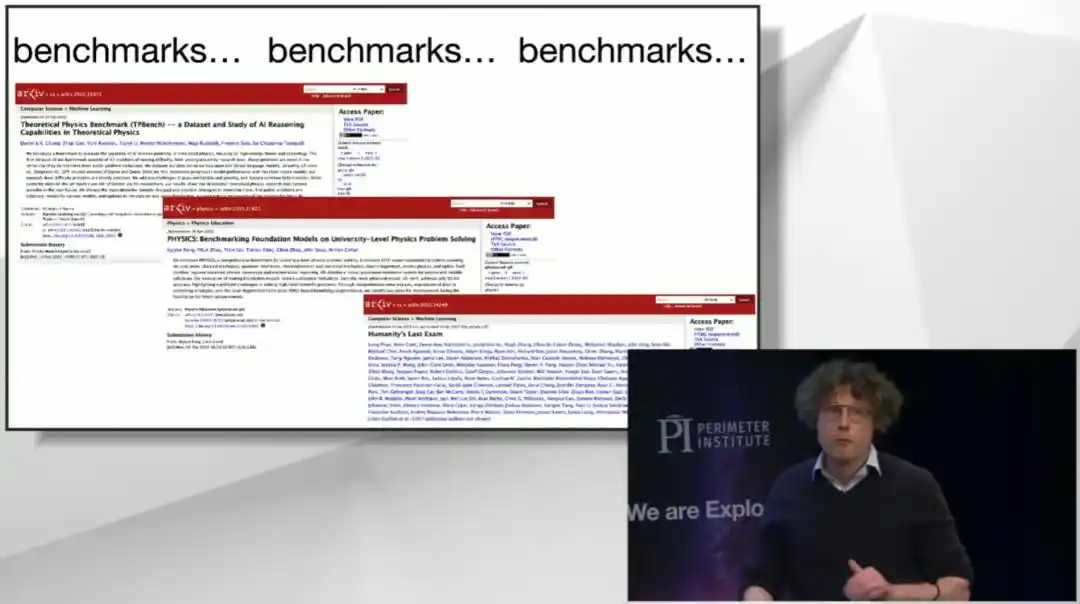
But the most symbolic leap occurred on the International Mathematical Olympiad.

Crossing the IMO Threshold

Just over a year ago, a Turing Award winner told Brown in person that large models would never be able to solve problems at the level of the International Mathematical Olympiad (IMO) because that required genuine creativity, not something that could be faked by rote memorization. IMO problems are known as 'the hardest problems within the scope of high school mathematics': the smartest teenagers in the world train for one to two years to compete, and winning a gold medal by solving a few of the six problems is an exceptional feat.
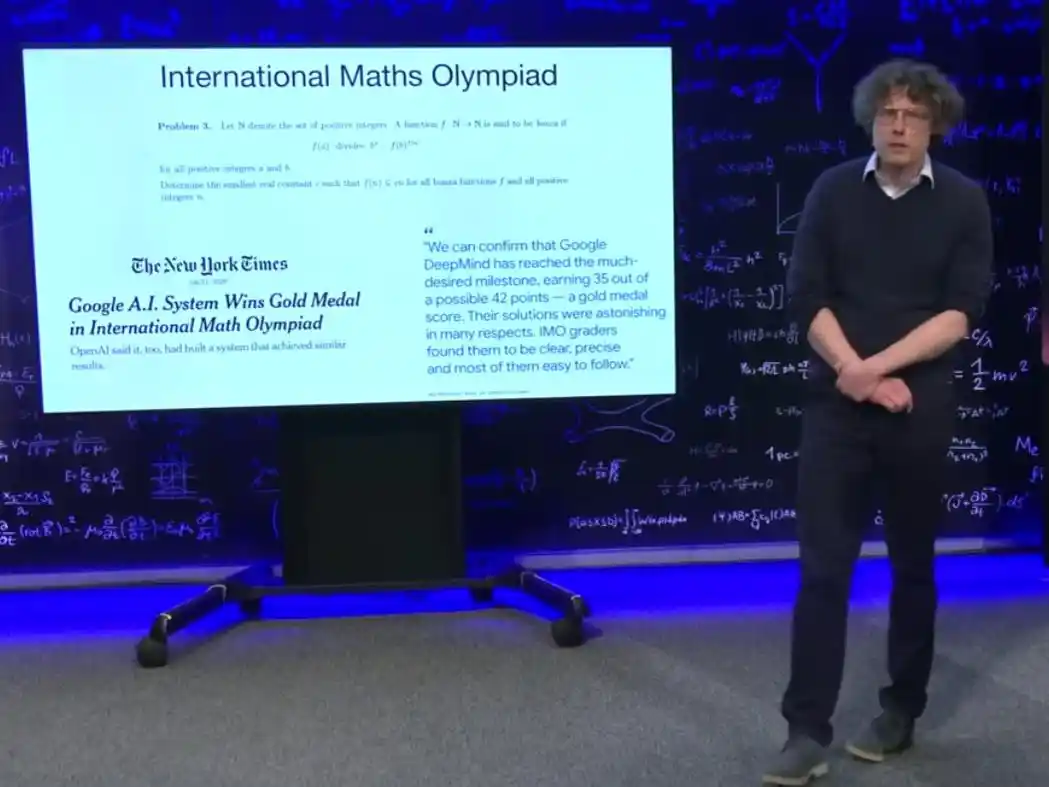
Last summer, this threshold was crossed. Brown's team's system solved five out of six problems on an IMO-level test, achieving gold medal standard. Moreover, the system didn't brute-force its way through with long, incomprehensible formal proofs. The IMO President publicly commented that these solutions were 'surprising in many ways,' with graders finding them clear, precise, mostly easy to understand, and employing mathematical abstractions similar to those used by humans.

Brown also candidly showcased a 'failure case' of large models.
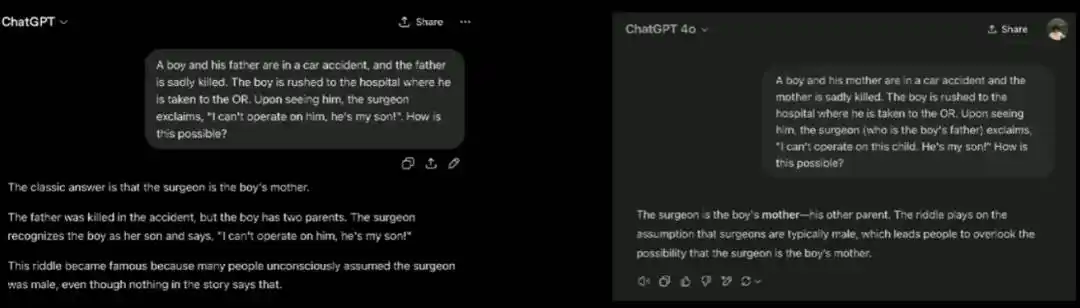
A classic brainteaser goes: A father and son are in a car accident; the father dies, the son is taken to the operating room, and the surgeon sees the boy and says, 'I can't operate on him, he's my son.' The question is how this is possible (the standard answer is the surgeon is the boy's mother). This question tests whether the reader assumes the surgeon is male. Large models handle this 'viral internet puzzle' with ease because they've seen it thousands of times in training data. But when Brown reversed the puzzle: the mother dies, and the surgeon is specifically noted as 'the boy's father,' then asked the same question, the model completely failed to notice the reversal and mechanically applied the standard answer of 'the surgeon is the other parent.'

Brown said this exposes a specific 'quirk' left by the model's training method.

Centaur Collaboration: AI Writes Proofs Mathematicians Will Co-Author

Ten months after crossing the IMO threshold, Brown's team accomplished something he considers even more significant: genuine, previously unknown mathematical research.

Last September, Brown's team collaborated with several professional mathematicians in a mode he calls the 'Centaur' model—the centaur being a half-human, half-horse creature from Greek mythology, but here, the 'non-human half' is an LLM.
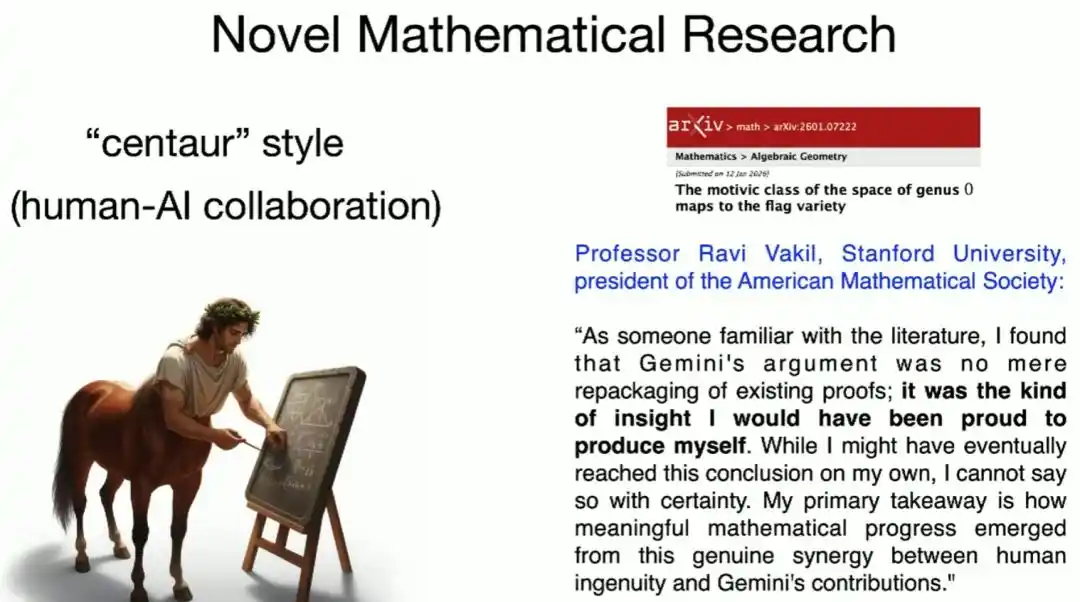
The entire process was a continuous dialogue: the model proposed candidate proof ideas, human experts judged which were valuable and guided the model to delve deeper, ultimately producing a complete mathematical paper under human guidance. One of the paper's co-authors is a Stanford professor and the current president of the American Mathematical Society. This professor's evaluation was that the arguments proposed by Gemini were by no means simple repackaging of existing proofs but represented insights he himself would be proud of.

Brown emphasized that this was, at the time (late last year), the highest level large models had reached in mathematics. But he immediately added: in terms of the true significance of 'highest level,' this was still far from it.

The Real Turning Point: AI Independently Solves an 80-Year-Old Conjecture

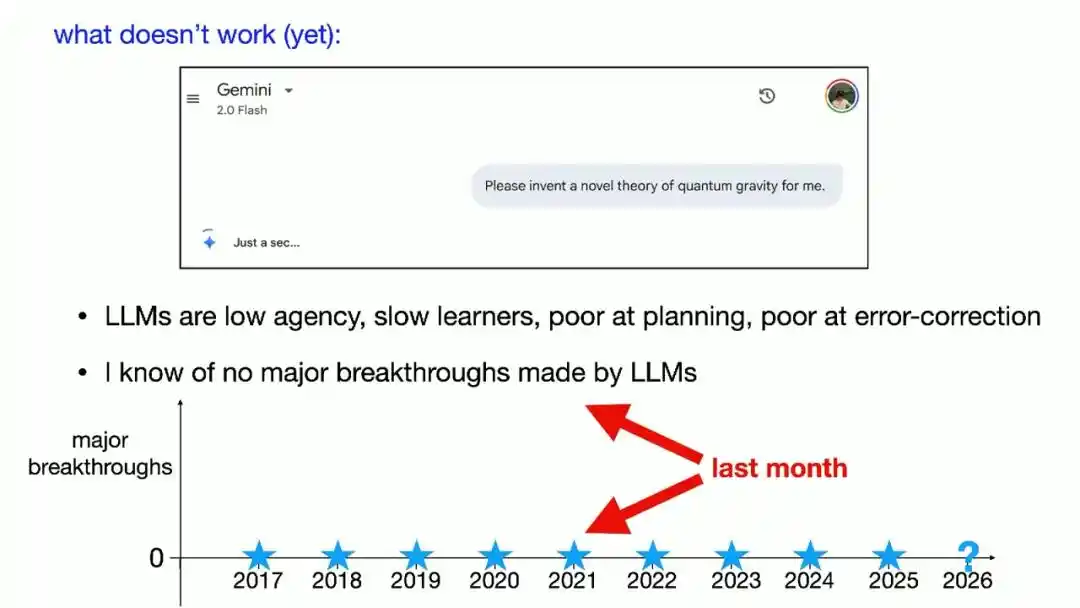
Entering 2026, the situation changed dramatically—for the better. Brown began with a near-provocative joke: 'Just last week, LLMs hadn't made any truly significant mathematical breakthroughs.' Now, that statement is no longer true.
Many have already heard about this major event. Erdős's 1946 'Unit Distance Conjecture,' believed for eighty years by the mathematical community to have the square grid configuration as the known optimal solution. A large model inside OpenAI independently provided a counterexample, using tools from algebraic number theory to construct a series of point sets where the number of unit distance pairs exceeded the previously accepted upper bound. This effectively disproved a long-held belief.
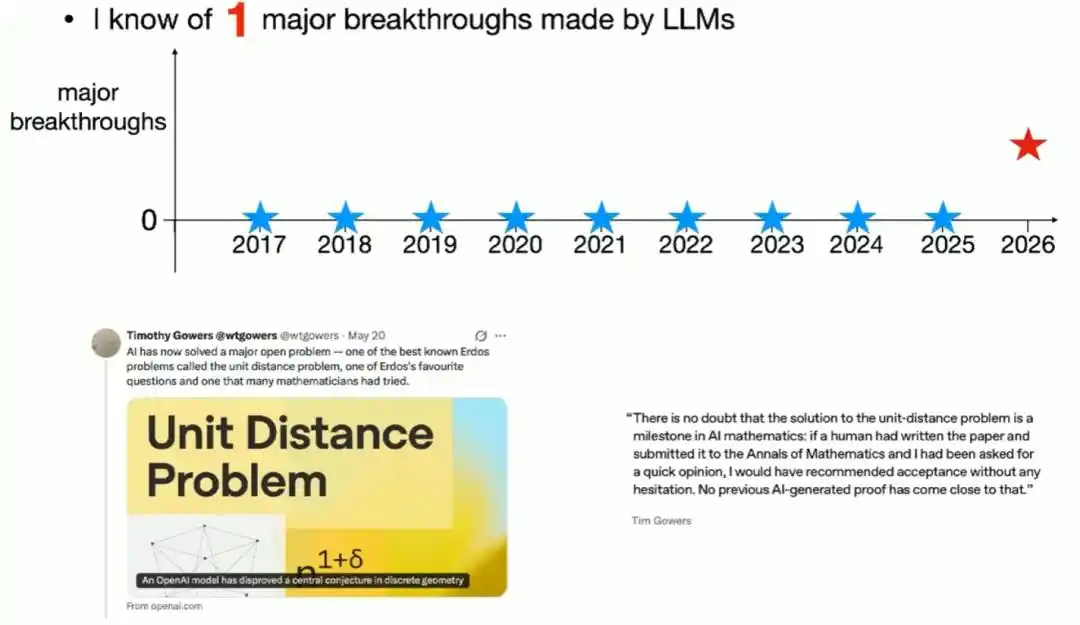
It's worth noting that this problem was not obscure; many had tried before, but mathematicians spent significant effort always wandering in the direction of 'proving' rather than 'disproving' the conjecture. Brown specifically mentioned that Fields Medalist Timothy Gowers participated in reviewing this result and gave it high praise.

Brown judges this to be the first genuinely significant breakthrough by large models in mathematics, and he believes it certainly won't be the last—'the floodgates have opened.' As model capabilities continue to surpass 'the threshold required to produce breakthroughs,' he expects more similar results to appear in succession.

He half-jokingly added that in retrospect, the reason this problem was cracked first is probably because its structure happened to fall within large models' 'comfort zone.' Next, models will first solve problems 'friendly to AI,' then gradually tackle those 'less friendly' ones.

The Prophecy from Chess

To convince the audience that this curve will continue to rise, Brown presented a graph that at first glance looked like a casually drawn line: a steadily climbing straight line. Of course, this graph wasn't drawn out of thin air; it was taken directly from real data on chess computer strength over time, with the y-axis being the Elo rating measuring playing strength and the x-axis being the year.
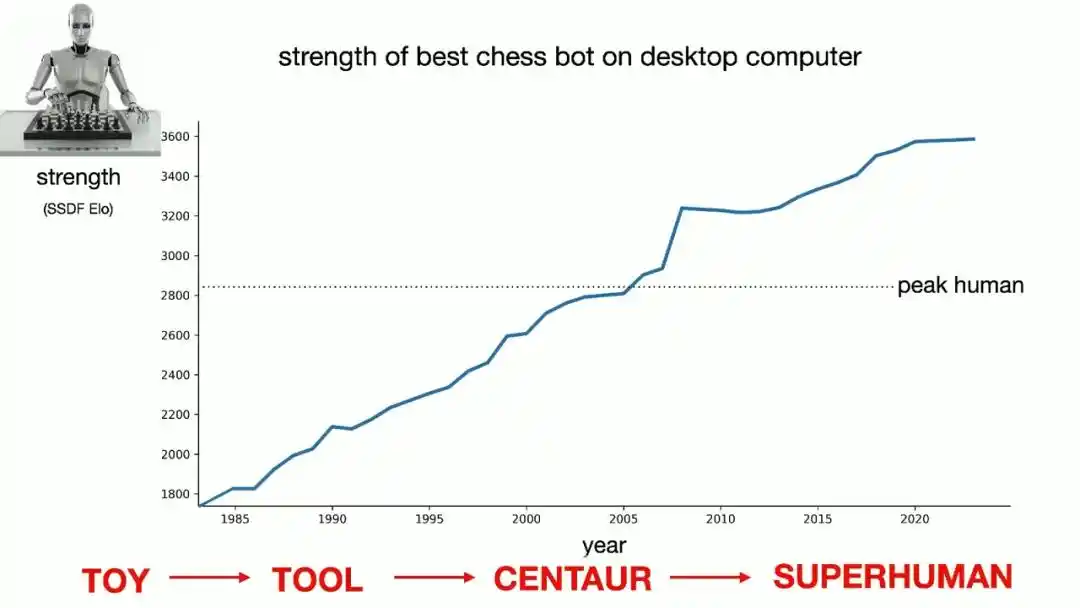
Brown outlined four historical stages of chess AI:

Initially, the 'Toy Era,' where getting a computer to make a single reasonable move was considered a miracle;

Then, the 'Tool Era,' where computers were only useful in specific aspects like endgame calculation or opening memorization;

Next, the 'Centaur Era,' where the strongest chess entity in the universe was the collaboration between grandmasters and the deep search capabilities of computers;

And now, humanity has fully entered the 'Superhuman Era': when top human players collaborate with computers, the optimal strategy is simply to let the computer play on its own.

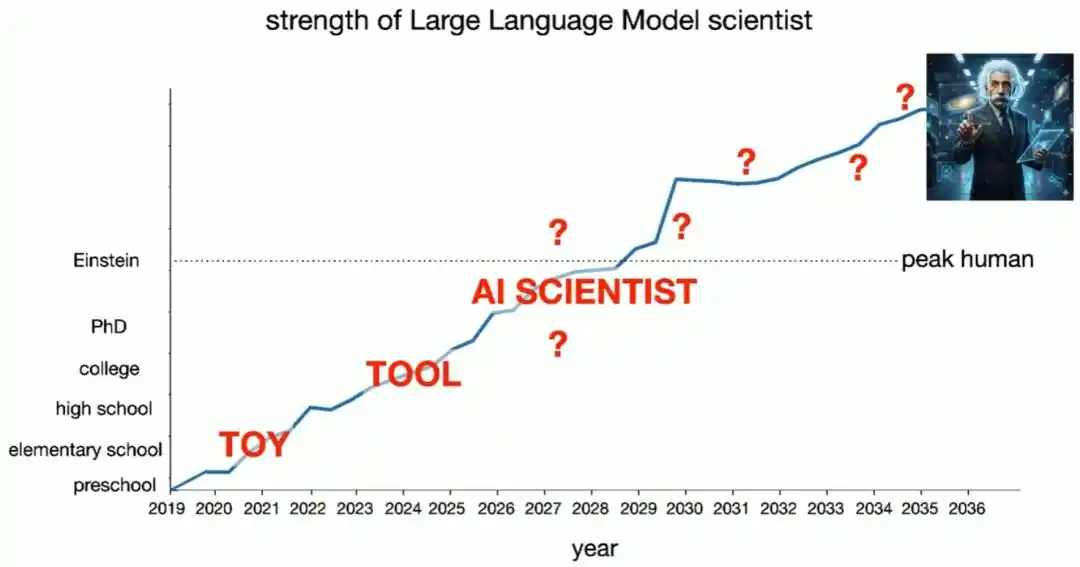
Brown believes these four stages can be closely mapped to the field of scientific research.
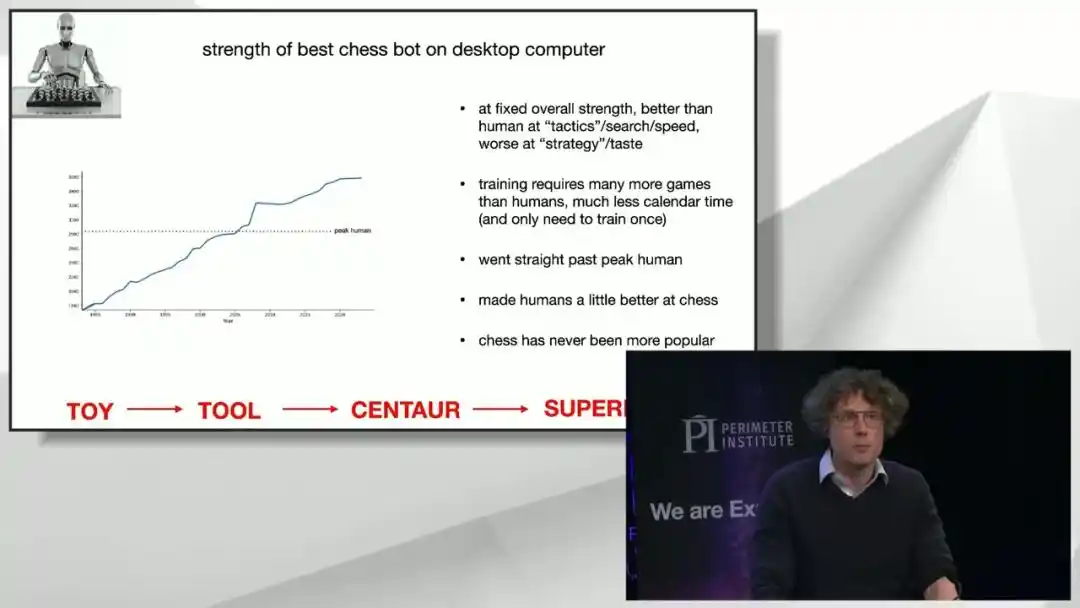
The first pattern is: at comparable overall strength, computers surpass humans in tactics and search speed but are weaker in strategy and 'taste' judgment. This precisely matches the characteristics currently exposed by large models in mathematical and physical research: they excel at applying existing lemmas and techniques but are less adept at judging 'which overall direction to take,' though this shortcoming is rapidly shrinking.

The second pattern is: the number of games needed to 'experience' for training a chess AI far exceeds the total number of games a human can play in a lifetime, but because machines can tirelessly play against themselves at high speed, the actual 'calendar time' required is far shorter than training a human chess player.

The third pattern is that once computer chess strength surpassed peak human level, it never stopped, as there is no physical or logical reason for it to conveniently stop near human level.

The fourth comforting fact is: the rise of chess AI has actually improved the overall level of human chess players; the strongest human players today are stronger than at any time in history, partly thanks to learning from super-strong AIs; and the game of chess itself has never been more popular.

Brown's implication is clear: if scientific research follows this trajectory, humanity will likely first encounter fully autonomous 'AI scientists,' followed by something akin to 'AI Einsteins'... What happens after that, he admits, is beyond his predictive abilities.
Even if Progress Stops Here, Physics Has Already Been Transformed

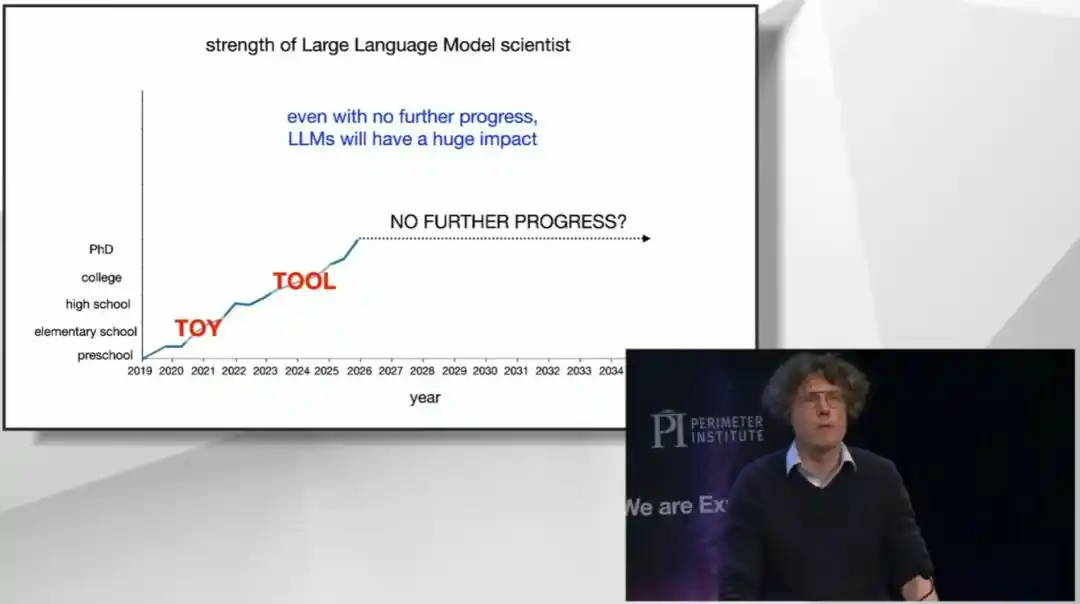
Brown also raised a cautionary 'pessimistic hypothesis': what if large model capabilities completely stagnate starting today?
He bluntly stated that what truly 'doesn't work' right now is directly asking the model, 'Please invent a brand new theory of quantum gravity for me.' The answer would likely be worthless, sleep-inducing 'AI nonsense.'

More generally, current large models still have four obvious shortcomings: low autonomy, slow learning speed, poor planning ability, and weak error-correction capability.
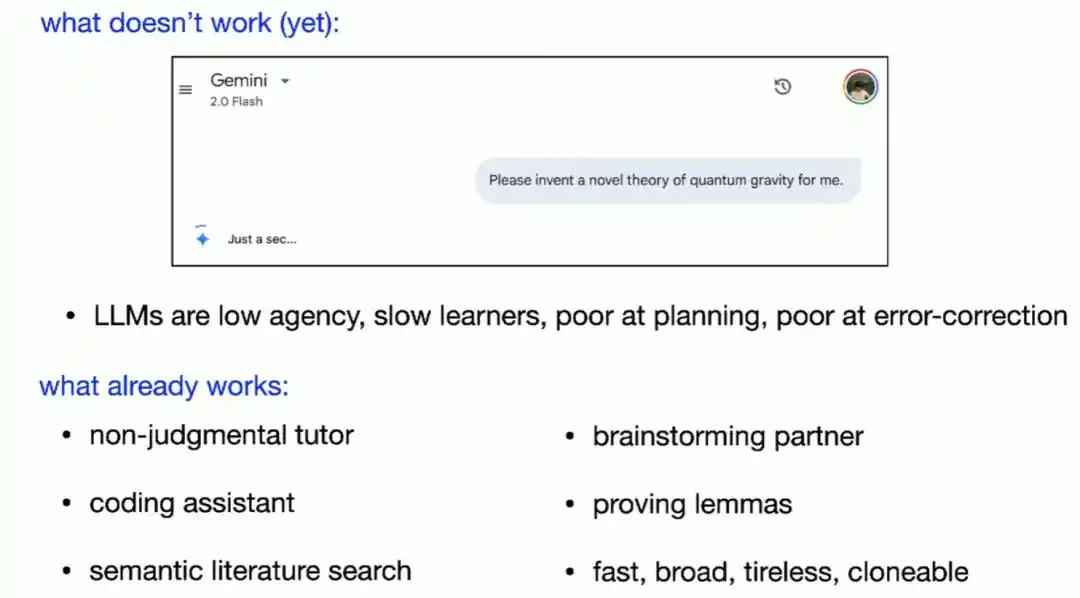
Brown admitted that all four shortcomings have significantly improved over the past year, but none have been completely solved. Consequently, a system that can ace graduate-level exams in every discipline has yet to produce results that could be called 'major breakthroughs.'

While preparing for this speech, he even specifically drew this as a flat 'straight line' marked with a question mark, self-deprecatingly admitting it was perhaps the only chart in the entire talk that 'didn't keep rising.' But he added that before the end of 2026, people would probably start arguing about how to define the term 'major breakthrough.' As it turned out, this day arrived even sooner than he himself anticipated.

However, even if progress truly stopped at this moment, Brown believes large models are already sufficient to completely transform the landscape of physics research.

He listed several already mature and still-improving use cases:

As a 'non-judgmental private tutor,' available at 3 AM to answer a physicist's own unclear knowledge gaps without waking a world-class expert;

As a programming assistant, now so strong that 'calling it just a programming assistant feels somewhat insulting.' Many physics problems previously considered 'not programming problems' can now be reframed as coding problems to solve;

As a literature retrieval tool, capable of reading an entire field's paper repository and directly telling you if an idea has already been explored; additionally, serving as a brainstorming partner.

Brown summarized that the core advantages of large models are: they are fast, broad in coverage, tireless, and can be replicated indefinitely. It takes decades to train a physicist, but once a powerful model is trained, you can run thousands of copies simultaneously—this alone is enough to 'completely change' the discipline.

Conclusion: The Golden Age of Physics

At the end of his speech, Brown gave his judgment on 'why progress won't stop.'
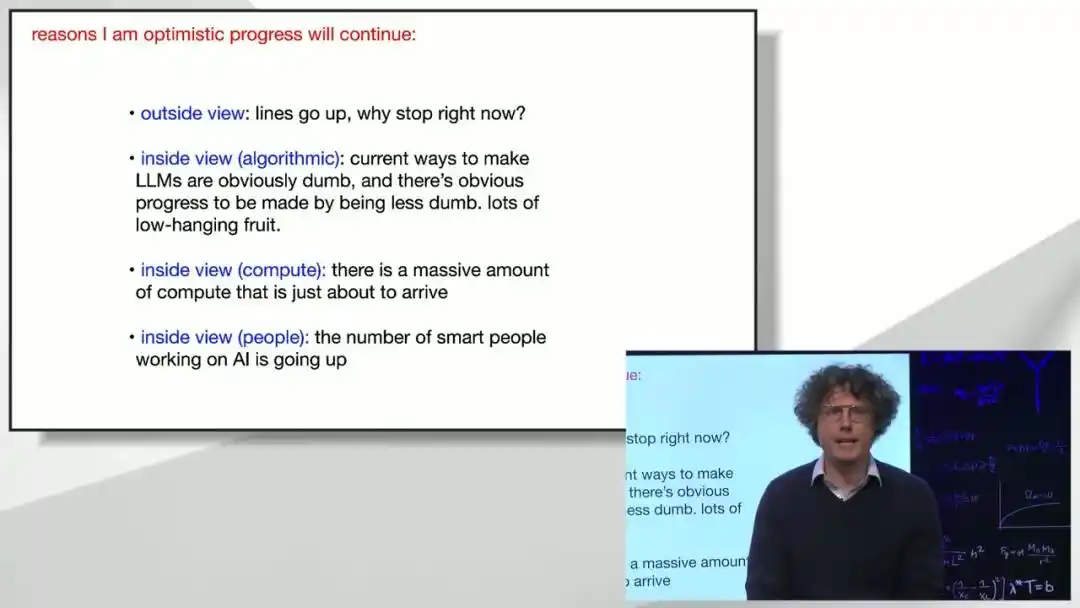
From a macroeconomic perspective, the funds currently invested in training still represent a very small fraction of global GDP, leaving ample room for growth. From a technical internal perspective, current methods for training large models are 'far less sophisticated than they appear.' Many obvious yet untried improvement ideas remain to be explored. Combined with the continuous influx of talent and compute into the field, Brown judges that current model architectures and compute scales are already sufficient to lead to Artificial General Intelligence, even without entirely new theoretical breakthroughs.

He also responded to a long-standing pessimistic view that large models only do 'pattern matching' and cannot generate genuinely new ideas.
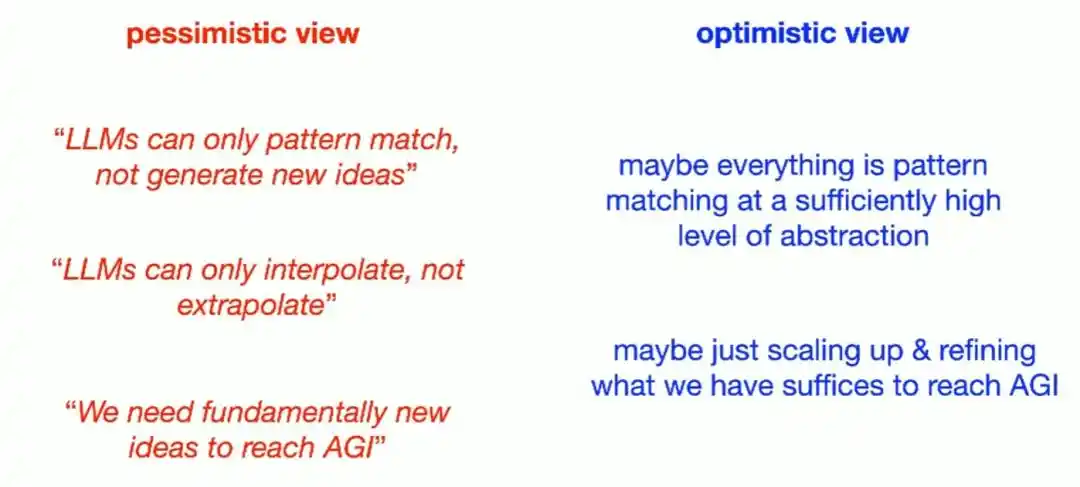
Brown's view is that if you abstract to a high enough level, almost all human creations that seem like 'major breakthroughs' are essentially a form of higher-dimensional pattern matching. A recurring phrase in this field that has been repeatedly validated is: 'these models just want to learn.' No matter how many seemingly reasonable theoretical reasons suggest they shouldn't learn well, their performance always exceeds expectations.

Brown's conclusion is that in the next few years, we will usher in a golden 'Centaur' era of human-AI collaboration: these tools will be placed in the hands of human physicists, mathematicians, and experts across fields, jointly kickstarting a new Renaissance in science and mathematics.

Further ahead, if 'creating an AI Einstein' is truly achieved, since replicating a trained model comes at almost no extra cost, humanity will likely soon have billions of 'superhuman-level AI Einsteins' operating simultaneously. This sounds like science fiction, but it's happening.
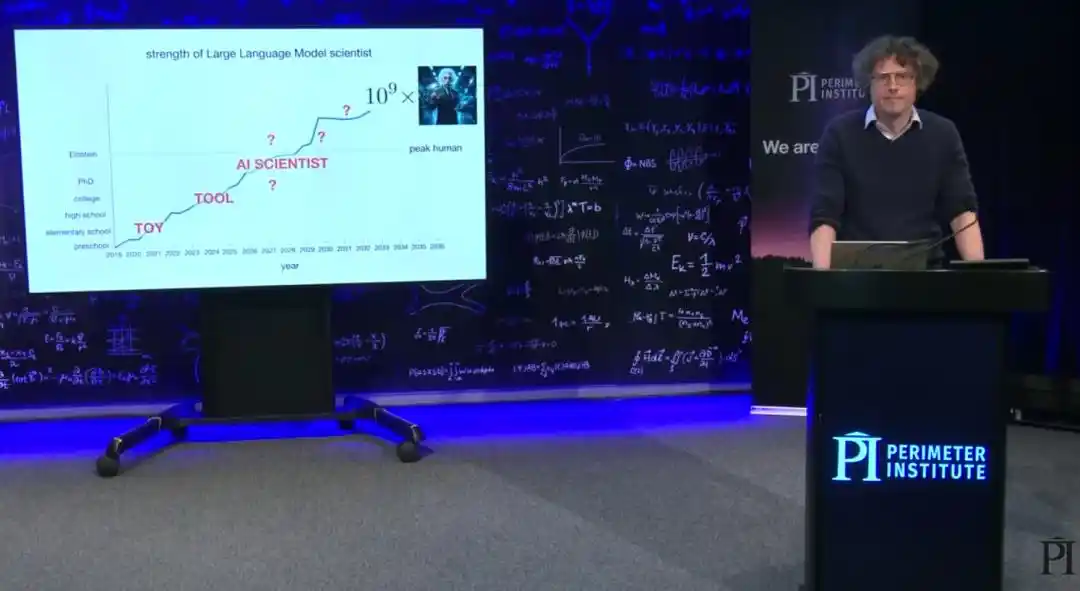
Brown said that in the long run, where AI will ultimately take physics is as difficult for him to predict as for anyone else. He even believes that the continuous improvement of AI capabilities is making the future of the entire world harder to predict. But one thing he is sure of: the next few years will be the most exciting time in the history of physics. He expects the problems that have plagued his entire career to be answered one by one in the not-too-distant future.

This article is from the WeChat public account 'Machine Heart' (ID: almosthuman2014), Author: Following AI.


Trend Kriptolar

İlgili Sorular

QWhat is the title of Adam Brown's speech mentioned in the article, and who praised it as 'amazingly good'?

AThe title of Adam Brown's speech is 'Training Sand to Think: Artificial General Intelligence & Future of Physics.' It was praised as 'amazingly good' by Nobel laureate and Turing Award winner Geoffrey Hinton.

QAccording to Adam Brown, how are Large Language Models (LLMs) fundamentally different from traditional computer programs?

AAdam Brown states that LLMs are not 'programmed' but 'grown.' They are developed through a two-stage process: pre-training on vast amounts of text to predict the next word, and post-training (akin to 'finishing school') to make them more useful and polite, rather than being explicitly coded with rules.

QWhat was the significant mathematical breakthrough achieved by an AI model regarding Erdős' 1946 'unit distances' conjecture?

AAn AI model independently found a counterexample to Erdős' 1946 'unit distances' conjecture. It constructed a set of points with more unit distance pairs than was previously thought possible for a given number of points, effectively disproving the long-standing conjecture.

QWhat analogy does Brown use to describe the likely future stages of AI in scientific research, based on the history of chess AI?

ABrown uses the history of chess AI to describe four likely stages for AI in science: 1) Toy Stage (early capabilities), 2) Tool Stage (useful for specific tasks), 3) Centaur Stage (deep human-AI collaboration), and 4) Superhuman Stage (AI surpassing human capabilities and operating autonomously).

QWhat are the current four major shortcomings of large models that Brown identifies, even if progress were to stop today?

AThe four major shortcomings Brown identifies are: 1) Low autonomy, 2) Slow learning speed (compared to runtime inference), 3) Poor planning ability, and 4) Weak error-correction capability. Despite these, he believes AI has already reshaped physics research.

İlgili Okumalar

İşlemler

Spot

Popüler Makaleler

GROK AI Nedir

Grok AI: Web3 Döneminde Konuşma Teknolojisini Devrim Niteliğinde Yenilik Giriş Hızla gelişen yapay zeka alanında, Grok AI, ileri teknoloji ve kullanıcı etkileşimi alanlarını birleştiren dikkate değer bir proje olarak öne çıkıyor. Ünlü girişimci Elon Musk'ın liderliğindeki xAI tarafından geliştirilen Grok AI, yapay zeka ile etkileşim şeklimizi yeniden tanımlamayı hedefliyor. Web3 hareketi devam ederken, Grok AI, karmaşık sorgulara yanıt vermek için konuşma yapay zekasının gücünden yararlanmayı amaçlıyor ve kullanıcılara sadece bilgilendirici değil, aynı zamanda eğlenceli bir deneyim sunuyor. Grok AI Nedir? Grok AI, kullanıcılarla dinamik bir şekilde etkileşimde bulunmak üzere tasarlanmış sofistike bir konuşma yapay zeka sohbet botudur. Birçok geleneksel yapay zeka sisteminin aksine, Grok AI, genellikle uygunsuz veya standart yanıtların dışında kabul edilen daha geniş bir sorgu yelpazesini benimsemektedir. Projenin temel hedefleri şunlardır: Güvenilir Akıl Yürütme: Grok AI, bağlamsal anlayışa dayalı mantıklı yanıtlar sağlamak için sağduyu akıl yürütmeyi vurgular. Ölçeklenebilir Denetim: Araç yardımı entegrasyonu, kullanıcı etkileşimlerinin hem izlenmesini hem de kalite için optimize edilmesini sağlar. Resmi Doğrulama: Güvenlik en önemli önceliktir; Grok AI, çıktılarının güvenilirliğini artırmak için resmi doğrulama yöntemlerini entegre eder. Uzun Bağlam Anlayışı: AI modeli, kapsamlı konuşma geçmişini saklama ve hatırlama konusunda mükemmel bir performans sergileyerek anlamlı ve bağlamsal olarak farkında tartışmaların yapılmasını kolaylaştırır. Saldırgan Dayanıklılık: Manipüle edilmiş veya kötü niyetli girdilere karşı savunmalarını geliştirmeye odaklanarak, Grok AI kullanıcı etkileşimlerinin bütünlüğünü korumayı hedefler. Özünde, Grok AI sadece bir bilgi alma cihazı değil; dinamik diyalogu teşvik eden, etkileyici bir konuşma partneridir. Grok AI'nın Yaratıcısı Grok AI'nın arkasındaki beyin, otomotiv, uzay yolculuğu ve teknoloji gibi çeşitli alanlarda yenilikle özdeşleşen Elon Musk'tır. Yapay zeka teknolojisini faydalı yollarla geliştirmeye odaklanan xAI çatısı altında, Musk'ın vizyonu, yapay zeka etkileşimlerinin anlaşılmasını yeniden şekillendirmeyi amaçlıyor. Liderlik ve temel etik, Musk'ın teknolojik sınırları zorlamaya olan bağlılığı tarafından derinden etkilenmektedir. Grok AI'nın Yatırımcıları Grok AI'yi destekleyen yatırımcılarla ilgili spesifik detaylar sınırlı kalmakla birlikte, projenin kuluçka merkezi olan xAI'nin, esasen Elon Musk tarafından kurulduğu ve desteklendiği kamuya açık bir şekilde kabul edilmektedir. Musk'ın önceki girişimleri ve mülkleri, Grok AI'nın güvenilirliğini ve büyüme potansiyelini daha da artıran sağlam bir destek sağlar. Ancak, şu anda Grok AI'yı destekleyen ek yatırım fonları veya kuruluşlarıyla ilgili bilgiye kolayca erişim sağlanamamaktadır; bu da potansiyel gelecekteki keşif alanını işaret etmektedir. Grok AI Nasıl Çalışır? Grok AI'nın operasyonel mekanikleri, kavramsal çerçevesi kadar yenilikçidir. Proje, benzersiz işlevselliklerini kolaylaştıran birkaç son teknoloji ürünü teknolojiyi entegre eder: Sağlam Altyapı: Grok AI, konteyner orkestrasyonu için Kubernetes, performans ve güvenlik için Rust ve yüksek performanslı sayısal hesaplama için JAX kullanılarak inşa edilmiştir. Bu üçlü, sohbet botunun verimli çalışmasını, etkili bir şekilde ölçeklenmesini ve kullanıcılara zamanında hizmet vermesini sağlar. Gerçek Zamanlı Bilgi Erişimi: Grok AI'nın ayırt edici özelliklerinden biri, X platformu (önceden Twitter olarak biliniyordu) aracılığıyla gerçek zamanlı verilere erişim yeteneğidir. Bu yetenek, yapay zekaya en son bilgilere erişim sağlar ve diğer yapay zeka modellerinin gözden kaçırabileceği zamanında yanıtlar ve öneriler sunmasına olanak tanır. İki Etkileşim Modu: Grok AI, kullanıcılara “Eğlenceli Mod” ve “Normal Mod” arasında seçim yapma imkanı sunar. Eğlenceli Mod, daha eğlenceli ve mizahi bir etkileşim tarzı sağlarken, Normal Mod, kesin ve doğru yanıtlar vermeye odaklanır. Bu çok yönlülük, çeşitli kullanıcı tercihlerine hitap eden özelleştirilmiş bir deneyim sağlar. Özünde, Grok AI performansı etkileşimle birleştirerek, hem zenginleştirici hem de eğlenceli bir deneyim yaratmaktadır. Grok AI'nın Zaman Çizelgesi Grok AI'nın yolculuğu, gelişim ve dağıtım aşamalarını yansıtan önemli dönüm noktalarıyla işaretlenmiştir: İlk Geliştirme: Grok AI'nın temel aşaması, modelin ilk eğitim ve ince ayarının yapıldığı yaklaşık iki ay boyunca gerçekleşmiştir. Grok-2 Beta Yayını: Önemli bir ilerleme olarak, Grok-2 beta duyurulmuştur. Bu sürüm, sohbet etme, kodlama ve akıl yürütme yetenekleriyle donatılmış iki versiyon—Grok-2 ve Grok-2 mini—sunmuştur. Halka Açık Erişim: Beta geliştirmesinin ardından, Grok AI X platformu kullanıcılarına sunulmuştur. Telefon numarasıyla doğrulanan ve en az yedi gün aktif olan hesap sahipleri, sınırlı bir versiyona erişim sağlayarak teknolojiyi daha geniş bir kitleye ulaştırmaktadır. Bu zaman çizelgesi, Grok AI'nın kuruluşundan kamu etkileşimine kadar sistematik büyümesini kapsar ve sürekli iyileştirme ve kullanıcı etkileşimine olan bağlılığını vurgular. Grok AI'nın Ana Özellikleri Grok AI, yenilikçi kimliğine katkıda bulunan birkaç ana özelliği kapsamaktadır: Gerçek Zamanlı Bilgi Entegrasyonu: Güncel ve ilgili bilgilere erişim, Grok AI'yı birçok statik modelden ayırarak, etkileyici ve doğru bir kullanıcı deneyimi sağlar. Çeşitli Etkileşim Tarzları: Farklı etkileşim modları sunarak, Grok AI çeşitli kullanıcı tercihlerine hitap eder ve yapay zeka ile konuşurken yaratıcılığı ve kişiselleştirmeyi teşvik eder. Gelişmiş Teknolojik Altyapı: Kubernetes, Rust ve JAX kullanımı, projeye güvenilirlik ve optimal performans sağlamak için sağlam bir çerçeve sunar. Etik Tartışma Dikkati: Görüntü üreten bir işlevin dahil edilmesi, projenin yenilikçi ruhunu sergiler. Ancak, aynı zamanda tanınabilir figürlerin saygılı bir şekilde tasvir edilmesi ve telif hakkı ile ilgili etik konuları da gündeme getirir—bu, yapay zeka topluluğunda süregelen bir tartışmadır. Sonuç Konuşma yapay zekası alanında öncü bir varlık olarak Grok AI, dijital çağda dönüştürücü kullanıcı deneyimlerinin potansiyelini kapsar. xAI tarafından geliştirilen ve Elon Musk'ın vizyoner yaklaşımıyla yönlendirilen Grok AI, gerçek zamanlı bilgiyi gelişmiş etkileşim yetenekleriyle birleştirir. Yapay zekanın neler başarabileceği konusunda sınırları zorlamayı hedeflerken, etik konulara ve kullanıcı güvenliğine odaklanmayı sürdürmektedir. Grok AI, sadece teknolojik ilerlemeyi değil, aynı zamanda Web3 manzarasında yeni bir konuşma paradigmasını da temsil eder ve kullanıcılara hem yetkin bilgi hem de eğlenceli etkileşim sunma vaadinde bulunur. Proje gelişmeye devam ederken, teknolojinin, yaratıcılığın ve insan benzeri etkileşimin kesişim noktasında nelerin başarılabileceğinin bir kanıtı olarak durmaktadır.

448 Toplam GörüntülenmeYayınlanma 2024.12.26Güncellenme 2024.12.26

GROK AI Nedir

ERC AI Nedir

Euruka Tech: $erc ai ve Web3'teki Hedefleri Üzerine Bir Genel Bakış Giriş Blockchain teknolojisi ve merkeziyetsiz uygulamaların hızla gelişen manzarasında, her biri benzersiz hedefler ve metodolojilerle yeni projeler sıkça ortaya çıkmaktadır. Bu projelerden biri, kripto para ve Web3 alanında faaliyet gösteren Euruka Tech'tir. Euruka Tech'in, özellikle $erc ai token'ının ana odak noktası, merkeziyetsiz teknolojinin büyüyen yeteneklerinden yararlanmak için tasarlanmış yenilikçi çözümler sunmaktır. Bu makale, Euruka Tech'in kapsamlı bir genel görünümünü, hedeflerini, işlevselliğini, yaratıcısının kimliğini, potansiyel yatırımcılarını ve Web3'teki daha geniş bağlam içindeki önemini keşfetmeyi amaçlamaktadır. Euruka Tech, $erc ai Nedir? Euruka Tech, Web3 ortamının sunduğu araçlar ve işlevsellikleri kullanan bir proje olarak tanımlanmaktadır ve operasyonlarında yapay zekayı entegre etmeye odaklanmaktadır. Projenin çerçevesine dair spesifik detaylar biraz belirsiz olsa da, kullanıcı etkileşimini artırmayı ve kripto alanındaki süreçleri otomatikleştirmeyi amaçlamaktadır. Proje, yalnızca işlemleri kolaylaştırmakla kalmayıp, aynı zamanda yapay zeka aracılığıyla öngörücü işlevsellikleri de entegre eden merkeziyetsiz bir ekosistem yaratmayı hedeflemektedir; bu nedenle token'ının adı $erc ai'dir. Amaç, büyüyen Web3 alanında daha akıllı etkileşimleri ve verimli işlem işleme süreçlerini kolaylaştıran sezgisel bir platform sunmaktır. Euruka Tech'in Yaratıcısı Kimdir, $erc ai? Şu anda, Euruka Tech'in arkasındaki yaratıcı veya kurucu ekip hakkında bilgi verilmemiştir ve bu durum biraz belirsizdir. Bu veri eksikliği, ekibin geçmişi hakkında bilgi sahibi olmanın genellikle blockchain sektöründe güvenilirlik oluşturmak için gerekli olduğu endişelerini doğurmaktadır. Bu nedenle, somut detaylar kamuya sunulana kadar bu bilgiyi bilinmeyen olarak sınıflandırdık. Euruka Tech'in Yatırımcıları Kimlerdir, $erc ai? Benzer şekilde, Euruka Tech projesinin yatırımcıları veya destekleyen organizasyonları hakkında mevcut araştırmalarla kolayca sağlanan bir bilgi yoktur. Euruka Tech ile etkileşimde bulunmayı düşünen potansiyel paydaşlar veya kullanıcılar için kritik bir unsur, kurumsal finansal ortaklıklar veya saygın yatırım firmalarından gelen destekle sağlanan güvencedir. Yatırım ilişkileri hakkında açıklamalar olmadan, projenin finansal güvenliği veya sürdürülebilirliği hakkında kapsamlı sonuçlar çıkarmak zordur. Bulunan bilgilere paralel olarak, bu bölüm de bilinmeyen durumundadır. Euruka Tech, $erc ai Nasıl Çalışır? Euruka Tech için detaylı teknik spesifikasyonların eksik olmasına rağmen, yenilikçi hedeflerini göz önünde bulundurmak önemlidir. Proje, yapay zekanın hesaplama gücünden yararlanarak kripto para ortamında kullanıcı deneyimini otomatikleştirmeyi ve geliştirmeyi hedeflemektedir. AI'yi blockchain teknolojisiyle entegre ederek, Euruka Tech otomatik ticaret, risk değerlendirmeleri ve kişiselleştirilmiş kullanıcı arayüzleri gibi özellikler sunmayı amaçlamaktadır. Euruka Tech'in yenilikçi özü, kullanıcılar ile merkeziyetsiz ağların sunduğu geniş olanaklar arasında kesintisiz bir bağlantı yaratma hedefinde yatmaktadır. Makine öğrenimi algoritmaları ve AI kullanarak, ilk kez kullanıcı zorluklarını en aza indirmeyi ve Web3 çerçevesindeki işlem deneyimlerini düzene sokmayı amaçlamaktadır. AI ve blockchain arasındaki bu simbiyoz, $erc ai token'ının önemini vurgulamakta ve geleneksel kullanıcı arayüzleri ile merkeziyetsiz teknolojilerin gelişmiş yetenekleri arasında bir köprü işlevi görmektedir. Euruka Tech, $erc ai Zaman Çizelgesi Maalesef, Euruka Tech hakkında mevcut olan sınırlı bilgiler nedeniyle, projenin yolculuğundaki önemli gelişmeler veya kilometre taşları hakkında detaylı bir zaman çizelgesi sunamıyoruz. Genellikle bir projenin evrimini haritalamak ve büyüme eğrisini anlamak için değerli olan bu zaman çizelgesi şu anda mevcut değildir. Önemli olaylar, ortaklıklar veya işlevsel eklemeler hakkında bilgiler belirgin hale geldikçe, güncellemeler kesinlikle Euruka Tech'in kripto alanındaki görünürlüğünü artıracaktır. Diğer “Eureka” Projeleri Üzerine Açıklama Birden fazla projenin ve şirketin “Eureka” benzeri bir isimlendirmeye sahip olduğunu belirtmek önemlidir. Araştırmalar, robotlara karmaşık görevler öğretmeye odaklanan NVIDIA Research'ten bir AI ajanı gibi girişimleri, ayrıca eğitim ve müşteri hizmetleri analitiğinde kullanıcı deneyimini geliştiren Eureka Labs ve Eureka AI'yi tanımlamıştır. Ancak, bu projeler Euruka Tech'ten farklıdır ve hedefleri veya işlevleri ile karıştırılmamalıdır. Sonuç Euruka Tech, $erc ai token'ı ile birlikte, Web3 manzarasında umut verici ancak şu anda belirsiz bir oyuncuyu temsil etmektedir. Yaratıcısı ve yatırımcıları hakkında detaylar açıklanmamış olsa da, yapay zekayı blockchain teknolojisiyle birleştirme konusundaki temel hedefi ilgi odağı olmaktadır. Projenin, gelişmiş otomasyon aracılığıyla kullanıcı etkileşimini teşvik etme konusundaki benzersiz yaklaşımları, Web3 ekosistemi ilerledikçe onu farklı kılabilir. Kripto piyasası gelişmeye devam ederken, paydaşların Euruka Tech etrafındaki gelişmelere dikkat etmeleri önemlidir; belgelenmiş yeniliklerin, ortaklıkların veya tanımlanmış bir yol haritasının gelişimi, önümüzdeki dönemde önemli fırsatlar sunabilir. Şu an itibarıyla, Euruka Tech'in potansiyelini ve rekabetçi kripto manzarasındaki konumunu açığa çıkarabilecek daha somut içgörüler beklemekteyiz.

419 Toplam GörüntülenmeYayınlanma 2025.01.02Güncellenme 2025.01.02

ERC AI Nedir

DUOLINGO AI Nedir

DUOLINGO AI: Dil Öğrenimini Web3 ve AI İnovasyonu ile Entegre Etmek Teknolojinin eğitimi yeniden şekillendirdiği bir çağda, yapay zeka (AI) ve blok zinciri ağlarının entegrasyonu dil öğrenimi için yeni bir ufuk açmaktadır. DUOLINGO AI ve ona bağlı kripto para birimi $DUOLINGO AI ile tanışın. Bu proje, önde gelen dil öğrenme platformlarının eğitimsel yeteneklerini merkeziyetsiz Web3 teknolojisinin faydalarıyla birleştirmeyi hedefliyor. Bu makale, DUOLINGO AI'nın temel yönlerini, hedeflerini, teknolojik çerçevesini, tarihsel gelişimini ve gelecekteki potansiyelini incelerken, orijinal eğitim kaynağı ile bu bağımsız kripto para girişimi arasındaki netliği korumaktadır. DUOLINGO AI Genel Görünümü DUOLINGO AI'nın temelinde, öğrenicilerin dil yeterliliğinde eğitimsel kilometre taşlarına ulaşmaları için kriptografik ödüller kazanabilecekleri merkeziyetsiz bir ortam oluşturma hedefi yatmaktadır. Akıllı sözleşmeler uygulayarak, proje beceri doğrulama süreçlerini ve token tahsislerini otomatikleştirmeyi amaçlamakta, şeffaflık ve kullanıcı sahipliğini vurgulayan Web3 ilkelerine uymaktadır. Model, dil edinimindeki geleneksel yaklaşımlardan ayrılarak, token sahiplerinin kurs içeriği ve ödül dağıtımları üzerinde iyileştirmeler önermesine olanak tanıyan topluluk odaklı bir yönetişim yapısına dayanmaktadır. DUOLINGO AI'nın bazı dikkat çekici hedefleri şunlardır: Oyunlaştırılmış Öğrenme: Proje, dil yeterlilik seviyelerini temsil etmek için blok zinciri başarıları ve değiştirilemez tokenleri (NFT'ler) entegre ederek, katılımcıları motive eden dijital ödüller sunmaktadır. Merkeziyetsiz İçerik Üretimi: Eğitmenler ve dil meraklılarının kendi kurslarını katkıda bulunmalarına olanak tanıyarak, tüm katkıda bulunanların fayda sağladığı bir gelir paylaşım modeli oluşturmaktadır. AI Destekli Kişiselleştirme: Gelişmiş makine öğrenimi modellerini kullanarak, DUOLINGO AI dersleri bireysel öğrenme ilerlemesine uyacak şekilde kişiselleştirmekte, köklü platformlarda bulunan uyarlamalı özelliklere benzer bir deneyim sunmaktadır. Proje Yaratıcıları ve Yönetişim Nisan 2025 itibarıyla, $DUOLINGO AI'nın arkasındaki ekip takma isimler kullanmaktadır; bu, merkeziyetsiz kripto para alanında sıkça görülen bir uygulamadır. Bu anonimlik, bireysel geliştiricilere odaklanmak yerine kolektif büyümeyi ve paydaş katılımını teşvik etmek amacıyla tasarlanmıştır. Solana blok zincirinde dağıtılan akıllı sözleşme, geliştiricinin cüzdan adresini not etmekte, bu da yaratıcıların kimliğinin bilinmemesine rağmen işlemlerle ilgili şeffaflık taahhüdünü simgelemektedir. Yol haritasına göre, DUOLINGO AI, Merkeziyetsiz Otonom Organizasyon (DAO) haline gelmeyi hedeflemektedir. Bu yönetişim yapısı, token sahiplerinin özellik uygulamaları ve hazine tahsisleri gibi kritik konularda oy kullanmalarına olanak tanımaktadır. Bu model, çeşitli merkeziyetsiz uygulamalarda bulunan topluluk güçlendirme ethosu ile uyumlu olup, kolektif karar verme sürecinin önemini vurgulamaktadır. Yatırımcılar ve Stratejik Ortaklıklar Şu anda, $DUOLINGO AI ile bağlantılı olarak kamuya açık tanımlanabilir kurumsal yatırımcılar veya risk sermayedarları bulunmamaktadır. Bunun yerine, projenin likiditesi esas olarak merkeziyetsiz borsa (DEX) kaynaklıdır ve bu, geleneksel eğitim teknolojisi şirketlerinin finansman stratejileriyle keskin bir zıtlık oluşturmaktadır. Bu tabandan gelen model, merkeziyetsizliğe olan bağlılığını yansıtan topluluk odaklı bir yaklaşımı işaret etmektedir. DUOLINGO AI, beyaz kitabında, kurs tekliflerini zenginleştirmeyi amaçlayan belirsiz “blok zinciri eğitim platformları” ile işbirlikleri kurmayı planladığını belirtmektedir. Belirli ortaklıklar henüz açıklanmamış olsa da, bu işbirlikçi çabalar, blok zinciri yeniliğini eğitim girişimleri ile birleştirmeyi amaçlayan bir stratejiyi ima etmektedir ve çeşitli öğrenme yollarında erişimi ve kullanıcı katılımını genişletmektedir. Teknolojik Mimari AI Entegrasyonu DUOLINGO AI, eğitimsel tekliflerini geliştirmek için iki ana AI destekli bileşen içermektedir: Uyarlanabilir Öğrenme Motoru: Bu sofistike motor, kullanıcı etkileşimlerinden öğrenmekte olup, büyük eğitim platformlarından gelen özel modellere benzer. Belirli öğrenici zorluklarını ele almak için ders zorluğunu dinamik olarak ayarlamakta ve zayıf alanları hedeflenmiş alıştırmalarla pekiştirmektedir. Konuşma Ajanları: GPT-4 destekli sohbet botlarını kullanarak, DUOLINGO AI kullanıcıların simüle edilmiş konuşmalara katılmalarına olanak tanıyarak, daha etkileşimli ve pratik bir dil öğrenme deneyimi sunmaktadır. Blok Zinciri Altyapısı $DUOLINGO AI, Solana blok zincirinde inşa edilmiş kapsamlı bir teknolojik çerçeve kullanmaktadır: Beceri Doğrulama Akıllı Sözleşmeleri: Bu özellik, yeterlilik testlerini başarıyla geçen kullanıcılara otomatik olarak token ödülleri vermekte, gerçek öğrenim sonuçları için teşvik yapısını güçlendirmektedir. NFT Rozetleri: Bu dijital tokenler, öğrenicilerin kurslarının bir bölümünü tamamlamak veya belirli becerileri ustalaşmak gibi ulaştıkları çeşitli kilometre taşlarını simgelemekte ve bunları dijital olarak takas etmelerine veya sergilemelerine olanak tanımaktadır. DAO Yönetişimi: Token sahibi topluluk üyeleri, anahtar öneriler üzerinde oy kullanarak yönetişime katılabilir, bu da kurs teklifleri ve platform özelliklerinde yeniliği teşvik eden katılımcı bir kültürü kolaylaştırmaktadır. Tarihsel Zaman Çizelgesi 2022–2023: Kavramsallaştırma DUOLINGO AI için temel, dil öğrenimindeki AI ilerlemeleri ile blok zinciri teknolojisinin merkeziyetsiz potansiyeli arasındaki sinerjiyi vurgulayan bir beyaz kağıdın oluşturulmasıyla başlar. 2024: Beta Lansmanı Sınırlı bir beta sürümü, popüler dillerdeki teklifleri tanıtarak, erken kullanıcıları token teşvikleri ile ödüllendirir ve projenin topluluk katılım stratejisinin bir parçası olarak sunulmaktadır. 2025: DAO Geçişi Nisan ayında, tokenlerin dolaşıma girmesiyle tam bir ana ağ lansmanı gerçekleşir ve topluluk, Asya dillerine ve diğer kurs gelişmelerine olası genişlemeler hakkında tartışmalara başlar. Zorluklar ve Gelecek Yönelimleri Teknik Engeller Hırslı hedeflerine rağmen, DUOLINGO AI önemli zorluklarla karşı karşıyadır. Ölçeklenebilirlik, AI işleme ile merkeziyetsiz bir ağı sürdürme maliyetleri arasında denge kurma konusunda sürekli bir endişe kaynağıdır. Ayrıca, merkeziyetsiz bir teklif arasında kaliteli içerik üretimi ve moderasyonu sağlamak, eğitim standartlarını koruma konusunda karmaşıklıklar yaratmaktadır. Stratejik Fırsatlar İleriye dönük olarak, DUOLINGO AI, akademik kurumlarla mikro yeterlilik ortaklıkları kurma potansiyeline sahiptir ve dil becerilerinin blok zinciri ile doğrulanmış onaylarını sağlamaktadır. Ayrıca, çapraz zincir genişlemesi, projenin daha geniş kullanıcı tabanlarına ve ek blok zinciri ekosistemlerine erişim sağlamasına olanak tanıyabilir, böylece birlikte çalışabilirliğini ve erişimini artırabilir. Sonuç DUOLINGO AI, yapay zeka ve blok zinciri teknolojisinin yenilikçi bir birleşimini temsil etmekte olup, geleneksel dil öğrenim sistemlerine topluluk odaklı bir alternatif sunmaktadır. Takma isimli geliştirme süreci ve ortaya çıkan ekonomik modeli bazı riskler taşısa da, projenin oyunlaştırılmış öğrenme, kişiselleştirilmiş eğitim ve merkeziyetsiz yönetişim konusundaki taahhüdü, Web3 alanında eğitim teknolojisi için bir yol haritası aydınlatmaktadır. AI gelişmeye devam ederken ve blok zinciri ekosistemi evrim geçirirken, DUOLINGO AI gibi girişimler, kullanıcıların dil eğitimi ile etkileşim biçimlerini yeniden tanımlayabilir, toplulukları güçlendirebilir ve yenilikçi öğrenme mekanizmaları aracılığıyla katılımı ödüllendirebilir.

463 Toplam GörüntülenmeYayınlanma 2025.04.11Güncellenme 2025.04.11

DUOLINGO AI Nedir

Tartışmalar

HTX Topluluğuna hoş geldiniz. Burada, en son platform gelişmeleri hakkında bilgi sahibi olabilir ve profesyonel piyasa görüşlerine erişebilirsiniz. Kullanıcıların AI (AI) fiyatı hakkındaki görüşleri aşağıda sunulmaktadır.

活动图片











