Delphi Digital: The Era of Tokenization Has Arrived

比推2026-02-18 tarihinde yayınlandı2026-02-18 tarihinde güncellendi

Özet

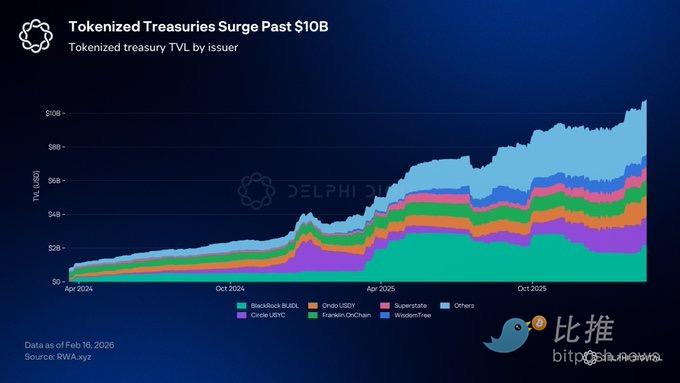
Tokenized U.S. Treasuries surpassed $10 billion in January 2024, led by institutions like BlackRock and Franklin Templeton. While government bonds are relatively straightforward to tokenize due to their standardized nature, equities present greater complexity because they involve shareholder rights such as voting and legal ownership. Two primary models exist: custodian-backed tokens (e.g., xStocks, Backed) offer price exposure but not direct ownership, while transfer agent-registered tokens (e.g., Superstate, Securitize) record holders directly on the shareholder registry, granting full rights. The latter enables functionalities like 24/7 trading, use as collateral in DeFi, cross-margin capabilities with crypto assets, and direct capital raises without traditional underwriters. However, challenges remain, including fragmented liquidity across blockchains, KYC/AML compliance friction, varying international regulations, and limited integration with traditional exchanges. While Nasdaq has applied to trade tokenized securities, broader market adoption depends on regulatory clarity and improved liquidity. The market is betting that the transfer agent model—which offers real ownership—will outperform custodian-based structures. Equities can now be settled instantly, traded around the clock, and used as collateral, but whether this becomes standard depends on regulatory and liquidity developments.

Source: Delphi Digital

Compiled and Edited: BitpushNews


In January, the scale of tokenized treasury bonds exceeded $10 billion, with BlackRock, Franklin Templeton, Ondo, and Circle leading the market. Government bonds were the first to be tokenized because they have standardized instruments and liquid markets, making the process relatively straightforward.

But the real challenge lies with stocks.

Stocks represent shareholders, who possess voting rights and legal rights that must be enforced. Tokenization projects have all hit the same wall: you can mint a token representing a stock, but you do not actually own the share.
Not all tokenized stocks operate in the same way. Tokens issued by platforms like xStocks, Backed, and similar are backed 1:1 by shares held by a custodian. Investors gain price exposure and can trade 24/7, but ownership remains with the custodian.

Custodian vs. Transfer Agent

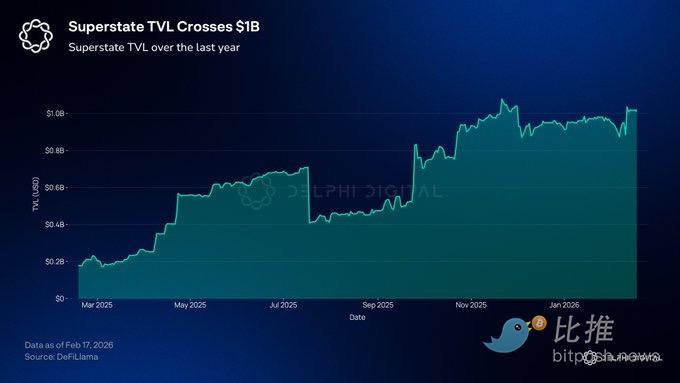
Superstate and Securitize are registered as transfer agents with the U.S. Securities and Exchange Commission (SEC), directly recording token holders on the company's shareholder registry. In September 2025, when Galaxy Digital was tokenized via Superstate's Opening Bell platform, GLXY token holders became genuine shareholders with voting rights and dividend entitlements. The blockchain was integrated with the shareholder registry.

Securitize has adopted a similar approach on the fund side. As the transfer agent behind BlackRock's BUIDL, they manage one of the largest tokenized treasury funds. They are also bringing institutional-grade private funds on-chain, lowering investment barriers and expanding access to alternative assets that were previously out of reach for most investors.

Recent guidance from SEC staff clarifies this distinction. Issuer-led tokenization through registered transfer agents creates ownership with full shareholder rights. Custodian-backed tokens may face different regulatory treatment and limitations compared to direct shareholder registration.
Genuine shareholder status enables functionalities that custodian-backed token structures cannot achieve.

Shareholders can trade 24/7 on supported trading platforms without waiting for the Toronto Stock Exchange to open. Shareholders of Forward Industries can pledge their equity as collateral on Kamino. Even if shares are deposited in lending pools, Superstate tracks beneficial ownership, ensuring dividends are distributed to the correct holders regardless of where the tokens are stored.

Backpack Exchange and Superstate have announced plans to enable cross-margining between tokenized stocks and crypto assets. Once live, traders can hold both tokenized stocks and SOL in the same account and use both as margin. Traditional brokers typically cannot offer this service because stocks and cryptocurrencies exist in completely separate custody and clearing systems.

This is unprecedented capital efficiency. Shareholders can obtain liquidity without selling, hedge across asset classes in a single account, and trade globally without settlement delays.

Raising Capital Without Underwriters

Superstate's direct issuance program allows publicly traded companies to reduce reliance on traditional underwriters for on-chain fundraising. Investors pay with stablecoins, shares are minted directly into their wallets, and companies receive funds instantly, with no cash settlement delays.

Traditional equity fundraising involves underwriters, roadshows, and settlement delays that can last weeks. Direct issuance compresses this into a single transaction, with the shareholder registry updated in real time.

The first issuances are expected later this year, likely from small-cap public companies that find traditional capital market infrastructure too costly relative to their trading size.

Missing Pieces

Liquidity remains fragmented. Tokenized stocks exist on multiple chains with no unified order book connecting them. Trading volumes are small compared to traditional markets, limiting the scale investors can move without impacting prices.

KYC requirements create friction with DeFi's permissionless architecture. Only whitelisted addresses can hold tokenized stocks, meaning they cannot be integrated into every lending protocol or liquidity pool. Issuers need to verify investors before they receive shares, and this verification must persist as tokens move between wallets.

Outside the U.S., regulatory frameworks vary significantly. SEC guidance applies to matters involving U.S. federal securities laws, but Europe, Asia, and other markets have their own rules, which may not align.

Traditional exchanges are watching closely. Nasdaq has filed an application with the SEC to trade tokenized securities. But until regulators and existing participants figure out how this fits into the existing market structure, actual exchange support for on-chain stocks remains pending.

Conclusion

Tokenized treasury bonds have proven that this mechanism can work at scale. Now, the stock space is catching up, achieving genuine compliance and true DeFi integration.

The market is betting that the transfer agent model, which records token holders as actual shareholders, will outperform indirect ownership structures that only provide price exposure.

Stocks can now be settled instantly, traded 24/7, and used as collateral in markets that never close. Whether this becomes the standard for how stocks operate or remains a niche play for crypto-native companies depends on whether liquidity and regulatory clarity can keep up with the infrastructure already in place.


Twitter:https://twitter.com/BitpushNewsCN

Bitpush TG Discussion:https://t.me/BitPushCommunity

Bitpush TG Subscription: https://t.me/bitpush

Original link:https://www.bitpush.news/articles/7612882

İlgili Sorular

QWhat is the key difference between tokenized stocks issued by platforms like xStocks/Backed and those registered with the SEC as transfer agents like Superstate/Securitize?

APlatforms like xStocks and Backed issue tokens that are 1:1 backed by stocks held by a custodian, providing price exposure but not actual ownership. In contrast, SEC-registered transfer agents like Superstate and Securitize record token holders directly on the company's shareholder registry, granting them full shareholder rights including voting and dividends.

QWhat major milestone did tokenized treasury products achieve in January, and which companies are leading this market?

AIn January, the size of tokenized treasury products surpassed $10 billion. Companies such as BlackRock, Franklin Templeton, Ondo, and Circle are leading this market.

QWhat are some of the unique functionalities enabled by true shareholder status in tokenized stocks, according to the article?

ATrue shareholder status enables functionalities like 24/7 trading on supported platforms, the ability to use equity as collateral (e.g., on Kamino), receiving dividends regardless of where the token is held, and cross-margining between tokenized stocks and crypto assets in a single account for unprecedented capital efficiency.

QHow does Superstate's direct issuance plan aim to change the traditional capital raising process for public companies?

ASuperstate's direct issuance plan allows public companies to raise capital on-chain with reduced reliance on traditional underwriters. Investors pay with stablecoins, shares are minted directly to their wallets, the company receives funds instantly, and the shareholder registry is updated in real-time, compressing a process that traditionally takes weeks into a single transaction.

QWhat are the main challenges or missing pieces currently hindering the wider adoption of tokenized stocks?

AThe main challenges include fragmented liquidity across different blockchains without a central order book, smaller trading volumes limiting large-scale moves, friction between KYC requirements and DeFi's permissionless architecture, and varying regulatory frameworks outside the U.S. that are not necessarily aligned with the SEC's guidance.

İlgili Okumalar

From Theft to Re-entry: How Was $292 Million "Laundered"?

A sophisticated crypto laundering operation was executed following the $292 million hack of Kelp DAO on April 18. The attack, attributed to the North Korean Lazarus group, began with anonymous infrastructure preparation using Tornado Cash to fund wallets untraceably. The hacker exploited a vulnerability in Kelp’s cross-chain bridge, stealing 116,500 rsETH. To avoid crashing the market, the attacker used Aave and Compound as laundering tools—depositing the stolen rsETH as collateral to borrow $190 million in clean, liquid ETH. This move triggered a bank run on Aave, causing an $8 billion drop in TVL. After consolidating funds, the attacker fragmented them across hundreds of wallets to evade detection. A major breakpoint was THORChain, where over $460 million in volume—30 times its usual activity—was processed in 24 hours, converting ETH into Bitcoin. This shift to Bitcoin’s UTXO model exponentially increased tracing complexity by shattering funds into countless untraceable fragments. The final destination was Tron-based USDT, the primary channel for illicit crypto flows. From there, funds were cashed out via OTC brokers in China and Southeast Asia, using unlicensed underground banks and UnionPay networks outside Western sanctions scope. Ultimately, the laundered money supports North Korea’s weapons programs, which rely heavily on crypto hacking for foreign currency. The incident underscores structural challenges in DeFi: its openness, composability, and lack of central control make such laundering not just possible, but inherently difficult to prevent.

marsbit1 saat önce

From Theft to Re-entry: How Was $292 Million "Laundered"?

marsbit1 saat önce

Google and Amazon Simultaneously Invest Heavily in a Competitor: The Most Absurd Business Logic of the AI Era Is Becoming Reality

In a span of four days, Amazon announced an additional $25 billion investment, and Google pledged up to $40 billion—both direct competitors pouring over $65 billion into the same AI startup, Anthropic. Rather than a typical venture capital move, this signals the latest escalation in the cloud wars. The core of the deal is not equity but compute pre-orders: Anthropic must spend the majority of these funds on AWS and Google Cloud services and chips, effectively locking in massive future compute consumption. This reflects a shift in cloud market dynamics—enterprises now choose cloud providers based on which hosts the best AI models, not just price or stability. With OpenAI deeply tied to Microsoft, Anthropic’s Claude has become the only viable strategic asset for Google and Amazon to remain competitive. Anthropic’s annualized revenue has surged to $30 billion, and it is expanding into verticals like biotech, positioning itself as a cross-industry AI infrastructure layer. However, this funding comes with constraints: Anthropic’s independence is challenged as it balances two rival investors, its safety-first narrative faces pressure from regulatory scrutiny, and its path to IPO introduces new financial pressures. Globally, this accelerates a "tri-polar" closed-loop structure in AI infrastructure, with Microsoft-OpenAI, Google-Anthropic, and Amazon-Anthropic forming exclusive model-cloud alliances. In contrast, China’s landscape differs—investments like Alibaba and Tencent backing open-source model firm DeepSeek reflect a more decoupled approach, though closed-source models from major cloud providers still dominate. The $65 billion bet is ultimately about securing a seat at the table in an AI-defined future—where missing the model layer means losing the cloud war.

marsbit7 saat önce

Google and Amazon Simultaneously Invest Heavily in a Competitor: The Most Absurd Business Logic of the AI Era Is Becoming Reality

marsbit7 saat önce

İşlemler

Spot
Futures

Popüler Makaleler

ERA Nasıl Satın Alınır

HTX.com’a hoş geldiniz! Caldera (ERA) satın alma işlemlerini basit ve kullanışlı bir hâle getirdik. Adım adım açıkladığımız rehberimizi takip ederek kripto yolculuğunuza başlayın. 1. Adım: HTX Hesabınızı OluşturunHTX'te ücretsiz bir hesap açmak için e-posta adresinizi veya telefon numaranızı kullanın. Sorunsuzca kaydolun ve tüm özelliklerin kilidini açın. Hesabımı Aç2. Adım: Kripto Satın Al Bölümüne Gidin ve Ödeme Yönteminizi SeçinKredi/Banka Kartı: Visa veya Mastercard'ınızı kullanarak anında Caldera (ERA) satın alın.Bakiye: Sorunsuz bir şekilde işlem yapmak için HTX hesap bakiyenizdeki fonları kullanın.Üçüncü Taraflar: Kullanımı kolaylaştırmak için Google Pay ve Apple Pay gibi popüler ödeme yöntemlerini ekledik.P2P: HTX'teki diğer kullanıcılarla doğrudan işlem yapın.Borsa Dışı (OTC): Yatırımcılar için kişiye özel hizmetler ve rekabetçi döviz kurları sunuyoruz.3. Adım: Caldera (ERA) Varlıklarınızı SaklayınCaldera (ERA) satın aldıktan sonra HTX hesabınızda saklayın. Alternatif olarak, blok zinciri transferi yoluyla başka bir yere gönderebilir veya diğer kripto para birimlerini takas etmek için kullanabilirsiniz.4. Adım: Caldera (ERA) Varlıklarınızla İşlem YapınHTX'in spot piyasasında Caldera (ERA) ile kolayca işlemler yapın.Hesabınıza erişin, işlem çiftinizi seçin, işlemlerinizi gerçekleştirin ve gerçek zamanlı olarak izleyin. Hem yeni başlayanlar hem de deneyimli yatırımcılar için kullanıcı dostu bir deneyim sunuyoruz.

379 Toplam GörüntülenmeYayınlanma 2025.07.17Güncellenme 2025.07.17

ERA Nasıl Satın Alınır

Tartışmalar

HTX Topluluğuna hoş geldiniz. Burada, en son platform gelişmeleri hakkında bilgi sahibi olabilir ve profesyonel piyasa görüşlerine erişebilirsiniz. Kullanıcıların ERA (ERA) fiyatı hakkındaki görüşleri aşağıda sunulmaktadır.

活动图片