Crypto Users Hit By 1,400% Surge In Impersonation Scams, Research Shows

bitcoinist2026-01-14 tarihinde yayınlandı2026-01-14 tarihinde güncellendi

Özet

Impersonation scams surged by 1,400% in 2025, causing billions in losses as criminals used AI tools, voice cloning, and fake customer-support schemes. The average scam amount increased by over 600%, with AI-enabled methods proving several times more profitable. Scammers impersonated exchange staff and celebrities using deepfakes and sophisticated social engineering, making operations more efficient and harder to trace. One high-profile case stole nearly $16 million. Total on-chain crypto scam losses for 2025 are estimated between $14 billion and $17 billion.

Impersonation scams exploded in 2025, growing by about 1,400% and driving some of the biggest losses seen in crypto fraud to date. According to analysis by Chainalysis, scammers used AI tools, voice cloning and fake customer-support schemes to scale up attacks, pushing total scam losses on chain into the low-double-digit billions.

Impersonation Scams Jump Dramatically

Reports have disclosed that the rise was not just in the number of cases but in how much each case cost victims. The average amount taken in impersonation schemes rose by over 600% compared with the prior year, a jump that turned many small cons into large heists. Chainalysis highlights the role of automated tooling and commercially available phishing services that let scammers run scams like factories.
Source: Chainalysis

Criminals Used AI And Deepfakes

Fraudsters leaned heavily on AI techniques in 2025. Based on reports, AI-generated voice and face clones, paired with very believable messages, helped criminals impersonate exchange staff, celebrities or close contacts. These methods increased both reach and success rates. Industry writeups and analysts show that AI-enabled scams were several times more profitable than older approaches.

BTCUSD currently trading at $94,929. Chart: TradingView

A High-Profile Example Shows The Risk

One public example involved scammers posing as a major exchange and clearing nearly $16 million from victims in a single operation. That case became a headline because it showed how quickly an impersonation scam can turn into a mass theft when it uses polished fake identities and coordinated social engineering. Financial news outlets and industry trackers used that case to illustrate the shift in tactics.

Operations Became Industrialized

Based on Chainalysis data, scam groups now resemble small businesses. They outsource parts of the fraud chain — writing scripts, buying deepfake clips, and hiring money movers. This setup made fraud more efficient and harder to disrupt. One analysis found AI-assisted schemes were about 4.5 times more profitable than traditional scams, a gap that attackers exploited to level up operations quickly.

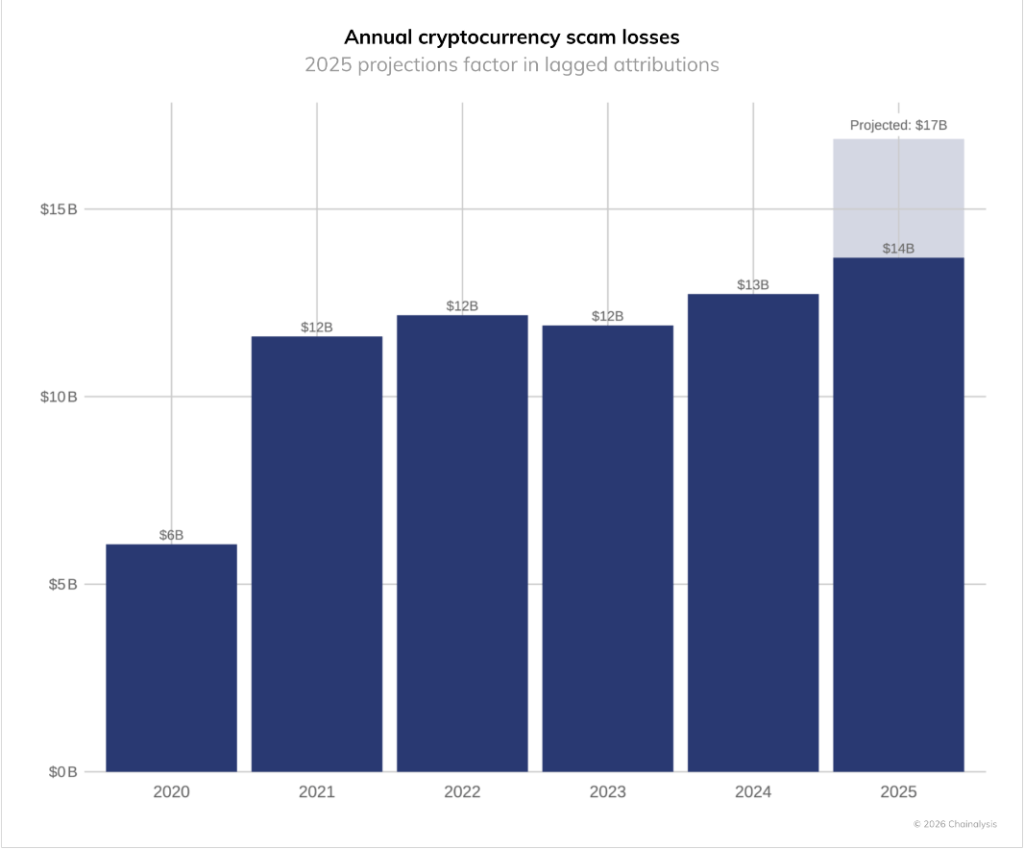
Estimates of total crypto scam losses for 2025 vary by outlet, but multiple sources put the number well into the billions. Some trackers reported $14 billion in funds stolen on chain, while Chainalysis noted the figure could be as high as $17 billion once more data is tallied. The difference reflects how quickly new incidents were discovered and how some thefts moved off public rails.

Featured image from Unsplash, chart from TradingView

İlgili Sorular

QWhat was the percentage increase in impersonation scams in 2025 according to the research?

AImpersonation scams grew by about 1,400% in 2025.

QWhich company provided the analysis on the surge in crypto impersonation scams?

AThe analysis was provided by Chainalysis.

QWhat technologies did scammers heavily rely on to scale up their attacks in 2025?

AScammers heavily relied on AI tools, voice cloning, and fake customer-support schemes to scale up their attacks.

QHow much more profitable were AI-enabled scams compared to traditional approaches according to one analysis?

AOne analysis found that AI-assisted schemes were about 4.5 times more profitable than traditional scams.

QWhat is the estimated range of total crypto scam losses for 2025 as mentioned in the article?

AEstimates vary, with some sources reporting $14 billion and Chainalysis noting the figure could be as high as $17 billion once more data is tallied.

İlgili Okumalar

From Survival to Accelerated Growth: The Journey of Zcash's Three-Year Rise as Told by the Founder of ZODL

**From Survival to Accelerated Growth: Zcash Founder Details the 3-Year Rise** Three years ago, Zcash (ZEC) was a struggling pioneer in privacy technology, with a price near $30, low shielded supply (11%), and a community mired in governance disputes. Today, ZEC trades around $600, with over 31% of its supply (~$3B) in user-controlled shielded pools. This transformation resulted from breaking key constraints. First, **governance shackles were removed**. The old model guaranteed funding to two entities (ECC and ZF) regardless of performance, creating a monopoly. In 2024, ECC rejected further direct funding, forcing a change. The NU6 upgrade ended direct funding, allocating 8% to community grants and 12% to a protocol-controlled treasury for retroactive rewards, expiring in 2028 unless renewed by overwhelming consensus. The entities also relinquished their trademark-based veto power, freeing community governance. Second, the **product focus shifted** from pure cryptography to user growth. Previously, engineering excelled at privacy tech but failed to attract users. In early 2024, the team (later ZODL) pivoted to building products users wanted, like the Zodl wallet (default privacy, hardware support, cross-asset swaps). This drove shielded supply to grow over 400% in ZEC terms, with 86.5% of recent transactions being shielded, representing real user adoption. Third, the **narrative evolved** from the limiting "privacy coin" label to "unstoppable private money." This clarified Zcash's value proposition: a Bitcoin-like monetary policy with verifiable private payments via advanced cryptography. This structural narrative—protocol (Zcash), asset (ZEC), gateway (Zodl)—enabled broader exchange listings, institutional interest, and ETF filings. Finally, **organizational constraints were broken**. In early 2026, the ECC team left its non-profit structure after disputes over control, forming Zcash Open Development Lab (ZODL). ZODL raised $25M from top VCs (Paradigm, a16z, etc.), gaining the capital and agility of a startup to scale consumer products. Current metrics show strong momentum: social discussion volume for ZEC surged 15,245% in a year, with 81% positive sentiment. The focus is now on enhancing user experience (Zodl wallet), scalability (Tachyon project targeting Visa-level throughput with 25-second blocks), and post-quantum security (quantum-recoverable wallets coming soon). Zcash is positioned to become faster, more usable, scalable, and quantum-resistant.

marsbit2 dk önce

From Survival to Accelerated Growth: The Journey of Zcash's Three-Year Rise as Told by the Founder of ZODL

marsbit2 dk önce

Five Counterparty Risk Architectures: A Settlement-Layer Methodology for Classifying TradFi Models in Crypto Exchanges

**Summary:** This companion piece reframes the five TradFi-on-crypto exchange architectures, previously classified by "architectural fingerprint," through the lens of counterparty risk. The core question is: whose balance sheet bears the loss first in a stress scenario, and has it historically done so? Each of the five models corresponds to a distinct risk holder with its own documented failure modes. * **Model 1 (Stablecoin-Settled CEX Perpetuals):** Risk is held by the stablecoin issuer (e.g., reserve composition, bank connectivity) and the CEX's own book. History includes Tether's banking disconnections (2017) and reserve misrepresentations (CFTC 2021 Order). * **Model 2 (CFD Brokers):** Risk resides on the broker's balance sheet (B-book model). Regulatory differences (e.g., ESMA's mandatory negative balance protection vs. Mauritius FSC's lack thereof) define loss allocation rules, as seen in the 2015 SNB event (Alpari UK insolvency). * **Model 3 (Off-Chain Custody & Transfer Agent Chain):** Risk lies with the off-chain custodian/platform. User asset recovery depends on Terms of Use and corporate structure, exemplified by the Celsius bankruptcy ruling (2023) where Earn Account assets were deemed property of the estate. * **Model 4 (DEX Perpetual Protocols):** No single balance sheet bears risk. Loss absorption relies on a protocol's insurance fund and Auto-Deleveraging (ADL) mechanism, as demonstrated in the GMX V1 (2022) and dYdX v3 YFI (2023) incidents. * **Model 5 (Regulated CCP - DCM-DCO-FCM):** The most institutionalized model concentrates risk in the Central Counterparty (CCP). However, history shows CCPs can employ non-standard tools under extreme stress, such as mass trade cancellation (LME Nickel, 2022) or enabling negative price settlements (CME WTI, 2020). The report argues that regulatory choices and counterparty risk structures are co-extensive, not in an upstream-downstream relationship. It concludes with five separate observation checklists (not predictions) for monitoring the structural vulnerabilities of each risk model.

marsbit19 dk önce

Five Counterparty Risk Architectures: A Settlement-Layer Methodology for Classifying TradFi Models in Crypto Exchanges

marsbit19 dk önce

İşlemler

Spot
Futures
活动图片