Crypto Treasury Firms Face $15B Selling Pressure From MSCI Decision

bitcoinist2025-12-19 tarihinde yayınlandı2025-12-19 tarihinde güncellendi

Özet

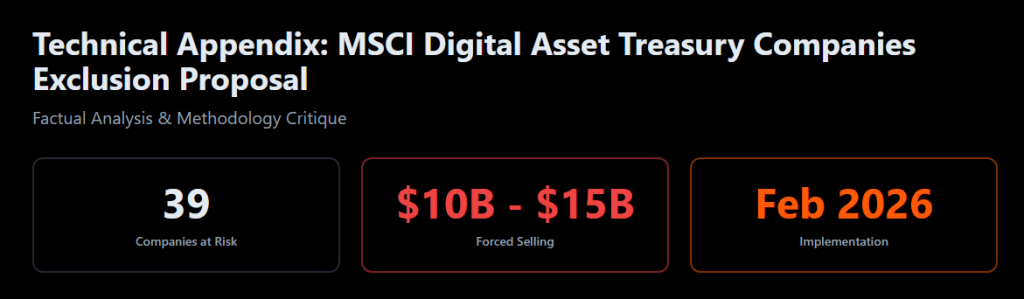
Analysts estimate that passive funds could pull between $10 billion and $15 billion from companies holding significant crypto assets if MSCI proceeds with a proposed rule change. The index provider is reviewing a policy to exclude firms holding over 50% of their assets in digital currencies from its benchmarks, a decision expected by January 2026. If enacted, index-tracking funds would be forced to sell shares of affected companies. JPMorgan analysis singles out MicroStrategy as the most impacted, potentially facing $2.8 billion in outflows. Beyond stock sales, there is a risk the companies themselves might liquidate crypto holdings, adding direct selling pressure to both equity and crypto markets. Industry groups are pushing back against the proposal, arguing for an operations-based classification instead.

Analysts have calculated that passive funds could pull as much as $11.6 billion from companies that treat large crypto holdings as corporate treasuries if MSCI removes them from its indexes, a move that would force index-tracking vehicles to sell shares.

Reports say that number comes from adding direct MSCI-tracked outflows to possible follow-on selling by other index providers.

Estimated Outflows Range

The figure sits inside a wider band of estimates. Some analysts and press pieces put the possible damage anywhere between $10 billion and $15 billion, depending on whether other major index providers copy MSCI’s decision and how much passive money is forced to move.

The analysis that produced these numbers looked at roughly 39 listed companies that meet MSCI’s proposed definition of a digital-asset treasury firm.

BTCUSD now trading at $87,105. Chart: TradingView

MSCI’s Proposal And The Mechanics

According to MSCI’s own consultation documents, the index provider is reviewing a rule that would treat companies holding more than 50% of their assets in digital assets as non-constituents of its broad equity indexes.

MSCI extended the consultation through December and said it expects to announce conclusions by January 15, 2026, with any changes applied in the February 2026 index review. If a firm is removed, funds that track MSCI benchmarks typically must reduce or sell their stakes automatically.

Strategy Stands Out

JPMorgan’s work has been singled out in multiple reports. According to that note, Strategy alone could face about $2.8 billion in passive outflows if removed from MSCI indexes, and larger losses if other index families follow.

Analysts say Strategy’s unique position — with a very high share of its balance sheet in Bitcoin — makes it the single biggest driver of the total outflow math.

Risk To Crypto Holdings

Some sectors warn that, beyond stock selling, the companies themselves might liquidate crypto positions to meet margin or liquidity needs, which could push crypto asset sales toward a figure as high as $15 billion in the worst scenarios. That would add direct selling pressure to both the equities and crypto markets.
Source: Bitcoin for Corporations

Industry Pushback

Based on reports, a group named Bitcoin For Corporations, along with several affected firms, pushed back, saying the MSCI test relies on a single balance-sheet threshold that doesn’t reflect how these companies actually operate.

The campaign has drawn public comments and petitions; several reports put the signature count at about 1,200 to 1,300. Companies have filed feedback with MSCI and have argued for an operations-based classification instead of a holdings-based cut-off.

Featured image from Unsplash, chart from TradingView

İlgili Sorular

QWhat is the estimated amount of selling pressure that crypto treasury firms could face due to MSCI's proposed rule change?

AAnalysts estimate that crypto treasury firms could face selling pressure ranging from $10 billion to $15 billion.

QWhat is the specific threshold in MSCI's proposal that would cause a company to be excluded from its indexes?

AMSCI's proposal would treat companies holding more than 50% of their assets in digital assets as non-constituents of its broad equity indexes.

QWhich company is singled out as the single biggest driver of the total outflow math and why?

AMicroStrategy is singled out as the biggest driver due to its unique position with a very high share of its balance sheet in Bitcoin, potentially facing about $2.8 billion in passive outflows.

QBeyond stock selling, what additional risk to the crypto market is highlighted in the article?

AThe article warns that the companies themselves might be forced to liquidate their crypto positions to meet margin or liquidity needs, which could add direct selling pressure to the crypto market.

QWhat is the main argument made by the industry group 'Bitcoin For Corporations' against MSCI's proposal?

AThe group argues that the MSCI test relies on a single balance-sheet threshold that doesn't reflect how these companies actually operate, and they have advocated for an operations-based classification instead.

İlgili Okumalar

OpenAI Post-Training Engineer Weng Jiayi Proposes a New Paradigm Hypothesis for Agentic AI

OpenAI engineer Weng Jiayi's "Heuristic Learning" experiments propose a new paradigm for Agentic AI, suggesting that intelligent agents can improve not just by training neural networks, but also by autonomously writing and refining code based on environmental feedback. In the experiment, a coding agent (powered by Codex) was tasked with developing and maintaining a programmatic strategy for the Atari game Breakout. Starting from a basic prompt, the agent iteratively wrote code, ran the game, analyzed logs and video replays to identify failures, and then modified the code. Through this engineering loop of "code-run-debug-update," it evolved a pure Python heuristic strategy that achieved a perfect score of 864 in Breakout and performed competitively with deep reinforcement learning (RL) algorithms in MuJoCo control tasks like Ant and HalfCheetah. This approach, termed Heuristic Learning (HL), contrasts with Deep RL. In HL, experience is captured in readable, modifiable code, tests, logs, and configurations—a software system—rather than being encoded solely into opaque neural network weights. This offers potential advantages in explainability, auditability for safety-critical applications, easier integration of regression tests to combat catastrophic forgetting, and more efficient sample use in early learning stages, as demonstrated in broader tests on 57 Atari games. However, the blog acknowledges clear limitations. Programmatic strategies struggle with tasks requiring long-horizon planning or complex perception (e.g., Montezuma's Revenge), areas where neural networks excel. The future vision is a hybrid architecture: specialized neural networks for fast perception (System 1), HL systems for rules, safety, and local recovery (also System 1), and LLM agents providing high-level feedback and learning from the HL system's data (System 2). The core proposition is that in the era of capable coding agents, a significant portion of an AI's learned experience could be maintained as an auditable, evolving software system.

marsbit29 dk önce

OpenAI Post-Training Engineer Weng Jiayi Proposes a New Paradigm Hypothesis for Agentic AI

marsbit29 dk önce

Your Claude Will Dream Tonight, Don't Disturb It

This article explores the recent phenomenon of AI companies increasingly using anthropomorphic language—like "thinking," "memory," "hallucination," and now "dreaming"—to describe machine learning processes. Focusing on Anthropic's newly announced "Dreaming" feature for its Claude Agent platform, the piece explains that this function is essentially an automated, offline batch processing of an agent's operational logs. It analyzes past task sessions to identify patterns, optimize future actions, and consolidate learnings into a persistent memory system, akin to a form of reinforcement learning and self-correction. The article draws parallels to similar features in other AI agent systems like Hermes Agent and OpenClaw, which also implement mechanisms for reviewing historical data, extracting reusable "skills," and strengthening long-term memory. It notes a key difference from human dreaming: these AI "dreams" still consume computational resources and user tokens. Further context is provided by discussing the technical challenges of managing AI "memory" or context, highlighting the computational expense of large context windows and innovations like Subquadratic's new model claiming drastically longer contexts. The core critique argues that this strategic use of human-centric vocabulary does more than market products; it subtly reshapes user perception. By framing algorithms with terms associated with consciousness, companies blur the line between tool and autonomous entity. This linguistic shift can influence user expectations, tolerance for errors, and even perceptions of responsibility when systems fail, potentially diverting scrutiny from the companies and engineers behind the technology. The article concludes by speculating that terms like "daydreaming" for predictive task simulation might be next, continuing this trend of embedding the idea of an "inner life" into computational processes.

marsbit31 dk önce

Your Claude Will Dream Tonight, Don't Disturb It

marsbit31 dk önce

İşlemler

Spot
Futures
活动图片





