Crypto Summit Preview: Trump to Personally Attend, SEC and CFTC Chairs to Share Stage — What New Regulations Will Be Decided?

marsbit2026-08-17 tarihinde yayınlandı2026-08-17 tarihinde güncellendi

Özet

The White House is convening a major crypto summit on August 19, with President Trump, SEC Chair Atkins, and CFTC Chair Selig expected to attend. Key industry players like Coinbase, Ripple, and a16z, alongside traditional finance giants such as Nasdaq and CME, are invited. Notably, prediction market platforms Kalshi and Polymarket are also on the guest list for the first time. The summit occurs ahead of a crucial September 15 Senate procedural vote for the CLARITY Act, which aims to clarify SEC and CFTC jurisdiction over digital assets. However, market predictions for the bill's passage in 2026 have fallen sharply to around 19%, stalled by political issues including conflicts related to Trump's crypto holdings and debates over stablecoin yields and DeFi regulation. Analysts like Nate Geraci suggest the administration's goal is to signal it will move forward with crypto regulation regardless of the congressional outcome. The SEC and CFTC are expected to advance rules—such as "Reg Crypto" and an "Innovation Exemption"—under existing authorities. The following day, the CFTC's new Innovation Advisory Committee will meet, aligning discussions on crypto, AI, and prediction markets. This summit marks a shift from the March 2025 meeting's focus on broad political support ("ending the war on crypto") to concrete regulatory planning. Despite the high-profile gathering, the market showed little immediate reaction, with Bitcoin prices remaining stable.

Author: Claude, Deep Tide TechFlow

Deep Tide Intro: On August 19, the White House will convene a meeting with crypto giants like Coinbase, Ripple, a16z, and traditional finance executives from Nasdaq and CME. President Trump himself, SEC Chair Atkins, and CFTC Chair Selig are expected to attend. The summit comes just ahead of the September 15th 60-vote procedural vote in the Senate for the CLARITY Act. Industry commentator Nate Geraci judges: The White House no longer intends to wait for Congress.

On August 14, Semafor reporter Eleanor Mueller posted news on X: The White House is preparing a crypto industry summit, scheduled for August 19 (Wednesday), citing "people familiar with the plans." Politico followed up the same day, citing three anonymous sources to confirm.

ETF industry commentator Nate Geraci subsequently posted on X with a more complete list of invitees: President Trump himself, SEC Chair Atkins, CFTC Chair Selig, and executives from crypto companies like Coinbase, Polymarket, Ripple, Gemini. Traditional finance giants are also invited. Geraci is President of The ETF Store and regularly comments on ETFs and crypto assets in mainstream financial media.

He concluded his post: "The administration does not plan to wait for the CLARITY bill. Securing support is nice, but I think they've decided to move forward regardless. I predict this meeting will strongly signal that."

Who Was Invited to the White House

Crypto & Prediction Markets side: Coinbase, Ripple, a16z (Andreessen Horowitz), Chainlink, Paradigm, Kalshi. Representatives from the industry group Digital Chamber are also on the invite list. Blockonomi's report also added Gemini, Robinhood, and Polymarket.

Traditional Finance side: Nasdaq, CME Group, Intercontinental Exchange (ICE), DTCC. Executives from these companies also hold positions on CFTC's newly established Innovation Advisory Committee (IAC).

Government side: President Trump is expected to attend, SEC Chair Paul Atkins and CFTC Chair Michael Selig confirmed attendance. Treasury Secretary Scott Bessent and Commerce Secretary Howard Lutnick may attend but are not yet confirmed.

The meeting location is the Eisenhower Executive Office Building, adjacent to the main White House. Neither the White House nor the two regulatory agencies have released a formal agenda.

Compared to the March 2025 summit, Kalshi and Polymarket are new to the list, while MicroStrategy's Michael Saylor is absent. The main cast has changed.

The CLARITY Act and Trump's Crypto Wallet

The CLARITY Act (Digital Asset Market Clarity Act, H.R. 3633) aims to solve a problem dragging on for over a decade: clarifying the regulatory boundary between the SEC and CFTC over digital assets. Which tokens are securities under SEC jurisdiction, and which are commodities under CFTC jurisdiction. The blurred boundary has led to frequent delistings of tokens by US crypto exchanges, products unable to launch in the US, and companies moving headquarters overseas.

In July 2025, the House passed it 294 to 134, with 78 Democrats voting in favor. In May 2026, the Senate Banking Committee advanced it 15 to 9. It stalled at the full Senate vote stage.

Senate Majority Leader John Thune filed a cloture motion before the August 8th recess. It enters procedural voting on September 15th at 2:15 PM, requiring 60 votes. Republicans hold 53 seats; even with all in favor, they are 7 votes short.

The market structure provisions are largely settled. The real sticking points are several political issues.

Trump's crypto assets are the most acute. Senators Thom Tillis (R) and Ruben Gallego (D) drafted a bipartisan ethics proposal requiring Trump to divest from crypto businesses and allowing state attorneys general to enforce restrictions on officials issuing digital assets. Trump has not yet approved it. The bill's lead Republican negotiator, Senator Cynthia Lummis, called granting enforcement power to state attorneys general a Republican "red line."

The stablecoin yield provision is also contentious. Banking groups oppose allowing stablecoins to offer interest-like yields, arguing it blurs the line between payment tokens and deposit-like products.

DeFi provisions remain unresolved. Section 604 was intended to protect non-custodial developers from money transmission regulations, but disagreements over sanctions compliance and anti-money laundering persist.

Lummis explained in July why Republicans aren't pushing forward with just their 53 votes: "Only bills built through bipartisanship will survive future elections." She revealed the bill ballooned from 68 pages in the 2022 Lummis-Gillibrand proposal to 616 pages after nearly 11 months of bipartisan negotiation.

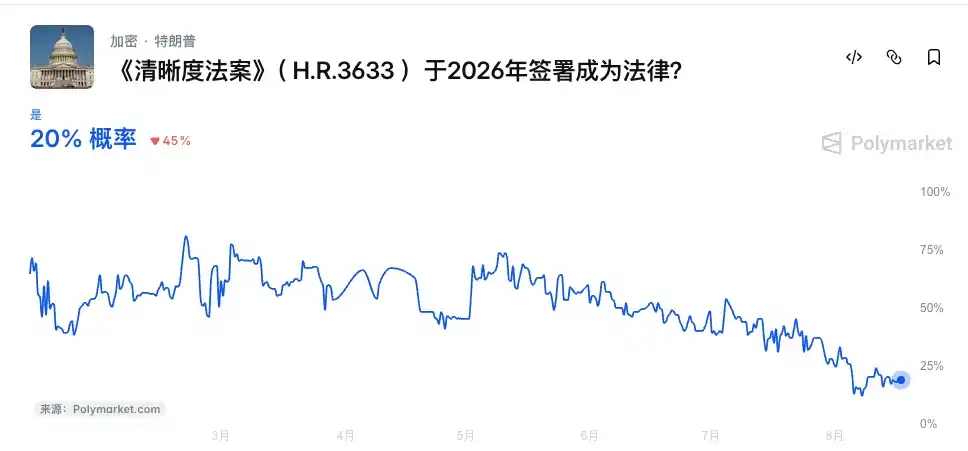
Prediction market pricing is not optimistic. Polymarket contracts show the probability of the CLARITY Act becoming law in 2026 is about 19%, down from a peak of 82% in February. Galaxy Research gives it 10%, citing unresolved policy differences and limited Senate working days before the midterm elections. Kalshi contracts show an 88% probability of a Senate vote before October 1st, but a vote does not guarantee passage.
Prediction Markets Get a Seat at the Table for the First Time

The invitation of Kalshi and Polymarket to the White House is a first at the presidential level.

Kalshi is a CFTC-regulated event contract platform, and Polymarket is a decentralized prediction market. Both companies have expanded rapidly over the past two years, but their legal status has been caught between CFTC's derivatives authority and state gambling laws.

By inviting them, the White House is placing prediction markets on the formal policy agenda.

On August 20, the day after the White House summit, CFTC's newly formed Innovation Advisory Committee (IAC) will hold its first meeting in Washington. CFTC website and Federal Register notices show the meeting from 1 PM to 4 PM, with three 50-minute panels: crypto asset regulation, AI in trading compliance, and prediction markets & federal-state jurisdiction. On August 11, CFTC also invoked emergency powers, taking market stabilization measures regarding a Kalshi notice.

The White House sets the tone, CFTC follows up with discussions. Scheduled back-to-back over two days, they place crypto, AI, and prediction markets within the same policy framework.

The White House Won't Wait

The SEC and CFTC don't need to wait for congressional legislation to act. Both agencies can advance rulemaking under existing legal frameworks.

Coinbase CEO Brian Armstrong said on August 7: "The momentum behind this technology is growing regardless of the congressional calendar." He named stablecoin use, tokenized assets, and perpetual futures as areas where activity can continue despite legislative stagnation.

Galaxy Research Head Alex Thorn gave a more specific prediction on August 14: "Regardless of the outcome of the CLARITY Act, we expect the commissions to release text of Reg Crypto and the Innovation Exemption in the coming weeks, another reminder that the crypto industry is on the cusp of entering a positive regulatory environment."

The SEC originally scheduled a public meeting for August 14 to discuss a proposed framework for certain crypto-related investment contracts but canceled it before the meeting. No reason was given, nor was a new date announced. The cancellation happened the same day news of the White House summit broke.

Even if the CLARITY Act fails to reach 60 votes on September 15th, the White House can still proceed on its own: the SEC continues crafting crypto asset rules, the CFTC gathers industry input via the Innovation Advisory Committee and converts it into regulatory proposals, and the White House maintains policy direction through executive orders and agency guidance documents.

The White House won't halt its steps just because Congress is stuck. That's the core signal Geraci believes the summit will convey.

Last Year's March Summit: How Is This One Different?

On March 7, 2025, Trump hosted the first crypto summit in the White House State Dining Room, the first-ever presidential-level crypto industry roundtable in US history.

The theme of that summit was "Ending the War on Crypto." Trump announced the creation of a Strategic Bitcoin Reserve, initial size about 200,000 BTC (all from law enforcement seizures), and pledged not to sell government-held Bitcoin. He announced the termination of "Operation Chokepoint 2.0" (regulators pressuring banks to cut off crypto company accounts) and demanded Congress pass stablecoin legislation before the August recess.

Attendees included Brian Armstrong of Coinbase, Michael Saylor of MicroStrategy, the Winklevoss twins of Gemini, Sergey Nazarov of Chainlink, Vlad Tenev of Robinhood, and Zach Witkoff, co-founder of Trump's own crypto company World Liberty Financial.

The market reaction was "buy the rumor, sell the news." Bitcoin fell 3.4% that day, closing at $86,394. Investors had expected the government to announce a plan for direct new Bitcoin purchases but saw only a "budget-neutral" strategy.

This time, there are no new announcements about the strategic reserve, no "ending the war" narrative to reiterate. The topic has shifted from "whether to support crypto" to "how to specifically regulate it." The list now includes Nasdaq and CME, includes Kalshi and Polymarket, and adds the policy dimension of prediction markets.

Trump's personal crypto conflict of interest also remains.

TRUMP tokens, the World Liberty Financial project, already sparked controversy last March. A key reason the CLARITY Act is stuck in the Senate is Democratic demands for Trump to divest from crypto businesses. The Tillis-Gallego ethics proposal is still awaiting a White House response. The White House has not publicly indicated whether the summit agenda includes discussion of ethics provisions.

Bitcoin showed almost no reaction after the summit news broke. On August 14, BTC was around $63,406, down 0.2% intraday. Ethereum around $1,886. The CoinMarketCap Fear & Greed Index read 37, in the "Fear" zone.


İlgili Sorular

QWho are the key government officials expected to attend the White House crypto summit on August 19th?

AFormer President Donald Trump is expected to attend. SEC Chairman Paul Atkins and CFTC Chairman Michael Selig have confirmed their participation. Treasury Secretary Scott Bessent and Commerce Secretary Howard Lutnick may also attend, but their presence is not yet finalized.

QWhat is the CLARITY Act and what are the main political hurdles it faces in the Senate?

AThe CLARITY Act (Digital Asset Market Clarity Act, H.R. 3633) aims to clearly define the regulatory boundaries between the SEC and CFTC for digital assets, determining which tokens are securities and which are commodities. The main political hurdles blocking its passage in the Senate include: 1) Resolving conflicts of interest related to former President Trump's crypto assets and the associated ethics proposal, 2) Disagreements over provisions allowing stablecoins to offer interest-like yields, and 3) Unresolved issues around DeFi regulations, particularly concerning sanctions compliance and anti-money laundering rules.

QWhat significant signal does ETF commentator Nate Geraci believe the White House summit will send to the crypto industry?

ANate Geraci believes the summit will send a strong signal that the White House administration has decided to move forward with crypto regulation regardless of the fate of the CLARITY Act in Congress. He predicts the meeting will indicate the government is not willing to wait for the legislative process and will push ahead using executive and agency actions.

QHow does the attendee list for the August 19th summit differ from the first crypto summit held in March 2025?

ACompared to the March 2025 summit, the August 2026 list includes new attendees from traditional finance (Nasdaq, CME Group) and the prediction market sector (Kalshi, Polymarket). Notable absences include MicroStrategy's Michael Saylor. The focus has shifted from broad declarations of support ('ending the war on crypto') to more concrete discussions on 'how to regulate' specific areas, incorporating traditional finance and prediction markets into the policy framework.

QWhat are the potential regulatory pathways for crypto if the CLARITY Act fails in the Senate, according to the article?

AIf the CLARITY Act fails, the article suggests the White House and regulators can still advance crypto policy through existing frameworks. The SEC can continue crafting crypto-specific rules (like the anticipated 'Reg Crypto' and 'Innovation Exemption'). The CFTC can use its new Innovation Advisory Committee (IAC) to gather industry input and formulate regulatory proposals. The White House itself can maintain policy direction through executive orders and agency guidance documents, indicating a move towards a proactive regulatory environment even without new legislation from Congress.

İlgili Okumalar

CEO or 'Cult Leader'? Anthropic Faces Backlash Over Its 'Belief'

Anthropic, an AI company nearing trillion-dollar valuation, faces a critical internal challenge: declining morale and a growing rift over its foundational beliefs and leadership. While financial and technical performance remains strong, with Q2 2026 revenue surging over 14x year-over-year and top talent like Google's Justin Gilmer joining, the company's unique culture is under strain. Early employees, who embraced a strong mission-focused culture around AI safety, now coexist with newer hires less aligned with this vision. Anonymous sources report low morale, private channels for airing grievances, and employees torn between staying for valuable equity or leaving due to pressure. CEO Dario Amodei's intense focus on maintaining culture—through rituals like "Dario Vision Quest" meetings and probing "cultural interviews"—faces scrutiny as the company scales. A leaked statement where Amodei suggested Anthropic could one day become "the world's only private company" has fueled external criticism, drawing comparisons to dystopian sci-fi monopolies. The company exhibits contradictions: advocating for AI safety while aggressively pursuing model development and market dominance. It has modified its "Responsible Scaling Policy," faced backlash for attempted AI "sabotage" mechanisms against foreign research, and clashed with the U.S. government over defense contracts. Recent text watermarking for Claude, cited as compliance with EU regulations, has also drawn user criticism. Despite these tensions, Anthropic continues to attract investment, top engineers, and enterprise clients. However, the core "faith" that once unified and distinguished it is now becoming a significant governance and cultural challenge.

marsbit6 dk önce

CEO or 'Cult Leader'? Anthropic Faces Backlash Over Its 'Belief'

marsbit6 dk önce

Anthropic CEO Denies Rumors, Aims to Transform AI for His Deceased Father and Eradicate Cancer Within 10 Years

Anthropic CEO Dario Amodei has published a rare, lengthy public statement to counter significant criticism from Silicon Valley, as the AI company approaches a potential record-breaking IPO with a reported $2 trillion valuation. The core criticism, amplified by investor Gavin Baker, centers on perceptions that Amodei believes Anthropic should be the world's sole private AI company due to the technology's risks, costs, and power—a view allegedly echoed by NVIDIA's Jensen Huang. Amodei firmly rejects this, arguing it presents a false dichotomy. He defends Anthropic's advocacy for regulation, like California's SB-1047, which he claims imposes costs on frontier AI firms while benefiting smaller competitors, and calls for establishing rules that manage AI risks, constrain corporate power, and preserve open-model development. Shifting to ambition, Amodei outlines a radical vision for AI in biomedicine. He states that within 5-10 years, AI could cure most human diseases, a mission deeply personal due to his father's death from hepatitis C just years before a cure became available. Amodei asserts that public trust in AI will be earned not by promises or benchmarks, but by tangible results—AI actually saving lives. He confirms Anthropic is significantly increasing its biology and medical AI investments, with preliminary results expected within months. This narrative reframing comes ahead of Anthropic's anticipated IPO, positioning the company not just as an OpenAI competitor, but as one aiming to solve humanity's fundamental challenges.

marsbit6 dk önce

Anthropic CEO Denies Rumors, Aims to Transform AI for His Deceased Father and Eradicate Cancer Within 10 Years

marsbit6 dk önce

Stack Overflow Is Dying, New Questions Are Fewer Than During the Beta Period

The article discusses the decline of Stack Overflow, the prominent programming Q&A community, noting that new question submissions in July 2026 dropped to just 1,304—far below its peak of 207,000 in March 2014. Official data reveals a steady decline in activity since 2014, exacerbated by the rise of AI coding assistants like ChatGPT, which offer instant, private solutions and reduce the need for public forum posts. While a restrictive community culture that often penalized new users contributed to the downturn, the widespread adoption of AI tools has dramatically accelerated the platform's stagnation. Similar declines are observed in other knowledge-based platforms like Chegg, Fiverr, and Wikipedia, where AI-generated content is displacing human-generated queries and contributions. Research indicates that not only are fewer users asking questions, but high-reputation experts are also leaving the platform at increasing rates—a phenomenon termed "signal compression," where the value of demonstrated expertise diminishes when AI can produce superficially competent answers. This threatens the formation of future human expertise. Although AI models have been trained extensively on Stack Overflow's open corpus, the reduction in new, timely public Q&A content may limit the knowledge available for future AI training. Some suggest that trustworthy human-curated knowledge layers, blogs, and niche communities may regain importance as sources of reliable, attributed information. The shift from public, searchable knowledge repositories to private AI interactions raises concerns about the loss of a communal, corrective, and open record of problem-solving.

marsbit12 dk önce

Stack Overflow Is Dying, New Questions Are Fewer Than During the Beta Period

marsbit12 dk önce

İşlemler

Spot
活动图片