Crypto hack counts fall but supply chain attacks reshape threat landscape

cointelegraph2025-12-23 tarihinde yayınlandı2025-12-23 tarihinde güncellendi

Özet

New data from CertiK reveals that while crypto hackers stole $3.3 billion in 2025, the number of attacks fell sharply. Losses were concentrated in fewer, more damaging supply-chain attacks, which accounted for $1.45 billion across just two incidents, including the $1.4 billion Bybit hack. This shift indicates attackers are moving away from simple code vulnerabilities toward more sophisticated infrastructure-level exploits. The number of security incidents decreased by 162 year-over-year, suggesting improved protocol-level security. The median loss per hack fell 35.75% to $103,966, though the average loss rose to $5.3 million due to high-value outliers. Phishing scams were the second-largest threat, costing $722 million across 248 incidents. A significant subset was "pig butchering" romance scams, which used prolonged emotional manipulation and cost the industry $5.5 billion in 2024.

Crypto hackers stole $3.3 billion in 2025, but the number of attacks fell sharply as losses became concentrated in fewer, more sophisticated supply-chain exploits, according to new data from blockchain security firm CertiK shared with Cointelegraph.

While total losses remained elevated, the decline in incident counts and a drop in median theft sizes suggest that protocol-level security is improving, pushing attackers away from simple code vulnerabilities and toward phishing and infrastructure-level attacks.

CertiK said supply-chain breaches emerged as the most damaging threat, accounting for $1.45 billion in losses across just two incidents, including the $1.4 billion Bybit hack in February.

"The Bybit exploit signals that well-capitalized, well-coordinated threat actors are becoming more active across the ecosystem," the report said, predicting a rise in the “sophistication” of supply chain attacks as attackers target more infrastructure providers.
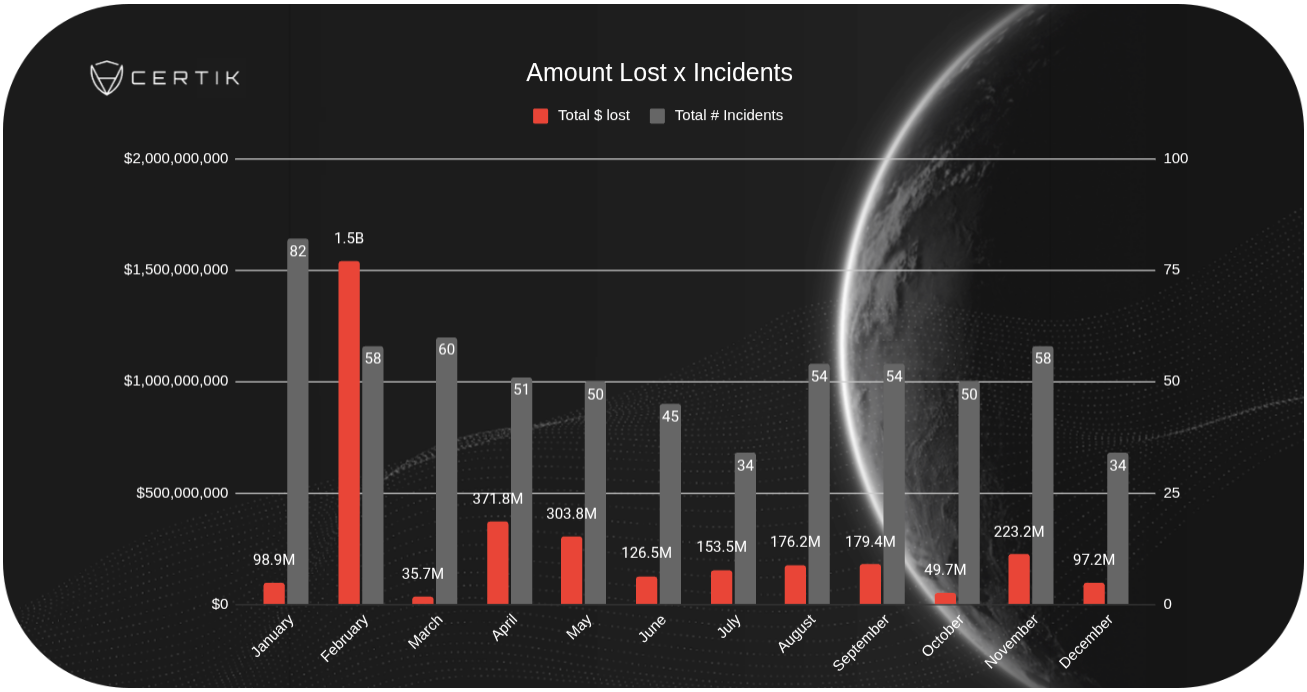
Crypto hacks by amount and incident, yearly chart. Source: CertiK

Related: Soulja Boy token sparks backlash after Base co-founder posts purchase receipt

The number of security incidents decreased by 162 counts year-over-year, indicating that blockchain cybersecurity measures are improving despite hackers aiming for larger targets.

The average amount lost per hack stood at $5.3 million, a 66% increase from the previous year. However, the median loss — a measure less influenced by outlier incidents — fell to $103,966, down 35.75% over the same period.
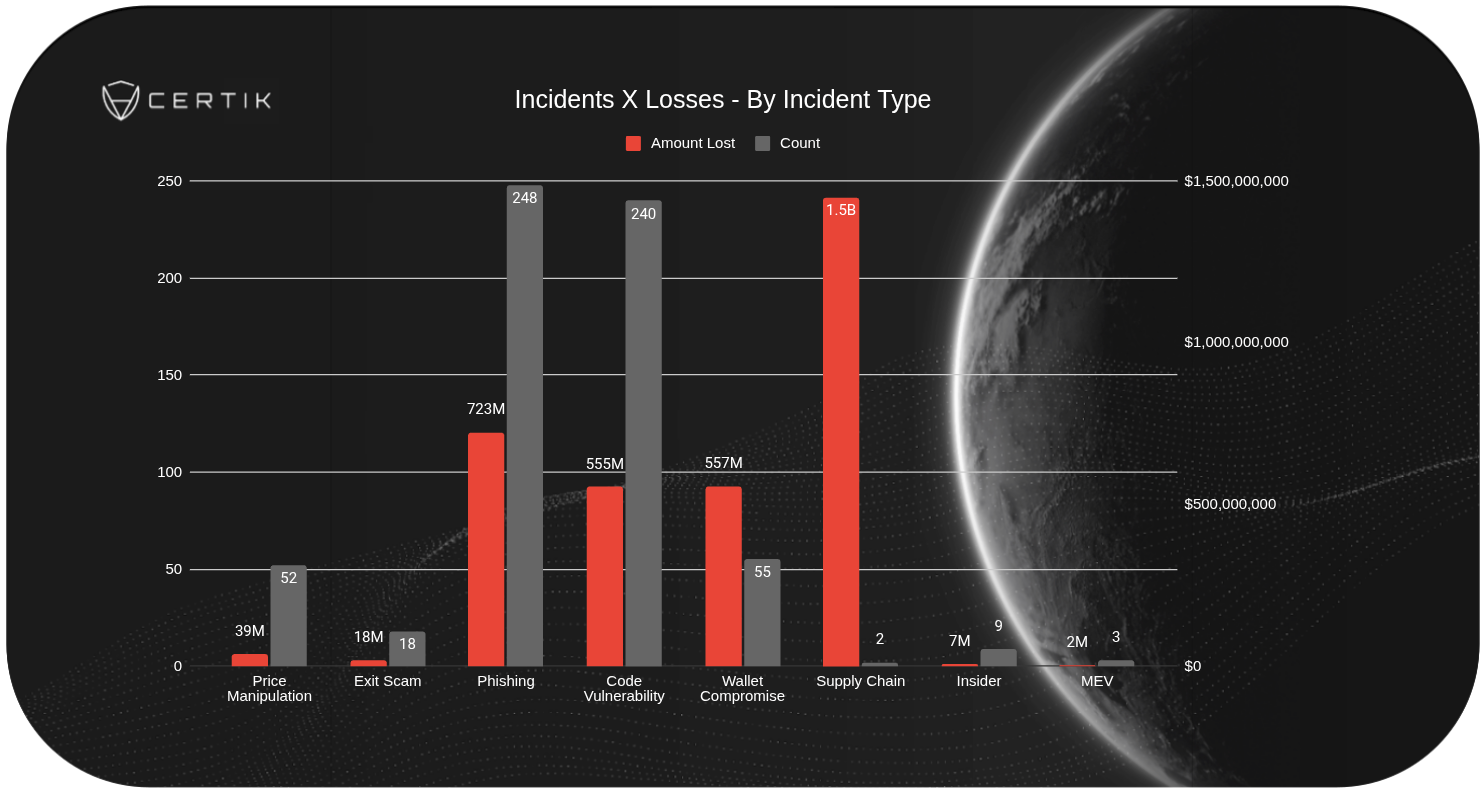
Cryptop hacks by incident type and amount of losses, one-year chart. Source: CertiK

Related: Solana AI token Ava hit by launch sniping tied to deployer: Bubblemaps

Code vulnerabilities fade as “pig butchering” scams threaten crypto savings

Phishing scams became the second-largest threat, costing crypto investors a cumulative $722 million across 248 incidents.

Recently, an investor lost their entire Bitcoin (BTC) retirement fund in an artificial intelligence-fueled romance scam, also known as a "pig butchering" scam, where the con artists used prolonged emotional manipulation to convince the investors to transfer their funds.
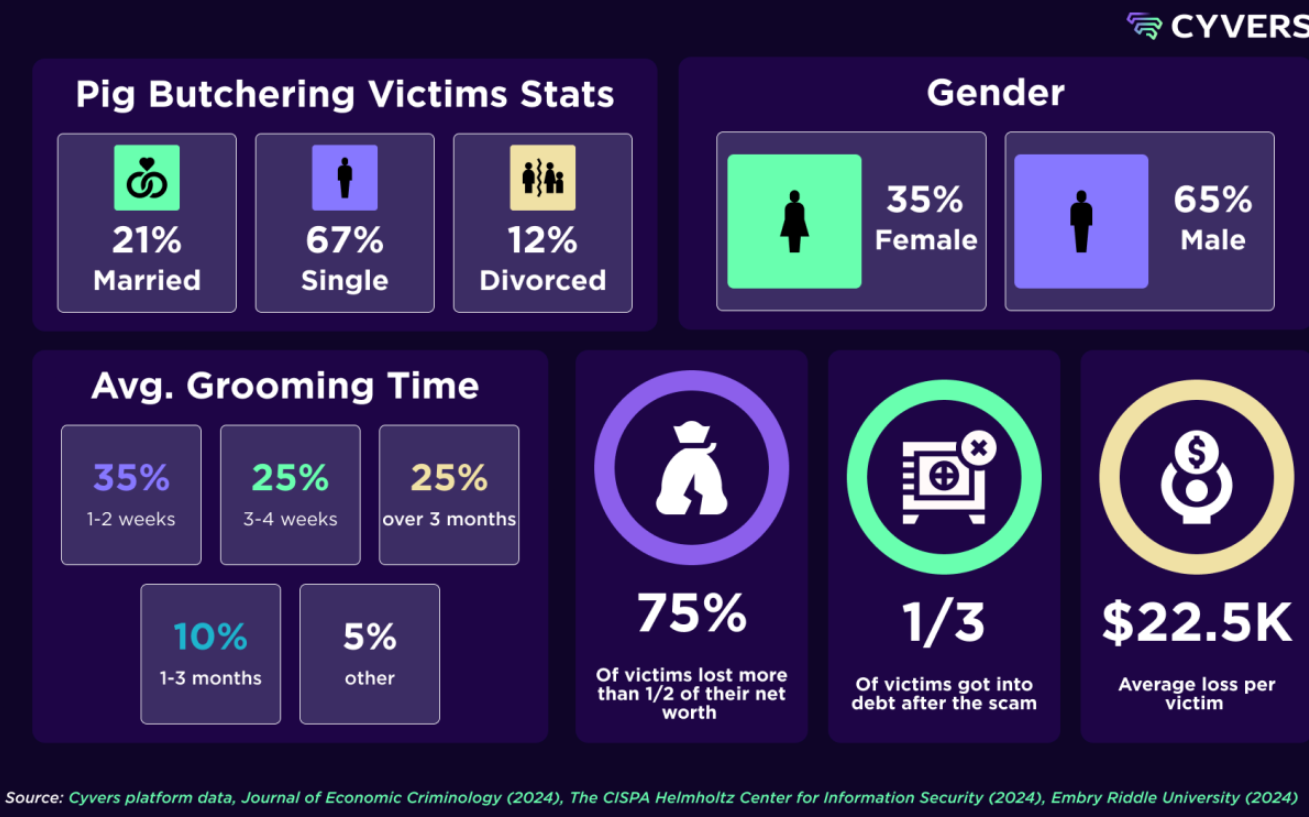
Pig butchering victim stats, grooming time. Source: Cyvers

Pig butchering scams are a subset of phishing scams that cost the industry a collective $5.5 billion in 2024, across 200,000 individual cases.

Notably, the average grooming period for victims is between one and two weeks in 35% of cases, while 10% of scams involve grooming periods of up to three months, according to blockchain security platform Cyvers.

In June, the US Department of Justice announced the seizure of over $225 million in crypto linked to pig butchering scams.

Magazine: Coinbase hack shows the law probably won’t protect you — Here’s why

İlgili Sorular

QAccording to CertiK's data, what was the total amount stolen by crypto hackers in 2025 and what was the most damaging type of attack?

ACrypto hackers stole a total of $3.3 billion in 2025. The most damaging type of attack was supply-chain breaches, which accounted for $1.45 billion in losses.

QWhat does the report suggest about the trend in protocol-level security based on the decline in incident counts and median theft sizes?

AThe decline in incident counts and the drop in median theft sizes suggest that protocol-level security is improving. This is pushing attackers away from simple code vulnerabilities and toward more sophisticated methods like phishing and infrastructure-level attacks.

QWhat was the average amount lost per hack and how much did it change from the previous year?

AThe average amount lost per hack stood at $5.3 million, which was a 66% increase from the previous year.

QWhat are 'pig butchering' scams and how much did they cost the industry in 2024?

A'Pig butchering' scams are a subset of phishing scams that involve prolonged emotional manipulation to convince victims to transfer their funds. They cost the industry a collective $5.5 billion in 2024 across 200,000 individual cases.

QWhat significant action did the US Department of Justice take regarding pig butchering scams in June?

AIn June, the US Department of Justice announced the seizure of over $225 million in cryptocurrency that was linked to pig butchering scams.

İlgili Okumalar

Why Is the World Nervous About Japan Raising Interest Rates?

In June 2026, the Bank of Japan raised its policy rate to 1%, marking its first hike to this level since 1995. While this rate remains low compared to global peers like the US and Europe, the move signals a profound shift for a nation that has been a global source of ultra-cheap funding for decades. Japan's long-standing near-zero or negative interest rates had facilitated massive "yen carry trades," where international investors borrowed low-cost yen to invest in higher-yielding assets worldwide, such as US tech stocks and emerging market bonds. This made Japan a critical, often overlooked, source of global liquidity. Japan's ultra-loose policy stemmed from structural challenges post-1990s asset bubble: aging demographics, chronic low inflation/deflation, and high public debt. Recent shifts, including sustained wage growth (exceeding 5% in recent years) and inflation consistently above the 2% target, have created a "wage-price spiral" possibility, prompting the policy normalization. The global market's concern lies not in the absolute rate but in the potential unwinding of the yen carry trade. As Japanese borrowing costs rise, the economics of these leveraged global investments change, potentially triggering deleveraging and capital outflows from risk assets. Market anxiety focuses on the end of a thirty-year consensus that Japan would perpetually provide cheap funding. Ultimately, the global impact will depend on the interplay with US monetary policy. While Japan is tightening, the significant interest rate differential with the US remains. The key future dynamic is whether simultaneous Japanese hikes and eventual US rate cuts will narrow this gap, forcing a major recalibration of global capital flows and asset pricing built on an era of abundant, cheap yen liquidity.

marsbit3 saat önce

Why Is the World Nervous About Japan Raising Interest Rates?

marsbit3 saat önce

Research Report Analysis: MRVL's Optical AI Booming, Why High Valuation Keeps Morgan Stanley's Star Analyst Sidelined?

Report Recap: MRVL Optical AI Boom - Why High Valuation Led Morgan Stanley's Star Analyst to Stay Neutral? Morgan Stanley analyst Joseph Moore maintained an "Equal-weight" (Neutral) rating on Marvell Technology (MRVL) on May 28, raising the price target from $172 to $195, below the trading price. This stance comes despite Marvell reporting a record quarter and significantly raising its full-year outlook (FY27 revenue ~$11.5B, up ~40%). Moore's neutral view is based on valuation. The $195 target implies ~40x CY2027 P/E. He contrasts MRVL with NVDA: both trade near ~$200, but Nvidia's forward EPS is more than double Marvell's. For MRVL's valuation to hold, it needs consistent earnings upgrades, proof of networking market share gains, or certainty on large-scale custom AI chip shipments—none of which are confirmed yet. Growth is driven by two pillars: **1) Optical Interconnect** (the faster runner): Moore raised FY27 growth expectations to >70%, with the optical module product line nearing a $1B annualized run rate. **2) Custom AI Chips** (the climber): Confidence in FY28 is growing, but a major new customer project only ramps in FY28, with no current revenue visibility. Key risks are the underperforming Storage, Enterprise, and legacy Networking segments. Moore acknowledges the real AI opportunity but believes the current price already reflects it. For the stock to work from here, investors need to see the optical business hit its targets, custom chips ramp as planned, and a recovery in the weaker business units.

marsbit4 saat önce

Research Report Analysis: MRVL's Optical AI Booming, Why High Valuation Keeps Morgan Stanley's Star Analyst Sidelined?

marsbit4 saat önce

İşlemler

Spot
Futures
活动图片