Crypto Credit Crisis Deepens As BlockFills Files For Bankruptcy

bitcoinist2026-03-16 tarihinde yayınlandı2026-03-16 tarihinde güncellendi

Özet

Crypto lender BlockFills and three related entities under parent firm Reliz LTD have filed for Chapter 11 bankruptcy protection. The filing comes after the company halted customer withdrawals last month, citing a sharp Bitcoin selloff as the reason. Prior to the bankruptcy, a Delaware court had already ordered 71 Bitcoin frozen due to a customer fund dispute. Chapter 11 allows the company to continue operating while it restructures its finances and negotiates a repayment plan with creditors. Customers with balances on the platform are considered unsecured creditors, meaning they will be last in line for repayment. The amount and timing of any recovery depend on the company's assets and may take months or years to resolve. This situation mirrors previous crypto lending failures, such as Celsius and Voyager, where customers faced long waits for partial repayments. BlockFills has not disclosed its total liabilities or the number of affected customers.

A Delaware court had already ordered 71 Bitcoin frozen over a customer fund dispute before crypto lender BlockFills formally declared it could no longer operate.

That freeze — tied to a legal battle with creditors over how client money was handled — cast a shadow over the company well before it filed for Chapter 11 protection this week.

Customers Locked Out As Withdrawals Halt

BlockFills stopped letting customers move their money last month. The company pointed to a sharp Bitcoin selloff — the coin dropped from above $97,000 to below $64,000 between mid-January and early February — as the reason it needed to protect both itself and its clients.

Deposits and withdrawals went dark. No timeline for restoration was given.

Now the company and three related entities, all operating under parent firm Reliz LTD, have taken their case to federal bankruptcy court in Delaware.

The filing seeks a Chapter 11 restructuring, which allows a company to keep running while it works out a repayment plan with the people it owes money to.
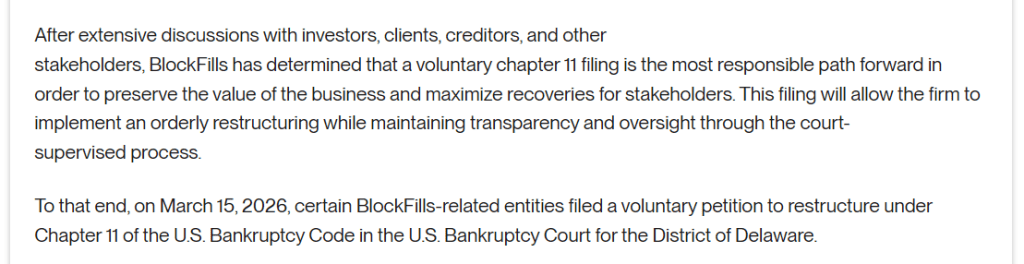
BlockFills' statement on company updates and Chapter 11 bankruptcy filing.

In a statement, BlockFills said the decision came after talks with investors, clients, and creditors. The company said it believes the court process will give it the time and structure needed to stabilize operations, find additional sources of cash, and look at possible deals with outside parties.

Officials said the goal is a consensual restructuring — meaning one that creditors agree to rather than one forced on them by a judge.

What Chapter 11 Means For Those Owed Money

Chapter 11 is not a wind-down. It is a legal system that provides a company with a moratorium to restructure its finances during which an automatic stay prevents creditors from collecting their debts.

BTCUSD now trading at $73,450. Chart: TradingView

As for customers who have balances on the platform, the situation is not so straightforward. They would be considered unsecured creditors in a bankruptcy case, which means they would be last in line after secured creditors and expenses approved by the court.

The amount they will get back and when that will happen is dependent on what assets BlockFills actually owns. That process can take months or, in complex cases, years.

BTCUSD trading at $73,240 on the 24-hour chart: TradingView

Bankruptcy Filing Caps A Difficult Period For The Firm

BlockFills has been under pressure from multiple directions. The frozen Bitcoin order involving Dominion Capital pointed to deeper disputes over whether customer funds were properly segregated — a question that goes beyond market timing.

Reports indicate the company had been in talks with stakeholders for an extended period before concluding that a court-supervised restructuring was the only viable path forward.

The collapse follows a pattern seen in earlier crypto lending failures. Companies including Celsius, Voyager, and BlockFi all suspended withdrawals before filing for bankruptcy during the 2022 market downturn. In each case, customers waited — sometimes years — for partial repayment.

BlockFills has not disclosed total liabilities, the number of affected customers, or the full value of assets under its control. This is a developing situation, and more details are expected to emerge as court documents become public.

Featured image from Unsplash, chart from TradingView

İlgili Sorular

QWhat was the primary reason cited by BlockFills for halting customer withdrawals last month?

ABlockFills cited a sharp Bitcoin selloff, where the coin dropped from above $97,000 to below $64,000 between mid-January and early February, as the reason it needed to protect both itself and its clients.

QWhat type of bankruptcy protection did BlockFills and its related entities file for?

ABlockFills and three related entities filed for Chapter 11 bankruptcy protection, which allows a company to continue operating while it works out a repayment plan with its creditors.

QHow are customers with balances on the BlockFills platform classified in the bankruptcy case?

ACustomers with balances on the platform are considered unsecured creditors, meaning they are last in line for repayment after secured creditors and court-approved expenses.

QWhat significant event involving customer funds occurred before the formal bankruptcy filing?

AA Delaware court had already ordered 71 Bitcoin to be frozen due to a customer fund dispute, which was tied to a legal battle with creditors over how client money was handled.

QWhich other crypto companies does the article mention as having followed a similar pattern of suspending withdrawals before filing for bankruptcy in 2022?

AThe article mentions Celsius, Voyager, and BlockFi as companies that suspended withdrawals before filing for bankruptcy during the 2022 market downturn.

İlgili Okumalar

Annual Salary of Millions Competing for Electricians, Meta Rushes to Open Its Own Technical School

The AI boom is facing an unexpected bottleneck: a severe shortage of skilled construction workers and electricians. As tech giants like Meta, OpenAI, and Alphabet race to build massive data centers—such as OpenAI's $16 billion "Stargate" project—they are hitting a critical labor wall. The U.S. needs an estimated 130,000 more electricians, 240,000 construction workers, and 150,000 supervisors by 2030 for AI infrastructure alone, but tens of thousands of electrician jobs go unfilled each year. While AI companies offer high premiums, with electricians earning up to $280,000 annually, worker scarcity still causes massive losses—delays on a single project can cost $14.2 million per month. The complexity of building AI data centers, which require immense power (equivalent to powering hundreds of thousands of homes), sophisticated electrical systems, and advanced liquid cooling solutions, demands highly skilled technicians who are in short supply. To combat this, companies are investing heavily in training. Meta has committed $115 million to a free training school offering tuition, housing, and stipends, targeting 5,000 new workers. OpenAI is partnering with unions to secure skilled labor. These efforts are paying off, with a significant rise in Gen Z interest in trade schools over college. However, the power demands are staggering. AI data centers are driving a rapid surge in electricity consumption, projected to account for up to 12% of U.S. power use by 2028 and raising costs for consumers. Furthermore, the construction boom is project-based, leading to a potential future glut of trained workers once building peaks, which could depress wages industry-wide. The race for AI supremacy now depends as much on skilled hands as on advanced chips.

marsbit1 saat önce

Annual Salary of Millions Competing for Electricians, Meta Rushes to Open Its Own Technical School

marsbit1 saat önce

OpenAI No Longer Sells Its Most Expensive Model for Profit

OpenAI is shifting its business strategy away from promoting its most expensive, flagship models for every task. Recent price cuts—80% for GPT-5.6 Luna and 20% for Terra—signal a deeper change: the company now actively advises users that many tasks don't require the most powerful model. Instead, OpenAI recommends a tiered approach: use the high-end GPT-5.6 Sol for complex planning and analysis, then delegate execution to cheaper models like Luna. This mirrors moves by Anthropic, which recently launched Claude Opus 5 at half the price of its top model, Fable 5. Both companies are de-emphasizing flagship models as primary revenue drivers, using them instead for brand prestige and technological showcases. The industry is entering a "mass-market" phase, similar to automotive, where high-volume, cost-effective models handle daily operations and drive scale. OpenAI's price reductions are partly enabled by AI models themselves optimizing underlying code and infrastructure, creating a self-reinforcing cycle of efficiency gains and cost reduction. Competition is shifting from "who is smartest" to "who offers the best value." The goal is no longer selling individual models but fostering widespread API adoption and ecosystem lock-in. By making AI calls cheap and ubiquitous, companies like OpenAI aim to become the indispensable, utility-like infrastructure powering automated workflows—the "water and electricity" of software, quietly embedded everywhere.

marsbit1 saat önce

OpenAI No Longer Sells Its Most Expensive Model for Profit

marsbit1 saat önce

İşlemler

Spot
活动图片





